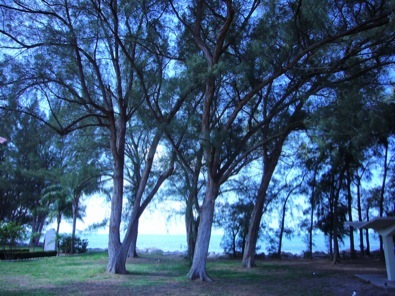
Australian Pine, which really isn’t a pine

Casuarina equisetifolia: Dreaded Edible

It is truly fitting that the Australian Pine ends up on a site dedicated to edible plants because where it has been introduced it is a much-loathed tree by government botanists. But, where it is native the Casuarina was a life saver.

When I first moved to Florida, a life-time ago as a young man escaping snow, I slept out many a night under the Australian Pines listening to the sea breeze whistling through its needle-like branches, which brings up my first point: The Australian Pine is not a true pine. It looks like a pine but it is not a “pinus.” Pine needles are actually modified leaves. What looks like “needles” on the Australian Pine are actually branchlets.  On those skinny needle-like branchlets are the minute leaves. So the tree is not edible like a pine. In fact, in Australia that “pine” it is called the She-Oak and the Bull-Oak — no, I have no idea why the gender bending.  While not an oak either it does have several overlooked positive elements.

The first is its red sap is drinkable, should you ever need potable water. Next the gum of the tree is edible and was collected by the Aboriginals of Australia, where it is native.  They also ate the young “cones” the branchlets and roasted winged seeds, though at 30,000 seeds a pound I’m sure that wasn’t easy.

Australian pines were introduced into Mexico before 1852, to the Caribbean at Barbados in 1870, Hawaii before 1895, and was naturalized in the West Indies and Florida by 1920.  The rumor that John Ringling (1866-1936) of circus fame introduced the tree to Florida is not possible as stated. The Australian Pines were around some 14 years before he was born and were naturalized in Florida 16 years before he died. That he could have brought the species to Florida is possible though I would not think probable. Perhaps he planted one in Sarasota, his winter home.

As with many problem plants, the US Department of Agriculture had a hand in the tree’s introduction and proliferation.  Seeds were readily available from California by 1908 and it was a common shade tree in Palm Beach by 1921 (the tree can grow eight feet a year, eclipsed only by the Moringa which can easily do 10 feet a year.)  It can be trained into a hedge but is extremely vulnerable to fire and intolerant of frost. It also makes an excellent bonsai specimen (see photo on bottom.)

By 1940 it was one of the most widely planted trees in Florida, usually for ditch and canal stabilization as well as a wind break. It was the tree of choice to protect causeways to the Space Center, though artistically interrupted by the Melaleuca, also now on the biological hit list. Several memorable freezes since then has reduce that population but they can still be found along the shores of Indian River lagoon with a good stand unbelievably still at Haulover Canal north of the Space Center. Popular as they were, starting in 1952 cities were crafting ordinances against the species. To cities they pose an enormous financial burden, not only ruining water and sewer mains but buckling streets. Worse, they fall over.
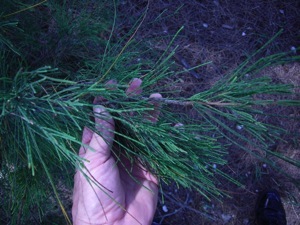
The “needles” are actually branchlets

In their native habitat Australian Pines — called Casuarinas — send down strong deep roots to the water which make them extremely stable. They like uneven topography so they can tap into pockets of water. The geography in Florida is such that the tree sends its roots outward for water, horizontally, and is thus very unstable and prone to falling over, even in mild breezes let alone the afternoon hurricanes we call thunder storms or the many true hurricanes of late. Their removal, standing or down, is prohibitively expensive. By 1969 the tree was a serious threat to the Everglades, the Keys and south Florida in general. Yet, as late as 1976 the state’s agricultural department was still selling the trees (clearly a left hand, right hand problem.)  On the up side Australian Pines have two flowering seasons and are a significant allergen from December to April and in August and September, keeping allergists in patients and money. Remember, there is no profit in curing an ailment, only in treating one.

If the trees were not invasive they would be recognized for their many good qualities. They return a lot of nitrogen to the soil and have a usable but brittle hard wood. It can be used for carving, small tool handles, boomerangs, spears, rough posts, beams, boat building, electric poles, fences, furniture, mine props, oars, pilings, roofing shingles, wagon wheels, yokes, canoe slats and hulls, shingles and high BTUs firewood. Seasoned outdoor cooks in Florida say it is one of the best woods for barbecuing adding a nice flavor to meats. Australian Pines have been called the best firewood in the world, and it can be burned green off the stump (as can ash.) India plants forests of them just for firewood. The Australian Pine is also noted for its firewood leaving a pure white ash that was ideal as a clothes whitener prior to commercial whiteners. The ash was also used in soap making. I also suspect it can be used to moderate acid in lichen to make them edible.

Of the 17 species seven were introduced to the Americas, four of which are still found here and there. The one on the coast is usually Casuarina equisetifolia, which lives to 40 to 50 years old. Inland in south Florida is the Casuarina glauca, the Swamp Oak or Brazilian Oak. Casuarina cristata, or the Black She-Oak, will not be found anywhere where it is salty and Casuarina Cunninghamiana, the River She-Oak, is found the farthest north in the state — Deland is about it, the 29th parallel or so–  and always inland. The coastal one grows twice as tall as the inland ones, reaching 100 to 150 feet. Nothing will grow under them. They hate clay and being waterlogged. Rats don’t like them and their roots can trap sea turtle hatchlings. However, drinkable water can be obtained from the limbs or roots of the trees, the latter preferred. The branchlets can be chewed to moderate thirst. Gum collected from the trunk is melted with warm water to form a jelly prior to eating.  The young female “cones” and stems are also chewed to relieve thirst. Or, young cones are cooked and eaten, the older seeds roasted. Fruiting in spring and fall locally, the cones stay on the tree all year. Male trees have flower spikes from yellow to brown at the end of branchlets, while female plants bear globular reddish flowers along the trunk and branches. Species are separated by the number of branchlet whorls and sex.

From a report 118 years ago:

Mr. A. T. Magarey, in a paper entitled “Aboriginal Water Quest,” in Proc. Roy. Geog. Soc. S.A. (session 1894-5), quotes Eyre, Vol. 1, 349-351, for an account of these water-bearing roots.

“Speaking of the Desert Oak (Casuarina Decaisneana, F.v.M.), he quotes Mr. W. H. Tietkens (“Ooldea Water,” region S.A.):— Travelling once with a small native boy of about 10 years of age, and towards the close of a dreadful day, the waterbag long since emptied and the boy gasping for water, and myself no better (the boy was riding a very unusually tall camel, we still had 15 miles more to travel), all at once a cry broke from him, and with one bound he was off that camel and running towards an [She]-oak tree, well four chains distant at least. I stopped the camels and went up to him. He was clawing away at the hot sandy soil, and at last — snap. A root one and a half inches thick was broken, a hard pull, and about 8 feet of root was exposed, lifting the soil as it was raised. About 2 feet length was broken off and upended into the mouth, and a cold drink the result. But not sufficient; another and another length was broken off till we had sufficient. We did not take any more than one root, and I think there were eight or ten more such roots — enough in abundance for a dozen men…..The water so obtained was cool, quite cool, colour- less, and refreshing; but I have noticed that upon exposure to the air for a few hours it becomes a pale brown colour, such as would be noticed in water into which a piece of bark has been dropped.”

Not only do the roots have water, but the branches as well. In Australia where they are often called Casuarinas, many times they grow where there is underground fresh water, even when near the ocean.  The Aboriginals knew the tree always meant water one way or another. The tree also played a role in the mysticism of many of indigenous people.

The Tahitians believed they arose from warriors who died in battle, killed by clubs or spears made from the Australian Pine. The warriors’ hair became the foliage and their blood oozed forth once more as the red sap.

 Casuarina (Kass-yew-uh-RYE-nuh ) refers to the fine filamentous branches. They supposedly resemble the cassowary feathers .  Equisetifolia (ek-wih-set-ih-FOL-ee-uh) means resembling a horse’s tail. Also, most of the Casuarina discussed here have been moved into a different genus, Allocasurina (meaning like the Casuarina.) So you can find them listed both ways.

Green Deane’s “Itemized” Plant Profile

IDENTIFICATION:

Pine-like tree of open, erect growth to 150 feet, dark-green hair-like “needles” are miniature, jointed branches, fruit a cone-like, woody, with sharp points (some species smooth) three quarters of an inch long, half inch wide. Here’s how to tell the local species: Six to eight leaf scales per whorl. C. equisetifolia; C. glauca 10-17 leaf scales per whorl. C. cunninghamiana 8-10 leaf scales per whorl.

TIME OF YEAR:

Sap all year, young branchlets all year, cones when young, summer, they persist all year

ENVIRONMENT:

Varies with species, some tolerate salt well, and are found on shore, others cannot tolerate salt and are usually found inland. They like it wet.

METHOD OF PREPARATION:

From Aboriginal reports: Sap from branches and roots drinkable. Gum from tree or cones edible or can be put in warm water and drank. Young branches and cones chewed to quench thirst. Young cones and leaves edible cooked. Seeds edible when roasted.

HERB BLURB

A decoction from the astringent bark has been used as a remedy for diarrhea, beri-beri, sore throat, cough, headache, toothache, sores, and swellings. They would mix the bark with water for application. Extracts from the bark are also used for tanning hides and staining and preserving fishing lines and fabrics.
 

{ 50 comments }

Fresh flowers can be used in salads

Bauhinias’ Beauty

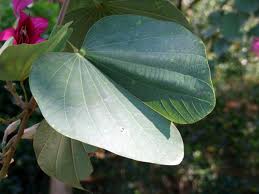
Bauhinia leaf nicked named "Camel Foot"

It’s called the Camel Foot Tree, the Cow Foot Tree, the Mountain Ebony Tree, the Orchid Tree, and the Hong Kong Orchid Tree. I ignored it until one day my curiosity got the better of me, and I discovered another edible in my local landscape.

Why did I ignore it? Well, there are so many imported ornamentals in Florida it could be a time-consuming task to identify them all. Plus most of the ornamentals tend to be toxic.  But this was a tree I had noticed many times in many place and when I saw a stand of them readily accessible I decided to key it out and put a name on it: Bauhinia. (bah-HIN-ee-uh.) More so, my friend and fellow forager Sunny Savage in Hawaii uses the flowers in salads.

At least nine Bauhinia have edible parts from nectar to seeds. B carronii, B. esculenta, B. hookeri, B. malabarica, B. purpurea, B. racemosa, B. retusa, B. tomentosa, B. variegata (white flowered.)

Gaspard Bauhin, 1560-1624

A native of India, it is a tropical tree to 40 feet. But it is also found in subtropical areas and I live exactly on the subtropical/temperate line. There are occasional frosts here and an established tree can take a few degrees of frost. Farther south — say 100 miles — it is a common and well-naturalized tree, and on the official pest list. That’s another reason to put it on the edible list: The tree is becoming common and that means plenty of food should one want it. The stand I saw was along a bike trail so access is not an issue.

Jean Bauhin, 1541-1613

World wide there are over 600 species in the genus. In the United States they are naturalized along the coastal area of California, Texas, Louisiana, and central Florida south, planted in Arizona, Georgia, Hawaii and Puerto Rico. It is also a favorite of India, Vietnam and China. In Hong Kong, where B. blakeana is endemic, it is a special of the local ecosystem. The tree was introduced into Florida before 1900. The edibility of the B. blakeana is not mentioned but it is thought to be a hybrid between B. vareigata and B. purpurea, both with edible parts.

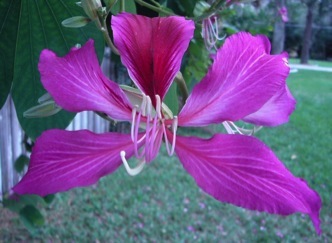
The give away of the species is it’s distinct leaf, basically a circle with a clef on one end, giving it the appearance of a round, cloven hoof.  Of course, it is planted for its five-petal flower resembling an orchid.  When in blossom it is considered “staggeringly beautiful.”

Sir Henry Blake

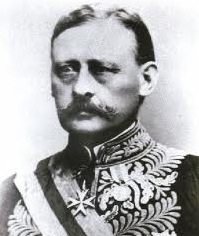
The name Bauhinia is after two 16th century Swiss botanist, Jean and Gaspard Bauhin.  Variegata (vah-ree-uh-GAH-tuh) is for white variations on the leaves, purpurea (pure-PURE-ee-a) is from Greek for purple and blakeana (blay-kee-AY-nuh) is named after Sir Henry Blake, British governor of Hong Kong from 1898 to 1903. He was an enthusiastic botanist who discovered the blakeana in 1880 near the ruins of a house on Hong Kong island. The flower appears on the flag and coins of Hong Kong.

Bauhinia seeds contain high amounts of linoleic and oleic fatty acids and low amounts of myristic and linolenic fatty acids.

Some identification guides:

B. purpurea usually flowers September through December;

B. variegata January to March while the tree is leafless;

B. tomentosa (toe-men-TOE-suh) has yellow blossoms;

Green Deane’s “Itemized” Plant Profile

IDENTIFICATION:

Semi-deciduous tree to 40 feet, spreading crown. Leaves alternate, long petiole, thin-leathery, simple, deeply cleft at apex, making two large rounded lobes; lower surface downy. Flowers are showy, fragrant, in clusters near stem tips, five petals, clawed, overlapping. Fruit a flat, oblong pod, to one foot with up to fifteen seeds.

TIME OF YEAR:

Young leaves in season, flowers and pods usually fall.

ENVIRONMENT:

Full sun to part shade, all soils.

METHOD OF PREPARATION:

B. variegata: Young leaves, young seeds, young seed pods boiled. Flower buds pickled, flowers cooked. Can be made into a  chutney.


{ 26 comments }

Beach Bean

Canavalia maritima, Rosea, Beach Bean

It’s the tank of beans: Three inches long, an inch wide and very thick. And with good reason, it lives near the sea.

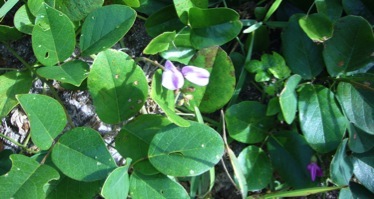
Canavalia maritima (aka rosea) gets mixed reviews, eaten for a long time and listed as toxic. The adult beans are definitely to be avoided but the young seeds are being eaten by humans somewhere now.  Here is what Prof. Daniel Austin has to say about it in his huge book “Florida Ethnobotany:”

“Ignorance, they say, is bliss. So, my students and I were certainly blissful for years. At one time I had an anthropology student who was interested in plants used by people. She convinced me that the seeds of the bay bean [Canavalia maritima] were edible by gathering a handful in the field, cracking the seed coats with her teeth, and eating the contents. I tried them, and they were tasty — nutty and sweet. Then, I read about the alkaloids and proteins found in the seeds, and discovered that they were considered by many to be toxic. I quit eating them and stopped showing students how to eat them.

“However, there is a long history of people eating many of the species in the Canavalia. For example C. ensiformis is grown as a vegetable in tropical areas. The young pods are sliced and eaten like French Beans… C. gladiata seeds are edible, and its foliage is used for fodder.

“More recent studies of chemicals have established that… Canavalia contains cyanides, complex proteins, and alkaloids. … Yet other studies have confirmed what humans discovered thousands of years ago — processing the seeds renders them edible….”

Austin goes on to say there is no record of local natives using the C. Maritima for food, and among Caribbean people it is viewed as a medicine.

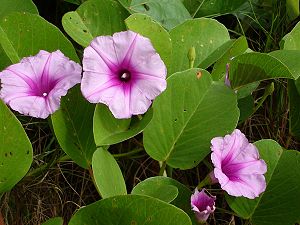
Ipomoea pes-caprae

Perhaps C. maritima should be put in the same category as its close look alike, the Ipomoea pes-caprae, edible in small amounts in an emergency.  When the two plants are in blossom it is easy to tell them apart. C. maritima has a pea blossom (wings and keel)  I. pes-caprae, a morning glory blossom, fused petals. When not in blossom the C. maritima has alternating leaves of three, whereas the I. pes-caprae has single alternating leaves. Mature C. maritima beans are toxic, which is just as well. I have found the pods while out canoeing or kayaking and they are tough to open.

Canavalia (kan-uh-VAY-lee-uh) is the latinized version of the native Malabar name for the plant. Maritima (mar-ih-TEE-muh) of or near the ocean.

Green Deane’s “Itemized” Plant Profile

IDENTIFICATION: Vine to 30 feet or more, creeping along the sand. Leaves alternating with three thick leaflets to five inches long, oval to oblong, blunt at tip. Bean-shaped flower. Fruit a dry pod to six inches long, an inch or less wide, flattened.

TIME OF YEAR: Summer and fall

ENVIRONMENT: Beaches above the high-tide line.

METHOD OF PREPARATION: Young seeds boiled throughly.


{ 7 comments }

Atriplex cristata: Pigweed by the Sea

Beach Orach Crested Salt Bush

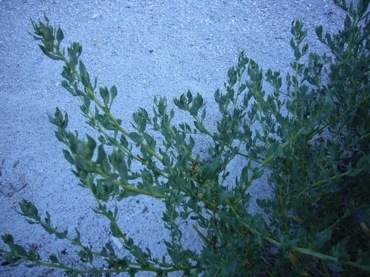
Beach Orache Crested Salt Bush

Anyone familiar with the Goosefoot family will see the Beach Orache and presume it is probably edible, and it is.

A distant cousin to the Chenopodium, the Atriplex is an Old and New World plant that wasn’t used much by the Natives Americans though elsewhere in the world it has a long history of feeding folks. The east coast Indians apparently ignored it for the most part, though the west coast Indians used it.

Atriplex cristata, said AT-ree-plex kriss-STAY-tuh, is one of a large genus whose leaves and seeds are eaten around the world. More than two dozen Atriplex are edible, and probably more. Atriplex is the ancient named used by Pliny for the orache, also know as A. hortensis. Cristata means crested. It has also been called A. pentandra (pen-TAN-druh) which means with five antlers, or in this case five stamens.

A. cristata can be found on the coast from Texas to New Hampshire. But Mainers don’t fear, A. glabriuscula runs from your coast north to Greenland. It’s also in the Great Lakes area down through Indiana to Kentucky. It is also found in Alberta, Canada. An import no doubt. In fact, an Atriplex can be found in all areas of North America except Arkansas, Tennessee and Nunavut Territory in Canada. The leaves and seeds of the following species have been used in North America: A. argentea, A. californica, A. canescens, A. confertifolia, A. coronata, A. elegans, A. lentiformis, A. nuttalii, A. patula, A. serenana, and A. truncata. Locally we also have A. pentandra. Also eaten is A. halimus and A. semibaccata, the latter common in Australia but naturalized in North America. The Hopi Indians used the ashes of the A. canescens as baking powder, and the roots of the A. californica can used as a substitute for soap.

Closely related to the beet and spinach, there are no member of the Atriplex genus that toxic, but, not all are palatable. And in the “I didn’t know that” category meat from sheep that graze on Beach Orache has high levels of vitamin E.


Green Deane’s “Itemized” Plant Profile

Beach Orach Crested Salt Bush

Beach Orach Crested Salt Bush

IDENTIFICATION:

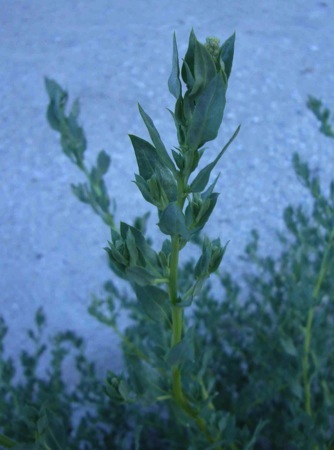
An annual or perennial, sprawling to erect, much branched and clump-forming, six inches to 1.5 feet tall. Stems obtusely angled, leaves attach to the main stem or have a short stem, alternate or opposite, oblong, oval or slender-elliptic .5 to 1.5 inches long, silvery scurfy underneath; often curling upward. flowers in short, dense, naked terminal spikes, usually yellow, seeds reddish brown.

TIME OF YEAR:

In warmer climes nearly year round, in northern climes summer into the fall.

ENVIRONMENT:

Sandy beaches, keys, mainland Florida, a costal plant for most of its range.

METHOD OF PREPARATION:

Leaves cooked like a green (reduces), minute seeds cooked, added to soups and stews or ground. Some say the leaves and seeds can be eaten raw. The seeds perhaps but I find the leaves too bitter to eat raw.

{ 1 comment }

Fagus grandifolia: The All-American Beech

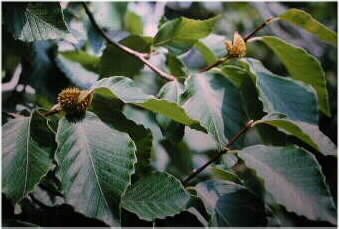
beech

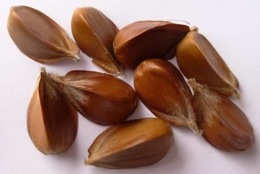
beechnuts

Tree trivia: Beechnut chewing gum had nothing to do with the Beech tree or the seeds it produces. It was, however, the name and logo of a company that made candy, and was my favorite chewing gum as a kid.

The American Beech (Fagus grandifolia) is found from Nova Scotia, southwest to northern Florida (down to Alachua County) and over to the Mississippi River and into eastern Texas,  eastern oklahoma,  and northwest Arkansas. Paleobiologists tell us that at one time the beech was found through most of North America and could grow there now. But, because of the ice ages they disappeared from the western two-thirds of the continent save for some in the mountains of Northeastern Mexico. Environmentally beech is found with maples, birches, the basswood, black cherry, southern magnolia, eastern white pine, red spruce, several hickories and oaks.

American Beech

Beech trees begin producing seeds around 40-years old, and by 60 can be producing huge amounts. They don’t produce every year and can cycle anywhere from two to eight years. In northern and central states the beech flowers in late April or early may when the new leaves are about one-third grown. They are quite vulnerable to spring frosts. The seeds ripen between September and November. Two to four nuts are usually found in one bur. Heavy frost can cause the bur to open and drop its seeds. There are about 1,600 seeds to a pound.

Beech seeds, like acorns are also called a mast, are sought after by a large variety of birds and mammals, including mice, squirrels, chipmunks, black bear, deer, foxes, ruffed grouse, ducks, and bluejays. Beech wood is used for flooring, furniture, turned products, veneer, plywood, railroad ties, baskets, pulp, charcoal, rough lumber, shoe lasts, buttons, bowls and barrels for aging beer. It is also preferred by those with wood burning stoves because of its high density and good burning qualities. Creosote made from beech wood is used internally and externally as a medicine for people and animals.

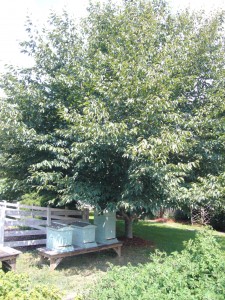
Cultivated Beech tree and bee hives in Banner Elk North Carolina

From the human point of view, the American Beech provides quite a few edibles. The inner bark is edible, young leaves are quite tasty while they are soft. The sweet seeds are very edible and can be crushed into a butter. The nuts have a low amount of fagin which is slightly toxic and is found in the skin of the kernel (roasting allows that skin to be easily rubbed off.)  The European beech, F. sylvatica, has more fagin and has to be used more carefully. Beechnut oil does not have any fagin and was used in Europe for centuries for cooking (and as a hair tonic.)  Seeds have been crushed, boiled, and the nourishing liquid drank. They were also ground up and added to cornmeal and berries to make a bread.  Beech sawdust has also been mixed with flour to extend it when making bread in times of scarcity. Raw nuts should not be eaten to excess.

Fagus grandifolia means “edible large leaves. “Fagus” comes from the Greek verb Fagito, which means to eat and was the name of the European beech, F. sylvatica (edible of the woods.)  The species name is Latin.  To go back a little further “fagito” came from Akkadian “paglu” meaning strong.


Green Deane’s “Itemized” Plant Profile

IDENTIFICATION:

Leaves alternate, simple, elliptical to oblong-ovate, 2 1/2 to 5 1/2 inches long, pinnately-veined, 11-14 pairs of veins, with each vein ending in a sharp distinct tooth, shiny green above, very waxy and smooth, slightly paler below. Male flowers borne on globose heads hanging from a slender 1 inch stalk, female flowers borne on shorter spikes, appearing just after leaves in the spring.  Nuts are irregularly triangular, shiny brown, found in pairs within a woody husk covered with recurved spines,

TIME OF YEAR:

Nuts ripen in fall, young leaves in spring while tender.

ENVIRONMENT:

Old forests, neither dry nor wet, found with maples, birches and oaks.

METHOD OF PREPARATION:

Inner bark is edible, young leaves edible, mature seeds (best to remove their brown covering.) Can be roasted and or made into a nut butter. The oil is good for cooking.


{ 18 comments }