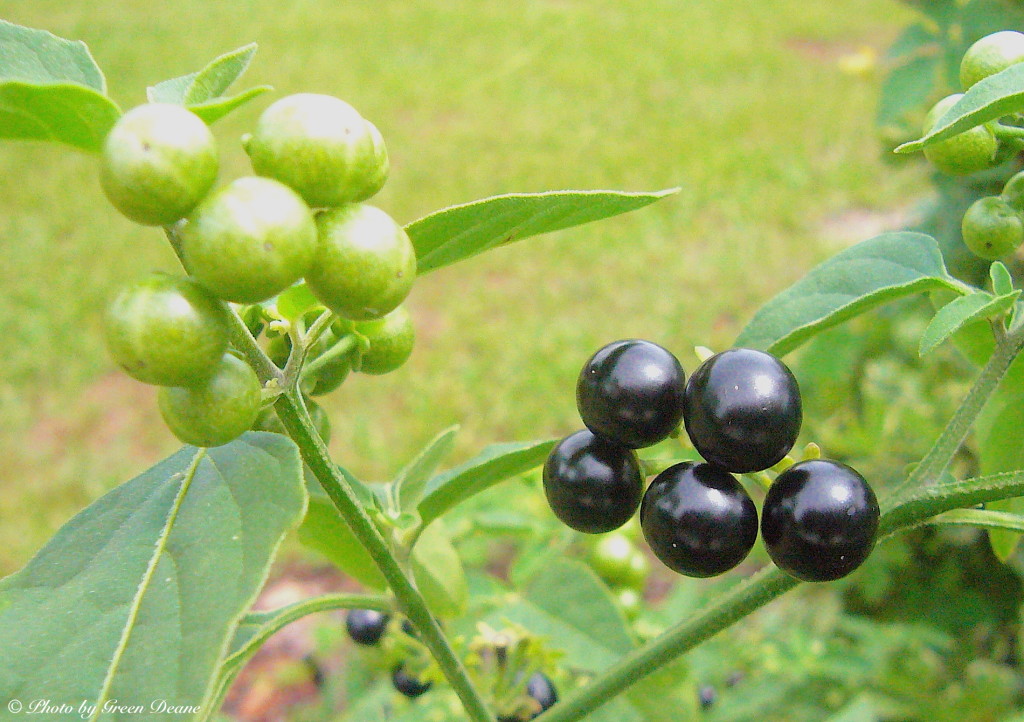
Green Solanum americanum berries are toxic. Totally ripe berries are edible. Photo by Green Deane
Solanum americanum: Food or Poison?
Anyone who’s done some foraging has seen the “Black Nightshade” also called the “Common Nightshade” and (DRUM ROLLLLLLLLL) the “Deadly Nightshade.” It’s one to four feet tall, oval to diamond shaped leaves, with and without large blunt teeth, little white star-like flowers with yellow cores followed by green berries that turn shiny black, larger than a BB, smaller than a pea. Some foraging books will tell you it is very edible and the dangers overrated; some will say it will kill you, don’t eat it. I land on the edible side and I eat it.
But, to cover myself legally because there are a lot of fools with lawyers, I am not suggesting you eat any part of any wild nightshade. In fact, let me include what Delena Tull Phd. writes in her book Edible and Useful Plants of Texas and the Southwest.
“The toxicity of the species is quite variable in different varieties and in different parts of the world. Euell Gibbons reports using the ripe berries in pies and numerous other references indicate that the ripe cooked fruit may be safe. Personally, I consider the whole plant potentially deadly and leave it alone. “
Delena’s book is well done and well-considered so her comment carries weight, though I was surprise to see her take that view. What that means is do not experiment on your own. Find a local person who knows if your “Black Nightshade” is edible and how. Now for some extensive history, paraphrased as much as possible:
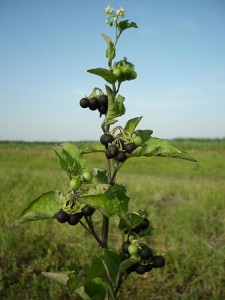
IMPORANT: Notice the berries are dull on the S. nigrum.
Solanum nigrum (soLAYnum KNEEgrum, the Black Nightshade) is found in the Old World, Africa to India and beyond. Its leaves are used as a green, boiled twice or more like pokeweed. In Kenya four varieties of it grow and three are highly sought after. It is the prime potherb. The fourth variety is considered too bitter to eat. Of 61 greens tested in Africa, S. nigrum had the highest amount of vitamin A. In the region of India the plant has many names and is firmly in the human food chain and very popular. It is also in medical use. Modern Greeks call it “Styfno. They boil the leaves then use them as the basis for a salad.
Now, back to North America.
When Europeans arrived they saw the native nightshades. Because they resembled the Black Nightshades in the Old World they were considered variations of the Old World nightshades and were called … Black Nightshades … all of them. But as time passed botanists had different opinions and the names were changed, or worse combined, such as Solanum nigrum var. americanum. Every botanist with an opinion called these plants what he thought they should be called. What was once thought of as varieties of one native in North American ( S. nigrum) became many plants with many names. Then even more careful botanists got rid of some of the names and said they weren’t Black Nighshades at all and were not Old World variations. In fact, some think the S. americanum (ah-mare-ree-KAY-num) isn’t even a native but is from Australia. On top of that, the Old World plant, the original Black Nightshade, became naturalized in North America as well. So it became quite a muddy soup. Then there were reports of toxicity, which makes some sense if you were calling non-Black Nightshades Black Nightshades, essentially inducting non-edibles into the edible group. To say it is a foggy, foraging family is an understatement. Even the pro’s profess confusion though I think they caused it. Native peoples had it sorted out well long before there were botanists.
There is no doubt Solanum family has toxic members. And the green berries of the plants mentioned here are toxic. They have killed a few children and at least one adult within record keeping. Livestock eating the plants/green berries in the field or dried in hay have been poisoned and or died. Yet, around the world for centuries many of the Black Nightshades are listed as edible if not highly esteemed. For the last quarter of a century, in particular, botanists have been writing about the names and toxicity when ripe and/or prepared correctly. Some still say yes, some still say no. Let’s look at our main three:
1) A native first called S. nigrum then S. nigrum var. americanum is now called Solanum americanum; 2) a variation of that S. americanum is called Solanum ptycanthum, (p-tic-ANTH-um) and 3) the Old World one is called Solanum nigrum. While they can all be found in most regions of the United States, the S. americanum favors the South, the S. nigrum the mid-west and the S. ptycanthum the north. However, the S. ptycanthum is the most wildly dispersed and reported in most areas. It also comes with less pedigree and is not reported in California.
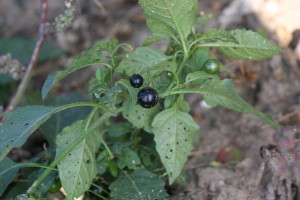 Some think S. ptycanthum is a North American native, some think it is a cross between the S. americanum and the S. nigrum. One author says the mature fruits might be edible. One serious scientific report says they fed ripe S. ptycanthum berries to rats for 13 weeks with no detectable problems. A third says the Native Americans, like the Cherokee and the Catabwa, ate the leaves of the S. ptycanthum and held them in high esteem. The latter appeals to me but if the S. ptycanthum is a hybrid with the old world S. nigrum and not a native, how long was it around for the Natives to discover it, use it, and hold it in high esteem? Or do they think it is a hybrid from tens of thousands of years ago, just as they think the S. americanum originated in Australia? When details like that are left out one sometimes wonders how comprehensive some “botanists” are.
Since these three plants look very much alike what are the main features to sort them out (though the plants are highly variable)?
1) The S. americanum has green berries flecked with white. On ripening they turn SHINY black. They also grow in an umbel cluster, that is, the stems of the berries all go back to generally ONE central point. The sepals do not adhere to the fruit. Berries have 40 to 110 seeds. The stem is NOT very hairy. The seedlings do not have maroon under their leaves. (Personally I also look for some blossoms with white petals bending downbut most of the blossom withwhite petals bending up.)
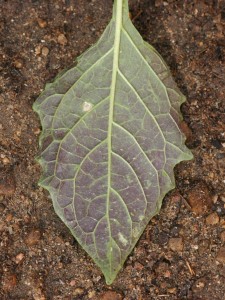
The underside of a S. ptycanthum leaf.
2) The S. ptycanthum looks the S. americanum except it has maroon coloring on the bottom of younger leaves, particularly sprouts. The berry contains 50 to 100 seeds. No doubt it is often confused as an adult with the S. americanum. This would suggest growing some of what you think are either S. americanum or S. ptycanthum and looking at the underside of the young plants. Some say the adult plant has some red under its leaves.
3) The S. nigrum has DULL black berries when ripe, and they tend to be larger than the other two. Also the stems of the berries do not emerge from one single point but are separated slightly on the stem, staggered like a spike. It tends to have 25 to 30 seeds, 1.8 to 2.2 mm long, but they can range from 15 to 60.
Though ubiquitous and plentiful I avoided the “Black Nightshade” for years because of their reported toxicity even when ripe. Then I learned of a local grocery store manager from Cuba who ate the ripe berries whenever he found them. With a living local guinea pig alive I had to give them a try. My plant de trepidation was the S. americanum and I was careful, starting with a quarter of one berry at a time, then the next day half a berry et cetera, working my way up. They’re quite tasty. I have not eaten a cup of them at a time or baked a pie like Euell Gibbons, but as a trail side nibble the ripe berries have proven quite edible, though the flavor varies from musty to sweet. They look black but are actually intensely purple, and probably full of anti-oxidants.
While I have not personally proven this to myself regarding all three species mentioned here — the S. nigrum is not that common locally — some researchers say the stems and leaves of both the S. americanum and S. nigrum are edible after being boiled. And for reasons I will get to, I will add they should be boiled twice, at least 15 minutes each time. These experts also say the berries of each are edible when totally ripe, either raw and cooked. As for the S. ptycanthum, the cooked leaves were eaten by Nnative Americans and, as mentioned earlier, in one experiment the ripe berries fed to rats for three months caused them no harm.
The young leaves of S. americanum — which you should boil at least once, maybe twice before the plant blossoms — are on par with the nutrition in Amaranth leaves but with less vitamins A and C. Per 100 grams edible young leaves contain: 190 calories, 4.7 grams of protein, half a gram of fat, 8 grams of carbohydrates. Other nutrients are calcium 210 mg, iron 6.1 mg, beta-carotene 1.9 mg, vitamin B1 0.14 mg, and vitamin C 40 mg. In the book Plant Resources of Southeast Asia they report the content of boiled leaves and young green fruit: 140 calories in 100 grams, protein 1.9 grams, fat 0.1 grams, carbohydrates 7.4 grams, calcium 274 mg, iron 4.0 mg, beta carotene 0.5 mg, vitamin B1(thiamin) 0.10 mg, and vitamin C 17 mg.
While the nutritional value of leaves have been reasonably researched data on berries of the American Black Nightshade is elusive. A large study of the family in Africa where S. americanum is consumed just happened to leave that species out. However, a commonly eaten relative, S. torvum, has this line-up for 100 grams of fresh fruit: 160 calories, protein 2 grams, fat 0.1 grams, carbohydrates 7.9 grams, calcium 50 mg, phosphorus 30 mg, iron 2 mg, vitamin A 750 IUs, vitamin B1 (thiamin) 0.08 mg, and vitamin C 80 mg.
Now, why boil the leaves twice? Three reasons. The first one came from a veterinarian report on the S. nigrum saying the toxicity varies plant to plant and season to season (though I think they were lumping them all collectively as Black Nightshade.) As an example they cite the potato which produces toxic green skin potatoes sometimes depending upon the growing conditions. So while boiling once may work this year, it might not work next year. Next, in Africa they boil the leaves of the S. nigrum twice. How long they boil them is not reported. It was called “a while.” Thirdly, I had a close friend boil until tender the leaves of the S. americanum. He did not boil them a second time because he thought he had the leaves of a totally different plant. He ended up with a headache. That says to me boiling once is not enough even if it is. The older the leaves get the more bitter and toxic they are, so foragers should collect younger leaves and tops and not eat it to excess. Let’s take a closer look at the plants.
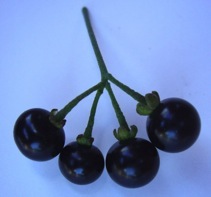
Ripe S. americanum berries, edible
The Solanum americanum has alternating leaves that are hairy underneath, particularly at the edges. They are not reddish-purple underneath when young. They can be oval to triangular, no teeth or irregularly teethed. Flowers, five petals, white, have small anthers. The berries are speckled with white until fully ripe whereupon they turn black and shiny — shiny, that’s important. The berries are usually in a cluster, on several short stems originating from one point or nearly one point — one point, that’s important. The sepals do not adhere to the fruit. It tends to have 40 to 110 seeds or more, 1 to 1.5 mm long. Here in Florida it fruits nearly all year long.
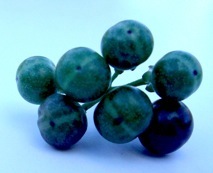
Unripe S. americanum berries, toxic
Professor Julia Morton, in her book, Wild Plants for Survival in South Florida, says fully ripe berries of the S. americanum are edible raw or cooked. Young leaves and stems are edible cooked. The Mansfeld’s Encyclopedia of Agricultural and Horticultural Crops also says the cooked leaves and ripe fruit are edible. Sam Thayer in his latest book, Nature’s Garden, also argues they are edible. The leaves contain about 6990 mg of beta carotene per 100g.
The Solanum nigrum, one to three feet high, has dull black fruit — dull that’s important — and the fruit is larger than S. americanum. It can have up to 60 seeds though 15 to 35 is common. Unripe fruit can be light green to almost white. The flower has large anthers, the sepals generally adhere to the fruit, and they are racemiform, that is, not all originating from one point but along the stem (peduncle) — that’s important. Its ripe fruit is edible as are its cooked leaves, according to Edward Schelling and Qi-sheng Ma, Department of Botany, University of Tennessee, as reported on page 223, Vol. 46, Economic Botany, 1992. The Canadian government also reports the berries are edible. Mansfeld’s Encyclopedia of Agricultural and Horticultural Crops reports the cooked leaves and ripe berries are edible.
So that’s fairly clear. Then along comes Solanum ptycanthum. The S. ptycanthum is very similar to the S. americanum but it is mostly hairless and may have leaves with purple undersides, particularly when young. Purplish undersides is important to identifying the young plant. It is also called the Eastern Black Nightshade and the West Indian Nightshade.
The S. ptycanthum is an annual or short-lived perennial that will grow to a yard or so but usually is shorter. It tends to be well- branched in the upper parts and the stems are usually nearly hairless and smooth. Mature leaves alternate, they are pale green, soft, thin, almost translucent, oval to oval-lance shaped. Flowers are small, usually two to five grouped together in a small umbel-like arrangement (from one point) on a short stalk (peduncle) sticking out from the side of the stem rather than from the axil (where the leaf meets the stem.) The flower is star-shaped, white or white tinged with purple with a yellow star, often streaked with purple when growing in cold temperatures. Looks like a potato flower but much smaller. The plant flowers from June until late autumn in northern climes. Fruits green at first but turning black, shiny and juicy when mature, 50 to 110 small flat seeds and 4 to 8 small, hard, irregular stone-like crumbs. Mature fruits of detach at the junction of the pedicel and peduncle (where the stem of the berry meets the stem it was growing on.) I’ve read no reports of the S. americanum having stone-like crumbs, which if true would be one more difference between the S. americanum and the S. ptycanthum.
For the record the leaves and young shoots of Solanum villosum (vee-LOW-some) are used as a leafy vegetable. Its berries are light green or yellow when ripe and the leaves are so hairy that they may feel sticky. Its berries are not edible as far as I know. The leaves of the S. guineense (gin-ee-EN-see) are also edible. And adding to the confusion is the Solanum retroflexum, fomerly Solanum burbankii. Its cooked leaves and ripe fruit are edible. As its old scientific name indicates, it is of hybrid origin. The plant was reportedly bred by Luther Burbank in the early 1900s and is a hybrid of S. villosum and S. guineense, though that may be in dispute. S. retroflexum is compact, typically growing to a height of one to two feet and can fruit when only four-inches tall. The fruit is dark blue-purple when ripe. Green (unripe) fruits are toxic.
Generally said a Black Nightshade plant can produce up to 178,000 seeds per plant. There are about 2,000 seeds to a gram. The plant can be propagated by stem cuttings. Under cultivation leaves and stem tops are regularly harvested. The composition of 100 g edible portion of “African” nightshade leaves (I presume S. nigrum) is water 87.8 g, 39 calories, protein 3.2 g, fat 1g, carbs 6.4 g, fiber 2.2 g, calcium 200 mg, potassium 54 mg, iron 0.3 mg, beta carotene 3.7 mg, ascorbic acid 24 mg. The dry matter content varies from 6–18 % depending on plant age, soil moisture and fertilizing. The protein is rich in methionine.
Solanum means “quieting” because some members of the family induce sleep. Americanum means of America, nigrum means black, and ptychanthum is from two Greek words meaning “folded flower.” Villosum is hairy and retroflexum means bent backwards. Like the S. nigrum, the S. retroflexum has sepals that turn back away from the berry. Burbankii for Luther Burbank and guineense means from Guinea.
IDENTIFICATION:
S. americanum: Green berries speckled with white, fruit in a cluster radiating from one point. Shiny black.
S. ptycanthum: Similar to americanum but young leaves and shoots maroon under leaf, fruit has seeds and crumbs.
S. nigrum: Dull black berries, arranged along the stem.
TIME OF YEAR: Summer in northern climes, year round in warmer areas.
ENVIRONMENT: Will tolerated sand and dry conditions but prefers well cultivated and rich soil. If it makes a tomato happy it will make a black nightshade happy.
METHOD OF PREPARATION: Ripe berries raw or cooked, young leaves, stem tops boiled twice, 15 minutes each time.
HERB BLURB
Bruised leaves used externally to ease pain and reduce inflammation, also applies to burns and ulcers. Their juice has been used for ringworm, gout and earaches.