Chain of Contamination

In police work there is the chain of possession. When evidence is collected, who has it, and where it’s kept is recorded constantly. With food we might call it the Chain of Contamination.
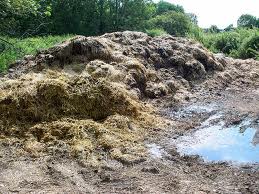
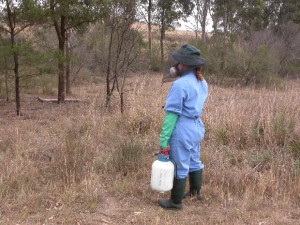
First it might be a genetically modified plant, one that has not been proven safe by being eaten over centuries. Then there is the soil and water. They could be polluted by a variety of means.  The ground might also have real old fashion manure on it, dog to human — think ebola — or it might be artificial manure called fertilizer. As for water, is there any fresh, wholesome water any more? If you are not on your own well, someone is putting something into your water somewhere.
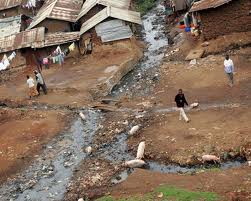
The plant could be raised in a second or third world country where sanitation is still centuries behind, or by a first-world businesses trying to cut corners. Then there are the pesticides, herbicides and growth hormones. Let’s not forget as well all the people who handle the plant from the ground to the store shelf. There’s a lot of opportunity there for the plant to not be wholesome by the time it gets to you.

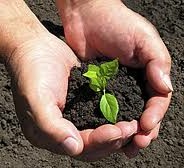
What of the wild plant? I walk in the woods or field and harvest it, my hands being the only ones that touch it. Neither the soil nor have been treated with anything. The only water is rainwater. And the plant is genetically original and nutritionally superior to the store-bought equivalents. That is perhaps the best case scenario but not at all impossible.
I used to know an old Italian organic gardener in Deltona, Florida, named Rudy Picconi.  He was doing organic gardening decades before it was fashionable. I asked him back in the early 80’s about insects bothering his plants. He said he used a wide variety of natural ways to keep them at bay. But, he said, “you have to let the insects win some of the time.”  There is more wisdom in that than one first assumes.
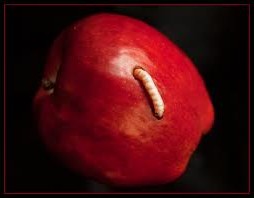
Think of the person who will not eat the wild apple because it has a worm hole. The worm hole tells you the apple is wholesome, as do a few holes in spinach leaves, or a blemish here and there on a beet.  Do you really think chemicalized food that kills other creatures is more wholesome than natural food? If the insect can live off it so can you. If it kills the insect you might want to reconsider. Not only that but when our ancestors found a worm in an apple it was extra protein, not something to be tossed away.

I am not saying insects and humans are alike or affected by the same things. Clearly we are different creatures but we share being alive and that makes us vulnerable. Given the bad record of food chemicals it seems prudent to lessen the chemist in the kitchen and the environment.
As for irradiated food… it might just be another form of sterilization, but I prefer food that has retained its natural ability to rot. If it can’t support something as simple as a bacteria I’m not sure it is good for me. Like genetically modified crops, irradiated food has not been around for centuries to prove it is wholesome. Perhaps in a century or two there will be enough of such food consumed for a good decision to be made. But right now the safety and any possible effects, good or bad, is an educated guess.

Setting aside bad food advice from dogmatic doctors — read Good Calorie Bad Calorie by Gary Taubs, his new book is Why We Get Fat —  one of the main problems we have is a lot of our food really isn’t food. It is preprocessed stuff and additives. And the other problem is much of the real food is also cursed by the chemist. The only sustenance untouched is wIld food, and it looks better every day.

I’m not against progress or science but I have lived enough to know that empiricism and science are great but limited tools. Their ability to be descriptive of reality is often woefully exaggerated.  That’s when the guessing begins. And that’s when our health suffers.
{ 1 comment }

Civilized Food

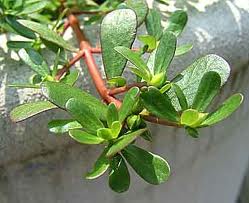
While making my purslane video I was thinking back to a family friend who refused to eat purslane because it was a “weed.”

It had taken over about one third of her garden and was to date the best and most luxurious patch of purslane I’ve have ever seen. She was adamant, however. It was a weed and she wasn’t going to eat a weed. If I may bend definitions a little, she had become accustomed to “civilized food” and she wasn’t going to eat any wild food.

For most of human history “wild food” was all there was. Now days “civilized food” is about all there is. And civilized people eat civilized food. Said another way, I think the resistance to eating wild food is more than just approaching the unknown and what dangers in might hold. Foraging is not what civilized people do. Cavemen did it, Native Americans did it, primitives do it as do starving populations. Foraging is just not included in the things humans do in a functioning modern society. The prevailing view is that foraging is ancient, primitive, and or dysfunctional. Hmmmm…. I guess that describes me fairly well.

Foraging for food is like… making your own salt, far removed from modern life. We used to get or make things for ourselves. Now we simply go to some place and exchange money for things. Money is transferable time and energy. And in all fairness we have to exchange: There are too many of us to live off the land and not enough time to do all the things we would need to do to live the good life.  Billions would starve if it were not for civilized food, and life would be more tooth and claw if not for the grand division of labor producing all the things we need, or want.

In its own way foraging, while not a threat to modern man, is for most a reminder that life was crude. But that is a backward glance. Looking forward foraging is environmental awareness. It is nutritional advantages. Foraging is also empowering and with that comes piece of mind and confidence.

Foragers can use the past to educate people about the future. Foraging is about tomorrow, whether society holds itself together or not.  It’s about treating the environment right. It’s about nutritional awareness and how “civilized” foods keep us alive but not healthily so. It is also about being self-sufficient, the first rule of being an adult and a fully-enfranchised citizen. Depend upon yourself, not the government. The more responsible and competent we are in all aspects of our lives  the less government and governing we need. Self-sufficiency is more than physical, it is also mental. Anything you can learn that increases that broad idea of self-sufficiency is to the good, including how to put more wild foods into your diet. It is also very comforting in a deep way to be aligned with nature rather than viewing it as something wrong that needs to be fixed.

As for foraging…. Learning to forage to me is like learning to swim. I may not “need” it most of the time but when I end up in water it is a good thing to know.

{ 2 comments }

Cast Net Junkie

I will admit to being a cast net junkie.

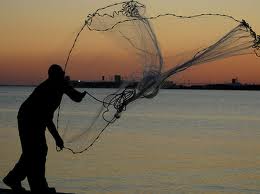
Some people collect coins or stamps. I collect cast nets. I started throwing nets some 40 years ago and have been hooked since. What does this have to do with foraging? Quite a lot.

I went to Daytona Beach yesterday to visit a friend who has a timeshare there. I took along my favorite cast net as I was supposed to catch dinner. The pressure was on. So was the heat… record breaking. With the humidity the heat index was 105. The heat won after just a few tosses. So netted fish was off the menu. However, being a forager is also be resourceful.

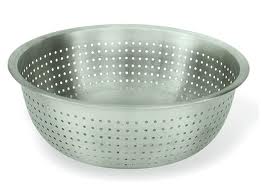
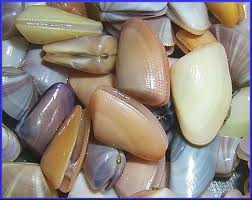
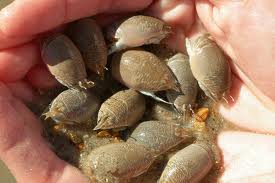
Borrowing a colander I sifted a quart of tiny coquina ((Donax variabilis) from the low-tide sand and more than a few mole crabs (Emerita talpoida.) Then I found some sea purslane (Sesuvium portulacastrum)  and sea rocket (Cakile edentula.)  If I had caught a fish before avoiding heat stroke I could have stuffed the fish with either or both.

Coquina

I boiled the coquina and mole crabs for their broth, cooked the purslane separately to reduce the salt, then combined everything plus some of the coquina meat and warmed it up again making a beach chowder for supper. Not exactly pompano but delicious nonetheless.  If we had some butter and cream to add all the better. Coquina broth also makes an excellent base for creamed potato soup.

Mole crabs

The coquina and mole crabs are as unknown edibles as the sea purslane and rocket. The more important lesson though is finding four edibles and making a meal. While foraging is a hobby, it’s also an always-available plan B. I’d like to think my plan B yesterday wasn’t much different than ancient reality.  When nature provides you have to be flexible, particularly for a meal.

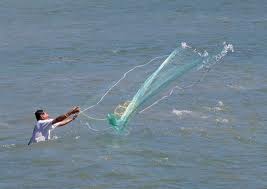
As for the cast nets. It is very rare for me not to catch something. In fact, I am usually the only one on the beach catching anything. My favorite net is a light green one I can put anywhere within 20 feet. I can even throw a net from my kayak and canoe. On the beach most fishermen think I am casting for baitfish so when they look in my bucket they’re usually astounded to see I caught what they couldn’t.  I’ve also had to educate a park ranger or two. Most of them don’t know under Florida law every fish you can catch with a hook in saltwater you are allowed to catch with a cast net. (Hint: When the say they are going to give you a citation ask them to write down the number of the law you are breaking. This always results in several radio conversations and no citation.) Florida has, however,  outlawed seine nets in many cases but not cast nets.

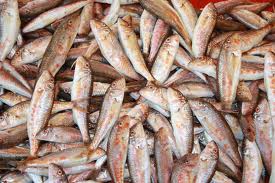
Red Mullet

I throw left and right handed — I can fish longer that way — and view it as good exercise. Throw 20 pounds of lead 200 times and drag it back and you have had some exercise.  I think it’s also more sporting for the fish. I’m not preying on their hunger and they have a chance to get away. And not every fish I catch I keep so they go back unharmed.

As for foraging: My net turned up empty yesterday but not the belly. Foraging is knowing what’s edible, when it’s in season, where to find it, and how to make it into a meal.

{ 5 comments }

Budget Cut Benefits

Two effects of the economic times are influencing foraging. First is an increase in the number of people who are putting food on the table by foraging. The other is an increase in edible weeds.

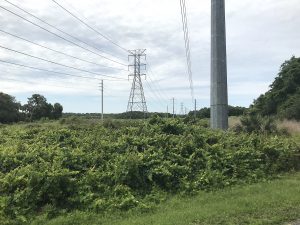
One result of tight budgets is that various agencies don’t have the money to pay for weed control. Wild edibles that were often kept at bay by regular mowing or spraying are now flourishing. Along the bike trail I have been using since it opened I’ve seen more edible than ever before. It is an interesting example of how less is more, as well as a 13,000-year-old lesson.

There was a time when no resources were spent controlling nature and nature provided ample food for man to survive. Then came agriculture, then cities and eventually a population that cannot survive without big agriculture. A century ago when most folks not only stopped foraging but started moving off the farm they planted non-edible plants about their homes and cities. They even allocated money to keep nature in check, as if nature was a green enemy. We went from being part of nature to opposing it. Nature went from being a provider to being a pain. We turned on something that has sustained humanity for eons. And more to the point, it was and is perhaps a pointless expenditure. Nature has far more resources than man and doesn’t need a bank account to get something done

Blackberries along the bike trail. Photo by Green Deane

The bike paths are just accessible now as they were last year. But less plants are being mowed or sprayed. Nature is responding and coming back with wild edibles: Ground cherries, peppergrass, blackberries, milkweed, yams, maypop, grain grasses.  We stop spending money battling nature and nature provides more food, for free, and I can still ride the bike path.  That strikes me as a win win win and a lesson not to be forgotten when the economy recovers.

{ 0 comments }

The Mesolithic Era is not a sexy topic that will win friends and influence people at parties. But, it is something foragers should think about. If you are a survivalist it is mandatory knowledge.

Flintstone Knife

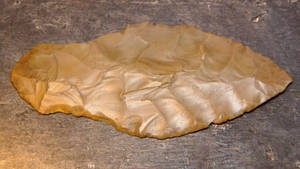
Mesolithic literally means middle stone, or the Middle Stone Age. When exactly that was is a bit of a debate. Some places got metallurgy before others so it is a fluid definition. Let’s put it at 8,000 to 10,000 years ago for northern Europe and perhaps North America as well. Metallurgy might have migrated around the north polar regions after that.  More specifically, what we’re interested in is the time before man was using metal.  What does that have to do with foraging?

Well, everybody foraged back then. It was how one lived. In fact, most of your time was spent foraging, going from food source to food source. Throw in hunting and a few fights and you have your 9 to 5 Mesolithic day, though dawn to dusk might be more accurate. What can possibly be instructive about foragers 8,000 years ago? One consideration is how they cooked food without pots and pans. That brings us to fire.

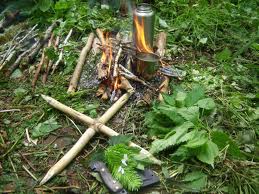
Making fire by hand

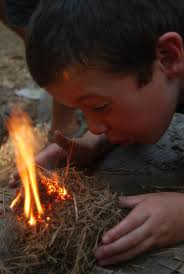
A camp fire is more than burning wood. Which wood, the size of the wood, and how the fire is made allows for great sophistication in cooking, particularly without pots or pans. Even in my youth with a wood cook stove in the basement, the kind of fire and wood was important.

If we were roasting potatoes, we wanted steady hot coals that put out a consistent heat for an hour or two. That usually meant a hard wood of medium size reduced to coals. If it was biscuits for breakfast it was a fire made of small soft wood, like pine. That produced a very hot but short fire, perfect for making biscuits and browning them in a few minutes.  Baking bread required large pieces of hard wood.

There is not only the fires to consider but the coals and ashes, the ground and local material such as stones and leaves to wrap food in or make mats out of. For example, the “traditional” New England Clam Bake is a method of cooking devised before there were pots and pans.

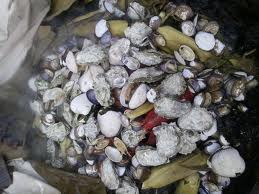
Clam bake

When I was a kid, we would go down to the Maine shore at low tide late on a summer afternoon. We’d wade out to an island about a half a mile from shore, getting quite muddy in the process. Once on the island we would dig a pit, line it with rocks, and build a big fire. Then we’d go looking for food…. crabs under seaweed, mussels, sometimes fish caught in tidal pools, clams in the mud. When the fire had burnt down, we toss all the stuff in the hot pit: Fish and crabs on top, cover it all with seaweed, then cover the seaweed with dirt. We’d then go play and or build a small camp fire nearby because we always spent the night.  In a couple of hours we’d shovel off the dirt and seaweed and have a feast.  In the morning we’d warm up what we hadn’t eaten and play until the tide was low enough to wade back to the mainland. No pots, no pans, no forks or knives. Fresh nutritious food.

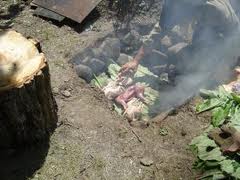
Roasting in the ground

Every time I collect a wild edible I ask myself how could the foragers of the mesolithic prepare it? Roots would be roasted, sometime in the fire itself, sometime beside the fire. Some roots were buried in the ground before the fire was started and not uncovered until the foragers were ready to move on days later. This was particularly so with roots in the Americas that had calcium oxalates in them that only break down with long dry heat. Some nuts were roasted in sand under a short hot fire. Depending on the fire and the food cooking could be in, around, over or under a fire.

Roasting nettles over open fire

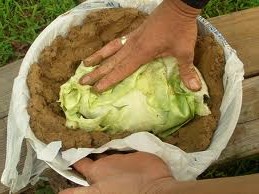
Some greens, nettles for example, can be wilted by the fire and made edible in a matter of seconds. Others have to be steamed.  Some small roots can be buried in the ashes and covered with dirt. Why dirt? Dirt locks out oxygen and keeps the roots from charing. If you buried a wrapped fish the sand will also keep it from charing. Baking was also possible if you had clay. The food was wrapped in grass or another suitable leaf, and all of it encased in clay. Then the clay “oven” was set next to the fire and tended, turned now and then to cook the food.  Eggs were wrapped in clay or had a small hole cracked on top and propped up in the ashes.

Wrapping fish in clay

Learning to cook like a cave man has several advantages. The first one is you know how to cook no matter where you are as long as you can make fire. The second is you don’t have to carry a lot of pots and pans to eat well. Third, such cooking forces you to think about the plant and ways to use it. And primary cooking is usually more nutritious. Fresh food, freshly cooked and into you not long after harvested is healthy. It is also leaving out a lot of the non-food stuff in processed food these days. Cooking fish and game is similar to plant materials. They can be roasted, steamed or baked. It depends on the food and the materials on hand.

If I am traveling light, I take one pot/pan for all possible cooking needs and a few spices. I forage along the way for meals. If I am driving to a site and camping, then I dig out my cast iron ware and set up a wilderness kitchen — ya gotta play now and then. The idea behind both methods of cooking is not to survive but thriving, not subsistence but living well while in the wilds.

Regardless of what wild food you cook or how you cook it, knowing how to prepare it without pots and pans brings useable knowledge and independence to your outdoor experience.  I’ll cover more techniques in the future.

{ 3 comments }