
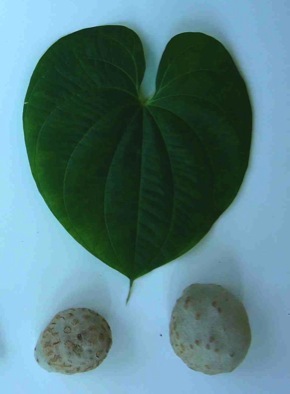
Dioscorea bulbifera, the infamous Air Potato
The “Cheeky Yam, or Yam on the Lamb
Yam B, Dioscorea bulbifera, is definitely second best to Yam A, Dioscorea alata. Why is Yam B, the D. bulbifera second best? For two reasons. It requires more work to prepare it to eat, and doesn’t grow as big as D. alata. Let me tell you right now I have dug up one (1) Yam B tuber, but not from lack of trying. Despite decades of looking I’ve only found one. Forager emeritus Dick Deuerling, has however. He’s the author of “Florida’s Incredible Wild Edibles.” Dick was a stickler for taxonomy so when he says he dug up a D. Bulbifera tuber, not a D. alata tuber, boiled it twice and ate it, I believe him. I’d ask him to do it again but he died in his 90’s more than a decade ago. I remember that July in 2013 because I had to go to three funerals.
The yam in question, D. bulbifera, ((Dye-os-KOH-ree-uh or in Greek thee-oh-skor-REE-uh)) is the green scourge of Central Florida, ….and South Florida, ….and North Florida…. watch out Georgia here she comes…. It was sent to a researcher in Orlando in 1905 as a possible ornamental and food crop. He reported it would be a dangerous plant to Florida but didn’t kill the plants he experimented with. A little over a century later it now carpets many parts of the state.
That D. bulbifera can be an attractive ornamental is attested by tourists mistakingly taking it home to plant. That it was a potential food crop is debatable. While there may be one species of D. bulbifera there are many varieties. I have noticed, for example, that some have smooth tan round in-the-air bulbils (probably Asian backgound) and others have dark brown bumpy round in-the-air bulbils with tan pimples (probably African background.) What variety was sent to Orlando was not recorded. An Australian version does put on a large root.
D. bulbifera’s underground root is always referred to as toxic but also eaten in some places. How’s that for ambiguous? And it gets worse, the …. in-the-air bulbils… wrongly called “air potatoes” apparently vary in toxicity, some edible some not. While the bulbils are constantly called toxic by authorities rumor persists they are edible (with special preparation.) In fact I had a visitor from Brazil a couple of years ago while I had some D. bulbifera bulbils (Asian: Smooth and tan) on my desk. He said his mother cooked them all the time. I asked him to ask her how she does it. (Crushes, dries, bakes, leaches then uses.) On the other hand Dick had two friends boil D. bulbifera in-the-air bulbils and had to go to the hospital (Asian or African not known.) To make matters worse some writers make no linguistic distinction between the above ground in-the-air bulbils and below ground (in the dirt) roots compounding the confusion by calling them both “tubers. ” And technically the underground tubers are not roots but rather “adventurous stem material.”
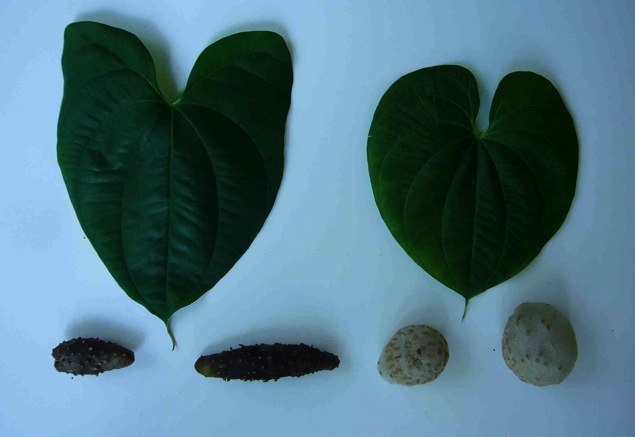
Yam A, the Alata on our left with in-the-air bulbils, on the right is Yam B, with in the air-bulbils. No root is shown.
The D. bulbifera has large round ball to heart-shaped leaves and a round stem. It climbs at eye level from your lower right to upper left (called the S-twist) and has in-the-air bulbils that are round, brown and lumpy (African) or round smooth and tan (Asian) hence the nickname “air potato vine.” And to add to the confusion, Yam A, the Dioscorea alata, (uh-LAT-tuh) has dark brown bulbils as well but they tend to be 1) cylindrical and or 2) very misshapen, neither round or cylindrical, L-shaped, Y-shaped, or a lumpy lump. D. Bulbifera’s in-the-air bulbils are, to my knowledge, always round regardless of color. D. bulbifera can grow a root about the size of a softball (occasionally to a basket ball,) but apparently does not grow a large root too often if rarely in Florida. That would explain why I have only found one. In fact, I became so frustrated with the D. bulbifera, Yam B, I put it on the back burner, the way in the back, for over a decade.
Many years later I became a fan of Ray Mears, a British bush crafter. I ordered some of his DVDs and one of his books about wild edibles in England. Unexpectedly, the Dioscorea bulbifera came up. One of Mear’s episodes was about the Aborigines in Australia. They dig up two kinds of yams, one called “long yam” and one called “cheeky yam.” They steam roast them for a couple of hours then eat the “long yam” immediately but not the cheeky yam.” They grate the cheeky yam then leach it in a flowing stream overnight. Then they eat it. No botanical name was given for either yam. But when I was reading his book Mears happens to mention in passing there is one non-edible yam in England. Then he said it is similar to the one the Aborigines eat in Australia, the D. bulbifera. Well, as one might expect, that caught my attention. I was beginning to think my friend Dick was the only one who ever found a D. bulbifera root to eat but apparently the Aborigines had found them, too. Alas, we don’t know what varieties.
Researching yams again, this time with the internet, I discovered the “long yams” the Aborigines eat are, Dioscorea transversa. The D. transversa (trans-VER-sa) like the D. alata, twists when it grows, lower left to upper right, he Z-twist (as does Yam C, the Dioscorea polystachya mistakenly called D. oppositifolia.) The D. bulbifera, however, twists lower right to upper left, the S-twist. By now I was getting the idea that readily edible yams at eye level climb from your lower left to upper right. Z-twist, then behind. The ones that twist the other way, S-twist, need special preparation or are not edible at all. That may seem like a small observation but it took about a dozen years to sort out.
So I do know two things. Dick has eaten the D. Bulbifera undergound root and I have eaten the D. Alta’s underground root. In Dick’s book he says he boiled the root twice to get rid of the bitterness. Then, after peeling, he used it just like cooked potato. In Australia, to remind you, the Aborigines roast it for a couple of hours, grate it, and then leach it overnight in a flowing stream. I know Dick’s method works for Yam B found here in Florida. I don’t know if the Aborigines’ method would work with Yam B’s here.
And what of the bulbils? The bulbils of some D. bulbifera are reported as edible but they require special preparation as mentioned above. Just boiling will not do it. Often their preparation is peeling, sun drying (read long term chemical decay, not short term in an oven) then boiling. Another report is they are soaked then boiled. As third says they are cooked with lye, a method used with some horse chestnuts. A fourth says none of them are edible anyway.
My suspicion is there are different varieties of D. bulbifera and some may be edible in-the-air bulbils. What we do know is that even where they are eaten they are cut open to see if they turn brown quickly. Those that are are not used. And, in some places even after being careful in selecting the Yam B in-the-air bulbils and preparing them the are fed to a dog first to make use.
As a final note of confusion, there is a native Dioscorea in England, the Black Bryony (Dioscorea communis or Tamus communis). It is know as toxic, especially it’s red bulbils/berries. Whether a properly prepared root is edible is unknown. We do know cooking the root changes its chemical makeup, reducing its raphides (calcium oxalate crystals.) The internet also wrongly includes it in the cucumber family.
Green Deane’s “Itemized” Plant Profile
IDENTIFICATION: Dioscorea bulbifera: ”Air potato vine.’ Large heart-shaped leaves, alternating, stem round, climbs from lower right to upper left. Bulbils usually tan, round and smooth, Asian, or round and dark brown with light dimples, African. Underground root roundish, can be lumpy and distorted when grown in hard soil.
TIME OF YEAR: Fall, September to December. For two months the vine dies back making locating difficult.
ENVIRONMENT: Yams do well in sun or partial shade and prosper with ample rainfall. They require good drainage, and therefore, are often planted on mounds or ridges.
METHOD OF PREPARATION: Undergound roots, should you find one: Boil in two changes of water, peel, then slice or mash it, or bake it or chill it and use in a “potato” salad. Make sure it has absolutely no bitterness. I consider the in-the-air bulbils of the D. bulbifera as not edible. If they are it involves considerable process using multiple cooking methods.
Does ne one know where I can buy some of the potatoes vine plants??
Buy them? They are a noxious weed in Central Florida. You can’t even give them away. As as it is the lesser of all the yam, why do you want some? They would also become invasive in a similar warm climate.
I doubt that they would survive a MD winter, but, I’d still like some.
Yes I have some. They make a beautiful climbing vine. Let me know
if I you are still interested.
http://www.OneGreenWorld.com carries two species of Dioscorea, or ‘Cinnamon Vine’ both sold as producing edible tubers: D. batatas, also called ‘Chinese Yam’ (two varieties/cultivars); and D. nipponica or ‘Japanese Yam’. The D. nipponica is also said to produce edible above ground ‘tubers’.
Both species are listed in their catalog as hardy to USDA zone 4.
http://www.RaintreeNursery.com also lists ‘Cinnamon Vine’ D. batatas in their catalog.
Both companies offer a wide variety of unusual edible plants, ery useful for those wanting a ‘normal’ looking edible landscape in their yard – which can help keep neighbors & officials happy. Edible Landcaping in Va is another source of unusual and interesting edible plants.
Often companies that sell such things have the wrong name which then makes one suspicious of what they say it can be used for.
“Winged Yam (D. alata) vines twine to the right, whereas air potato (D. bulbifera vines twine to the left” Invasive Plants by Sylvan Ramsey Kaufman and Wallace Kaufman
Clockwise and counterclockwise are based upon the position of the viewer. That is why I say “at eye level” either lower left to upper right, or lower right to upper left — at eye level.
Cinnamon Vine or Chinese Yam (Dioscorea oppositifolia) twine counterclockwise from an underground tuber that can be 3 feet long. Kaufman and Kaufman
Clockwise and counterclockwise are based upon the position of the viewer. That is why I say “at eye level” either lower left to upper right, or lower right to upper left — at eye level.
There are varieties of Dioscorea bulbifera that are very edible. In some places they have been cultivated for many years as a food crop. The wild type in FL is not edible. ECHO in Fort Myers grows the edible form and gave me a tuber to grow at one point. I have another friend from Vero beach who is also growing the edible form and she recently gave me a bunch of sprouting bulbils to plant. She has been growing them for years and refers to them as purple yam. The edible form looks different from the wild form, when it first comes up the stems and leaves are a purple color. The wild form looks very different… I have both growing just feet away from each other and as I pull up the toxic ones to remove them it is very easy to distinguish which is which. I have eaten them, many people around the world eat them. They take no extensive preparation, they are a food crop prepared just like any other yam. The inside of the yam underground is a dark purple color and the bulbils are the same on the inside as the underground tubers. The air bulbils are edible, not just the tuber. The cultivated varieties are less invasive due to their edibility. The toxic ones sit there without being eaten and re-sprout, our goats won’t even touch them.
In his book Perennial Vegetables, Eric Toensmeier has several pages about this specific crop with great detail on how to grow and prepare it. He claims that in the future the question will be the ecological damage of NOT growing air potato because of its potential as a no-till perennial staple crop providing starch. ECHO also has info on this crop.
What is the vibe’s shape? Which way does it twist at eye-level (Z or S) and are the leaves singular or in pairs?
I’ll second the existence of edible varieties of d. bulbifera. They are not the wild ones, but look just like them. The aerial bulbils are round and gray, just like most of the wild bulbiferas around here. They are easy to prepare and reputed to be delicious.
I had heard of the existence of a purple-fleshed D. bulbifera from S.E. asia, called “ube yam.” I went on a pilgrimage to a variety of Vietnamese grocery stores in Orlando looking for them. Apparently, almost any purple root vegetable is called “ube yam.” Most of what I was shown when I asked for it was a species of Ipomoea also known as the purple Okinawa sweet potato (has white skin). I did find one store that had large purple roots of D. alata, which appeared to have been frozen (though the store denied it). I took some home anyway but they were mostly non-viable. Some people in N. Fl have purple alatas growing, and you can sometimes find the regular white ones in uncultivated settings. Josh, if you’ve got purple bulbiferas, I have some friends who are very interested in getting some. Please email me at ufdionysus@aol.com.
My friend Dan has eaten the wild d. bulbifera aerial tubers. He chopped them into pieces and boiled them multiple times until the bitterness was removed. He said there wasn’t really anything left by the end of it and it wasn’t worth the effort.
I am concerned about how the new biocontrol for air potato vines will affect the cultivated varieties.
The leaves are singular. I don’t know what you mean about the vibe… explain a little better.
The Perennial Vegetables book does classify this as the Bulbifera, I double checked. I highly recommend that book for info on this plant. This is one of the author’s favorite vegetables and writes extensively about this plant.
I recently visited a favorite park in Miami. It is a lovely hammock/hardwood area but lately has become very overgrown with Dioscorea Bulbifera. I fear that if left unchecked, the vine will soon entirely cover and possibly destroy this location. I have even considered donating some of my time and attempting to remove some of the overgrowth. Do you know if this is worth the time in trying to remove the climbing vine or am I blowing against the wind? The small “air potatoes” are seemingly everywhere on the ground and ready to sprout new vines galore.
Great article. My friend has tons of these in her yard, and thanks to you, now knows what these pesky vines are. By the way, according to the “Chinese Materia Medica, third edition” by Bensky, Clavey and Stoger”, Asian D. bulbifera’s underground tubers are used in Chinese medicine for psoriasis, insect bites, and coughs. However, it is also listed as toxic, with different side effects depending on the individual, and the book doesn’t really tell you how the roots are prepared for medicine.
Hey. It turns out my “air potatoes” were actually D. alata.
Regardless, check this article out. I would do anything to get some of these varieties.
http://naldc.nal.usda.gov/download/CAT87208471/PDF
They D. bulbifera, are everywhere here in Florida are famine food at best. There are varieties of that species which are not edible.
UP HERE IN atlanta i have the bulbiferous variety, i believe. They look like miniature replicas oh an idaho potato, round with the little spots on them. I was taught they were edible. While ive never eaten a huge quantity..for days at a time. Ive never felt any ill effects. As for preparation i washed them and sauteed them in butter. Thats it. I DIDNT CONSIDER THEM FAMINE FOOD…THEY ARE JUST LIKE LITTLE POTATOES TO ME. Am i in the wrong? Or do i possibly have a safe variety?
They might be yam C bulbils.
Any chance I could get a few from you? I realize that they may not survive MD winter, but, I can always use a large planter, and, bring them inside.
Thank you.
The ones here in Florida…. If I eat them, are they poisonous ? Will I get sick, or what ?
If you boil the root twice, no but they (D. bulbifera) rarely root in Florida. The air potatoes are full of steroids and hormones that will make you sick.
I just moved in to a lovely cottage in an older neighborhood in a south Louisiana city. The whole area is very green with a lot of mature landscapes, both cultivated & wild/opportunistic. The neighboring house is for sale and has an untended garden overgrowing onto my property. I have a young son and wanted to identify the vines, of course, to make sure they pose no threat of any type. I believe one of my encroachers is this “air potato” or “yam b” vines. It is an attractive vine with large heart shaped leaves and does look like a domesticated ornamental & is lovely the way it decorates the lattice on the patio. It is producing round to oval brown potato looking bulbs with light bumps on them. It is starting to yellow in places as if it is dying back though we have had a very temperate fall thus far. If my son does not ingest these pods growing from the vine, I take it that it poses no more of a threat than some other established plants that are poisonous (like the mature azaleas with blooms that are toxic if ingested). Is this correct? I have photos, is there an email address or other way to submit for positive or close to it, identification?
Round and tan bulbils are to be avoided. Round and brown with bumps is in a fuzzy area. I generally say no to those as well.It is mishapen ones we are interested in and the lead topic in the Dec 4th newsletter. In the long run the air bulbils while toxic are not usually fatally so. They are full of steroids and hormones which is what sends you to the hospital should you eat even cooked ones. It is best just to avoid the above ground parts. They do not pose a contact threat like poison ivy would.
So would these plants be toxic to dogs? Our dog recently died due to the ingestion of something, we think in the yard…after many tests we are still in the dark. Just curious- I think we have some of this in our yard.
i have no idea with this plant. my father asked for it from his friends (in Indonesia). they said that it is Japanese Potato and can be eaten. so my father planted it and it grow well to the top of mango tree. the bulbils (I think) are green with some pimples on them and turn brown the next days. they are rather round shaped, like potato.
And this morning, my father picked three brown bulbils, not in the ground, and tried to fry one. We peeled and sliced it like potato. The flesh is quite tricky because of the latex so I soaked it first. I poured a little salt, then fry them. I looked at the light green flesh that hasn’t been fried, and it turned brown. We ate some and it taste quite sweet. But I was anxious about it so I searching on internet to have some information.
There’s no complete information in Indonesia websites so I searched the English. But there are still some ambiguous information. I’m still confused. Is it poisonous? can it be eaten?
Green with pimples? Never heard of them being that color. I have seen them round and tan, or, round and brown with tan freckles. I have not seen them green with pimples. Did you see the articles on Yam A and Yam C? In some countries there are varities of Disocroea bulbifera that are edible. Perhaps you have one, or, you ate a young one. Many “wild” yams are not edible because they have steroids and hormones in them that can upset the body’s function.
who ever wants these please let me know. They are all over my 1 1/4 acre property… not so wise to propagate ….
Any chance that they will survive MD winter? If so, and, if you still have some, I’d love a few tubers. Especially if they are the edible variant.
Thank you.
Dean, your inability to locate subterranean tubers of D. bulbifera confuses me. I find them every time I look. Often there’s not much to find, but it’s still there. You might just be looking at the wrong time of year, but they have some sort of tuber during most of it. D builbifera and alata exhibit distinct seasonality.
The tubers are the overwintering strategy for the plants. All the energy they were able to accumulate in the previous year is stored there. In the spring/summer, when they start growing, that stored energy is used to grow a vine; the more stored energy, the longer/higher the vine can grow before the leaves open up. They don’t even need water during this period. As the stored energy is used up, the tuber gets soft and lumpy and eventually is shed as the new tuber begins to grow. That us often around the end of July/beginning of August around Gainesville. You can see that as a little bb or pea sized tuber at the base of the vine.
By winter, in strong vines, the subterranean tuber can get about as big as a baseball. They have wiry roots sticking out in all directions, giving it a hairy appearance, and the skin is fairly smooth in between. Many take on a reddish hue. I find these a lot while digging alata tubers from mixed stands. They are easy to differentiate.
You may wish to add a couple more Dioscoreas to your repertoire. D. dodecanurea or discolor is a very pretty leafed vine, grown for its outstanding ornamental qualities, but it is very invasive and scares me more than any other Dioscoreas I’ve encountered. It does not make aerial bulbils. It makes them in the ground, where you will not be able to see them or pick them up. It also does not seem to have the same seasonality as the others in extinguishing the old tuber as it grows a new one. It also does not grow straight up from its tuber, but grows a delicate root sideways under the soil for quite a distance before sprouting upwards. This all makes the tubers very hard to find and the stand very hard to eradicate. A friend of mine says he’s eaten small ones raw with no ill effects.
Another Dioscorea that grows (too) well around here is sansibarensis. It has a pretty shape to the leaf. I once decided I wanted to shrink the stand of them at a botanical garden I was employed at. Among other things, I cut one large vine near the ground and put garlon on the stump. The vine up in the trees failed to whither. This perplexed me a great deal and I checked and rechecked numerous times to make sure I hadn’t accidentally cut a different vine. For months it refused even to wilt and even managed to grow aerial bulbils, while completely detached from the ground.
I spelled a name wrong. It’s dodecaneura
Anyone ever heard of using Dioscorea bulbifera or D. alata as an antispasmodic herbal preparation like you might use D. quadranata or D. villosa?
I live in Wakulla county, just south of Tallahassee. While harvesting some sasafrass I came upon some vines of what I believe to be both alta and bulbifera. After reading your article on alta, I felt adventurous and harvested some, steering clear of the “bulbifera”. The underground tubers resembled hairy idahoes. The aerial bubils were collected for planting (elongated, brown, and hairy) The tubers were washed, scrubbed, peeled, and boiled. Slippery little devils with no bitter taste. Even after 3 boilings they continued to yeild a slippery slice with a liquid that appeared to have a very high starch content. After feeding some to the ex wife with no apparent ill effects, (should have stuck with the poison mushrooms), I tried some myself. The taste resembled mashed potatoes with walnuts. the leftovers I tried to fry like potatoe pancakes but they lacked sufficent binder to remain cohesive, but still with a tasty flavor. Saving up for your dvd’s (did I mention ex wife?), perhaps a collection of recipes would be helpful for the curious. Also looking for some snowberry plants or seeds (chiococca alba), which according to preliminary reasearch by U of Palm Beach, may show promise in combating psedunomis (sp) originalis, a mersa type infection with a mortality rate approaching 75%k, and is a common ingredient in an elixer from the Dominican Republic called Mama Juana. Thanks for your excellent work. Looking forward to more. If you would like some sassafras root for a refreshing tea, or take a cup of water ,add half a cup of aformentioned root being cut into small pieces and mashed up, biol to 1/2 volume, cool, then apply to poison ivy and minor rashes, I feel you will be pleased with the result with the only drawback being surrounded by beautiful women drawn in by the most pleasant odor.
I have a planting of Dioscorea sp. that I have been trying to identify as to species for 40 years. I’m in Central Illinois, found this vine growing on the fence in the first house I bought in 1973. To shorten the story, this is a beautiful vine that out competes several of our more obnoxious vines here in the midwest U.S.. Took me several years to get to the genera, local State U Botany Dept couldn’t even tell me for years. Finally narrowed it down after retiring and having the time to spend in Internet research. But, I still can’t narrow it down to species or to edible or not.
The most significant difference from every ID I can find on the net is that the vines emerge purple and gold, but most importantly the stems are square, not round, but square. Would love anyone interested in this challenge and I’ll send pictures next spring.
Did you read about Yam C?
Thank you so much for this article! I finally know exactly what the heck is trying to take over my yard!! I looked it up when I first moved in the house but this article was way more information than I ever found!
I live in Tampa, Fl and moved to V.M. Ybor neighborhood a year ago. I have been trying to get rid of these suckers ever since! They are taking over the shed and trees!
Thanks again!
Are you sure they are D. bulbifera? Could they be D. alata?
Hi Deane,
I have dug both yams with my Aboriginal ‘aunties’ many times and prepared both too. May I make some suggestions for your testing edibility, particularly with the cheeky yam?
First off, forget the rubbish cooking method of boiling. The only things worth boiling water for are some herb teas and eggs. Any other produce in boiling water only loses nutrients and dilutes out the flavour.
Aborigines rarely boiled water until modern times. It was just unnecessary. Also, bitter principles in food poorly destroyed or denatured at 212F or 100C. They need much higher temperatures and a ground oven can reach 400F and slowly fall through the temperature range to eating heat.
Anyway, my aunties showed me how to use the edge of a hot ash fire to cook small long yams (D. transversa) or for larger yams, just turn them often over hot coals. These are absolutely delicious. The long yams are slightly sweet, firm texture even a little chewy and are very filling. They are nutritionally superior to cultivated sweet potato or white potatoes and are low GI and high fiber.
D bulbifera does need the water leaching but makes a slightly bitter breakfast food and is regarded as a tonic food or immune booster. The Australian cheeky yam tubers are hairy with many small root hairs.
Here are a few methods of preparation from my book, The Bushfood Handbook (out of print but I am working on a Kindle edition).
There were at least thirteen different ways to do this, although each was usually specific to different areas. Three methods are described below.
1. The tubers were washed and then roasted in a ground oven. The outer skin with its ‘head’ of root hairs was removed and the yam flesh grated into a coarse mash. This mash was then washed in running water or in several changes of water until the bitterness had disappeared. The slurry was poured into a hole dug in sand in order to drain. After this the gratings were either eaten cold or fashioned into cakes and heated on coals to be eaten hot.
2. With the availability of billies and saucepans a new method has developed. The yams are peeled, cut into small sections, boiled for about fifteen minutes and then soaked for three days in sev¬eral changes of water before being roasted and eaten.
3. A dry method from the Kimberley was used by the people around Kalumburu (and east to the Victoria River in the Northern Terri¬tory). The yams were roasted over an open fire and the roots and skin removed. The peeled yams were sliced into centimetre-thick pieces, coated with a ‘batter’ of wet ash from burnt river gum bark and cooked in a bush oven for several hours or overnight. The bitter principle was absorbed from the yams into the ash, which was washed off before the yams were eaten. The batter may have needed to be reapplied and a second roasting done if the yams were still cheeky after the first baking.
Even after all the preparation of cheeky yams the product is still slightly bitter, but this was seen by Aborigines as being medicinal and the food was important in other ways. The quantities that could be collected and communally processed could support large gather¬ings for social events.
In Aurukun, prepared cheeky yam was a staple for children and was part of the ceremony in which infants were named. For Aborigines in other areas there were different rules or taboos which determined who could eat cheeky yam. On the Tiwi Islands off the north coast of the Northern Territory, the preparation of cheeky yam is an integral part of the women’s initiation ceremonies.
Thanks for the great information.
Two different farmers here in Central America shared supposedly edible varieties of D. bulbifera with me this week – I planted them both and made a video:
https://www.youtube.com/watch?v=Drc-76S_26w
I was told they let the bulbils sit around for a while before eating them, which takes away the bitterness. Not sure, I’m still nervous. We shall see. Josh Jamison at H.E.A.R.T. has had good luck with a geometric looking type that is good to eat. I think the smaller one I planted was that kind. The other one looks like the toxic ones I found all over Florida.
Top notch info, Vic. Thank you.
Thanks for the article. I am presently taking an Indian Ayurvedic supplement called “chyawanprash” as a tonic, and D bulbifera is one of the main ingredients. It can be dissolved in liquid, or spread on toast. It seems one country’s medicine is another country’s “invasive weed”!
I was born and raised in Brazil, and my family had the air potato in our vegetable garden, not as a pest but as a vegetable just like our carrots, eggplants and such.
In fact that’s how I found this page, because I was searching information online about the air potato (in Brazil we call it Cara’ and it’s pronouncec Khur-ah).
We ate it all the time: steammed, mashed and in soups. But my favourite was the “cara-roll”: my mom would could and mash the air potato, add flour and milk, mix everything and then bake little rolls like dinner rolls. Hot out of the oven with some butter… heaven!
Maybe the variety we had wasn’t either the African nor the Asian, but South American. Definitelly not toxic, and quite tasty.
I love your Website! I have to dig up these little buggers everywhere and yes they are terrible! They can grow 15 ft a season I think! So I switch my thinking and try t see the edible potential. Free food. I do feel cautionary and I do see a couple varieties. There is a park near me, Arlington Park where they look like Kudzu vines by fall covering EVERYTHING. Some of the leaves on these are very large. In my yard(and neighbor’s where they drop and trail in from) I am pretty certain they have the bumpy round brown pods. Thank you.
Just this year I’ve been noticing the leaves on the air potatoes are starting to look like swiss cheese, then my friend tells me that some authority has released a beetle to eat them. So here’s that info f.y.i. http://entnemdept.ufl.edu/creatures/BENEFICIAL/BEETLES/air_potato_leaf_beetle.htm
My husband and I both broke out in a wicked rash while trying to clear a pile of air potato vines that had wandered over from a neighbor’s yard. I went looking, and would like to warn all here to be careful, apparently there are many varieties of this vine and some are quite toxic. For example, I found this:
Tubers and/or aerial bulbils of unpalatable varieties of D. bulbifera have been used to create poisons for various uses (Martin, 1974). Poisons are derived from alkaloids (i.e., dioscorine), saponins, sapogenins and/or tannins present in tubers of a given variety (Al-Shehbaz and Schubert, 1989; Martin, 1974). In various parts of Africa and on the island of Java, aerial tubers are used to make a fish poison (Al-Shehbaz and Schubert, 1989; Martin, 1974). The poison released by grated tubers placed in a stream acts to stun fish at fairly long distances (AlShehbaz and Schubert, 1989). Poisonous varieties of the plant are often used by farmers to confuse and deter potential thieves through the planting of unpalatable varieties within the main crop variety (Martin, 1974).
from: http://www.fleppc.org/Manage_Plans/AirpotatoManagementPlan_Final.pdf
and this (complete with a picture in the original):
.I KNOCKED THE BULBS OFF AND PUT THEM IN A JAR TO DEAL WITH LATER…AFTER 12 HOURS OR SO THE PALM OF MY HAND BECAME ITCHY AND VERY SORE AT THE SAME TIME…BY THE NEXT DAY A HUGE RASH HAD DEVELOPED WITH BIG BLISTERS…I COULD NOT STOP THIS FROM SPREADING AND I WENT STRAIGHT TO THE DOCTORS…TWO INJECTIONS AND A 6 DAY PREDNISONE PACK SLOWLY AND I DO MEAN SLOWLY STOPPED IT FROM SPREADING…10 DAYS LATER IT WAS STILL NOT COMPLETELY GONE…A STRONG WARNING TO EVERYONE ABOUT THIS from: PlantFiles Pictures:Air-Potato (Dioscorea bulbifera)
So, be very careful, unless you know exactly what species you are dealing with!
Some excellent photos of edible cultivars here:
https://growerjim.blogspot.com/2016/12/dioscorea-bulbifera-edible-air-potato.html
The variety called “Africa” I’ve just eaten last week, here in Africa – Ghana – about 40 minutes cooking, taste like potato. No ill effects, just like eating potatoes.
Can you eat the leaves of either variety of the air potato plant? I thought I read somewhere that you can (?)
Thanks in advance! 🙂
I do not have any reference that says any leaves of any species is edible.
Can my pet goats eat this plant w/o any harm,,,?
I have eaten the B for years, I was told they were edible and never heard otherwise until I looked it up. Me and my kids have eaten the air “potato’s” raw, why wouldn’t I just keep eating them?
I knew of two women who ate them cooked and ended up in the hospital.
Everything I can find on Diascorea bulbifera discusses edibility/toxicity of the bulbil or root…what about the leaves/stems?
I typically harvet yard weeds to feed my rabbits and I’ve just discovered this growing in my yard, (first time in 8 years.) I would like to know if this is safe to feed them or not…for reference, their systems are very similar to equine.