
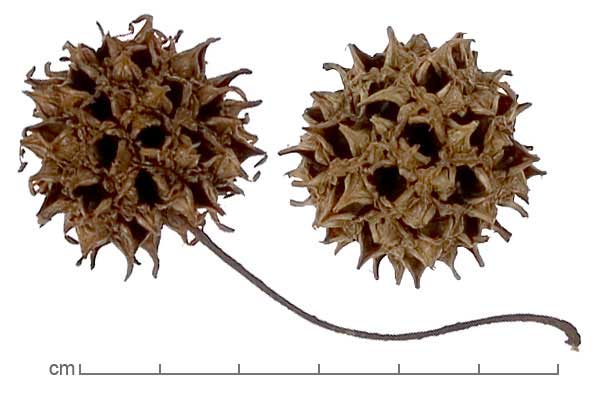
Dried Sweet Gum Fruit
The Sweet Gum tree is the sand spur of the forest. You painfully find them with your feet. The vicious seed pods have impaled many a forager and has done much to ruin the Sweet Gum’s reputation. Perhaps it is time for some rehabilitation.
The only edible part of the tree is the dried sap which makes a fragrant, bitter chewing gum. Despite its name the gum is not sweet. It’s called Sweet Gum to separate it from a different species altogether, the Black Gum, Nyssa sylvatica, which is extremely sour and bitter. In comparison the mildly bitter Sweet Gum is definitely sweeter. Dr. Francois Couplan in his book The Encyclopedia of Edible Plants of North America states on page 60 the gum “it has antiseptic qualities.”
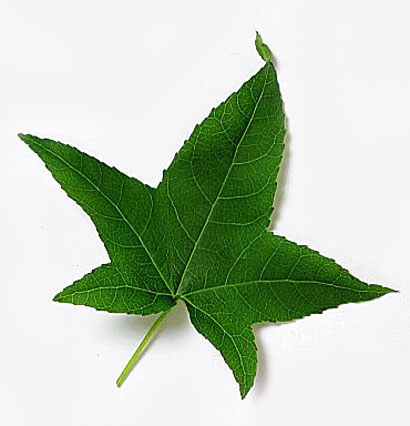
Sweet Gum Leaf
That would be the extent of our interest in the Sweet Gum if it were not for influenza. Viruses are little packets of chemicals that can’t reproduce on their own. They have RNA not DNA. So they need something live to reproduce in. Birds, pigs and humans are the preferred hosts. You might be surprised to learn that most strains of the flu start out in birds. It usually jumps from bird to pig and from pigs to people. It can also be found in whales and seals. Sometimes the flu jumps directly from bird to man, resulting in a very strong and often deadly flu. That led to finding special treatments. Among them is Tamiflu.
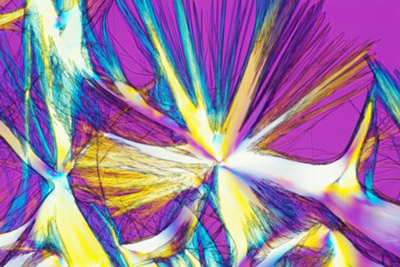
Crystalization of oseltamivir phosphate, the active ingredient in Tamiflu
Tamiflu, or chemically said, oseltamivir phosphate, is made from the star anise tree, Illicium verum, a native of China. Specifically it is made from the seed pods. The prime ingredient is shikimic acid. (she-KEE-mick or SHE-kah-mick.) A shortage led folks to look elsewhere for shikimic acid, and they found it: In pine needles, and infertile Sweet Gum seeds. Sweet Gum bark and leaves have some but the highest concentration is in the infertile seeds. The star anise pod is about 7% shikimic acid, the pine needles 3% and the Sweet Gum 1.7% to 3%. Interestingly, Sweet Gum tea was an herbal treatment for the flu and the Cherokee made a tea out of the bark. Shikimic acid is not Tamiflu any more than steel is a car. That said it is an ingredient, a base material, and whether it is efficacious on its own is a different inquiry.
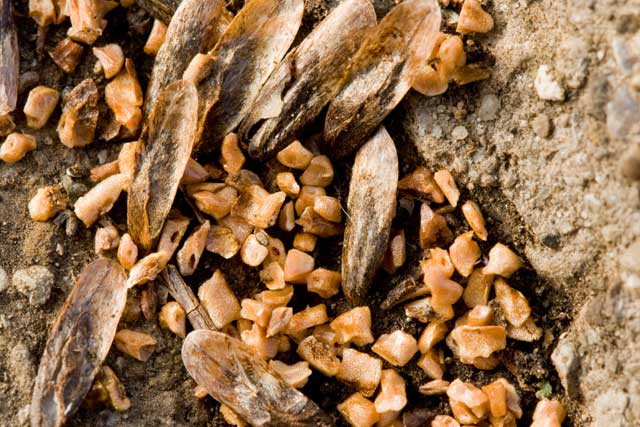
Sweet Gum Seeds
First, how do you tell infertile sweet gum seeds? Fertile seeds are black with wings on either side, infertile seeds are yellow and wingless. Now, how does shikimic acid work? To reproduce the virus needs to break out of the cells it is in. A protein makes that possible. It is believed Shikimic acid can inhibit the protein. The flu doesn’t reproduce which shortening the duration of the infection and thus shortening or lessening the symptoms, which in some cases of the flu is what is deadly. In some flu infections it is your body’s response to the flu that kills you rather than the flu directly. This is why some flus kill the young. They have very strong and immediate immune systems that overwhelm the body while fighting the disease. Whereas some of us older folks have slower immune responses and may have partial immunity from previous infections. As for the preparation, dosage, and consult a doctor or herbalist. As I say that is all outside my pay grade. It usually involves soaking crushed green Sweet Gum fruits in alcohol to make a red tincture.
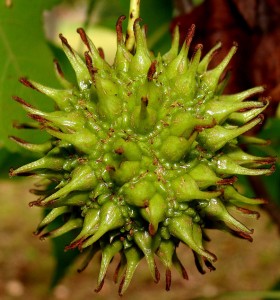
Unripe Sweet Gum Fruit
Botanically the Sweet Gum is Liquidambar styraciflua. (lick-wid-AM-bar sty-rass-
To read a scientific study on the medicinal side of the species go here.
Green Deane’s Itemized Plant Profile: Sweet Gum
IDENTIFICATION: Liquidambar styraciflua: A medium-sized to large tree, growing to 65-155 feet (20–35 m) with a trunk up to 6 feet (2 M) in diameter, can live to 400 years. Leaves alternating, usually have five (but sometimes three or seven) sharply pointed palmate lobes. dark green, glossy turning brilliant orange, red, and purple the autumn. Leaves have substantial amounts of tannin. Fruit, compound, round, 40 to 60 capsules, each with one or two seeds.
TIME OF YEAR: Flowers later spring, fruits in summer, persists in winter.
ENVIRONMENT: Prefers deep, moist bottomland and full sun. Found from southern New England to Florida west to mid-nation.
METHOD OF PREPARATION: Slashed to the cambium, sap will leak out and harden. The resulting gum can be chewed. Unripe fruit can be crushed and soaked in alcohol to make a medicinal tincture. The bark can be used to make a medicinal tea.

Would that mean I could make an antibiotic tincture from pine needles . that would be way easier to find and make for the next flu season.
I am thinking about doing that but I am not an herbalist so I can’t advice others to do so. I would check with our localal herbalist.
Even we herbalists can’t legally advise others to make or take tinctures, since we are not a recognized profession in the United States. But we can make recommendations, as long as we don’t “diagnose” or “treat” illness. So certainly this would be one good approach when flu infection has occurred. But I’m a huge fan of prevention, and for that you might want to look into the herbs that help to strengthen the immune system (medicinal mushrooms, Astragalus) and the herbs that help the body to “prepare” to fight viral infections (elderberry). Good luck and good health!
Conveniently, pine needles are extremely high in Vitamins A and C! So as a preventative measure, and as a treatment after infection, pine needles hold great promise. Of course, consult a professional and do your research! Pine needle tea is not good for pregnant or nursing women.
During flu season, a daily tea made from pine, rose hips, echinacea, sage, and/or other anti-microbial and immune boosting herbs can go a long way toward prevention.
There are other, tastier ways to naturally boost your immune system. I have read that pine needles are a good survival food because of the vitamins, but I read about them as a tea to be used for vitamin C mostly. Meaning, don’t boil them, just pour boiling water over them or you will destroy the vitamins. Mary’s Nest is a YT channel that does not pretend to be other than a cooking channel, but she does put out there some recipes she has learned about (and she gives due credit) for health-boosting foods and drinks. There are a LOT of channels to find pro-biotic food recipes, including what Mary shows. I like her because she is a small channel and very quick to answer any questions, even if it’s to say “I don’t know”.
Mary does not pretend to be a doctor or know-all, and if you ask about substitutes because of allergies or health issues, she will tell you what she knows and often includes those issues (without names) in future videos. She also makes it clear that you can do your own research, another thing I respect.
There are safe ways to experiment with wild foods that I learned because I am so poor. The internet has made this very much safer, but it is still better to learn first hand from someone experienced.
*Side note: I have learned dandelion greens have more iron than spinach. Why do people still kill it instead of eat it? The flowers and roots are also edible and nutritious, from what I read.
Thanks for writing. I have a larger article on pines.
You would not be making an “antibiotic”, which is used to kill bacteria. You’d be making and antiviral. Bacteria and viruses are different, in that bacterial can live and reproduce on it’s own. A virus is not actually a living organism, and requires a hosts DNA or RNA to replicate itself.
Antibiotics won’t help the flu much. The flu is Virus, antibiotics are for bacterias not viruses.
My Dad keeps calling the one growing in his front yard a Red Maple. I keep telling him that it is a Sweetgum. We discuss what it is atleast once a year and i keep telling him its a Sweetgum. When the leaves come back we will discuss it again.
Walk around barefoot; you’ll know if it’s a sweetgum.
I bet he’d remember too! lol
awesome research Deane! I spent the night with ANdy FIrk whom enlightened me on such knowledge…now the preparation…I’ll see if 7 song or Susan Marynowski have any ideas.
I was under the impression that the shikimic acid was found in the unripe fruit rather than the infertile seeds, but I could be totally mistaken about that. If I were to make a tincture of this plant, I would collect the unripe fruits or unfertile seeds, whichever one you want to try, chop them up and pack a small jar about halfway with the plant material, and cover with 100 proof (50%) vodka. Higher percent spirits would be even better…we have 153 proof (76.5%) available in Florida, and 180 proof (95%) is available in Georgia and some other states. You could also potentially make a decoction (simmered tea) with the plant parts, but the unripe pods would only be available at a certain time of year. The pods are also difficult to collect unless you find a tree with low-hanging fruit, as it were.
I should have said *fill the jar* with the vodka. So the jar will have 1/2 packed plant material and be full of vodka. You can shake it if you are inspired to do so. Strain after about 6 weeks or never. 🙂
How long of a shelf life would this mixed drink have?
I think the dificulty of separating the seeds from the unripe pod is why the whole fruit is crushed and packed in.
I harvested green balls, set them on a tray and let them dry. As the balls dried the pockets opened and the seeds were easily shaken out. I then used a mesh strainer to strain the fertile from infertile seeds. I am going to macerate the seeds with young pine tips to make an antiseptic!
Susan, Are you crushng the green gum balls or leaving them whole? It’s time!
I have recently purchased a house with a cluster of 3 Sweet Gums standing at about 80 feet, I am thinking I may need to have them cut down but unsure about how their root systems are. Trees are very close to foundry fence and neighbors pool and are about 5 meters from my house.
Will the roots become a real problem ?
yes, the roots can be an issue…. but the green fruit of the sweet gum in an alcohol solution are, depending on dosage, as good as tamiflu to shorten and end the flu.
once you prune one of these trees more will pop up all over the place,in fact 10 at once,happened on my property,i welcome them all,the more the merrier
What would be the proper dosage of the solution?
For that you will need to consult an herbalist.
I recently saw a huge flock of crows eating something on the sidewalk beneath a row of winter sweet gum trees. I walked closer and saw only the ripe pods and spilled seeds on the sidewalk, so I must assumed they were eating those. Earlier in the late fall, I caught a squirrel eating them from above me as I walked under the tree, depositing crumbs on my sweater. Are there no reports of the seeds being edible for humans?
I’ve never found any reference to eating sweetgum fruit/seeds et cetera. It does have medicinal uses, however. Green seeds are 3% shikimic acid.
In Japanese website I saw the seeds of sweet gum (although it’s not Liquidambar styraciflua but Chinese sweet gum L. formosana) contains sweet taste and thus had been eaten in Korean Peninsula. But unfortunately no direct references about eating the seeds in Korea can be seen in the website.
Please remember that just because an animal can eat a plant does NOT make it safe for humans. Always consult several sources eating our using unfamiliar plants.
I have a tree in our back yard that has “fruit” that falls off looking like small potatoes. My husband’s uncle was visiting one day and said it was a sweet gum tree. But after looking at the picture above, that’s definitely not the “fruit” that falls from the tree. Any thoughts as to what I have?
Probably a sycamore… then again I should ask where you live as that could be important.
I am not a tree expert by any means. Although I have been trying to find out what my tree is also. Have found a few with spines on the “fruits”, one of which is a Buckeye Tree. If you have anything close to what is above try looking up the Buckeye Tree. Mine tree..yes the Sweet Gum…Spiney’s hurt!
It sounds like a paw paw tree if you’re still wondering from 2013. 🙂
a little off topic, but is mid january too late to collect seeds for planting. i am located in southern california in ventura county, the tree in the front yard is still dropping spike balls that are still greenish yellow. would the seeds need to spend time in the fridge or would the recent cold weather be enoughfor them, the temp has been around mid 30’s in the mornings to anywhere from 50-75 in the afternoons.
Just collect them and leave them outside until you are ready to plant them.
I love the shade in the summer from the sweet gum tree,but I need to know if there is any thing I can do to stop the fruit from being produced? A home remedy,chain saw? Please help and advise I’m tiered of raking! Thanks.
Actually, there are a few things, but I do not know if they are toxic or not. A product called Florel which is a Growth Regulator, is reported to work well… if you apply it at the right time. NAA (napthalene ascidic acid) products will cause the immature balls to shrivle and fall. It has a longer window of treatment. Then there are injections, and a soil drench. I have researched every way possible to stop my prolific tree from producing spiny balls. I do know know if these are toxic, so please do some research. In the end, I have realized that I have been defeated; therefore, I am always trying to find “creative” to coerce/entice/manipulate others to help me rake them up.
I can’t wait to utilize these trees, or their fruit I should say! We are surrounded by many. Thanks for a great article! As an odd side note, we were hit by an f4/f5 tornado a year and a half ago. We used to live in heavy woods, and now we don’t 🙁 we grieved at the loss of the trees. But the trees that are left, virtually every one still standing in the direct path, is a Sweet Gum. I found this fascinating when I realized.
where do you live? I live in northwest FL and we just had a f4/5 hurricane and yes my woods are a mess but the cypress and sweet gum are still standing! Just found out today about the positive sides of the sweet gum. Can’t wait to gather good balls and try a tincture!
I have a Sweet Gum tree in my back yard and I have wondered if I could recycle the balls in some way? They do not break down very easily. I have so many and when it’s time to rake them up, I normally have a big leaf bag full.
( We had only been living in this house a couple of weeks and had not yet met anyone in our subdivision. I was in the back yard and stepped on some of the gum balls that were hidden in the grass, lost my footing, landing hard on my rump….. I looked up and saw a neighbor smiling….. I only remember how painful it was and the embarrassment. Now every time I step on one I remember that day) 🙂
Sheila,
If you have an outdoor fire pit or cook stove, they burn really well.
The sweet gum trees seem to drop balls all year around. I hated mine, until I learned about its medicinal value. I am going to try a mower with a bag attachment this year. I have seen websites dedicated to finding uses for the horrible spiny balls. Here are few ideas: Craft: Sweet Gum Mini-Wreath, Sweet Gum Balls For Flower Drainage ( put them in bottom of pots), http://www.etsy.com/search?includes%5B%5D=tags&q=sweet+gum+balls . Believe it or not, I even saw someone that wanted to buy sweet gum balls! Perhaps we could market them???
If we could, We could become Rich in a very short time!
I feel for you on slipping on the gumballs. We live in the rolling hills of the piedmont in SC, and the Sweet Gum tree is very prolific here. It takes a lot of practice to walk the hilly trails, especially in the fall, when the dry leaves add to the challenge of rollerskating on gumballs, LOL. But, to the question: Is it possible to recycle sweet gum balls? While researching them, I found out that wickens and others use them in their occult practices and they sell online sometimes 5 for $3.00, but sometimes 100 for $5.00. They balls are also used in crafts, and I have seen them dipped in metallic paint and used as ornaments. So, all you have to do is to box them up and put them for sale on EBay. 😉
I have a sweet gum tee in my yard and I get a bunch of seed pods every year off of it. I put the seed pods around a shrub and it killed the shrub. Are the seed pods toxic? I would like to add them to my compost pile ? Good idea or bad?
Toxic? Np. Hard on bare feet? Yes.
Ed. I read your blog there and what you have could possibly by a black walnut tree and not sweet gum. Black walnuts are also spiny balls, very similar. They are very toxic to other plants. They will kill gardens other trees nearby. We spent many years cleaning these up and burning them. My father-in-law died 3 years ago and we finally got to cut them down. Neighbor finally had a nice garden. I like english walnuts which are sweeter, black walnuts are bitter and not my cup of tea. Nobody wanted them, we asked, so we burned them, year after year. They are nasty.
I have been doing research about the sweet gum and the black walnut.The black walnut was the research paper for my sun . The
tincture of the green husk of the nut,kills virus,mold, bacteria,mildew,
parasites. I make a gallon of the tincture for my church every year.I found that the tincture of the dried sweet gum ball will eliminate gas,and sooth the lower intestine.Any one can email me and get the 20 page report ,or the short version of the black walnut and or both trees fruit tincture. olinhart@gmail.com
I beg to differ with you on black walnuts being “spiny balls.” I live in a grove of them, and they are about as spiny as a tennis ball. The husk is relatively smooth until it rots with age and falls off the nut shell – and that SHELL is rough as any corncob and almost as hard as rock. I don’t find the nutmeat to be bitter, but it has a definitely different flavor than mild English walnuts.
I also have honeylocust trees (Gleditsia triacanthos), another garbage tree, for their horrible thorns and big brown flat pods full of seeds that ALL GROW. I wondered about the edibility of the ‘beans’ and found little information. They lie on the ground in our driveway like gravel for many months, defying even being driven on, before finally softening during a hot, rainy summer and sprouting. So, I gathered a bunch of pods, shelled out a cup or so of the beans and boiled them for what eventually became at last 2 hours, until they were soft enough to eat. With butter and salt they were tasty, but as they cool after cooking they generate a thick glue-like mass that really should be rinsed off, especially before reheating. If I ever cook any again, I will change the water at least twice during the process, then rinse them again before reheating any leftovers! If you collect some for cooking, make sure there are no little insect holes in them before you store them. I add a little bit of diatomaceous earth to jars of such things, to kill any tiny trespassers with more legs than I have that I might have missed.
We have used them as mulch around trees and nothing bad happened.
My Aunt used the Sweet Gum branch for a toothbrush. Has anyone ever heard of that?
Yes. My grandmother would use sweet gum twigs to chew on and brush her teeth. My mother has done that as well. Not tried it myself, as yet.:)
Are there any plants – flowers, groundcover, etc – that will grow under a sweetgum tree? We have not been able to find any info and are tired of looking at the bare ground under the trees where even expensive grasses won’t grow.
Yes, Hostas and Orange Stone Crop Sedum love it under my Sweet Gum tree. The Sedum is taller than most Hostas, so plant it next to the tree…then ring it with Hostas. If you get a few plants, they will multiply quickly. You can break one plant apart and have several the next year. They root easily. At the edge, I usually put a ring of shade loving annuals, making sure to plant them in a high grade potting soil.
I hope this helps.
im looking to buy red tree sap
can you use the wood for burning in a fireplace??
Yes, you can use the wood to burn. It is also a valuable lumber.
Sweet gum wood is not good fire wood. It will burn when it is dry but it does not burn hot like oak or poplar for example. You cannot split sweetgum with the usual maul or wedge and hammer. For that reason, only the limbs small enough to cut to length for use in your fireplace are worthwhile. Sweetgum rots quickly, so don’t expcet to use it more than one season.
makes a good fire wood–does not split well after it gets dried–pick the green balls-cut in half place in a quart canning jar cover with vodka let sit 2-6 weeks strain –use a dropper of tincture to a cup of hot water–the vodka will evaporate,sweeten with honey -enjoy your tea–good flu remedy–bird or swine–
Thank you!
When would be the best time for tapping sweet gums for their sap, and what type of equipment would be neccesary? Thanks.
Well… anythime but the sap thickens so it’s not like maple sap per se, and the flavor is strong.
Hi, thanks for all your efforts in identifying these plants for us, so so helpful! My father-in-law, who grew up in east Texas and was very straitlaced, would never even have a glass of wine or beer, used to say that when he was young, he and his friends used to chew the sap from the sweetgum, though he didn’t know why. Later I read that the sap is a mild narcotic and we teased him about it. Is it true that the sap has a narcotic effect? Is that what makes it medicinally useful?
Do you know of any furniture manufacturers that purchase sweet gum trees?
I would like to buy some of fruit off a gum tree.
Still want to buy sweet gum balls? Green or dried brown ones! My grandchildren will pick up and sell/ send them for 5 cents each; that’s 20 for $1.00 or 100 for $5.00, if you pay postage. Grammie E
I am making Christmas ornaments for my grandkids. I saw an ornament that used a sweet gum ball. I would love to buy some if you are serious.;-) Linda Achberger
hello
i have some of these trees in my backyard.
when i saw this peculiar spiked balls on the ground i picked them up
and brought them inside as ornaments. (belgium the are rare)
I found out the had a very nice sweet saur odor so i put them under my window as natural flagrant.
later i found out that the spikes bursted open to sread the seads, genious nature!
so i collected all seeds, and i went for research on internet.
i didn’t even knew the exact name so i started with maple fruits and clicked on this picture.
but let’s get to the point,where do i extract the sap from? the fruits, the tree itself or the seeds?
is it poisonous?
2) how can imake a 20% flavour alcohol out of it?
friendly greetings
and another thing, they have a beautiful decoration now in autumn red and yellow leaves , so beautiful 🙂
Cut the bark. The sap flows out then thickens. The sap is too bitter to make wine from it. It is called Sweet Gum not because it is sweet. It is called sweet gum because the other “gum” trees are more bitter.
I’m always in the market for the spiked seed pods — or any seed pods for that matter — for use in my Tree Art. Check it out, and I’ll take any that you wish to send me. My email is at the bottom of my web page: http://www.treeartbyrheena.com.
Do the American and Chinese Gum have the same benefits regarding Flu?
Also my tree has seeds like large grains of sand that blow around the yard but not every year.
I do not know about the Chinese gum tree. My herbalis consultants say the American Sweet Gum does have benefits regard the flu.
Hello
As kids growing up in the 60’s we would collect the gum from gashes in the sweet gum tree and chew it just like chewing gum . It was all ways sweet to my taste in East Texas.
Hi Kenneth. I’m in southern Virgina. We have many sweet gums around here. I have known them well since I was a kid, because they were the trees we avoided cutting up for firewood. If you ever tried to split one, you would know why. The wood isn’t much good to use to build anything either. So it’s mostly considered a weed tree around here. Two years ago, I cut one out of my wooded lot, to use as a temporary post for my hammock. As it dried, the wood would crack open in a twisting, spiral pattern, just like the grain. I guess that’s why it’s not used for wood working. Last year, since I have been researching wild edibles, I did learn about the sap once being used for chewing gum, but I have yet to try it. My latest efforts have been tapping my 5 maples for maple syrup. But I will at some point try it. Otherwise, I may use some of the trees in a hugelkultur project within my larger permaculture project. I’ll find a use for them yet.
My question is what do I do with the red ball that falls from the sweet gum tree. Nobody I have read have any suggestion can you tell me what to do with them when they fall from the tree please. One thing for sure I am tried of raking them up my self and thinking about cutting it down, if it is no use for nothing. thank you Please write back or email me for the answer
Red fruit?
I replied earlier in the blog about the sweet gum and the black walnut.
See reply. ken hart
I have a Gum Tree that is in my yard, it’s healthy but I just don’t care for it. We are looking to have it removed but because it is alive I would rather donate it or sell so it can live on… Any recommendations?
Rheena, I have 10 bags reserved for the trash collection. If that doesn’t work, Next year, about this time, you can come to AA county MD and take as many as you can rake. One catch, you have to take them all…….
Can the wood of this tree be used in post & beam construction? I have several in my yard and don’t want to burn them.
Most reference say it is used for wood products and veneer because it is pretty and sometimes sold as “satin walnut.”
I live near a sweet gum forest in South Carolina, and enjoy the beautiful luna moths that it supports. Their caterpillars eat the leaves. Just saw the first one of the year tonight (April 5), attracted by my patio light.
We have come to live on a lake and had a guy tell us that our sweetgum trees were “stressed” and needed to be cut down. He said that the trees are putting out little low branches and that indicates stress. I am wondering if he just wanted the job! They look like perfectly healthy mature trees to me. Any wisdom?
Unless they might fall on something important I would let nature take its course.
so I finally made a sweetgum ball solution. processed green sweetgum balls and covered them in vodka—-2months later and it smells just like tincture of benzoin! Any recommendations on how to go about using this stuff?
For dosage one should ask an herbalist.
I had a botonist friend who does this, and she uses it in the place of Tamiflu☺️
I’ve heard that Tamiflu has been know to cause psychiatric effects especially in children. Things like confusion and anxiety and that anaphylaxis is another possible side effect. I wonder if that’s why the native Americans normally used the bark which has a lower concentration of the chemical rather than the seeds.
Take a bag of gumballs to art class and brainstorm. Sometimes the best
ideas come from goofy suggestions. Remove the stems and use the gumballs for a mini-golf game at a picnic. Have a contest to see who can collect the most gumballs in a given time frame (ten minutes).
Use a gumball in place of an egg in a spoon race, it’s just as much
fun and less messy. Use gumballs instead of darts to break balloons
at a party. Your ideas are as good as mine. Enjoy !
I searched up for where the sweet gum tree is located generally and it didn’t say that at all in this article about the tree which I need the place for it and can’t find it anywhere and I had high hope for this website but I guess I was wrong sorry for thinking it would say its location on this website 🙁
Google sweet gum USDA and you will get maps showing the range of the tree.
South Carolina is loaded with them ,I have 6
I used to chew/eat the raw stems of the leaves of the Sweet Gum tree when I was a child. Bitter at first, but you get used to them.
So can the leaves of the
Sweet Gum Tree be used in compost?
Leaves? Why not?
What about the balls for mulch? They leave holes in the grass, has anyone tried them in the garden for weeds? I was wondering if they would kill the plants they were put around?
We have many, many sweet gum trees in the woods on our 10 acres. I am wondering if the ripe pods have medicinal value left in them. Just in case, I gather them and make a tisane or tea form them. I spice it up with lots of cinnamon and honey. I do know that the young saplings can come up by the hundreds from seed, naturally.
yes – a medicine for the flu. It is an ingredient in Tamiflu
I have 2 apple trees and was reading reviews for a product called a Nut Wizard. I saw someone use one to pick up apples. Most of the reviewers raved about how well it works on “gum balls”. I’ve never heard of a gumball tree so was looking it up and found this site. Thought I’d pass on the info about the nut wizard, it sounds like a winner (for black walnuts too)
The Nut Wizard sounds good, but it is labor intensive. I do NOT recommend it for sweet gum balls. We have found that raking into mounds and ‘sweeping’ into trashcans or using lids or car sized snowshovels like a dustpan for dumping those little ‘ankle breakers’ into trash cans works the best.
We have beautiful sweet gum tree shading our front yard, and the house in the mornings, that’s a marvelous climbing tree, and a hammock can also be hung from branches, so I won’t let my spous cut it down. The one in our back yard is our last remaining tree, with lowest branches already above the phone lines to the houses, is in a perfect spot for blocking sun, so I won’t let that be replaced either. I love the fall spicy aroma of the crushed leaves as we walk on them, but we do hate the ankle breakers, and they are a lot of work to clean up.
Mom said when she was young growing up in Arkansas she would collect the sweet gum and mix with stretchberrys and made bubblegum. Has anyone else heared that? Reply
I have heard that only female sweet gum trees produce the spiney balls. Does anyone know if that is true? I have so many sweet gum trees that I would like to eliminate all those that produce the balls. They are too much work and agrivation to keep them picked up or raked up.
The sweet gum is not male or female. Each tree is capable of producing fruit on its own.
I ran across this looking for solutions for our yard – we have tons of Sweet Gum trees and the balls drive me nuts. One arborist figured out a way to keep the trees but reduce gum balls by 70-90%; involves injecting tree with something.
Search “eliminate sweet gum balls” on You Tube:
https://youtu.be/TJ_rVWrmVCs
or manual tools: – 1. costs $350 but looks amazing. https://youtu.be/4UBH6GskNP4
2. much cheaper but a little more work:
https://youtu.be/Br8UvGTKyWM
I ordered option #2. plan to make tinctures from green sweet gum balls, worth a try for flu season!
I thought the Bag a Nut was a genius idea when I first saw it years ago, but realize that the videos only show sparse lawns with ground that’s completely flat, not lush grass with lower spots here and there, and not many gumballs to pick up, either. Spouse doesn’t think it will work for us, and it’s too expensive to just try it. Wish we knew someone who had one to try theirs.
I have all anyone would want. email me. have found the best way to cultivate the spiny buggers is to use the wet vac and collect them. looks weird to the neighbors but works best.
A wet vac !!!! Thank you ! I hate these trees. I don’t see any wild life eating the seeds here in Quakertown, PA, and they hurt my feet when I try to walk across the lawn. I will definitely get the wet vac out this weekend ! Thank you !
The bark and unripe seeds make a tea or tincture that might save your life from the flu.
I live in Boise Idaho and these are every where here! I will definitely keep an eye out and give this a shot!
I have 23 acres with lots of Sweetgum trees. At first I want theses trees gone but now a truly appreciate their value. I love their colors in the fall. I live in east Texas. I have plenty of seeds if anyone wants them. I am going to research their medical value and hope to convince my husband that he should not try to cut them all down.
Hi there
I see you may have sweetgum seeds available
I’m in BC, Canada, not sure of the postage and such, but can they be shipped here?
Thanks and cheers, Apryl
I live in Southwest Texas and I’d love to have some seeds.
Hi Fae,
I reached your message when researching the best natural foods for Goldfinches. I work for a wildlife rehabilitation organization called Four Lakes Wildlife Center in Madison WI. Sweetgum seeds are a favorite food for finches, mourning doves, bobwhites, and wild turkeys. The seeds and fruits are also favored by chipmunks, and squirrels. So we have many animals that would thrive on your seeds. Do you still have any that are available?
Goats & sheep like to eat the leaves. The leaves are also great to line the floor of a duck house ..their fragrance helps with odors.
I am rearing 54 Luna moth caterpillars. I found them as eggs and have, so far, successfully reared them through their 3rd instar. They love sweet gum leaves, but I only have one tree in town that I know of. But at least that tree is generous in it’s offer of leaves! Lunas eat many types of leaves (birch, walnut, sumac, hickory and a few others), but mine really prefer hickory and sweet gum. It’s September and they will over winter as cocoons, so I hope the leaves stay good until they start spinning their cocoons! If I am going to do this again, I may need to beg some seeds from Fae!
Where do you live ? Our street in encino, ca is lined with sweet gum
I have a 25 year old Sweet Gum in front of my house, planted by the developer in the tree belt. In spite of being side-swiped in the early 90’s by a teenage driver, this tree is very healthy, about 40 feet tall, and bears a tremendous amount of leaves and prickly balls, which I dutifully rake up every fall.
Coincidentally, we can’t sustain any grass in the tree belt or in the front portion of the lawn near to this tree. We have replanted several times, at least 3X with seed and once with sod. My wife insists that the tree is killing the grass and the tree has to go. The rest of the front lawn is fine.
Thinking ahead to marketing the house, the situation presents a bad first impression of our house. Yet I’m reluctant to take the tree down without knowing for sure what’s going on. Does anyone else have a similar issue with the Sweet Gum Tree?
Grass always struggles under trees. When you put your house on the market just put some.nice hardwood mulch down, it will make the space look intentional. Some.trees and plants areballelopathic and produce their own form of herbicide that keeps.other plantsbfrom growing nearby. I am not famikiar ifbSweetgum is or not.
Can anyone provide tips on the best practice for harvesting the gum? I’ve found some sources that recommend tapping it like you would a maple tree, but this page seems to suggest slashing vertically and allowing the sap to dry right on the tree. How would one then clean and prepare the sap for chewing? Any help would be much appreciated! Hoping to harvest a bit of the gum from our liquidambar soon.
Frankisence harvested harvested the same way
We have several sweet gum trees in our yard. They have beautiful color in the fall; but, yes, the prickly balls that are produced are a problem. Our big challenge is keeping them healthy. We have lost one and another is looking sickly. We do live in an area that gets little natural moisture but we water regularly. Do you think think leaves that are yellowish are a sign of needing iron.? Or something else? Our local plant people don’t seem to know what we need to do.
when leaves on any plant or tree are yellow, and typically indicate the lack of nitrogen. This is typical for sweet gum trees. You can find an inexpensive bag fertilizer at Walmart or another store.
Yellow leaves could also indicate iron chlorosis, a symptom of planting an acid loving tree in alkaline soils. Without the right PH balance your tree won’t be able to uptake sufficient iron. You should test the PH of your soil. Sweet Gums love slightly acid to acidic soils and won’t thrive, and will even sometimes die if they are in highly alkaline soils.
Yes Sweet Gum can suffer from chlorosis – have that check out in your soil
Epsom salt (magnesium sulfate) always seems to green up my garden vegetable plants quickly.
I have a new puppy and caught him chewing on seed ball. Need to know if it is bad for dogs. I tried the SPCA’s toxic & nontoxic lists and it wasn’t listed under sweet gum or liquid amber. Anyone know?
If I had found any reference like that I would have included it.
Just FYI, Burmuda Grass grows just fine under Sweet Gum trees. Just keep it cut short because the balls hide very well in it.
Love the sweet gum tree for the shade and fall colors but do not like the balls. Anyone know of a way to treat the tree to prevent the balls from being produced without harming the tree.
If not, thanks anyway.
Does anyone know where I can find / buy sweet gum oil? Please e-mail me at imn2god@hotmail.com with sweet gum oil in subject line if you know of any places that sells it. Can’t find it anywhere and I’m scouring the internet!
Why does my tree about every 4-5 years has 0 seed pods , I mean none,, I’ve lived in my house almost 10 years,, and this is the seconded time this has happened…
Hi Ann.
I have lived here in my house in Shillington, PA for a little over 8 years now. This is the first year I have noticed no gumballs!! Every Spring I would need to rake up those godforsaken things to the tune of 27-30 large lawn and leaf bags. I am thrilled there will be no raking this year. With that being said, I too, have no explanation as to why there is no fruit on the tree.
Our large sweet gum tree in Westfield NJ has faithfully dropped gumballs all over the neighborhood for each of the first 23 years we’ve lived here. This year, nothing! Does anyone know what’s going on?
I would guess you had a frost at just the right time to freeze the bloom, especially if fruits come back the next year.
Although their ankle breakers to me and tough on my bare feet I was wondering if I could utilize them somehow I now live under another huge sweetgum tree and tiptoeing around
Did you hurt its feelings? Go back. Tell it that you didn’t mean it. Praise it for all it has done. Be sure to include :
– Seeds for the tiny birds that can work their beaks into those little holes (big birds don’t try)
– Chewing gum for the indians and prolly the pioneers (dried sap)
– Medicine for viral flu…(crushed green fruit)
– Drop dead beautiful Fall colors …and…
–All that beautiful mulch that you ignored ? Say you’re sorry! Maybe next year -lol
Not sure what you’d do with 27 bags of them, but in smaller quantities the dried balls look nice in dried arrangements. In Atlanta one year I embedded toothpicks in them and covered a Styrofoam cone with them, lightly sprayed the whole thing with gold paint and stuck tiny colored ornaments between the balls. It made a lovely Christmas decoration.
Ha! I guess I had more spare time in those days.
We recently had a problem with our septic system. When the D box was examined there were roots all thru the pvc pipes..we dragged several feet from the 3 pipes and the roots covered the D box thoroughly.. We were told the tree was too close to the septic and should be cut down..any other solution besides
Had same problem and used a company that reline the sewer line with out disturbing anything garuntee for 50 years was a two day project
This doesn’t apply to septic my bad
Hi Deane, can you recall you sources for the use of the seed pods? My books refer to the “balsamic juices” of the plant, but not which part the juices are taken from? Is this in reference to the pods?
Not that I know of. It is the infertile seeds in the green fruit that has the crude shikimic acid in them, and some in the bark as well.
This tree is an excellent pioneer species and fixes Nitrogen to the soil. Sweet Gum is also used on toxic spill areas as a phytoremediation plant.
I leave in Australia. I got that tree at my backyard. love the shade in summer and the red colour in the fall. Hate them for the ball droppings. the birds are eating them all the time and every day out backyard is covered with them. thinking of chopping half of it to better controll the birds. Use the water hose. Will wait till the winter and half of it will be gone. Hope it will not growback next spring.
I wish we could stop the fruits from growing. Anyone??
I appreciate your website. Found it today as I was looking for options regarding handling the annual dropping of my Gum Tree balls. I just finished raking/hand gathering the balls for another year, so my try to use the wet vacuum that one person suggested. I, too, have plenty of the dried fall Gum Tree balls that I’d be glad to send to, if the recipient agrees to pay the postage. Thanks all for the comments.
I have heard so many stories about people cutting these beautiful trees down. Check out http://www.baganut.com for picking up the fruit that falls. The machine will change how you think about your tree!
Another use for sweetgum we’ve found is for growing shiitake mushrooms. The sweetgum logs do not last as long as oak for this purpose, but work well. We cut them during the winter when they’re not leafed out, then inoculate them with sawdust spawn we usually get from Field & Forest in WI. We’re in NW FL; our property has an abundance of sweetgum trees.
I’ve also used the young leaves to steam extract sweetgum essential oil. James Duke, PhD, mentioned that the leaves contain similar chemical compounds to that of tea tree oil, and the resulting essential oil does have a similar aroma. (Unfortunately, the oil yield from sweetgum leaves is not great, which makes its extraction less productive than one might wish.)
just found this paper (national institutes of health funded research):
https://www.ncbi.nlm.nih.gov/pmc/articles/PMC4441155/
Thanks.
Thanks so much for the great article! I’ve just strained my sweetgum ball tincture, and was wondering: Can the remaining plant matter be dried and powdered for medicinal purposes? Or is it basically inert now that it’s been soaking in the alcohol? Thanks in advance!
When you create a tincture of the sweet gum balls in vodka where do you store it in the refrigerator?
Because of the alcohol content it does not need to be refrigerated, can be stored on a shelf out of direct sunlight.
Can you use the brown seed pods for tincture or do they have to be green?
Green because it is easier to see the infertile seeds then.
I got tired of rolling on the gumballs every time I was carrying in groceries. I made a sidewalk with a gradual arch to it. My wife insisted the sidewalk should be flat, but I told her I had reasons for it (with no further explanation). One night after the seasonal wind that causes all of the balls to drop at once, I took her outside and positioned her looking down the sidewalk and asked her what she saw …
“nothing”, she said.
“Look again”, I said…
Suddenly a light came on as she realized the gumballs had rolled to the edges leaving the walkway clear.
Hi, I live in SC. I harvested the green pods today (July 12), and as i was trying to chop them, they are super tough, very fibrous and I can’t get a knife through them. Have I waited too late to harvest for tincture? Thank you, your post on sweet gum has been very helpful!
No its not to late I put mine i. The freezer and took them out when I had time in several months..then just added them to a jar hole. and covered with 100 prof everclear for 6 months .strain and use . droperfull in hot water with honey. You might want to try only a drop to make sure no alegers
Can anyone here collect sweetgum (Liquidambar styraciflua) balls/seeds in large quantities? I am looking for a lot for our seed company.
I have a huge tree. Where are you located?
Hi there, I just got curious about sweetgum seeds when they came up on a native plant FB page, and you say “Fertile seeds are black with wings on either side”? I found pics and it looks like just a long straight maple tree samara. What you mean “wings on both sides”?
Break the spiky fruit open, find the seeds inside.
Sweet gum “half-logs” make great backlogs for fireplace. (Make with chainsaw). They burn slow and last for several days, reflecting the heat forward. There is an art to splitting gum. Make the logs about 15″ long and piece off the “splits” from the outside of the log with an axe, rather than trying to split the log in half. Just keep working around the outside.
Hello! This was a great blog and was very interesting. I did some further research and according to foragingtexas.com, not only can the seed/fruit be used for a medicine solution; the seeds can be used as food in a survival situation. They contain protein and other nutrients. The leaf buds can be safely eaten raw, but they are less nutritious.
Anyway, I have several trees near my house in California, and I decided to drill for sap with my knife. I made a gash about 3 inches deep but still never found any. Will drilling deeper permanently injure the tree?
Forgot to clarify that the tree is most definitely a sweetgum, and the info I provided is about the sweetgum tree.
Will drilling for sap in my sweetgum permanently injure it?
My goats have stripped the bark off a number of sweet gum trees, so I have been blessed with a small Harvest of resin.
I came to your blog looking for guidance on how to process and utilize this blessing, but you don’t speak much of liquidamber.
My daughter has been battling some chest congestion and I think this would benefit her greatly as a tea. Do I make a cold infusion as you did with the frankincense? And then heat it to make a hot tea? Do I go directly with boiling water over the resin? Does heat damage any of the properties?
I appreciate any guidance you can give as I’ve only been an herbalist for about 6 years and I have never worked with any of the resins.