
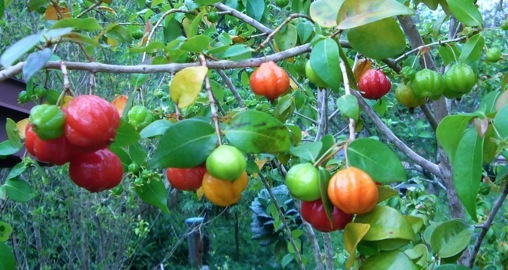
The shrub’s fruit ripen over several weeks, Photo by Green Deane
Surinam Cherries: You’ll love ‘em or hate ‘em
The Surinam cherry is not a cherry nor is it exclusively from Surinam. It’s also not from Florida but it’s called the Florida Cherry because it’s naturalized throughout the state and real sweet cherries don’t grow well there.
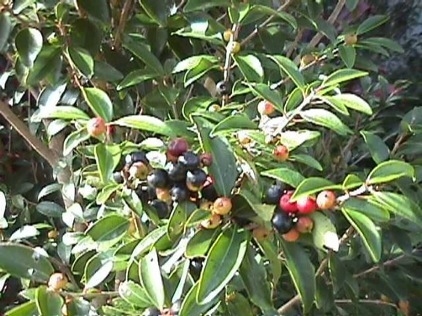
Eugenia axillaris, a second and darker species that grows locally
I will freely admit these little red pumpkins are an acquired taste. Most folks are expecting some kind of cherry taste and they don’t have that. No matter how ripe, there is a resinous quality. To be blunt, you either like them or you definitely do not. More so, they must be picked when absolutely ripe or they are a very unpleasant edible experience. What is absolutely ripe? There is orange red, the color of cars, and here is blue red, the color of old-time fire trucks and blood. Surinam cherries are edible when they are a deep blood-red. Let me repeat that: A deep blood-red. An orange red one won’t harm you but you’ll wish you hadn’t eaten it. And I know you will push the envelope and try one that is not deep, blue-blood red. Don’t blame me. I warned you. You won’t die or throw up or the like but your mouth will disown you and the next time you will pick a very ripe one. The only one in the picture above that near ripe is the red one on the lower right, and perhaps the one on the lower left, and only if they drop into your hand. When fully ripe they are very sweet and juicy.
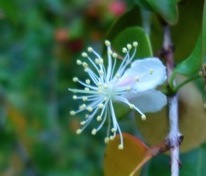
Surinam Cherry is closely realted to the Simpson Stopper with similar blossoms
The plant is native of Surinam, Guyana, French Guiana, southern Brazil, Uruguay and Paraguay where it grows in wild thickets on the banks of the Pilcomayo River. It got to North America the hard way. Portuguese voyagers carried the seed from Brazil to India then to Italy and the rest of southern Europe and then to Florida. It is cultivated and naturalized in Argentina, Venezuela and Colombia, along the Atlantic coast of Central America; the West Indies, the Cayman Islands, Jamaica, St. Thomas, St. Croix, Puerto Rico, Cuba, Haiti, the Dominican Republic, the Bahamas, Bermuda and Florida. It is grown in Hawaii, Samoa, India, Ceylon, Africa, China, Philippines, the Mediterranean coast of Africa, Israel and the European Riviera. If you’re in a warm area, that is, you don’t hit 30F too often, there is probably one near you.
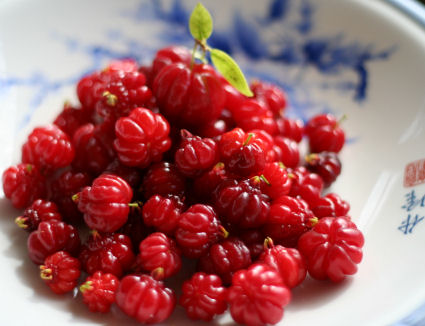
Make sure they are deep red, otherwise the taste is very offensive
It was introduced as an ornamental and edible fruit before 1931 in Florida. By 1961 it was widely planted in central and south Florida, especially for hedges. A decade later it was seen escaping cultivation and invading hammocks in south-central and south Florida. In 1982 it became a target of eradication in southern Florida. It is now reported in 20 wildlife areas as well, and threatening rare scrub habitat. Thus, by eating the fruit and destroying the seeds you are helping the environment. EAT THE WEEDS! In fact this very day I saw it along a bike trail and did by civic duty and ate as many ripe ones as I could find.

Prince Eugene of Savoy, 1663-1736
In the mediterranean area it fruits in May. In Florida, depending upon the winter, the fruit begins to ripen around St. Valentine’s day and should be available by the Ides of March and in full fruit by April Fools Day. There are two prime varieties, the common blood-red and the rarer dark-crimson to black, which is sweeter and less resinous. In Florida, the Surinam cherry is one of the most common forgotten plants and over runs many back yards. In Florida and the Bahamas, there is a spring crop and a second crop, September through November. Some times a third and fourth crop, depending on weather.
Besides being blood-red, the fruit should drop effortlessly into your hand when you touch it. If it doesn’t want to let go, let it be. Collecting should be done twice a day and often the best ones are the ones you have to fight the ants for. The “cherries” are an addition to fruit cups, salads and ice cream. They can be made pies, preserves such as jelly, jams, syrup, relish or pickles. Brazilians ferment the juice into vinegar, wine, and a liquor. The fruit is extremely high in vitamin C and A. Don’t eat the seeds. One probably wouldn’t kill you but if you think the unripe fruit tastes bad the seed is distaste on steroids. The fruit, I have been told but do not know, can be made into a fine wine.
The scientific name is Eugenia uniflora (yoo-JEE-nee-uh yoo-nif-FLOR-uh.) Eugenia is named for Prince Eugene of Savoy, 1663-1736, a patron of botany and horticulture. He was a great general and spent most of his life fighting in wars, constantly. Apparently it agreed with him. When he died in his sleep at age 72 he was the richest man in the world. Yet if it wasn’t for a fruit would we ever hear of him? Uniflora is from Latin unus, one or single and folium, to bloom, read one leaf.
That said, there are in other warm areas several edible Eugenias and at least one more naturalized in Florida, but it isn’t that tasty. The other edible species include: Eugenia aggregata, Eugenia cabelludo, Eugenia dombeyi, Eugenia klotzschiana, Eugenia reinwardtiana, Eugenia Smithii, Eugenia stipitata, Eugenia uvalha, Eugenia victoriana and Eugenia axillaris, the other one found in Florida.
Surinam Cherry Chiffon Pie
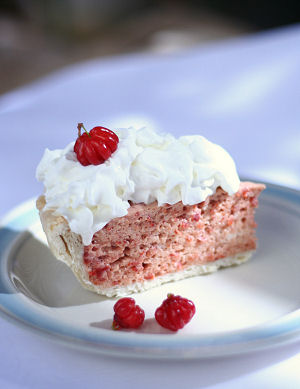
Surinam Cherry Chiffon Pie
by Rowena
The original recipe calls for surinam cherry juice, but this was made with some fruit pulp. Rinse the cherries and remove stems and flowery ends. Using quick pulses, process a few times then pick the seeds out. The flecks of cherry throughout the pie makes for a pretty presentation when cut and served.
1 pie crust, 9-10 inch diameter, baked and cooled
1 tablespoon unflavored gelatin powder
¼ cup cold water
4 large eggs, separated
1 cup granulated sugar
3/4 cup surinam cherry pulp (about 1½ cup fruit)
1 cup whipping cream, sweetened with powdered sugar and whipped to soft peaks
Soften the gelatin in 1/4 cup water. Beat the yolks together with HALF of the sugar and add the fruit pulp. Cook over medium heat until thick, stirring constantly. Add the softened gelatin and stir until dissolved. Cool and set aside.
Whip the egg whites until frothy then gradually add the remaining amount of sugar, beating until peaks begin to hold their shape. Fold beaten whites into cherry mixture and fill pie shell. Chill until firm. Top with prepared whipped topping just before serving. Serves 8-10.
Green Deane’s “Itemized” Plant Profile
IDENTIFICATION: Evergreen, multi-branched shrub or small tree to 30 feet, can be busy, usually shrub size in Florida; young stems often with red hairs and dark red new foliage. Leaves opposite, simple, short petiole, oval to lance shaped, Flowers white, fragrant, half in across, with many stamens; occurring solitary or in clusters. Fruit fleshy, juicy, red berry to inch and a half wide, looks like a little red pumpkin, 1-3 seeds
TIME OF YEAR: February to April, September to November in Florida.
ENVIRONMENT: Naturalized in urban areas, a border plant backyard escapee, vacant lots, untended area. In native central America range it is a thicket tree.
METHOD OF PREPARATION: Ripe berries raw or cooked. One unripe berry can taint the rest. Learn to identify the ripe ones. If you slice ripe ones open, take out the seeds, and the fruit sit in a refrigerator for a couple of hours they lost much of the resinous tang. In Brazil they ferment the juice into vinegar or wine, and sometimes a distilled liquor.
HERB BLURB
Research shows native concoctions of the tree do help in the control of Paracoccidioidomycosis (PCM), a yeasty disease endemic in Latin America, where up to 10 million may be infected. The smelly leaves can be use as an insect repellant.

I recently moved to “Upcountry” on Maui. I came across Surinam cherries at a local farmer’s market in Makawao. I have never seen them before. Both dark red and nearly black varieties were there so I bought some of both. I am an adventurous eater so I am not one to judge for other people, however I do believe, like Vegemite, Surinam cherries are an acquired taste. I would not even begin to describe them except to say you really should try them yourself. And yes, I will be buying more having acquired the taste.
One either says… yeah, that’s edible, or, your mouth says you have betrayed its trust and it hates you, and the less ripe the more horrid.
As children we were adventurous eaters. We lived off the land, eating cherries and a weed with wonderful hot pods. For us, it was a no brainer, because we saw other kids blissfully gorging on them and we followed suit, eating only the nearly black ones that were so ripe, they would fall into your hand when picking. We learned, through trial and error which were the best, avoiding the red ones and going for the ripe. They were never an acquired taste for us, we loved the black ones from first bite! YUM.
They are not sweet. But very nice to eat. I recommend them for those who like tastes other than sweet.
They remind of un-ripe Mango, with a sweet tartness.
I havent decided if I like them or not. They werem’t horrible but not nearly as sweet as I expected. I may try them once more especially with the cake recipe
I live on Molokai, Please send me some seeds of the dark red kind!!! Mahalo, Inge
I am on Molokai have plenty fruit right now if you want seeds. The berries are red
theres construction going on, at the university of hawaii campus in manoa. since theres construction this this surinam cherry tree, maybe 15-20 feet tall, its been cut and pruned so it actually looks like a small tree. everyday i climb this rail, and start picking at the tree. i help myself to as much as i can see on the tree. there is only soo much, all the others are light orange (bitter taste) but everyday theres a good amount of super dark blood red ones. i don’t think anyones knows about the tree cause its really well hidden by plywood walls obstructing the view to the construction site. in my opinion they taste better than any other cherry i’ve tried. its like a cross between an orange, guava fruit, and a little bit of mango, like 15%. i really like them a lot. but only the super dark ones, the ones that fall off the tree as soon as you touch them, cause other wise,
WOOOWW!!! they’re super bitter. like chewing on a lemon, peel and all
I am glad that I have finally been able to identify these berries. I live near Fort Lauderdale, FL and the condo on the sidewalk I walk buy has a long hedge which grows these berries several times a year. I have always been fascinated by them, as they look like little pumpkins; almost like a candy. I never knew if they were edible and have only once seen a homeless man eating them (at least he was picking them – I believe to eat them). But since I’ve never seen anyone eat them, I have been afraid to try one. Now that I know they are edible, maybe I will get up the nerve to bring a few home, wash and unseed them and try them out. Thanks for your help!
Hint: They ripe when they are blue red not orange red. Hot cars are painted red with overtones of orange. You want a red with the over tones of blue, like the old red firetrucks. The ripe ones aren’t really blue but you want deep rubish red, not an orange red. They aren’t toxic when orange red they just insult your mouth. (The seeds are not edible.)
put on refrigerator for few hours it even better
I have some on the bushes right now and I made a mistake and pulled a “red” one off and I tasted it. Wow, I am thinking about pulling the hedges out and replacing them, they are horrible. The worse tasting fruit I have ever tasted. LOL I will wait until one falls into my hand and then put it in the fridge for a few hours before I pull them. I hope I like them or semi-like them. Maybe they will be OK in a smoothie.
Red it not ripe enough. There is the orange red of a farrie and the blue red of an old fashioned fire truck. You want them a deep blue red to eat, not a bright orangy red. When orange red they will insult your mouth. The best ones are the deep blood red ones on the ground.
I’ve tried the common red Surinam cherry and dislike its aftertaste. Black Surinam cherry, a variety that isn’t that hard to find, is super sweet, and just like the name says, it eaten black or dark red. Once I tasted it I was hooked. I now have 3 trees/shrubs. I am not sure if it comes true from seed but will find out soon enough. It’s definitely not grafted. I live in Naples, FL.
I live in the cape where did you get black ones?
Check out the Rare Fruits Club. I got one from them.
just bought one at Top Tropical on Orange River Blvd in Fort Myers
Hi Linda, I live in Naples too, my husband just Picked this beeries up because of it’s color and the many birds that were eating them, this one are the red kind, but I would love ti try the black ones, we are thinking of using them as hedges. Could you let me know where you got them or of I can get some seeds from you, this is Fantastic:)
I think I must be strange because I like even the orange ones!! lol
I just picked and ate my first fruit at the orange stage. I liked it too. A little tart, but interesting. Now I can’t wait for a ripe one!
My childhood home had hedges all around. The berries start green, then turn yellow, then orange, then red, then deep red, then finally dark purple. The orange are too strong for most tastes, but I liked them. For me, anything from red on is delicious, red being resin/sour, then getting more and more sweet, till finally the dark purple are very sweet and juicy – if you can get to them before the birds and bugs. Your best hope is for the ones deep inside the hedge where the birds can’t see them. My fondest wish is that they could grow in Colorado where I live now.
There is nothing wrong with you, the near dark red ones or the near black ones are very good, no, they are not as sweet as the ones that fall into your hand when you touch them but if they come off with a little tug, they are very edible, all these sugar freaks that have to have all the tartness removed are the people who need to get a grip. I can even eat them when they are still a little orange. But must admit the redder, the better..
Last year I bought two bushes from Walmart labeled “cherry, prunus avium”. Now that they are producing fruit, I realize that these are not regular cherries but surinam cherries! But thanks to your article, I shall not destroy them, but put them to good use. Thanks again for the article. If I ever get around to making wine from these cherries, I shall save you a bottle, Mr. Deanne!
I also love these berries, I can not eat all of them. Has anyone tried freezing them, like to know, thank you
Yes, you can freeze them, you can cook and strain them and then freeze the juice . I make Jelly all the time from them , my customers love them. Aloha
After the last fruit, go ahead and trim them just a little. they will grow better.
We kids ptcked and ate them on the way home from school back in the fifties, I have one in the back yard that I tried to make into a tree!
But its just a very tall bush loaded with berries, I pick about a quart off the ground every day, some of the bushes near by have almost black ones and they are very sweet.
Im thinking about putting them in the freezer til I get enough to try and make some wine or jelly.
has anybody ever made wine from surinam cherries ?
They make the most wonderful JAM! Best jam I’ve ever had.
Recipe for jams/jelly’s. Thanks
The ripe fruit make a refreshing drink as well as a really nice jelly. But I recently made a chutney after picking almost 10 lbs on a friend’s farm in the Virgin Islands. The chutney is the bomb!
I have a question. I planted several suriname cherries from seeds and after 3 years finally have fruit. I now want to cut them back and trim them a bit. What is the best time of year to do this? Thanks for your feedback.
The coldest month of the year is usually best. Here that is January.
Thanks for the info, Green Deane. I will wait until January. Thanks for your site. I thoroughly enjoy learning from you.
We have a long (20 ft. maybe) hedge partially around my condo’s pool. Five years ago, I found out what the berries were called and that they were edible. So, I would pop the whole RIPE berry in my mouth, spit out the seed(s) and enjoy. I know they are plentiful in vitamins, antioxidants, etc. AND, I have been making jam for these five years. I pick and freeze and pick and freeze until I have a good supply (maybe 6 qts.). I just finished my third and final batch of jam….using just granulated sugar and a bit of water for sweeting and thickening. Each batch might make a quart and a half. I share with neighbors and also northern relatives. It’s a “unique” treat.
Our bushes here at my condo only produce once a year, a couple of months AFTER a cold spell…that sets the flowers to begin blooming…. anytime from January on… Some folks don’t care for the taste, but I do enjoy making the jam….raised on a Pa farm, with sour cherry trees, this is the next best thing. And if the jam comes out a little thin, then I pour over vanilla frozen yogart or ice cream.
Can I grow them in N CA where we have frosts?
Good question. They grow here in Central Florida and we get frosts and an occassional light freeze.
YES! I live in Vista (Northern San Diego area-by Camp Pendleton Marine Base)California. We do get frosts down here but not has heavy as Northern California. I rent from a new owner who does not know what all the trees are. The home has many fruit trees that the origianal owners (from India) planted. I just found out this week one of the trees is a Surinam cherry tree. I ate the darkest fruit and it was not real sweet. This bush(?) has been trimed and tied/trained into a tree about 8 feet tall at the moment. I was told to keep the branches below my waist cut back to keep it neat and tree like. I have had no problem with this tree and actully the fruit snuck up on me. I have been looking at the trees when I water them, twice a week and didn’t pay much attention to the few flowers I saw. When I went to water them yesterday there were various shades of fruit on the tree. I touched one of the orange fruits and the dark one next to it fell. I rinsed it cut it open and saw the stone and ate it….mmmm good. The stone, is large like other cherries have.
OMG! I grew up with these in my backyard and remember loving them sooo much…even the orange ones! LOL I haven’t tasted one of these since I was a kid…WHERE CAN I FIND THESE! Any help in finding them would be greatly appreciated!
They are everywhere where you live. Had to miss them.
I grew up in Sarasota and had them in our yard when I was a kid. We would walk around and eat these all day. I miss them so much. Where can I buy a plant and try to grow it in Georgia.
Thanks so nice to see your web site.
I grew up in Sarasota/Tallevast, Fl and just loved them!!!!
Where can I purchase this plant in FL
Most lawn and garden shops will carry it.
ECHO Global Farm
Yelp (3) · Closed · Opens 9 AM
17391 Durrance Rd, North Fort Myers, FL 33917 · (239) 543-3246
I live in Barbados in the Caribbean. I have surinam cherries in my back yard. The tree is not usually found in Barbados, but I was lucky to have got one. It is a prolific grower and the bright red cherries fill the trees at least twice a year. Few persons love the fruit but I thi;nk that is because they pick them before they are really red. I need a jam recipe as I hope to make some nest time I reap.
Would like to hear more about this delightful fruit.
Maizie Barker-Welch
Hi. I live in Southern California. Any idea where I can get them? We’ll be moving soon, so I cant plant a bush.
I would suspect nurseries would carry them.
I was curious about them and picked a basket up from Good Land Organics at the Santa Barbara Farmer’s Market (Tuesday, State St). Unique flavor and fun to try.
I have a small tree/bush in Inhambane, Mozambique, Africa. Nobody knows this tree around here. Was about to cut it down when I see that it produces fruit. I live 10 meters from the water front, my garden is sandy and salty and very hot/sunny and she thrives in it! love the fruit, and think they must be amazing in cake and dessert decorations.
Mozambique… the long reach of the Internet. You can also make wine out of the fruit.
I belong to the rare fruit growers and this was one of my first rare fruit, mine is dark purple when ripe and is one of my favorite treats while I’m tending to my garden. I share this fruit when in season and have had many different reactions, most enjoy it; but I have learned to discribe the taste bwefore sharing so they don’t expect it to taste like a cherry.
I think it has a smokey flavor! Almost like a barbeque sauce ” Sweet Baby Rays comes to mind”. But fruitier!
I have about 15 Sur. Cherries in my yard. They NEVER produce fruit, or flower, for that matter. Some are shade, some are sun, some get watered, some dont, some get fertilized, some dont….. I cant get fruit of them them.. Any suggestions?
Like Tanja, I planted pitanga (as these are called in Costa Rica) in hedges, also left some untrimmed. Except for one tree, untrimmed, by a fence, none have given fruit in 27 years. Once in a while I see a couple of flowers but they fall off. What is happenning? There is high humidity here. The soil was tested, found to be pH balanced. We have only used, once in a while,horse manure as fertilizer; also use the liquid runoff from
bocachi, a fermenting agent for treating organic food waste (effective microorganisms), to no avail. Yet, in my neighborhood I see several pitanga trees covered in fruit now.
Aloha,
A friend just gave about a quart of surinam cherries that she had frozen & a pie recipe to try with them. I have only eaten them fresh here on Oahu so I am anxious to try this pie (similar to a cherry pie but with the surinam instead). BTW I found that I could use an olive/cherry pitter for removing most of the seeds of the frozen surinams (I don’t think it would work on fresh ones since the skin is so tender & I did have some trouble with the surinams that had a double seed). These are the regular red surinams not the darker ones which I have never seen here. I will let you know how the pie turns out.
We live in Amanzimtoti, South Africa and have quite a few of the Surinam cherry tree’s. We usually can’t get to them in time as the monkeys get to them first. But were out there this morning and found a few ripe cherries. Lovely.
Where could we find seeds for the dark cherries? Would love to have one as a house plant. The tree or bush would not make it in our winters. Have been looking at all of our seed company books and can not find them.
I have two plants that I grew from seeds. How long does it take them to fruit? They are nice bushes now.
So glad to have found your website…we have three big trees (of the red kind) and I thought they were very beautiful. I noticed that the squirls liked them and fought over them so I figured they might be edible. I tried one the other day and they are good…a little different but good. I am picking them when they are ripe and freezing them until I have enough to make jelly (I have to get to them before the squirls do! haha). Do the dark ones grow here in Flordia? Do they taste the same? I noticed some elderberry plants growing wild also…I haven’t tried those yet. We love the website…lots of cool stuff there. Take care! 🙂
I live in Orlando and have several young trees of the black variety.
Email me if you would like to connect
I’m in Winter Park and would love to have a black one . Do you still have any?
I love pitango as they are called in Israel. They are grown in gardens but not commercially.
I have surname cherries Red , Grumama purple , Pitango yellow & cherries O Riogrand Red & lots of tropical Fruit 150 kinds . Ed in Brandon FL U.S. A. Zone 9.5
We used to live in Brandon, but now in Merritt Island. Do you sell any of your plants? I have the red ones but would like to try the others. Thanks! Be blessed!
My son asked about the berries outside our apartment. We just tried the Suriname Cherries and were pleased that our curiosity was rewarded. He found a very ripe one! Thank you.
My love for Surinam Cherries nearly killed me.
One day I took a hand full of cherries,put them in the blender without taking the seeds out and liquefied them.I then added honey to improve the taste and blended the mixture.I loved it so much that I it did it again for several days.My toes are now swollen and tomorrow I have an appointment with the doctor.
I am only learning TODAY that the seeds are not to be eaten.
How about more recipes, thanks
These are growing in my back yard and I just discovered how wonderful they are. The darker…the better…that’s for sure.
I was eating them at a baseball game and everyone was telling how poisonous they are! when I was a teenager we had that hedge on the side of our house so ate tons and that was forty years ago!
Parents tell kids that all wild plants are poisonous (and 93% of the time they are right.)
I just got my first tree and cant wait for it to fruit. how long does it take to bear fruit the first time. I LIVE IN THE CARIBBEAN?
I discovered them a few weeks ago in my condo. Since then I have been picking them and juicing them with carrot and apples. I must admit, you love them or hate them.
Uh, oh! I’ve been eating orange-red Surinam Cherries for 60 years, I had no idea they were supposed to be bad tasting. Orange to Red is tart, and I like the flavor. I discovered them in 1955, walking to school.
Young grasshoppers eat them green, and harvest a shrub of them in a day or so.
I made Jello with them. Don’t. The flavor was medicinal tasting and strong. And I used the dark red cherry!
We grow these about 40 meters from the beach in Belize, along with Natal plums, which seem to love the sandy soil. I believe the distinctive flavor comes from a family of chemicals called Turpenes, pretty common in tropical fruits, probably evolving to repel insects and birds. We have loads of birds in the yard who feast on wild craboo, sea grapes and cashew fruit, pecking holes in anonas, but they give the Surinam Cherries a wide berth.
Surinam Cherry (Pitanga) is a medicinal plant. Do you have GERD or acid reflux? This plant is wonderful for treating that. Try making jam with it, and have a spoon of it when you get symptoms. The tannins in the jam are astringent and stop acid secretion in the stomach. This medicinal plant could put Nexium (and other proton pump inhibitors) out of business!
Great in-depth information and loved the pie! There are lots of sweet dishes using pitanga but not many savoury, however, a Brazilian chef recently contributed this recipe for prawns (shrimp) with pitanga: http://www.brazilianfoodguide.com/barra-prawns-with-pitanga-and-north-eastern-couscous/
Surinam cherries, or pitanga, actually grow all along the east coast of Brazil, not just in the South. They’re also common in Australia, particularly in the states of New South Wales and Queensland, where they’re considered invasive. I say, eat the weeds!
My parents house had a hedge that was about 40 feet long of Florida cherries. I do miss eating them right off the bush. The hedge was also thick enough that my sisters and I used to hide in them playing “hide and seek”. This was about 40 years ago.
Thanks for the very practical info on these “cherries”. I recently came across an article on them in our old horticulture encyclopedia and I’m enthralled: “The flesh is soft and melting, very juicy, of the same color as the thin skin and of an aromatic, subacid flavor.” “When [the leaves are] crushed they emit a pungent odor which is rather agreeable; in Brazil they are often gathered and scattered over the floors of the houses, the odor which they give off when trampled upon being appreciated and considered efficacious in driving away flies.” –F.W. Popenoe (from The Standard Cyclopedia of Horticulture, L.H. Baily). It goes on to say that the plants do well in many types of soil and even with irregular watering.
We live on the California coast right next to San Francisco. It doesn’t frost here but I suspect it’s too cool for this plant to really thrive so I might try one in the greenhouse we hope to build soon. My encyclopedia says they come true from seed, so perhaps I’ll start some indoors in the meantime.
I too grew up in Palm Beach, Fl and ate these off our front hedge. Then moved and didn’t see them for thirty years. I was in S Daytona and a neighbor had them and I kept the seeds. Now I am in Napa, Ca, and wondering if they will grow here. Should I start them inside? When should I plant them? As it seems everything grows well in Napa, I am hoping these do too.
I grew up in Ft Myers Fl, and we had a row of them in the field by our house. My grandmother loved them and would eat all we picked. I thought they were the nastiest thing ever. Even the smell was disgusting to me. I read all the comments above and I cannot believe no one else mentioned the fact that every single Surinam cherry ha s a WORM in it. Yes- you read that right- a tiny worm is in every single one! Right by the pit! Don’t believe me? Wait till the next time you pick one and check it out!
Extra protein…
I find the nearly black ones here in Hawaii really enjoyable. I’ve got two large bushes here on the Big Island and eat as much as they can produce. 🙂
These sound awesome. I am far outside the growing zone for these, but I would like to try growing some in a pot. Would anyone be willing to send seeds for both the red and darker varieties so I can try them?
I have a hedge of these between my house and my neighbors.
As they grew older I have had less fruit each year. (I’m not big on fertilizers).
I love the flavor..
Seeds grow quickly after thoroughly drying.
My kids grew up loving the taste of the fruit..
I am interested in finding a source for Surinam Cherry Jam, as I have two family members who suffer from acid reflux. If it works for them, that would be wonderful. Does anyone know any commercial source? Does anyone have any (frozen or made into jelly) that you would be willing to share with, or sell to me? I am near Meridian, Mississippi, will
be driving down to Pensacola (and also to the Mississippi Gulf Coast) before the winter is over. Willing, of course, to buy it by mail also.Thanks.
I am so happy to finally have a name for the “chinese cherries” I loved as a kid growing up in south Florida. We had one of these shrubs (it was big) in our back yard & I was constantly “raiding” the tree for this very different tasting treat. I am one the people who LOVE this weed. Now I know how to find it. THANKS
I was kind of surprised to find the name of this plant and an article about it. I haven’t seen or heard anything about Surinam Cherries since I lived in Florida nearly 50 years ago when my parents had a hedge of these bitter berries all along the front of the house by the sidewalk. They were shaped like miniture pumpkins, some were green, orange or red, which always had such a nasty flavor no matter what stage they were in. I don’t even think the birds wanted them. They were colorful to look at, that was all.
What does waiting for ” moderation” mean ?
That means to avoid spammers and other nefarious forces of the internet all comments have to be read by an editor first. I receive about 400 fake emails a day. I cleaned out this mail box at 11 last night. It is now 7 a.m. and I have 290 fake pieces of mail.
Quite a few people don’t like the taste of them, even when ripe.
I remembered as a child, growing up in Orlando, a neighbor had the Surinam cherries as a hedge and I discovered how wonderful they tasted. I ran across a row of trees in Eustis, Fl and picked some of the fruit for seeds. I was so delighted to discover them again. One seed grew into a 3′ bush and is full of blooms right now, can’t wait to taste them again. I live in Howey In The Hills, Fl . I would love to see the black ones. got any seeds? Enjoy the Website.
Have you ever heard of the surinam cherries altering sence of smell towards the smoky smell? If so for how long? Thank you for your time. I also enjoy them.
Haven’t heard of said.
A truly delightful piece albeit read after I’d had a ‘not so ripe’ few. Thanks
My girlfriend and I were feasting on the ripe cherry’s and discovered tiny white worms in some of them. This was discovered after we ate them.
I do not know if the worms are harmful but to what I’ve read on the internet the worms are larva’s to a small fruit fly. Does any one know anything more? I also understand that these larva’s cannot survive in the human intestinal track. None of this information has been confirmed.
Also a I have a very severe puncture wound on my right hand and I applied some of the smashed fruit on the wound and woke up feeling the pain was greatly reduced.
We eat a lot of larval remains in much of our food. Our reaction to them is a learned response. They are edible and nutritious. As for the fruit on a wound, it is astringent and that often helps wounds.
Thanks for sharing this information. I have several plants in my condo. Today I went and picked a bag full. I am now going to take out the seeds wash them and freeze some.
I’ve been eating those cherries since my youth of growing up in Tampa and the surrounding area. I developed a taste for them when I was very young and continue to enjoy them whenever/wherever I see them. Thanks, I wish I could afford your classes and get transportation to it. Doug of Z-hills
My surinam cherry bush is fruiting for the first time but most of the fruit is splitting open while still green. What can I do to stop this?
That might be a result of overwatering, you a lawn system or nature or both.
My plant is in a 3 gal nursery pot. I noticed it wilting in the summer heat so I started watering every day when it started blooming in January. I water in the morning, so when it rains in the p.m. or night it gets a lot. Next year I hope to have it in the ground. Thanks for your help.
I have a small tree of these planted by a bird sometime ago. The tree is sprawling but pretty and has a nice crop of cherries this year. I discovered these as a hedge in South Florida. I now live in West Central Florida and am enjoying this plant so much, I am going to try and grow some plants from seed.
PS: I like the taste of the orangey ones too.
My kids like these, including my two year old. Unfortunately, the two year old accidently swallowed a pit this morning…should I be taking her to the doc?
I just read this. How is she? Generally the tree is not toxic but kids are small and the seeds are not usually eaten. Though a young digestive system might not make much headway over a seed. What was the outcome?
I gave her a bowl of oatmeal just afterwards…she’s fine so far. She goes over to the tree and just starts munching…generally she spits out the seeds, but one got away! She even likes the tart ones…and the grapefruit that grow here also.
I had no idea what these were when we first moved here a few years ago. We did a web search and found your site…we really enjoy your work! I made the pie suggested above and it turned out great…YUM! Thanks so much. Maybe sometime I’ll take the (older) kids when you do a foraging class (if kids are ok that is).
Take care and thanks for responding 🙂 Michelle
Thanks for letting me know. Our knowledge has been expanded.
Plentiful here in Bermuda right now…. Hedges along the road are laden with fruit and falling in the road. Most people have them as hedges somewhere in their yard. I have been picking them daily from the tree in my yard. Have made a batch of jam. Want to try some recipes I found – Cherry chiffon pie, Cherry and walnut bread, Cherry flaming and liqueur. What a shame that more people here don’t pick and eat or use them in their recipes. I do…love them…and nutritious!
hello,
i live in western belize and have about 30 surinam cherries, range between 3 yrs-10 yrs age. they are no pest here and agree the birds seem not to be interested (unlike the mulberries, which birds devour). wash, pull whatever stems etc on them, and freeze. try cooking them in your steel cut oats. we remove the pits as we eat them, but may get one of those cherry de-pitters as someone suggested its use on frozen ones. i also like them cooked stovetop in cast iron pan – butter, sliced apple, surinam cherries, cinnamon, honey and cacao nibs. top with cream. yum.
thanks for the useful information on your site.
I have picked 2 or 3 quarts of cherries as they ripened and put them in the freezer. I am looking for a surinam cherry jelly recipe using fruit pectin. Anyone have a good one? Thanks!
Know it’s too late … but what’s good enough for Smucker’s works for me. A cup of fruit to a cup of sugar, using 4 cups of fruit (cleaned and pitted) for each package of fruit pectin. A small amount of butter will reduce foaming.
in reply to Sandy, #75 Surinam cherry; I live in Clermont, very close to her and have a “black” cherry. I would love to share with her if nobody has yet. Is there anyway you can forward my e-mail to her?
Absolutely love your website. A friend, Lisa, in Bay Lake, FL has been telling me about you for….quite a while. I just began reading your work today and regret not heeding her suggestions earlier. She wants to have you out to her property to see what weeds she can harvest. Do you do this and how much do?
Thank you for responding,
Gretchen
In Belize on Hidden Falls Farm, we have over 20 medium size Surinam cherry plant some 8 ft tall. And planting more.
We make the most delicious jam using little sugar and no pectin.
We either seal in jars or put in back of the shelf in refrigerator.
Only jam we like better is Ground Cherry.
Must not eat the seeds.
While on vacation over 15 years ago in Southern California, I tried my first Surinam Cherry at a nursery South of San Diego. I popped the seeds in my shirt pocket. Back in Chandler AZ. I got one to grow. Thinking is might not like the Arizona sun, I planted it under a covering to my front door. For many years I have had 50 or so cherries each year. A couple of years ago, it broke through the covering and has now grown about 3-4 feet in the full Arizona sun. That upper section now yields hundreds of cherries, the bottom still gives about 50 or so.
Thank you for the information. This is helpful and informative. The only other person able to give us information about the Surinam cherries was an old friend form Puerto Rico that is over 90 years old. She assured us they were not poisonous.
I have three trees in the yard in Santa Monica CA,it fruits two times a year,in spring and september
Hi Dennis – we are in Santa Monica and my wife is from Brazil and loves Pitanga. We want to have a tree and are happy to. Hear it is growing well. Any particular advice on what part of the yard and also would you mind advising where you bought your tree or did it grow from a seed?
Full sun, regular watering. Can be trimmed to be compact or opened like a bowl.
What do I need to do to make my Surinam Cherry bush produce fruit ?
How old is it, where is it located?
I ate these as a kid growing up in Hialeah, Florida, along with mangos, avocado, kumquats, loquats, oranges, and grape fruit. All over the neighborhood, we would ride our bikes around just eating fruits out of peoples’ yards and our own yards.
I just came in with a few cherries I picked off the bushes we’ve had in our back yard for years in the Rio Grande Valley of South Texas (McAllen) I have tasted a few in the past and now know why they tasted pretty bad as I wanted to know if they were poisonous. No, just not really ripe! I’ll try some now that fall off in my hand but will probably save the rest for the squirrels that have shown up in our area in the last few years. Don’t laugh but they’re new enough on the scene that we’re still enchanted with their antics and spoil them with bird seed. The only problem here is the competition with our native Green Jays and White Wing Doves.
I grew up with this particular fruit. I am a Florida native and like Sandy from the Orlando areas. My grandmother had one in her front yard. We kids would always pick the bush before the fruit gets ripe, we loved them. I guess you can say eaten green is also an acquired taste. My grandmother would always say “stop eating those cherries before there ripe or you gonna get the bloody flush”, whatever that means. She really didn’t want us kids eat the fruit before there ripen. We also ate persimmon before it was ripe, just feel the tightening of the tongue.
Growing up in Miami, I found these trees/shrubs all over the place. I disagree that the blood red one’s are the best. I thought it was too sweet. I preferred the more tart orange-red ripeness the best. I’m living in Austin, TX now and don’t see these trees anymore. Makes feel like taking a vacation back home and picking them off the tree
i found that 9 out of ten all had a lil bity worm at least worm larvey in them why knever knew why anyone tell me please
Has anyone had any luck ripening “picked too early” berries either in the fridge or on the unrefrigerated counter?
I picked about half a bit too early. Normally I do wait until they fall into my hand upon the slightest touch but I was too hasty this time.
Unlike some fruit they are not biologically designed to ripen off the tree.
Quick question; I have a tall (10ft) Surinam hedge, it’s becoming very thin at the bottom & middle, thick at the top (landscapers shears once a month),
What is the correct way to prune to bring growth to the bottom & middle of the shrub? I’m afraid I’ll kill it or no growth at bottom or middle if I cut too much.
Thanks in advance for your advise.
Ruth
Wow, that’s beyond my known-how. I don’t trim anything except my beard.
We have a Black Sirinam Cherry about 15 feet tall. It grows amazingly – like a weed. When I trim branches 8 more grow back. I started eating it when a friend told me that TART cherries are good for pain. I have chronic nerve pain and the four neurosurgeons I saw all want to give me narcotics. So far have resisted. One day walking by this gorgeous tree I finally grabbed a handful – about 15-20 dark red, very very tart cherries. This was one of the best nights sleep I have had in years. When I woke up in early A.M. hours I had no pain. I ate 10-15 of these every night for about two months.
Wow, what a difference! Now I have been trying to grow seedlings from this tree with some success. We find Sirinam’s in 3 gal pots for $10, but nurseries don’t know if they are Black or not.
Can anyone tell me if there is actually a Black Sirinam versus one that is just plain Sirinam?
Good Afternoon,
I am writing in hopes of you telling me anywhere in Florida that grows Surinam cherries for commercial purpose. I moved to Grand Cayman from the Big Island of Hawaii where I was able to get Surinam from several different backyard sources. Here in Cayman, they are around but the Iguanas are horrible when it comes to these, they love them and nobody grows them to sell, I have a local farmer that planted 4 trees for me about a year and a half ago but they are not ready and I really need some for an event in mid October this year, any help would be greatly appreciated, thank you!
Regards,
Melissa Logan
Executive Pastry Chef
I do not know a commercial source. However, I know someone who does some supplying of wild foods and certainly can be trusted to deliver Suriname Cherries. He is Andy Firk in Arcadia Florida, email is AndyFirk@yahoo.com. You can mention I referred you.
Hi! They grow very hardy in most of South Florida. That includes everything from zone 8 through 11. I live in 10b, and they grow really well. They flower and fruit at least 3 times a year, sometimes 4.
That cherry on the photo is edible but it’s mostly used for medicine btw I am from Suriname in Suriname we call those cherry’s..
Monkie monkie cherry’s but there are other one’s that aren’t used for medicine I even have two cherry trees in my backyard I’d say considering that I’m Surinamese I would advise you to not eat the one in the pictures, if you happen to stumble upon them make sure they’re blood red
Can anyone tell me if you can use the leaves and what can they be use for.
Thanks
As far as I know there is no edible use for the leaves.
Just read it is used to make tea in South America. And the leaves are put on the floors and when walked on emit a fragrance that repels flies.
They use the leaves to make a tea for a sore throat. Do not drink it, just clean the mouth with it.
I grew up eating this cherry in Miami; what sweet memories. Fresh tropical fruit on your own trees is one thing I really miss from living in S Florida.
We have surinam cherries growing on Kauai. I’m a learning wine maker and want to make wine from tropical / local fruits. Would love to hear of a wine receipt. Also wondered if it is known if the pits MUST be removed before the primary fermentation? Some pits – no problem, some MUST be removed before (like peach). The trees are loaded and am gathering and freezing them after selecting the ripest ones & removing the stems & the leafets(?) at the other end.
Mahalo for any info.
Dawn on Kauai
I would try it without the pit. I heard that risunous flavor stays in the pit and may leech out into the wine. You can always try a small batch and see how it comes out. I have made wine with cherries, peaches and loquats and left the pit in. With these fruits the pits added a more woody complex flavor as if aged in a wooden barrel. That could be the case with the surinam cherry.
I have a healthy bush producing well. It’s in full sun and next to the downspout from the gutter so gets ample water.
Now … how in the world do you get the pits out? Too big for a typical cherry pitter.
Would love suggestions please!
I’ve seen these around for years and just tasted them for the first time. VERY curious flavor — I’d describe it as 40% cherry and 60% Frazier fir. The resinous taste lingered on my tongue for quite a while after I tasted the fruit.
Thanks a lot for this awesome blog — appreciate your hard work!
We had a 50’ hedge of these in South Miami when I was a kid. The black fruited kind. They’re pretty, but none of us would eat them.
As I got older it became my job to trim them. That’s when I learned what hate is! No electric trimmers back then.
I went on Google street view tonight, and the (deleted) hedge is still there 60 years later! My address was 7152 s.w. 66 st. South Miami.
They’re planted along 71st street. (A. K. A. Memory lane- at least tonight).
John Kaay
I too lived in so. Fla. (Lauderdale Lakes – off of Rte.441). The hedge owned by a preacher-neighbor next door had plenty of available fruit for consuming,(and throwing at each other). Many a kid in my neighborhood got “disciplined” from moms dealing with stained clothes, including yours truly. (It`s funny what memories come up from internet observations)!
I’ve been doing research on pitanga for about 20 years now. First, we were trying to figure out color inheritance – why seeds from black fruit may produce a plant with red fruits (10 to 20% of the time), but red fruits don’t ever seem to produce a plant with black fruits. We used a Florida black-fruited, grafted variety know as ‘Zill Dark’, let it self pollinate and then planted seeds – at Florida Southern College in Lakeland. We got about 75% black fruited and 25% red fruited plants and they are in a hedge even today on the FSC campus. I moved on to the University of Hawaii and we planted a large field of seedlings from ‘Zill Dark’ at the Kona experiment station. We planted 137 seedlings and we also planted 20 grafted ‘Zill Dark’ plants. Only about 10 of the seedlings were red fruited. We have been evaluating the seedlings since 2007 and have published several papers in Acta Horticulturae, the latest two were just available this year from presentations a year or two back. We have provided fruits to local chefs and others that make jams and jellies and we were lucky enough to have our fruit used in a sorbet that won the “Top Chef” competition on Bravo TV. The black fruits can be reasonably sweet, the brix can be 12% or higher when fruits are fully ripe. The plants are easy to grow, the only pests of any significance, both in Florida and Hawaii is fruit fly. One has to prune the plants so that the fruit isn’t too high to pick, since you don’t want it to hit the ground. We think if we can develop a soft landing area for the fruits, then shaking the plants a couple of times a day will get you all of the ripe fruits – and we think the best use will be either as dried fruits (they retain a very distinct flavor when substituted for raisins in recipes) or as juice, probably in a mixed juice product since the flavor can be rather strong – but not unpleasant as some of the tastes are volatiles and they evaporate rather quickly. If you place fruit in the fridge in a plastic container, the flavor will change each day for several days until it does become very black cherry in flavor. We are planning an experiment to see if we can improve the grafting techniques, since cuttings will not root and seedlings may not taste at all like the parent plant.
I’m from Brazil and there are other types like Eugenia pitanga Eugenia selloi
I put in a hedge of these last year, remembering how we used to enjoy eating the ripe ones and my mother making jam from them. They are blossoming for the first time. A recommendation: No matter how ripe the fruits are, you should remove the 4-5 tiny green sprouts at the bottom of each the cherry before eating it. Those little sprouts give off a bitter taste that override the sweetness of the cherry, no matter how much you like the flavor of the fruit! So make sure to take them off and discard them before eating or doing anything else with the cherry.
The tea made with fresh leaves is an outstanding anti-inflammatory, the best medicine to prevent and treat gout.
What about the leaves? Are they edible?
No. I would have said so if they were.
make tea
I am from Brazil here in Brazil called “Pitanga” she is native to the Atlantic Forest her genus and Eugenia the scientific name and Eugenia uniflora, there are other edible Eugenics like Eugenia involucrata that is a big tree it tastes just like the most caught Pitanga in the mouth, there is Eugenia brasiliensis, which is a small tree that is rare and has a very sweet taste, Eugenia pyriformis
that is a tree that gives a round yellow fruit that is good acid for juice and has 4x more vitamin c than orange
I live in Brazil and I’m absolutely crazy about Suriname chery, or “pitanga” (that, in native people language means “red”). The bushes grow wild near beaches, and I can spend hours near them picking these jewels, ’cause it is never enough! Trully, I already did it.
I found the text somewhat unfair to this delicious fruit (but of course, the author admited some love them, some hate them).
Maybe processed foods trained our tongues to expect (and like) only sweet, sour and salt.
And I have to agree: it has its mark, it is not another sweet thing in the orchard. If you have the opportunity, try it – with no expectations, because it is like anything else you know.
Old Sarasota H.S. (the three story red brick) had hedges along their sidewalks. In the mid-1960’s, as I waited for my school teacher father to wrap up for the day I would graze along the hedges eating the fruit in the spring. It seemed that no one else was aware they were edible but I discovered it just by taking a chance. I now live in Palmetto, in a 1920’s home with ancient shrubs that are about 20 ft. high, and at present (March, ’21) they are overloaded with fruit. Until this article I was not aware of a dark-blue variety. Thank you for the article.
I don’t mind the acquired taste since it’s said to be nutritious but I can’t take the white worms/maggots in every Surinam cherries.
Thank you. This was interesting read.
I live in Brisbane Australia and just came across one of these trees while walking my dog. She often eats lillipilly fruit and I gave her some of these (ripe ones off the ground) Suriname cherries and she enjoyed them too. I’ll give it a go tomorrow. Funny someone said smelt a bit like a greenish mango … I agree when I squashed one between my fingers to check to see if it smelt funky…. I thought mango.
I live in Browns Plains Qld Australia. 4 years ago, I removed a 64000 litre salt water pool from the back yard and there was this poor looking excuse for a shrub there. It was run over several times over the 2 days removing the pool. Roll forward to Jan 2022. I now have a 4ft high bush and it had these nice creamy white flowers which produced this bright
Colourful fruit. I have just found out what it is an I am looking forward to taste the “RIPE” fruit next flower display. It is happening now. Reading this site, a great surprise to find out what I have. It sure is not like my 3 lippy Philly trees like someone suggested. Another surprise fruit tree addition to my small suburban back yard. Hmmmm, Looking forward to adding it to my lemon cheese cake.
We planted hedges a couple of years ago and we now have a huge crop of these lovely fruits! Q: would it be ok to boil into a jam or sauce and then strain to remove the pits and worms?
We planted hedges a couple of years ago and we now have a huge crop of these lovely fruits! Q: would it be ok to boil into a jam or sauce and then strain to remove the pits and worms?
I hated this fruit for 51 years snd then I tried the dark colored one last year! Dang#%^ What was that? I tried another and another and the rest is history!
I kept it a secret from everyone else, I get to enjoy the fruits, all to myself!
I just found about 100 trees in the garden at my condo and even the bright red ones are delicious!