
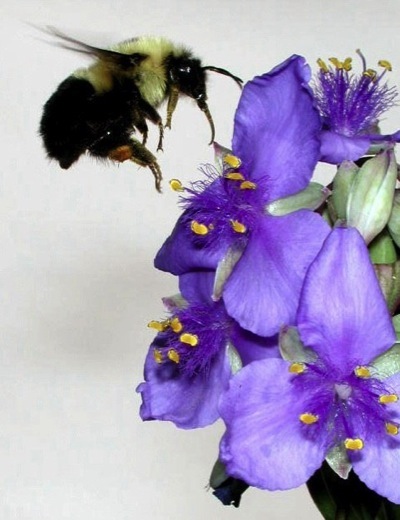
Bee landing on a Spiderwort blossom taken on film by Green Deane before there were digital camera

Captain John Smith, 1580-1631
There are 412 years, as of Dec 20th, 2017, between the sailing of John Smith to the New World and spiderwort gamma rays, but they are connected including Pocahontas.
Smith was a colorful character. He went to sea at 16, was a mercenary, fought against the Turks, was wounded, enslaved by them, escaped, killed three Turkish commanders in separate duals, was knighted by a Transylvanian prince, and by December 1606 at the age of 26 was sailing to America. It was not a smooth voyage. The ship’s captain had planned to execute Smith on arrival for his bad behavior during the trip. But, when they arrived they opened sealed papers from the Virginia company: The man who was to be hanged was put in charge. Now that’s a reprieve.
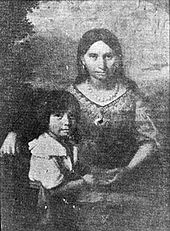
“Sedgeford Portrait ,” said to represent Pocahontas and her son, authenticity debated.
Life was rough for the Jamestown Colony. Food was scarce. Sailors were reluctant to farm, which prompted now Captain Smith to make one of his more famous pronouncements: He who doesn’t work doesn’t eat. That got the weeds pulled. Smith’s dealings with the natives — where he met “Pocahontas” actually named Matoaka — were as strained. They were the only grocery within thousands of miles and he didn’t always pay. Indeed at one point Smith was to be execute for bad credit. It’s a good thing he wasn’t killed because Smith had other tasks, besides evading executions, and that was to collect seeds for his friend, John Tradescant, the elder.

John Tradescant, the Elder
Tradescant, a decade older than Smith, had fought here and there as well but he was also always picking up seeds and items of interest. He was truly the first naturalist of record. Because of that, Tradescant began gardening for various nobles and in time was the gardener to Charles I, a position his son John, equally as talented and famous, would also hold. The elder Tradescent introduced many plants into England including Cos Lettuce from the Greek isle of Kos, birthplace of Hippocrates. Think of that the next time you have some Cos lettuce, or Romaine as it is called in America.
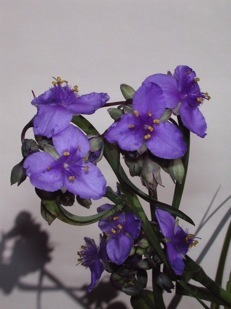
Flowers are only open for a day
Smith was able to return to England with seeds of what is commonly now know as the Spiderwort, which is still popular in English gardens. When plants were being named, the Spiderwort, because of its association with the Tradescant family, was given the Latin name Tradescantia virginiana (tra-dess-CAN-tee-ah vir-jin-nee-AY-nah (In the plant world, Virginiana means North America.) The Tradescantia is in the greater family of Commelinaceae, worthy of a separate article some day.
Why the Spiderwort is called that is in dispute. Wort is Old English for plant, so that part is not in contention. There are four reasons given for the “spider” part. 1) The viscous sap will pull out like a spider thread when a leaf or stem is broken. 2) The clusters of blossoms look like spiders hanging from a web. 3) The plant is leggy and in toto looks like a really huge spider on your lawn. (And my favorite, 4) dew on the plants stamen hairs look like drops of dew on a cobweb.
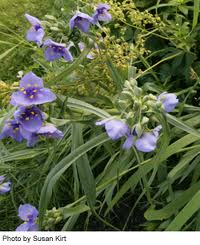
Flowers are always in clusters
The Spiderwort is sometime called a Day Flower, as is its cousin the much smaller Commelina, which is also edible, Flowers on both stay open only one day. The Spiderwort has numerous family members, perhaps two dozen in the United States, many if not most of them edible. Check with your local expert because a couple of crawling siblings definitely are not edible and can also cause dermatitis — especially non-green and stripped varieties, Tradescantia pallida comes to mind. Most common edible on my postage stamp lawn is the Tradescantia ohiensis, though the truth is the species are harder to tell apart than twins in the dark. Here in Florida, the
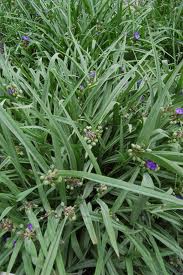
Stems can be cooked like asparagus
height of its season is late in the spring but it also blossoms nearly all year, and more importantly, as it ages it does not grow rank. Its leaves do not change in flavor as the plant ages. The leaves are good for salads as well, or in soup and stews but they are mucilaginous. The stems can be braised like asparagus. Spiderwort remains a popular edible because they are one of the few salad greens that can take Florida’s summer heat. The flowers, at one time favorites for candying, make very pretty blue additions to back yard salads. There are white and rose blossoms, too, but they are too rare to eat. Also, Tradescantia fluminensis, which looks like a Commelina with a white flower is edible, too.
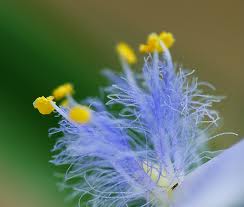
Radiation turns blue hairs to pink
Oh, and the gamma rays… The cells of the stamen hairs of some Tradescantia — the wispy hairs that look webesque when moist with dew — are “bioassays for ambient radiation levels.” Or said another way: The hairs are blue. When exposed to gamma radiation they turn pink. So if you think you’ve been near a nuclear explosion, just check your nearest Tradescantia.
To read about dayflowers, Commelinas, click here.
Green Deane’s “Itemized” Plant Profile
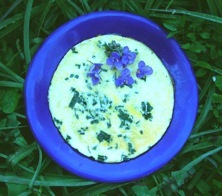
Tradescantia Omlet
IDENTIFICATION: Clumpy perennial to two feet tall, violet-blue to purple, three-petaled flowers with contrasting yellow stamens, open up a few at a time for only one day, numerous flower buds. Flowers bloom year round in Florida, late May to early July in northern climes.
TIME OF YEAR: Leaves and flowers year round in Florida, leaves all but winter up north, flowers spring and early summer.
ENVIRONMENT: Grows in average, medium moisture, well-drained moist acidic soil, full sun to full shade. Tolerates poor soils. Lawns, roadsides, moist waste areas
METHOD OF PREPARATION: Leaves raw in salads —green tasting — leaves cooked in soups, stews, omelets, Spiderwort stalks cook well like asparagus. Flowers in salads, or candied. Doesn’t grow rank as season progresses. Sap used on skin conditions.
Hi;
I belong to the Herb Society in our town and we give little talks about certain plants in our meetings. Just a small group. I have a very nice supply of Spiderwort in my yard and want to give a talk on these. I read your article about how they are hard to tell apart from their relatives who are not edible. My spiderworts look exactly like yours pictured and are also purple. I guess there is no way of getting around this; I’ll just have to find someone local who can officially tell me for sure. lol I want to make a salad with them for the group. lol thanks for listening. any comments? janie
Hmmm… I’m not sure I wrote that. The edible ones look similar, the non-edibles are usually a different color altogether, such as totally purple. Still, check with a local expert.
I was wondering the same thing as Janie. I took it to mean that it is hard to tell the edible from the inedible, and am glad to find out that it isn’t that difficult. Am going to try some today in an omelet. Thanks for all your research, Deane, and for sharing it with the world. We will need to know all of this as a matter of life and death some day in the future; who knows how far away that is, so we had better learn to use these edibles now.
Had to share the knowledge you shared on an herberl group. I have spiderwort all in my flowerbed .I’m gonna try a few things with it.Thank you again.
Hey Green Dean can you tell me if Tradescantia hirsuticaulis is edible or not? Its the only one I seem to be unable to nail down! Also it appears to me that ohiensis is indistinguishable from virginiana. From what I gather above it seems to me you think they are both edible?
thanks! Mike D.
I have no information on the t. hirsuticaulis. To my knowledge both T. virginiana and T. ohiensis are edible.
I tried cooking some of these with eggs as you suggested in your YouTube video, the stalks and flowers are very nice with a very unique flavor and texture, though I did notice some astringency. The leaves, however are just plain awful! No flavor and very tough texture. Am I missing something?
The leaves are … not the best part of the plant…
Thanks for the advance info. I read on Plants for a future that the very youngest leaves are used for food. This post confirms why.
Just finished my first spiderwort stalk with garlic omelette. stuffed in a pita with red mustard leaves. Yum. Thanks so much for the colorful history and useful information.
Hello Green Dean,
I feed the below referenced plant to my guineas as a treat, Tradescantia fluminensis. Is it edible for humans?
It’s invasive.
Joe
Not that I know of.
Hello Green Deane,
I really would like to know the answer to my question. If not edible please explain why not. Here in N. Florida the Tradescantia fluminensis is usually sprayed with herbicide…one reason not to eat it! How is the best way to determine an answer without putting humans at risk?
Regards,
Joe
The first question I would ask is what is the botanical name of the “ground ivy” that another site says can be used medicinally.”
Hi Green Deane,
Love your website. For years I’ve been curious about eating wild plants. I’ve been known to taste things that look edible to me (I taste and spit out, several times…not very ladylike, I know, but safe…I’m crazy but not stupid) Now with your videos (I got for Valentines Day from my husband), newsletters, website and other references I’m looking forward to actually knowing what I’m tasting. I’ve got to get a local expert before I make a salad, but I’m excited to learn more. Thanks for being out here for us folks that want to be more in touch with nature.
Hello Green Deane,
I live in Central Florida and have spiderwort in my back yard. However, it has 4 pedals on the flower. I took pictures but don’t see a way to upload them here. Do I have a generic mutation? It looks exactly like your pictures here, except the extra pedal on the flower.
Might be Mexican Petunia instead… photos can be up loaded to the Green Deane Forum on the UFO page, unidentified flowering objects.
I was wondering if the edible spiderwort varieties were edible for iguanas and other lizards. would you happen to have that answer?
Than you so much for sharing your knowledge!!!! ?
Is it okay to eat the stalks raw? I’ve eaten it and the taste is good, but the texture is even better, nice and crisp. That said, I’m wondering if there is a downside to eating raw Spiderwort stalks.
Yes, you can eat the stalks raw but they also cook well and can be fermented.
Hello Green Deane ! I have been a fan of yours for years. I refer many friends. coworkers and patients to your website. I am a RN and do a fair amount of Permaculture Gardening. I would love to pay you to come to Jacksonville sometime. Tour my yard and/or the FSCJ campus on Beach Blvd. A weekend is best for me so my son/sons can come along. I live near Regency Square. I realize we are still practicing social distancing and you may want me(us) to wear a mask. I have a pretty flexible schedule so please think about it. Feel free to text me at 904 444 1028. Floyd
Sorry for my tardy reply. It is better to email me at GreenDeane@gmail.com.
Hi I hope you are safe and well during these trying times. I am very “green” to gardening and decided to try to learn more about the plants in my yard that the previous owner planted. I was wondering g if you could tell me when the best time is to harvest spiderwort. (I just discovered that I had them in my yard during quarantine). I would love it if you could shed some light on this for me. Maybe an instructional video of how to harvest the leaves, stalks, and roots. I want to make sure I am cutting everything right to ensure I don’t damage the plant itself. I have searched and searched every video but can’t seem to find one that answers my questions. I hope you can help me understand this plant better so I can use it to add to family meals properly.
Thanks
Sandy
I am wondering how best to keep them between harvesting and eating? at least for over night.
I am not an expert on wild plants but, often eat such things. In answer to your question; I would rinse the spiderwort stems in cold water, pat dry and keep overnight in a closed container in the crisper section of the refrigerator. Good luck with them. My plans for tomorrow are to harvest the day lily blooms, spiderwort and wild onions to add to an omlette.
The story you have here about Pocahontas is not true. I know it seems benign, but the story of Matoaka is a deep wound on the indigenous people who are still here. Can you please update this article?
https://indiancountrytoday.com/archive/true-story-pocahontas-historical-myths-versus-sad-reality