
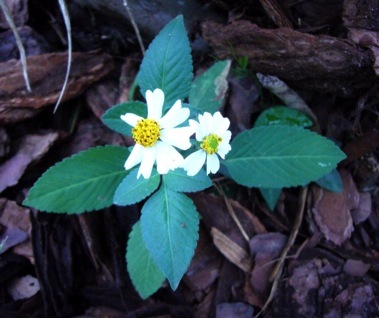
Bidens Alba, up close
Bidens Alba: Medical Beggar Ticks
Some edible plants just don’t get any respect. If there were a contest for under appreciated plants, Bidens alba, would be a heavy-weight contender.
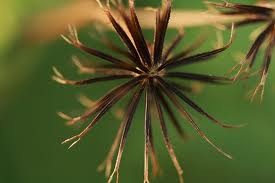
Biden alba seds, note the two teeth
Nearly anyone you ask about Bidens alba who knows it will say it’s a weed, not a pretty one, nor a useful one, not a nice one. Yet, honey production everywhere would be hurt without the Bidens family. In Florida, B. alba is the third most common reliable source of nectar. Quite an accomplishment for a weed growers and suburbanites are constantly trying to get rid of. Also, without the Bidens species many a butterfly would go to bed…ah…roost… hungry. (The second most common nectar producer in Florida is the saw palmetto and the top producer is the non-native, citrus which Greening might kill off.)
The B. alba aka Bidens pilosa (BYE-denz AL-bah, pil-OH-suh) also has an edible flower. It’s a tangy if not vigorous addition to salads. Bidens’ young leaves — a few at a time — are suitable for the salad. Shoots, tips and young leaves are good potherbs. It’s dried leaves are also a favored in Hawaii for tea. All of this, yet few guidebooks on wild edibles mention it.
TIMEOUT: Much confusion reigns whether B. alba and B. pilosa are the same or different species. One can find both references, and combinations as in B. pilosa var. alba. A 2006 genetic study showed they are separate species, even if
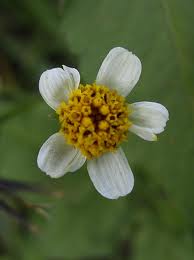
Bidens pilosa has shorter petals.
the difference is little. So, how can we tell them apart (though it makes little difference as both are eaten.) B. alba is the larger and better (I use “Big Al” to help me remember.) Its blossom petals are usually a centimeter long or longer, and it has five to eight petals. Think of the B. pilosa as smaller and lesser. Its petals are under a centimeter in length, usually 8 mm or less. It has four to seven petals, or none at all. Some times the geography helps. In Brazil, for example, B. alba grows only on the coast and B. pilosa inland, at higher elevations. Realistically, the differences mean little to us as they are both edible. Locally we have B. alba with B. pilosa occurring officially in only one northern county, Gulf County. We now resume our article already in progress:
As I said on one of my videos nature doesn’t know the difference between a cultivated plant and a wild one: She only knows survivors. And Bidens alba — also called Romerillo — survives. It grows so happily in my yard I can’t keep up with it. Left to its own, it will take over any unmown spot and populate it with as many Bidens per square foot as possible. Now you know why it is called an “invasive” species. It can have up to 6,000 seeds per plant and the seeds can remain viable up to five years.
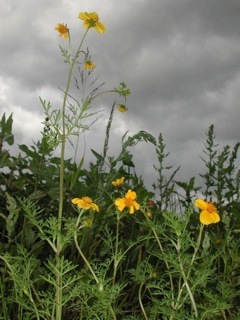
Bidens odorata
As for the edibility of the Bidens species, several are mentioned as edible. Find out which Bidens are in your area. The state of Florida does not list Bidens as a plant species that can cause harm, though it has had medical uses, and that in and of itself is a warning sign we shouldn’t ignore. There are at least two negative references I know of about Bidens pilosa. One is that B. pilosa is one of the few plants that can have a harmful effect on the skin because at least one of its chemicals reacts to light (some herbalists, however, consider that beneficial.) The other is B. pilosa (which is the most commonly eaten Bidens) may have a role in throat cancer in areas where opals are also found. This is because B. pilosa will uptake a form of silica — the same that creates opals — and that can have a topical cancerous effect. So if you have “Opaline Silica” in your area — they mine opals there — you might want to pass on the Bidens (I would presume B. alba would also uptake but I do not know.) On the other hand, however, Bidens is also shown anti-cancer activity.
Bidens is in the Aster family, a dicot with a root that goes vertical, not horizontal. That also makes it a composite and a relative of the sunflower. There are hundreds of species — authorities differ on the exact amount. The common names include beggar ticks, bur-marigolds, stickseeds, Spanish needles, tickseeds, tickseed sunflowers, and pitchfork weed. This is because its seed has two prongs on it that (sometimes four) stick to almost anything. And in fact “Bidens” means two-toothed. Alba is white and pilosa means hairy, or the feeling of hairiness. The Bidens odorata, a frilly yellow version, is also edible though it is a diuretic.
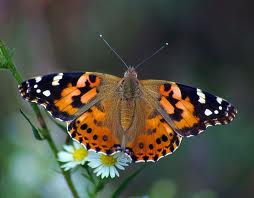
Vanessa cardui, the Painted Lady
By the way, Bidens are “zoochorous” which means the seeds are spread by animals, like the burdock. While the combination does not loose in translation from Greek, it does suffer in pronunciation. “Zoo” is not said like a collection of animals. Rather it is zoh-OH, which means “animal.” And “chorous” does not sound like a singing group. It comes from the verb score-REE-zoh, which means “I disseminate.” So, if you want to use that word and be close to the original Greek, it is five syllables: zoh-oh-score-REE-zoh.
Several Bidens are food for the caterpillars of some Lepidoptera, such as the Hypercompe hambletoni and the Painted Lady (aka, Vanessa cardui, the brush-footed butterfly). It is said only Sulphur Butterfly feeds off the B. alba as it has phytosterin, which can be a central nervous system depressant and lowers blood sugar.
As for the medical implications, in 1991 Egyptian researchers documented Biden pilosa had antimicrobial activity against a wide array of bacteria including Salmonella, Staphylococcus, Neisseria Gonorrhea, Klebsiella Pneumonia, and against Tuberculosis. It is also good for malaria, snake bite and has anti-leukemia activity. Research shows it lowers as mentioned blood sugar and blood pressure, stimulates the immune system and is anti-inflammatory. The powdered seeds are a topical anesthetic and aid clotting. There are also some reports the seeds might be good for prostate issues and use for lungs affected by COVID. And after all this the Bidens still gets no respect.
These’s between 240 and 280 known Bidens. Why they don’t know exactly how many Bidens there are is because of multiple and perhaps unnecessary names and or varieties. The nutritional composition of the Biden pilosa (and presumably the B. alba) per 100 g edible portion is: water 85 g, calories 43, protein 3.8 g, fat 0.5 g, carbohydrate 8.4 g, fiber 3.9 g, β-carotene 1800 μg, (Leung, W.-T.W., Busson, F. & Jardin, C., 1968). Another study found 111 mg of calcium and 2.3 mg of iron. These researchers also recommend you don’t eat the leaves raw because of a high saponin content. As a potherb they are excellent with many fine qualities: They are available all year round, keep very well, and don’t reduce in size when cooked. If they are a bit tangy, just let them sit cooked a few minutes. They store well. Cooked texture is good. Wine made from Bidens is called sinitsit. Incidentally, dried leaves of the B. Alba also make a good tobacco substitute. In 1962 Professor Julia Morton, who wrote many papers for the Journal of Economic Botany, recommended Bidens become a commercial crop.
B. pilosa also has 60 identified flavonoids including Quercetin and Luteolin. Among the micro nutrients are beta-carotene 1800 μg (which is pre-vitamin A) calcium 340 mg, phosphorus 67 mg and 2.3 mg of iron when dried. (Food Composition Table for Use In Africa, Leung, W.-T.W., Busson, F. & Jardin, C., 1968) Interestingly the dried plant has less calcium (111mg) and phosphorus (39) than the raw material. Usually dried “tea” material increases concentrations.
There are many edible Bidens and they grow just about everywhere so check out your local species. Those with edible leaves include Bidens bipinnata, Bidens frondosa, Bidens odorata, Bidens parvifolia, Bidens tripartita and Bidens laevis. Leaves of the Bidens aurea and Bidens bigelovii have been used for tea.
Synonyms for the Bidens Alba/Pilosa include: Bidens abortiva, Bidens adhaerescens, Bidens alausensis, Bidens chilensis, Bidens hirsuta, Bidens leucanthus, Bidens Montauban, Bidens odorata, reflexa, Bidens scandicina…. and….Bidens leucantha var. pilosa, Bidens pilosa var. alausensis, Bidens pilosa var. bimucronata, Bidens pilosa var. minor, Bidens pilosa var. pilosa, Bidens pilosa var. radiata, Bidens pilosus, Bidens pilosus var. albus, Bidens scandicina, Bidens sundaica var. minor, and Coreopsis leucantha
Green Deane’s “Itemized” Plant Profile
IDENTIFICATION: Compound leaves composed of 3-9 saw toothed oval leaflets. The leaves are one to five inches long and up to two and a half inches wide, bright green on top and hairy underneath. Plant tends to sprawl and root at the lower nodes if it touches the ground. The one-inche flowers in stalked clusters look like coarse daisies with five or more white rays and pale yellow centers. The ribbed seeds resemble flat black needles with 2-6 barbed hooks at each end.
TIME OF YEAR: Spring to fall, but year round in warmer climates around the world
ENVIRONMENT: Not fussy about soil but prefers full sun.
METHOD OF PREPARATION: Young leaves, tops, shoots as potherb. Some young leaves can be used raw in salads. Try a little first. Flower petals as a trail side nibble or a bit of white in salads. Dried, the leaves can be used as tea or smoked like tobacco. The flowers are mixed with sticky balls of rice and allowed to ferment in water to make a spirit. The leaves are also used in making wine.
More great info, thanks!
I have sheets of this plant in my gardens right now, as you describe it – as many per sq ft as there can be. Over the next couple weeks will be prime eating for little tender plants.
Great. Just make sure this time of year it is not dog fennel.
Just recently found your site. It is such a great resource! About the Bidens alba/pilosa, I was delighted to feel so confident in being able to identify it, having grown up in S FL with it everywhere. So I have been sampling it a bit at a time. Then I reread your post and realized I am not sure whether the whole flower is edible or just the petals. I have been eating the whole flower head, including the yellow center! I would especially like to know since I have children also, and want to be super cautious with anything they eat (of course if they see me eating it I they want to eat it, so I sometimes have to be a bit secretive). Thanks so much.
The whole blossom is edible.
I understand that the B. pilosa leaves have antibacterial properties. Would that also hold true for B. alba? Could those leaves work as such applied topically by bruising them first?
I would think so.
These bushes used to be ripped out my yard every year until I noticed that honeybees stopped coming to my yard, and my fruiting bushes produced very little fruit. Then we stopped mowing a certain part of the yard, the bidens alba came back, and so did the honeybees. Landscapers would look at us funny when we told them to leave the bidens alba alone, but these bushes, plus the lantana and the stevia, brought back more than enough bees to reward us with a decent fruit crop.
Interesting how nature works.
We have the bidens alba on Guam… the young leaves and stems are also used to speed the healing of skinned legs or knees.. crush leaves and tender stems into almost a pulp…. allow juices to cover area, then place rest of the crushed plant over sore.. leave for 30 minutes, remove and let dry completely.. sore should be dry and not get pus or infections by the next day.
Thanks for the info about eating the plant… had no clue…
Hi. Just wondering if you are an herbalist on Guam? I’m from Guam but didn’t grow up there and looking to reconnect with my roots. I’m curious about the plants and herbal traditions there. I heard my great grandmother, Damiana was an herbalist/midwife there. Would love to hear more about the Chamorro practices.
Just made a huge plate of this using olive oil, lemon juice, finely minced onion, tomatos and also some fresh grated parmesan cheese it was out of sight.
Sounds delicious. I think I’ll give it a try. I’ve eaten the flowers since I was a kid. They have almost a carrot like taste. I’ve been thinking about making jelly from the flowers to see how it tastes.
I’m wondering about the tobacco substitute property of this plant. Has anyone ever tried to smoke this stuff? Thought I’d ask before I dry some up and mix it in with my loose tobacco.
Did you try the leafs for the tobacco substitute and did it work?
Wow! This is delightful! I asked a question on YouTube and you directed me here. I did have bidens for lunch, the young leaves, and so delicious! Blossoms at supper, and I have something to tell all my friends. Thanks!
Whacking myself on the head after reading this. Here I have been pulling every sprout while having NO CLUE just how valuable this weed (?) is. THANK YOU for opening my eyes!
I’m among the many who’ve been trying to get rid of Bidens ( only knew it’s a weed called Spanish Needles ), thank you so much for the useful information, won’t be pulling out every plant- as they do multiply bunches, some are growing near my tree ferns in containers-impossible to pull out- one day when ferns are t-planted into the ground they’ll be separated. Ditches were full of Bidens til parish workers chopped ’em couple of weeks ago ( as they do pink primroses in the spring) so good thing I have some of both in the back yard.
I’ll call them Bidens from now on, easier, they deserve more respect, thanks to you Dean.
Interesting isn’t it, that the cities and other gov’t has brainwashed everyone to thinking edible wilds are weeds (in the bad sense), when we know that these plants are made for our best health. 🙁
I argued with the city about them, and even though the extension service agreed about their usefulness as pollinators and food, refused to go to bat for me. One code enforcement peep said ‘but the seeds get all over cats’. I reminded him that cats weren’t supposed to be loose.
I am beginning to prepare herbal medicines for myself and for my family. I have been searching to find this weed/herb from different suppliers but no one seems to have any. Do you have any information where I can purchase Bidens Alba or Bidens Pilosa? Thank you.
Have you tried B&T Seed? Also, where do you live. Perhaps I can send you some, they are seeding now.
How do you make a wormer from this plant?
I also am searching for a source of Bidens pilosa to start in our medicinals garden here in central Texas. I would be happy to reimburse you for seeds if you would be kind enough to send them to me.
It doesn’t grow here. Have you tried B&T Seed?
Hi Jenny,
I can send you plenty of seeds, they are taking over our backyard here in Florida. Let me know if you still need any.
Karin
My horses also love to eat bidens alba. I pick huge armfuls to feed them, being careful to remove any dried flowers and seed heads first, especially in winter when pasture is limited. I allow bidens pretty much full rein over the farm except garden areas because it is so useful. I keep a 30 x 50 ft area unmowed each year just to enjoy the bee and butterfly show, except I do pull out any dog fennel.
I am new to Florida and I noticed these white little flowers everywhere around here and found out that it was called Spanish Needle. It seems as widespread as Dandelion is in the Midwest. I am just wondering is there any species that looks just like it that might be poisonous or am I basically safe to start picking it and eating without worrying too much ?
No species look alike if you look close enough. That said yes there are several plants that look similar when young to young Bidens. To help ID look for last years plants nearby.
The square stems are what I always check for. There’s a similar looking ‘weed’ popping up on my lawn, so I’m careful. Thanks to long covid, I use this a lot to treat the tickling cough that won’t go away. And I do chew the leaves raw.
As a child growing up in Florida, I called these “sidewalk daisies” and put the flowers in my hair, but never considered them for a bouquet. But, years ago, I grew to respect their beauty when one night, after having allowed a clump to grow for flying critters in my garden, I noticed their luminescence in the moonlight. It was breathtaking, that clear night, those glowing flowers. Now I put them in vases, and have started using them in cooking. Thanks!
Wait… “The flowers are mixed with sticky balls of rice and allowed to ferment in water to make a spirit” ????
More info on how to do this please!
And, what are the medicinal benefits of a Spanish Needle-infused spirit?
Thanks for this awesome website!
I want to know more about this too!
Ever since I took a small survival course from a local native American Indian, I have been cultivating the “Spanish Needles” in certain parts of my back yard. It was mentioned in this course that the early colonists here in Florida used this plant for its high vitamin C content to combat scurvey along with pine needle tea. It apparently was highly prized back then and was considered by the instructor as a good survival food. But I was a bit foggy on the means of preparation. Thanks for this resource.
its amazing how Spanish needles change the flavor of free range chickens eggs…and all the pretty white butterflies around them are a plus this time of year
Do you feed them to your hens?
Wanted to pass on a great recipe for these abundant greens. … Place a piece of fish (i like to use salmon) on some tin foil. Wash a big handful of fresh, washed greens and plop them right on top of the fish. (don’t forget your spices and butter, etc. on it all) Close up the foil, poke a few wee holes in the top and bake for around 15 minutes at 400 degrees. Yum. …. Like so many others, I used to curse this little beauty. It seemed the more I tried to get rid of it, the more it would appear! Thank Goodness!! And thank YOU, Green Deane!!
Dean,
Love your site, you got me inspired years ago to find what weeds in my yard was edible in order to supplement my garden. Bidens pilosa / alba (which way outdoes my garden) was my first love; I eat it all the time, mostly in omelets. Here is some recipes I have found in my searches: “Blackjack” (bidens pilosa’s common name in S. Africa) with coconut milk:
http://203.64.245.61/web_docs/recipes/African%20Traditional%20Recipes_final_English.pdf
and ‘Ladakhi tea’ in the Himalayas:
http://link.springer.com/article/10.1007%2Fs10722-009-9441-3#page-1
(I make this minus the Yak butter and milk). Hope this adds to the collection, keep up the great work.
Thanks for the recipe ideas! Having a recipe for a wild food makes things much easier than having to figure out on my own how in the world to use it.
Is this plant eatable for rabbits?
I’ve seen wild ones eating it.
Dear Dean
Biden Alba leaves and stems can heal Herpes 1 and 2 ?
Thanks
I don’t know. I am not an herbalist, but they do have some photosensitizing qualities for some people.
I feed it to my rabbits whenever I think about pulling some up. They seem to love it.
I feed my rabbits arm loads of these and they LOVE this plant. Made some cooked tonight and it was BETTER than spinach!
Rabbits and chickens usually go nuts over it.
So excited to find your site! I too feed it to my bunnies and they only seem to eat the flowers. Maybe they know something we don’t? Anyway, great site and I look forward to linking you to our posts. Great info.
I feed it to my rabbits by the armload each day during the summer, they love it.
I feed it to my chickens and ducks.
I guess I’m confused and nervous about how much a “small amount” to eat raw is. One of the posters here said he made a whole salad out of it!
I’ve eaten it before because I read it was editable, but I’d eat a lot more of it if I knew the “quantity” (oz.?) I should stay BELOW. Seems like just adding a handful to a salad is enough and safe, but I eat 2 salads a day.
Thanks!
Julia Morton reommended it become a commercial crop and did not set any limit on it. I think a raw large salad would upset my tummy but I have a tender tummy. I also don’t think the flavor is that good raw so for me if I were to make a salad it would only an ounce or two of Bidens in a large salad.
I made some pesto out of about 2 cups of the leaves of this plant. I chose leaves from the new growth at the top. Processed with olive oil, nuts, parmesan cheese and garlic. Very tasty.
Some information recommended against eating these leaves uncooked but I suffered no ill effects.
An herbalist friend of mine suggested I eat a couple tablespoons a couple of times per day for a lingering chronic cough (possibly from lung yin deficiency). Do you recommend cooking them? What is your experience with this usage? In situations w/ a tender tummy what symptoms would manifest with the raw plant? Thanks so much!
Coming from the New England where plantain is available a good portion of the year and then moving to FL where it disappears when all the insects are at their WORST, I was so happy when someone told me about Spanish needle. It works awesome on insect bites! With other herbal remedies, I’ve had to re-apply several times to take the itch and sting away, but if I chew this up and put it on right away, it even seems to prevent the little pus spot that fire ants usually leave. Actually I think it’s even better than plantain on stings and bites! With 4 small children I have had ample opportunity to try this remedy out 😉
Wow, this is so great to know after all this time of cursing it all over the yard, now we can just eat it? How cool is that? My roomie who is in charge of lawn mowing is ecstatic that he can back off the attack status! If only we had known sooner! I’m going out to sample some now! Thanks!
i quit smoking with this plant. used it as tobacco replacement and it works i quit smoking cigarretes after 25 years. now i am making cigarretes and give them to friends who wants to quit smoking.
This plant, known as mozoquelite in Mexico is used to dissolve kidney stones.
1 quart of boiling water , 2 tablespoons of chopped plant, dry or fresh,
put plant in water for 3 minutes cut off flame, cover and steep till cool.
sip cooled tea infusion several times a day for a six week period.
I’ve heard several people say it got rid of their stones. Maybe its diuretic effect also helps.
When I lived in Florida, every time my Dad would come over to visit, he would get after me if I had let some “Beggar’s Ticks” grow, as if they were a threat of some kind. I guess he knew how badly they spread and how much the seeds stick to your pants legs (He was in a suit or dress clothes selling real estate much of the time, so a real nuisance to him). Wish he were still around so I could tell him how valuable these beautiful “weeds” are! 🙂
i have yard full of them.any money to be had for them? health food stores?
I love bidens alba.i got some seeds in okinawa,japan.i planted them in mountains of Luzon and now growing like weeds with beautiful white flowers.Thanks for other comments now i will use it in tea preparation with pandan leaves.
Thats very silly, you’ve imported a vigorous weed into your country. Good luck keeping that under control!
Hello! I was wondering if the older leaves are okay to eat too or just the younger ones?
Thank you!
I have not read of them cross pollinating.
Any links or resources on making sinitsit wine? I’m very interested and can’t seem to find more info about it online. Thank you Green Deane!
Thank you much for all the info.
I love Spanish needle the name in Jamaica but I am grateful for new information I use it to make pesto I love it
I just cook them in large quantities like I would cook amaranth greens. pig weed, spinach and in the past polkweed. Looking at the medicinal qualities of this plant I am concerned about the possible over dosing. I would like your opinion on that.
posted your link on my Fb group,”Wiregrass Foraging”
What you have found about silica uptake is similar to what is reported in Cuba about it (romerillo-b.alba).
What about the liquid when boiled? I can’t remember and it was a long video. Thank you!
You can use the liquid as an anti-inflammatory tea.
Wow! Fantastic knowledge, thank you for the research 🥰
Is there any way to know the effects on kidneys if one wants to utilize this plant? I have tons in he yard, and because I see the bee’s and butterflies visiting it, I endure the unsatisfied scowls of my neighbors..lol. Great reporting will share to my FB page and more. Thanks bunches
In case this anecdotal evidence is of any use, for about a year, my non-profit’s funding and volunteer availability plummeted, likely due to COVID. During this time, all of the pathways in our small native plant demonstration garden essentially became a Bidens alba garden due to negligence. During this time, however, the number of Atala butterflies living on the property skyrocketed. There were literally hundreds and the property is less than half an acre. It is surrounded by concrete jungle and I’ve only seen the atala leave our tiny property on rare occasions, presumably lost or kicked out in a fight with others in the horde. So, they’re almost completely restricted to our oasis. On rare occasions, I’ll find one at most 2 blocks away, and we have even smaller scale urban gardens at other properties nearby to check in on, so I know the area pretty well.
More importantly, the I have frequently seen the atala visiting the B. alba, presumably consuming the nectar, though I’ve never gone close enough to confirm that it actually succeeded. Once we finally got some volunteer help to clear the pathways for visitors to once again come through our demonstration garden, the atala numbers dropped backed to more reasonable numbers. So, in my opinion, it was a primary food source for them in that circumstance.
UF IFAS also seems to confirm a preference for this plant.
We have waaay to many Pitchforks growing at the moment. I tend to just dig them into the ground as they make a decent green manure. Eventually, once I set a bed up with mulch, pavers and desirable plants, Bidens can’t keep up and are easy to control. … but left to their own devices on an unmaintained plot of soil and they’ll take over in no time (possibly keeping out worse weeds?).
Would love recipe for wine
Me Too! I think it good be a good way to consume to benefits of this plant. If you find a recipe please share.
I accidentally discovered these weeds are like crack cocaine to my chickens. I stopped mowing my 2.5 acres due to increase in gas, the weeds grew everywhere. Through a pile of them into the coop one day, they loved it. Now they all eagerly await armfuls of these weeds everyday.
I love your site and have gotten lots of useful information from it. Is it possible to turn the flowers from a biden’s Alba into a tincture? If so, do you think it would have pretty much the same effect as the leaves?
I looked up Spanish Needle,and found your site. I have watched your video on Saw Palmetto. I live in North Central Fl. You provide a lot of information on edible plants. I have American Beauty growing on my property. I have made a jam with it. I am amazed that there is so much that can be consumed right from your own back yard! We all need to grow our own food and forage what nature offers. I will tell others about your site. Thank you! for what you do. Jeffrey