
Sesuvium portulacastrum: Maritime Munch
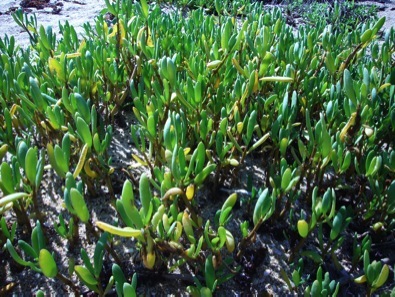
Young sea purslane
It looks like garden purslane on steriods growing in sand. And it grows all over the local beach, and other beaches in the South and as far north as the Delaware River in Pennsylvania.
Sesuvium portulacastrum (sess-SOO-vee-um por-too-luh-KASS-strum) was widely used by Native Americans. The stems were eaten raw or pickled, or cooked in two or more changes of water to reduce its saltiness. Often these days it’s found in Asians markets. One of the best-kept secrets of sea purslane is that it is a rich source of ecdysterone. Haven’t heard of ecdysterone? It’s an important chemical for molting insects and crustaceans. But, in humans it is reported to enhance athletic performance. That should make foragers out of jocks.
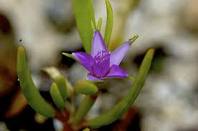
The blossoms stays open only one day
The lowly sea purslane forms an important and primary function in dune creation. Salt tolerant, it sets roots just above the high tide line. Sand-carrying wind hits the plant, slows slightly and drops the sand it is carrying. That helps build the dune and in time bring in other plants.
It is also found down the coasts of Mexico and South America to islands across the Pacific, Australia, Africa and Europe. As for Pennsylvania, it was found in Philadelphia county there in 1865, and presumed to still be thereabouts. On the west coast of the United States (and the salty desert southwest interior) your edible sea purslane is Sesuvium verrucosum.
It is a nice, salty, trail-side nibble. The word Sesuvium comes from the country of the Sesuvii, which was a Gallic tribe mentioned by Caesar. Why the plant was named after that is unknown. Portulacastrum means like the Portulaca, or purslane. In fact Sesuvium was originally put in the same genus as purslane but then got it own genus.
Sea purslane cooks up nice and tender, including the thick stems (remove old dead leaves first.) I’ve never found it too be salty. That said, raw, to me, it has a slightly bitter after taste, but not as strong as a raw yucca blossom. Actually it is a back-of-the-throat feeling that is between slightly puckery and slightly bitter… Easily ignored, and goes away. Cooked it looses that distraction. The older stems can be fibrous though tasty. I chew the pulp off the fiber and spit out the fiber.
Green Deane’s “Itemized” Plant Profile
IDENTIFICATION: Herbaceous perennial, thick, fleshy leaves narrow to slender obovate on succulent, reddish-green stems, branching regularly forming dense low-growing stands. Five-petaled flowers, small, showy pink, year round, Each flower opens for just a few hours each day. Leave up to more than an inch long. S. maritima very similar but leaves are no more than an inch long and are oblong to spatulate oblong.
TIME OF YEAR: Available year round
ENVIRONMENT: Along coastlines, grows on the ocean side of dunes to the high tide mark.
METHOD OF PREPARATION: Raw, pickled, cooked in two changes of water or more to reduce saltiness

Can you eat the flowers too?
You can but they are rather insubstantial.
Thank you for having Sea Purslane in the Newsletter. Finally we can forage something here on this island.
where does sea purslane grow? sounds like only on the east coast usa?
It is the east coast but one the west coast you have Sesuvium verrucosum which is edible (a different related species of sea purslane.)
does it grow on the california coast at all?
No but you have Sesuvium verrucosum which is.
is the ”succulent-appearing” ice plant with the fingers and fuschia flowers, that every body plants as a drought-tolerant, edible?? it seems close in nature to purslane…
Sounds good but without a botanical name I could not say. Carpobrotus edulis has edible fruit and leaves but it is a native of South Africa.
how about Carpobrotus edulis?
Carpobrotus edulis has edible fruit and leaves. It is a native of South Africa found nauralized in some California coastal counties, and a few counties in Florida. The fruit is eaten raw, dried, cooked. pickled or in chutneys or preserves. Leaves are used in salads or pickled like cucumbers.
Carpobrotus edulis is EVERYWHERE here–unfortunately, it seems to be taking over the habitat of the native seaside succulents…
but, if it is edible and at least somewhat tasty, perhaps i can make a dent in that…how do you recommend it be prepared?
thanks
thank you-
This is a very tasty plant. I finally got some late last year and planted it in my Great South Florida Food Forest Project.
I didn’t realize it grew so far north, though. I was nibbling on it down in the Caribbean. I’m going to have to plant it here in N. FL and see how it does.
This is, far and away, my family’s favorite wild edible. I sautee the leaves with butter, worchestershire, and garlic and we can’t get enough. They also make great pickles. So yummy we have to remind ourselves to leave some for others.
Thank you for the information! We forage this in the bahamas. Locals call it “sea pickle”. Now we’re picking it in NE Florida. Happy foraging!
Thank you very much for this post. I was in middle Florida this spring and saw along the red steams of Sesuvium Portulacastrum another look-alike but green. I wondered if it was the same plant and got the following results: the red steams (definitely the Sesuvium Portulacastrum) were over the sand like a carpet in rhizomes with pink leaves and had pink 5-petal blossoms, but the other plant that had green and yellow stems and leaves were not on rhizomes but forming a woody steam growing vertically. Both plants have same appearance of leaves like Purslane “on steroids” like you said.
I love to eat this kind of weeds so yummy and delicious, in our place here in the Philippines, we call this “ngalog” one of the best exotic food.
Én Magyarországon élek,és azt szeretném kérdezni, a téli hideget hogy vészeli át!
I live in Hungary, and I’d like to ask you how you’re going to survive the winter cold!
The plant and I survive Florida’s winter well.