
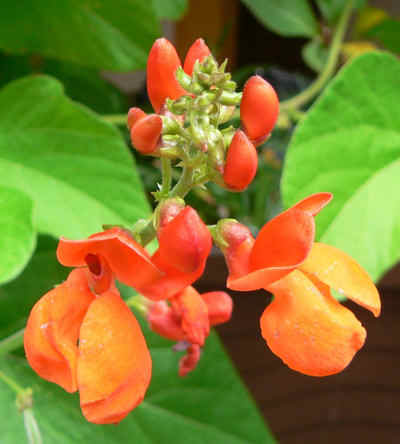
Two beans are grown for beauty, the Hyacinth Bean, edible with precautions, and the Scarlet Runner Bean, also edible.
It’s interesting that these two beans are so unlike the rest of the bean world yet so much alike. Both trail, that is, love to climb. They are showy, one towards purple the other red. They are perennials though are treated as annuals, and have starchy, edible roots. Their young leaves are eaten as well as their beans. Like the Hyacinth Bean the Scarlet Runner Bean also has tasty edible flowers. For the Hyacinth Bean go here.
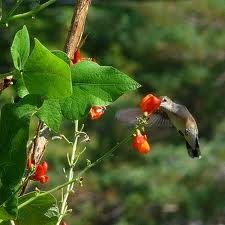
Botanically in Dead Latin the Scarlet Runner Bean is Phaseolus coccineus (fay-see-OH-lus koh-SIN-ee-us.) That’s the bastardization of two living Greek words that mean “Red Bean” though the seeds are multi-colored. (In Greek it’s: fah-SO-lee KOH-kee-no.) The Scarlet Runner Bean has also been called the Oregon Lima Bean, Aycoctl by the Aztecs, and Ayocote by the Spanish. It’s native to Central America and has escaped cultivation in many areas. This bean is still on the home kitchen menu in its original range but the rest of the world grows it as an ornamental. Lots of folks also use it as a nectar attraction for hummingbirds and butterflies. Historically, Scarlet Runner Bean was in English and early American gardens by the 1600s.
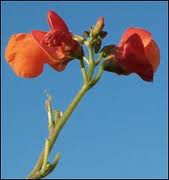
Edible Bean-flavored Flowers
There are some dozen and a half cultivars now. (Cultivars are made by man, varieties are made by nature.) The Dutch Phaseolus coccineus v. alba has white flowers. The “Butler” is stringless, “Painted Lady” has red and white flowers, the “Kelvedon Wonder” is an early variety with long pods, “Sunset” has pink flowers, and the “Scarlet Emperor” …has scarlet flowers. Under right conditions the Scarlet Runner Bean is the most productive of all the planted beans.
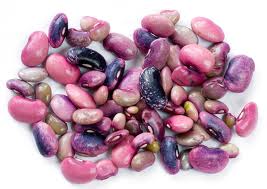
Scarlet Runner Beans produce many-color seeds
Like most beans the Scarlet Runner Bean contains small amounts of the lectin phytohaemagglutinin (figh-toe-hee-mah-GLUE-tin-inn.) The highest amount is in uncooked red kidney beans. It’s toxic in large amounts which is why kidney beans are always long-cooked. As few as five raw kidney beans can cause symptoms such as losing fluids and feeling lousy for four or five hours. While there are many people who report they eat Scarlet Runner Beans seeds raw it is a good practice to cook them. The young pods before beans truly develop are eaten raw.
I have planted both to climb guy wires near local telephone poles. It’s a win win win as they say. The ugly wire is covered with an attractive vine and blossom, I get to harvest the bean without having to give up any space or create a trellis, and the birds and bees are happy.
Green Deane’s “Itemized” Plant Profile: Scarlet Runner Bean
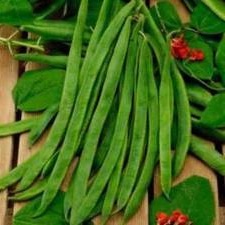
IDENTIFICATION: Phaseolus coccineus: Quick-growing vines, typical bean three-leaflet, dark green with purple tinged veins underneath, to 15 feet long/tall, red flowers borne in clusters like sweet peas, slender pods to a foot long. Seeds lima bean shape, color varies from shining black to violet-black mottled with deep red.
TIME OF YEAR: All year in warm climates, seasonally in temperate summer and fall
ENVIRONMENT: Fertile soil, adequate moisture, full sun, preferably something to climb on or it will ball up on the ground. Does better in moderate climates than either very hot or very cold.
METHOD OF PREPARATION: Young tender pods sparingly raw. Usually they are boiled, steamed, sauteed, baked, French-cut (in strips) before cooking; immature seeds used like shelled beans, read cooked; ripe, dried seeds used like dry kidney or Lima beans, long cooked; flowers have a bean-like flavor and are used in salads. Young leaves used as a pot herb, starchy root cooked. It is good food for cattle as well.

thanks i have a project to do and this helps me know more
any suggestions for keeping voles and chipmunks from eating the roots and stems? have planted 3 years in a row in diffrent locations always with the same end result…rodent food
Eat the little munchers….
Cats don’t like to walk on chicken wire. Sometimes just laying some down on the ground around the bed works well.
Ha ha the cats aren’t the ones eating the beans! Why discourage them!?
Put tin foil in your garden!
I have been eating scarlet beans for months and have not had any poisons that effect me but have had a side effect that has improved my diabetes and neuropathy of my feet and fell great. I can walk allot easyer and control my diabeties better having to use less insulin.
Hi. Is this still working out well for you?
I wonder if you have noticed much effect on your diabetes with jerusalem artichoke tubers, since they say we dont digest the sugar in them.
I lived in S.Africa for many years. That country has some of the most beautiful gardens in the world. However, we never heard of the scarlet bean. My first experience was in the U.S. I grew a few seeds which eventually turned into beautiful creepers and bore
large pods. Alas, snow fell and destroyed the plant and the legumes. I was unable to salvage any.
I want to send some seeds to relatives and friends in S.Africa. Could I do this without a licence?
Can you tell me if scarlet run plants are ok to feed to cattle?
It is good food for cattle as well. Last sentence in article above.
do they keep coming back every year??
I have planted them for 6 years in the SF Bay Area and about a quarter of the plants winter over. They look dead, but in early Spring they will put out half a dozen shoots, so each sophomore plant has the yield of six seed starts. None have made it to a third season.
By the way, despite their tropical origin, they yield very well and are quite comfortable in Mediterranean climates, even near the ocean. I love them.
They do get whitefly infestations, but they just go on – two flushes a season, about six weeks into their maturity and then a few months later. If you leave the pods on the vines too long they will get infested with a tiny boring weevil that leaves grainy bits on the bottom of stored seed containers and which will multiply rapidly through a jar of seeds. Leave the seeds out to dry, then freeze overnight to stamp out the weevils. This may cause longer sprouting times the next Spring, but I am not certain that this was due to the freezing.
Great information, thank you!
I’m confused! How many can you eat and do they have to be cooked?
is it ok to plant the scarlett runner beans a few feet away from pole beans?
CAN SOME TELL ME IF I CAN EAT THE YOUNG BEAN PODS LIKE I DO
GREEN AND YELLOW BEANS
PLEASE E MAIL AN ANSWER BECAUSE THEY ABOUT 1” LONG AND WANT TO PICK THEM.
THANK YOU
Yes, you can eat them. The pods have a scratchy habit that goes away after boiling. They take somewhat longer than other beans, and after the beans set and begin to swell the pods get tough and (to me) inedible. But I may just be insufficently hungry.
Mike
Regarding Michael McCleod’s white fly infestation, in our area early immigrants would add Pepperwood leaves to stored dried plant material to combat insect infestation. California Bay Laurel, aka Pepperwood , (Umbellularia california) is an indigenous plant in forested areas of California, so leaves are easily accessible. Native Americans supposedly camped under Pepperwood trees because the trees’ odor worked as a natural insect repellant. Michael, check out Marin or east Alameda counties for Pepperwood trees or San Mateo County, in the westerly hill area.
Dick Wild
The first time I grew scarlet runner beans was last year (2013). The stunning purple bean inside the rough pod were beautiful and delicious. I’m a vegetarian and the big meaty beans were thrown into every recipe I could think of. A favorite was to boil the purple inner beans and use the cooked beans in a Mediterranean style with tomatoes, calamata olives onions… They are delicious and have a wonderful mouth feel. But I would grow them again for the beautiful red flowers dressing up my vege garden alone! I live on the north top of the Olympic Peninsula, Washington.
I grew scarlet runner beans for the first time this past summer (2018) in Portland Oregon. They are so beautiful, grew up the poles and strings and into my trees. The hummingbirds loved them, which brought so much joy. I too would plant them again just for the beauty. I harvested dried beans but have yet to cook some. Will try your Mediterranean salad! Can I eat the beans from dried pods found on the ground if they do not have mold?
I live on the Florida Panhandle. I like the looks of the scarlet runner beans, and the versatility of their beauty, hummer/butterfly food, and edible seeds. Do you think that they would grow well in our hot, muggy environment?
Can you eat the leaves of the runner beans, if so im guessing you would use them in a salad??
The article says young leaves of the Phaseolus coccineus are boiled and eaten.
Please what are the medicinal and health benefit of this scarlet runner beans? i want to work on them for my research project work.
I’d like to help but I am not an herbalist.
I live on Vancouver Island, Canada. I first started growing scarlet runner beans over 25 years ago, after a friend gave me some of the seeds. I have never had to buy any further seeds, as these vigorous vine always manage to hide a few pods to ripen amongst the thick foliage. They are one of my most prolific garden plants, providing our family of six with a cornucopian supply throughout the growing season, with lots left for pickling, canning and freezing for use through the winter months…and as a bonus, they attract the hummingbirds and provide us with a shady screen for the patio. Everyone should grow these wonderful legumes, especially when partnered with Jerusalem artichokes as a trellis, and squash at their base.
Hi .. I’ve just started growing Scarlet Red Runner beans and just love them .. why hadn’t I grown them before, anyway! Besides the lovely Anna’s and the huge bees that visit the flowers .. I harvest lots of beans. I live in Victoria, V.I., so our climate is lovely. And I also grew my first Jerusalem artichoke. And I’ll sure save some seeds for next year .. as well as trying to keep the roots to see if they will grow next year!
Hi Anne-Marie, I too started growing this for the first time this year and they are amazingly beautiful. I’m looking for ways to cook them. I’m in Seattle, so our climate is similar. I love the idea of saving the roots to see if they’ll grow next year. Have you done that before? I’d love to try it.
HI .. sorry, I hadn’t visited here for awhile. Yes I have a huge jar of dried seeds from last year … they were very viable this year and again .. I have hundreds of seeds. This winter I plan to actually cook them 🙂 Such a beautiful plant they brighten up the whole garden. I hadn’t tried to regrow from the roots, had read that this can be done. A friend of mine (also in Victoria) did do this and she has had great success with it. I grew most of mine in pots and I will try that also, to see how it works.
Would you please describe how you pickle, can, and freeze? Are you making use of the pods when green and the beans? Thank you so much.
Great information, thanks a lot, I am interested in using this in some guerrilla grows. I was reading about the native swamp mallow, and it actually lead me to your article! 🙂
I am growing these this year for the first time and they are growing and flowering very well but have not set on any beans. Do I need to do something to get them to set? We have humming birds and bees and they have been flowering for over a month but still nothing. Flowers are very pretty though. We are zone 8B or zone 9 and very hot here currently. I am watering quite often though.
I too have very vigorous plants with tons of flowers but no fruit 🙁
Thanks for the informative article. I don’t have a lot of sunny space in my yard so I planted two tall containers with two seedlings each so the vines can grow up along my back stairs’ railings. They are vigorous with lots of flowers and baby beans. I’ll try leaving them in the containers over winter to see if they sprout in the spring.
I also have lots of lovely flowers but they haven’t set fruit. It has been very hot here but I have lots of bees and some hummers. I also water regularly. Any hints?
Mine did not produce fruit until mid-August, here in central Virginia. I was very surprised since I had given up hope!
Is it safe to raw pack scarlet runner beans to can in pressure canner?
Please go to this website about pressure cooking beans. I think it will be helpful since it even mentions scarlet runner beans.
http://www.fabulousfoods.com/articles/27942/how-to-cook-beans-in-a-pressure-cooker
Interesting info. I have grown scarLet runner beans for over 50 years and last year tried something different (to me) … When the new vines are about 3 ft / 1 meter tall, I tried nipping the end of the vine off to see what would happen. (I do this with my greenhouse tomatoes)
Well, the result was fantastic! The main vine seemed to keep growing but side shoots came out everywhere and the EIGHT seeds I planted gave us probably five times more beans than we could eat. Gave lots away! I use a “teepee” of poles about 6′ or more above ground and then run strings from the top to other trellises or the greenhouse. This year I only planted ONE seed at each pole. Once again I nipped the vine ends and the poles are lost in the jungle of vines. Loads of beans. Lots of blossoms fall off but we still get a huge crop. When watering I have found the bean plants like a misting – they do great in our damp Vancouver Island climate.
We find the beans get soggy when frozen… Oh well, they are great fresh!
Hi .. This sounds very interesting, I’ve been harvesting my rrb’s all summer and now just letting the pods grow. I plan to try your method next year, on a few plants. Whereabouts on V.I. do you live? We are in Victoria (Swan Lake). thanks!
Please advise as I’m new to these. We were out of town & returned to find many pods 5 inches or longer. I’ve just left them & don’t know exactly how or when to harvest. Do they dry in the pods? I know they are past the stage of using them like regular green beans. Thanks.
Hi there,
You can eat the pods that size and longer. We’ve had some much longer and they are still delicious. Best time to pick is when the pods are reasonably flat, in other words the beans haven’t matured much (a little is OK). The more mature the beans become; the more fibrous the pods will be; and with experience you can feel this happening. Once the pods are swollen with maturing beans I leave them on the plant until they turn brown (same color as a paper bag). Then I shell them and allow the seeds to dry for a few days; and I store them in a paper envelope in the refrigerator for next year.
I grew the Scarlet beans for the first time. Meant to plant the regular string green bean but misread label. I now have these massive hard beans. Tried steaming but they are woody… Now reading i see i should have harvested when younger. Anyone have a thought on how i can still enjoy these beans? I dont want to toss out…there are tons. Thank you.
My chef friend grew these and said when soft (red shelled bean) they can be added to quick sautéed vegetables, after they turn purple they can be cooked in a full flavored broth for 20 minutes! The pods need to be picked before they get 4″ long, those can be frenched and cooked like green beans…..hope this helps!
If you haven’t already gotten rid of them, don’t. Let the pods get as long as they will, which can be up to 8″ or more. You can let the pods (with the beans inside) dry on the vine, or pick them and let them dry themselves. The beans inside are incredible. They look like nothing else in nature. Bubble gum pink or lavender with splotches of navy blue or black, kind of like a jelly belly.
You can eat the beans while they are fresh, or you can let them become hard. Unless you have enough fresh to cook a meal, its better to let them dry–they lst as long as any dry bean and won’t get moldy while you are trying to collect a cupful.Cook them as you would a kidney bean but don’t stop when they are soft. Let them simmer another hour or two and they develop the most divine, buttery, creamy texture. in case you have not noticed, I am a big fan.
I planted these in my little garden patch at home, along with sunflowers, and did amazing! The runner beans would climb the sunflower, and helped support it for a while. It went crazy. The one plant that did sprout, is as tall as my sunflower or more at 9 feet, and wide as my garden at 10*6. Needed cages outside of garden to keep contained. Once wTered and left for a few hours, the vine gets softer and easily movable or trainable to creep where you want it. I’m picking them for thelima beans inside.
do the leaves resemble poison ivy leaves?
Yes they do. A cluster of three oval shaped, pointed leaves. I love this plant although I’ve never eaten them. I use the quickly growing vines to cover my backyard chicken enclosure. The vines grow to cover the mesh wire and provides shade and cover from rain. It also muffles chicken noises after laying an egg. I start the seeds inside to get a jump on the season. The red flowers are spectacular.
Aren’t the beans toxic to your Chickens? Or don’t they bother with the dry beans? I know once cooked they are fine & great for soups.
I believe the scientific name is composed of Latin words of Ancient Greek origin
I live in the NW…. have been growing Scarlet Runner Beans for the last 10 years, always started from the seed from the previous year. We use the dry beans to make delicious soup. The last three years each crop has been reduced. On each new shoot, most of the new beans drop off just as they are starting to develop. ????? This last year I changed the planting bed to a new site several miles away!, but still using last years seed. ????
Look up info on fava beans. You will see how they love the cold. It may be the weather.
I just sprouted some, but I live in Orlando. I’m afraid they have something more in common with the fava bean. They like the cold weather and won’t set fruit in the heat. We shall see what they do. Tomorrow is our first really cool day. Probably 60’s. Hoping for the best. Will let you know how n it goes. I got my runner beans in a packet from the nursery.
Can I grow these in Montana and survive the winter? What about deer eating them?
We should live in harmony with other creatures of the world. Remember, we humans came long after other animals, hence we must regard ourselves as “intruders’. We create havoc which other animals
find disturbing. Every problem has a solution. I plant corn along the perimeter of my corn field. Deer and animals that love corn consume the corn along the perimeter. By the time they reach the main field, I
would have harvested the corn there. Be creative and device a plan without killing nature’s creation.
Planted 10 plants around 21 foot single pole and vines grew to top of pole. Harvested over 2000 dry bean seeds from vines plus over 100 green bean pods. Our light-weight pole bent over from weight of vines. I live in south Puget Sound area but do not expect plants to survive the winter in this area, even though the SRB is considered to be a perennial. A fellow gardener had a 31 foot single pole last year and vines also got to top of pole. Harvesting of dry beans can be a problem due to wet, rainy conditions during our fall.
I live in Zone 9A Florida, and though Scarlet runners don’t usually produce very long for me here most years, the Coral to Pink flowering runner beans are going crazy. One pink-flowering runner vine has completely taken over our large Pink Grapefruit tree. I looked over the other day and it looked like there was a pink flowering tree where our Grapefruit tree used to live…that’s how floriferous this sprawling pink-flowering runner! It’s setting tons of beans too. We have beans in both the “green” and “shelly” stage, but we’re a bit afraid to eat them.
Has anyone tried the cooked shell beans of a Pink or Coral flowering runner…and lived to tell? If so, and no illness followed, how long did you cook the enormous shelled beans? Is there a cook time that makes the bean safe to eat….or are only the red-flowering and white-flowering runners edible?
This bean came to us as part of a “mixed bag” of various runner beans that I bought online. The seller listed pink, red, white, etc. as possible flower colors, and the variously colored seeds – ranging from black, white, purple mottled, tan and brown mottled, etc. were all beautiful – like garden jewels….I planted one of each, but so far have only seen two red-flowering vines (that have remained modestly compact in vine), and the aforementioned crazy productive sprawling pinkish-flowering one that has taken over the pink grapefruit tree.
Thanks for any notes on edibility, safety, cook time for the pink-flowering runner. Food or new terrible (but pretty) invasive exotic poison that I’ve inadvertently invited to our garden?
Are pink-flowering runner beans (shelled as large beans) edible, or are only the red-flowering types edible? I’m terrified after reading how dreadfully ill people have become from eating runner beans.
My scarlet runners had lots of flowers yet no bean.
I’ve eaten scarlet runner beans all my life (over 50 years) mostly raw straight from the garden, pod and all. Too small are tastless (need about 75cm or 3″ minimum) and too big are woody. Took me years to refind them in Melbourne, now keeping seed for future plantings. 2nd cropping a lot less than first.
I’ve grown Scarlet Emperors for 5-6 years. This year, something isn’t right … they are growing so slowly, the leaves are smaller than usual. I’m used to growth of 2-4”/day. This is the second year in s new location. They did well last year. I see no signs of insect issues other than a few munches on a couple of lower leaves. Any ideas? Thanks
I am growing Scarlet Runner Beans for the first time in the Pacific Northwest from seed that my sister sent to me. I was a bit concerned about the plants not setting any beans until now, the first week of September! I am starting to see lots of tiny bean pods. I had already decided not to be concerned about not getting any beans because the flowers, a beautiful red orange and white, have been attracting a hummingbird to come by every day or two to feed. I have since drawn a picture of the plants with their flowers and visitor, an Anna’s Hummingbird for an exhibit. I should mention that I am growing the plants (5 of them) in a pot and they are doing just fine. I have enjoyed reading all the adventures people have had with these beans and I learned a lot. Next, I plan to cook and eat these beans. That, I am sure will be another adventure to be continued because I plan to save some seed to plant next year.
I too am in the Northwest in B.C. and have had these beans in my life for more than 50 years. Shelled, mature beans that are dried need too be properly soaked before cooking and consumption! Please be mindful of this (as with any dried bean) because you could/can get quite ill if you do not! Ask me how I know. Long before websites I learned stuff the hard way.
Pollination. We have less insects, and these beans, unlike regular green beans, really depend on pollinators.