
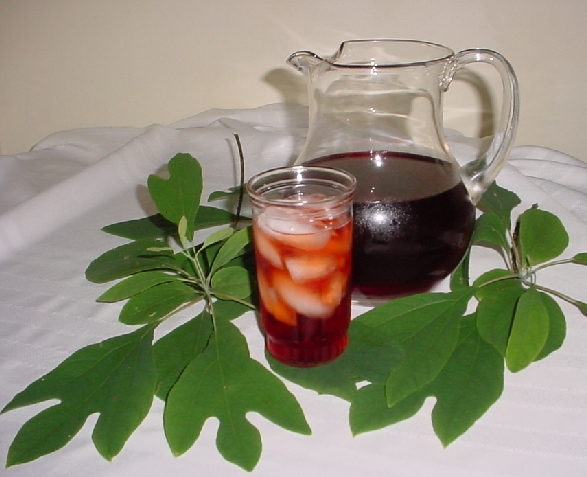
Sassafras tea drinkers have less colds
Sassafras Albidum: Beaux Gumbo
Bet your sweet sassafras! If you’re on the young side ask anyone not on the young side: Root beer used to taste a lot better, a whole lot better. Why?
Because it used to be made from the Sassafras tree. Nowadays the root beer flavor is concocted from “artificial ingredients.” Why?
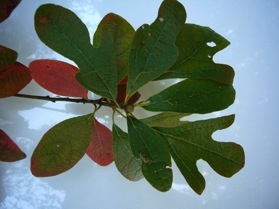
Dried leaves are gound to make “file”
Because some researchers force fed some lab rats excessive amounts of sassafras oil —safrole — and they got ill. That people didn’t get ill from drinking root beer was irrelevant. Safrole was ordered off the market and the state of Louisiana nearly left the union. One can’t have file gumbo without file (fee-LAY) and file comes from the sassafras tree (Sassafras albidum.) A compromise was reached with the gumbo foes: The leaves have barely if any safrole (SAFF-roll) in them so file was allowed but nearly all other consumed uses of the sassafras tree were out.
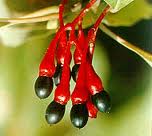
Non-edible fruit
In all fairness, safrole is a strong oil — also found in the yellow anise tree and the camphor tree. It was used to induce abortions, perhaps a muted reason why research was conduced on safrole in the first place, and why a reason was found to ban it. The lab rats who got extremely high doses ended up getting tumors in their livers and we got root beer tasting like bubble gum. But, as Dr. James Duke, below left, the author the Handbook of Edible Weeds, has written, safrole has to be put in perspective: Root beer with safrole was 1/13 as cancer-causing as alcohol in beer.

Dr. James Duke, author of the Green Pharmacy
Several thousand tons of Safrole are produced yearly outside the United States in China and Brazil. Distilled Safrole is used in perfume manufacturing and in natural insecticide products. Safrole shipments, however, are highly monitored internationally because Safrole is also used in the manufacturing of the illegal drug Ecstasy. Another reason to ban it. In high doses Safrole is also hallucinogenic. Said another way, sassafras is unhealthy if you abuse it. File, fortunately, is still legal, so you can buy it or make your own, if you can find a tree.
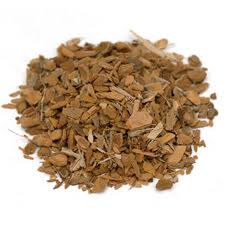
Sassafras Root Bark
Depending where you live the Sassafras tree —which can live to 1,000 years old — is one of the most common tree you never see, along with the Hercules Club, another topic de blog here. In Florida it’s easier to find marijuana growing in the wild than a sassafras tree… No, that’s not what “eat the weeds” is all about. But, if you do look you can find sassafras They reportedly grow as far north as Maine but I grew up in Maine and never saw one. If anyone knows where there is one in New England, please take a picture and send it along. At least one grows in Connecticut, according to a friend of mine. The usual given range is Massachusetts south to central Florida, west to Iowa and Texas. Locally — Central Florida — I know of one patch of them. One. That said when I take a month off in the summer to go hiking in the North Carolina mountains sassafras is everywhere, nearly a weed.
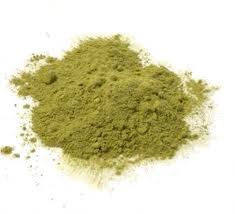
File gumbo powder
If you tear or crush sassafras leaves, they smell like root beer. You can make tea from the leaves by pouring boiling water over a small handful and letting them seep off heat for a few minutes, straining out the leaves. The roots of a young sapling make a better tea. It also makes a great jelly. Brew three strong cups and follow the Sure Jell recipe. Incidentally, the sassafras fruit resembles a blue berry in a red cup. It is NOT edible.

Mug of Root Beer
The name Sassafras (SASS-uh-frass) has been around for over 400 years, and there are several notions of where it came from. The leading contender is that it is a corruption of “saxifrage” which is Spanish from Dead Latin for “stone breaker” a reference to using sassafras for the treatment of kidney stones. It is diuretic. Albidum (AL-bih-dum) is also from Dead Latin and means white, referring to the tree’s white roots. Perhaps out of political correctness, many sites say Sassafras and Albidum are American Indian words but there is little evidence to support that. Incidentally “Root Beer” was originally called “root tea” by its inventor Charles Hires. A friend, however, suggested he would do better if he called it “root beer.” Hires, a pharmacist, was on his honeymoon when he came up with the formula for root beer. I’m not sure what that said about his marriage.
Sassafras has no natural enemies and its oil has been used as an antiseptic, a pain killer, and externally to treat lice and insect bites. It was once used in soaps, perfumery and toothpaste. The twigs were used as toothbrushes. Before WWI, research reportedly showed people who drank sassafras tea had fewer throat infections and colds. The wood is heavy, strong and aromatic and was used in boat and bed building. The bark can yield an orange dye.
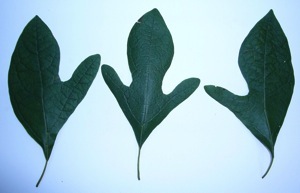
Sassafras has three “mittens”
The sassafras is nearly unique among trees by having different shaped leaves on the same tree: Right-hand “mittens,” left-hand “mittens” and double-thumb “mittens.’ On rare occasion, there will be a full glove leaf with five lobes. The leaves have no teeth. The only other “edible” tree that can claim different shaped leaves on the same tree is the Mulberry, but those leaves have teeth. In fact, my red mulberry has only oval leaves and no “mittens” at all. However Paper Mulberry trees do have very large, sand papery mitten leaves with teeth. Paper Mulberry leaves, however, are two to three times larger than sassafras leaves.
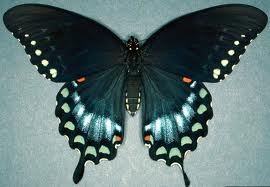
Spicebush Butterfly
Besides having an attractive scent for human bird watchers, the sassafras’ deep blue berries are eaten by some 28 birds including bluebirds, robins, red-eyed vireos, pileated woodpeckers, bobwhites and turkeys. Bears like them too. Beavers like the bark ( and apparently are made of sterner stuff than cancer-catching lab rats.) Sassafras was one of the first exports from the new world to Europe. As early as 1584 entrepreneurs were sailing to the Americas exploring and looking for sassafras. In 1603 two ships left England for North America for the singular purpose to take home sassafras. By 1610 sassafras was so prized that providing sassafras oil was one of the conditions of the Virginia Charter. (See my Pocahontas and Gamma Rays article.) Back then, in today’s money, a ton of sassafras was worth more than $25,000. I got my sassafras tree, however, for free.
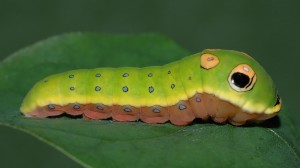
Spicebush butterfly larva
In fact, got my little sassy sassafras tree from feeding a goat. I stopped along a rail trail one day to feed a milking goat some grass that was just outside her reach — I like goats a lot — and noticed a sassafras sapling. I transplanted it to my yard because I thought it would be an unusual tree to have and I wouldn’t have to go looking for the next 1,000 years for leaves to make file. File, by the way, is not put in a gumbo, but is a thickening flavoring sprinkled on top, but I will leave those details to the Creole cooks. To make file:
Cut small branches from the tree in the fall when the leaves are starting to turn color. Wash them with water, a spray from a garden hose will do. Hang them to dry in a cool, dark place, at least out of the sun. Sun drying will fade the leaves. When dry remove leaves from the branches, and if you want, the stems from the leaves. Crush the leaves by hand. Put in a blender in small batches and blend until a powder. Sift the powder to get out any large pieces and store in a well-sealed container. A little goes a long way.
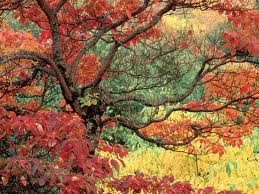
Sassafras in autumn
The state, national and world champion Sassafras tree — so named in 1951 — is in Owensboro, Kentucky. It is some 23 feet around and 78 feet high. Only 300 years old, it survived centuries of harvesting only to be threatened with a road widening in 1957. Then owner of the tree, Grace Rash, would have none of that. Her late husband, Dr. O.W. Rash, nominated the tree for the national register. She met the bulldozers with a shotgun and held everyone at gunpoint until a call to the governor, A.B. “Happy” Chandler, produced a pardon for the tree. The road was widened and the tree stayed, thanks to Grace, and Happy. Nowadays a governor would first take an opinion poll before acting, Grace would be locked up and on psychotropic drugs, and the tree dumped in a land fill replaced by a spindly designer picked Chinese elm sapling.
Oh, paleobotanists say the sassafras is like the ginkgo, a living fossil, going back some 100 million years…. They should’ve stuck a label on the tree: CAUTION: Eating sassafras may produce cancer in dinosaurs.
Green Deane’s “Itemized” Plant Profile
IDENTIFICATION: Leaves, 3 to 6 inches long with 1 to 3 lobes; 2-lobed resembles a mitten, 3-lobed leaf resembles a trident; green above and below and fragrant when crushed. Flower small showy, fruit, dark shiny blue ovoid in a red cup attached to a red stalks, maturing late summer. Twigs slender, green and sometimes hair, spicy-sweet aroma. Usually a shrub in the north, can be a tree in the south but usually a small scraggly tree.
TIME OF YEAR: Available year round.
ENVIRONMENT: Dry sandy spots, full sun to some shade. Here in Florida it likes to grown like a persimmon, along the edges of woods, fields and roads.
METHOD OF PREPARATION: Dried leaves for file gumbo, fresh leaves for tea, shoots and boiled roots for tea, twigs for trail toothbrush. A cup of bark in a quart of hot water seeped for 10/12 minutes can also make a good tea.
HERB BLURB
Native American used sassafras like the local drug store. Sassafras tea served as a pain reliever, stimulant, and diuretic. Safrole used to be called, by some, Shikimic oil. Interesting. Shikimic acid is the active ingredient in the influenza preparation Tamiflu.

We love sassafras, find tons here in Connecticut. I have read that safrole is the base ingredient in MDMA or ecstasy, a club drug. I wonder if this has a connection in the “cancer” scare of safrole in root beer. Making safrole an illegal substance adds to the difficulties of manufacturing and prosecuting of ecstasy use.
Anyway, we just make tea from the roots, and filé from the leaves.
Karen, The 3 Foragers
I am looking for information on the margreya tree. Not sure if I spelled it correctly. The leaves of this tree was boiled to make a tea which was given to us when we were ill. Would you have any information regarding this tree. Thanks
The Neem Tree is also called Margosa…
Tree is spelled moringa tree. Great health tree as can be seen all over the internet.
you can buy moringa seed online. I sprouted one this spring. It is in a grow bag. I live in north Florida and plan to plant it in the ground in the early fall.
The George A. Ricaurte ecstasy studies funded by the DEA which purported brain damage from ecstasy have been debunked. Ricuarte claims the l;ab sent him the wrong drug, but the mfg. debunks that claim by way of their automated packaging processing. The 30 vials sent to Ricaurte were part of a batch of 500 all of which were filled with the same material and none the others were found to have the wrong drug. So it is not possible his vials were mislabeled. Ricuarte actually dosed with a form of methamphetamine already none to cause the damage he documented. When no could replicate his results, the truth came out.
The moral of the story is don’t believe any study results funded by the DEA. The pressure to produce the desired results leads research to skew results in order to continue receiving funding.
Another DEA funded scientist Donald Tashkin was funded by the DEA to prove cannabis causes cancer. After many over a 10+ year period Tashkin ultimately found cannabis actually prevents cancer especially in subjects who smoke tobacco and cannabis. Guess who the DEA is POed out and will never fund again!
To date every replicated study of ecstasy has found it’s one the safest recreational drugs used with fewer than 1 adverse event per 100,000 doses and no more than one death per million. Most the deaths attributed to ecstasy have other been from other more dangerous drugs passed off as ecstasy or other major contributing factors. One young woman died from hyper-hydration–drinking too much water killed her. And near 100% of ecstasy deaths are artifacts of the War On Drugs, not the MDMA used.
Moral of the story: The War Drugs Kills!
You forgot to mention all the date rapes due to MDMA, along with Rohypnol, GHB, and ketamine, being slipped into unsuspecting victims drinks. There is no “safe” recreational drug when it’s being used to incapacitate others as a means to commit sexual assault; and I would hardly call rape a non-“adverse event.” Better to remain silent and let others think you’re stupid than to open your mouth and remove all doubt.
A chemical has no innate morality. It’s how humans use it that makes it good or evil
In East TN, you can’t walk 5 feet along a tree line without seeing a sassafras bush. I can’t recall seeing too many that were much taller than myself, though I’ll have to look again when I get back there. I drank the tea a number of times as a child, though our mother discouraged it because of the safrole. I think she really only allowed it for the sake of nostalgia, as she had drank her share of it in her childhood. In looking into it these days, I have found mention that safrole is also in nutmeg and cinnamon. I have also found mention that it evaporates at room temperature(volatile oil), which leads me to ask if the safrole, good or evil, should even be a consideration for dried and stores roots?
I have been looking for some sassafras root to make ginger beer and root beer and I can’t find it anywhere! I’m out in the bottom of Colorado where we don’t have any sassafras trees. Does anyone know where I can find some?
You might ask on the Green Deane Forum.
We have plenty of sassafras do you still need some? We bounce from NC to Ohio. Let me know? lare64@yahoo.com
There is lots of Sassafras over most of the Midwest USA. I cut down many in northwestern Ohio. To find lots of smaller trees to harvest roots for tea or root beer, or the leaves for feelay, just look for larger Sassafras trees. They get quite big in just 15-20 years. The younger saplings and bushes are always near the parent trees.
This tree is also excellent for firewood and produces a beautiful picture perfect fire with many oranges, yellows and blues. And gives off a wonderful, pleasing aroma. Many older Hollywood movies used this wood since it produce the very attractive, picture-perfect fire. The bark is quite thick and I know people who would just harvest the off mature trees without taking too much from any one spot. The bark heals itself within the growth season.
I’ve heard before that this is how the Indians would harvest the bark to preserve the resource for teas for their ailments and cures. The bark around the base of the larger trees can be almost two (2) inches thick, or more. I’ve seen 80 feet plus trees felled and the bark was very thick at the base, and easily removed with the right tool.
Yo Jeanette I have access to lots of it. Just let me know how much you want. Jim
Read ur reply to Jeannette. ..my family has been drinking sasafras as tea for as long as I can remember. ..i got married in sept of last year and I live in Michigan. ..i can’t find it anywhere. …i would be tremendously grateful if u could send me sasafras root for tea…i would be tremendously happy for any amount u can send..
.u can send it COD to
Gwen Springer
Midwestern Dental
45650 Ford Road
Canton MI 48187
I live in central IL. Just cut down several sassafras trees due to having trouble getting the mower between them. I wished I’d have known they were such a hot commodity. I have a million little saplings coming up everywhere now.
Try cultivating them organically and selling the leaves for file at a local farmers market.
I would love some of the saplings to grow in my yard. I wonder if they could handle zone 9 temperatures?
I just came across this article, and was so surprised at the comment that you didn’t find much sassafras in CT or in New England! I grew up in CT, and it’s one of the first trees that I got to know as a kid. We’d rub leaves on us to keep away mosquitoes. There are loads – especially around ponds and other waterways.
Hi Lorraine, I have drunk Sassafras tea as a young person. My parents knew how and when to harvet it from the woods. I have been tryiong to fimnd it and learned that because of the bark containing safrole, it can be dangerous to one’s health. I have several articles about the tea and its safety; however, I am very interested in knowing more about rubbing the leaves on the skin to deter mosquitoes. Please respond.
This is a great article on Sassafras (and a great website in general). We have many Sassafras trees on our property in Southern Ohio, some which are large (a few feet in diameter).
I disagree with Sassafras having no natural enemies. We have a big problem with woodpeckers drilling HUGE holes in the base of the stumps eventually killing the larger trees. I have seen holes 3″ square drilled into trees. I have also seen Sassafras trees in parks completely covered (and defoliated) by Japanese beetles. We don’t have the beetle problem because our trees are not surrounded by grass (so no grubs).
I love the smell of the crushed leaves, old broken twigs and the roots, but to me the only portion of the tree that smells like root beer is the root itself. The leaves don’t smell (nor taste) anything like root beer to me.
I find the history of the Sassafras tree fascinating. I have read that the roots of this tree were once this country’s largest export. It reportedly was prescribed to cure syphilis, so people stopped drinking the tea because of the stigma!
Do you have any large dead or downed sassafras trees you would be interested in selling or trading for turned bowls or cut lumber?
Locally sassafrass only gets big enough to turn a pen…
Are you still interested in a sassafras tree? I have a good sized tree on my fence line which I would like down – it would made beautiful bowls or lumber. I don’t want to just cut it and burn it, but if you want it, take it! Saplings come up everywhere in my yard! I am in north Louisiana. Have lots of cypress knees too, because I am waterfront. Let me know if you are interested. thx Barbara
For the readers, Barbara, where is the tree.. like west Florida, North Georgia…
Do you still want the tree out? I could stand to get away for a bit, and I have an outlet for it. Reply to my email
a leaf a day keeps the ticks away! ok, maybe more like three or four leaves. it works well!
Howdy from East Texas…these trees are all over and one of my favorites…I have a bunch since I am a forester by degree. Excellent well researched article. Will be checking out rest of your site now.
How much would you want to mail 2 to CO. Or if you’d want to trade I have Lilac and Scotch pine saplings
I live in Missouri. I was taught to look for sassafras trees by the 3 different leaves, but unlike the article states, the leaves are football, mitten and 3 lobes. I came across sassafras hiking today and brought home the 3 different leaves to show my son and noticed the mitten is right-handed. I found your article by searching for left-handed mitten – since I’m a lefty : )
Now I’m confused by the football shaped leaf. Is this a variation?
It can happen now and then. Occasionally you will find a sassafras with two thumbs and no aroma when the leaf is crushed.
Did the football shaped leaf come off the same tree? Here in central Alabama, sassafras tree are found in the same environment as pawpaw. One of the largest pawpaw patches in my area is also a sassafras patch. Seeing that pawpaw has a large football shaped leaf and that they grow together, maybe it’s a pawpaw leaf.
No, occassionally here there is a sassafras leaf without thumbs.
Hi I have a stand of Sassafras on my land in Massachusetts. I have found the football leaves to come from the younger trees. The well developed mittens and double thumbs come from the older trees.
Sassafras are threatened/endangered here and are not to be destroyed.
They make wonderful tea from the leaves.I won’t pull up the roots for root beer due to its endangered / threatened status, A long time ago we used to make fresh root beer and it was heavenly.
Totally loved the file directions. Lived in New Orleans a long time ago and gumbo and Creole food is incredible. If we care for our plants we can keep these traditions going sustainably.
Thank you for a very excellent website. Well done you and all the readers. Love everyone’s replies. Thanks everyone!
Best wishes to all,
Jeanmarie
We have many Sassafrass trees here in Virginia. I had noticed the unique mittens shaped leaves on this tree and had wondered if other trees had multiple shaped leaves. Thanks for the update. I had also read about the cancer risk and had avoided making teas. Maybe I’ll give it a try.
I live in the piedmont N.Carolina and have small trees on my property that have mittens , smell nice, but they are almost all three lobed leaves with the middle being sorta stubbed off and almost never pointed. ???
Could be a sassafras…do the leaves have teeth? Are they kind of leathery?
Hi Dean.
you could say the leaves are kinda leathery though thick applies also. always three lobes, no teeth edges are smooth. wish my camera was working. Again very pleasant smelling, i even chewed a tiny bit of a leaf, nice taste and aromatic and spit I spit it out.
My sister says you should dig sassafras roots in the spring to make tea. Is this true? I buy a sassafras concentrate at a local grocery but it is not as flavorful as what my mom used to make.
The root has been used for tea, sparingly.
Darlene, is it in the spring you dig the sassafras roots, I use to dig the roots and make tea, I forgot if it was spring or fall, appreciate getting back to me. By the way I love to drink the tea, I always heard it purified the blood, but haven’t heard that from any of the commits. Thanks from Missouri where there is plenty.
I live in Connecticut and have 2 or 3 sassafras trees in my front yard.
I am interested in planting a sassafras tree in Fort Myers, FL. Is there any reason why it would not do well here? If not, where could I obtain a good specimen?
It might be too warm. I’m near orlando and they only grow to spindly shrubs here. The USDA say Orange County is as far south as they have been reported to grow in the wild.
Thanks for the response and practical advice.
Can one buy sassafras root in Conn.? Thanks, Josie
It is for sale all over the internet.
Unfortunately, the Redbay Ambrosia Beetle, a recent pest introduced into the gulf coast area from Asia, has a taste for sassafras. It transfers a fungus to the plants which wipes them out. This is bad news for one of my favorite plants.
Ah… Asia.
We can always rely upon it.
The Asian honeysuckle is choking all of the wooded areas in southwest Ohio.
I’m a trucker. Sassafras looks different in different regions of the country. Sometimes they look very different, but the roots always smell strongly of root-beer 🙂
Some of them have spade/hourglass-shaped leaves.
They may appear to be shrubs to some people, but the ones that live long enough turn into big trees.
Often, the roots connect underground. If you’re careful, you might be able to dig up a long runner w/out breaking it. The best tea comes from the outer-bark of the root. The inner-woody part is useless.
I used to drink gallons of sassafras tea when I was a boy. I’d make it as concentrated as I could. Tastes great w/ sugar.
The sassafras tea concentrate that is sold in healthfood stores has had the safrole removed and tastes awful & makes me sick.
There are many regions where it’s hard to find, but once you find one, there are usually many more nearby. They are very easy to identify, once you know what the leaves look like, and since the leaves are edible, it’s worth learning how to ID them. I’ve never ate a bunch as a meal though. They just don’t seem very substantial, but they might keep someone from starving if they’re in the right area.
I am a native of Louisiana, i am 60 yrs old and and have been drinking tea from the roots of the Sassafras tree my entire life,it grows abundantly in central Louisiana (where i live) and is very easily identifiable, i really like the flavor of the tea. Dug some roots about a month ago and and brewed and really enjoyed it, i try to brew some every fall. I have thoroughly enjoyed this article,, it backs up what my mom has been telling me all my life,(moms know best). Incidentally i am beginning to feel like a dinosaur. Lol…..
Would it be possible for you to do a video of how you prepare the root and make the tea and post it on youTube? My father told me about it when I was a little girl. I loved the tea. Thanks from Baton Rouge.
I pray the new year treats you well, Mr David.
I’m from South Africa. Just came across this site. I appreciate the stories and comments. I would love to try the tea. Rooibos is the tea I grew up with. Please share to taste. I’m scared to order from any website. Never know what’s in the mix. Best wishes.
I don’t sell material but I will give you email address to someone good who does.
I’m in Massachusetts on the coast, and we’ve got boatloads of Sassafras here! The saplings take over the edges of the yard every year – we cut them down, and they come right back the following year. They go from inocuous-looking sapling to small tree very quickly. I love the “mitten” leaves – it’s a perfect description of them. I’ve been thinking of digging some roots this year and trying to make real root beer.
Hi Christine,
I grew up on the North shore near Swampscott Marblehead and my Grandmother and mother always made root beer every fall in a giant empty pickle crock in the basement.They weighted down the lid and
When it was ready sort of effervescent they had us kids help them bottle it in the old glass beer bottles with the wire bale stopper lids.
One year they didn’t get the case out into the bulkhead where it was cold fast enough and we had exploded root beer all over the cellar!
It smelled great! As little kids we loved playing in the sweet smelling root beer cellar.Good luck making your root beer .Its incredible .
Here in PA, my brothers and I used to chew the green bark off the twigs and eat it. The bark slips off the wood easily and provides a refreshing flavor. I came across some recently and enjoyed it just as much. It’s also used to enhance the flavor of apple butter, but I don’t know what part of the tree is used for that. Can anyone tell me?
I live in Jackson County in Southern Ohio and Sassafras are everywhere. Here in Jackson County we have the Apple Festival and apple butter is a favorite commodity. When I make my apple butter, I use really strong sassafras tea and apple cider to enhance the flavor. I just add 4 cups 50:50 mix to my stockpot of apples and let them cook down. Then once the consistency is right I add my powder spices before filling my jars and processing.
Thank you for the apple butter recipe with the Sassafras. Can’t wait to try it.
Thanks for the article, I enjoyed reading about your experiences with this fine tree. I’ve dug up my fair share of trees large and small to get their roots for making into tea and root beer. Can’t get enough of the stuff, love the beverages and the joy of introducing a novice forager to the joy of ‘root wrestling’ – wow what an aroma those roots release! These trees do grow in Southwestern Ontario, have harvested roots, twigs, and leaves from trees in the Hamilton and the Windsor areas. Mostly I see them only reaching about 25-30 feet but there is one big (for Canada, anyways – this is their northern limit) one near my home that stretches up about 45 feet with a trunk at least eight feet around. I would sure like to see the Kentucky champion sassafras sometime!
hey man I’m from Windsor and spent parts of the last two days looking for the sassafras tree but couldn’t even find one… if you can point me in a direction where they grow… I hear they are rare and grow in patches…
Searching for something about goats eating weeds on tea plantations
in China accidently got onto sasafras,
Remember drinking sasafras tea as a young boy in rural Georgia,
that was over 80 years ago.
A catclaw bush grew through a latch on a shed door I have
on an airstrip in the Nevada desert…
Spent my working life, starting as a teenager in 1944 as a merchant
seaman, 40 years.
Computers have put the world at my fingertips,
looking back and connecting the memory dots.
Thanks…….for ur stories…
I was SO excited about finding sassafras this weekend near Stockton, MO. I’ve looked for one of these “common” trees for YEARS here in Missouri: I DON’T THINK “COMMON” is a good word; Elm is “common”…Sassafras is UNCOMMON-COMMON, I digress!
Anyway, there were literally 20 or 30 little saplings and 2 HUGE trees near the lake. I jumped up and down and squealed like a 6 year old at Christmas! I sacrificed one sapling for tea, after confirming there were plenty, and dug up another to take home! I’m looking for a “hard ale” recipe for the sassafras root I have, if anyone knows of a fermented drink recipe…I’d appreciate it!
I live in Virginia and I have several sassafras trees in my yard. My dog seeks these trees out to eat the leaves. Do you think that she just likes the flavor or is do the leaves provide some medicinal or nutritional benefit? Also I saw in one of the comments that eating the leaves keeps ticks away. Is that true?
Thanks for this informative site.
This is an amazing site and I just keep on learning! Glad to find that I also have a bit that I can contribute. I just encountered Sassafras a couple of weeks ago – was so surprised to see that they grow in Ontario. Apparently – here in Hamilton – it is at the northernmost part of it’s range. The area is Cootes Paradise
I have a couple of photos which I would be happy to send along . Am currently drying some leaves to make file’ powder & tomorrow will gather more to try that delicious looking tea. Let me know if you would like the photos Deane.
Find it often in CT. I almost always encounter it at “woodland edges” which coincides with field guides and fact sheets. Love the aroma and one of my favorite trees. See web link for autumn photograph
I grew up drinking sassafras tea every spring. Even as a young woman, I’d go out in the spring to dig some roots. I now live in AZ & buy the concentrate, but it doesn’t make as good a tea as steeping the roots did. My parents viewed sassafras tea as a healthy spring tonic, so I was drinking it before I can even remember. It was one of my favorite treats as a young child. Banning the sale of sassafras was asinine.
I was surprised to find that there are many Sassafras trees in the Philadelphia area.
The story of its ban by the FDA (on account of safrole) reminds me of wormwood – the “hops” of absinthe. Wormwood contains thujone and it was determined unsafe base on similar testing methods – injecting rodents with high doses of the isolated chemical thujone. Just add big business special interest (wine companies) and religious hysteria to the mix and you have the infamous absinthe ban.
I picked up some Sassafras leaves on Saturday and now enjoying a nice cup of Sassafras tea. Very pleasant flavor – reminds me of a bit of wormwood and horehound – but less intense.
Thank you for all the info. However..is there a recipe for making the tea that someone would like to share.
I live in the Hudson Valley and have three Sassafras Trees over forty feet at the edge of my property.
Hi! I live in Maryland and used to make the tea every spring. To make it, dig up 2 or 3 small saplings. You will want a fairly large root (about the diameter of a pencil). I use a vegetable brush and lightly scrub the roots to get the dirt off. Place in a 2 quart pot of water and simmer for about 20 minutes until the water looks like reddish brown tea. I no longer have a place to dig for the roots. Enjoy!
Hi I have made great tea without digging up roots.
Fresh leaves I pick up after a storm blows them down.
I place several on the warmer or in a crock pot on warm or low depending on your crock pot and I steep the leaves slowly over night. The tea is delicious full flavored .
I also boil the wigs with the bark on them .great flavor.
Hope this helps.
Wondering if anyone has frozen the leaves to make tea in the winter?
I live in West Virginia and the Sassafras tree grows wild here everywhere in our woods. I live in a smaller city in North Central WV and actually have a tree in my yard that is at least 50-75 years old. If anyone wants Sassafras all you have to do is drive down a country road and look in the tree line and you will most assuredly find one. Love the tea!
Hi if there is anyone there who can tell me how to have a sassafras tree mailed to me please let me know.Beleived to be a great healing agent.
Tish,
You can order them from the Arbor Day website I just ordered one. Will be delivered in November for fall planting. Reasonable prices too!
At Durham NH we have stands of sassafras on the bank of the Oyster River, part of the Great Bay Estuary system. Our primary stand includes 23 trees, most over 60 feet tall. It is a wonderful habitat for birds, including the usually shy pileated woodpecker, and a large family of flying squirrel. We have planted hosta and pachysandra for their ground cover. The trees began turning last Monday, Sept. 30. Took some photos today, I’ll post it on your facebook page. You may repost it with credit, if you wish.
Found this interesting article researching for a program t5o give in November at my herb society meeting. grew up in south Georgia and remembered hearing about sassafras tea, but had never made it myself. I buy file to cook with but would like to try making my own and doing some tea to share at the meeting.Leaves are turning slowly here in Alabama this year.Will look on line and see if I can locate a site to buy one or roots. Will be getting the book also. thanks for the great read..and the very good comments.
Thanks for the information on Sassafras. As a kindergarten teacher I take my classes on nature walks through a neighboring untouched nature area. I always show them the wonderful sassafras tree and its unusual leaves among many other wonderful things. There is only one sassafras tree in the whole area. (I guess since there is no other one to cross pollinate with…we will never have another.) We are in PA and hour north of Philadelphia.
i live in mcminn county tn. 2 years ago i was clearing out some of my property to make a veggie garden and along the process i was tilling the ground when i felt an strong escent . didnt know where it was from until my father in law told me that i have had chop off a sassafras tree ..thats when i took action to seek more information about the tree and since then i keep sassafras root in my house just about from mosquito bites to head lice killer since my kids come from school one day with plenty of it to share …yeah right.
I live in central Texas and make walking sticks from sassafras and other saplings. If anyone has an abundance of saplings that need to be removed, I am looking for lots of them. Please contact me if any questions. Would prefer saplings from northern states. They seem to have less insect problems.
I am a pharmacist and live in Taylor. I have been collecting antique medicine bottles and have several sassafras oil bottles along with a lot of others. Anise oil is also one of my favorites. I have property on the San Gabriel river in far eastern Williamson Co. I will start lookinf for Sass trees. I would like some saplings.
I live in RI and we had a beautiful grove of 24 Sassafras trees in the front of the house that had been there since 1975.
Suddenly last summer, all of them died. We had to cut them all down for firewood since, living in the Atlantic Corridor, we have hurricanes and the dead trees could fall into the house or onto the power lines.
We could find no fungus or disease. I have seen articles about Asian beetles, but I’ve never seen any evidence of those either. We are so saddened to lose those trees, and especially since we have no idea why they died like that. They are the only species of tree on our property or on the street that died like that.
Does anyone have any idea what could have killed them?
I posted your question on the Green Deane Forum and this was one answer. You might want to consider joining the forum. We chat about foraging all the time.
It was not old age… not if all 24 died at one time. They could have been killed from the stress of the drought 2 years ago, even after coming back last year. Or, it could have been a winter kill issue. Or, possibly root rot after the stress from one of these natural events. Sassafras also sprouts from the roots, often forming a colony. If the roots have been affected, they would not resprout after this die off, otherwise, it is possible that they would.
One other possibility is that the yard was treated with a selective herbicide. Perhaps one that was included with a fertilizer. Or a neighbors yard was so treated and the runoff from it killed the trees.
I do not have any pictures because it is winter but I live in fairfield county Connecticut and have several Sassafras trees in my yard and dozens in my woods. I used to chew on the sticks as a kid to get the flavor. It is amazing to hear that they seem rare in these parts as I have always grown up (including in Maine) seeing them all over. The three shaped leaves made it the first tree I was able to identify. Funny story in relation to soda production and drug production. My Ex was interviewing someone for a soda festival in Arizona and they were saying it was so hard to make good root beer because safrole was so hard to find because of “those damn druggers and there extacys”. Hope you enjoy.
I live in the West Coast and just ordered bareroot Sassafras tree for planting in my backyard. Im very excited that I will have a Dino tree in my property that will outlive around it for a thousan years.
:”)
I’m 62yrs old and live in southern Missouri. Have drank sassy tea all my life. NEVER BOIL sassy in any way shape or form, STEAP ONLY.
Lots about red sassy but nothing about white sassy. Red is drank in spring and summer to thin the blood so your body cools easier. White sassy is drank in the fall and winter to thicken the blood so you stay warmer. People with blood conditions, use with CAUTION.
White sassy is extremely hard to find. Ph in the soil determines the color. The only place to find white is usually in a fence row next to a hay field or cow pasture. If there is any kind of tree or shrub growing close by will change the ph in the soil and the sassy goes red.
We use sassy poles for our chickens to roost on. It prevents them from having mites and foot fungus. Our dog house floor is made from sassy poles to repel mosquitoes and copperhead snakes.
Right thumb…..left thumb…..double thumb mitten…..either way sassy is “thumb up”!
Awesome information! Thanks… I am from Va and had no idea there was a white and red option. Now in Illinois I am determined to see if I can find either one.
I love sassafras we used to drink it as kids. It’s hard to find near me .Anyone who has some extra roots i would be willing to pay for you can contact me at carlscheuer@gmail.com
I drank it as a child and it’s a fond memory. 🙂 I live in Coastal Mississippi and have not seen a sassafras tree since childhood. I’d love to plant one since I buy and use file’ regularly but I hear they won’t do well this far south? I love the thought of walking to my back yard to grab a few leaves to dry and grind… not to mention making tea for my own children to try. 🙂
They grow here in Central Florida, but not too tall.
I have hade this tea all my life. It started when my mom was trying to lower my dads extremely high blood pressure. We had a gallon of this tea in the frig everyday. Yes it did lower his bp. And he had no further problems. We just washed and boiled the roots in about a quart and a half of water.. That made a concentrate and we added enough water to that ( once strained ) to make a gallon. We sweetened with sugar or honey just like store bought tea bag type teas. Never got sick. Never got cancer. We drink it year round and I find spring roots from saplings to be more bitter tasting than summer harvested adult tree root fragments. I really dont care for the bitter taste of sapling roots but I only tried spring harvest of saplings so Im unsure of the qualityin other seasons. Adult roots make better tea in my opinion. And btw, we are almost never sick. My kids ages 7-17 don’t get colds like most kids. I never though about it being the tea!! My husband has never missed a days work from being sick. I here it does thin the blood, which my mom told me as a child, so we have no more than a quart a day each as a rule although the hubby sneaks more 😉 His family grew up drinking it too. Good luck to everyone seeking trees. Try east Tennessee!! We have lots. (sorry for typos could not reread since I posted from my cell )
Tons of sassafras here in Jersey! I’m gonna try your recipie suggestions asap!
We live in rhode island and have about 10 trees in our back yard. They’re huge about 50 – 60 feet high but we think they are dying and not sure why. I don’t know how to send you a picture and add it to this comment page. Send me your email and I’ll send you a few.
Hey Guys, I am looking for saplings about 4′ +. If anyone has any please email me terri@sommellamarketing.com. I am willing to pay. I am in PA. Thanks!
We have a cabin near Tionesta Pennsylvania, and the sassafras grows like weeds. It’s everywhere! We need used to make tea from the roots all of the time. We were afraid we would ruin the woods by pulling all of the trees out.
I believe I have a group of small ones in my back yard how can I send you a photo?
Photos can be posted on the Green Deane Forum’s UFO page, unidentified flowering objects.
I see sassafras trees growing in the woods of NH all the time. I’m surprised to hear you say they are scarce. Next time I’m out i will take some photos
I have roots boiling now on stove. It’s all over the place here in Northwest/Central Louisiana and East Texas, especially in Longleaf pine country. I can it in my pressure canner to save on shelf. I also put some root in container w/water and Rusty Blackhaw berries, Parsley Hawthorn, and Winter Huckleberries; let them soak in fridge for however long it takes me to get around to it, then boil up berries, squish thru a pillow cas, and make syrup, jelly, etc. And if you get some dried wood;even rotten; with bark on it, it’ll smoke ham, ribs, etc. that’ll make you SLAP YO MAMA!!!!!!! Good like wow! try using some dry pecan wood with it too!
Is it legal to sell plants/parts online….interstate/intrastate?
It usually depends on the plant and what part of the plant.
Worked as an Arborist for 15 years on Cape Cod. These are all over from Hyannis to Provincetown. They grow and spread very rapidly with the largest near Pilgrims Monument. These trees are great for hillsides and help prevent soil erosion.
Does a tea or concentrate made from the leaves or file taste anything like sassafras bark or root….like root beer? I’m going crazy trying to find a safrole free sassafras extract or bark without added preservatives or colorings.
Similar…
first: extract flavour from the plant leaf root etc (somehow like orginal rootbeer manf. ) second: remove the safrole. third: submit sample to a professional lab for analysis.
it would be de-safrolized ? i think the important part might be the safrole incl. ? note: i would check with a local expert as well before consuming anything like this. great page and amazing plant!
A question: I have read that safrole is a volatile oil which evaporates. If so, wouldn’t boiling the sassafras root cause the oil to leave the liquid? Tanks.
How many times is it okay to boil and reuse the same sassafras roots?
Until it is not sassafrassy….
I tho k I may have the westernmost Sassafrass tree in my front yard in Spokane WA. Good friends of ours moved to Upstate New York, and have it growing all over the edges of roads. The found a young sapling and mailes it to us 10 yrs ago. We just harvested some leaves for file, and tried making leaf tea. Very nice.
Tree started at 16 inches, now about 7 ft tall 10 yrs later. It’s doing well, in a semi shady spot on the North of the house.
Every couple years I take a picture with my daughter, 2 yrs older than the tree. 10 yr old Sassafrass and 12 yr old Sassy Ass.
I also live in spokane WA and was wondering if you still have the tree in your yard? I would love to take a cutting if you wouldn’t mind If I tried to root my own.
I live on Long Island, NY and I have a wonderful one in my backyard. Now I know what to do with the shoots that grow all over the yard.n They smell so wonderful.
I am 72 years old and when I was a kid, my dad would grab a couple of sassafras leaves off of a tree and give one to me and we would eat them. When digging post holes and clearing out some of the trees the roots would smell like root beer and he told about his family making sassafras tea out of the roots when he was young, but we never did that. We would just eat a couple of leaves. When I was probably in my 20’s, I grabbed a couple of leaves and I ate one and had a friend eat the other one. He really questioned me about being OK to eat, and I told him my dad and I ate quite a few when I was young. I think that was the last time I ever ate a sassafras leaf.
Did anyone else just eat the leaf?
Ron, our Amish neighbors do the same thing. They eat the leaves and chew on the stems while they work with fences. They laughed and said it was like chewing gum. We are in SE Indiana and sassafras grows like a weed here. It fills in young tree stands and edges along with elderberry, mulberry, honey locust, and juniper.
In the early 1980’s I would make sassafras tea and take it along to drink during high school track meets. Everybody on my team loved the tea and always asked if I had some. This was in Missouri. I know that sassafras trees grew in Illinois also because my grandmother would take me out mushroom hunting and we would find sassafras.
I live in TN and I am 14. I find a lot of sassafras in the woods next to my house. I make tea all of the time and all year long. What is the best time of year to pick the roots? Or is it okay to pick it any time of the year?
Summer and fall are the best though they can be used any time.
Hello Deane! Good day to everyone. 🙂
Is this tree illegal to possess or grow? I’m paranoid about storm troopers raiding (and taking) my property because I have a tree that ‘could’ be used for nefarious purposes. I’m just a big plant nerd and I’ve wanted to make homemade root beer from scratch ever since I can remember. I’d love to have this tree but I’m worried it’d bring ‘invasive predators’ to my home. Do I have anything to worry about?
No the tree is not illegal to possess… heck some Louisiana police might kiss you for it…
N, you don’t. Its a perfectly harmless ordinary tree. When you see it you’ll say, Oh That? It grows everywhere.
I live in Connecticut and it grows everywhere.
Hi Deane, just wanted you to know I have several sassafras trees on my 20 acres.
I also have a picture of a tree I would like identified, you you would be so kind. You did show the bark one time and I asked you if they grew in Michigan and you replied with a yes. I can email it to you, but I cannot find your email address. I love reading about all the wonderful things you have to share.
Have a good day and I hope yo email you that photo one day.
Thank you
Ihave been making tea out of the roots since I was a child. I swore it helped from getting a cold. I never knew you could use the bark and leaves for tea. I am also confused about what is toxic. The root? The Bark? or the Leaf. Can someone explain that to me? Thank you. This tree is not only great for tea but the leaves in the fall are so bright yellow.
What other trees can you use the bark or leaves for tea or whatever that are safe? I like using everything as natural as possible.
says sassafras is hard to find but its everywhere where i live about an acre of forest behind my house is sassafras, tree lines etc.
Ive got lots of young trees growing out back, on the hill here in Tennessee. Ive gotta try using them!
We moved to NW Arkansas a little over a year ago…discovered I have Sassafras trees in my front yard! I remember cousins making homemade root beer when I was young and would love to try it myself. Ours are getting ready to bloom and I hope the impending freeze doesn’t ruin the blooming… I must admit I stumbled across your videos by looking for information on the tree…so glad I did. I enjoyed your presentation style. Thanks for all the information. I will be checking this site for more information in the future.
Thank you for your kind words.
My stupid uncle sold the house I was to inherit.On the property was her prized sasafrass tree.75 feet tall and a ddouble tree.The address was 147 Jones st. WestHaven ,Connecticut.I just looked on Google to admire the exotic tree and to my horror the endangered tree was gone.Cut to two monolithic stumps.I want to kill someone!!!
That is horrible! I continue to be saddened by things like that. I am a tree hugging nature lover and have no respect for those who think nothing of destroying nature for sometimes very little purpose at all! I feel your anger…?
What is the best nursery to buy a sassfrass tree to be grown in Florida?
Walking the trails in and around Hammonasset beach state park in Madison CT last week, we observed many Sassafras trees and young saplings. You may wish to check this out.
Enjoyed your article.
I live in Southeast Georgia. My grandmother had us youngsters gather sassafras roots for making delicious tea. We drank it hot or iced. Delicious. Not able to go looking for the trees now, unfortunately. I am sure there is trees still growing in our county along wood lines and in forested areas.
There’s an enormous Sassafras near a creek bed behind my house in southern Indiana. It might rival the champion in height, but it’s only about 9 feet around. I’ll have to bring a protractor and tape measure on my next hike.
Hi, can anyone tell me how to use the root bark of Sassafras to make root beer? Should it just be scraped off and added right away to the boiling liquid, or should it be dried first? All help would be appreciated!
I’ve loved Sassafras ever since I was a boy in North Carolina. My dad used to make us tea as a treat. I live in Jacksonville, FL now and was thrilled to discover that my back yard is FULL of Sassafras of all sizes.
I may be the person with the sassafras tree in Connecticut. The man who will be cutting this beautiful tree down said “I have to tell you that is the prettiest sassafras I have ever seen”. The problem? Baby sassafras everywhere. They are in my gardens across the street at my neighbors, next door, everywhere. I have hired people to dig them out, to cut them down, and even (going against my green preference) try to poison them. I am now planning to cut down the mothership and poison her roots.
They are in decent supply here in Eastern Massachusetts, so not too far from Maine. They are not the most common tree around, but are readily found in certain woods. They rarely get over 6 feet tall here, and seem to live under the shade of much taller forest trees.
Sassafras is all over the place in the Eastern US, at least in the Mid-Atlantic. I can see no fewer than 10 from where I am sitting right now.
They are also ridiculously easy to identify- try looking at forest edges, around land cleared for houses or buildings, etc.
I would like to have a sassafras tree in my yard in Central Florida. Where can one be purchased?
I just read about the article about the sassafras tree and saw you’d asked where you might find one. I live in NW FL and bought a tree yesterday at Floral Tree Gardens on Pine Forrest Rd just north of I-10 in Pensacola. It’s about 36″ high. I saw them last year and really wanted it then but was on a mission looking for another type tree.
I love the fall color it has and am interested in medicinal type plants & trees. Please do let me know if you found one and how it’s doing.
Sincerely
Paula
I bought some off Amazon. I started with 5, about 10 to 12 inches. 2 leafed out. That was last year. So far this year no leaves, but still greenwood, so I am still waiting.
You asked about sassafras in New England. Sorry no pictures but this spring I found a small stand of it in Western Mass. along the AT.
Also no photograph, but a large, mature sassafras tree at the curve of Hubbard Pk. Rd. in Cambridge, MA.
I usually never leave comments anywhere besides reddit but I have to say, this article was amazing to read. I live in Florida (9b) and just turned 30 and really started getting into gardening. My first plant I ever grew from seed was a passionflower vine. I grew it because I wanted to use the leaves in tea and to smoke so I can fall asleep easier (which works great for me) and it’s still growing wonderfully. Since then I knew that I wanted to specifically grow medicinal plants that have uses besides just looking pretty. I am going to grow sassafras as my next project. Even if I only get to use it years from now I will be happy that the next generation will be able to enjoy it. I want to know what root beer is supposed to actually taste like and so should my children and their children. I also want to experience the psychoactive properties of the plant, especially because it is an entheogen which can be very good for the soul and for mental health.
It is no surprise to me that the feds outlawed certain uses for this plant because god forbid somebody ingests it and feels euphoria. I will never understand why our own and other governments are waging war on plants, especially entheogenic plants and substances which can give you overwhelmingly positive and undeniably human experiences. They can even help people with PTSD and folks who are terminally ill and also help people become more mindful of others and empathetic. I guess cutting down 300 year old trees in order to build another road is more important than discovering your soul or even enjoying the taste of root beer. I hope they stop the war on plants someday. Anyway, this was a wonderful article to read. Thank you & much love.
I found a few young Sassafras trees in our tree kine today, I’ve taken pictures of them if need let me know where n how to send them to you.
Ty From, Glasgow, MO.
Send them to GreenDeane@gmail.com
In my experience, Sassafrass wood is very light weight, I am curious why you say it is heavy?
We have tons of it growing up here on my ridge in the Appalachians of WV. Each spring I use the sapling roots to make rootbeer.. I also boil the entire root, keep reducing it down until I get a strong dark heavy scent… I use that for he made soaps and lotions.
I have 3 (that I know of & can see) growing on my property in North West PA. 2 young ones & an older one. Both close to our roads edge. Can’t reach any of them as they’re on a steep hill…