
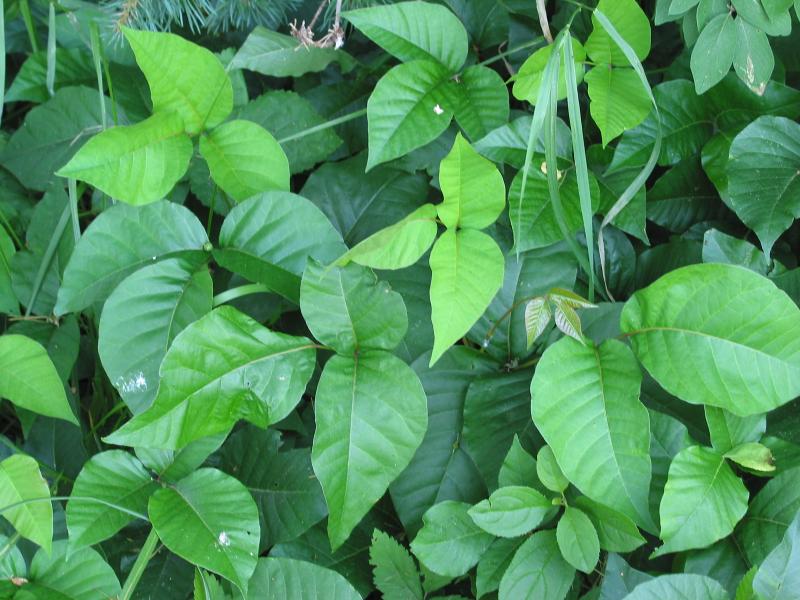
Three leaves, no spines, can be trouble
I did something this past week I have not done in some twenty years: I got poison ivy.
Given what I do for a living, running around the wild all the time in a state smothered with poison ivy, I suppose two cases 20 years apart is a good record.
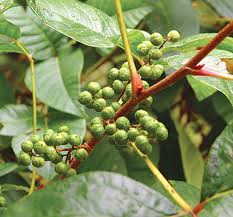
Berries range from green to white
It’s a small rash with a big itch, on the front of my right knee. Clearly I kneeled in it. That I didn’t notice is perhaps a professional embarrassment or a statement to my enthusiasm. But I really didn’t get off the beaten path so where I actually got exposed is a tad of a mystery. As for other irritants I’m assaulted by fire ants often, which is why I wear long white socks while teaching. They are my first line of defense against those amazingly painful creatures. And wasps are also in the occupation hazard mix. Fleet of feet helps with those, and avoiding three places where they love to nest: Folded palm fronds, and inside sculpted podocarpus or elaeagnus bushes, occasionally southern cedars as well.
When I knowingly get exposed to poison Ivy I quickly wash — within the minute — with Fels Naptha soap. That has seemed to have worked for the last two decades. Of course the key word is “knowingly….” Fels Naptha is an inexpensive industrial strength laundry soap sold by the bar in most grocery stores, costing somewhere around a dollar per. My mother used it as well. Experts say immediate washing is good, even with just water. You want to remove the offending oil urushiol (you-RUE-she-all) before it penetrates the skin. The woodlore of using Jewelweed juice on skin exposed to poison ivy might stem from the plant’s saponins, a natural soap it contains. The important point to remember is don’t use a soap with oil in it as the oil will just spread the urushiol around making things worse. You want a non-oil soap that breaks surface tension and helps wash the urushiol away, as quickly as possible. I always have my “poison ivy” soap and water with me when in the field.
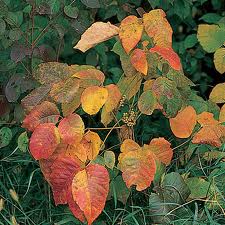
Poison Ivy In Fall
There’s an amazing amount of misinformation about poison ivy on the Internet, even on medical sites that should do better. While there may indeed be three people among the seven billion of us who are absolutely immune to poison ivy, the 6,999,997 rest of us are not. It is more accurate to say we differ in our resistance and rate of expose. Said another way, nearly everyone will get poison ivy if they are exposed to it long enough, including the 20 percent who are really resistant. For some that is one exposure, for others dozens. The folks who say “I’m immune to poison ivy” are the prime candidates because they are not avoiding it. Over the years I have spoken to many a person who was extremely surprise when they got their first case of poison ivy because they were “immune.” The point is you will get poison ivy at some point if you keep getting exposed to it so the best course of action is to avoid it and keep that day as far away as possible, if ever. Dr. John Kingsbury, who was an expert on toxicology, says the plant cells have to be breeched to release the oil, that just rubbing the plant would not cause a problem. He added, however, that an insect chewing part of a leaf would release the oil so even a small amount of crushed cells can release enough oil to cause a reaction. He was adamant that soap did no good and that the contamination was immediate. Other views have disagree in the 47 years since he wrote his book saying that non-oil soaps, even plan cold water helps if used immediately.
Incidentally, there is little difference between Poison Ivy and “Poison oak.” There’s no agreement whether they one or two species. Best guess is different varieties of the same species. From our point of view it doesn’t matter. It, or they, are bad. In fact there are six related species that can give people rashes or other allergic reactions: Mangoes, cashews, pistachios, poison ivy, poison sumac, and Brazilian pepper.
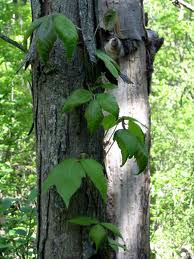
Poison ivy can climb and cover trees
All that said there are some interesting facts about poison ivy. Only humans, some other primates, and guinea pigs can get it. Your dog and cat can’t. But they can carry the oil, urushiol, on their fur and give it to you, and that oil is active for years. Poison ivy is also a very nutritious food for deer as well as rabbits. Some 60 birds eat the fruit and bees visit the blossoms.
What is fascinating is how poison ivy works. The oil “locks” onto your skin cells, essentially interrupting the chemical signal from the skin to the rest of the body. Thus the area expose is viewed as foreign, so the body attacks it. The result is sores, itching and bleeding. As bad as that is it also has a positive side. Native Americans would put poison ivy sap on warts so the body would get rid of the warts. That’s some interesting thinking. Unfortunately poison ivy can also be systemic. You can get it on your knee and have it crop up on your back. In fact, the only other time I got poison ivy the first blisters appeared in my right elbow. Then they showed up in my left elbow then behind both knees.
What irritates me the most is not my current itching but that I am so good at recognizing it that it managed to get me anyway. There is one other possibility. I’m quite sure I did not come in contact with the plant. However, it did rain and the oil can wash off damaged plants with the water carrying the oil. I could have knelt in that, a more feasible explanation, or at least one my ego likes it.

Euell Theophilus Gibbons 1911-75
There is also a controversial side to the plant: Eating poison ivy to confer immunity. No doctor would recommend it nor do I. However, Euell Gibbons, the previous generation’s back-to-nature guy, wrote that he ate some every spring and never had a case of poison ivy there after. I know an herbalist who does the same thing in the spring every year. And I personally have seen one person eat it, again in the spring. There are three theories:
One is they all eat the plant in the spring when perhaps urushiol production is low. Or, two, the mucus that covers our insides protects us and we just digest the oil. A third possibility is it does somehow confer a protection. Kingsbury was firm in his thinking that eating it was very dangerous and that the plant was dangerous all year long. I think I will leave the experimenting to others. I’m not compelled to try it, not sure why… ah pardon me a moment while I scratch my knee…
For me avoiding poison ivy has worked fairly well thus far so no sampling in spring needed though I am pondering switching to long pants, maybe a tight body suit… nawh…

I’ve read that drinking goat’s milk from goat’s eating poison ivy can confer immunity. Sounds much nicer than eating yourself.
Okay…. you first…
don’t hold back on trying goats milk! Not that any immunity could be conferred, it is possible, but also that part of it might not work at all. goats milk is one of the closest things to human milk because of the way its produced by the animal and it is generally very healthy. Often people who are allergic to cow’s milk can drink goat’s milk without issue. It tastes so similar you’ll be surprised. Nothing at all wrong with it and it should be tried just to be adventurous. It of course is a great food!
we had goats for years when our kids were growing up on our farm, and the goats indeed LOVED eating poison ivy, and kept large parts of our farm clear of the stuff. I used to be VERY very susceptible to poison ivy (I still remember having my eyes swollen shut with it as a young child, or rubbing my entwined fingers back and forth to ‘scratch’ it all up and down my fingers, resulting in balloon fingers 😉 ), but after having goats and drinking their milk daily, I just about never had any cases of it. I *am* very good at *spotting* it, as most are who get poison ivy very easily, and so I also practice ‘severe avoidance’, but I think there may indeed be something to this idea of ‘immunity from goats’ milk.
Love this website!!!!!!!! The BEST!!!!
Shulamit
What about the manchineel tree (sp?)?
Avoid the Manchineel, Hippomane mancinella.
If you’ve ever wondered what the green or red lumpy bumps are on poison ivy, they’re galls caused by a mite that makes its home in the plant’s tissue.
http://bugguide.net/node/view/214835
The lacquer you speak of was from poison ivy? maybe that was the indelible part of it and it may have been mixed with something else like pokeweed. Or it may be a case of the first person saying something that ultimately gets distorted down the line, if you know what I mean. 🙂
When the toxic oil is dry it loses its toxicity, at least to touch.
Just a followup on the comment regarding drinking milk from goats that ingest poison ivy. I dated a girl who drank milk from cows that ate poison ivy. I observed her rubbing poison ivy leaves on her arms with no apparent effect even days after the event. I don’t know if she was resistant, immune or crazy but it was weeks before I agreed to let her touch me. And she was Hot!
Since I have “systemic” poison ivy; I don’t have to touch it. I went in the woods a short distance a few days ago. I saw some small PI plants; maybe 3″ tall. I didn’t touch them. and it was cool so ho heat transfer. I got it on my hip, my thigh and lower leg… all under my clothes…..
I tried Euell Gibbons’ advice on eating poison ivy! I ate a leaf every day starting in the early spring. Sometime in June I tested my immunity by pressing a large poison ivy leaf to my arm, and got no rash (and I definitely am sensitive to it.) I stopped eating it then, supposing I’d got my immunity for the year, and later touched some and got a rash, so I suppose the immunity only lasts while you are eating it.
I tried it again the next year, but because we had very cold weather followed by very hot weather, it soon became difficult to find small enough poison ivy leaves to eat. I knew when I ate one that was a little too large, because I would get a small rash somewhere on my body that had definitely not touched poison ivy. So I gave it up, and haven’t done it since.
I have done the poison ivy immunity immunization process. The first time I ate a leaf I was very nervous as I am very allergic to it. I learned the technique from an instructor whom I trust. He has been doing the technique for 20 years. He eats one leaf per week, in the spring, gradually progressing in size, for 9 weeks. You cannot get into poisin ivy during the 9 week process or it will negate the immunization effects. It gets him about ten months of immunity, so winter months(Georgia) are risky especially since the plant has no leaves on it here. I would never condone anyone trying it…but I took the initial leap of faith and know I can eat it(not letting it touch my lips). My teacher has tested it by rubbing a leaf on his arm and only reacting with a red bump similar to a mosquito bite that went away wi to try thin an hour. Im hopeful to have the same success! I recently had steroid shot, cream and antibiotics to alleviate a bad case of poison ivy, so for me to try this was scarey..but im 5 weeks in and no negative results.
My husband is a farrier (he shoes horses). He gets very small bits of it, usually on his hands several times every spring. We have been quite certain for a very long time now that he is picking it up from the horses, since he has to pick up and work on their hooves. He never ends up with a bad case usually only one to three little bubbles.
On my end of things I never seem to have a bad reaction to it, but I have eczema. I have often said that eczema is the itchiest thing in the world and if you can learn the self control to not scratch it, well then even poison ivy isn’t that much of an issue. I find the more you scratch poison ivy the worse it becomes, perhaps because it is just one more way to irritate the skin on an already irritated place. I have also heard that if the blisters pop that liquid can spread it, I don’t think that is true, but what is your opinion or knowledge on that?
No, popped blisters don’t spread poison ivy.
I used to say I was immune to poison oak. Two years ago in the spring, I was breaking branches on our property. I had scraped my arm and must have touched poison oak on the open skin. I had it on my inner arm where your arm bends. It blistered up, tons of puss. It was horrible! I had to sleep with my arm straight and take a shower using one hand to wash my hair. Every time I bent my arm, the blisters would break open. Disgusting. I stay far away from it now.
Nearly all the people who end up in the hospital over poison ivy/oak are folks who thought they were immune whereas what they were really doing was lowering their resistance. Then one time too many and BAM!
I spend a lot of time in the woods and never get it. I hunt, primitive camp and bushcraft so I know I get exposed but not even an itch in decades. When I was a kid in North Carolina I got it really, really bad several times. Once while skipping school, I was swinging on a vine at the local swimming hole and I got it on almost every inch of my body. Had to take baths in calamine for weeks. It was really horrible. I can’t remember ever having it since then. I have heard that people who work in factories where cashews, a related plant, are processed develop a resistance to it as well. Could a extreme exposure like mine develop your resistance to it. Seems weird but it is the only thing I can think of that would explain this.
The medical literature is full of examples like yours, folks who thought they wrer/are somehow immune. They are the ones who end up in the hospital with a severe case. As for an explanation, the current thinking is everyone is born with a resistance to poison ivy. The resistance varies individual to individual. But, each exposure reduces the resistance and at some point it will be one exposure too many and you will end up in the hospital. I have had many people tell me a story just like yours only to end it with having to go to the hospital and now are severely allergic to it. I actually have one “immune” student who now cannot virtually get anywhere near a plant, he doesn’t even have to touch it to get it… and he was immune just like you. The point is avoid poison ivy or it will catch up with you one day.
I got poison ivy one time as a young child, about 4yo. I have been VERY resistant to it ever since. My children seem to be resistant also. We live in the country just south of Indianapolis IN and the stuff is crazy here. We have vines several inches in diameter growing up all the trees in our yard. I pull it off and pull as much of it out of the trees as I can every year. It just keeps coming back. I don’t use gloves or any sort of protection and low and behold, I don’t ever get it. My mother has psoriasis and has used many different forms of steroids all her life to combat it, she is also a CNP (nurse practitioner) and claims that her steroid use has resulted in her “immunity” to poison ivy and claims it could possibly be part of the reason I am also resistant. I don’t know why we don’t get it for sure, but I do know for sure that we don’t. I consider myself blessed in this nature and have no intention of changing my behavior or “avoiding” the stuff as I have to battle the weed all summer every year.
I always check wood that’s being burned for poison ivy and the oil can travel in the smoke. I’ve heard of cases of internal poison ivy from smoke inhalation.
* * * * *
A quick fix for the itch:
I use a hair dryer as soon as I notice the spots or itch. Use the hair dryer on low speed on the infected area for as long as you can stand it. If needed, stop for a few seconds, then blast it again. Once or twice at a time is usually all it takes for instant relief. It will feel like the hair dryer is burning your skin on the infected area, but if you move the hair dryer to an area of skin that is not infected, you will note that you hardly feel the heat. But be careful to not actually burn yourself. A little “common sense” is good here. This method really provides almost instant relief and it actually feels like the “ultimate scratch” to the infected area without actually scratching it. Also helps dry it up quickly and prevents secondary infections from scratching with fingernails. This fix provides relief for hours, even from bedtime to dawn, giving you a peaceful night’s sleep without waking to itching during the night. For me, it usually clears it all up in just a couple of days or so. You can use this method as many times during the day or night as you want. This method (hair dryer) also works equally well on insect bites. Try it – you’ll like it. You will be amazed.
* * * * *
One of my mom’s favorite stories is how she used to brag to her friends as a kid that she was immune to poison ivy. Her friends said, “I bet if you rub it between your hands you’ll get it.” She rubbed it between her hands and on her arms, and didn’t get it. “I bet if you roll around in it, you’ll get it” was the next challenge. She did, and no reaction. Then they said, “I bet if you ate some, you’d get it!” She ate some…and she got it, everywhere, in her mount, on the soles of her feet, in her eyes. It was 8 days or so in the hospital.
That said, I was told that the Native Americans in the redwood forests of California would give their kids small amounts of poison oak to develop immunity to it. So the idea seems to have been around for a long time.
I was definitely one of those people who lost a natural resistance to poison ivy. My reactions were getting worse until I found an old magazine written by MD’s from the Eclectic School around the turn of the last century. They suggested poke root, curled dock root, stillingia in a neutralizing cordial to reset the bodily constitution. Rhus Tox homeopathically is another remedy that was mentioned earlier if you don’t want to eat the leaf. They also recommended bathing the area with Belladona. There are so many ways of addressing this sensitivity. I have used Technu and found this to be helpful, as well. Love this site by the way, Green Deane!!
I used to roll around in it, but now try not to. some times I get strange itches after crawling throgh the woods at night, but not as bad as wet grass on my feet. I have treated people with jewel weed(impatiens) with 100% success every time. use choise plants of medium size in ground more dry than wet. take the etire ariel parts and sqeeze the muselaginous sap into the other parts which are then torn to bits. rub it in as soon as posible. 50% rubbing alcohol can be used to wash the poison ivy sap(which turns a light tan shirt grey) off some what. I hear sumac root tea can be used the same way. speaking of mangos, the green ones can supstitute apples in a cobbler. it would not suprise me if no one on earth could tell the differance.
Jewelweed does not grow within 500 miles of here.
Hello, since there is large amount of it all over the il/wi area I did a little test. I rubbed a bit on the back of my hand then waited. I was one of those people who thought they were immune. (But up until recently I really never knew which plant was which. Over the past few years I have been paying more attention and learned to identify it). Three days later the bumps n iching began. I then rubbed some broad leafed plaintain leaves into it. The iching almost immediately stopped and the bumps were gone in a few days. Another time I was searching for firewood n camping in a campsite that was, for lack of another word, covered with this ivy. Since I was in short sleeves n shorts I again rubbed the plaintain leaves all over my legs and arms which were starting to itch and again all the discomfort stopped and no further treatment was needed.
I’m another high resistance/immune category.
I’ve yet to get a case of it, and I know I’ve been exposed quite a bit. I used to run through it when I was little, and when I learned to recognize it, I’d pick it just because. I also used to weed it out of my dads yard and garden since I never caught it.
I’ve wisened up a bit since then, and have actively avoided it for the past 15+ years; Of course I’m always tempted to give it another test ;p
I wear shorts all summer and walk through the stuff up to my knees. Most of the time I never get it and if I do i just spit in my hand or cloth and rub the spot that was affected. Being careful not to brake open the Ivy as you walk through it does work and for years that has kept me safe.
The scientific theory of lowering your resistance every time one is exposed is odd.
When I was younger, pre-adolescent, I used to break out from it. Haven’t in years now even though I often have to handle it.
Perhaps it was the goat milk we drank in my teens. Goats used to eat a lot of it.
I do know one should never burn it. We were getting a bee tree many years ago and my grandmother happened to get a whiff of the smoke. We thought she wouldn’t make it.
Years ago the naturalist from Mill Creek Park in Youngstown, Ohio: Lyndley Vickers always ate poison ivy every spring. He would start out with a small leaf cut in small pieces and put it in a capsule he swallowed. He was completely immune all summer when he did this in the spring. I’ve always been too afraid to try it. This was in the 1960’s.
I think the goat’s milk has conferred immunity, somehow. I have been handling poison ivy nearly every day to carve out new paths for the electric mesh that confines my goats. I am amazed to get no bothersome rash, if any effect at all. I wish my body would be so strong with bug-bites!
About the ink/lacquer…I’m curious to learn more about this. I used my loppers to cut large pieces of poison ivy into the goat pen…half inch diameter vines or more. After I put my pure white goats in there, they looked like dalmatians the next day. I couldn’t imagine what in the world made marks like creosote, then I noticed the cuts were seeping the stuff. Wow! I want to learn more about this. There must be a use for it!
It also does a fine job of hiding in black berry if you are not looking for it. Its rare in my area so I wasn’t. The black berry having scratched me a few times also worked well to really give a nice application. But it certainly has made my priority to look for bad plants first.
Oh and Duane, if the she was hot it might not be a good omen that she had such affinity for poison ivy.
Hi Green,
Do you know if the roots that are left over from the vine on a tree can still contain the urushiol.
Yes, and they can remain toxic for years.
I have had poison ivy rash more times than I can count, since I live in the woods and the plant is very hard to eradicate. I do know that urishol is also in the vine and root. Washing with degreaser (dish soap) right away helps. Alcohol also helps wash away the oil and is temporarily soothing. Chlorine/bleach and salt may work for some, but I’m not into pain like rubbing salt on a wound. However, there is a “miracle” cure available everywhere. MUD! That’s right. Mud will dry and absorb the oil and give instant relief as it drys. Continue washing it off and reapplying until the rash is gone and you will have baby soft skin. Mud works for other rashes as well, even helps ease the itch of bug bites/stings when there’s nothing else available. I’ve found that clay-type mud is best. It also help with sunburn, and if you’re out of sunscreen, mud has a SPF of 100.
Now go get muddy!
It’s not resistance, but the buildup of histamines. Poison Ivy’s effect on us is an allergic reaction. Allergic reactions never happen the first time someone is exposed to something. Or necessarily even the second, or third… Each time you are exposed to a substance that you are allergic to, the body develops histamines. And with allergens, there comes a point that exposure to an allergen will result in enough histamines to attack and get the reaction.
As somebody who has been hospitalized twice (with numerous other times of severe reactions) due to my throat closing up through the poison ivy swelling, no thanks on the eating it. That would likely kill some of the people who have these severe reactions. In my case, somebody was burning it and I breathed in the smoke (up my nose, down my throat, whole face swelled, eyes shut, etc.). Nobody else in my family was affected.
Avoidance is key!! (as I wonder how I got PI for the first time in years–and find little bumps popping up between my fingers, on my feet, etc.!)
Funny that humans, primates, and guinea pigs are the only animals that are susceptible. These are the same animals that don’t make our own Vitamin C. Hmm…
One of my earliest memories is when I was maybe 3 or 4 and waking up screaming because of this incredible itch over half my body (we lived in a rural area where we played all day in the woods, fields and creeks.) I remember my dad picking me up and standing me on the bathroom sink counter and pressing very hot water compresses over me. At first, I think I was hysterical, but soon I realized the maddening itching and pain was stopping. And that is how I have treated poison ivy ever since! It is interesting, because in all the comments, only one with the hair dryer, mentions treating poison ivy with heat. (I’ll have to give the hairdryer a go next time, thanks for the tip) Yes, press very hot, as hot as you can stand it without actually scalding yourself compresses onto the affected area. It will sting for a minute, but then the relief will set in. Doing this will stop the itch dead for 8 to 10 hours, then you have to repeat as needed. You can actually see the blisters contract. It is not a cure (PI lasts, as the saying goes, a week and a half to ten days). But it sure does make it bearable.
The best prevention is avoidance, and I remember my dad being very thorough after that incidence in teaching me what poison ivy looks like, and I have likewise taught my children, my girl scouts and other children in my care how to identify it. And identifying it not just in full leaf, but in new bud, in berry, and the bare vines. One time even that was not enough for me. I was planting daffodils around an old tree stump one late fall day and before I knew it I was breaking out on my wrists, then on my face. I couldn’t for the life of me figure out where it came from. Then I remembered that when we cut that tree down a year before it had a PI vine on it. So even a year latter, though dead, the roots (or maybe the soil) was still carrying the oil! And I got it on my face because I got the oil on my coat sleeve and then I probably pulled my hair back and brushed up against my face! When I realized why I kept getting more and more of it, I through my coat in the wash!
I agree, a first aid kit with soap and water is essential when camping or other outdoor activities. I know many times suddenly I see a leaf sticking out somewhere, even in a city sidewalk, and wash quickly, even within a half hour of exposure, that I don’t get it. But more importantly, I use coverage when in the woods. The same coverage, long pants, socks over pants, that protects against ticks, then peal the cloths off inside out and launder.
No, not soap. That makes things worse. A detergent is better.
Fels Naptha is just soap – regular SOAP, made with OIL. By the way, ALL soap is made with lye – ALL soap. So there is no such thing as just “lye soap”. And ALL soap is made with some type of oil. No lye, no soap and lye needs the oil to combine with for saponification – the process of making soap. Detergent is different – it uses petroleum products and other “stuff”.
Also, a person can go for years thinking they are “immune” to poison ivy and then, all of a sudden one day, they aren’t anymore. The more you are exposed, the more susceptible you become until it finally catches up with you and BANG – full-blown case of poison ivy.
Fels Naptha has minimal oil content and is designed to remove oil which is the offending chemical in poison ivy/oak/sumac.
Regarding urushiol and cooking:
I have searched everywhere on the web and cannot find this discussion: We discovered a major crop of grapes on our property and intertwined with some of it was poison ivy. We Carefully picked about 30 pounds of grapes and cut out the ivy we could get at.
Now I want to make jam but cannot find any info on the cooking of the mash. Does urushiol boil off and become harmless. It would be nice to know before I go through the effort of handling all the grapes
Thanks for writing. That’s a tough question. Those who consume poison ivy say the oil is simply digested. I have no idea. Urushiol does not “boil off” nor does it become harmless. Just the opposite. If it becomes airborne it can cause severe problems such as when poison ivy is burned. Then it bothers not only the skin and eyes but the lungs. Very dangerous. The smoke has put people in the hospital. What follows is not my advice, and I do not recommend it. Don’t do it. Is that clear? If I had picked that many grapes from a patch with some poison ivy, I would be tempted to get long rubber gloves and wash the grapes thoroughly in water a mild soap — like a soap used expressly for cleaning fruit. I would change the water often, if not dip the grapes in several buckets and rinse them well.Then I would clear the house and give it a try, or do it outdoors and stand up wind.
processing the mash means a pretty intense boil not a flame to create smoke. I’ve seen on the web that Urushiol has a boiling point of just under 200 degrees. Water by itself is 212 – add grapes and sugar that number goes up. Where do I find if this process breaks it down
Your questions are beyond my chemical pay grade.
any ideas on where to post this question?
I proceeded with 4 batches of jam. The thinking was that ok I’ve got 30lbs of grapes. Some of them (not a big amount) came into contact with the poison ivy leaves. The skins separated from the pulp (with gloves) then cooked the way jams get cooked. Since the stuff gets boiled all the way down to jam consistency the temp is maintained pretty high. My assumption is the stuff boils off but it would be nice to find a definitive answer on it.
I have now eaten a fair amount of it and so far so good
Interesting to read other stories of eating young poison ivy leaflets to gain immunity. When I was young I worked with an old farmer who liked to tell stories he’d heard from his ‘Uncle Clarence’. These were often things Uncle Clarence had learned from the ‘Indians’. This was in New Jersey so presumably the Lenape. One of these handed down bits of wisdom from the natives was just as others here are writing, that eating the small poison ivy leaflets in spring would give you immunity to a rash from the plant throughout the summer, though he added that no one he knew had had the courage to try it!
My Poison Ivy story. Perhaps my dear (now deceased) father was resistant to Poison Ivy. He told me a story that when he was 18 years old he and some friends went a few hours north for a blueberry-picking vacation. He had never caught Poison Ivy and bragged to his friends about his “immunity.” With the wisdom of an 18-year-old he backed up his words with action and picked some Poison Ivy leaves and rubbed them over his entire body. The impressive proof backfired. He became so sick, that the entire crew of young men had to cut their vacation short just to bring him home as he had Poison Ivy over most of his body. From that time forward he seemed to get Poison Ivy just by looking at it.
I too may be resistant to Poison Ivy as I have never had it for sure. I have had one or two bumps that I suspected might be the start of a Poison Ivy outbreak but they just went away in a couple days without spreading.
Because of my dad’s story I never take chances. If I am working near it, I try to take a shower within a couple hours. Thanks, Dad for telling me that story so maybe I can get through this life without a serious case. I’m now 66 and still love camping and the outdoors. Just a couple more decades to go.
There was a post about eating poison ivy on the Pocahontas Nature Club (West Virginia) Facebook page. I thought you might find this interesting.
“These are my very favorite spring-time wild edibles. I don’t recommend them to anyone else, however!”
https://www.facebook.com/groups/pocahontasnatureclub/permalink/1510219682335332/
There was a post about eating poison ivy on the Pocahontas Nature Club (West Virginia) Facebook page. I thought you might find this interesting.
When I was younger, I rubbed a leaf on the back of my hand because I wasn’t sure if it was poison ivy or not (it was). The back of my hand swelled up and it looked like I had leprosy or something! After that I knew what to look for.
A few years back I tried eating poison ivy leaves when they were small. I forgot to try to eat them when they first came out so the leaves were bigger than the initial growth. I also didn’t eat them with anything to keep them from contacting the roof of my mouth and I got some itchy bumps there, though it wasn’t as itchy as when it gets on dry skin.
Euell Gibbon’s said to eat them with a sandwich, so maybe I’ll try that next spring.
I’ve read a few of Euell’s books and i’m not sure he is the best source for this. Don’t get me wrong, i completely trust him when it comes to how to find and cook food, but the guy seems kinda… ‘funny’. He might just include a harmless little prank about eating an irritating plant for kicks and giggles. I have told a few of my buddies to chew on a Jack-in-the-Pulpit leaf, maybe Euell is doing the same. (he probably knew that our saliva protects our mouths from the oil and figured it harmless)
I think its interesting that poison ivy is in the same family as mangos and cashews. Both of which have the toxin. Mangos have it in the stem, when picking it you have to be careful not to get the sap on you. Cashews, have the toxin in the seed husk, and have it specially removed. I believe by heating.
I wonder if heating poison ivy berries would render them edible. Another closely related species are pink peppercorns.
https://www.atlasobscura.com/articles/are-pink-peppercorns-poisonous
Steaming renders cashews edible:
https://earthsky.org/earth/lifeform-of-the-week-poison-ivy-poison-oak-poison-sumac
Is there something else in the berries that is toxic?
I have a video on them: https://www.youtube.com/watch?v=WkkZNGwv9jw