
Pindo Palm: Jelly, Wine and Good Eats
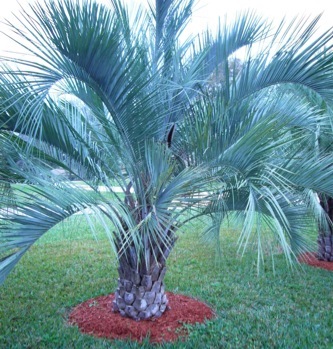
Pindo Palm, Jelly Palm
Cemeteries remind me of Pindo Palms. They are a common landscape plant in Florida cemeteries, and public parks as well. In fact, they are a very common landscape plant in southern climes and most owners are glad to give you the fruit and surprised to learn they are edible.
Banana yellow, sometimes with a rose blush, they are sweet and tart at the same time. Pindo Palms are also lost fruit. They were once the stable of every southern yard that didn’t dip below 12º F degrees or so. Now it’s considered a palm that creates a mess on lawns. Indeed, one of the common complaints about the Pindo Palm is that it produces too much fruit… Think about that: Only a nation with yards of decapitated grass and an obesity epidemic would think a plant produces too much food.
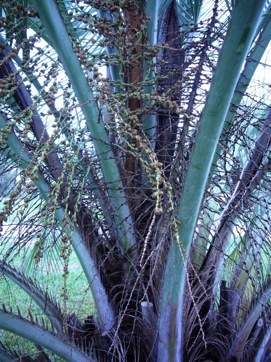
Look for short spines on each side of the frond
The fruit of Pindo Palms are often called palm dates and were used to make jelly — hence Jelly Palm — because they contain a good amount of pectin. That same pectin makes for a cloudy wine, the other common use and name for the plant, Wine Palm. Its botanical name is Butia capitata (BEW-tee-uh kap-ih-TAY-tuh.) Butia is a Portuguese corruption of an aboriginal term meaning “spiny.” Capitata is Latin, meaning “with a dense head” referring to the seed heads. The name Pindo comes from the town of Pindo in southern Brazil where the palm is native. Its common local name is Yatay. It’s habitat is grasslands, dry woodlands and savannas of South America. It ranges across northern Argentina, southern Brazil, Paraguay and Uruguay. Besides Florida, it’s a popular landscape plant throughout the Gulf and southeastern Atlantic coastal regions and northern California, places that are subject to only occasional frosts. It is reported in isolated microclimes in North Carolina, Washington DC and British Columbia.
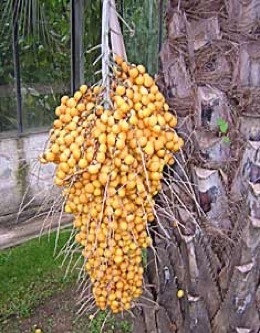
Ripe Pindo Palm fruit
When I was a foreign exchange student teaching in London back in the Dark Ages BC (before computers) I took a trip to Cornwall and the Scilly Islands. I still have pictures of Pindo Palms growing there. I suspect the fruit of the B. capitata was made into jelly more often than pies et cetera because eating it is similar to eating sugar cane, in that it is tasty but very fibrous. Some people can swallow the fiber and have no tummy problems, in others it can upset stomachs. So, chewing the fruit and spitting out the fiber is accepted practice. Try only one at first, they don’t agree with everyone. One writer said they have a “terrific taste that starts out like apple and transforms to tart tropical flavors as it tantalizes the tongue.” To me they taste like a banana and a nectarine put together. Of course, once you have juice from the palm many things can be made from it and no southern home should be without a jelly palm. They are inexpensive, hardy, showy and bountiful. Incidentally, the seeds are about 45% oil and are used in some countries to make margarine. The kernel tastes intensely of coconut. The core of the tree is also edible, as like the cabbage palm, but that also kills the tree so reserve that for palms only slated for development execution.
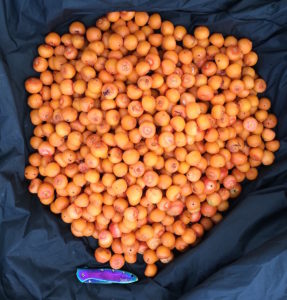
This Pindo Palm fruit will be used to make wine. Photo by Green Deane
cv fgt
Green Deane’s “Itemized” Plant Profile
IDENTIFICATION:An evergreen tree growing to 20 by 12 feet, a long spike of green fruit — see upper right — turning yellow then dropping, ripe fruit very fragrant. Note the spines on the fronds in the upper right picture. Fronds are very long.
TIME OF YEAR: Evergreen, fruits in late spring in Florida.
ENVIRONMENT: Landscape plant that likes full sun,sandy well-drained soil but needs moisture, grows fuller if in partial shade.
METHOD OF PREPARATION: Fresh fruit off the tree, juice made into jelly and wine. The best fruit are usually the ones you fight the ants for. Also the flavor and sugar content can vary from tree to tree.
Pindo Wine
Pindo Wine is very tropical, takes a long time, and can have clarity issues because of the natural pectin.
About 1.2 kg of ripe pindo fruit
1 Campden tablet
1.2 kg sugar dissolved in 1 liter boiling water and cooled
½ tsp tannic acid (optional – slightly alters the taste and lightens the color of the wine)
½ tsp yeast nutrient
general purpose winemaking yeast
For wine: Cover the fruit with water then use clean hands and rub out the seeds. Mash up the fibrous fruit pulp. Add crushed Campden tablet and leave, covered for 24 hours. Make up the wine starter. Add the pectinase dissolved in a little water and leave for several hours. Add the sugar syrup, tannic acid and yeast nutrient and make up to 5 liters. Add the yeast. Stir 3 times per day for 6 days before sieving into a demijohn. Rack and add sugar as necessary. A final specific gravity of about 1.020.
Pindo Jelly
One would think it would be easy to make jelly out of the fruit of a plant called the “jelly palm.” The answer is yes and no. It is called the jelly palm because the fruits, in a good year, have enough natural pectin to make jelly, barely. So, one should add pectin. The other issue is the seeds. You can cook the fruit with the seeds still in them but I think that can impart a woody flavor to the jelly and reduce its ability to jell (I think cooking the seeds release some of the edible oil and that affects the process.) On the other hand, cutting the fruit off the seed is a chore. Friends make the job go quicker. You can cut the pulp off or try to rub the seed out, your choice.
Since three cups is the standard for Sure Jell, start with six cups of ripe fruit. Cut and scrape as much fruit as you can off the seeds. One would like to say cut the fruit out but it hangs on so tenaciously to the pulp you really have to cut the fruit off the seed. Starting with six or more cups should yield you three cups of cleaned fruit. When you have three cups, cover with three cups of water. Bring to boil and cook until you have about 3.5 cups of infused juice. Yes, measure it. When you have those 3.5 cups, filter the juice and make jelly per the recipe on the box for three cups, adding two or three cups of sugar, depending upon taste. Of course, you also don’t have to filter it, and can use three cups as is, the texture and clarity will be slightly affected, but it is just as wholesome.

I agree that cooking the fruit imparts a woody taste, but I have found a way that makes it easier to make jelly. I freeze the fruit until it is all ripe, then thaw it. This seems to help break down the fibrous nature of it. I then use an electric mixer to mash the fruit off of the seeds. It takes a little while, but it is a LOT easier than doing it all by hand! I have even refrozen it several times to break down the fiber more, but once seems to work well. It’s an alternative to cutting it off by hand that works for me… I neglected to say seeds and most of the fiber are left in the strainer, but I just tried your suggestion of rubbing the seeds out after breaking it all up with the mixer. I think it works better than the strainer and will do that from now on. I did wear textured latex gloves which made the job even easier. Thanks for the tip! Jomi
Easy way to remove the seed. Put in blender with water. Put in small quantities at a time.Turn on grate for about 20 seconds and you can pick out the seeds from the liquid.
Hello. I have several Queen Palms in my yard. They have ton’s of fruit and I’d like to try and make jelly from them. I am wondering why you don’t include them with the pindo palm or recommend them for jelly also. I hate to just throw them away. Are they poisonous? Will they make you sick from eating them? Any help or suggestions would be greatly appreciated. Thanks.Lori
Very ripe queen palm fruit can be used. I need to clarify my video on that.
At what age do pindo palms begin to bear fruit?
Around eight or nine years old.
I cook the berries and then use a big cone shaped restaurant style sieve to squeeze out the juice and pulp. I use the juice from that and the cooking water to make the jelly, and none of us who enjoy the jelly have noticed any kind of woody taste at all. It is delicious and comes out a clear, amber/orangey color.
One year we were in a hurry and didn’t have the big strainer yet, so we experimented with not straining it, but left the pulp in the jelly. It had a more primitive taste and was not as good as the other method, but very good for barbeque sauces, etc.
It is not at all easy to make and I think of sensible people I know and how they’d never go through that process. My 2 trees produce a conservatively estimated 1200 pounds a year. You may not believe this, but it’s true. There is no way I could process that much fruit. But I feel better that I at least do some part to honor such extremely fruitful production.
I have a queen palm tree loaded with fruit, can I eat them? or do anything with them?
Yes, queen plam fruit is edible when ripe. It is, however, very sugary and full of fiber that’s tough to eat. Most people just kind of suck the sweetness off the fruit then toss the fiber and seed away.
I have a few 30 ft queen palm trees with 1oo’s of pounds of ripe fruit on them. Can these panicles be cut from the trees as the fruits turn deep orange, or do they have to fall to the ground naturally? I just tried some of the fruits from one of my queens that I had never sampled, and it is as good as a Pindo Palm, or any of the edible Butia palms I have sampled. Really nice apricot/banana flavor with a very buttery/oily finish. I think a jam/jelly is in order, maybe would be good to add in mango or something with a little more substance. Do you have any links or articles on the Queen Palm that may give some more information on the topic? Thanks.
When they’re ripe they’re ripe. I’d have no problem with cutting of the seed panicle if they were ripe. Perhaps I should do a separate article on the queen palm.
Hello. I have been searching the Internet trying to find recipes for Queen Palm Fruit – I can’t find anything!! I looked at Food Network, All Recipes, various culinary sites – nothing. I thought of trying to contact someone native to South America who may have recipes, just not sure how to go about that. Like many of the posts, I have very ripe, bountiful fruit falling off of the Queen Palm in my yard & would love to use it. Would be fantastic to locate recipes for this fragrant fruit. If you come across any, please share! Thanks.
Just use Jelly Palm recipies but you may have to use less sugar.
Just made some jelly. It tastes great although not quite as “tropical” flavored as the plain fruit. Needed to nearly double the amount of pectin called for in the recipes, possibly due to cooking the fruit off the sides which may have resulted in “extra” oil??? Not sure but an excited to have an unusual gift for friends at Christmas.
Agree to the comments re. Queen Palms… very sweet and not nearly as much flavor. Pindo Palms much preferred but very hard to find!
I have one jelly palm and one tree that looks exactly like the jelly palm, but it has red fruit. My kids have been eating both fruits for years and really enjoy them. They suck the juice more than actually eating them. Last year and this year the trees have produced so much fruit, I decided that I really need to do something with it this year. I believe the red fruit is Queen palm, but the tree is not any taller than the jelly palm. So my question is two fold. Could the red fruit be a pindo/queen hybrid?? Should I mix the two fruit for my jelly and add less sugar or stick to the jelly palm by itself??
They do hydridize. Can you sent me a picture?
I have a Pindo Palm in the front yard. I have watched the squirrels scurry up and down with the fruit and wondered if they are edible or good for jams and preserves. Now I know. Will try to make jelly (I prefer jams and preserves because of the whole and crushed fruit in them. ) Would that be a possibility or is the fruit too fiberous? Is the skin or rind of the Pindo Palm edible or is it necessary to peel or in some other way to remove it?
The skin is edible but the fiber does bother some tummies. Jelly avoids that potential issue.
I have a queen palm. I place a new string laundry bag over the bract to catch fruit as they ripen and fall. I place the cleaned fruits in a large pot and cover with about an extra inch of water and simmer. Then I let it sit. If too thick I add a bit more water. I mash down on the fruits to extract as much flavor from possible and then strain out the liquid into mason jars. I drink the juice early in the mornings with a little honey added for a sweet fiber drink without fussing to get the pits out. Im going to try the water and blender idea. Heres a sauce I made last year . Thanks for all the info here. http://oneminutehealings.blogspot.ca/2012_09_01_archive.html
We have a Palm in our yard. We bought it at the beach & planted it about 8 years ago. We have snow & ice here so we have covered it like a snow glob & put lights at the base during the winter to keep it warm. This year it had a “ton” of fruit. We did not know what this “fruit” branch was as it was growing & changing; even when the fruit started turning yellow. Low & behold I found this site ( & others) then discovered what we had. We started collecting the fruit. I made my first batch of jelly yesterday! Taste great! Will make more!
Good story, nice ending. Enjoy.
Sorry for my spelling… glob/globe. Also, I wasn’t very clear. We had several fruit branches on the tree. Can’t say about the woody taste when leaving the seed in the cooking process. I cut & scraped the fruit off before cooking. Good site.
I have a pindo that is roughly 12-14 feet tall. It is full of fruit right now, and just starting to ripen on one stalk. Three others are still green.
Above it says they fruit in late spring, and drop said fruit in the heat of the summer. Why is mine so late considering it is almost November?
I am located in Ocala if that matters.
Thanks!
That would be unusual but perhaps not possible. Got a photo?
I don’t as of the moment, but I could take one if you would like. Planning on cutting them off sometime this week.
How would I post a photo here, or send you one?
You can post photos on the green deane forum on the UFO page, unidentified flowering objects.
Mine is also beginning to drop the fruit and it is almost November. I live across the St. Johns river in Welaka
I am getting fruit off my tree now, which is November 17. I am located in Destin, Fl. I feel sure that it is a Pindo Palm. First time it has fruit the tree. I love at recipes that you have posted. I am interested in making a pie. Do you have a recipe for making a pie?
Pindo palm fruit is too fibrous for making pies, I would think.
i made pindo cobbler
I’d love to see the recipe or did you wing it? did you keep all the fiberous bits
Thank you so much for this post and all the pointers! We’ve lived in our coastal NC house about 2 yrs and just realized – after most fruit was done – that one of the palms is a pindo, probably 16 yrs old, and that I could make stuff with the fruit. I got probably 6 gallons of fruit though, and have made jelly, simple syrup for cocktails (great w/either rum or bourbon and some lime juice), and a pie.
I made this recipe subbing pindo juice for key lime (https://www.gritsandpinecones.com/key-lime-mousse/). It’s not chilled yet but from licking the bowl I think it’s pretty good! It’s very mild flavored, so I next time I would cook down the juice a little to make it more concentrated. I think I will also try a lemon meringue pie recipe that isn’t creamy (cook cornstarch, water, flour, add egg yolks, etc. rather than using sweetened condensed milk).
How wonderful and tasty.
Hello! I’m sorry to say this, but Pindó is the Queen Palm (Syagrus romanzoffiana), not the Butia Capitata nor the Butia Yatay. You can check, here in Argentina and all of latin america where it grows we call Pindó to the Queen Palm. In Brazil is called Jerivá.
It is common to find regional differences in common name use.
I bought my house from someone who owned a rare plant nursery. It is fruiting right now in California. I was told it is butia but the fruit is a mix orange/red and yellow. definitely fiborous. I was thinking about blending the fruit once seeds are removed with coconut milk..was thinking about muffins, drinks, popsicles and cobblers. any recipes you know of?
Five Pounds of Whole Pindo Palm Fruit
500 grams sugar
1 whole banana (later cut into slices) and a second banana skin
Brought the fruit to boil in one gallon of water. Simmered for a few minutes. Added whole banana to sterilize, folded in sugar, then let cool. Rubbed fruit. Left seeds. Put all in fermentation bag.
1.5 TBS citric acid
1 TBS yeast nutrient
Pectin: 2 TBS
Acid Level: 4.5
SG: 1050
D47 yeast
SG: 1002 to secondary 6.3%
Added 70 grams of sugar
What was final yield in gallons from this recipe? Thank you
Crack the seed and the inside taste like coconut.
We have learned so much from your site and really appreciate your information.
Our 13 year old Pindo started losing color, then limbs began drooping to the ground. There is no apparent cause, but it looks to be dying. Should we cut it down or try to save it?
Usually when they start to look bad there is little that can be done.
I’m in Australia and the fruit on my tree are orange not either yellow or red and taste like apricots. Also the frond of the palm do not fall off as I believe some species do and that this is the difference for Butia yattay to Butia capitata , is this correct? AS the Fruit are now dropping ( March) I’m going to collect them and try to preserve some for jam making.
I’m in South Australia and have just picked a bowl full of dates (May). My tree also produces orange fruits – quite small with a large seed inside and not much flesh. They taste really nice, although fiddly. I’d like to know how you go with making jam out of them – I had the same idea, but never heard of date jam. Can you post how it went?
I have what I think is a Pindo Palm in my backyard here in Wilmington ,NC. Being new to this area (a NY native) I would like any advice you can give on the care of this tree. Does it need to be trimmed? It seems that the fronds closest to the ground are dying. Is this normal? Should I cut them off as new growth appears? Also should I be fertilizing it? Any info is appreciated. Thank you.
We moved to the Panama City, FL area recently and have two of these trees in our back yard. Do you pull the whole stalk off the tree to gather the fruit — or wait till they drop and gather them from the ground? Which way is best to prepare the fruit? Cut it from the seeds before cooking — or cook it whole? Thanks —
Pick the fruit as it ripens, or off the ground. It’s easier to cook whole.
Picking up dropped ones is easy work, and they are usually ripe. Cooking whole is the easiest route.
Definitely “cut” the whole head when they’re ripe. Mine are Yellow with very red tops. Also pick up what drops. I have a test, If you can remove the fruit from the stalk exactly like you open a child-proof med bottle, use it. If not, toss it. So you apply pressure to the fruit in 1 hand and hold the stalk in the other. Twist gently, if the fruit comes off clean it’s ready to use, if you can’t get the stalk & top off it’s not worth all the rest of the trouble.
Of the fruit is about the size of a regular marble, toss it. If it’s the size of a ping pong ball and slight soft under pressure, use it, otherwise….
We live in central florida. Too cold for queen palm to thrive. Ours are yellow right before they’re fully ripe and then they darken a lot.
I have what I was told is a pindo palm – not a queen palm. It looks exactly like the pictures on your video, however, my fruit is orange. I live in the Florida panhandle where the temperature if very hot and humid. Could that have a bearing on the color of the fruit? I plan to make my first batch of jelly from the fruit this year as I’ve had an abundant harvest so far and more to go.
A neighbor from Costa Rica informed us that these are considered a delicacy in her native land, so we tried. Very tasty. She said that they can make you feel intoxicated. Anyone experience this?
When you make wine from them, yes.
I wonder if your neighbor was talking about pejibaye? They look very similar, but the pejibaye are much larger and more fibrous/starchy and are boiled in salted water (like hot boiled peanuts) until tender.
I am getting the dates from my neighbor and I am going to make fig and palm mixed jelly. I tried it once before and ended up with some really good syrup for pancakes. This year I am adding more pectin and making a bigger batch since I know it tastes really good!
Great info, we recently moved to Uruguay and discovered a plethora of hanging fruit from our palm out back. Our neighbor who is a traditional Gaucho said the little nuts can be roasted in the oven and ground for a unique type of coffee, apparently they also make a popular liquor from it. When I get the recipe I will share if anyone’s interested. Gotta love free bounty! I also harvested a half cup of the nuts for a banana bread it was delicious.
Corinne, can you please post the recipe you made for the Banana bread and the recipe for the unique type of coffee? Thank you
yes, would Love the bread recipe Corinne.
I got to the fruit of the pindo in the Publix parking lot before the landscapers cleaned up and now have 2 palms growing that are a couple of years old. I may be dead before they make fruit, but they sprouted from seed easily. I love the irony of getting food “outside” the grocery store!
They fruit when quite young, you have only a few years to wait.
My jelly making process different from others I have read.
First I freeze fruit. When I am ready to make jelly, lay frozen fruit on old towel on sturdy plank or cutting board and while in freezer bag smash with meat tenderizer mallet (smooth side). Then I put the all the smashed fruit into a big stainless steel pot, cover with water, and boil till mush (about 30 minutes), occasionally smashing even more w potatoes masher. Then I laddle and strain pulp and liquid into sturdy bottles or jars and freeze until ready to make the jelly or wine, etc., sometimes using a tough jelly bag. Still a lot of work, but not as time consuming as taking seed and fiber out by hand. I chuck all the mush and seeds into my compost pile. I was surprised that a goodly number of the boiled seed sprouted, so when about 6 inches high, I transferred into pots for me and family and friends.Cathy, I too love free food that most people ignore or throw away—palm fruit, pecans in from of our YMCA, poke berries to help relieve arthritis inflamation. So much more out there that we weed kill or mow or ignore. Back to y
the land.
I have been making Pindo Jelly from my Pindo Palm for many years; however, this year I am going to attempt to make Pindo Wine. I am wondering how long is the shelf life of a Pindo?…and, do you or anyone have any recipes for making Pindo Wine. I have one recipe that I think is very good; however, would be interested in hearing from others that have made wine from the Pindo fruit.
I have what I thought was this Pindo palm, but the fruit is not pulpy at all and it is more orange than yellow. It was hanging from the lower part of the palm in a long cluster. Very sweet and juicy. I only got about 6 cups so I am going to try to make some jelly. Thank you for your website
I have to disagree with you that Pindo Palm fruit is always yellow. I have a pindo palm in my yard and have been harvesting the fruit for jelly for three years. It is definitely a pindo and not a queen, but my fruit is reddish orange. I do have a little problem with my jelly firming up enough to suit me. Any suggestions? Also, I always cut my fruit off the nut before cooking the fruit.
They can cross with the Queen Palm and get reddish.
I have a Pindo in my yard and the fruit is orange with a red blush at the top end. The fruit is about 1.5 inches in size. And it tastes great. Very sweet, a bit pulpy but fully ripened very juicy and very eatable. Just not much body there to eat. Seed is large and what pulp there is sticks to it pretty firmly.
Actually am making jelly with the first ripening of fruit today. Looks like I will have enough for about 5 or 6 jars. But there is a ton more fruit on the tree yet to ripen. I have bags over the two spines that have ripening fruit so it wont hit the ground.
That they can cross with a Queen Palm is interesting? That might be what happened with mine. But its definately a Pindo because of the stout thick trunk and I am guessing its about 10 years old, maybe a big older. Sure puts out the fruit. Put out 4 stems with about 100 or more fruit per stem, guessing anyway. The smell is strong and very fruity. Smells like a peach/mango cross and tastes like a peach with pineapple overtones. Very sweet yet has a pleasant tartness to it. Going to be interested in how the jelly tastes.
we made our first batch of pindo jelly and kept the seeds in to make the juice. we made our first batch of pindo jelly and kept the seeds in to make the juice . we found that we had to double the pectin because it did not set up and it could be because of the oil from the
I double the pectin in just about every jelly/jam I make. It truly ensures a good set and I’ve never had any product turn gummy because of this, nor is the taste affected.
Has anyone experienced a reaction to Pindo jelly. I made jelly with Pindo fruit and taste tested it , about 1/2 tsp. About 30 mins later I noticed a stomachache…then burning in my stomach…soon the whole digestive tract lips to stomach, including esophagus, throat, mouth and tongue. My husband ran to the store to get an antacid…which didn’t help at all. The burning lasted for about 5 hours before it started to wane. At first I thought. It might be a coinsidence but my husband reminded me that I had complained a week earlier of the same symptoms only more mild. After discussion we realized that it was the day that I had tried raw ripe Pindo fruit for the first time. I have no food allergies but because of this incident I threw the jelly out immediately.
I have met one person for whom the fiber of the fruit gave them a mild, short tummy ache. What I ask is are you sure it was a Pindo Palm? I ask because if a palm is not edible it is usually calcium oxalate that is the offending chemical (which can be ease with lime juice, or if no lime juice lemon juice.) Also, some time the Pindo will hybridize with closely related palms.
One of my dearest friends has discovered Pindo Palm fruit and had me over to show me how to process it. She picked and I did not see the tree. She soaked the fruit in water. Then we separated the fruit from the seed, mashed it and strained out the fiber. Then I made a pudding with tapioca. Honestly, it had a very unpleasant bitter taste that sort of clung, a little worse than endive in salad. Is there a way to get rid of this bitterness?
I thought I answered this before. My first question is are you sure it was a Pindo Palm?
I am interested in making palm oil from the pindo palm kernels left over after I make jelly. Do you have any advice on how I should do it?
Unfortunately it requires crushing the seeds and or heating and crushing. They used to use rock and a grinder turning donkey. Now there are machines for such things. However, fat is so important in times of need it is still done by hand.
I purchased a 2.5 ft tall Pindo from a tropical nursery here in Corpus Christi, TX. It was four years old when purchased; they are slow growers. That was 11 years ago and it’s now about 8 ft tall at the crown, but fronds grow up another five feet. It’s in full sun, clay soil, and I rarely water it, as it’s part of my xeriscape. I apply organic fertilizer once a year, usually in June or July. The tree fruited two years after planting in my yard. Fruiting varies year-to-year, any time from July through September. One peduncle ripens at a time, with 100 to 150 individual orange fruits. Taste is similar to a blend of caramel, mango, apricot, with a touch of citrus and coconut, and very sweet. I only eat the fruits that fall to the ground with a gentle shake of the peduncle, as they are fully ripe and less fiber. I usually eat them fresh (ah, how wonderful they taste!), but will freeze them as collected, if I make jelly. One peduncle will bear ripe fruit for about four days, then the next peduncle will start to ripen. Usually has four or five peduncles, so fruit ripening continues for several weeks. Fruit makes a fine tasting sorbet. Several sorbet recipes on the internet, but I like the fresh fruits, seeds removed, lightly chopped, mixed with coconut cream, and lightly frozen.
I am very interested in roasting the pindo seeds as a coffee substitute. If anyone has some information on how to do this, or can point me in the right direction, I would appreciate it. I am also interested in any other recipes out there using the fruits . I am doing the standard jelly and syrup, and will be doing wine. Always looking for something different. Thank you!
Interesting! What did you find? How did it turn out?
Use a cherry pitter to remove the seeds. This is very effective as long as the fruit are not too small
The directions for the wine are not very clear can anyone give a better instruction?
I use a fruit press from the 1890 range works wonderful.Today i started juicing about half of this years crop from 1 ten foot pindo.the press pours the juice out like a moonshine still but plenty of it.Tomarrow is jelly making day.TSC has jelly jars.Took me a week to find them.Big Lots also has jars at a better price.hope it goes well.
What model cherry pitter did you use? I just got one to try this and the pindo seeds are too large for the hole in the pitter and don’t get pushed out of the fruit.
It’s a generic one… actually an olive pitter.
Do you know if Pindo hearts are edible?
I am wondering the same… Green Deane, do you know?
I have 1 pindo palm tree. It is about 10 feet tall. I have had it for about 5 years now. I never get any fruit off of it. Do I need another tree to get fruit? Do I perhaps have a male tree and need a female tree? Thanks.
I have a pindo (7 to 9 yrs old) that bore its first flower stalks last year – 6-8 of them. None of them produced fruit. They just dropped off. Is this normal? Is there an easy answer to the problem?
A lawn service person told me to cut the penducles out of the pindo palm in my yard because they will harm the tree..Will taking the penducles out before the berries come in harm the tree? The tree is about 9 years old and has grown berries before but I never used them.
I had always wondered what the local wild parrots were eating outside a Home Store in the SF Valley. The article made it clean the birds were eating Queen Palm Fruit. Lots of small green parrots have gone wild in the Banana Belt of Burbank and Pasadena ( no frost and big old banana and avocado trees ) in good weather parrots come west into the San Fernando Valley. The store planted the palms for landscaping. They are at least 30 feet high.
When I was younger and very curious, I sampled the dried seeds of the pindo palm. I had to develop a kids technic because t took brick to crack it but often would smash the whole thing. The seeds were attractive due to being shaped like chocolate chips and tasting a bit like coconut. I named them after me, Lou nuts. 😉
Have been making blueberry and strawberry jam with citrus as natural pectin. Going to add the pindo pulp to the jam to see what happens. I have had the palm for 30 years and it always killed me to throw those “grapes” out.
I am from Zimbabwe. I have queen palms that produce the orange fruit when they ripen. I like picking them when they harden a bit and I discovered that they improve in taste when they have the green and orange color.
I use a metal 1/4 teaspoon to remove the seeds. Insert the edge of the metal measuring spoon and push down against the side of the seed which cuts the pulp away from the seed. Do this on the north, south, east and west side of the seed. (Don’t rotate around, that does not cut away all of the pulp.) looks like a pitted olive seed when done!
I made jelly and thought all was going great. The flavor is fantastic but it never set up. Very liquidity like syrup. In fact, I labeled it syrup. Any tips for getting it to set up?
I started making the jelly this year after watching a video and I cook the whole fruit for 1 hour and use a potato masher to mash it up while it’s cooking. After it cools off a little I use cheese cloth to strain it then cook 5 cups with juice from one lemon, a little butter to keep it from foaming up too bad and a box of pectin. Cook for 15 minutes then add 5 cups of sugar and cook another 15 minutes and it’s ready to can and is the best jelly you will ever get. So far I have done about 50 jars of jelly and will probably do another 25 and that’s from one tree and I have 2 of them so they make a lot of the best jelly you will ever get. And no wood tase in the jelly and I always cook the whole fruit.
I’m washing and freezing about 10 lbs of fruit today. I’d love your favorite wine recipe and sorbet recipe. Also, It seems that if you boil too long you lose pectin? is that true?
Hmmmm…. I don’t know. I’m just an amateur when it comes to making jelly. I know in wine making boiling does not reduce pectin.
Laura Bennet-+ any others asking about pectin- I usually add diced tart apple and/or diced plum if I think I will need a little more pectin. 1 medium/ large apple, 2-3 medium/ large plums.
We live in Wilmington, NC. This is my first year making palm jelly from our trees! There is so much!! We plan to just keep making jelly, not to waste the resource. I used your recipe for my second batch. The major thing that helped me in the process was using a blender to get the seeds out of the fruit. Saved so much time and didn’t have to cook the fruit down in Water. Thanks for your help! My family is in jelly making mode this are summer. Our second round of fruit is in process of ripening. We have fruit till September keeping my kids busy picking up the goods. It is hard to keep up!