
Maples: How Sweet It Is
It’s amazing what you can do with two trees and a cow: Maple walnut ice cream. It was the prime ice cream of choice when I was young. It can still be found regionally, sometimes, and never overseas. Then I have to settle for chocolate ice cream, another marriage between bovine and bark.
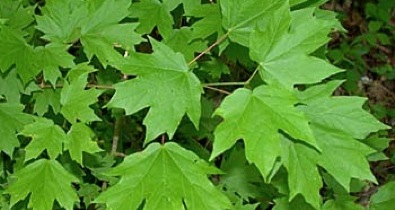
Maple leaf, think Canadian Flag
While maples are associated with colder climates, several species of maples grow in the South and at least four of them in Florida, two of them reportedly better for making syrup than the famous sugar maples of Vermont.
To anyone who grew up in northern climes, finding maples in Florida is a bit of a challenge because they aren’t the huge, craggy trees of up country. But, they are here; shorter, thinner, but just as welcoming to the forager. With one exception They all provide the same edibles: Sap, seeds, inner bark and sweet young leaves. (You did know there was more to the maples than syrup.)
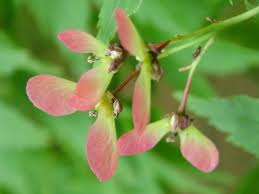
Maple seeds with wings
The four maples commonly found in Florida include the Florida Maple (Acer floridanum AY-ser flor-i-DANE-um) sugar maple (Acer saccharum AY-ser sack-uh-RYE-num) red maple (Acer rubrum AY-ser ROO-brum ) and the Box Elder (Acer negundo AY-ser nuh-GUHN-doe) with the first and last lauded for sugar production. There may also be a smattering of other maples as well, such as variations on the Southern Sugar Maple, the Chalk Maple and assorted imports such as Japanese maples. In usage, most maples are the same, no matter where they are.
The most famous maple product is maple syrup. I never “sugared” as a young man but I had a neighbor who did, Bill Gowan, and I helped him often. He had about a dozen sugar maples, and seven kids to feed. He also heated and cooked with coal so there was always a hot kitchen stove to boil the sap down to syrup, a 30-to-1 reduction in a good year. Every spring for many years I helped him collect the sap, a daily ritual that including emptying buckets brimming with the clear liquid. Inside the kitchen his wife, Maxine nee Lambert, kept a huge two-burner copper pot boiling all day long to reduce the sap, leaving their house very humid. For my labors I always got a quart of fantastic home-made maple syrup. That on buckwheat pancakes was probably as close to gastronomic heaven as I will ever get.
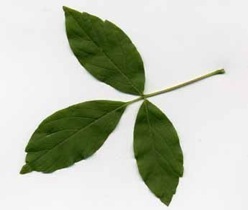
The “Box Elder” is a Maple
All the maples will produce sap for sugaring, but they vary in amount and quality. The odd-man-out maple, one that does not look like a maple, is Acer negundo, the Box Elder. It was more esteemed than the sugar maples and was a major source of sugar in the South. In fact, until sorghum and sugarcane were cultivated maple trees were the main source of sugar in the New World. Somehow Europeans never discovered how to tap their own maples. Distilling the sap is a dissertation unto itself. Box Elder seeds are NOT edible They contain hypoglycin A, the same toxin that’s found in Ackee.
Regardless of species — there are over 200 trees you can tap including Birch, Hickories, Sycamore and Ashes — tapping trees is done the same way. You either bore a small hole into the foot-wide or more tree, on an upward slant, and tap in a hollow spigot. Another way is driving in a half-tube metal spigot. Driving the metal spigot makes enough of a wound to get sap without drilling a hole. A bucket is hung from either tap and collects the sap. At the end of the season the tap or spigot is removed. Drilled holes are filled with a hardwood dowel. Next year you tap in a different spot.
Next on the list of maple edibles, in nutritional terms, are the winged seeds, actually samaras. To eat them you removed the wings and then parch, roast or boil them. Each winged helicopter pair produces two seeds. You can also eat them raw and should try one first. If it is bitter you can leach the seeds to reduce the bitterness. If they don’t taste good, take heart. Like acorns, they can vary tree to tree so try another one if they are not palatable. Again the seeds of the Box Elder (Acer negundo) are toxic.
The inner bark, the cambium, is next on the maple nutrition list, the same bark that delivers the sap. It can be eaten raw, boiled or roasted. Indians also dried it then pounded it into a powder, as they did inner barks of several trees including pine. Left over fiber can be sifted out. Lastly, young leaves can be eaten raw or cooked. They are sweet and delicate. But like all greens, provide the least amount of nutrition. By the way, dry or wilted red maple (Acer rubrum) leaves are toxic to horses.They can have pyrogallol which inhibits the ability of red blood cells to carry oxygen.
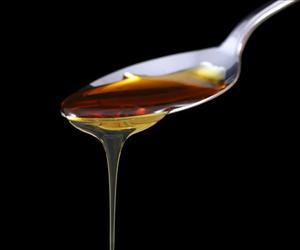
Europeans never tapped their maple trees or sycamores.
Acer is the Dead Latin name for the Maple and literally means “sharp” perhaps because it was used to make spears and lances. Floridanum means Florida. Rubrum means red. Saccharum, sweet, and Negundo, which is from the Sanskrit word nirgundi which literally means “that which protects the body from diseases.” The Box Elder maple did not get that name because it was good at reducing disease but because it resembled another plant that does, the Vitex negundo. The word “maple” started out as mapulder in Old Saxon then mapultreow in Old English then mapel in Middle English.
Maple Beer
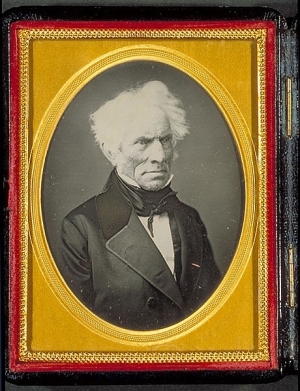
Francois Andre Michaux, 1770 – 1855
The following was written by botanist F. A. Michaux, left, in 1853, in his book “North American Sylva.” “Upon four gallons of boiling water pour one quart of Maple molasses [syrup] add a little yeast or leaven to excite the fermentation, and a spoonful of the essence of spruce: A very pleasant and salutary drink is thus obtained.” Francois is the son of Andre Michaux, also a famous botanist, and for whom Gopher Apples got their botanical name, Licania Michauxii. Many Internet amateurs get the two botanists confused and say the photo at the left from 1851 is of the senior Michaux. Don’t think so. The senior Michaux died in 1802 some 20 years before the first photographs were made. To see a younger rendition of Francois read Gopher Apples.
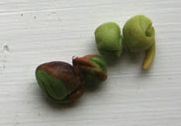
Maple Seeds Taste Like Peas
To collect seeds run your hand down the branch stripping them. One at a time peel off the outer skin, what we called the “whirlygig” when I was a kid. Cut the end and squeeze out the seed. There is a seed on each “wing.” They resemble peas or beans. Taste some seeds, if they are not bitter enjoy them raw, or roast them, or even boil them. If they are bitter — that varies with species and when harvested — you will need to leach them like acorns either soaking in several changes of cold water or cooking in boiled water. To roast seeds put them in a 350 F oven for 10 minutes or less. You can also dehydrate the seeds. Roasted or dry seeds can be ground into flour. Third warming: Do not eat the Acer nugundo seeds.
Green Deane’s “Itemized” Plant Profile
IDENTIFICATION: There are two groups of maples. One usually has opposite leaves, lobed, think Canadian Flag. The others have alder shaped leaves, ovals often with teeth. The leaves of the Box Elder can be green and white mixed.
TIME OF YEAR: For sugaring and collecting inner bark, the spring with warm days and cold nights. Seeds in the late winter/early spring, young leaves when ever present, best in spring. Bark as needed. Here in Florida maples can be seeding in late December to early January. Much later in the spring farther north.
ENVIRONMENT: Southern maples like damp, moist soil, river banks. I know several that grow in the Wekiva River swamp. In northern climes, on forested hill and mountain sides.
METHOD OF PREPARATION: Sap has to be boiled to reduce it 30 to 50 times, seeds raw, parched, roasted or boiled without wings. Taste first for bitterness. Inner bark dried, pounded, then cooked. You can eat the wings if you don’t want to remove them but they cam be bitter and hard to digest.
HERB BLURB
Native American Indians used an infusion of maple bark to wash wounds, treat back or limb pains, hemorrhoids, postmenopausal ailments and as a vaginal wash.
In an emergency situation, maples can be tapped for their water content as it takes a lot of maple sap to get enough sugar for syrup. The sap being mostly water. Another good friction fire wood also.
Where would I be able to find a list of all the trees that can be tapped?
Is raw mayple surup healier for the body than boiled? Does it taste good raw?
It is mildly sweet water.
There is no such thing as ‘raw maple syrup’. Before being boiled down, it is just sap. Howver – the water content of the sap can be reduced somewhat by allowing the sap to freeze, which it will naturally do if left outside overnight, as the ‘sugaring’ season occurs when daytime temperatures are warm, but the nights are still below freezing. This results in a slightly sweeter ‘water’ like substance that is pleasant to drink, but is still barely sweet to those accustomed to soft drinks, and other highly sweetened foods and drinks sold in the USA today. Allowing some of the water to freeze out of the sap before boiling does reduce the time and the amount of fuel neccessary to make maple syrup.
When in Florida is a good time to tap maples?
Early spring, just like up north.
As Deane says, before the sap from maples (or birch trees) is boiled, it tastes like water with just a hint of sweetness. You can concentrate the sap somewhat by freezing a lot of the water out of it, but you will still have ‘sweet water’. It won’t be syrup until it has been boiled. There just is no such thing as ‘raw maple syrup’.
My dog eats the leaves of our Japanese red queen acer tree and seems quite happy doing it. are they safe for a dog to eat? are they safe for humans to eat?
thanks,
Kaybee
The Japanese have been eating Momiji leaves for centuries.
Safe for humans, dunno about for dogs.
I would assume that maple flowers are also edible, but I can’t seem to find a reference to confirm this. I’ve tried those of A. glabrum, A. grandidentatum, and A. negundo, all of which were satisfactory. Can anyone cite a reference for the flowers of these species?
We eat the Norway maple flowers in the spring when they fall off the trees. They can be eaten in a salad, or made into a pesto-type sauce for pasta or vegetables.
Do you have a maple flower “pesto” sauce recipe you can share here?
It’s very hard to find interesting, ‘off the beaten path’, foraging recipes.
Norway Maples are very invasive. I’d get rid of one.
Some species don’t seem to have much of a seed. The Norway maple (Acer platanoides) in our yard puts out flat seeds like pieces of paper. But the silver maples do produce rounder seeds, like tiny almonds. We get mountains of seeds from both, so I should try them. They’re really edible raw?
Want to plant a red maple tree as a memorium in a dog park. Would it be harmful for dogs to eat the seeds?
Dog lover Tampa, Fl
Dogs usually have no interest in Maples. The seeds are bitter so if they ate a lot perhaps but that is unlikely.
I have a question. You said that Acer negundo, the box elder maple was the odd man out. What did you mean by this? I box elder maple not to be used as a food source as are the other maples, or did you mean something different? Thanks for your time.
It doesn’t look like the rest of the maples.
I learned that you can tap from the lower, young limbs and attach a bag to the weighted limb to collect the sap. You don’t get as much, but at least can get some water.
hello. i live on the south coast of oregon and we have all kinds of maples here. in particular the big leaf maple. are they still in the edible species type?
I’m also in southern oregon, I’m going to try tapping the maples down here soon. I’ll let you know how it goes.
Also trying to find out what other trees I could try as well.
I want to thank you for all the information you have given. We have 27 acres of red maple here in Florida and I do not know who to turn to in order to get to know /use these trees more. If you know of anybody here please let me know. We are in Polk County Many Thanks
I have a question for you: I have tons of Red Maple trees here in Polk County Florida. I would like to extract the Maple Syrup but at the moment the ground is waterlogged and it is very difficult to get inside the forest to do the job; it is really a thicket. Would it be possible to put the taps during late April beginning of May and leave them closed in the trees to open them during early spring to be ready for sap collection? This winter has rained a lot and my land is just a swamp. Thank you
Red Maples in Florida? Perhaps you mean swamp maples that produce red seeds.
Are swamp maples not real maples?
Yes, Swamp Maples” are real maples. Red maples are a specific variety and have red leaves, quite common as an ornamental up north. I also recall the leaves of the red maple are toxic to horses.
I’ve eaten the flowers and young leaves of the young red maple to no ill effect as a post breakfast snack. Has any others done the same?
I get lots of little maple sprouts popping up all over the yard this time of year, and I’m wondering how much of the tiny maple is edible. I’ve eaten leaves, flowers and seeds from adult maples.
But for the little maple sprouts, I’m wondering if I can eat the whole thing, roots and stem as well as the leaves?
I am using soaked red maple leaves to wrap an entire brined turkey to cook in the oven in a clay pot. Was going to smoke the turkey but I do not feel like stoking a fire in 90 degree summer heat. Maple leaves impart a fantastic taste to chicken and other meats.
I made samaras pesto this spring and it was fantastic.
Is the samara or seed of Acer pseudoplatanus safe for people to eat as a snack? I have read that it is on some websites but others report it is toxic for horses. If not is there any maple trees trees that produce seeds poisonous to people?
yes.
I just started using the sprouts of our Norway Maple in salads. I snap off the root ends first. When they become larger seedlings, I harvest the remaining young leaves for salads while “weeding” the yard, discarding the tough roots and stems to the compost heap. The Norway and sugar maples are safe to eat, but the other varieties may contain concentrations of these toxins: https://www.mdpi.com/2072-6651/14/9/608
I’ve been searching online for discussions about preparing and eating the young sprouts, recipes, and a nutritional analysis, but haven’t found a source yet. If I can’t find an online source, I suppose the county extension office, an herbalist, or university botany department may have some of that info.
Hello. I see that boxelder/manitoba maple is unsafe to eat since it causes jamaican vomiting sickness, but what part is inedible? I used to eat the seeds as a kid (never enough to hurt me since it is so much effort to get the seed from the pod) but now as an adult I want to eat seeds more. I tasted the wing part of the helicopter while it was still green & not dry. It tasted lemony & good. Is it edible? What part of the acer negundo contains hypoglycin A? (I think I will chop off the wings to eat if the bottom is inedible.) In the spring, before the seeds develop, can I eat the seed pods?
Jamaican vomiting sickness is usually associated with unripe ackee fruit.I have no reference connecting it to maples.