
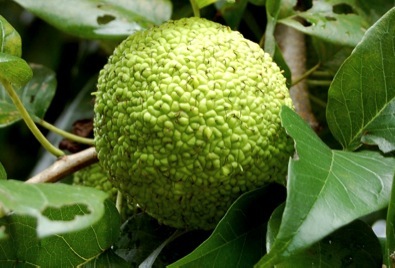
Osage Orange fruit
Maclura pomifera: The Edible Inedible
Sometimes everybody is almost wrong.
If you Googled “Osage Orange” or “Maclura pomifera” (mak-LOOR-uh pom-EE-fer-uh) in 2009 you’d get some 50,000 hits. Approximately 49,997 of those sites told you the Osage Orange is not edible. Two of three remaining sites, here and one mentioned below, said it is edible. The third one reported we said it is edible but we must be wrong. (In 2026, a search for Maclura pomifera produces about a million more hits, quite a change in 15 years.)
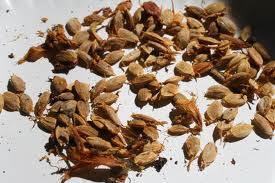
Osage Orange Seeds
In all fairness, not all of the fruit is edible. Only the seeds are. In fact, the Osage Orange it is closely related to the Mulberries, which we do eat, and the Paper Mulberry which also has an edible fruit. But, 99.999999% of the Internet sites 15 years ago said it was not edible. Why? Two reasons. Somebody a long time ago said the fruit was not edible, and the Internet is mostly cut and paste wrong.
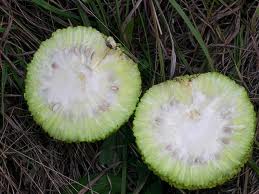
Fruit is not edible
It was from Jim Mason, a naturalist with the Great Plains Nature Center in Wichita Kansas, that I learned the seeds were edible. They taste somewhat like raw sunflower seeds. Not bad for an inedible fruit though he did say it takes a lot of work to get the seeds, and he’s right. The Osage Orange grows in Florida — I know where there is one in Jacksonville on Euclid Avenue. I have visited it several times. However, the tree grows in abundance in the mid-west, being part of the 1930’s reclamation process. It is, or was, the most intentionally planted tree in the United States in competition with the Lacebark Elm (Ulmus parvifolia). Its native range is a swath running from east Texas up into Oklahoma and parts of western Arkansas. It grows in 39 states and Washington DC, excluding the coldest and or driest areas, such as the high plain states and upper New England. Also found in Canada, it’s “invasive” in Italy and approaching invasive in Spain.
To separate the edible seeds from mature fruit put the fruit in a bucket of water and wait until the fruit is soft, then separate the seeds out. This will be an aroma-filled process and not pleasant. Let’s just say starving would help.

William Maclure, 1763-1840
Also called Hedgeapples, the Osage Orange got some of its reputation from killing livestock. But careful investigation shows the animals usually suffocated on the large fruit. That got translated into “toxic.” But one livestock feeding study found no significant chemical problems with the Osage Orange. As for the seeds, birds and small mammals have enjoyed them for a long time. Squirrels seem particularly fond of ripping into one.
While the edibility of the Osage Orange has been maligned for decades, its usefulness as a tree has not. It was and still is esteemed for making bows. In fact, some bow makers think the Osage Orange’s wood for bows is superior to the Yew Tree, which is usually held up to be the classic standard. The wood is turned into various products or used to make guitars. The bark also furnishes a yellow dye and tannins.
Botanically, the Osage Orange, Maclura pomifera, was named for a Scottish-born semi-American geologist named William Maclure (1763-1840.) He moved around a lot so calling him an American is a bit iffy. Pomifera means bearing apples.
Green Deane’s “Itemized” Plant Profile
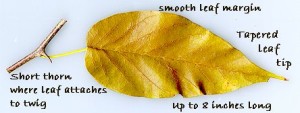
Graphic courtesy of the Great Plains Nature Center
IDENTIFICATION: Tree to 40 feet and 20 inches diameter, often with a short thick trunk and numerous low branches. Bark gray to yellow-brown, thick, divided into narrow forking ridges, usually with hard sharp spines to one inch at leaf base. Sap thick, white, sticky. Leaves alternate, ovate, 2 to five inches long, one to three inches wide. Fruit large yellow-green knobby balls to five inches in diameter.
TIME OF YEAR: Fruit, smelling faintly of orange, in late summer, fall.
ENVIRONMENT: Bottom lands that are often inundated with water, mixed with other hardwoods, and interspersed with prairie, and grow where moderately dry as well.
METHOD OF PREPARATION: Seeds raw or roasted
. One addition to make. A study that was looking for old homesteads to excavate in the midwest. They originally thought of using old wells as a possible homestead locator but found old Osage Orange trees were more indicative of a former homestead nearby. That says something about the usefulness of the tree.

These trees were used largely on farms to produce hedgerows, thus hedge apple, and for fence posts. The wood is very dense and resists rot well. I have a friend who does wood working and is always trying to save me the hassle of picking up the fruits. I spoke to a nieghbor, one of his trees came down in a storm and I was getting the main trunk and large branches for my friend, and he told me his father used to have a wagon tongued with Osage Orange. I found out through some farmers at an auction that this in fact true. Some locals used to buy the largest trees to harvest to turn ox yokes and wagon tongues. I also heard of a few people using the dye though I think that practice is far gone.
This is actually the first time I have ever heard of the Osage Orange being edible. I will have to give it a go next year as our season is gone and the only ones I find are mushy and overly pungent.
Wow- on target about finding info on eating osage orange– spent over 2 hours and hundreds of searches before finding yours… including both the other 2 sites you referenced! I just knew there had to be an edible part of the fruit, and was disappointed that just the seeds can be eaten but that is better than nothing. I am very suprised it has not been referenced anywhere for use as a flavoring in any foods such as jams or jellys.
what are the results of eating the seeds?
They satisfy your appetite.
There is a lot of interest in the hedge-apple for curing almost
any type of cancer……….do you have any more information ?
Regionally abundant, esoteric, underutilized plants often magically become a new “cancer-fighter” or “superfood” and are exploited by health food companies with strong marketing … In general, it is best to take such optimistic claims with a big grain of salt.
Absolutely false. There is nothing in existence that does that. Those are silly claims made by people trying to earn a quick buck off of the ignorant. If such a thing were real we wouldn’t be dumping poison and radiation into people as a “cure”
they don’t dump poison and radiation into people as a cure, they do it to make money. lots of things work against cancer, but modern medicine is only interested in things that make money… I use 35% hydrogen peroxide and DMSO to fight my cancer and can’t wait to try this…. GOD Bless you
Not delightful tasting, but not horrible either. Ever eat a real orange and bite into a seed before you can spit it out? That’s what Osage-orange seeds taste like. It’s a pain in the butt to get to them, and a god-awful mess too, alternately slippery and very sticky, a real mess. Wikipedia describes the juice of the fruit as a “latex”, and that’s the truth. Even after multiple handwashes, it is incredibly sticky, and god help you, if you get it under your fingernails.
The reason I found this website is because I just ate some seeds about 5 hours ago, and truly got a bit of a euphoric “trip”. I’m on the internet now, to find out what the heck just happened to me! According to the USDA write-up on the fruit, it is ALL edible, not just the seeds, but truthfully I would not recommend it, simply because it is non-yummy.
I ate three seeds, on an empty stomach, and at about 200 pounds I am, just to give you some idea of “dosage” here. About 45 minutes after ingestion, started noticing that something felt funny. I got a tight-and-floaty feeling across the forehead, a little tingling on lips and mouth. That forehead feeling, I recognized that, from college days. First thing that heralds the onset of a ‘shroom’ trip is that feeling on the forehead.
About an hour and a half after eating them, my cheeks felt numb and it seemed like my sense of smell got very sharp. Slight dizziness, felt giddy and sleepy at the same time, and that’s really the definition of “euphoria”. Briefly had a runny nose, but it was a 40-degree day, so maybe that’s what caused the wet nose?
No trouble with balance or motor skills, just a little “loopy” like I’d had too much coffee, but without the jitters that caffeine causes. After about 2 and a half hours, the euphoria started to fade and I stopped yawning, and now, almost five hours after, I feel completely normal. No upset stomach, no pains or any other lasting side effects, so far anyway!
As a whole, it was a fairly pleasant experience.
Now, after reading on the ‘net for a while, found that the fruit and seeds have mild anti-bacterial properties, and have very strong flavanoid compounds, which are a class of high-powered anti-oxidants. Also read that some compounds in Osage-orange fruit are under investigation for the most important anti-oxidant characteristic: preventing cancer!
You probably heard about anti-oxidants in red wine and dark chocolate and broccoli, and recently Nestle has done testing on a drink they concocted which is massively stuffed with various flavanoids. The news is that the drink had a remarkable effect of boosting memory in participants of the study, but Nestle has more testing to do and doesn’t expect to begin selling the stuff for a few more years.
Now that I just got an actual “buzz” from Osage-orange seeds, I’d say skip that glass of bordeaux and 80% cacao bar, just give me a handful of monkeyball seeds… now if only they could make ’em taste like chocolate, LOL.
Well that’s it, I’m off to more ‘net reading, to find out just what compounds are in the Osage-orange seeds and find out what gave me a 2-1/2 hour euphoria. Honestly, that was completely unexpected. I just ate them because a friend found one on the side of the road and we didn’t know what the hell it was, but googled it and Mr. Goog said the seeds were edible.
If something’s edible, I’m an omnivore, so I’ll eat it. But now, I’m pretty darn interested in finding out more!
What you described is the same type of reaction I get to anti-inflammatories. This is an allergic reaction – be careful!
‘Giddy and sleepy at the same time’ sounds like a very strange definition of euphoria.
Certainly that is not how I would define or describe it.
That is an allergic reaction to the latex. Be careful.
Commenting here to second that what you describe definitely sounds like an allergic response to latex. You can google latex and cross reactive foods. Watch out for the skins of figs!
I made a tincture to explore the pain and inflammation claims and I feel so much better. No trips or anything like that but much less anxiety and my chronic pain is less frustrating. If that’s an allergy, it’s the best one I ever had. My friend has a freeze dryer so I harvested a bunch.
This is amazing. I’m going to harvest a bit of it all. And store to study these affects. Thanks for the great knowledge you all have shared! Truly our creator gives back to us. Check out the thinking tree in Pulgia, Italy. A tree shaped into a man’s face, with facial features on the bark. Is my favorite (My personal outlook) The Osage Orange tree in my backyard. Eating these seeds/extracting and many more techniques, I’m sure this will be a great benifit to my family and I. I feel blessed y’all and I don’t like to bring religion into forums. But seriously these trees are amazing. Agarwood is another AMAZING tree!!! More amazing attributes. I also believe that The seeds of our own personal environments our Native trees and even our animals play a role. These are our weapons of healing. You’d be surprised what vegetation is around you that has many benifit to the human body. Speaking of. I would assume a human body does the same thing any living thing does if it gets sick…. It detoxifies itself. We are what we eat. These things will bring you many blessings 🙌
My daughter’s friends father claims he healed his stage 4 cancer by eating shavings from the outside of the fruit.
I am considering making a jam from Osage oranges. Admittedly, due to the information I have seen saying “freeze the fruit then pull it out a grate off a tablespoon a couple of times a day at eat it -+- as a possible cure for cancer”. I don’t have cancer, but I am thinking that it could be a good preventative… So why not make it palletable by adding cinnamon, sugar, and a low sugar pectin..making a jam? Well maybe because even with less sugar in the jam, it would cancel out the benefits of the cancer fighting power of the Osage??? I don’t know, is it like eating processed trash foods and then taking vitamins… Can’t hurt but probably isn’t worth the effort… What do you think? I am asking for your opinion due to your response which resonated with me. What’s your gut say?
Cancer feeds on sugar. So putting sugar in the recipe would be defeating the purpose. Do your homework because big pharmacy makes big money off of sugar. Suggestion…use natural pectin.
Every cell in your body feeds on glucose (the simplest sugar of all) including cancer cells if you have any. So what? It makes me cringe everyone someone says cancer feeds on sugar. It’s like saying rats breath air. So what? You can’t starve cancer by just not eating sugar. Your body will make sugar from fat or protein if it has to. Eating lots of sugar is not good for you but it has zero to do with cancer. ZERO!
Pectin isn’t a sweetener it’s a fiber that thickens jams and jellies.
So I’m confused as to why it should be used to replace the sugar. Also cancer feeds on sugar? No it feeds on you!
Actually restricting sugar — that is simple carbs — is a successful treatment for some cancers. There is a growing school of medical thought that sugar indeed does feed many cancers.
I just read an article on an Australian news site about Jackfruit it looks like a giant stretched Hedge apple, so I did a quick bit of research and they share both the mulberry and moraceae family names. The Jackfruit tree also has orange wood used as a dye. The reason for my post is that the Jackfruit is at the moment the latest fad in vegetarian meat substitute dishes around the world its flavour lacking flesh absorbs spice, herbs etc. and has a meat texture. Point being if hedge apple flesh could live up to jackfruit as an edible alternative to meat, well the skies the limit for the scorned, friendless, little hedge apple hehehe x
Jackfruit is a really delicious fruit. My wife is Filipina and we eat it a lot. Believe it or not you can make a really good BBQ jackfruit that it like a pulled BBQ Chicken or Pork. You can hardly tell the difference.
Oh! God no! There are so many better things to put into my body. The latex is significant, coupled with the extreme bitterness, and general messiness of this fruit, No my gut says: Not Me! I too was a youthful omnivore prone to experimentation. When seeking to extract seeds to make a more orderly hedge row, I had an unpleasant neighbor on the otherside of my fence, I thought to plant just the seeds after extraction. The taste is firmly in my memory and my mouth puckers with the reminder. I am now quite allergic to latex and wouldn’t be able to do it again. I always thought that the fruit extract should have some use as glue , paint, or mordant. I moved away prior to development. The aforementioned hedge row never filled in cleanly and was bolstered by thorny locust. It is thick and impenetrable now. Plant thorny locust, mow them over a few times and they get vicious, in Arkansas anyway.
I finally (tried to) make a syrup. It tastes pleasantly mild in a glass of water but makes you want to pucker if you take it straight. I should have added more water. It’s a bit strong. I want to make gummies but have to find something to help disguise the taste. Not sure I want to keep it on heat very long because of the antioxidants.
I’ve been eating small amounts freeze dried, trying concoctions that I make for the last month with no ill effects. In fact, I feel better than I have in a long time. The tea is very mild and nice for mood enhancement.
I don’t use the seeds. The fruit pulp is resistant to browning, but the seed coating begins to brown in minutes. A pulp made with the whole fruit started turning brown before it froze in the freezer. I tested some fruit pulp made without seeds and core and left it on the counter. A few days later it had puffed up a little and started to smell funky but still had it’s pretty canary yellow color.
A tincture made from Everclear and freeze dried fruit didn’t seem to have any mood lifting properties so I think the desired properties are best dissolved in water.
Just use healthy sugar replacements like monk fruit, coconut sugar or stevia.
Anyone know how I can get ahold of some hedge apples without having to hunt for them?
FYI. You can eat hedge apples. They’re good. Google grilled hedge apples with bear steak. Watch the video.
Where I used to live in Western Pennsylvania, the Amish sell the fruit as a spider repellent. We used to keep the fruit in paper bags in every room of the house and discard as soon as the fruit started leaking into the paper. Supposedly the fruit ripening gave off a gas that repels the little buggers. Saw very few spiders in the house.
I have heard that the fruit are sold in Asia for the same purpose… but never seen it with my own eyes.
Brady,
Where in Asia is it sold?
Thanks.
Melly
I have several large osage oranges to sell this year if you are interested.
I would love to purchase from you. What state are you in? How do we go about that?
Yes you can eat these in small doses. I live in Kentucky. My mother and I both have cancer and I know several people that have done what we are doing and the tumors are gone. No we do not eat the seeds. We freeze these and then grind the shell and all to the creamy white center a little at a time. We were told no more than a table spoon a day. They taste like cucumber to some and honey dew Mellon to others. More than this amount can cause diarrhea. But I will say I believe it does kill cancer cells. It is high in B17. I know people who are in remission. So we are doing this and we are not getting high or sick from it.
I took a chance and ate hedge apples during a fight with cancer. The first thing I noticed was two warts I had on my finger and toe were gone after a few weeks. Although I did go thru surgery and chemo my doctor was amazed at what he described as perfect blood work He said whatever your doing keep doing it.
Theresa hello my name is Carrie and I have a lung cancer is there anyway u can send me exactly how u two ground them and ate them and does it truly help. Really I have a type there telling me has no remission we can only prolong my life maybe five yrs. I appreciate it and thank u so much are u and ur mother still cancer free.
I’m battling cancer and would like to get in touch with you for encouragement. My daughter told me to find some of these but having trouble doing so.
I live in Kentucky & when I lived with my parents they dealt with Wolf Spiders constantly. A hedge apple tree grew just down the road from the house, & my dad would always get the ones that had already fallen off of the tree & cut it up to lay them around spots in every room of the house. You rarely ever saw a single spider afterwards. No idea how it works, but it always worked for them!
I hang mine is a mesh bag. The just dry slowly, no mess. Keeps out the mice too.
I saw hedge apples for first some 30 years ago at the local botanic garden, and i really liked the trees with the big yellowish balls. Later it appeared that it is not only nice but one of the best wood for bow making. wow! The hunt for the seeds started and ended up with a stolen ball. ( i confess) For some some reason the messy frosty watery workup did not bring any seedlings at all. Eventually i found a place where i could get 30 cm “almost trees” from a nursery. Nice thorny stuff 25 of that. The osage conquered Hungary, Szeged. I’ll be back with its taste after the first harvest.
Did you buy yours from cold stream farm? I was considering doing so, how did they look? Thanks.
No, I did not.
I received my first 700 from Cold Stream farm. They arrived and planted well, it was Feb. 2012. Most, like 99% all budded leaves. Some right away in March and some really late, maybe as late as June and I’m in Georgia. I was thinking the later to leave up had root problems to sort out? Now I sprout them from Seed, that’s real fun. Tree Help.com has seeds. And a friend of mine harvested 69 Hedge Apples for me. A video shows a soaking in a bucket of water does wonders on picking through the fruit for the seeds. This tree and it’s fruit has some very interesting chemicals that may be very beneficial to humans.
Was walking trail today found strange fruit. Will go back tomorrow to pick up more. Love learning about odd green ball from tree near me
I used to sit and admire these big old osage orange trees growing in an old field. One tree had a large and very busy bees nest. I video taped their festival-like lives.
Then one day I went there and the nest had been taken down. The city most likely protecting hikers.
Every year I used to take those brain balls with me but never came up with anything to do with them. They would just roll around my car floor till I tossed them. Pungent smell. Back then everyone said and I read that they were toxic but kept spiders away.
I am so happy to hear that they are edible. Can’t wait to try ’em out!
Thanks for all the info.
I’ve been searching for the answer to the question of Osage Orange growing in Florida… and you have answered it for me! Thanks! Now I have another question. I live in Pensacola and have been trying to find a Osage Orange tree for some time. Do you know of any up here or what sort of areas should I be looking in for me to find one? Thank you for your help and great website.
-Jon
A few hundred miles north of you they are epidemic.
I live in Jacksonville. Don’t know where any are.
There is an Osage Orange tree on Euclid Street in Jacksonville. If I could just remember the cross street. It is 1750 Euclid Street. East side. South of cross street Beverly. Here is a view of the property. I think the Osage Orange is south of the big one in the middle… next to the car. But I think that is the right spot. That’s about a mile due south of you.
https://www.google.com/maps/@30.286663,-81.715621,3a,75y,157.1h,90t/data=!3m4!1e1!3m2!1sJY0ryfioSLDpbv8qanMWpQ!2e0
https://www.google.com/maps/@30.286244,-81.71561,3a,75y,90t/data=!3m4!1e1!3m2!1sz_ma9PouduIT88VDFUJpQg!2e0
I’ve got several growing in the back yard, in Marianna, FL, about 250 mi. west of you. Be glad to send you some “oranges” so you can plant some new ones. You pay the postage. Relatively slow growing trees.
They do have nasty thorns when they grow a bit. They go right through the sole of a sneaker, and into your foot.
Wow…I live in Ponce de Leon, 40 miles west of you. Glad to hear that they grow in this area. I am in the woods and have heard that neither spiders or roaches like osage. I would like to buy a few from you to plant on my property. Thanks…
Actually about 45 miles north. I don’t have the tree but I can speak to the owner of it and ask him.
DAVE.. I LIVE IN BONIFAY AND WOULD LOVE TO START SOME OF THE ORANGES AS I WAT A HEDGE ALONG MY PROPERTY FRONT.. COULD YOU EMAIL ME AND LET ME KNOW ABOUT THE SEEDS?? THANK YOU
Hi Dave, may you please email me as I’d love to grab a fruit or two if you allow me. I am in FL east coast. I have stage 4 breast cancer and at this point I’ll try anything that may work. There is a farm in GA that gives them out for free but would rather not travel that far. cgmb84@gmail.com.
I had one go through sneaker under the Osage and didnt know it was from the tree at the time. It fell just short of puncturing my foot…
If you could kindly send me some hedge apples, I would pay postage and be so grateful!
Dave. I need to connect with you. Can you please send me some? I’ll pay for postage. NY sister is dying from cerosis of liver. I’m desperate to try anything for her.
Hello everybody im here in memphis do anybody know someone that has a orange tree n can send me some u guys r bless just 2 get up in go out n your own yard in get oranges anytime u please awww man im so jealous.
There is one at the edge of Lamar park in Oxford ms.
There is a grove of them in Grand Jct. Right into town, left on the first road (by the old Western Auto) to the end of the street. Turn right and they are in the yard to your right. I don’t know the current owners but it seems a good way to make a friend.
Peaches, I live just north of Memphis. Did you find the oranges you were looking for last year? We have a tree up here that is dropping them like crazy right now.
I have a tree near me in pa.
Hi Noreen, I’m fighting cancer & would be so grateful to take as many as possible, paying for postage.
I’ve found them up here in north east alabama.
I love my Hedge Apple trees here in AR!! (Growing up in OK, we called them Horse Apples.) Yes, they are all over the place here. I try to protect the ones that I have. Besides me loving them and the fruit…I like a tree that’s strong! They provide snacks for the squirrels and deer that visit here plus some entertainment for my kids!
And I have tried frozen shavings of the hedge apple with no ill effects. It was were VERY mildly sweet in an earthy sort of way. That was daily for several weeks last fall and I’m still here!
How do you eat it
You eat the seed only or the fruit has edible part
I have a big tree in the yard and it has thousands of big green fruits. Few are falling on the ground due to weight.
The article explains what parts to eat.
There is no reason not to eat them unless you are allergic to plant latex. If you can’t eat bananas and avocadoes, don’t eat hedge apples. The texture is awful but they are a passable nibble when dried. I like them best freeze dried. They are full of anti-oxidants and one of a very few plants that contain Pomiferin. Go to PubMed and look up Maclura pomifera or Pomiferin and you’ll see that it has been extensively studied and have a lot of potential as a superfood. It also shows activity on CB1 receptors. Maybe an inexpensive replacement for CBD oil? Unfortunately, the technical jargon in that study is beyond my comprehension.
They are most enjoyable as additive to herbal tea when sliced and dried. Use a small amount. Large amounts can cause diarrhea or stomach upset. This is like a normal “herbal cleanout” and passes after a few days of use.
You only need a teaspoon of the dried fruit for a serving of tea. Don’t take it when driving or any other dangerous task until you are sure you don’t get the “loopy” reaction. I haven’t heard that from anyone else who has tried it so it may well be an allergic reaction.
Gina B. I am in Arkansas & looking for hedgeapples to fight my cancer, (it worked for daughters friend). Would it be possible to purchase from you? I’m in NWA but willing to drive.
These trees are also know as bois d’arc (pronounced like: boaw dark). this is French and the French explorers gave it this name; meaning bow wood. They had noticed that the Indians made their bows from it.
I now live in Kansas and everyone here calls it Osage orange but where I grew up in Oklahoma everyone called it bois d’arc — only they pronounced it bodark.
I did a search of the osage orange after reading the name in a couple of different stories. I was born in Kansas and have lived most of my life here and all I have ever heard the tree called is Hedge or Hedgeapple. Makes great fence posts and burns very hot. Have seen horses eat the apples and pack rats seem to use them as their mainstay food source. My dog brings them to me for me to throw for her to fetch. Will have to look into making a bow from hedge.
Question concerning the edibility of this plant. You indicate that the seed are the only edible portion of the fruit.
Is the rest of the fruit poisonous or simply bad tasting making it unpalatable for any type of consumption?
In your article you mentioned the amount of mis-information on the Internet and I do not trust what I have read so far. The reason I ask is that I was contemplating a jelly experiment, but not sure if it would be a poisonous experiment or not.
The rest of the fruit isn’t toxic per se. It just has a difficult texture. The comment about freezing it.
did you ever work on the Jelly/Jam experiment? I was also interested in its use as a flavoring of some sort and was going to experiment myself this fall.
Any luck with jelly/jam experiment? I’d have sworn I had found a recipe for one or the other a couple of months ago, but now that a neighbors OO (osage orange) has fruit — LOTS of fruit — I haven’t been able to locate it. I get a new stove in the next few days — maybe I’ll do some experimentation.
The entire hedgeapple is edible, and cures cancer 95 percent of the time.
I have heard that if you cut up the fruit into pieces and put around your house or outside it will keep cockroaches away
I’ve read the same.
They most definitely keep cockroaches away. We had a tree in our yard in NY and gave them away to neighbors to get rid of roaches. My mom would split one in half and place under the kitchen sink. We gathered up unused fruit to take to the park for the squirrels.
Looking for a Definite answer as to whether the osage orange is edible or not. Thank you
Very edible. I eat them everyday. It tastes alot like a mild cucumber.
Not to mention they are great for your health. Thanks.
how do you prepare them to eat I just planted three new trees and looking for help as to what to do with them. I know if there is a fruit some one has figured out how to use it
Freeze. When it is hard enough, grate it with cheese grater, i use the fine grater. Eat one tsp a day if you are not sick. One tablespoon three times a day if you have serious ailment. There was an anecdotal account that a man ate 18 hedgeapples, and after which his serious ailment disappeared.
Too bad, the mulling log cabin accounts of its use and cure testimonials have been taken down.
Melly
That is my website and it hasn’t been taken down. I haven’t updated my website recently since I have had computer problems. My husband knew the guy that ate 18 hedgeapples in a two week time period. Only side effect, it gives some people diahhrea.
Preparation of osage orange alcohol extract (google translated according to russian source https://alcofan.com/maklyura-adamovo-yabloko-nastojka.html)
1. Weigh the maclura fruits and chop them coarsely or in a blender (if there is a lot of raw material, you can use a meat grinder).
2. The resulting gruel is filled with alcohol in a 1:1 ratio.
3. Store the glass container with the mixture in a cool, dark place (not in the refrigerator).
Steeping time:
The best medicine for both external and internal use is considered to be one that has been steeped for a year. The substance acquires a brown color;
If the medicine is needed urgently, the tincture can be used for external use within two weeks, and for internal use within 1–6 months. In such cases, it’s convenient to divide the original raw material into several containers, straining the medicine as needed.
4. The finished Adam’s apple tincture is filtered and stored in a cool, dark place; it retains its beneficial properties for 10 years.
My husband brought home this strange green “brain” fruit as big as an orange about a week ago. I finally cut it open today, (took several tries!) and it was sooooo sticky! Like latex ugh…hard to get off. No big seed in the middle, but a few very small seeds that looked like pumpkin seeds. The smell was just a green, fresh smell. After reading all about the Osage tree and where it is located, I would like to announce we have at least one tree in Dalton GA!
Sticky latex comes off easily with a little cooking oil. Rub and use an old rag to wipe it off. Then wash.
Hey Brother I just read your post. I live in Blue Ridge and would love to start some Osage trees so if you still have the tree we could meet up when they are ready.
Thanks
Hawk
I live in country Bama and I see hundreds of these fruits on trees and on the ground. It is hard for me to believe that they aren’t edible. They look so much like the breadfruit from the islands except they have seeds. I haven’t cut any of them open because I didn’t know what they were.
HI Ganel,
what season are hedge apples in ‘Bama? I am interested in having some of the fruit….will pay all expenses. email me. I am in dire straights to find the fruit.
thank you.
Victora
I have hundreds of these items. I hate them and would be glad to send
you all you want, just let me know
I would love to have a few!! I used mine in Michigan and really works to get rid of spiders. Let me no and how to work this out or if you still want to get rid of a few. Thank you so much you can contact me at my email
James Lucas if you could send me some. I will pay for postage. This is hard to find and CA doesn’t have any. I would greatly appreciate it. I’ve read it is good for cancer as a family member was recently diagnosed with the evil cancer. Thank you in advance
Yes Cali has them. There is 1 big tree in Julian that throws fruit all over the ground every year.
Send some to c.d.Sutton at 3545 Thomas St., Jacksonville, FL 32254. Let me know what postage is. Thanks.. 904-566-0959
I WOULD LOVE TO HAVE SOME FRIUT LET ME KNOW HOW MUCH TO SEND TO FL. AND I WILL PAY. THANKS
One grows in Jacksonville, if you are there the right time of year you can pick the fruit up for free.
I have a number of these trees on my property here in Charlotte NC. They are all in full bloom and full of fruit!! Would be happy to send some to anyone willing to pay shipping and add a little something for my efforts (Please keep in mind, if you know this plant, it has 1/2 -1 inch thorns that chew up your arms and the fallen branches can easily pierce thru sneakers and into ones foot).
Contact me at Ronnyboy921@gmail.com or text me to call you back at 704-905-6183
I’m desperate for some to fight cancer if you’re willing to send to Arkansas.
Hi , the name of this fruit came to me in a weird dream. My dead uncle told me about it. He gave it to me in Spanish as the “naranja de nudo”. I looked it up and to my surprise it exists and I found out it goes by other names, the Osage orange and hedge apple among other names. When I looked it up it says it treats the illness my ex husband has “ascites to the liver” which can turn to a liver cancer. I’m so astonish about this revelation in a dream and that the fruit exists and also about his illness!
Hello Mary, I feel that I should tell you the story behind Pomifera’s Skincare Line. I replied earlier but I feel like I should tell you the History behind Todd Johnson’s Creation since you mentioned that your dead Uncle came to you in a dream about the Osage Orange.
Growing up in Rural Iowa Todd’s Great Uncle Don would tell him stories about the Osage Orange being used during the Great Depression to heal skin ailments. Todd went to college and graduated as a Phd Chemist. Uncle Don Told Todd to isolate the Osage Oranges healing properties and they would make a Million Dollars.
Todd went on to work with a Top Pharmaceutical Company and didn’t research the Osage Oranges Benefits. When he retired he decided to find out if he could isolate the healing properties. Long story short he found that the healing properties came from the seeds of the fruit. He created a process to extract the golden oil and found the literal Fountain of Youth.
There are a few video’s of Todd talking about the history behind his creation on my page but my page is full of information so I’m not sure how easily they can be found. I would be happy to send you the video’s if you are interested. I have a video pinned on top of the page of Todd explaining the Clinical Trial Results which is very informative.
Launching on February 3rd Pomifera sold almost a Half a Million in 26 Days! It’s first Million Dollar month was in June, the 19th of June the company had hit it’s first Million Dollar month with 11 days to spare. Pomifera ended June with 1.6 Million in sales. In 5 months Pomifera is considered a 20 Million Dollar Company.
Maybe your Uncle was trying to tell you something like Todd’s Uncle Don told him. Only Todd didn’t make a Million, he will be a Billionaire!
I hope you enjoyed reading this. Stay Safe!!
Colleen Bourque
I know people who have been using the fruit as a pest repellent for their home for many years, and they swear by it. I’ve been to their home during each of the seasons and never once seen any kind of bug or spider in it, much less any other kind of pest! They place them a few feet apart all around the exterior perimeter of their house and property every year (or perhaps twice a year, I’m not sure…).
I live in Pensacola, FL, and have family in Corpus Christi, TX. I am desperately looking for a source in both places, as we’d very much like to start using the osage oranges. (An intense phobia of any and all cockroaches/palmetto bugs/whatever you want to call them is a salient point here!) It’s obvious to me that they work better than any bug spray, chemical, or electronic deterrent we’ve ever tried! Let me know if you can help, please! Thanks!
For deterring cockroaches…I’ve read catnip (nepeta cataria) is very effective. Osage apples may work also, but the least amount of sugar or smell of rotting fruit might just attract them.
They attract ants [at certain ripeness] so be careful where and how you place them. As a side note…Cockroaches HATE bay leaves. Thank you to everyone who has enlightened me on understanding so much more about these great trees.
Hi guys I need som Osage orange fruits if any one can sand mi I well pay all expenses.thank you
This link was just sent to me, and i cannot keep from leaving my comments. Hedgeapples are edible, and NO, they are not poisonous. They taste a little like cucumbers. The most valuable use for hedgeapples, is the ability to stop cancerous growths. I have been either eating or taking a hedgeapple capsule for 7 or 8 years now to help prevent cancer. I personally know several people who have been CURED of cancer by eating the hedgeapple. If i was told i had cancer, i would not take chemo. I would just double up on my hedgeapple intake. The ingredient found in hedgeapples is called tetrahydroxystilbene. Look it up, studies have proven that this ingredient reduces cancer cells. Nope the pharmaceutical companies or doctors won’t tell you about this. They can’t figure out how to put a price tag on it. There’s too much money in cancer research.
Where do you get hedgeapple pills at? I have never heard of this.
I live in Kansas and there are hedge trees all over in Central East Kansas , say around Lawrence. They were planted as fence rows back in the early days, and they really don’t like them here now and some farmers just cut them down. They use the tree for fence posts and even burn the wood, but it sparks really bad . The hedge balls just fall on the ground as no one uses them and have no use for them. If you drive down a country road when the hedge apples are ripe, you will see them laying in the ditches. I have heard that some people put the hedge balls around their house or basement to keep bugs away, but that’s all. Mostly, people don’t like the trees anymore because they have humongous thorns and will go right through your shoe and even a tire!
I have never heard of anyone eating the hedge ball.
Barb Williams ; I have been eating the fruit of hedge apple for five years ,,, and drink the sap or from the fruit since 2000’s … I also have used the fruit and sap for the externer portion of the body … like flesh eating bacteria ,,, poison ivy ,,, spider bite ,,, cold sore ,,, skin cancer ,,, burn sore from electric blanket ,,, warts … used on warts since 1980’s … and in 1995 i use it on flesh eating bacteria … and heal me with in three days … still used on other thing’s …….,,,,,…….
i have hedge apple capsuls and get you any amount that you need
I am interested in getting the capsuls.Thank You.
How do you fill capsule with Osage Orange? Curious. Have no desire to create them to sell them but just curious considering how the stuff inside is like latex rubber.
Can you tell me where I can get hedgeapples this time of year or where I can buy the capsules. My wife has stage IV colon cancer and decided to stop the second round of chemotherapy – didn’t think she could live through the second round! Your reply will be greatly appreciated.
Please go to (a now defunct website) and search for the hedgeapple cancer cure. There are people on there that freeze them and will send them to you for just the cost of shipping. Also tell her to try 2 teaspoons of baking soda mixed with deer park water twice a day. When you get the hedge apples, make sure she eats as much as possible for 6-8 weeks. I am NO DOCTOR, so take my info for what it’s worth. Just trying to help. I pray your wife makes a hasty recovery.
Chris,
That website does not exist anymore
Melly
I HAVE SEVERAL CAPSULES AVAILABLE
Jimmy ,
I have as many hedgeapple capsules as you will ever need . Are you still in need of them? if so you can call me at 937-763-1969, this is my cell phone , if I miss your call leave a message and I will return your call as soon as possible.
Bill Willey,
I forgot to comment that this hedge apple or Osage orange which is the same thing , can be found as a dietary pills on amazon.com
Can you tell me where you get the hedge apple capsules? I have been looking. I had cancer removed from my bladder last year and am interested giving this a try.
did you find any hedgeapple capsules? i have an abundant supply if you still need them
THANK YOU!!!! Judy Mullins Your reply was what I was looking for on here. I have heard the same thing and I have seen several trees down the road from me and would like to know how much of the shavings you eat a day and I have heard that it freezes well.
There must be truth to Judy’s story. They have withing the last few months pulled her website. I am trying to find out how to dry and capsule the fruit because I find the taste unappealing but now can find nothing about it on the internet….seems someone has been pulling the plug on websites that claim the hedgeapples can cure cancer. What has happened to this country’s right to free speech!!!!
I do not know anything about the cancer-fighting abilities of the Osage Orange, if any. But I assure you I am about as independent an old grouch as one can be and I will not be forced to remove articles that I think should stand.
Ever since the AMA got control of deciding who would and who would not be allowed to become doctors they have eliminated the freedom of anyone to say anything is the cure to anything unless you have millions of dollars of study to prove it. Not to mention stopping anyone from making any money on anything unless it is the Drug Companies.
The website is mine. I haven’t checked in a couple of weeks, but at that time it was up and running. This is December 30, 2017. http://www.mullinslogcabin.net
Here is a web archive of Judy’s site.
http://web.archive.org/web/20191123195631/http://www.mullinslogcabin.net/
Judy,
It is so good to see you posting again. Miss your website. Huh, but i copied and posted it and have the whole thing on file. I sent email to the lady that gives away the apple, but have to pay for postage, and she has not answered.
Please email me for the source of the capsules.
Many thanks Judy. God bless you kind heart.
Melly
tita_mel@yahoo.com
Judy,
Should taking the hedge apple be pulsed? Meaning taking it three weeks then one week off, then three weeks again, then one week off again, etc.? Do you pulse your hedge apple in take?
Many thanks Judy.
Melly
The lady that sells the capsules recommends two capsules a day for 30 days, and again in 6 months, as a preventative. Not sure how often when you have cancer.
Judy Mullins, I’ve been fighting cancer naturally for 6 years now,(supposedly stage 4). It’s trying to raise its ugly head again but haven’t tried hedgeapples which I have heard about. Where would I get the capsules you mentioned
A tale of two oranges…
I gave the osage orange a try this year. I can attest that the seeds are hard to remove. I picked up about 10 osage oranges from the ground. I got better at seed removal by the third piece of fruit by slicing them vertically to make about five or six thick, round slices. Then I used my thumbs to push out the seeds into a colander. Then I washed them. The difficulty was the time and mess. The white, pulpy substance became quite sticky — superglue strength, holding my fingers together — and took much cleaning with pumice soap to remove.
And all for what? I dried and roast the seeds. They tasted ok; but for me, the labor wasn’t worth the small yield and mundane taste.
Also this year, though, I tried Poncirus trifoliata, also called bitter orange or hardy orange. These definitely were worth it. As explained at “Plants for a Future,” I let them sit for about two weeks, which somehow made them juicier. But then I was on my own to figure out how to eat them. I cut two or three at a time and squeezed the pulp, juice and seeds into a tea pot; added boiling water; let cool to room temperature; strained and drank. Delicious. I’d describe it as a lemony grapefruit juice.
Bottom line, I’ll continue to respect the osage orange but will leave it alone. And I’ll be sure to harvest far more bitter oranges next year.
-chris
Maybe the ‘super glue’ aspect should be investigated?
Oil seems to do a better job removing the sticky latex than soaps, with or without pumice.
I was just introduced to this fruit yesterday and the winter farmer’s market in Wisconsin when a man gave my daughter one and told us about it. It has such a wonderful, earthy, fresh, fruity smell. Is there a way to make it into potpourri or use the scent for soap? I just read some company is using the essence as a natural bug repellent. I’m not sure if that means mosquitoes, but I’d love any ideas for turning this into something useful.
No,not mosquitoes but rather cockroaches in the house.
Good day to you Deane, and to all your readers.
Mama always said… or Uncle Ed said… or Grandma said… but someone always said about the Hedge…
The wood is hard and dense to cut (true that, I have used a chain saw on them), they burn hot in a fire (true that too), as stated prior – they kill cockroaches (Mama said this is because they eat the fruit and the sticky juice clogs their digestive tract – but I have not experimented with this so cannot confirm), they were used in the past to create a hedge that was impervious to cattle – simply by taking cuttings of the limbs (up to several inches in diameter) and burying them horizontally in the ground so they just show at the top of ground level, and that no animals eat them (untrue – I have observed partially eaten fruits for many years, mama got this one wrong).
Your moma was right, they don’t eat the tree, but they do eat the hedge apple. Notice my email (osagemann) The hedge apple is not the tree…I make wooden cooking utensils from Osage Orange wood.
I found lots of these fruits awhile back but didn’t know they are from Osage as I am a beginning bow maker. I googled fruit uses and was happy to see your site. I’ve been watching your youtube videos for a long time:) Much respect
I keep looking, but have yet to find any Osage Orange trees in my area. Deadwood, SD Any clues on close in spots would be appreciated! I’ll probably have to just buy som seeds!
If you’re actually wanting to grow the trees Musser Forests sells them online and through their catalog for relatively decent prices. I’ll be ordering some for my parents’ property as a (slightly late)gift for their anniversary.
I read all your wonderful posts and had to add my two cents. I use hedge posts because my grandfather took branches about as big around as your arm and made fence posts during WW II and the are still solid to this day. (however it is impossible to drive a fence staple in them now) The wood continues to get harder with time. Okay I am gonna to touch on a subject that has only been briefly touched on, burning this wood for heat… This wood is the hottest burning wood in my area (Missouri). If you put just osage orange in a fireplace insert it will get hot enough to MELT the metal. If you burn this wood mix it with other types of wood. Lastly, my grandmother and great grandmother made ornaments but slicing the fruit and baking them in the oven. The fruit turns brown and wrinkles in a wavy sort of way. The made some really pretty ornaments that I remember fondly. If you want details on how they did it let me know.
Hi Jeff,
I would love to find out how they made the ornaments.
Thank you.
I would love to get the details on how your grandmother made the ornaments as well.
Would love to have details on how to make ornaments with Osage Orange fruit.
I would love to make these ornaments, too!
I would like details on making ornaments.
I would like to know how your mother made the ornaments.
Thank you.
I read in an old time gardening book that they would use the osage wood to bend rail road ties when they were putting rail roads through, they’d pile some osage wood up on the ties and wait till they got hot enough to bend. That is some hot wood! If you had a kiln oven I bet it’d be a good thing to use for firing.
Jeff, I as well would love to know how to make ornaments.
This post has me wanting to grow Osage orange trees!
I have been wondering if there’s a shortcut to getting the seeds out – perhaps soaking or freezing the ripe fruits whole to soften them (or a combination) — it seems like there must be some shortcut to make collecting them more worth one’s while. They can often be so bountiful where one finds them…
As a retire I spent several years as a Passport in Time volunteer with the Forest Service. On one project we were searching for house remains to map a mill village that had existed between 1790 and 1890. After spending much time looking for stone piles and fireplace remains a fellow worker and I were talking about the site when it came to our attention that each of the house sites we had located had had a Osage Orange tree near by. We began looking for the trees instead of the foundations and were very successful. “The Question” Why were these people planting this tree? The insect repellent is to date the most logical answer I have been given.
Good shade canopy, open understory, resistant to rot, long lifespan, resistant to oxen and horses (you can park a carriage under them without concern of destroying the shade tree), fruit is easily avoided (as opposed to small acorns that hurt your feet when you walk on them). What a better yard tree is there?
Im from Missouri where the hedge apple/ missouri orange/ osage orange trees are all around. The trees were grown mostly for ‘hedge rows’ they grow fairly fast and work really well for fence rows. They have a yellow inner bark that burns hotter than any other wood I know of in a fireplace or woodstove. The wood crackles and pops and most of us midwesterners that burn wood for heat know that you will stay very warm while burning hedge wood. The hedge apple is worthless, as far as I know. Cows, pigs, and wildlife won’t even eat them but they do have a glue substance inside of them that works like elmers glue when your in a pinch. I’m sure it has other uses, but none that Im aware of from folk tale.
crystal ; osage orange fruit and sap can cure disease and cancer ,,, from external portion to internal portion of the body … and i’m still use it on everything … and sharing with friends … i have some been bottled since 1995 … I would like to test it on something like uncure deadly disease …….,,,,,…….
Petero, Please do share what experiences you’ve had and what you know of using Osage Orange for medicinal purposes. I made a tincture last fall using cut up pieces fruit gathered in Arkansas late Sept. off the ground – my gut feeling was that it must be medicinal in some way. I have several friends with cancer and want to know more about herbal alternatives. Thanks!
i slice the whole hedgeapple in thin slices and put them in a dehidrator until it is dry and then i put it in a blender and it comes out like dust. then i put this in capsules . i normally take one capsule in the morning and one at evening meal. im not prscribeing this to anyone , but you can google hedgeapple and use your own thoughts as to what you want to do.
It is curing my half sister of cancer.She is taking the capsuls.I donot know about it being bottled.I would like to know about that.
Petero, I’m your tester girl.(stage 4 cancer 6 yrs. No traditional treatment to speak of). My Oncologist treats me like I’ll die any day but then says keep doing what you’re doing. I’m still working but still need something to knock out the tumors. Pick me.
These posts are obviously not emailed back to the people who posted them… but is interesting to see that someone apparantly read the article, and still says ‘the hedge apple is worthless’.
I havn’t seen livestock pay any attention to them, but the squirrels pulled them appart in the late winer or very early spring for the seeds. By that time the fruit had been through a bunch of freeze/thaw cycles and had spftened considerably, making the squirrels’ work easier. Before that they ignored them.
I had a bandsawmill for several years, the goal to get free pine trees and cut into lumber and build my house. After all that people kept bugging wanting me to cut up trees for them… it wasn’t long after I got rid of the sawmill, but not before someone told me they would swap me some cypress logs if I’d cut up their osage orange trees into 6×6 posts. I had to get special bandsaw blades. The wood is denser than hickory and puts off more BTUs in the fireplace than hickory or oaks also. It makes a beautiful gold sawdust and the wood itself is gold and dries into a pretty bronze. They used the posts in the construction of their 3 story house on the river.
I am very interested in purchasing hedge apples, for medicinal purposes, not just for me but several of my friends that have cancer. I live in the orlando area of Florida. Please feel free to email me any sources. FYI the hedge apple does not need to be completely ripe, to eat.
thank you
vrhine@gmail.com
Victoria, I have several hedgeapple capsules ready to ship. If you are still interested you can contact me at , rangerbill01@hotmail.com
Several years ago we had horses that would go nuts over them. We always called them horse apples because horses seemed to love them.
Thumb up for this great article! Living in Romania, I first found the ‘monkey balls’ of this unusual tree some 10 years ago in a garden located several blocks from my home. For the last 3-4 years I’ve been trying to get my own Osage orange tree from burying the lime balls in my own garden at my country house, but with no results. Last fall I ordered from a supplier a couple of Maclura Pomifera baby-trees no higher than a foot and I’m happy to say that both of them survived a harsh winter. Does anyone know how long it takes for a small tree so have fruits?
be care what you wish for these things can take over before you know it and they are almost impossible to get rid of. These things have thorns that are sharper than nails . They can easily pierce a car tire.
I was brought up in a rural part of Tennessee and we had an Osage Orange chopping block in the backyard that I used to split kindling for our cook stove. It was also used to end the lives of probably several thousand chickens over the years. It was rot resistant and had stood the test of at least 25 years of use with only a slight indentation from repeated hatchet strokes. The wood is resinous and burns with a hot flame but can gum up your chimney and cause a fire hazard.
Fence posts made from Hedge can easily last a 100 years. They resist rot and insects . Once dry ,cutting this wood is near impossible. Even green it will dull an chain saw before you know it. When burned as fuel it burns hotter than any wood i’ve ever seen.
Charlie,
Is it true that when you burn the wood, it gives and fire cracker sound and sparkles as well?
Thanks.
Melly
Two more cents…
There is a spineless variety called ‘White Post’, but very difficult to find. My folks had one such when I was a child. If anyone knows where a nursery is that will sell such, I would love to know! (The spines can leave flaws in the wood, and I would like some turned items in this wood, larger than the purchased ‘pen’ blanks).
I have been told there is also another variant called ‘white shield’, supposedly faster growing and softer, as it was designed for turning utensils. .
I still have and use daily grandmas osage orange cutting board. And a turned potato masher. Hmmm… I wonder how it would do as a garbage disposal pusher…
To those who are looking for the standard spiney variety, eBay has both seeds and started sprigs.
Great work, but I eat the WHOLE fruit everyday and it is VERY edible and quite tasty. It tastes kind of like a mild cucumber and is VERY good at getting rid of any fungi or cancerous tumors in the body and it also helps clear your sinus passages of fungi and mucus and help you to breath normally. I know of several people that had cancer in late stages and eating the entire fruit killed all the cancer cells and saved their lives. You can believe what you want but I am telling the truth. You would just have to test it for yourself. Thank You.
The huge variation in edibility shared here makes me wonder if different stages of ripenness affect the taste, texture, and latex contnet? Or if there are huge genetic variations between the trees that the fruit is singificantly different from tree to tree?
It almost sounds like people here are sometimes talking about different species, but is is hard to mistake this tree for any other in the US. Even when tlaking about the thorns; they were there but we never had any issue with them. Fallen limbs were gathered and burned or added to the bruch pile in the woods, but the tractor tires stayed intact when mowing the area. And the horses p;ayed with them a bit but never really ate them. Just the squirrels, and only after winter had softened them. Oh, and the wood burned too hot for wood stoves, but was fine in stoves also designed for coal burning. I don’t remember it being an issue in terms of build-up in the chimney stack, maybe because it was cured?
I’m intrigued about what you have written. I would really like to have more information about eating the whole hedge apple. We recently found out that my old man has differential cancer and it is in his tongue. His son had heard that boiled hedge apples cure cancer so we are looking into different options that may help, along with what the doctors are saying. We live in KY where the trees are plentiful but the season has passed for fresh ones. We are wanting to know the processes that go along with getting the hedge apple prepared for eating. I don’t think that boiling them would work because it would take away any of the healing properties that the apple may contain. This is very important to us, so I hope that anyone out there that has the real knowledge of how to go about preparing the hedge apple for eating would respond to our cry for HELP! Your knowledge and experience would be a real blessing to us! Also I believe there may be different species of the hedge apple tree. We have always heard as well that they are poisonous. We are older and we have never heard anything good about the hedge apple from our older ancestors.
Chris, I believe you and am needing some to beat cancer. I’m in NWA & having trouble locating.
Any ideas?
The other day while collecting mullberry leaves for tea making,l noticed a horseapple tree with almost mature sized fruit.I’m having a bug problem so l brought home a few.Having read the above testimonials l thought I’d test the waters and nuked one in water for about ten minutes.The resulting tea tasted fine and after a few hours I was feeling fine,so l decided to eat a pinkie sized portion of the fruit.I went to bed feeling fine.Get this ,l had a viagra-type response all night.When l awoke l felt a little queasy,but not too bad. I ate and did some chores. Around noon l became sick and puked my guts.I remained in bed all day weakened,and I’m still weak today.
Next time avoid the chores…
I have a huge one of these in my yard and found out the hard way about these knives, I mean thorns that still has my hand throbbing. Live in North Carolina and we have lots of water bugs (roaches )so gonna try them as a bug repellent. Very curious how you eat them for the medicinal purpose as a cancer killer this sounds awesome. The big ugly fruit no one eats cures cancer. Go figure.
we have land in SE Kansas that is overrun with these hedge trees. I was pretty sure that the white sap that comes from piercing one of the “apples” was poison. When we were kids my brother got someone it in his eye . His eye turned red and swelled shut. We had to take him to the ER . They gave him Antihistamines and patched his eye for a day or two. Does anyone have any info on that white latex like sap??? I’d like to find a way to make these pesky things pay
its been reported out of Kentucky that it cures skin cancer
Hedgeapples cure all types of cancer!!
Judy, would you ingest hedgeapple or use it externally for skin cancers.
Also, would this be safe for animals also. We have two dogs diagnosed with cancer.
I has oral cancer the other has liver cancer. any info would be greatly appreciated.
Thank you, Stacy
COMPOST
Pile the hedge apples up beside or on your compost pile in the fall. The woodland critters will appreciate the winter food supply. To your advantage they only want the seeds and leave a nice pile of compost for you in the spring when there is never quite enough of that black gold.
The fruit of the hedge apple is indeed edible, I have eaten it myself and as long as the fruit has two hard frosts or freezes on it it is edible.
I live in SE Kansas where hedge trees are plentiful. We trail ride with our horses and when the hedge apples start to fall, it’s difficult to push the horses past them. I have never heard of them being poisonous and my horses have been eating them for as long as we’ve had horses (a long time). They do prefer them after a frost. I was told once that the fruit will take on an alcohol type quality after a freeze. That’s when the horses seem to REALLY want them. I have tasted them and they are citrus tasting. I have also sampled the shiny leaves of the female tree, again very citrus tasting. The horses prefer the mature fruit and love the leaves. I think if your looking for human consumption, you should follow the horses nose and go for the mature fruit. I think the seeds would be much easier to remove once the fruit has been frozen once or twice too. They are extremely hard when they first come on the trees. Once they have fallen and frosted, they become much softer, sweeter and easier to work with.
Finally! Maureen is right. I grew up with horses and cows, and they relished the fruit and the leaves. I was once served a pie made with the “horse apples” and it wasn’t bad, though cinnamon and sugar could make most anything palatable. This tree is closely related to mulberry, which also has milky sap, so don’t buy into that meaning it is poisonous.
Today was the first time I had seen this tree and fruit. Being the curious guy I am, I picked one up, broke it open, smelled it (it smelled like citrus n sweet) and took a nibble. It tasted sweet but I didn’t swallow it since I didn’t know if it would be safe. I picked up others and noticed that the ones that didn’t smell as sweet often had this white sticky stuff oozing out. Can anyone tell me how to tell if the fruit is ripe? I’m guessing that the ones oozing “latex” are not ripe.
I have hundreds of these fruits lettering my yard. If anyone wants them, drop me a line.
Kirsten, I do!!! I’ve been searching for these around me.. I’m wanting to plant a living fence around my land. I live in north east Texas, near Houston. Are you far from there?
Found a tree growing in La Porte, TX. Took me forever to identify based on the fruit.
Kirsten,
Do you still have some nice ones? I mean ripe, but not over ripe, with no black dots? I would like to purchase some.
Also how does one know if the tree is female or male? Must one have both male and female so there could be fruit on the female tree?
I do! Fighting cancer. Appreciate.
I am in tennessee
We just moved to a rural home in Southeastern Iowa and have these trees all around our property. At first we thought they might be some kind of black walnut from the large, green, bumpy fruit, but diligent google searches led us to discover its true identity as osage orange. I have learned a lot from this page so thanks to everyone for sharing their knowledge about it.
I am interested in the ornaments, and also wondering if anyone has tried baking the sliced fruit. Also, how do you cut the wood if it is so dense and gummy? Isn’t that bad for a chainsaw? I read that the bow makers split the wood somehow with a wedge.
We have lots of these fruits scattered over the property and at this time (early October), we have not had a deep frost yet (temps have gotten down to the 40’s, though), and the fruits are still very bright green, hard, and milky. They do resemble bread fruit in the internal fruit structure, although breadfruit is not sappy, but starchy inside as I remember. That’s why I was wondering how they bake up, because they bake the slices of breadfruit on the islands. Also curious if the osage orange is related to breadfruit, and what does osage means?
I found a page about osage orange’s medicinal properties and many scientific studies confirming its anti-cancer, anti-fungal (especially Candida albicans) , anti-Alzheimer, anti-Parkinsons, immune-promoting, and antimicrobial to name a few. Thought I’d add the link for anyone wondering: http://www.racehorseherbal.com/Wild_Herbs/Osage_Orange/osage_orange.html
Like the vital nutrient iodine, they found a component called lupeol, that causes natural cell death (apoptosis) which stops tumors from developing and even shrinks active ones, and there are heart-protective factors, as well as powerful antioxidants.
Apparently, researchers have taken notice, and the tree’s leaves and inner heartwood (the fruit, too) have been positively shown to contain a form of resveratrol, and something called Tetrahydroxystilbene (THS) which has very strong antifungal properties. Follow the page to the end and it contains abstracts from the actual scientific studies and a chart of the plant’s healthy polyphenols. Researchers also concluded that although the plant is considered inedible, it is also safe and “can be used as a food additive.”
I’ve also read this article which has led me to work with the leaves (tinctured) ~ a very delightful taste I must say… Hoping to learn more in terms of its anti-fungal activity…
The density of the wood makes it a challenge to cut, but I do not recall even the fresh wood being ‘gummy’. But the fruit can be, with the latex substance.
I live in southern ontario canada and just found out about this strange fruit after finding a couple of trees on my way to work. I plan on gathering a couple and try and get the seeds out to grow my own tree. I will totally try putting some in the house for a spider deterent.
These things are currently dropping like bombs in Cincinnati, common on the hillsides in the older parts of town. In winter they’re easy to spot, the naked trees have a greenish yellow cast to them unlike any other. On the rare occasion I mistake a different tree for an osage, the culprit is always a mulberry. The grosing habit is similar.
As for sprouting osage, throwing the whole fruit in the compost pile resulted in scores of seedlings, but the youngsters need to be faithfully watered or they wither. Very hardy when they grow up, but not when they first hatch.
If you want the seeds, freeze the fruit, then thaw it. This renders it somewhat mushy, and surprisingly easy to slice. Then you work the fruit with your fingers and thumbs and pop the seeds out. Kind of messy, use bowls, a sieve, water. Yield is impressive, 500 seeds from one very large specimen, about the size of a big grapefruit. Not bad work if the internet’s down for the evening.
To me, the raw seeds taste like the hedge apples smell, with a barnyard manure aftertaste. Maybe it’s the medication I take. YMMV.
I live in Cincinnati on the west side,can you cite a street?
I would love to grow a hedge of these, the food value is incidental…
I haven’t seen them on the west side, which doesn’t mean there aren’t any; I just haven’t seen them. The hillsides around the old city parks are good spots. Easiest to point out is a big spreading tree at almost the bottom of Parkside Pl., in Eden Park. In fact, it’s on Google streetview listed as 1066 Parkside. Looks to me like there are mulberry trees in the mix, but the Osage is there too. Most of the oranges roll down the hill and get squished on Martin Dr., but many stay under the tree.
PS. When extracting seeds, have dedicated utensils. Spouses object to the latex getting stuck to knives, bowels, countertops…
Bowls. Not bowels. ;o)
Lehman Avenue in Price Hill. Along both sides of the road near Summit View apartments.
I picked up a bunch from the roadside the other day. They were much bigger than they appeared from a moving auto. Hadn’t a clue what they were till my dog ate into one;then I looked hard on the Internet to be sure it wasn’t poison for her. I am in Rochester NY and this thing seems to do just fine in our long, cold, snowy winters.
I am in San Felipe TX and just passed one of these trees on my morning walk. Thanks for helping me ID it, and for all the helpful information!
Wow, so glad I ran across your site on Osage Orange. My husband had brought home some hedge apples because I was loosing the battle with 2 different types of cockroaches, he had stated that when he first bought the house 30+ years ago he had roaches and said he took his families advice (what he thought was called “crab apples” not really knowing the correct name), and put out the Osage orange/ hedge apples and said that within in weeks they were gone. Told me to just cut off the top and place in a bowl or lid and place under the sinks and in places where the pets couldn’t get to them. I went to search on this to make sure these were crab apples because to me they are some HUGE fruit, none that I have ever seen growing up, to my surprise they ARE NOT crab apples. 🙂 I am glad to learn the proper name of these brains. I know can educate him on what they are and we will be tasting the fruit as well. Still learning something new every day!!
the article you replied to was about how only the seeds are edible. so why are you tasting the fruit? It’s latex. and not good.
Two points not mentioned – if you want to burn the wood in your wood stove, cut the tree after all the leaves have fallen and wait a few more weeks. The sap runs back into the roots and gumming your chain saw won’t be as much of an issue. Once it is cut, let it cure for a year at least. It needs to dry out. The hotter burning wood is the old stuff – wood that has been cut and curing for years. If you find some old hedge posts, they burn great and very hot. But you will go through chains faster on the old stuff. It cuts like steel.
Second point – if you want to plant some, don’t bother digging the seeds out of the hedge apple. Dig a shallow hole and plop the whole apple in it. No need to dissect it. Apples buried by animals by stepping on them grow every year around here (Flint Hills of Kansas). We spray them and cut them down because they grow so readily. They are one of the easiest trees to start.
One more point, there are male and female trees. One does not have thorns and does not bear fruit. There have been some comments about the thorns. Thorns are longer in the Spring when new branches form. They can be three to four inches long when green. But when they harden, they are only an inch or so. Best to wear leather boots when working around trees where the ground is not maintained. You will likely have sore feet if you wear tennis shoes.
But if you want a more spiny tree, plant a thorny locust. Their spines are three to five inches long. They grow right next to the hedge trees. They WILL pierce a tire.
Oh, one more thing (reminds me of Columbo), the old hard hedge wood posts you find need to be extricated fully from the ground. If you break them off (can be done with a skid steer), you will leave a stob which will puncture tires. Experience speaking. That old hard post is like a chunk of sharp steel sticking out of the ground. (Pardon me for any misspellings – I’m typing on my phone.)
Ah! Cutting the wood when dormant was why we never had an issue with gummy wood. But why would anyone cut any kind of tree for firewood, or lumber, during the growing season? (Unless one fell acrosss a road or something.)
Aside from it being too hot for that sort of work in summertime, wouldn’t it be best to cut wood when the sap is in the roots?
Plus many kinds of trees will sprout and regrow pretty quickly from the established roots- for totally renewable firewood, fence post, fence rail, and pole building wood- among other uses. You get MUCH quicker regrowth than from planting seedlings, though the sprouts may have to be thinned depending on what you want to use the resprouted wood for.
Thank you Chris. I am trying to get acquainted with this tree and i find you very informative on the subject. I wonder if this would make good garden chairs if they don’t rot.
Melly
I have a Oasage / hedge apple tree that’s got to be one of the buggiest trees I’ve ever seen that stands in my front yard. Has the biggest fruit, we have truck loads of them every year. I live in SC . My husband and I are not able to clean up the fallen apples . If anyone knows who would be interested in this tree for the wood that is just beautiful I mean that this tree has to be at least 100 years old I would be so greatful for any advice. Thanks in advance. God bless….
I have about six bushels of fruit from one tree. We have just harvested the crop today after a heavy frost. A local market sells the fruit mainly as a decorative fruit for the season. I took in a bushel two days ago and they were almost sold out. I am going to continue researching this fruit to see if it has any nutritional benefit. If anyone out there finds anything further please let us all know. Thanx from Southern Ontario, Canada. Bruce
We’ve use the fruit as a super pest repellant for years on the southern shore of Lake Michigan. Spread around the basement. The one year we didn’t when we went to Florida, pests destroyed the hvac system
I found the easiest/lazyman’s way to sprout the seeds for seedlings is to leave the fruits lie and freeze on the ground through the winter, in a protected place open to the elements. The fruits will be rotting in the spring after thawing and the seeds will germinate in a clump. the rotting fruit seems to nourish and protect the little germinants. They root right through the soft fruit into the soil. Give them a few weeks to “harden” before separating while keeping moist, and planting temporarily in potting soil. Keep well watered until their second season.
Does anyone know whether bows are made from the stem or branch wood? Also what size wood stave would be best for using to make a bow?
Will Osage Orange grow in Northern Idaho? Thanks!
On the Green Deane Forum there is a thread dedicated to bow making and a lot of useful and technical information.
If anyone
is looking for hedgeapple capsules i have an abundant supply.
i can be contacted by e-mail . rangerbill01@hotmail.com
no order to small and no order to large.
Lost your phone number,need more pills.My number is 9544722281.Thank you Bill Please call me.
Specifically which birds and small mammals eat the seeds of Osage orange? Can you refer me to any references?
I’ve seen squirrels eating the seeds, but no references, just an eyewitness account.
I have also observed squirrels eating the seeds, each year in late winter or very early spring, after the fruit had softened, they dug out the seeds and ate them. This was routine, every year.
Musser Forests (sell trees and other plants) sells Osage Orange trees. They’re a reliable seller. Plants are small but relatively inexpensive.
http://www.musserforests.com
Do you have any seeds you are giving away? I live in Ontario and would like to try and grow this! It’s native to the region.
Hallo from South Africa…..I use Macluras as decor …..how can i make the fruit last longer ….will they dry well? Any advice on their preservation please
Can I grow Osage Orange in (tropics)Puerto Rico? I know is there is some in Hawaii India, Africa,I’m into archery and would love to have it close so in my old age I could make bows,lol!
The fruit also make great smashballs. One person pitches. The other person swings and SMASH! Loads of fun!
As that helps the tree get its seeds spread around the tree would probably agree.
Or, as my husband did to my son, tell him shooting the fallen fruit is excellent target practice! But carry a towel with you. My son came back covered in sticky goo. (He now calls them “snot apples”.) 😉
I grew up in central Kansas and we always called them Osage Oranges. My grandmother, who homesteaded in WaKeeney in 1901, believed that the trees’ roots went out 16 feet into the fields and caused the drought that made their farm fail. When she was very old and had dementia, she would repeat “16 feet into the fields” dozens of times a day. She hated them, but I have always loved rows of them alongside the fields.
Perhaps there was more to the story… but it is interesting how small incidents can be come personally important in many ways.
Current understanding of how trees function within the hydrological cycle would contradict your grandmother’s impression. Trees typically help, rather than harm, this cycle. First, the hedgerows also act as windbreaks, moderating the dessicating effect of dry winds on any plants in their windshadow. They also collect dust and dirt blowing in the wind, which can have an effect like sandblasting on plants.
Osage orange tree roots reach, according to one government report, as much as 27 feet down into the soil. This allows them to access water unaccessable to the roots of most crop plants. Trees pump water from deep underground into their leaves, and then into the air via transpiration. Other plants underneath and nearby benefit from the moisture that falls at the ‘drip line’ around the far edge of the foliage, as well as from the local increase in humidity.
After centuries (or longer) of viewing every living thing as being in competition with each other, scientists are beginning to understand that synergies and co-operation are far more common than cut-throat competition. Most farms and homesteads that failed did so because few people then understood how natural ecosystems thrived, and how to tap into the inter-relationships that made the prairie so abundant. Only a slightly higher percentage of farmers understand this now. Sadly, periodic drought just made the ‘wearing out’ of those farms happen that much faster.
Those interested may want to read Jerry Brunetti’s ‘Farm as Ecosystem’.
I live in North Carolina. Today I went for a walk near my house, there is a dead end in the area with one small field, on it there is a section with overgrown weeds , I love to look at the different kinds of weeds, to me they are also beautiful . As I was looking around I saw a small tree in the middle of them. I looked up and there were three softball size green lumpy fruits. I have not seen them since I lived in Ohio 50 yrs. ago. I got so excited that called out ” monkey balls” that is what we use to call them when I was little. I then turned around and there were two people looking puzzled. LOL I had to laugh and I asked the man if he knew what they were called, I of course explained . He told me he never noticed them before, but I could google the description .And I FOUND YOU. thank you for the awesome info I am going back and check on them later in the season, it’s probably too early. I have a lot of health issues, and I need to investigate this. Every ones insight was helpful.. God Bless
Thanks, and I will be in Boone NC for the next two weeks hiking around.
the tree with so many names…..the hardest tree native to north america…the wood with the highest density….one of my favorite trees….i have an old bo’dark bow that is at least 60 years old, still has a cast to it that is amazing… i drive for a living, and keep my eyes out for like victims errr,,trees, every once in a while i find one being taken down, and try to collect the trunk….i have a number of staves curing …..fruits for the house pests….and now i will be collecting them for eating also…the giving tree
I have plenty for sale. please see websitehttp://www.ebay.com/usr/ehmountainemporiumhw
closet or room deodorizers:
this is what I found works best.
take a sharp knife and cut the skin off, leaving them sappy, take an old coffee can with a lid and store in your spices after you use them to coat the hedge apples that have been skinned.
once you do coat them with spices (I prefer cinnamon) you have to lay them in an open air wire basket. like one of those three tiered hanging wire baskets that you can hang over your sink for your taters onions etc. but don’t stack them as they will mold if air is not allowed to flow around the whole apple. they will shrink up a lot as they dry. once dry though they are quite easily the best pomander you will ever have to give or use as a gift. when you get them ready to lay in basket, take a christmas tree ornament hanger and stick it into the flesh of the orange, once the apple dries up and turns hard then you have a way to hang your apple in closet or on christmas tree or you can then cover the apples with lace or ribbons whatever you wish. have made several over the years and still enjoy seeing them in the closets when I go to get something from it. they will shrink up to about 1/4 of their original size.
if you want hedge apples, you can buy them in boxes off ebay, they are quite cheap as many sellers!! I sell some boxes every year on ebay. they are good for so many things.
we like to find the weird looking ones, like doubled up ones and use markers and make faces, etc and take pictures for our hedge apple album. our kids and grandkids like to use them like baseballs and throw them at the trees to see if they will stick on the spikey thorns, its like a fall game after hunting season hours are over. yep sit in the deer stand for all morning then come down and have hedge apple baseball games. improves their throwing skills. and they have gathered up the crummy ones, put on the sand pile and used as targets for gun shooting practice too. then I make them gather up the pieces and throw into the chicken pen, as the chickens love the seeds. squirrels sit in trees and scream at them too for ruining their winter possibles. deer also eat on them. so hubs will take the machete and chop em up and spread them on the deer trails too. helps squirrels gather up what they want for winter as well.
we also have tumbleweed races out here, so whatever trips your trigger, hubs says.
am currently dehydrating slices of the skin and pulp about 1/2 off around the apples, leaving the seed pod centers, will take out as many seeds as we can, and feed the rest of those fruits to the chickens to peck clean fo seeds, then will throw up against the house outside for repellent balls. I am not sure they work as repellents but we do kick em over to the foundation when chicks are done with them.
one winter we gathered all of them and put them whole in the big hole in our driveway, when the cowboys run over them with their trucks, it squashed them enough the squirrels and our chickens were fighting over the seeds, but we kept throwing them in the hole til finally it managed to make a nice underlayment for the load of sand we put on top, made a sort of tough layer and has been helping hold that sand in place to keep the size of the water hole smaller after a rain or snowmelt. so we have used the apples for many things.
I sliced them into about 1/2 inch slices, put one toothpick broke in half into the center then layed them on my oven rack and turned oven on to 200degrees then after the dried, they were a wavy conical shape, I pulled out the toothpicks then made a U shape out of the top of floral wire and stuck the wire thru those holes, twisted the wire together under the cone shape, then covered that stem with green floral tape and stuck them in a vase, makes a nice brown flower arrangement for fall.
each year I like to try something different, but nothing beats a display of pumpkins and hedge apples on the porch. til the apples start to get mushy and turn brown, then they go to the chicken yard or the foundation of house.
My husband has stage 3 rectal cancer with 1-2 positive nodes. He was on chemo pills and radiation for 28 days. He will soon see a surgeon. I started him on Osage Orange this week. He seems to be getting a headache. Could OO be the cause?
Debbie did your husband have any luck with the osage orange? I ate apiece of it after I read it helped stomach problems and my problems cleared right up.
Everyone has great info about these! I have 2 of the trees on my new property in Ky. I always wanted Hedge Apples after reading about their medicinal uses. I had never seen one in person. Then we bought the property not yet knowing. I saw a tree from a distance that looked like it had a fruit, and turns out it was the Hedge apple! I was actually excited. I’ll post more if I try to eat them. My husband has cancer like symtoms, so hopefully I can get him to try it, but that’ll be REAL hard to do!
Some of the string instruments I’ve seen on line show attractive grains in the wood, however I am curious given the hardness of the wood, could a seasoned (dried out) blank of osage be used to make recorders or primitive clarinet type of instrument? A common wood for clarinets has been grenadilla (extremely dense wood), if osage is also dense, resistant to rot, I wonder if it also might be a good wood for such instruments. I’ll be curious to try some bow limbs for a bow/arrow experiment also. Good winter project cutting some large limbs down to cure for later.
Just ran across this article and thought I’d reply. Osage Orange is an extremely dense wood, and is heavy. It is very possibly the best wood on the planet for bows, including yew, so it should work for a musical instrument. Rot resistance: it was (still is) traditionally used as fenceposts in the midwest, because it just doesn’t rot. I know of an old field where the gnarly, ancient-looking posts were set around 1900. The wire is long gone, but you could rewire those posts and they’d probably last another 100 years.
Thank you so much for all the information.
God bless you
Be my guest and come get these horrible trees that yield big annoying green balls every fall. They fall all over the yard and are hard to clean up. I live in Shelbyville, Tn and have a backyard full of them.
I live by Wheel off of Hwy 64.
Where are you located?
I like to roll with my grandkids to see who can roll the farthest
I’m in Estill springs. Do you still have them. I’ll come and get them.
I’m sitting in my tree stand watching a squirrel go to town on an OO hedge apple and got to wondering what else oo was good for. Wow.
And I’m surrounded by them. I have no idea how many there are.
I have a blind behind an oo dead fall the I’ve used for almost 10 years. I just realized it hasn’t really rotted much at all.
I’m thinking this might be good wood for making knife handles.
Gets rid of a plethora of insects. I would cut each one into quarters and put in the corners of all the rooms in my house. Never had an insect problem after that !
Now, let me be clear, I am not an expert, but I am very fond of this tree. just wanted to throw in a few cents on what I have learned.
1. they do repel insects. they work wonders at it
2. they make great fence posts.. ugly knotty fence posts, but they rot at 1/3 the rate of marine treated wood and last a long long time. i can remember fence posts that i was told had been up through 3 sets of wire as a kid, and thats a long time. family said that fence posts had been up over 35 years… still holding up.
3. they burn HOT HOT HOT. be CAREFUL. you can use a small log to clean creosote out of your chimney.. but again.. start with a 6″ long by 2″ thick piece and feel it out! many ha house with triple insulated chimney has burnt to the ground because some dope threw in a large chunk and it overheated the system!!!
common names, osage orange, bowdark, IRON WOOD, hedge apple… and the IRON wood comes from the fact that when laying rail they would pile this wood up on a rail and burn it, and without bellows they could stack it in a way that would get hot enough to bend rails, it seriously burns that hot. .. or so the story goes. and i believe it.. partly due the fact that i have experimented with it, and let me tell you.. it burns HOT.
I live in Indiana on a bluff overlooking the Wabash River. I have Osage orange, honey locust, and Kentucky Coffee Bean trees. Although the article states that only mega fauna eat the hedge apples, I don’t believe that’s true. Here’s a picture of some hedge apples on the ground in October. After the snow covered the ground there were all kinds of very small animal prints in the snow around the hedge apples tearing into & eating the seeds. There were never any deer tracks, only rabbits, squirrels, and the tiny prints which I think might be mice or possibly chipmunks. Wish I had taken a picture of the “torn apart” hedge apples with all the tiny animal prints! Now that the snow has melted, the hedge apples are completely gone.
I saw your comment on the osage orange tree on the eattheweeds.com website. I have been searching for this tree in this area. I would like to see if you would be interested in contacting me about this article. If so please contact me at 12915jopoole@gmail.com. Thank You, Jo
But it is such an ugly tree. Its a mess. It doesn’t even grow like a tree. You dont just prune it, you have to attack it like a gladiator. It sprouts from the ground, every branch every tip, every notch, every fork. Its a mess. If ever there was evidence that a plant can be damaged by radiation or energy or infrared, its the Osage.
Braham cattle are the equivalent. This strange version of the cow, huge hump, massive folds of dewlip, almost not a cow, is the Osage version of a tree. Its a mess.
Brahman cattle are actually a different species of cattle than Europena cattle – Bos indicus instead of Bos taurus.
Though, like the botanists Gren Deane mentions on this site as constantly changing the scientific names of plants, some scientists use different names for these distinctly different kinds of cattle, or consider them to be sub-species of the same kind. Doesn’t matter- you are right, Brahmans are not the same as European cattle! THe hump and dewlap are aong their adaptations to hot climates with distinct wet and dry seasons.
Osage orange, to me, is a beautiful tree. Distinct in appearance, yes. But wouldn’t it be boring if all trees looked the same?
I actually boiled and ate a very small amount of the fruit itself several years ago with no ill effect. I don’t recommend this due to the stated toxicity of the fruit. This tree is related to the breadfruit tree. The fruit upon boiling it did have a slight bread scent to it.
Osage Oranges or as French Trappers called them. Boi D’arcs (BOWDAWK Americanized…). While Indians used it for hot burning firewood and wood for their bows… Settlers originally prized it as a Living Fence. Planted a few (3) feet apart in a shallow linear trench. You would take the first years growth and bend it left (or to the right) weaving it across the planted tree to it’s left (or right if you choose!). The second year limbs would grow vertically UP from these horizontally bent pieces and you would weave them in the same pattern. The 3rd and 4th year you’d have a hedge described by settlers as “Horse High, Bull Tough, Hog Tight”. The tree grows about 3 feet per year. The wood burns HOT as it’s a member of the Hickory family. Named after the Osage Indian tribes. Pretty yellow wood but nasty thorns. Referenced in many of first settlers letters and diaries of the plains. Enjoy.
I thought that osage orange was in the same family as mulberry and figs. But hickories are in the same family as walnuts, butternuts, etc, I thought. Deane, can yoy shed some light on this?
Thanks!
P.S. Keep it trimmed if you use it as a fence…it’s pretty invasive!
I recently camped with friends at the highest point of Whitetop Mountain, in Grayson County, Virginia. It’s the second highest point in the state, at 5,518 feet. We found an Osage Orange growing there, along with Northern Firs. It seemed very healthy.
My friend told me it was poisonous to cattle, so I had to see what I could find out about it. I also do not like relying on Wikipedia and other public sites. I usually try to find a university website to get accurate information.
Am sad you do not like to rely on Wikipedia, but here in Asia, its the next best thing. University websites are quite reliable. But I really like GreeneDeane’s site.
Thanks. Wikipedia has too many mistakes to be trust.
Recently bought some land in Vine Grove, KY. Today was the first day we had a chance to explore and we came across the most unusual and beautiful tree we had ever seen. We also noticed all these large lumpy green fruity things on the ground. We now know we have an Osage Orange tree. Thanks for all the information on our wonderful find.
When I was about 10 my horse loved to eat these in Alton, Illinois. she worked up a green foam inher mouth while she chewed. I have wanted one ever since. We called it a hedge ball tree. Now I can finally get one using the correct name. THANK YOU!!
I have read an article about the fruit of the Osage Orange being use as a cure for cancer. The rind was ground up and frozen and I think some of it was dried. Do you have any info on this, and could you please send it to my e-mail address. My husband has cancer and I would like to take the info to his Doctor. Thank you. Sandra Jacobi
That is outside of my expertise. You might find this webpage interesting. http://classicalformulas.com/ReadingRoom/OsageOrange.html
I met a very old gentleman in Kentucky who cured himself of stage-4 liver cancer metastasized to the colon, with Osage Orange after just one month. When he showed up for surgery, the techs said their scanning equipment was broken, because they couldn’t find ANY cancer. That was 35-some years ago. He says, freeze the ball for 24 hours. Dice it up with a hacksaw. Eat a piece the size of an ASPIRIN 3x/day for 3 days, then 2x/day thereafter for one month!!! He knows of about 400 people who have tried this and they are ALL WELL!!!
Get them now, wash them off, and freeze them. When they are thoroughly frozen, grate a tablespoon of it, rind included. Eat it and drink a glass of water. Google ‘osage orange cancer cures’ and you’ll see many pages about people having been cured.
I didn’t know any part of the hedge-ball (as I’ve heard it called in Kansas) is edible; but I have heard that it is a good natural insect repellent. It does smell a lot like citronella. What say you?
I think these trees are beautiful, especially once they get a few decades under their belts. Then they lose their dense, shrubby appearance and mature into a ‘proper’ tree. They’re still leafier than most, and make a great shade tree. There’s one here in Elgin, Illinois, on the parkway along Rt 31, that took three of us hand-to-hand to encircle it. Gorgeous specimen with a lot of character! In the old days, the primo wood for wagon wheels was Osage Orange, also called iron wood. It’s a yellow wood, so as it aged, people would paint their wheels yellow to spruce ’em up. People that couldn’t afford iron wood wheels would paint theirs yellow so they’d look like the pricey ones. (When people started staging reconstructions, they’d usually paint the wagon wheels yellow because that’s how they originally looked- even if they didn’t know the back story) Sort of like when white wall tires were a must-have and people painted their black tires to look like expensive white walls lol! And Osage wood just doesn’t seem to rot. Some years ago I was walking through the fields of an old farm that had been incorporated by the Cook County Forest Preserve. I noticed a guy wandering around too, and we stopped to chat. I told him it probably sounded silly, but I loved to follow the fenceline and admire the old posts. He said his family had owned the land and he liked to come by once in awhile, and that his grandfather had set the posts around 1900. The wires had rusted away, but you could’ve rewired those posts and they would’ve stood just fine. I tested one once, there was no rot and no give, like it was set in concrete.
This might be in line with the oil you make. In 1991 I worked on Perrymen Test Course in Aberdeen Proving Ground and on the #1 course
where there stood a patch of OO. I was into planting trees at the time and picked up a big bag of fruit. I went home and put some of the fruits (some had mold on them) in a bucket of water and sand and commenced to break them up with my bare hands. As I broke them up with my bare hands I started to get a very funny feeling in my hands. I took my hands out of the water and went to wash them off but the tingling was coming up my arms. I felt it come to my shoulders and the feeling came into my chest. There was no one else at home at the time so I sat by the phone to call 911 thinking I poisoned myself. I sat there for 20 minutes as this great rush came through my body. It slowly subsided and went away after 2 hours. At that time I was taking a potent arthritis med after I had gotten Lyme Disease. A week went by and for some reason I decided I didn’t need it anymore so I stopped taking the med. I have not felt arthritis pains since. My back doesn’t hurt much either even though the Doc said I’ve enough stuff wrong with my back to put 4 people in a wheelchair. I’ve tried this several times since but have never gotten the tingly feeling again. I didn’t get to the original OO trees on the course so I’m wondering if the mold on the OO had some type antibiotic effect on me
I have about 20 or more Osage Orange trees on my property in Howard county MD . I always wondered about the big green balls they drop. Tell me more.
http://iowapublicradio.org/post/iowa-chemist-turns-nuisance-fruit-spendy-cosmetic-oil#stream/0
Live in Dundas Ont Canada
Have 1 Osage tree in the neighbourhood,
Aparently there is one more somewhere in the area
Guess S Ontario is the northern limit for this tree
Thanks for the info on Osage Orange,there’s some down the street in Mentor Ohio close to Lake Erie, I plan to put some of those balls around in the woods near my house maybe they will grow!
The bark makes iced tea. Any info about healing properties of the tea?
Having eaten the flesh of Osage Orange I well tell you it can be eaten. A friend that had been in the British West Indies fixed it as you would Bread Fruit.
The Washington Post had an article on jackfruit back in June of this year. As I looked at the pictures of the fruit I kept thinking “that looks like something else, what?” And then it dawned on me: they look a lot like Osage orange fruits. That’s not surprising: jackfruit, breadfruit and Osage orange are all members of the fig family (family in the botanical sense).
The directions in the article suggest that the white core of the jackfruit be cut out and discarded. The fleshy part under the rind with the seeds is apparently the part eaten (after the seed are removed – the article says they are delicious boiled and peeled).
In looking at the images of the cut Osage orange fruit, I can see that the white core takes up a lot of the interior of the fruit. And the layer with the seed does not look thick. But if I were to try eating one, that’s the part of the fruit I would focus on.
The season for fresh Osage oranges is just around the corner: I might get adventurous and try some.
Here’s a link to the article in the Post – it might give you some ideas about how to deal with Osage orange.
https://www.washingtonpost.com/lifestyle/food/read-this-before-you-lug-home-that-jackfruit/2016/06/06/7d45b17e-282f-11e6-b989-4e5479715b54_story.html
Great article. I bought a small farm in Kentucky, and have HUNDREDS of these trees. They were planted years ago as a barrier, now they multiply every year. they have strong wood that burns very very hot. when you first put them in the fire they give off a perfumed smell that is wonderful. after they carbonize they start to smell like coal. I have ruined at least 2 chainsaw blades each year trying to tame them, and the dry wood can only be cut with a carbide blade.. All in all I think they are a beautiful , leafy, hardy tree, offer a lot of shade and as long as you don’t park under them, a great tree.
Where in my I’m looking for some bark of the Osage for tincture I have lymes n it helps with that
I meant where in ky I’m in louisville
Great info from all! Here North of Chicago they are fairly common but surprisingly enough, they are not known by the population at large; it is surprising because the sheer look of the fruit itself makes one think it could be “exotic”….I guess most people are not curious.
We have several hundred on the farm, from near 150 year old trees to new growth any architects needing custom cut Osage Orange logs let me know.
Where do you live in in ky
Osage Orange trees are entirely medicinal. The leaves, bark, wood and fruit have been shown to treat a wide range of ailments.
There 2 trees here in London, Ontario that I know of. So far after 40 years they have not proven to be invasive as some claim. I have always visited the location off and on and never seen any others growing. I wish the cemetary that they are located in would make an effort to start growing 3 or 4 more in case they need to replace the trees they have. I know I plan to visit in the fall and get a few of the fallen seed balls.
Weather and creatures foraging might have kept them in check.
I have a good friend that uses the hedge apple and has for two years. He freezes/ thaws/ slices 1/4 inch thick, dehydrate for three or four days. Then he blends/ chops into a course to fine powder, sift and store on the counter in a jar. Take one tablespoon a day. He has seven bad teeth, There is no swelling, and no pain at all. if he misses a day he will remember real quick. He is now mixing 1 to 1 jam and the powder. It tastes like fig bar jam, pretty fair. He has many times mixed it with fruit juice, shake and drink. We have around 6,000 to 14,000 of these for sale. 30:00 cash will get you two large or some smaller ones. H,A. Mattres’s. 200 east Shermon. Harrison. Arkansas. 72601.
Now ti’s the season. (We are honest)
I’m in far North Austin Texas [basically the Austin-Pflugerville border for those who might know the area]. After a mid-afternoon thunderstorm I decided to go wandering along the creek near my house and I came across a tree I’ve never seen before with softball sized green balls on it. After attempting to reverse google the pics I took didn’t work out I tried to describe it and hoped for the best. I found your page and have already learned more than I expected. I took one of the fruit with me. Hopefully the park won’t notice LOL I don’t think I’ll try eating it any time soon but I’ll happily store the info just in case. The tree is interesting–slender but leafy branches yet able to hold multiple fruit. Some branches had clusters of 8-10 fruit! Mother Nature never ceases to amaze me.
The seed oil that is cold pressed is used as an emollient by Alcone. Called “One Drop Wonder” it is a booster added to lotions, hair conditioner as a moisturizer, anti aging , antioxidant, UV protectent, repairs damaged and aged skin.
Yesterday morning I was walking to my car when something just dropped to the floor next to me…made a loud noise …. I turned and saw this weird looking, yellowish pale green fruit…..huuuge! I never saw anything like it in my whole life. Looked up at the tree but couldn’t really see where the fruit was falling from, since I was standing next to the park with many different trees in it. It looked very exotic and kind of tropic, so it didn’t make any sense to see it here in the upper Manhattan, in New York City.
I’m glad I found this site, thanks everyone for a very interesting exchange of information on Osage Orange. You just made my day!
I am in north east pa and I found a tree with the oranges on this year .
Found 2 big beautiful lime green Osage Oranges on the ground in the woods where I walk clients in Glendale, S.C. Had no idea what is was until my 86 year old client who is a gardener at best said she had seem them and could not wait to look them up. Thank you for this informative site. I am curious about any studies that the seeds or fruit can be an antioxidant helping to fight cancer?
Around here in Kansas where many were planted back in the dust bowl, they are my favorite firewood. Extremely hard to cut and will wear out a chainsaw chain much faster than other woods, but also burns well the day you cut it and much better after a year of seasoning. Almost as hot as coal though, so you had better have a good air controls on your stove. A runaway hedge fire will melt all but the best wood stoves. Was planning on planting a row of them, and will collect some of the balls for that purpose. If you weave the saplings together you get a hog proof fence. The trees have thorns on their younger branches, but none on the trunks of mature trees. They grow between the fields here where they were planted in the 30’s.
I recently saw a shared post [from 2015] in regard to hedgeapples and helping someone with cancer. In the comments, others confirmed it too helped them with their cancer. Another comment shared how they prepare and eat them. Here is part of that post. [TY JM, as I copoed from your post] The two easiest ways to get into your body is first freeze them, then take out of freezer and use a slaw grater, just like you are making cole slaw. You can’t overdose on it. Most people do 1 or 2 tablespoons twice a day, followed by a glass of water. The other way is use a food dehydrator, slice the hedgeapple in several slices, put in dehydrator, turn it daily, and in about 3 days it will completely dry, then you can pulverize it with food processor. I use a Magic Bullet machine. It’s totally powder at this point, you can get gelatin capsules at health food stores.
I am doing further research as a friend’s son [her last living son out of 3] was recently diagnosed with cancer. I pray this will help him as it is in an advanced stage.
On another note in regard to cancer….grape seed extract has great properties.
Other good natural cancer cures are flax seed (check duckduckgo.com, they aren’t so censor happy as Goo ber is), Dr. Johanna Budwig’s photoelements of life book (by Apple Publishing), Johanna Brandt’s grape/grape seeds and fasting cancer cures, there are many others such as Essiac (Tom Valentine’s book “Search For Health” had a great article about it, in it he had the recipe that supposedly after you boiled the herbs together you are supposed to let it cool, and then boil it once again for maximum effect), Latrile, oxygen therapy is supposed to help, vitamin B 17 (buckwheat is an excellent source), there are many others. ALL have been suppressed (follow the money), their discoverers have been hounded, arrested or as with Dr. Nicholas Gonzalez- offed. Best to avoid it totally by eating right (not the food pyramid, instead research Dr. Weston A. Price), avoiding RF emitting devices (cellphones, wifi, cell towers if you can!), toxic detergent, toxic “flame resistant” mattresses, ‘perfumes’, sugars, GMO foods (including meats fed with GMO’s, try to get grass finished meats- go hunting). Also avoid ‘enriched’ wheat products with synthetic ‘folic acid’, which the liver can’t break down, and when it was introduced into the food supply it made colon cancers go way up.
I have a growth in my lung and thyroid. Both have remained dormant for the past two years. I dry whole hedge apples and powder it. Then I add 1/4tsp plus a couple drops of poke tincture to my coffee a few times a week. You should always do your own research and know your own body because you could react differently than I. Not all medications are or act the same in all people so by no means am I saying trust my judgement or do as I do. Just trying to lay to rest that at least in my case small doses help me.
This is the weirdest bunch of comments I’ve ever seen. Guess I’ve been dumb all my life, now 71 years old, about what we’ve always called “horse apples”. We have 2 huge trees in our back yard, one is apparently the “male” tree as it produces no fruit. About 50 ft away is the “female” tree as it produces about 100 apples, or Osage oranges, a year. I hate them being all over the yard but the squirrels absolutely love them. Although they make such a mess because they only eat the inside seeds. But if that makes them happy, then I’m all for letting them have the fruit. We do have to trim the trees every other year because they can get out of control as they produce huge new limbs every year. These trees apparently grow wild where I live in Texas as they are everywhere here. I’ve never thought of eating them. One year at Halloween time, I took several of the then ripened fruit and painted some orange, yellow and green and put them around my flower beds as Halloween decoration. But the squirrels even got them too. I hate the mess they that the fruit leaves and especially when the squirrels have had a picnic in the yard but they make absolutely wonderful shade trees. The birds here also love the “pickings” that the squirrels leave behind. One other comment. Long ago before people started using iron stakes for property borders in real estate descriptions, people used the wood of this tree for property borders because the wood didn’t rot. Have you ever read a property description that used the comment “….so many feet from bois d’arc stake for corner? If you have, then it’s the wood from this tree.
Thank you for the information you supplied here! Your article is very informative, and much appreciated!
I signed-up to be a voluntary, contributing editor to Wikipedia in order to improve it, and would invite you to do the same. Additions and changes to the information in an article will be accepted as long as you have credible proof to back-up any additions/changes and cite those sources. Some people sink a lot of time into reviewing articles, but that is not necessary — I only tweak articles as I come across something that needs tweaking. ?
Thanks for writing. That is a sore spot with me. I read a Wikipedia article once that referenced me twice and got it wrong, absolutely wrong, twice. Both attributions were exactly the opposite of what I wrote. As for other mistakes there are so many in the real of foraging — mostly wives tales — that it would be a full time job to correct them. That is why Wikipedia is not allowed to be quoted on any of my sites or Facebook pages. It is grossly wrong often and widespreadly so.
In 2009 I moved to Kentucky from Wisconsin and saw my first hedge apple tree, and quite frankly hated it. It’s a huge 30′ tree in my front yard next to where I park my vehicle, and every Fall I cursed having to pick up the hundreds of hedge balls littering my yard and parking spot. I’ve had two busted windshields from them and have nearly broken my ankle stepping on them in the dark on many occasions.
In the Fall of 2013, while checking my companies on-line sales venues, a pop-up ad came up on my computer of a company selling hedge apples. I was astonished! I immediately started marketing them on all our sites. Although I believed that people were purchasing them as a spider repellent, I had read on several different websites about the anti-cancer properties of hedge apples but never really saw any professional studies on them until last year.
Three events happened to me last Fall that totally changed my perspective on the humble hedge apple. First, I found out that seed oil from them was rare and incredibly beneficial for skin. I also meet two people who use hedge apples for pain relief; a physician who eats them frozen for his back pain, and a Russian lady who now resides in Chicago who makes tincture from them to use topically on her arthritic knees. This information caused me to delve into research on hedge apples. I have found the best search results were found using the Latin name for the fruit, Maclura Pomifera. This resulted in a tremendous amount of reputable information on research done on the medicinal properties of hedge apples, especially the compounds Pomiferin and Tetrahydroxystibene. At this point I started asking my customers if they minded my asking what they were purchasing them for. Fifteen of them told me for treating cancer!
At this point I created a new company to handle all things pomifera, Maclura Products LLC. My biggest hurtle to overcome was coming up with a method of preserving hedge apples for those wanting them year around. The solution, Freeze Drying raw hedge apple. Maclura Products now produces 100% cold pressed hedge apple seed oil we call Essential Gold, a body made with Sweet Almond Oil, Jojba Oil and the Essential Gold, and most importantly, Freeze Dried Hedge Apple in either capsules or powder.
For website links or videos on the research please contact me and I will be happy to send them to you.
Hello Anthony, the creator of the Osage Orange seed oil launched a skincare company of his own in February of 2020. Pomifera is Co-Founded By Todd Johnson PhD Chemist & Creator & Lindsay Marie Colombe. Pomifera is a Phenomenal Skincare Line, the results are noticed within hours for some of my Clients.
I’m sure that it will not surprise you that Pomifera Rose Oil (100% Pomifera Oil with 3-4 drops of our Signature Fresh Essential Oil & Herb Blend) is Scientifically & Clinically Proven to be the Best Natural Oil in the World! It is very affordable also, It is $47 for a full ounce of Pomifera Oil. No other company can sell it for our price because it costs so much to produce it. Todd has his own patented equipment that can produce the oil at a much faster rate. Everything is made in house in Rural Iowa. 100% Made In America!
If you are interested in learning more, My Facebook page is Colleen’s Fountain of Youth with Pomifera, it has hundreds of Before & After photos and information on the company & products.
I just harvested a few here in Oklahoma Oct 6-2018 I peeled of a spot off the bumpy skin and sliced a sliver/piece off like a cucumber. It tastes like grass and cucumber mix actually not bad and so much better than I expected! The one I tested wes ripe! This is important, if you ever ate an unripe persimmon you know what I’m saying. and is causing some gas and rumblings. the other thing I noticed is it get a little gummy in the throat and feels like something is stuck (I ate a pretty good chunk) that may be why many say 1 teaspoon graded ( hey a test is a test) An I am crass for trees and fruit all of my 63year old life. It did make me a little drowsy and I took a swallow of olive oil to ease the sticky throat.I feel great! Therefore the whole of it is edible but unlike myself take small dosages half a tea spoon to see if you get a reaction. I freeze and sell to some Orental people/comunity and at the farmers market for a couple buck a piece .
Hi,
the Osage Orange on Euclid Street in Jacksonville unfortunately hasn’t had any seeds in its fruits.I live about 4 blocks from it and I check every year in September. There must be no male tree within miles.
The way I got the seeds out of mine was I waited until they were over ripe (mushy), I let them get rained on and you can soak them in water (the whole fruit). Then I mushed them up with a stick in a bucket and filled up the bucket with water. Then I stirred it around real good and let the seeds settle at the bottom, then poured off the gunky stuff. Makes it easier to get the seeds.
Actually. I saw a video by AlmazonKitchen
Take a slice, about 1/4″ thick.
Season it as a vegetable, and fried it.
It showed him eating it. He has made several videos afterward so, he lived…
I will also be trying this. If I can eat jackfruit, this should be no different.
Me and my wife are taking hedge apple capsules daily and am now selling the products
deburch37@yahoo.com
For capsules made from the entire hedge apple
Hey,
Just wanted to chime in here. We purchased a farm here in Missouri a couple years back and also a herd of 31 cattle. It was August when we did so and we have hundreads of old hedge trees loaded with fruit. Let me tell you the cattle went crazy. It was like going out to feed pigs slop. They were fighting over them like spoiled children. I mean these cows are dozens a day. And the leaves they are like candy. They went so crazy over them I had to look them up and got a little scared when I saw how they would often get lodged in their throats. But the cattle chewed them up like gum balls and would have froth coming out their mouths. They would swim across a pond just to get a loan hedge ball. Pretty crazy. I will tell you that they must be rich because they all seemed to be able to crap through a screen door after feasting on them and that’s pretty much the same effect I had after eating too much of one?. Now I will say my pigs could care less for them and pigs will sit there and eat a trailer if you let them so who knows. I did capsulate mine and try to take them when I can remember for health. Looking forward to finding more about these trees God has blessed us with.
Cheers
My last word on this subject, to each their own, I never going the taste enticing. There may be regional and varietal differences, much like when I went from Northern Arkansas to Southern Indiana and was told to split elm wood for the fire. Arkansas piss elm and winged elm have spiral rings that alternate direction each year and as such are impossible to split, and smell bad when burned. The elm in Indiana smelled very floral and was straight trained / split very nicely. Beau D’Arc, Leave Orange can be over rated as for resistance, older trees with sufficient wetness rot quite readily. For now making finding straight trained Heartwood is the key and not always easy to get.
My latex allergies and my aversion to the taste leaves much more for others to love.
Hello Darrell, I see you sell Hedge Apple Capsules. I am interested in getting information on this product. I am with a skincare company that is created with the oil from the seeds and it is Phenomenal. The healing powers are unbelievable so I would Love to get my hands on these capsules. This fruit is truly a gift from God, I know as far as the skincare alone I can guarantee you it is literally the Fountain of Youth,
We have found the fruit in NY State :).
Frederick Law Olmsted– was the countries first landscape architect= He designed Central Park and 100’s of other parks across our land. Olmsted planted Osage Orange trees on his Staten Island NY home. They are still there=- still giving fruit and they are over 150 years old~~. Olmsted came to Staten Island from Conn as a young man and practiced planting different things on his 125 acre SI farm. His house ( pats of which was built in 1680,) still exists– It is a NYCity landmark and is in the long process of being restored- with about 4 original acres around it== Many trees planted by him are still thriving on the property. Check out the Friends of Olmsted,Beil house on face book.
I was born and raised in north eastern Ohio and we had Osage Orange trees along the roads bordering our farm. The fruit was sticky and nasty, smelled awful and , as an adventurist kid, I tried tasting them. I found. early on they were bitter and in no way desirable to eat. My Dad used to pick up 3 or 4 of them to practice his juggling with.
Hi Paul I work with a new skincare company that uses the seeds from the Osage Orange Fruit to make a Miracle Golden Oil to create our skincare. Our Co-Founder and Creator of Pomifera Oil Todd Johnson PhD Chemist, has posted videos of him juggling the Osage Orange. I think he usually uses 3. Todd lives in Iowa, Pomifera is made in house in rural Iowa.
I have a previous comment from 2012 that I had forgotten about. I’ve planted these trees from saplings and from seeds, I’ve hunted the seed pod balls and admired just one or two trees. If anyone has any of these trees in the USA that they want removed I would like to speak to you about allowing me to take the wood, even large trees. I am a conservationist but sometimes someone wants a tree removed and I would like to salvage wood from a tree in this fashion. I am a wood worker. Additionally I would be happy do discuss the tree with anyone. Steve
I forgot to mention I’d be happy to remove it. The comment reads as if you get all the hard work done somehow and I just come and steal all the wood. No, I’d do all the hard work, but aside from 72,000 pounds of winching capability, I don’t climb trees so lets not get too excited about trees near buildings. I have all the sizes of chainsaws and some 20,000 pound trailers. I would be willing to drive nearly anywhere for the right tree(s). But I am not buying trees. Thank you, again. Steve
Guys don’t be swindled out of your trees. I’ve been a wood worker for 30 years and the Osage orange “secret” is starting to get out. It’s a wood we have used In the hills for over 100 years for many many things.
Twice and tree times harder than many hard woods and is the most rot resistant wood known.
A 2 inch x 12 inch x 5 foot board can sell for 2000 dollars. Rick people are starting to use it for our door patio furniture and benches .
When a stranger comes up and offers to cut down that troublesome tree that drops balls all over your lawn for free…. be wary.
Now the latest craze is Osage oil– pomifera. Skin benefits are unsurpassed supposedly for bug bites to fungus and rosacea. Also the macerated and tinctures pulp supposedly cures cancer🤷 I used to have Osage wars with the neighborhood kids while eating roly polies…should have been eating those seeds I guess instead🤣💚
Hello Jessica, Yes the oil from the seeds have unlimited healing properties. I work with a skincare company Co-Founded by Todd Johnson PhD Chemist and original creator of Pomifera Oil.
Pomifera Rose Oil is Scientifically & Clinically Proven to be the Best Natural Oil in the World.
Pomifera Skincare Line will be one of the most effective Skincare lines in the world, if not the best. The results are unbelievably fast and very effective. If you would like to learn more visit my Facebook Page Colleen’s Fountain Of Youth with Pomifera. I have Before & After Photos also, you will be amazed at it’s effectiveness!
Mary are you aware the Osage Orange Seeds are used to create a golden oil that is used in a Skincare Line? Pomifera Skincare Launched in February 2020 by Co-Founders Todd Johnson, Phd Chemist & Creator of Pomifera Oil, & Lindsay Marie Colombe, self made millionaire in the Direct Sales Industry. Pomifera Oil has unlimited benefits such as anti-aging properties, helping to treat skin conditions, fading age spots etc. the list goes on and on. It can be used by everyone in the family including pets!
Almost every product in the line contains Pomifera Oil, The Star of The Show is Pomifera Rose Oil. Pomifera Rose Oil is 100% Unrefined Pomifera Oil & 3-4 Drops of it’s Signature Essential Oil & Herb Blend. It is Scientifically & Clinically Proven the Best Natural Oil in the World. Pomifera’s Skincare Line is extremely Affordable & Effective.
Facebook Page Colleen’s Fountain of Youth with Pomifera has information on the company and Before & After Photos.
To shop for Pomifera Products go to http://www.pomifera.com/afountainofyouth
Thanks for the information. I found it informative while on a trip to Kansas. Being from Idaho I had not seen this tree and the fruit was very interesting. On terms of being accurate did you mean to say it was a Native tree from Texas into the mid wet right after you said it was basically introduced?
The last years we processed 400 lbs a year, This year we will be doing 1200 lbs. In the last five years. All the people that have came to me have been cured of cancer, Arthritis, COPD, Limes, constipation, and a fake virus called co-vid 19. I reserve my first amendment right to say or write anything that I need to! Quote: Disinformation is the code word for Truth! Sy
Oh sure. The cure for cancer is osage orange. So just how does it kill cancer cells and not regular cells? By what mechanism? What magical compound does Osage Orange contain that can do what very few modern medicines can do? I’m sure if it did cure cancer, there would be quite a few companies trying to figure out just how it works. I have been around long enough to see that there is a sucker born every minute. Remember when vinegar was supposed to cure everything? Before you believe this malarkey, ask to see the results of the clinical trials and the papers published in medical journals.
I have a memento piece from a tree that was on a farm in Aotearoa New Zealand turned as a tag on a key ring. Hard rich dark wood with lighter brown stripes as though the different colours were growth rings. We will be planting some this year.
https://fitoplaneta.com/shop/284/comm/makljura-nastojka
‘Steve ‘ I would be willing to drive nearly anywhere for the right tree(s).
So how do I get ahold of you? I know of several piles of hedge trees pilled up ready to be burned on neighbors land… also may have other live trees available….but I’m not going to post my number here.
Omg I just tried this and wow! Yum! thinly slice- remove core and pan fry until caramelized and cooked all the way through. So the latex is cooked. Drizzle with a thick balsamico and salt and it is delicious! If not cooked all the way it could give you a latex allergy so cook until caramelized. But why the hell don’t we eat this all the time? It is so delicious! No kidding. What a freaking waste leaving them on the grass to rot. I was worried about allergy – I have a latex allergy- but ate no more than a little bit my first time instead of indulging in a whole hedge. No allergy. And Yum! Seriously it was good! Native foods are under utilized. I wonder if native peoples ate them once and that knowledge was just lost.
Gene, Why don’t you go to PubMed and actually look up the clinical trials? Look up Maclura pomifera, and the main antioxidant, Pomiferin. Then come back and tell us what you learned.
I made a long list to make it easier for you. It’s at the bottom of this page.
https://altnature.com/gallery/osage-orange-edible.htm
I finally (tried to) make a syrup. It tastes pleasantly mild in a glass of water but makes you want to pucker if you take it straight. I should have added more water. It’s a bit strong. I want to make gummies but have to find something to help disguise the taste. Not sure I want to keep it on heat very long because of the antioxidants.
I’ve been eating small amounts freeze dried, trying concoctions that I make for the last month with no ill effects. In fact, I feel better than I have in a long time. The tea is very mild and nice for mood enhancement.
I don’t use the seeds. The fruit pulp is resistant to browning, but the seed coating begins to brown in minutes. A pulp made with the whole fruit started turning brown before it froze in the freezer. I tested some fruit pulp made without seeds and core and left it on the counter. A few days later it had puffed up a little and started to smell funky but still had it’s pretty canary yellow color.
A tincture made from Everclear and freeze dried fruit didn’t seem to have any mood lifting properties so I think the desired properties are best dissolved in water.
There is an easier way to get the seeds. add 4-6 fruit, submerged in water, to an Instant Pot. High pressure cook between 5-10 minutes, depending on how soft you want the fruit. Remove fruits from water, let cool. Drop fruits in a jelly bag, or any other fine sieve net bag, seal, and twist vigorously to remove excess moisture. You can pick through the leavings for the seeds, or, as I do, empty the jelly bag in a colander and rinse with high pressure to further separate the seeds. NOTE: wear protective goggles, the sap is no longer sticky, but really burns the eyes if it gets in them.
Was reading a blog where an enterprising food explorer made Osage Orange wine. Though the latex seems to have gummed up his pots and buckets. It turned out well:
https://jdylanrees.wordpress.com/2018/03/12/osage-orange-wine/
I bet the seeds were far more accessible after fermentation!
Howdy, i read your blog occasionally and i own a similar one and i was just wondering if you get a lot of spam comments?
If so how do you reduce it, any plugin or anything you
can suggest? I get so much lately it’s driving me insane so any help is very
much appreciated.
SPAM, like your post” Yes, some 1,500 a week.
I have a couple of these trees on my property in Texas. I’ve always heard them referred to as Bois D’Arc trees. But everyone pronounces it like Bodark. I was surprised to learn it’s most likely squirrels getting into the fruit. I assumed raccoons but there’s a bunch of squirrels around here so that checks out.
I live in the U.K. and am a former garden designer and have never heard of this tree until yesterday. Because of the relatively benign climate and the former vast empire, plants were brought to the U.K. from all over the world. Therefore it is likey, with the vast collection of imports, it is growing here somewhere.
I am currently on holiday in Italy. Last evening on our walk around Montepulciano we spied a large tree hanging with green ‘baubles’. My wife and I first thought that it had been decorated for some festival. On closer inspection we found some of the baubles on the ground and declared them fruit. We were amazed not to have seen such a tree before.
Later last evening, I was trolling the internet for ideas about protecting plants from insects and I came across a site claiming to have the answer.
The site declared that the Amish farmers had been using Osage Orange for crop protection in their gardens for generations. The site declared that the Amish inserted upright sticks of OO on a grid formation every 12 feet. They claimed that the sap (latex??) was a powerful insect deterrent and crop protector. This use of OO has not been mentioned in any of your posts.
Does anyone have any experience, or knowledge of this practice? The site claimed that this used to be a regular farming practice in America, going out of use after the nation was persuaded to use chemical insecticides after the war when the ammunition factories were converted to making chemicals. I would be fascinated to hear of any experience, memories or lore. All best.