
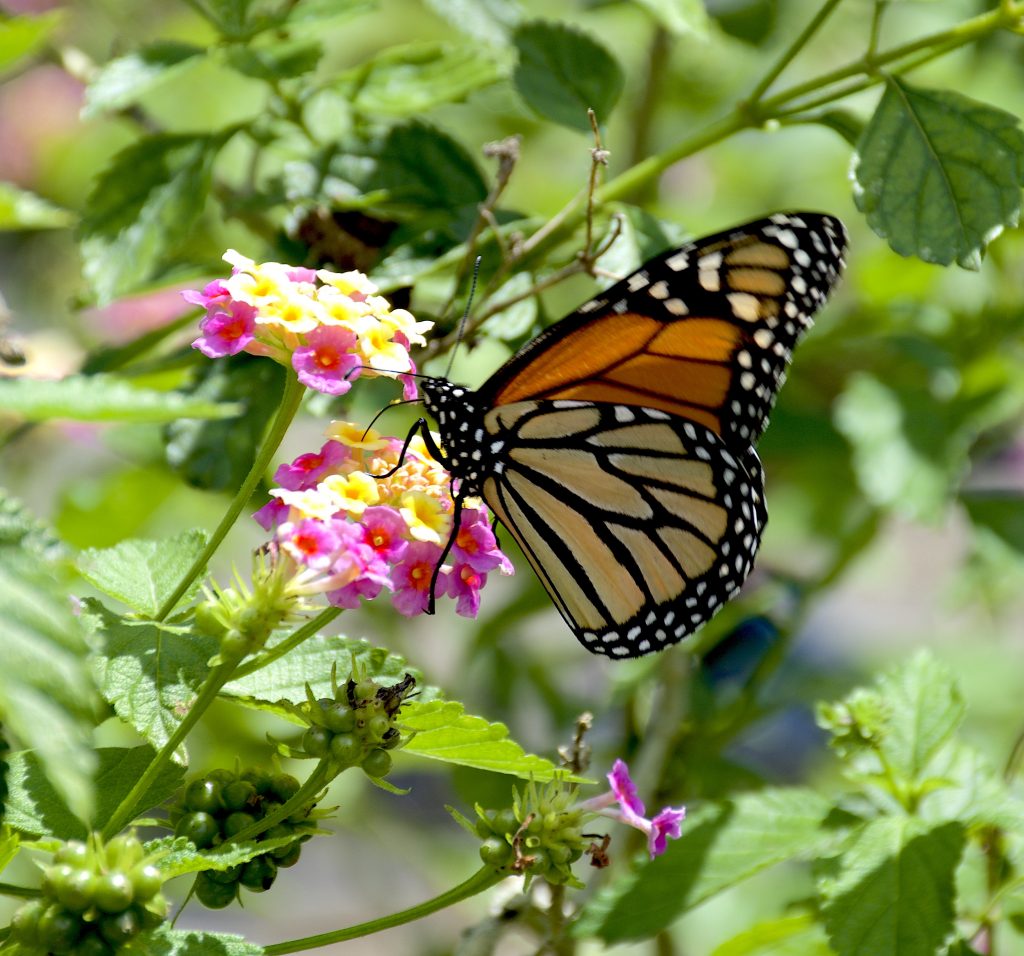
Butterfly on Lantana camara blossoms. Photo by Green Deane
Lantana camara: Much Maligned Nibble
Ask anyone who has heard of the Lantana camara and they will tell you it is poisonous. And they are right. Unripe berries have killed children and the foliage has killed livestock. But listen to Professor Julia Morton who was the leading expert in Florida on toxic plants.
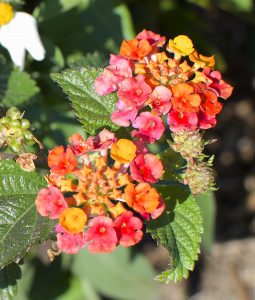
Lantana camara blossoms are multi-colored. Photo by Green Deane
In her book “Plants That Poison People in Florida” she states: “The ripe fruit are eaten by natives wherever the plant grows.” She wrote that in 1995. A 1996 study by Herzog said the same thing (Coppens d’Eeckenbrugge & Libreros Ferla 2000, TAMREC, 2000). On the other hand the University of Texas at Austin says the ripe berries are toxic and Delena Tull in her 1999 book about plants in Texas writes: “Though some previous publications assert that the ripe fruit is edible, experimental studies show that both ripe and unripe fruit are potentially lethal.”
So there you have it. Two views of the Lantana camara. I’ve eaten ripe berries as a trail-side nibble and I am still here. They are very sweet, crunchy and slightly aromatic. I have not made a pie nor have I consumed more than a handful at a time but they have posed no problem thus far. However, they can make you more light sensitive so it is a berry best tried one at a time until you know you are not effected by it.
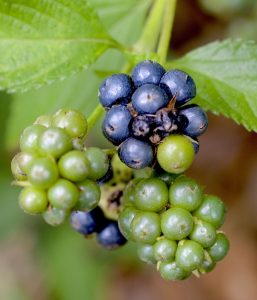
Unripe and ripe Lantana camara berries. Blue is ripe. Photo by Green Deane
Just so there is no confusion. Ripe means deep blue or black berries. Not green or partially green. There is no doubt that green Lantana camara berries have killed children and sickened adults. Conversely, a mild tea made from the leaf is still used in the Caribbean Islands to ease cold symptoms. The ripe berries are used to make jam, jellies, pies and cordials in Ecuador.
Lantana camara (lan-TAY-na ca-MAR-ah) has had a bit of linguistic history. Virgil (70-19 BC) called a plant lenta viburna, or flexible viburnum, now called V. lantana. It was used by Linnaeus for the genus name for these plants. Camara is a local South American name for the plant. Lantana grows from North Carolina west to California and points south.
A native of the West Indies or perhaps introduced from South American, it is listed as one of the worst weeds in the world. Butterflies, however, love it and it is a must-have bush in every butterfly garden. It’s the birds that spread the seeds around. It is also a cousin to the American Beautyberry.
Lantana camara leaves are also toxic to dog livers.
Green Deane’s “Itemized” Plant Profile
IDENTIFICATION: A persistent evergreen shrub to 6 ft (1.8 m) high, 8 feet in width. Leaves are 2-5 inches long by 1-2 inches wide with rounded tooth edges and a textured surface. Stems and leaves covered with rough hairs. When leaves are crushed they smell similar to cat urine. Flowers, small, in clusters typically 1-2 inches across. Flowers year round, color range from white to yellow, orange to red, pink to rose in unlimited combinations. Not all one color. Flowers often change color as they age.
Note: L. camara has blossoms of different colors, yellow and orange, pink and red. L. depressa has yellow blossoms only, or, white blossom with a yellow throat: No red, pink or orange blossoms. I have not found any reference as to the edibility of ripe L. depressa berries.
TIME OF YEAR: Fruits can ripen all year but are heavy in the early summer. Fruit when ripe is purple/black.
ENVIRONMENT: Waste places to landscaping to a potted plant. Prefers full sun.
METHOD OF PREPARATION:D ark ripe berries out of hand. They have a flavor similar to a cross between black currants and cherries. They can be used to make jams, jellies, pies, and cordials. The fruits can be used to produce a light purple dye. The leaves can be used to polish wood.
From an article by Roger Hammer:
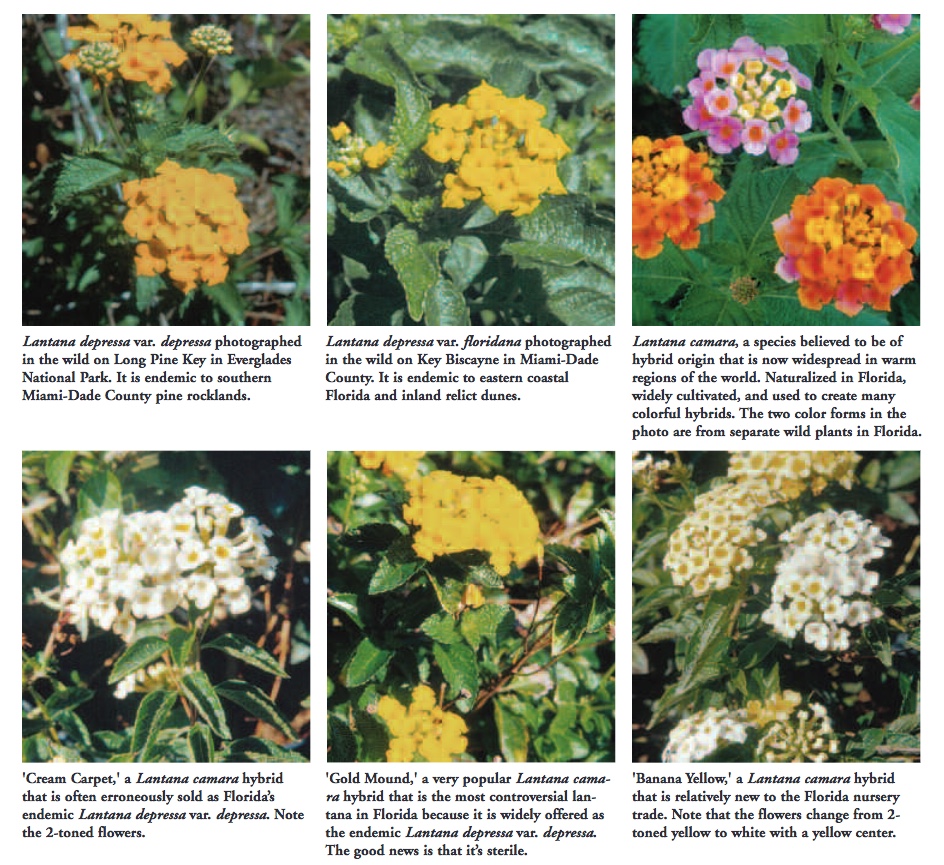
Various Lantana blossoms by species.

I have been doing some searching on Lantana and have heard most everyone consider the plant poisonous. The leaves and Green berries are the poisonous parts. Like you mentioned, the ripe berries can be eaten. I read some children in Africa do eat the ripe berries with no problems. I’m glad to read that you have eaten them too with no problems so I will try a little too. I have also read and researched that the plant has many medicinal properties. From what I have read it is antimicrobial, fungicidal, insecticidal and nematicidal properties.
Chis
I’ve eaten them and the seeds in the berries are almost the same size as the berry. You would hope for a juicy berry full of flavor, but this is not to be found in our multicolored Lantana. Likewise for Maypops, which poison control center says have various quantities of cyanide in them depending upon the soil you find it growing in. That may be the basis for the variations of toxicity. Spread the word.
Passiflora incarnata is the only Passiflora without cyanide. All the others have it in their leaves.
Actually, maypops are one of the few passion fruits with no traces of cyanide. Not sure why you’re being told otherwise.
Chris,
I also am interested in any uses for this plant as it is coming up all around my house in the orange grove where I live. The most amazing article I saved was from the use in the Philipines http://www.stuartxchange.org/Lantana.html
I have also asked a friend of mine to ask his mother about it, she is here visiting from the Philipines, I will let you know.
Linda
I have always enjoyed the leaves…if you pick just the top 2 buds and then run them through a coffeemaker the leaves come out like spinach…little butter and salt…the water in the coffee pot is the medicinal tea you guys referenced…its very helpful to the gastrointestinal tract…
Hope this is useful…I’ve been using them this way for almost a decade…
I’ll be sure to try the berries when they ripen…I’ve never tried them before
Cheers@
Linda,
Update, sorry its been a while. I’m still here, lol, I’ve been eating the berries! still little at a time. But I have also been crushing up fresh leaves and rub it on my bug mosquito bites as i work in the yard and it stops the itching! and seems to stop them from bitting me more too. I read that if you dry out the leaves and then burn them it acts as a mosquito repellant. I’m sure this works too when they are still green, just harder to burn. I’m researching now how to make tea for relief of symptoms of rheumatism, indigestion, joint pain, flu, coughs, colds sore throat, fever and possibly tapeworms?
Chris
my lantana flowers smelllike cat urine
OM my yard is overflowing with Lantana and i thought it smelled just like flowering pear…and they are not in bloom at this time of yr. sooooooooooo it’s the Lantana…wish i knew that before i planted so many…i almost have a lawn of lantana!
Both Lantana and purslane are used as landscaping decorum in the area of my job and never knew it was edible; thanks again G.D.
My experience with Lantana has been positive, I love the plant. My wife, from Veracruz, has made tea from the flowers (usually a leaf or two in the mix) that almost instantly quites the menstral cramps and produces a gentle relaxed state . I think it would ( the tea of flowers) substitute for Camomile tea in the evening before bed time. I have collected the seeds and have plants growing in south Texas from all parts of the world.
are all the verities of the plant edible, here in Israel, we got MILLIONS of this plant growing everywhere, i can literally go outside right now and come home with bags of fruit and flowers, but i am afraid that it will make me ill
how can i be sure,
Start with exact identification. A local botanist could do that.
I grew up drinking the the tea for colds, but didn’t know the ripe berries were edible. Thanks, Green Deane!
I grew up in southern India and have eaten lantana berries, maybe a handful at a time. They are sweet and very fragrant. I am sure as kids, we would have tried the unripe ones too and not liked the taste.
I used to eat the RIPE black berries as a child. the green berries are very poisonous to cattle especially after frost.
Lantana camara is one of the worst alien invaders here in the warmer parts of South Africa. A large area has just been cleared.
Can the wood of Lantana camara be used for barbecues or wood it be toxic?
Personally I would leave the wood alone.
I am coming across more and more dogs that love to eat the leaves.
They are all healthy, beautiful condition and doing the Iridology and viewing the eyes is fascinating. Is there anyone else that has had this experience please share with me. I have my thoughts on that it stops mosquitoes biting them . They do not eat all the year round either. Thanks Mary from South Africa
MY DOG ALSO EAT THE LEAVES MANY TIME , I THINK HE DOES THAT TO CURE STOMACH PROBLEMS
My German Shepherd Dog occasionally eats the lantana leaves when he wants to ‘spit up’ some digestive upset.. similar to dogs eating grass .. He’s going on 11 and has been eating the leaves for years and the vet says he’s in great shape for his age.
My 2.5 year old Rottweiler likes to eat them. He’s been eating them for over a year now and will stop whenever he wants. 126 lbs and healthy. In fact, he just ate them after eating dinner when I let him out to pee. The times he eats them are random. Not quite sure why he likes to eat them but I haven’t seen any bad side effects.
My goodness, I grew up seeing these plants everywhere in my neighborhood! Mostly for landscaping and since no one ate the berries, I just assumed they were poisonous. What a shame I’m discovering edibles now!
My little dachshund eats the lantana leaves and I have seen no side effects. But I visited this website to see if anyone has any information about the lantana. I’m relieved to read about other dogs that eat the leaves also. Thanks for the information.
Our two dogs (9 lb Pomeranian and 45 lb Pit bull) ate our Lantana bushes to the ground! Now they concentrate on wearing the dried pods from the mesquite tree…
Can I make an ointment from the plant for psoriasis and how
I am not an herbalist. I do not know the answer to that question.
since my childhood i have been enjoying ripe lantana fruit, its edible. may be i need a little more info about its leave
I tried my first Ripe Lantana Berry Today…I have been curious for years…my bush is a tree! 🙂 Yummy…tasted like a mini purple grape…no convulsions 🙂
I am so glad to hear the Lantana has herbal and food purposes. My goal is to only have plants with those two purposes in my yard. I was on the verge to getting rid of my Lantana, the only thing holding me back was that the humming birds, butterflies, and bees liked it so much. I am going to keep it now, Thanks!
Hi, I live in central Florida. I live with severe chronic pain everyday. I met a medicine man, 1/2 German 1/2 native American Indian. His grandmother (Indian medicine woman) taught him all the various natural herbal remedies. He’s very compassionate and the day we met I told him how much pain I’m in everyday. He gave me a baggie full of Lantana leaves and stems, dried out, he told me to make a tea, sweeten it and drink it. Honestly my pain (even with seriously STRONG, LARGE DOSES of narcotic pain medicine) my pain was still intolerable/unbearable. I didn’t care/want to live, so…….. I made the tea, with a small handful of leaves & stems, for the first time in nearly twenty years, I have found excellent pain relief. I don’t need to spend hours at the doctor, nor pay outrageous amounts of money that I don’t have becauseI haven’t been able to work. And I still could not work with my condition, but I’m now able to do light housework. And I’m comfortable enough to live. Also, I have, on many occasions, caught my 1-1/2 year old pup nibbling on the Lantana plants in the back yard. The mosquito theory and info is very interesting. Thank ya’ll it’s very nice learning & teaching.
I totally agree with you, I had red that it can act as steroid medication without the side effects of the steroid. So I have reumathoid arthritis and my doctor took me of steroids cause she was concern I was taking that for so long, and as soon as I stop them I had a bad flare up, so I called and called to request she refill my steroid but she did not. So I had a lantana plant that was all dry dying, so I cut some leaves and made a cup of tea I took it in the morning with the usual medications that I was taking and did not help with pain, stiffness, and a extreme fatigue that would keep me sleeping all day. Well like 1 hour after I drank the tea I was feeling so good no stiffness, no pain and no fatigue. I have been very energetic moving around like if I was using the steroids and my hands that were very swelling and painful in the mornings are doing incredibly. I have been doing this just 2 days and I plan to continue. I thank God for his creation.
Which lantana did you use. The camara or rugosa. Can you upload a pic. I do not want to use the wrong species
I’ve been searching for something to help my RA. I’ve been in severe pain over a year and nothing is working. I can barely hold a cup or fork some days. I’m going to grab me some leaves and stems from our plants and dry them out to test this. I’m desperate as well.
Dried pokeweed berries (one or two) swallowed whole are a common herbal remedy for RA. Check with a local herbalist.
I just checked this website again because of all the conflicting opinions. I myself have eaten handfuls of ripe and semi-ripe berries without noticing any effects. They usually disappear quickly thanks to birds. My 6-week old goat has been busily nibbling at the leaves for at least 2 weeks without apparent ill effects. One of my dogs has bonded with her and he nibbles along with her. Again, with no apparent effects.
My goat will nibble and spit out Live Oak and Carolina Laurel Cherry leaves which dominate the landscape here in Florida. She also avoids the Oxalis. One would think she knows what to eat and what to avoid.
One would think that animals would know what not to eat but our experience with wed-fed livestock says that is not the case. The first modern big book on plant poisoning in North America was written for livestock owners. Also, hungry animals will eat many things not food for them. Also animals can eat things humans can and we can eat things they can’t.
Thank you for that reply. I work in a vet’s office and animals will eat poisonous plants. And just because your pig, or a wild bird eats it, doesn’t mean it’s safe for your dog or cat. There are plenty of plant based foods that are safe for humans and not safe for pets. I would never test the toxicity of a plant by waiting to see if my dog gets sick after he eats it! Never let your pets consume plants that you aren’t completely sure are safe.
Wild Lantanas of various varieties grew in our parent’s backyard and in the fields and as a kid I ate ripe Lantana flowers on side road picks, the dark blue ones, it’s sweet and taste nice. No one told me it can be eaten but as a kid I did try to taste the berry . Kind of experimental one and I liked it. Imagine if this was poisonous, I could have long been dead and would not be able to write this comment 🙂
Thanks for writing. I know what you mean. Kids eat things and for the most part survived.
Thank you all for the information. I just planted 16 lantana’s in my front yard and had no clue they are poisonous. I have 2 boxers and wonder if I should pull them out? Both my dog and the neighbor’s dog were trying to eat them before I got them planted. Advice appreciated!
Dogs usually aren’t interested in Lantana.
Growing up in the Texas sub-tropics we had Lantana growing wild everywhere.. its still one of my favorite flowers. It does have a funny smell but its one that I really love..
I ate many many wild plants growing up.. but I dont remember ever trying to eat the Lantana.. Who knows.. Maybe I ate some & survived..
Thanks for a great site!
I have never eaten Lantana but I car tell you this, if you are bitten by a fire ant. Take a couple leaves and crush them, spread the moisture of the lantana over the bite . Five to ten seconds the pain is gone and most of time the bite will no longer bother you. If it does repeat with another leaf within 24 hours. I have used it for years on fire ant bites sometimes you never receive the white puss bump and if you do it has harden up and causes no pain.
my great dane puppy ate a whole lantana plant yesterday. It was in full bloom. she has diaharia now. will this kill her. she weighs about 55 lbs and is 4 months old. What should I do??
please answer me I am frantic my puppy might die
Mimi
Call your local vet.
we have these lantanas in my rural area. am here and i enjoy them whenever i find them ripe. we use them as hedge around the fields.
I am southern part of india too, i have eaten this fruit humpty number of times and had no problems whatsoever..
do you think it would be safe to make a vinegar or ferment from lantana flowers, i have see a local cocktail company using them for garnish.
There are over 150 species of Lantana but yours is mostly likely L. camara which was introduced to Australia in 1841 or so. My first thought is that it is difficult to make vinegar out of any blossom. The blossom have to be used to make wine first and then the wine inoculated with bacteria to make vinegar. However, white vinegar can be flavored with blossoms such as putting magnolia blossoms into vinegar. The real question is are the flowers safe to consume? I don’t know but if they are using them in cocktails for a garnish (which has great potential to be eaten) I would guess no. Are you sure of the blossom’s species?
Fascinating articles indeed. Noticed 15 or so years ago that it was an ingredient in a commercial meat tenderizing concoction in a Cajun meat rub I had in my kitchen or it might have been in the Zartrain shrimp boil spicing.
Has the plant ever been used as a component in beer?
Doubt it. The plant is toxic except for very ripe berries.
I’ve been reading that the leaves are used for tea and the roots are a traditional medicine.
I don’t know. I am a forager not an herbalist. That’s beyond my pay grade.
I like your sense of humor and your forager knowledge. 🙂
I am from Africa, and we have been eating lantana berries during our childhood and nothing happened to us we have it in our compound for landscaping also the company I work they are being planted for export to overseas.
My bull Terrier loves to eat these, these picky about plants that she eats, this one she loves. She only eats it when she has an upset tummy or is constipated, it helps her use the bathroom. I’ve never seen her vomit from it only act like a laxative.
Well then… we know they aren’t too toxic to dogs.
Are the SEEDS of Lantana camara also safe to eat?
TIA
Carlos
If the berry is ripe, yes.
My lantana berry blend is getting a little crispy on the edges of the leaves. Also, the blooms are very tiny. This is in a hanging basket. Help
I actually mistakenly ate lantana leaves thinking it was nettle while it was young with no flowers. I didn’t die, thank God.
I have just spent many days spraying Lantana with Glyphsphate. It is a major weed in tropical Queensland. If forests are disturbed it forms an impenetrable thicket and nothing can grow through it.
People here joke about how their fortune will be made when we can find a market for Lantana oil.
But I am worried about the effect on local bird life once I get rid of (most of) it.
I use to eat the ripe berries as a kid 45 years ago, but it was okay too.
Nothing to worry.
While researching natural supplements to combat coronavirus I came to Lantana. I see above in the comments that it has been used to lessen flu and colds. The article I was reading identified it’s active component and it’s action. Could be handy to know should the virus come close.
In reply to Chris’s post from February of this year, Chris I would like to know if you would be so kind as to post the link to the article that referenced Lantana and Coronavirus. I discovered a bunch more voluntary lantana on my property and would like to add this to the possible list of its herbal usage. Thx
When I lived in the Philippines I sprinkled Lantana flowers into my salad thinking they were part of the mint family. I never got sick in any way.
Funny. We’ve been eating these things here in Zimbabwe. The ripe ones are so good to eat.
In the English-speaking Caribbean we make evening tea from the leaves of Lantana camara. It is not know to be poisonous. We call it sage. I never ate the berries or fruit.
Just to point out, L. camara is NOT a “must” for any butterfly garden. There are native species that can (and should) be planted instead, though they may be harder to find. In Texas, we have L. urticoides, which is native, and is often available at the better nurseries. So you can have the best of both worlds: a Lantana that butterflies love, without assisting the spread of a noxious invasive.
I have just returned from Greece where we were served the lantana flowers (all different colours, orange, red, pink, yellow) on top of the puddings for all the family. They were delicious! Tropical tasting, blackburrant/mango. I’d never seen them served as an edible flower before so started down this google-hole to see if they were in fact edible. Looks like maybe they are not recommended… Does anyone know if they are actually classed as edible? Thanks
I grow this in UK, I have a few berries near ripening stage, although I wonder if a cool climate would cause issues with the toxicity. Only one way to find out I guess!
I am from Pakistan. Lantana is a very common shrub of Pakistan it usually grows in graveyards. I am now 50 plus but I remember when I was 6 to 12 I always went to school on foot and I think I used to cross two or three graveyards with my sisters and friends we all ate green and blackberries of Lantana But we were never harmed.
i know two people whohave major degree in farm and other one in forestry, they stated in their foraging book named “Panduan Meramban” Lantana Camara Flowers are edible.