
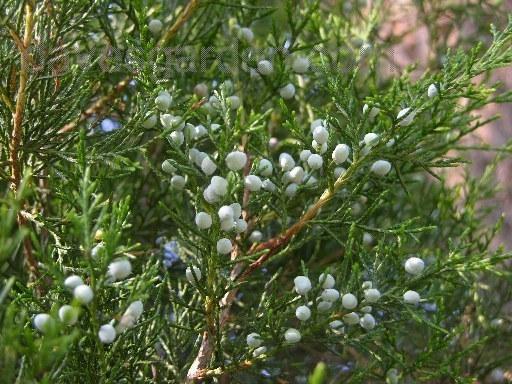
The Eastern Red Cedar is really a juniper.
In the cobweb recesses of my aging mind I have two youthful memories of junipers. One was to make a tea to “force out” measles*. The other was how horribly prickly they were when someone shoved you into them.
As for “forcing out” measles that is highly doubtful. Measles make themselves known without having to be prodded to debut by any conifer tea. However junipers do have the potent antiviral compound deoxypodophyllotoxin (DPT) which has been shown to be effective against viruses that cause the flu and herpes. So maybe juniper tea did have some effect on the intensity or duration of the measles. The DPT is found in berries and the leaves, aka needles. I wonder if it is also in gin which is flavored with juniper.
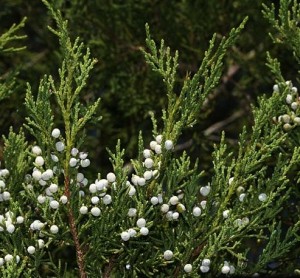
Southern Cedar, Juniperus silicicola
Common in the eastern United States — officially east of the 100th meridian — is Juniperus virginiana, top photo, joo-NIP-er-us ver-jin-ee-AY-
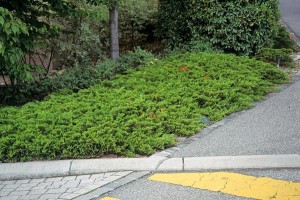
J. sabina, often planted in North America as an ornamental, cannot be used either berries or leaves.
Besides medicinal uses, which includes treating diabetes, the berries are employed for flavoring, most notably in gin and the French liqueur Chartreuse. It takes the “berries” two to three years to ripen. Mature but still green berries are used to flavor gin. Mature blue berries are used to flavor game. They are also used to flavor stuffing, marinades and stews. In Europe one cannot make authentic sauerbraten or sauerkraut without juniper berries. In the southern Alps a dark syrup is made from the berries and is traditionally eaten as a dessert with cream or hot milk. (Some berries are as much as 30% sugar.)
As with many herbs used medicinally or as a spice juniper berries should be used sparingly. Think flavoring, not food. They irritate the kidneys and are diuretic. Juniper extracts should be avoided. They may be fatal. Florida’s Seminole Indians had many medical uses for the Easter Red Cedar. They used it to treat cold symptoms, swollen joints, stiff neck or back, swollen legs, eye diseases, fever, headache, dizziness and diarrhea.
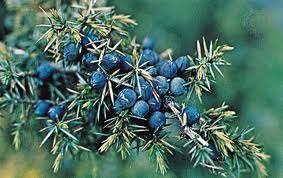
J. communis, the most common juniper in northern climates around the globe.
The bush I was pushed into as a kid and pushed others into was J. communis, left, the most common juniper in northern latitudes around the world, joo-NIP-er-us koh-MUNE-iss. It’s also the juniper that flavors gin. There are 13 species of Juniper in North America, two in Europe, some say 19 in North America and maybe 60 in the world. Definitely used by native Americans were J. californica, J. communis, J. communis var. montana, J. deppeana [aka J. pachyphlaea] J. horizontalis, J. monosperma, J. occidentalis, J. osterosperma [aka J. utahensis] J. scopulorum, J. tetragona, J. virginiana and Juniperus silicicola, the latter often called a variation of J. viriginana.
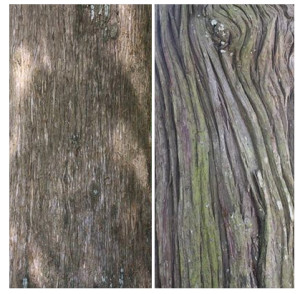
On the left is the bark of the red cedar (a Juniper) and on the right the bark of a white cedar, a Chamaecyparis thyoides
How the berries were used varied from tribe to tribe and species to species. The Acoma mixed the berries of the J. monosperma with chopped meat, put it into a clean deer stomach, then roasted it all. The Yavapai pulverized the berries of the J. deppeana, soaked them in water, put them in the mouth, sucked all the juice out, then spat out the solid matter. The Cahuilla dried the berries of the J. californica in the sun or ate them fresh. They also ground the berries into flour and used them to make mush or bread. The Diegueno considered the previous species berries as famine food only. But the Kawaiisu Indians deseeded the same berries, pounded the berries into a meal, moistened, molded the meal into cakes, dried them then ate them. The Paiute took the berries from the J. occidentals and mixed them with mashed deer liver for food. Or, they stored them in a grass-lined holes in the ground for winter use. The Apache boiled the berries of the J. osteosperma and ate them plain. But the Mescalero took J. monosperma berries, roasted them, added water, and made the mixture into a gravy.
Elsewhere the berries of these junipers have been use: J. tetragoan (Mexico) J. bermudiana (Bermuda) J. drupacea (Europe and Middle East) and in Asia J. chinensis, J. conferta, J. recurva and J. rigida.
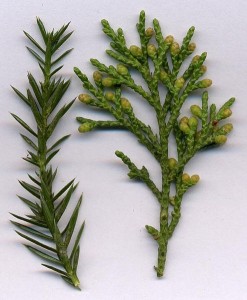
In some species of juniper young leaves look very different than older leaves.
One confusing element of identifying some junipers is that their juvenile leaves look different than their mature leaves, left. Young leaves of species like J. virginiana and J. chinensis are pointed, sharp even. Older leaves are overlapping and scale-like. Other junipers have only pointy leaves, hard and sharp. Some have a mixture of the two.
Juniperus comes from the Dead Latin iuniperus. Where that came from is not known but the best linguistic guess is iuncus meaning reed or rush. That might be related to an earlier Egyptian word ganu meaning reed, cane, shrub or bush. Iuniperus does NOT mean young — as in “junior” or evergreen. That is Wikipathetica nonsense. Iuniperus did get translated into Le genevrier in French from whence we get the word “gin.”

Franciscus Sylvius created a medicine we now call gin.
Gin was invented by Dutch physician Franciscus Sylvius, right, who wanted to make a diuretic medicine. He succeeded. In English the word “gin” first appeared in print in 1714. It was a very inexpensive alcoholic beverage to produce and became extremely popular. Alexander Pope in 1738 described it as “A spiritous liquor, the exorbitant use of which had almost destroyed the lowest rank of the People till it was restrained by an act of Parliament.” Actually Parliament passed Gin Acts in the 1730s and 1740s, which caused rioting. Everyone was swilling gin, kids to grannies, causing artist William Hogarth to engrave the print “Gin Lane” in 1751, below left.

Hogarth’s engraving Gin Lane show scenes of drunkeness and various illegal activities whereas his engraving of the same period, Beer Street, show happy, industrious people.
At one point of the 15,000 drinking places in London over half served only gin. More taxes and watering down the gin finally turned the alcoholic tide by the 1760s. The reason why gin took off was it was cheap, particularly compared to foreign booze that was charged tariffs. But there was also a cultural element. Beer was viewed positively and gin negatively. Hogarth’s other famous print, “Beer Street” shows positive scenes. The negative connotations of the time are still found in English with disparaging terms such as gin joint and gin mills.

Louisiana’s Cajuns are the descendants of French Canadians that were forcibly driven from Nova Scotia. Longfellows poem, Evangeline, gained cult then cultural status representing the inhumanity of their expulsion.
There’s one more bit of linguistic history regarding the J. virginana. The early French to Canada called it baton rouge, or red stick because the bark and wood have a red tint. When the Acadians were driven out of Nova Scotia and went to Louisiana to be come Cajuns — read Longfellow’s Poem, Evangeline — they found the Southern Cedar and named the capital of Louisiana for it, Baton Rouge.
To reiterate the berries of J. virginana and J. silicicola (Eastern Red Cedar and Southern Cedar) can be used but not the foliage. J. sabina and J. oxycedrus are to be avoided completely, berries and leaves.
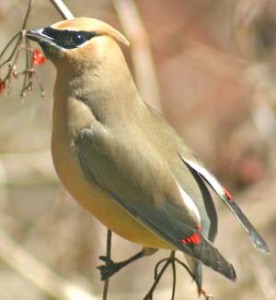
This handsom bird should properly be called the Juniper Waxwing.
As for wildlife the Cedar Waxwing likes the “berries” of the Eastern Red Cedar so much it was named after it. The J. virginiana also has one species of butterfly, the Juniper Hairstreak, that always lays it eggs only on the Eastern Red Cedar.
Bags can be made from the bark fiber of the Easter Red Cedar and the Southern Cedar.
* Did you know that measles might be a milder, human form of a fatal disease in animals? Researchers think measles came from distemper and jumped from dog to man about 4,000 years ago. Man befriended dog and dog gave him a disease. I had both kinds of measles when I was a kid, “German” and “Old Fashion” back to back, one right after the other. I was out of school for nearly a month… it was wonderful…
Use. I mainly use juniper berries as a source of yeast and bacteria for sourdough bread. I put a tablespoon or so of berries in non-chlorinated water with a little sugar for a couple of days, then use that water in mixing the dough. And when I make pickles I add a few berries to each jar for flavoring.
IF YOU ARE PREGNANT AVOID JUNIPER BERRIES: They can cause uterine contractions. Cows that eat a lot of juniper berries have a lot of end-of-pregnancy-issues.

DTP. Isn’t that the thing that’s recommended for treatment of alopecia?
No. Two different DPTs. The DPT in junipers is Deoxypodophyllotoxin. The DPT used to treat alpecia is Diphenylcyclopropenone.
I live in the Spanish Pyrenees where junipers grow everywhere. I’m certain they are J. communis. The fruits of these bushes (and trees) though are never blue. When ripe they are reddish to black. The local wild boar seem to relish eating them! All the references seem to indicate that the berries should be blue…… but they are not! Have I identified correctly? BTW they seem to taste ok (only one!).
I would be very careful. There are some toxic junipers in Europe.
Hello Green Dean…. thanks for the reply. I took your advice and armed with google translate I searched through the spanish pages on junipers. What I have here (amongst others), is J.oxycedrus. The berries whilst being reddish brown are edible and can be used in the same way as J. communis. Identification is distinct. Apart from the colour of the fruits, the leaves on J. oxycedrus have 2 white stripes running the length of the leave, whereas J. communis only has one white stripe. Isn’t nature great at given us clues once we know what to look for! Finally I’d like to say a big thank you for creating this site. I find the information and videos fascinating and appreciate the time and effort you put into this and your generosity in sharing your knowledge. If you ever find yourself in the Spanish Pyrenees I would be delighted to show you around.
The “cedar trees” we have in the Ozarks I understand are called junipers as well. You seem to be refering to shrubs more than trees. Would the berries of both the “soft cedar” and the one that is sticky as all get out be edible?
I don’t know what species those might be (soft cedar and the sticky one) so I can’t say.
It’s also Juniperus ashei (called the Ozark White Cedar in Arkansas). Younger Ashe junipers are sticky from the excess sap on their bark.
Pam, I believe the sticky ones you are referring to would be the red cedar or (hope i’m close to spelling this right) Juniperus virgiana. Do they have blue “berry” type seeds that drop from the trees? Pop up all over the place like weeds? Cut wood is majority, redish/purple with some white/yellow patterning in areas?
Very curious if these are the edible ones as well.
-A Missourian
I live in Alabama and have 5 acres full of Eastern Red Cedars (J. virginiana) and didn’t know the berries were edible. What time of year and color should they be before trying one? Thanks!
Here in Central Texas, we have an overabundance of Ashe Juniper or Mountain Cedar trees. It’s a very invasive species and the bane of range managers and land owners.
How does the Juniperus ashei fit into this matrix? Other than for making fence posts, are there any other uses for this tree?
All the best,
Jason
Yes they can be used, sparingly.
The link says They Came from the Sky. Is that the right link or does it look like it’s changed since 2013?
It looks like the changed the page. I have removed the link. Thanks for bringing that to my attention.
Hello mister Green Deane.
I see in one of my books ,one indien give somme blue berries from the red
cedar,to one men for clean him,for his diabete.
is possible you can talk to me ,were I can find this blue berries.
Thank-you for your help.
sorry for my bad english.
Serge.
You can buy juniper berries in stores that sell cooking spices.
Thanks again for the wonderful article , Mr. Deane. I make mead as a hobby, and I have used common juniper berries to flavor it. Could you please inform me about the following topics: can common juniper be cultivated here in spite of our Florida heat, and can the berries and foliage of J. chinesis be used to flavor alcohol? I’m guessing that the needles of J. virginica would not be safe to use for seasoning, based on your article. Thanks!
Hi, did an 80gal batch of beer and used 12oz of crushed cedar berries from starwest botanicals in the boil for flavor. Despite 2 yeast pitches it would not ferment. Might the berries have killed off the yeast? Thanks.
Generally said, no. In fact wild juniper berries have natural yeast on them (and that might be the problem. The provider of the juniper berries might have dosed them with a yeast killer which then did a number on your beer yeast.)
Had wood betony, sweet woodruff, and sweet flag in there also, all of which I’ve brewed with successfully before. Maybe some bad combo? Thanks for your thoughts on this.
How about the red cones of the relatively rare Pinchot Juniper, which occurs in Western Oklahoma? Are they edible?
Tull (author of Edible Plants of Texas and the Southwest) impies they are but never says so directly.
Hello Green,
I collected juniper berries from a local public hunting area for a recipe. After a few hours in the small jar I was storing them in I found larva of a number to be concerning but not alarming. I searched the net and came up with little. They don’t look like the Juniper Hairstreak larva and as far as I could find Juniper Borers are in the wood itself though they kind of resemble them. They are 1-2cm long no more than 5mm in diameter white with a brown head and emerging from some of the berries. I thought to ask here before I tried to find an entomologist to see if you had any advise as to the usability of the cones and how long they will keep or how to keep them from going bad and maybe getting rid of the bugs.
Thanks
As far as I know they are used bugs and all.
Hey Green Deane,
I am preparing some ground for a community garden which has been used for the occasional parked car (but I don’t want to take any chances). I was thinking of using Juniperus communis as a bioremediator, but I haven’t discovered where the plant would store these toxins or if the cones would still be safe to eat.
Thank you.
Well, the first issue is to find some research that says the junipers store bad stuff. A lot of plants don’t.
SO I live in central Texas , what variety of Cedar do you think it is?
they are really loaded with berries this year, and I was running traps and thought, there must be a use for the berries, the birds really like them.
I see Cedar wax wing and other birds eating them
Thanks for writing. What color are the “berries?”
I’ve heard that juniper/eastern red cedar makes an excellent bow wood for long bows. What do you think of junipers for bow making?
The truth is I don’t truly know. But there are several bow makes on the Green Deane Forum with many threads about making bows and wood selection. https://eattheweeds.com/forum/index.php/topic,4325.0.html
I grew up having that black syrup every morning for breakfast on bread with butter. As a child it was coined, “Dad’s brown jelly”. I’ve since moved to the US Northeast and over the last 25 years have never seen anything commercially available. Occasionally the family mails a jar and now there are a couple Swiss importers. I don’t understand why it hasn’t caught on in the United States. It is supposedly loaded with iron and other marketable ingredients.
You mean Juniper jelly? Never heard of it. Interesting.
It’s not a jelly. That’s just what we called it as children. It’s as thick as honey and darker than molassis. It has got a very distinct flavor – it’s just amazing and very good in tea.
http://imbibemagazine.com/sage-juniper-syrup-recipe/
You know what’s also fun? Taking a spill on a ski slope and landing with your face straight in a Juniper bush.
Naming a cookbook for my community “Cedarfield.” Suggestions?
Have: Cedar Digest; Cedar Post; Cedar Gram – already in retirement community. Help me “cook” it for our cook book title contest!
Wow. HOW do you KNOW SO MUCH?? (Merely rhetorical, don’t respond to that). But seriously, you keep up with all of these crazy comments and questions — geez you outta set up one of those “Advice Stands” like Lucy in Peanuts. It’s not easy bein’ green I guess, but anyway, THANKS for the knowledge and cool history sidenotes!
The problem with communis is most people would have died of old age before it’s grown a meter. Chinensis is a much faster grower. (spartan variety apparently very fast). The obvious question therefore is whether chinensis berries are as edible as communis. I’ve used communis berries before for UTI and it worked almost instantly (ground up tablespoon of berries in a tot of vodka, leave for a few hours. add boiling water, strain and drink when cool) which might explain the constant old wives tale on web sites that it’s bad for your kidneys. Drug companies have a vested interest in steering people away from free stuff that works better! The only research on the kidney story comes from tests on rats and they were given excessive amounts. The amounts used medicinally are very small and for short periods of time. In my case two doses (see above) over 24 hours! Given the rise of superbugs due to our own hubris and stupidity I suggest people wake up quickly and start looking for alternatives. Not long now and antibiotics simply won’t work.
There is no better medicine in the world for UTI (men or woman) than Juniper berries. Grind up a tablespoon or two of berries. Let it sit in just enough Vodka to cover them, for about an hour or so. Top up with hot water. When cool run through a sieve and drink. 2 to 3 times a day. Works very quickly every time and I’m talking up drug resistant UTI.
I am in Idaho and I see Juniper berries all the time when I am out and about. When trying to identify bushes/trees that have edible berries, how can I know for sure which Juniper I have in front of me. Are there some clear identifiers to be on the lookout for?
Thanks!
Tom Elpel should be able to help. In that part of the world most of the low junipers should be J. communis but there are almost always local variations.
I have planted hundreds of Sargenti junipers on my hill. Are they edible?
That’s a hard one…. Some expert consider Sargentii junipers to be a variation of Juniperus chinensis (var. sargentii Viridis) or Green Sargent. Others consider them a separate genus. So it is hard to tell as J. chinensis has been used.
I own a distillery and I want to harvest wild juniper from Colorado for my gin. As I have read the two dominant variety that grow wild here are edible, but I want to know the best time of year to harvest them? I went out this weekend and the Rocky Mountain Juniper had berries but the Utah Juniper did not, at least in the region where I was. Do you have any information about when these trees fruit and when the best time to harvest is?
Juniper berries (cones) aren’t seasonal per se. When things are just right the plants starts to make cones and it can take up to 1.5 years for them to go from light blue to dark blue/black. In theory if you want Juniper Berries in a particular stage you should be able to find them most of the time except the more harsh months.
The males take 18 months to grow and females take 2-3 years. Our tree out front had berries last year, but none this year. I think that is what you were asking…
No. You have to be careful. Some junipers in your part of the world are toxic.
I have rocky mountain and Utah Junipers. I was told that I could make a yeast from the berries for bread and that the bark, leaves and berries were excellent, (when steeped for tea) for UTI’s and several other medical uses. this same person told me that basically every part of these two junipers is for human health and consumption. Is this accurate?
I subscribed to Mother Earth News years ago and remember reading an article about the “frost” that forms on Juniper berries being used as a yeast for bread. But your post here is the only place I have found reference to this use. Have you tried it?
Ernie Overstreet
To answer your question, here is a blog post that I recently came across about using the wild yeast on juniper berries to make a wild yeast starter: https://www.growforagecookferment.com/how-to-make-a-wild-yeast-starter/
I haven’t tried it before, but it’s worth a try to see if it works. And always make sure to use filtered water (or water without chlorine) when making a homemade wild yeast starter (or when fermenting veggies traditionally), because otherwise the chlorine will kill the wild yeast and it will likely not work. In a pinch, you could use tap water that has been sitting out for over 24 hours to allow the chlorine to dissipate, but it’s probably best to use filtered water to take out the impurities before attempting to make a wild yeast starter.
Wow, Thanks for all your research! We have Eastern red cedar here, and I always wondered why some of the fruit was blue and some green. I saw a video that showed how to harvest the foliage for tea, and am glad to have seen your warning against this; if I understood you correctly? Also, Hubby would like to know if you know of a reason that some are more of a bluish color and some more of a green? In that same line; some around here are “weeping” and some are not. Any thoughts on that?
Hi,
Why are berries of J. oxycedrus best avoided? It was hugely exported from my region (Dalmatia) but not sure for the use..
Thanks
Thank you for all that information. I am a homebrewer interested in making an authentic Finnish Sahti. It is an ancient ale made with the needles of Northern Juniper. I have found references to j. comunis comunis as Northern Juniper. The problem is that this plant is listed as toxic. What wuold the species of juniper in Finland be? The branches and needles were boiled. Then tne sparge water was run over them. Thank you for any help you may be able to provide. Carol, brewster.
Was is the appropriate semi formal adjective or discrptor for juniper leaves
Scaly leaves?
Scales making up rough conifer needle like structutures?
Do you know if it is possible to make bread yeast from juniper berries? I was told by a native Texan it was possible, but cannot find the info. Thank you!
You need to put a lot of blue berries (really cones) in some water with sugar and let them ferment for a week or so. Then drain that water, add sugar and some flour and nurse it long as any starter.
I have heard that you can make marinated capers out of juniper berries. Is there any truth to this?
Hmmm… young ones perhaps… if you go to my home page and type in capers in the search window you will find several plants whose parts can be used as capers. The most controversial is green elderberries.
I live in the hill country around Austin and suffer from “cedar fever” every year. Can you take the berries from these cedar trees around here and make a tea or eat them some other way to build an immunity to “cedar fever”?
Yes, it is fairly common for people in the know.
The berries don’t give you an immunity, but more and more research is being conducted on juniper berries. They are finding juniper berries have a lot of antioxidant/antimicrobial benefits. Hill Country cedars are also loaded with vitamin C and camphor…both used to treat cold and allergy symptoms. However, don’t take more than 3-4 berries raw per day.
How do I help my Juniper thrive? It has blue berries the birds eat. Will spreading peanut butter on its trunk help to invite more insects. It has sap which runs but hasn’t during the winter. I had a Woodpecker visit once but haven’t seen him back.
Please tell me ways to ensure this very tall Juniper survives.
Thank you for your help. Can you e-mail me, please. Put in subject heading ‘Juniper.’
Is Juniperus ashei toxic?
I have an allergy to Juniper cedar and heard that eating the berries could help me on the allergy. Can you tell me if it is not poisonous and can help if I do this.
To see many photos of about 25 different species of juniper, http://botany.csdl.tamu.edu/FLORA/imaxxcup.htm is an excellent page. Scroll down to the Juniperus species to click on individual photos of each species.
You mention the cones (berries) of Juniperis cummunis have been used. Were they eaten? Do you know how they were used?
That is what the article is about.
Harvest Junipers in Oregon…I believe there is state $ to promote the logging of the trees. http://orsolutions.org/osproject/juniper
I wild harvested berries in juniper trees in Sedona. I’d like to assume they are safe by what I read here, but would you tell me your thoughts about wild juniper tress growing in the desert?. They are a powdery blue green and I thought I’d rush some and add some to sauerkraut.
Hi there, I live in New York and am looking to source some juniper berries in the state to use to make gin. I am however not really sure where to start. Could anyone please offer any advice where I could locate any?
In your part of the world nearly any wild low-growing juniper will be the right one. J. communis.
When I moved into my house 24 years ago there were three of what I assumed were “cedar trees” spaced along the south property line. During a visit my father-in-law took a saw and trimmed enough branches off each one so you could walk underneath. Unfortunately I’m pretty sure this began their long slow decline.
The one closest to the street died within a couple years and I took it out. The 20 foot log is still in the back yard, bugs don’t seem to be bothering it. The second one died but I kept it around because one of the larger branches had a rope swing my kids had enjoyed when they were little and they had sentimental attachment to it. Wouldn’t let me cut it down and still won’t. For years one branch showed some living green but it’s all dead now, just a perch for invasive collared Asian doves. The top of the third tree broke off in a storm and now the top is flat. I call it my cedar palm tree. It’s so tall and straight I’d like to turn it into a totem pole eventually. I am fighting a mulberry bush that has parasitized its roots but both are still hanging on.
I don’t really know what I have out there. Do I have cedar trees? They produce the berries, and several times over the years during fall when there is a sudden cold snap I have seen large numbers of several species of birds swarming over it in a frenzy eating those berries, including the cedar waxwings, bark creepers, black birds, grackles, robins, and sparrows among others. I really don’t want to cut down my “palm tree” or totally defeat the mulberry bush sucking on its roots because I hope I get to see another feeding frenzy or two before I croak.
So with that much description can you tell me if these are cedar trees or some kind of juniper? The trunks are about 15 inches or so in diameter, and I’m located in western Kansas.
Thanks for any info you can give me.
I’ve personally used the leaves of eastern red cedar for tea without any issues. Is there something about them I should be worried about?
Like to be added to emAil list
As far as I can tell you are already on the mailing list.
Hi, I am looking to do a Juniper infusion with Juniper branches. The recipe calls for juniperus communis but I could only find juniperus chinensis var. spartan in my parts of the world.
Can you advise if this variety is toxic or harmful for oral consumption as infusion i.e. tea like?
Thanks
Well… it has a lot of medicinal application. Juniperus chinensis is a well-known folk remedy in Korea, shown to exhibit anti-tumor, anti-bacterial, anti-fungal, abortifacient, anti-platelet, vasorelaxing, and anti-viral activities. Not sure I’d like to use it.
I have a cedar with light blue almost pinecones in PA
They are not really berries but tiny immature chrysalis blue green cones. Are they ripe. The trees are big and old..at least 15 feet. Feathery soft. I want to make a tea from both scaly greens and or berries. Wish I could send a picture.
Hello. I live in the San Antonio area, and am surrounded by mountain cedar trees- I believe they are called Juniper Ash. The female trees bear beautiful blue berries. Can I use them as Juniper berries for flavoring dishes? I am also interested in using the yeast properties in leavening sourdough bread, as someone mentioned in the comments.
some yrs the blue ‘berries’ are plentiful, and some yrs, like this one a blue berry cant be found. do you know the reason for this? thanks
Doing more research it really seems that both the berries and leaves are mildly toxic. Many government resources have a guide for tea with the leaves. And most resources say that both are mildly toxic but ok in small amounts. All quite confusing! It is too bad that where I live it’s mostly Virginiana. Is it true that Juniperus Communis can always be distinguished by the fact that it never gains adult foliage?
There’s a lot of specific info here, yet no references nor teachers credited.
I am my expert reference. That said I did and do most of my research in university libraries.
In 1980, we two Illinoisans took our first trip to the west to see the ravages of Mt. St. Helens and every national park we could access. Continuing south along the coast we were astonished by the varieties of beautiful trees, especially fascinated by the ones holding fearcely to the rocks at 7,000 feet of altitude. Typically tourists we bought cones at a gift shop and planted them in Illinois. We have two lovely 20 ft trees which have been very prolific and have given many young trees to friends who birdwatch etc. Such fun. Thanks for all you do. Love the information you present.
Thanks for all this info! I am in the California high desert with lots of Juniperus californica around. I would like to try making gin using our local Juniper berries. I’m pretty sure californica isn’t one of the (more) toxic Junipers, but I’m wondering if these berries would be appropriate for making gin. I think they are considered sweeter and not as resinous as those normally used. Any idea whether it would be worth a try? If so, would I use more or less than normal? Any advice would be much appreciated, thank you!
I have purchased some dried juniper berries from a local Mennonite store for a recipe. Would it be possible to try to grow a juniper from these berries? Thank you.
Hi Erin , I also bought some dried berries with the hope of sprouting the seeds and growing a Juniper plant. I have no idea what they should look like. I bought mine from a homebrew shop (Ballast Point Brewery) in San Diego, California. The brand is Brewer’s Best, with the slogan “Spices, Herbs, Fruits & Fruit Flavorings”. It is a small bag, 1 ounce, for less than $3. Packaged by: LD Carlson Company, Kent OH 44240 http://www.ldcarlson.com . The Juniper berries variety is labeled as “Juniperus communis”. So with all of that I am confident these are the right kind.
I am experimenting to see if I can get these to sprout. I have smooshed some berries to get the seeds out and separated from the pulp. Those seeds are in a moist paper towel in a zip-lock bag up on the top shelf of a cabinet where it is warmest in my home. It has only been a few days , so no results yet. I have had good luck sprouting a variety of different seeds with this method.
When I smooshed the berries it made a sticky mess from the resin. Separating the seeds was a bit of a chore and cleaning the resin from my fingers took some Fast Orange Hand Cleaner.
Now I am soaking some more berries in a jar of water to soften them up and see if it helps make getting the seeds out any easier. Maybe even just plant the whole berry and see if it sprouts.
If anyone has any tips, let us know.
Hello Green! I really hope I can get a reply from you. Thank you for all this information I live in Bermuda and as the Juniperus Bermudiana is specific to this region it is hard to find information. Do you have any idea if the foilage is safe to make tea from? Also I would like to know if there is shikimic acid in these trees giving them many of their properties. Please let me know thank you
I don’t think any “juniper” foliage is for tea. It is usually the cones.
So excited to have found your article and website. Have a feeling I’ll be doing lots of looking around.
We moved to land in north central Nebraska that I think has lots of juniper (everyone calls them cedar, here though). Really would like to use the berries, but not sure how to identify and make sure they are really J. virginiana. Do you know of a way to do this or at least to make sure we aren’t looking at the inedible ‘berries?’ Thank you again! So much fun reading your site!
From the bottom of my heart, thank you for being a source of positivity and light in this sometimes dark and overwhelming world