
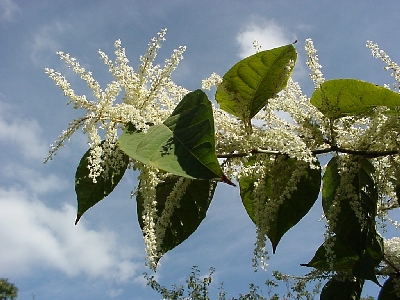
Japanese Knotweed in Fall Flower
Japanese Knotweed gets no respect. Nearly everywhere it grows it’s listed as a prolific, noxious, invasive, dangerous bad-for-the-world, the-sky-is-falling weed. Oh by the way, it’s edible. Might be even really healthy for you…. pesky weeds have that habit.
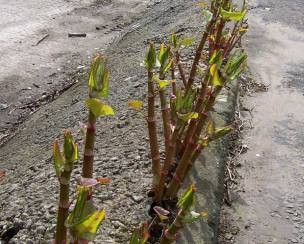
Young Shoots in Spring
Japanese Knotweed is listed by the World Conservation Union as one of the world’s worst invasive species. Perhaps it should be planted in countries where starvation is annual. Introduced into Great Britain by 1825 Japanese Knotweed has been on the decimation list for more than 30 years and has to be disposed at landfills licensed to handle the dreaded edible. In fact they spend some two billion pounds to combat it annually, which as of this writing is about three billion dollars a year. It increased the construction cost of the 2012 Olympic stadium by some 70 million pounds. Japanese Knotweed is also “invading” New Zealand, Australia, and Tasmania. It arrived in North America in the late 1800s and is officially found in 39 of the 50 United States, probably more, and six provinces of Canada. It’s an “invasive” weed in Ohio, Vermont, West Virginia, New York, Alaska, Pennsylvania, Oregon and Washington. About the only place where they are not upset with the plant is where it’s native, southeast Asia. What do they know the rest of the world doesn’t? It is said that Japanese Knotweed out lives the gardener and the garden.
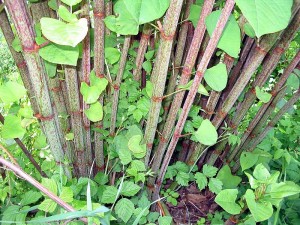
Knotweed Creats a Knot
Knotweed, in the Buckwheat family, is not liked in western nations because it grows around three feet a month, sends roots down some 10 feet, grows through concrete, damaging roads, dams, buildings and just about anything made by man. It’s a pain in the asphalt. Forages take advantage of it eating — raw or cooked — young shoots, growing tips of larger plants and unfurled leaves on the stalk and branches. Many folks say it tastes like rhubarb but I think a lemony green is more accurate, crunchy and tender. For the health conscious it is a major source of resveratrol and Vitamin C … a noxious weed AND very healthy. Tsk…Tsk… The California Department of Food and Agriculture and the book Cornucopia II both say the rhizomes are edible. No references are given as to how to cook them nor have I tried. Usually the roots are used medicinally. Giant Knotweed, Polygonum sachalinense (Fallopia sachalinensis) is similarly consume except its fruit is eaten as well, or stored in oil. Incidentally, the Giant Knotweed was “discovered” on Sakhalin Island, north of Japan, by Dr. H Weyrich, surgeon on the Russian expedition ship Vostok commanded by Captain Lieutenant Rimsky-Korsakov, older brother of the composer and sea captain N.A. Rimsky-Korsakov… it’s a small world after all…
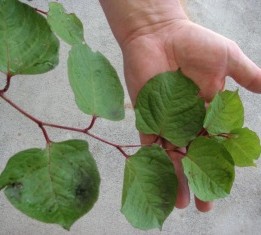
Note branch bends at nodes like an Eastern Redbud
Botanically take your pick: Japanese Knotweed is known as Fallopia japonica, Polygonum cuspidatum, and Reynoutria japonica. In Europe they prefer Fallopia japonica (named for Gabriello Fallopia, 16th century Italian anatomist who “discovered” fallopian tubes. Japonica means Japan. In North America it is known as Polygonum cuspidatum, which makes a lot more sense to me. I see nothing fallopian tubish about the plant whereas Polygonum (pol-LIG-on-um) means many joints and the plant does have that. Cuspidatum (kuss-pid-DAY-tum) means sharply or stiffly pointed, and that it is.
Other names names include fleeceflower, Himalayan fleece vine, monkeyweed, Huzhang, Tiger Stick, Hancock’s curse, elephant ears, pea shooters, donkey rhubarb, sally rhubarb, Japanese bamboo, American bamboo, and Mexican bamboo. The Japanese call it itadori which is from Chinese and mean “tiger walking stick”, “tiger stick,” or tiger cane. Best guess, and my thanks to Ala Bobb for the insight, is that the stick has stripes like a tiger. Sometimes it is called itodori which means “thread stick” a reference to the thready flower but also a fashion style. Two other names, in Chinese, are, “pain take” and “board take” In English we would reverse them, “take pain” and “take board.”
Lastly there is an ethnobotanical lesson in Japanese Knotweed: The Cherokee ate the cooked leaves. Shall we thus call it a Native American food? There are several examples of imported plants being adapted by the native population, no fools they. Those get reported as Native American food without the “when” being reported. Folks just assume they were eating or using said before the Europeans arrived. Black Medic is another example. If I remember correctly it first came to North America around 1912, just over a century ago. But it is listed as a Native American food because some western tribes did eat it once they knew what it was. It’s the same with a ground cover imported in the 1930s. The lesson is just because the natives ate a particular food it does not mean it was around before outsiders arrived. It’s kind of like saying chocolate pudding was an Aboriginal food.
Green Deane’s “Itemized” Plant Profile: Japanese Knotweed
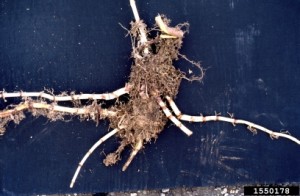
Rhizome runners can extend 60 feet
IDENTIFICATION: Polygonum cuspidatum: A semi-woody perennial, fast growing, hollow, bamboo-like stems forming dense, leafy thickets, woody with age. Young shoots are red. Leaves simple, toothless, hairless, alternating, broadly ovate with a pointed tip, 3 to 6 inches long, 2 to 4½ inches wide, on a long leaf stem. Flowers branching in spike-like clusters, individual flowers are 1/8 inch across, white to greenish or pinkish, with 5 petals, 8 stamens. Male and female flowers separate (dioecious.) Female flowers can produce small 3-angled black-brown fruit. Seed production is uncommon.
TIME OF YEAR: Purple shoots appear in spring, flowers late summer, early autumn.
ENVIRONMENT: Riverbanks, roadsides, moist, disturbed areas.
METHOD OF PREPARATION: Young shoots, growing tips, young leaves boiled or steamed and eaten like asparagus, or chilled and served with a dressing. Can be used in pies. soups, aspics, sauces, jams, chutneys even wines. The roots, actually rhizomes, are sometimes eaten. It is good fodder for grazing animals, including cattle, sheep, goats, horses and donkeys. Old stems have been used to make matches. It is high in oxalic acid so if you avoid spinach or rhubarb you should avoid knotweed.
Recipes from Herbalpedia
Japanese Knotweed Purée
Gather stalks, choosing those with thick stems. Wash well and remove all leaves and tips. Slice stems into 1-inch pieces, put into a pot and add ¾ cup sugar for every 5 cups of stems. Let stand 20 minutes to extract juices. Add only enough water to keep from scorching, about half a cup. Cook until pieces are soft, adding more water if necessary. They will cook quickly. When done, the Japanese Knotweed needs only to be mixed with a spoon. Add lemon juice to taste and more sugar if desired. Serve chilled for dessert just as it is, or pass a bowl of whipped cream. This purée is excellent spooned over vanilla ice cream or baked in a pie shell. Keeps well in the refrigerator and may be frozen for later use. (City Herbal)
Japanese Knotweed Bread
2 cups unbleached flour
½ cup sugar
1 ½ tsp baking powder
1 tsp salt
1 egg
2 Tbsp salad oil
¾ cup orange juice
¾ cup chopped hazelnuts
1 cup sweetened Japanese Knotweed Purée
Preheat oven to 350F. Sift dry ingredients together into a large bowl. Beat the egg white with the oil and orange juice. Add along with hazelnuts and purée to dry ingredients. Do not mix until all ingredients are added, and blend only enough to moisten. Do not over mix. Spoon gently into buttered 91/2-by-5-by-3-inch loaf pan. Bake about 1 hour or until a straw or cake tester inserted in the center comes out dry. Cool by removing from pan and placing it on a rack. For muffins, spoon into buttered muffin tins and bake about 25 minutes. (A City Herbal)

Hi Deane. We love/hate knotweed too. We have manged to cook up at least 5 recipes for this plant on our blog
http://the3foragers.blogspot.com/2011/05/japanese-knotweed-recipe-knotweed-jelly.html
As a kid, we used to whack each other with the dried stalks. In Florida, does the growth die back seasonally like it does here in Connecticut? Karen
Thanks… do I have you listed on my “resources” page?
Greetings from Japan… found your blog while searching for Hyacinth beans… very informative blog…
Am happy to learn the name of this plant… we actually enjoy picking it from the hills and cooking it in the spring…
Does anyone know anything about the edibility of Silver Lace Vine (polygonum aubertii) ?
It is not listed as an edible in any of my references.
I’ve been stomping/pulling/cutting this stuff all Spring and wondering what it was. Nice to know I can eat it instead of just pulverizing it! The only other good thing about Japanese Knotweed is that it seems to combat erosion somewhat. Thanks for the info.
Here in WA state, USA, Knotweed is a major erosion problem. It displaces native riparian plants which hold the soil, then dies back in the winter when the rains come and fills Salmon redds with silt.
I don’t understand how they can be a cause of erosion. The plant is decidious/herbacious, but it’s roots are what hold the soil together. They’re there year round.
The cause erosion because they will shade or choke out all other plants and then in the winter without the leaves the dirt below is bare of even grasses and so will erode under or around the knotweed.
well maybe they shouldn’t remove the leaf litter then. i’d need to see some real proof of this, it seems highly doubtable. If the winters are mild enough to fully decay the plants that dieback than the soil should be covered by winter annuals since the soil is bare. I don’t intend to sound rude, but it seems like a reasoning for government contracts to hand out tax payer money for genocide of the ‘invasive exotic’.
It’s not the rhizomes/roots of plant holding soil what stops erosion. More important are the leaves stopping raindrops . Sounds weird, I know, but it’s what I’ve been told on my pedology classes.
I wouldnt blame knotweed, more blame on that has to be put on washigton states over cutting of the old growth forest which has caused most if not all the problems of silt and runoff into the redds and also all the logging roads built to close to our watersheds thus causing degradation of the salmon runs. Funny how the state gov agencies seems to put all the highly beneficial plants/ weeds everthing that has benefit to the health of our eco-system on the noxious weed list and wants to erradicate it with highly toxic chemicals that are destroying all the beneficial pollinators , bees, butterflies, flies birds etc. Just read the effects that neonictinoids and the effects of the new 2-4-d pesticides are doing to our bees and pollinators..purposefully by the EPA in the nsme of big money for the GMO seed giants. I hope people begin to wake up soon to whats really happening and begin to be more pro- active its our childrens futures that are going to have to grow up eating their poison. I challenge people to really look into this. A good advocate pesticide action network or oregon sustainable beekeeping.
it’s is absolutely and eroding weed. we have a hill at the back of our house (2-3 feet from the house it drops off). we have a tall tree at the top of the hill and have watched the soil slowly erode to where the roots are so exposed that we are worried the tree will fall. it offers great shade so we are going to try to build retaining walls but i am worried the knotweed will break up the walls. i’ve been waging war on it as it grows without mercy all over our hill. it’s a huge woods in the summer but still the knotweed grows. i just spent a good 2 hours cutting down stalks and will finish up later this week in an effort to keep it under control. this stuff is a nightmare.
I fenced my stand of knot weed and bought a goat . Easy than cutting and cheaper better than weed killers that don’t work on knotweed well.
We have this problem at home in Wales and it gets to the stage here where insurance companies and banks won’t insure you/give a mortgage if there is any knotweed on the property. We had a serious problem for about 8 years and found that the only way of getting rid of it is to carefully cut the stems without dropping any leaves (as the plant actually spreads by leaf as well as root and seed) and to burn the cuttings, after this inject the stumps individually with some form of herbicide, ideally the strongest possible. this has to be repeated year after year every time a new shoot emerges. We have managed to reduce our problem in this way for acres and acres of the stuff to just the occasional shoot.
leaves and ground cover actually hold water in causing less need for watering the ground, so I don’t buy the erosion part either
this government really don’t care they are about profits not life
mine yours or nature, really they are greed and power stupid
meaning there greed and control freaky-ness makes them stupid to the point of bad thot process of living in this world to as if they don’t seems to completely escape there brain! see stupid, they pride there self in secrets and manipulation as if it was inelegance, and always seeking more brain dead people to believe them when we can see the lie’s as plain as day, I think they call that plausible deniability, see stupid, sheep have more brains they remind me of some one brain dead acting out of fear or trying to induce fear to remain in control, the government itself needs a wake up call because they are trying to trade in every thing that is not even theres while they walk off a cliff with worthless promises of value that is not there either, I wish people realized the government is not this country or belong to it
Well said!
(Can you say ‘corporate profits’?)
Better plant Kudzu there instead to help stop the erosion…j/k of course!
Can I eat the leaves too?
As the article says, young leaves cooked are edible.
I read some time ago in some book in the library that there were three hundred thousand plants classified and of them three thousand were editable. You are on one hundred and what? I hope you live long enough to tell us about all of them.
Haha I second that! You are by far my favorite internet source on plants. I wish they would put you on discovery channel or something.
Deane, what is the “ground cover imported in the 1930s” that native americans ate?
It’s a Dichondra.
I wonder if the seeds are edible as well?
I have read on another site that they were, but it was the only place I have seen that information. I have a plant here that has a TON of seeds all over it…
The internet is a sewer of misinformation. It is the least credible source of information we have. I have no reference to the edibility of the seeds of the Japanese Knoweed. However, the seeds of some of the plants in the same genus, Polygonum, have been parched and eaten among them P. douglasii and P. convolvulus. Either that one website is making an assumption or knowns something not reported elsewhere on the internet or in publications. I do not use the internet for research. I use the univeristy library as well as my own private collection. I have no reference regarding seeds. I note Steve Brill, a forager who writes a lot about Japanese Knotweed does not mention seeds.
I really enjoyed your article… there seems to be a lot of images Japanese Knotweed and all to me look different. I am launching a number of bee sanctuaries sin Japan… do you know if the bees like the flower? I am definely gonna try some of your recipes once I can figure out which of the many weeds growing is Japanese Knotweed… I have a better idea now at least what I am looking for.
Saying bees like knotweed would be a vast understatement. When my knotweed blooms in late summer, it literally hums with bees, and if you stand underneath it, it’s like there’s snow falling as they work over the tiny blossoms. By the way, I’m so happy to learn that this so called ‘noxious weed’ is not only edible but healthy & medicinally useful!
The beekeeper my parents used to go to years ago carried Japanese Knotweed honey. He claimed it was one of the most nutritious honeys out there, if not the most.
He’s no longer around and my father is currently trying to locate another beekeeper who has even heard of Japanese Knotweed honey.
Good luck with your bees!
I belonged to a Pennsylvania bee keeping club. I have tasted Knotweed honey. It is one of the best tasting honey types I’ve ever sampled. Pennsylvania railroads widely planted it to control erosion along the tracks, where it can commonly be found today. Because the railroads planted it to control erosion, I suspect they did it because it worked.
I thought the knotweed contained a fair amount of oxalic acid? About the same a ruhbarb? Thus be careful if you have issues with kidney stones etc.
The article mentions that knotweed contains oxalic acid, but so does spinach…
I’ve just recently found your site and have found it very informative. My question is this: is Japanese knot wood the same vine that in the south we call cud zoo vine? It’s everywhere covering trees and whole acres sometimes. If its an edible plant like ” Polk salad” I’m never going to starve.
No, Japanese Knotweed and Pokeweed are two very different species. Poke weed is edible boiled twice. Read my articles about it. Don’t get confused with the term Poke “salad.” It is really poke “salet” pronounced the same as salad. But it means ca ooked green. NEVER eat poke leaves raw.They can kill you.
Marsha,
Although they are not related, as the Kudzu is of the Pea family, Kudzu is highly edible. Enjoy! See source:
http://www.azcentral.com/style/hfe/food/articles/2007/03/20/20070320cookingkudzu0320.html
BTW, I grew up eating Poke Salet. Properly prepared as noted by Deane, it is an excellent cooked green.
Kudzu is, as you say, a vine; Japanese and giant knotweed are not vines. The photos clearly show the upright stalks of the knotweeds. Check out the article on this site on kudzu, and the YouTube video on kudzu on the EatTheWeeds channel.
In my yard the Japanese knotweed draws a TON of flies, a lot of different types too.
I put it away from the door hoping to draw flies from around the house.
Not too sure if it changed how many flies got into the house but I’ll keep it there anyway since it is a good source of edible plantlife.
Mr. Green Deane, so this is most definitely out of the intended scope of this post, however, this is the most in depth user online source for knotweed so I figured I’d try here….In a sustainable effort I am very interested in integrating knotweed into the fencing for my garden but I am worried about the initial threat of regeneration as well as the long term structural stability. I currently use sumac (which as a tree grows like a weed) and have no problems with regeneration as long as I let the cut stalks dry out a bit but I was curious about the resilience of the knotweed (I’d hate to accidentally transplant). Also, I recall building play forts as a child at my grandmothers house, cutting the stalks, staking them, tying them, but I can’t seem to recall how they stood a few days, weeks, months down the line. Do you have any insight as to the structural tendency of this weed. Does it harden like bamboo.
Thanks and great posting, this was a very enjoyable read.
It’s not a strong material
It spreads by seed and root. Roots will go 20 ft . I have had it come up through a crack in concrete floor 15 feet in side a dark shed. I read that it take three or more years of no growth to kill it.
An online Newsweek article states that there are only female plants, hence the seeds will not grow. The “crown” of the root system can be as big as a bull’s head and it has a massive roots system.
And to think I’ve been trying to kill these plants off. I simply pulled up young stalks in spring and harvested the growing tips and small tender leaves. They are not only edible but really very tasty, a mix of rhubarb, tender collard green, and a hint of artichoke. I simply cooked ’em in salted water for two minutes, drained, and gave them a squeeze of lemon. Next time, I think I will add the larger leaves to the water first and give them about two minutes before adding the tenderest parts for the last two. Thanks as always.
I have these growing on a slope in my back yard. I ate them for the first time yesterday. I wrapped them up in aluminum foil, drizzled with olive oil and a little salt. It had a taste that i don’t think everyone would enjoy, but i loved it! Not as much as I love Purslane. Its a much better feeling when you can enjoy eating the weeds that used to frustrate you with the endless task of pulling them.
There was a song about another type of “weed” and one of the lines went something like, “they cut and they burned and they burned and they cut. ” This reminds me of the way I have been trying to get rid of this knotweed for the past 10 years. Until recently, I had no idea what it was and could find no one else that knew. I finally had a professor at the university tell me what it was. I still figured I would have to get “radical” with getting rid of it until I did some research and found that it is managable and that it is also nutritious and has medicinal properties. I can’t wait to try some of the recipes. Now I am sitting here on this sack of rhyzomes and just smiling
If anyone knows of any in Florida…PLEASE email me. I want it for Lyme treatment. Because the powers that be fear it…the only way I can buy it is in expensive pills. Ridiculous. I can be trusted to drive a car or carry a gun..but not to handle a plant?
Thank You,
Tina
You could grow it here in the cooler months, just don’t tell the state or they will get very upset.
Many of the best medicinal plants are made illegal. Many of the best edible plants are condemned or have been made illegal at various times. It is the nature of fascism, which is the nature of power, which is the nature of humanity, which is the nature of nature. You can remove yourself through great effort and knowledge.
Knotweed can be used to combat Lyme?? What properties? how? this would be great to know… Florida if youre struggling at all with joint pain, Teasel is miraculous. Another roadside “weed”– 2 years of Meds and I couldn’t even hold a paintbrush my pain was so bad in my hands… 1 week of Teasel and it was GONE
Japanese Knotweed and Cat’s Claw herbs are supposedly useful in the treatment of Lyme Disease due to their natural antibiotic/anti spirochete properties. I am just starting on this treatment (I’ve had Lyme since 1997 and conventional medicine has failed to eradicate it). Since I’m new to this treatment, I can’t verify yet if it works or not, but many people are saying it helps them or outright puts them into remission.
It was recently advised that I try Resveratrol which is Japanese knotweed for after-effect symptoms of viral meningitis. I’ve only started and do not know how it will change my symptoms yet. It was advised by peoplespharmacy.com.
I buy the chipped up dried roots online from Amazon. I just steep it hot water for 10 or 15 minutes add honey and drink. I can’t say how much root to put in a cup of water for medicinal affects. Mine came from South Korea. It wasn’t extremely expensive and it was a considerable amount in the bag. Joe this helps.
I just filled a trash can with young plants that I dig up. Maybe I should save and use them? It is September, but some are very small plants, so can I cook and eat them and then use the roots for tea?
Ive heard jewelweed seeds are edible, is this true . I chewed some up last year and then spit them out because I was uncertain of their edibility they were quite tasty .
Read the article on jewelweed.
Searched articles ,can find none on jewelweed?
They are mentioned in the article on Edible Flowers. Jewelweed tastes bad, and requires a lot of cooking. Not a prime edible. Much over rated.
seeds are tasty IMO though i never eat many because of the less than average information on edibility.
And it probably doesn’t grow within 400 miles of here…
I have just come in from taking photos of knotweed in our area. It has spread exponentially along the road side and along all the small streams that are common here.(West of Ireland). The cutting of hedges by the council is seen as the main culprit of the accelerated spread as the tiniest amount of stem can take root. It has killed off the foxgloves, primroses, wild roses, vetch, buttercups, etc,etc. that were a feature of the roadside and riverbanks in summer. It may be a good substitute for rhubarb but unfortunately rhubarb is just not that popular. I keep bees myself and a varied diet is better than a single plant that only flowers late in the season leaving the bees without any forage in these areas early in the season when they need it most for increasing there numbers.
Root tincture of Japanese knotweed can be purchased and is very effective in treating Lyme disease.
I hope so as I am trying this “invasive” weed to eradicate an “invasive” species from my body! 🙂
I’ve been photographing the fallen leaves and also the fallen stalks of this plant for 10 years in September and October here in Connecticut. It was just by chance that I found this site and discovered their identity! Thanks for introducing me to a fascinating plant.
It has just come up in this area of Wisconsin. But, I think it is Bohemian Knotweed. Which supposedly is a cross with Japanese and Giant knotweed. Is this also edible? I have been trying to find info on the berries, are they also useful medicinally? Cooked, sugar, or just tincture?
We have Giant Knotweed growing in our yard. It was starting to spread, and we recently started digging and chopping it out, bagging the soil, as well, as I read that it is very easy to grow. Is the Giant Knotweed also edible? I am interested in how to prepare the roots as a resveratrol supplement. There are deep red veins in the roots. I am interested in finding out more about this plant. Can it be grown in containers and kept to a reasonable size, in order to harvest the useful parts of the plant, but not decimate native plant life?
Giant knotweed has much less resveratrol and other stilbene contents than japanese and/or bohemian knotweeds. Dry stems of all the knotweed species are good as a fuel, for heating, of high caloric value.
look up rhizome barriers used for bamboo, no reason to believe it wouldn’t work for knotweed. however, i don’t entirely trust them to last eternity many people are comfortable using them. if not get yourself a big tupper-tub and grow them in there above ground
Unfortunately this plant is considered an extreme weed because of it’s ability to survive any thing…Deep roots help the plant to survive burning flooding…has the reputation of being impossible to kill.
Others see it as a very important medicine.
Apparently it holds large amounts of resveratrol which has successfully treated lyme disease and heart disease…The main healing properties are in the roots.
Hard plant to control though but the Japanese have used it as an extreme healing plant for centuries…
it killed my diamond girl cat so its toxic to pets to eat
Resveratrol is what this weed can do better than any other ! It makes the cells and mitochondria keep growing that’s anti ageing and can when added to red wine without the alcohol rebuild the telomer in the cells DNA ! What it does with cells is what it does as a plant it just keeps growing not good for pregnant woman unless you want a very big baby haha ! Cells are like seeds growing other cells but than they stop and die out its a bio nano program in the DNA. Combine this plant with rye grass telomersa enzymes hyluronic acid amino acids glucose and B 17 vitamins nutmeg olive oil bio oil ! And you stay young and even regenerate all your cells back to a very youth full 25 year old In one tenth of the time it took to get old ! Not bad but most people are happy to die young and let there bodies rot ? The amount of times I have had to listen to people say anti ageing reverse ageing is not for them is a reality I am most pleased with it out lines the stupid mind set of most humans and makes sure idiots don’t live very long .
And I can already hear you say prove it hahahah I can prove it but the best thing to do is try it add it all to some good collagen and exercise than look at the results in just a few weeks .. The only bad thing is some body parts never stop growing like the nose and some skin but that can be sorted out !
I am a quantum mechanic and enjoy the sound of mad people saying they couldn’t give a dam than watch them rot slowly very funny hahaha than they say they like there body rot and eat more and more rubbish talk rubbish than blossom into giant fat pigs that cant run to the toilet fast enough !
My point here is your body is a plant that needs respect just like knot-weed or it gets out of control but knot weed keeps on living and give it a chance it would take over the world ! haha ! so eat it yummy mmmmm ! but please no fats with sugars errrrr unless your a lab rat .
You probably don’t know much about cells and the flow of electrons that make the chemical reactions that make new cells and some cells are immortal so keep them in good health .. You are made of star dust super novas wow billions of years old and we are all the same age at the atomic level so just relax eat the weeds read the last page of the bible and learn that heaven will help you if you help yourself !
There is no death with the knot weed so become the weed and lets chat for a few million years hahahahha why not weed hahhahahahahah lol xxx
VERY interesting comment! I am taking Knotweed as a natural antibiotic treatment for Lyme disease. Let’s see if my stardust supernova body, epigenetically mixed with knotweed can overcome this “invasive species” of borellia bergdorferi within my biogenetic framework. 🙂
Could you please provide a little more detail on your comment below concerning Japanese Knotweed? I find it fascinating and like to know more.
“Combine this plant with rye grass telomersa enzymes hyluronic acid amino acids glucose and B 17 vitamins nutmeg olive oil bio oil ! And you stay young and even regenerate all your cells back to a very youth full 25 year old In one tenth of the time it took to get old ! “
Love it!!!!
Atommix Tell me more. I believe you. You would know. Do you mean combine all those ingredients and eat- or put on your face? I know you can eat all of them (except the bio oil) but on reading ‘bio oil’ I thought I’d better ask if you meant to put them all on your face. Do you take knotweed in casule form or raw or cooked as a food? Thanks for any info you have about how to stay young (and reverse aging) it sounds so hopeful 🙂
A Japanese weed-gourmet (Begin Japanology, NHK World) claims to eat deep-fried Japanese Knotweed leaves. Would this destroy the Oxalic acid?
I am not a chemist, but with other plants that have oxalic acid heating does not get rid of the acid.
The only way to decrease the level of oxalic acid in foods that I know of is by fermenting them. I must try this spring to do some JK culturing.
Great article, great website!
I made a cold soup from it that came out amazing.
http://www.foragedfoodie.blogspot.com/2014/05/foraged-knotweed-cucumber-avocado.html
.I have heard that goats can eat this and it does no harm. If you don’t care to try eating it perhaps you could pasture your goats in the patch of it. Or maybe borrow the neighbors goats occasionally.
I have often wondered about using goats or pigs
We have quite a bit of knotweed in our back yard and since we moved here 6 years ago, we have been trying to get rid of it or at least keep it mowed back a bit. I’ve decided to explore other options for the knotweed, like eating it! My only concern is that I’m not sure what is in the ground that they are growing in. We discovered that the previous owner used the yard as a dump! There are car parts buried, glass all over and plenty of other junk that I can’t identify. We have been digging up junk for 6 years now and just don’t know what else is under there. It’s right around the area that the knotweed is growing. Is it safe to eat, regardless of the soil components? There are a few growing in my garden and I’m afraid that there are chemicals that were used in there too. Again, safe or don’t risk it? I live on a main road in a small city, so there is a bit of pollution and my yard sloops downward, so probably some runoff as well. Please let me know what your thoughts are on if I should eat this or not risk it due to the unknown. Thank you!
Important questions, Emily, regarding the possible contamination of the area in which a plant is growing that you are considering eating. Green Deane does cover that issue on this site and in his videos on YouTube.
One sobering consideration is that few plants anywhere can be considered NOT to have been exposed to contaminants of some kind, at some level. Actually, few foods of any kind have not been exposed to some kind of pollutant or contaminant, even the packaging often transfers harmful synthetic chemicals to our foods. One example: ‘Glyphosate (‘RoundUp’) and/or its still-toxic degradation byproduct AMPA were found in over 75% of the air and rain samples tested…’ according to a study by the US Geological Survey.
At some level, we have to use our common sense to determine whether the air, rain, or soil is too contaminated for the vegetation growing in a particular location to be ‘safe’ to eat. Being close to a busy road, especially downhill from one, would concern me, regardless of other possible contaminants.
Glass, of course, is basically inert, and composed of fused silica; other than concerns about what might have been stored in glass containers now broken, the only concern about glass is the potential for cuts. From sand it came, and to sand it will return- if crushed it essentially just becomes sand again.
Hello, and thanks for the great article. Do you know if stalks are still edible (boiled) if they are already 2-3 feet tall? Or are just the small shoots edible when they first come up?
Young and tender is always better with such things. It all depends on what you tummy can handle.
The stalks are about 3 ft tall around April 20. Choose sturdy, juicy looking ones and cut off at the base. As soon as possible, with friends present and a little pilsener, cut each stem from knot to knot and hand the bits out. Everyone peels stem at once and IMMEDIATELY dips it in gooey white salad dressing. Enjoy with a small glass of pilsener or similar beer, not wine.
The trick is that it be freshly picked, and very freshly skinned. Delicious.
I think, as with rhubarb, the oxalic acid is in the leaves, so I’d never eat them. The stems, once a year, for a celebration, shouldn’t do any harm at all.
I will tell you something that I don’t think I have ever shared. As a kid we used to put dried rhubarb leaves (and dried Burdock leaves) in a pipe and smoke them… very hot, very bad, but you know kids…
I am in the high desert. I love weeds for my livestock. Where could I get these seeds? My goats could easily handle to overgrowth. And it snows here so it would die down in winter.
why not plant a native plant for your goats that won’t become a problem after your goats are no longer part of that ecosystem?
Thanks for all the info. Do you have any good leads or links to eradicating JK? Bamboo eradication info online was ominous, nothing seems to work. Best bet seemed to be to keep pinching off new shoots as they appear and it will eventually ‘starve’ *IF* you can catch them all. Will that work with knotweed though, since it’s not related to bamboo? After finding your site, I may try eating the shoots until the thing is gone!
Removing Japanese Knotwood is a herculean task which usually involves removing a lot of soil. Eating it is revenge.
Great to have ideas of how to use Japaese Knotweed. In the Uk it is illegal to remove it from where it grows, so if you cook it it needs to be on a portable stove next to where you’re removing it. it is a real problem as an invasive too as it can grow up through concrete and destroy buildings, if it grows in the grounds of your house in the Uk, I’ve heard you can’t sell your house until the knotweed’s removed.
Thus eating said is one’s civic duty.
Japanese Knotweed is the source for many resveratrol supplements, not grapes as many assume. To this end, I would like to add a cautionary note. On the People’s Pharmacy there are accounts of people suffering ankle pain that progressed to an inflammatory (allergic) vascular reaction. I take an antihistamine daily and did not have the “bug bite” type lesions described by others but I did experience pain at the top of the foot and tired, achy ankles with minimal standing/walking. After months of this, never connecting the pain to the supplement, I also noted some mild swelling at the top of the foot near the ankle joint, but not on the side of the joint where such pain might occur from a strain/sprain.
For some reason I decided to research the supplement a bit more at which point I came across anecdotal reports of ankle pain on the People’s Pharmacy website (run by the authors of a newspaper column by the same name). I found the accounts of ankle pain compelling enough to stop taking 100mg Reseveratrol supplements. My ankle pain is fading for the first time in over six months, and nearly gone in just a week. In another week, I expect it will be entirely cleared. Prior to that I thought I must have injured my foot somehow, except that the pain kept going month after month without letting up. In hindsight, that pain appears to have been provoked by inflammation of the vessels that transverse the top of the foot in reaction to a daily 100mg. supplement.
I have read studies suggesting resveratrol may help with degenerative disc disease, a type of pain that is very difficult to treat (this was the reason I began taking it). However, inflammation from an allergic reaction is counterproductive to pain management.
Allergic reactions can come in many forms, not just the itchy rash or watery eyes most of us think of. I thought I’d pass this along as an FYI. Perhaps reseveratrol from another source would not provoke the same reaction — it could be the Japanese Knotweed, not the resveratrol per se, that is the culprit.
You forgot to mention knot weed honey!
Deane,
You rock. I’d love to get an interview for my podcast.
Cate
http://www.yogahealer.com/podcasting
Thanks… what would we talk about?
It was time for the annual pot luck supper for the UVM Extension Master Gardeners, Rutland, VT chapter. One would think it appropriate to bring non-manufactured food. One guy did just that. Strawberry-rhubarb pie. Two of them. Disappeared like a magician’s rabbit. The strawberries were true, but the rhubarb … well it wasn’t exactly rhubarb. Not even close. Japanese knotweed does taste very much like rhubarb. I know. I baked them.
I have this Japanese knot weed growing on my property what could be done to remove it is there any chemical maybe gasoline etc to kill this plant please inform me thank you
I know how to eat plants, not kill them per se…
Chemicals are said to be highly ineffective on Japanese Knotweed (and I don’t think we should be adding poisons to our ecosystem to kill any plants). From my research, the best strategy to remove JK from an area seems to be to cut and eat the shoots (or have goats eat the plants) many times until the roots run out of stored energy. This will probably take a few years! I’d like to hear from people who have successfully done this.
The problem with invasives is they replace native plants which feed far, far more creatures than just humans. Japanese knot weed, of course, is not to blame, but the reality is it takes over so voraciously that no other plants can grow. Plants and animals in ecosystems evolve together over 1,000’s of years. The JNW many feed some pollinators in the fall, (a good thing), but the reality is it limits native diversity severely. Where ever it takes over here in Maine NOTHING ELSE grows…no spring, summer or fall food and shelter for the insects and animals that have evolved here with other native species. Yes, in 1,000’s of years, (if humans do not do the planet in before hand), other creatures may evolve to feed on it. But, the truth is we are devastating the larger life community, and sadly, JPN is one more way in which we are doing so…
Good point. But many species of ‘native’ animals do readily adapt to using many introduced plants. Ruby-throated hummingbirds, an indigenous species, are said to prefer the blossoms of the introduced mimosa or silk tree over all others, for instance.
One species benefiting while many others suffer isn’t very justifiable either. Not to mention the plants that rely on the native hummingbirds to pollinate their flowers.
Hi,
I did bled some raw leaves, taken on big stalks, and blend those with a little water, and some sugar. Then I extracted the juice, just by pressing the pulp through a sieve. I got a real nice green juice.
It smells like fresh cut grass, but the taste is nice.
I just hope ther is no harm to consume raw leaves….
😉
Hi, No one seemed to mention Stephen Buhner who has done a lot of research on invasives weeds and plants. Along with eating them I would think it a treasure to have at least in some fashion. Many mentioning Lyme which I got two years ago. He has a number of books out and a website. I would love to have a controlled form of it here in Florida yet I see the major issue. I did look up Brazillian pepper on a Rainforest Herb Site which is rampant here in Florida on his premise that invasives grow in areas where they may be most needed. Teasel root is another example (and one used by Lyme sufferers) While not edible, the Brazillian pepper tincture I made(as they do in South America) helped me with a very serious UTI. And the Japanese knotweed is something I used with my Lyme . Just another FYI . His book Healing Lyme disease Confections I really read in depth and Japanese Knotweed is on the top of his list in many cases . He has a number of very good books out. A lot of info on knotweed on his website as well. http://buhnerhealinglyme.com
someone mentioned UTI’s. drinking bakingsoda water – 1/2 tsp to 8 oz water, 3 to 5 times a day clears them up in a couple days, unsweetened cranberry juice also works wonders, no need for antibiotics!
Take care that any you forage hasn’t been sprayed with weedkiller.
There is an Orwellian campaign of hate against this plant, and a veritable industry devoted to its extermination. The government is collecting £200m in VAT from it, and most likely a lot more from law firms prosecuting or defending people in neighbour disputes. Mortgage companies are refusing loans to people on the grounds that it is in their gardens or neighbouring gardens, which again causes a massive crop of VAT from legal work.
http://www.telegraph.co.uk/gardening/10686311/Gardeners-with-Rhododendrons-could-be-criminalised-by-new-EU-law.html
http://www.telegraph.co.uk/news/earth/wildlife/11763378/Ministers-surrender-in-battle-to-eradicate-Japanese-knotweed.html
http://www.telegraph.co.uk/gardening/11720693/The-UKs-most-invasive-plants.html
Now that the Knotweed is flowering profusely, is there any use for the flowers ?
Thank you
Bees love the flowers, specially Honey Bees. Great fall nectar source for bee getting ready for winter.
Great article Dean, as per usual. I am wondering, have you personally eaten the leaves?
I think I have this plant, and I hate undue prep, I would sooner eat the leaves than peel the mature stalks…
Begin in the spring by spraying roundup, use the concentrated and dilute 4-5 tbsp. per gallon. Spray every 7 – 10 days for a month. Skip a month then repeat if plant appears to be growing. DONT MISS ANY PLANTS AND TRY TO GET EVERY LEAF! BEWARE…..THE PLANT WILL CHANGE IN APPEARANCE. THE LEAF WILL LOOK COMPLETLY DIFFERENT AS IT MUTATES IN ITS STRUGGLE TO SURVIVE. In the fall cut to ground with mower and cover area with old carpeting (jute back). It will take 3 years minimum for all rhizomes to die while covered with carpet. Sometimes it will grow thru the carpet the next season. If so spray with roundup again as before (leave the carpet in place) and put another layer of carpet over the area which poked thru the original carpeting. Stay with it and you will win. Don’t keep up with the treatment and you will lose. This is a bad one….DONT LET IT GET AWAY FROM YOU. CHECK YOUR NEIGHBORHOOD. TELL YOUR NEIGHBORS WHO HAVE IT. GOOD LUCK.
I love this plant, it’s yummy and good for you. I don’t encourage its spreading, but won’t attempt to eradicate it either. Maybe if we all ate it it would disappear, lol
Poison are not the answer! The plant is edible and Honey Bees love the nectar.
I spent three years trying to dig up and remove knotweed from our yard to no avail.
Last year when I was diagnosed with chronic Lyme disease, the same knot I have made into tincture and has been the only thing helpful in my treatment so far! Japanese Knotweed has brought me from being bedridden to fairly functional again!
How did you make the tincture with knotweed? Thanks Mary
I just want to say I appreciate the work put into this article. I have a lot of respect for your work, I’ve used it as a major source of information to find local free food sources.
I am betting you and I have similar thoughts when we see things like “How do I kill it?”, especially posted on THIS site, which is about eating it. To those people, don’t even bother posting. This site is about eating the plant.
I think special attention needs to be paid to the fact the Native Americans eat it. They are likely the best custodians of the earth in human history. If they leave it alone what does that tell you?
As a second source of information for those curious I recommend Invasive Plant Medicine (The name may be slightly different) by Timothy Lee Scott. It was there that I found the best reasoning for leaving invasives alone or utilizing them. In the book it talks briefly about Deep Ecology, a philosophy that basically says the plants are there for a reason. Japanese knotweed is known as a traditional medicine for Lyme disease, and typically the plant magically appears in an area 6 months to a year before the first reported case of Lyme. It’s pretty consistent.
Anyway, I love this plant and I’m going to grow it wherever I set roots. Don’t start complaining because most are cloned female runners; seeds are rather rare. One carefree plant can probably replace that high maintenance salad garden 🙂
I have it growing abundantly enough to share. Let me know if you want me to dig some up and send it to you. My yard has been organic for 15 years!
Replying to Em Ellis’ offer for some Japanese knotweed starts. I would appreciate getting some tubers to plant this spring. I will be happy to reimburse you properly for them. I am in rural New York state. Thank you so much, I am looking forward to hearing from you.
I would like a start of the plant. A reasonable fee for shipping some roots & shoots – say? you say. 641-472-4925 1558 Nipa Blvd. Fairfield, IA 52556.
To Mike McConeghey and Joe Frischolz,
I have plenty growing in my yard this spring. I don’t use toxic pesticides and they’re growing far away from the road.
Mike, since I have your address I can send you some tubers.
I won’t be sending roots because they’re too deep to dig out. However, given the ease of propagation from just the tubers, you’ll have no problem propagating the species in no time. Please be responsible to not allow it to run rampant to neighboring areas. Also do not plant them anywhere close to structures where the deep roots and runners would cause eventual damage. It would be a good idea to grow them in large pots or planters to keep them contained. If for any reason there’s any issue growing them please email me. Joe, please email me your address.
My email address is woliver11166@gmail.com.
As far as reimbursement is concerned, just send me a check for the amount in postage you see on the small box. I’m sending it from New Jersey. Enjoy the health benefits of this plant!
Fellow wild plant forager and nature lover,
Wai
I have eighty acres, and far, far from any buildings I have a small scruffy area surrounded by forest except for one access road going through that forest. I think I could plant it there and the forest would contain it. I want it for both food and medicine. I am an herbalist and grow many of my own herbs, lots that Buhner recommends. His recommendations really work. From reading Buhner, the stuff is a fantastic medicinal and also edible of course. If you are still around and can do this let me know. Or just send me a little.
Sarah Marshall
PO box 95
Pettigrew, AR 72752
My knotweed started when the neighbour cut down 3 huge cedar trees on our property line. It must have been in the soil but I heard it does not grow in forest conditions. I understand that roots can lie dormant for up to 20 years.
3 years later it has taken over my rock garden, basically moving in and killing mostly flowers and bushes. Now it is advancing to the berry garden, just starting to take over the current bush, and getting too close to the raspberries, strawberries and blueberries. The only compensation as it gets close to the rhubarb is that it might serve as a replacement for same. I tried digging it, down to about 20 inches, only to find it grows faster in the looser soil. I have tried pulling it in the spring, which makes it travel farther, and cutting it, which also makes it travel farther.
As far as food goes, I have tried using the shoots in stir fry and it was good. It is now way too much to eat it all. My berry patch will be toast soon: I have to water the raspberries and strawberries so I suspect it will be there next year. I may have to quit watering the whole berry area to try and prevent the spread.
There is nothing I like about knotweed. It is now entering our grass area. It apparently spreads if I mow it, or if I water an area (apple tree, rose, flower bed) it moves towards it to get the water. The stuff in the grass is now very close to a flower bed. Thats how it moved to the new red current berry patch I was watering. Please beware where you plant it and know that it will go naturally where there is water or unnaturally where you water. The original place in a rock garden has a bit of a water erosion problem because we live on a mountain. I had planted many flower bushes and plants to prevent erosion.
I personally, would not plant knotweed anywhere. It is so hard to get rid of we can’t even expect that burning the rhizomes will destroy it. The leaves make new plants, the mowed stuff makes new plants. The stalks and roots make new plants. Beware, beware.
I forgot to mention that knotweed is also good for lungs and breathing problems and as it showed up just around the time of the Covid epidemic I wouldn’t be surprised if it is helpful for Covid.
Dear Deane
I find your article extremely interesting and informative. If I had some in my garden I would give it a go on the plate. I do feel you need to add something on the disposal of left overs for conscientious foragers, though I’m sure there won’t be much left by most of your community!
It is a criminal offence to lead to the spread of Japanese Knot weed. It does spread easily and it does impact on local ecosystems. Therefore precautions should be taken when discarding waste. It can’t go in your food waste bins, or the local authority tip, or your normal compost. Digging up the rhizome can also lead to its spread.
Devon Council have a quick guide and though they are not interested in its culinary qualities it may give and idea of disposal. (This probably differs outside the UK)
http://www.devon.gov.uk/knotweed_dos_and_donts
Hi
Can i screen out the roots with a big screen sieve to get rid of it.
Renovating a garden in south Wicklow’
john
Hi Deane,
I picked some of this in the spring. I didn’t get around to doing anything with it right away. When I did finally get to it, I noticed the insides of the stalks had little white bumps on it – some more than others. Is that some kind of mold or is it normal? It smelled normal and the tiny bit I tasted tasted normal. I chopped it up and froze it. I’m wondering if I should use it or dump it and make more room in my freezer! If you or anyone else has any answers, that would be great! Thanks
Elaine
I am guessing the Fallopian tube reference is because the stems are hollow and are in fact tubes.
This is my first post. I have told many people about your website, in the last few years, Green Deane. I showed a giant Japanese knotweed patch to a friend in the town we both live in, after he mentioned he took the supplement in pill form for his lyme disease treatment. When he saw the whole patch, about eighty feet solid, and ten foot wide, it made me feel good inside to teach a friend about the bounty of the Earth and how it’s possible to have free medicine when properly educated, after many years of study. Thanks, so very much, for your work, it means so much to me, and my friends that I teach.
I was initially looking at a site to help me make a bee house when they mentioned Japanese knotweed as being a great material to use because of its hollow stalks. I didn’t know what it was until I looked up a picture of it. Then when I saw it I said, ” Oh that’s sukanpo! ” I lived in Japan for 12 years and we would go to the mountains every spring to harvest it and make amazing pickles. My mother-in-law is from the Hiroshima area and I guess sukanpo is the local name for Itadori. This is an amazing food source. I miss eating it. If I knew of a place that it grew here, I would harvest it and pickle it. Too bad morre people don’t know its edible!
I have been whacking away at a big patch in my big back yard for twenty years now… just cutting down the shoots every spring and summer as they emerge tall enough to see above the ground cover (mostly creeping buttercup, but that’s about all that grows around here… ha!), and now they are sparse and small and I was SO happy to see that I’m finally winning… AND NOW I DISCOVER IT’S EDIBLE! SHEESH!!! (Just bit off a mouthful and even that way it’s not bad…) Sure didn’t LOOK edible. I give up.
I’ve been on my property in the moist Willamette valley in Western Oregon for 19 yrs with a large patch on Japanese Knotweed. I just learned what it was last wk when beginning a plant medicine class. All these yrs, I’ve mowed around it, cutting down the newest shoots to keep it contained. I love the heart leaves & flower for photos. & now I’m learning how to use it to heal my body. (P.s. I’ve not seen it spread anywhere else on my property. Or to my neighbors.) Maybe I’m just lucky.
To permanently kill the larger plants I purchased a large needle and syringe at a farm store. I drilled holes in the stalk and injected it with concentrated roundup. The roundup then goes systemically to all the roots branches, leaves and berries. Very effective! My plant was 8 feet tall by about 6 feet wide. Be sure to cover or cut off berries if the berries are ripe. You don’t want any birds to get poisoned.
I don’t have any trouble containing my mini forest. I do pull out or chop any plants that pop up where not wanted, and use a net when the plants get tall, so they don’t hang down over the walkway. My garden is a nearly a no water proposition, in dry Colorado with clay soil. In order to have green that isn’t prickly weeds and doesn’t need regular mowing, I let the knotweed grow. It makes a shady place in the summer and dies off in the winter so the west end of my house gets the sun. Passive solar. Lots of people beg my rhizomes to grow on their properties. They seem to have the same luck in containing it. On one property, in the middle of the prairie, where wind and weather are really tough on plants, and watering is restricted, it’s the only shade sometimes. Out there, it survives, even grazed by antelope, when not much else shade affording withstands.
Glyphosate is a systemic herbicide that will transmit the poison to bees and other pollinators through the flowers – and will last for at least 3 years in the soil, from what I’ve read. I think people are doing far more damage to the planet with glyphosate (and 2,4-d) than Japanese Knotweed. I’m encouraged by the number of people on this site who already seem to know this.
There’s a variety of JK that grows in my area – in the Coastal Range of Oregon – that produces tiny white seeds that resemble amaranth. Has anyone harvested these as a food source, and if so, how have they been prepared?
Thank you for this terrific information! You answered all my questions! I just found out that Japanese Knotweed has resveratrol and was wondering if it would be possible to forage it here in Massachusetts. It seems to grow everywhere, so I’m sure it is here. I think I saw some down the street. Thanks to you, I now know it is edible and some ideas for how people eat it! Important for me, before I eat something, is to know if there is oxalate content information on it, since I have pain and kidney stones with oxalates. You mentioned the “rhubarb” or “lemony” taste, so I had my suspicions this was a high-oxalate food, but I really appreciate that you came out and said it was high in oxalate (yay, there is information on it!), so I didn’t have to experiment or worry. Thank you again! I can’t eat it, but other people can and I feel very informed!
How does knotweed react to being harvested? If you take shoots, will it send up more later? If it sends more, how quickly, and will they be the same size, or thinner and leafier?
Thanks for this great information.
Answer: it sends up LOTS more, and thick ones too, but they gradually get tougher. Maybe if you stay cutting they won’t toughen up as fast? I’ll try harder next year. Thanks for the meals guys!
I don’t think you want to plant knotweed anyplace because it takes over and grows like crazy and is very difficult to get rid of without using weed killer. I had to put down black plastic at my camp to get rid of just a small amount after I bought the land.
It is not hard to find it growing all over the place. I canoe some rivers and I see it everywhere.
How do you make a tincture from the roots, with alcohol ? What is the active ingredient for Lyme disease ? I would guess it’s not resvirotrol because that is also in grape seeds, so then why would knotweed be considered at the top of the list for Lyme cures if that was the case ?
Can those little red ‘bumps’ (about 2cm.) that are now arising be used for food ?
If so, what would you recommend ?
I was watching our chickens nibble Knotweed flowers this morning and now I’m wondering if its flowers are edible? My internet searches are turning up nothing to answer this question…
Can somebody send me seeds? please contact me on tunixvr@gmail.com
I too would like to grow a few ,Here in western arkansas it gets very very dry in summer as well as super hot (over 102) and this Might just solve my bees problem about late honey production, as it is i have to spend almost 200 dollars a year to make the “bee drink” every year, that I can eat them is just a cherry on up. During fall and winter i hunt and fish to put as much food back as i can, if can freeze this shoots to add to that man oh man would that be nice, NOTE on pokesalad it is far easier to fix when very young then you need only boil it once ,(my grandmother taught me that) if the leaves are under say 2inches long, ANYTHING over that you would be well advised to cook it AT least 2 times but i would say 3 is a safer bet, however, it can be canned or frozen and lasts about 4 to 6 months.my email is rmorph123@gmail.com if anyone would Please send me either seeds or roots that would be grand.