
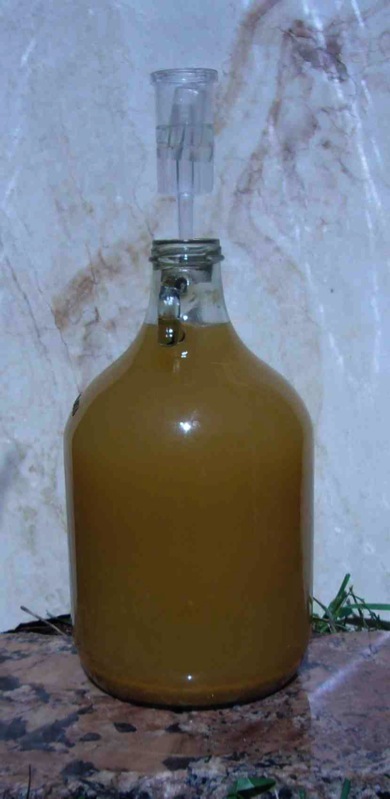
Homemade cider in the making
How To Make Hard Cider
You can make hard apple cider the difficult way, or the quick and easy way. I prefer the easy quick way. I’ve made a lot of beer and wine, including apple wine and a sparkling apple wine. The hard part was getting a cider taste rather than an apple wine flavor. And to be honest I wanted authentic taste but I didn’t think I had to work hard at it; our ancestors didn’t. This is not to knock those who spend months making an exquisite hard cider. This is a quick and refreshing drink for those with no patience.
When I was a kid my family would go to a local commercial orchard and buy bushels of bruised apples for our horses. We always got a couple of gallons of regular cider at the time. But then my father would ask for some cider from a particular barrel. That was the illegal hard cider barrel — illegal in that it wasn’t taxed. I remember the flavor of that hard cider well and when I made hard cider I wanted something close to that authentic taste. It wasn’t aged much, it wasn’t wine, and it wasn’t bubbly apple juice: It was hard cider with a crackle. And I also know they didn’t work hard at making it. It wasn’t involved, fancy or difficult. Here’s how I make my hard cider:
On Sunday I buy a gallon of apple cider at the health food store. It doesn’t have to be organic but the important part is that it contain no preservative, such as nitrates or sulfides. Ascorbic acid added is okay, and it can be pasteurized. I pour off a half a cup of juice and add a half a cup of starter (explained later.) I put on a fermentation lock and put it in a warm place. By Monday it’s fermenting vigorously. Friday I bottle it and put it back in the warm place. Saturday night I put it in the fridge. By Sunday, it’s cool and ready for drinking. If you let it age a week or two it’s even better. In one week you can be enjoying your own home-made hard apple cider with that great authentic old-fashion flavor.
Tastes vary. I like my hard cider a little on the sweet side, so I let it ferment for only five days, no longer. This, of course, may vary brand to brand. Some cider or juice may need to be fermented more or less depending on your personal tastes and the sugar content of the juice. When I bottle I pour it into empty 16 oz plastic seltzer water bottles, and put the caps back on. I let those set in a warm place until they are as hard as the bottles were when they had seltzer water in them. As I said, that usually only takes a day here. Then it all goes in the fridge. It can be drank immediately or over the next week or three. Keep an eye on the carbonation and make sure it doesn’t build up too much and break the plastic bottle. The dryer you like the cider, the longer you let it ferment before you bottle it and cap it.
Let me back up and provide some details. You can use beer yeast and a store-bought fermentation lock, or you can use wild yeast and a homemade fermentation lock. I use wild yeast and a store fermentation lock, basically because that is what I have on hand. Let me explain them both.
Using wild apple yeast is taking a chance that the yeast will throw a bad flavor, and opens the possibility of mold taking over before the yeast does. On the other hand, using a beer yeast increases your chances of success. I opted for wild apple yeast because I wanted my own yeast that no one else had. When I first bought a gallon of organic cider at the same time I bought an organic granny smith apple. It could have been any organic apple, but the key is it was an organic apple that should have wild apple yeast on it. I did not wash it. I took my apple cider and apple home. I peeled the apple and put the peeling into the apple juice and put it in a warm, dark place. It took almost two weeks for the yeast on the peeling to multiply to the point I could see bubbles rising in the cider. But by three weeks I was on my way. If you use beer yeast you will be in action overnight, greatly diminishing the chances of mold spoiling the party.
When I bottled that first batch of cider I kept the dregs, which were apple sediment, some juice, and a lot of yeast. I put that in a two quart soda bottle, added a couple of tablespoons of sugar, and kept it in a warm place, letting off the gas build-up every few days. One can also store it in the fridge long term. Now when I buy a gallon of cider, all I have to do is pour off a half a cup of juice, add a half a cup of starter, and then put that half cup of juice into the starter bottle with a little sugar. That wild yeast has produced very well for me for over two years. A bought yeast should perform even longer, but, at some point both will genetically drift and start to throw flavors you don’t want and you have to start again. Incidentally, you can use that wild yeast to raise bread slightly. Bread yeast will work to make cider but the alcohol content will be lower and the carbonation higher.
As for a home made fermentation lock: Since you will be fermenting it only one to three weeks at the most — depending upon what taste you like with your local brand — you can make a lock out of two things: a large balloon with a pin hole in it, or a piece of thin sandwich wrap with a pin hole in it held snug on the jug by an elastic band. Once the cider starts working there will be an outflow of pressure and that will keep any bad stuff out while the pin hole let’s the gas escape. Balloons are good if they are large enough to securely grab the jug’s mouth. Otherwise they can fill with gas and pop off even if you have a pin hole in it. Sometimes I use store locks and sometimes I use a piece of plastic. Balloons are really quite good but they have to be big balloons and they tend to be hard to find. Plain condoms held on with a rubber band will work well, too. Just don’t forget to put a pin hole in them and don’t forget you put a pin hole in them.
There is a certain amount of personal taste involved with how long you let the cider ferment. It depends on how sweet and how alcoholic you want it. The longer it ferments the more alcohol it will have and the less sweet it will be. If you let it ferment for more than a month or so it will start to lose its cider characteristic and start to be more like a semi-bubbly wine. It will also take on a harsh flavor that takes a couple of years of proper storage to moderate.
While purist have a good point when they say only certain apples and certain solids in the juice make a true cider, it is a continuum. Apple cider will become apple wine at some point. My hard cider is quick, lightly alcoholic, murky, and not harsh. You can easily drink it in a week. Apple wine is clear, more potent, and takes years to make not days.
The best thing is to do first time out is follow the schedule. Whether you use an apple peel that takes three weeks to get going or a teaspoon of beer yeast, count your five days after you can see a steady stream of bubbles to the top. (See my video to see what vigorous bubbles look like. It’s my most popular video.) Once you have a starter it works just as fast as commercial yeast.
If you like the sugar/alcohol levels of your test batch, then stay at five-day fermentation level. If you want it less sweet, let it ferment seven days or then 10 or 14. You may have to add a little sugar for carbonation if you let it ferment for more than three weeks. With my rich starter, my cider starts working within 24 hours and at the end there will always be a little sediment at the bottom of your jug and bottles. It is harmless. You can drink it or add it to your starter.
And what of the cider made this way? It’s very good. It is not rank. It is not on par with an English pub cider, but it’s quick, easy and you can get consistently good results. You could just as easily do five gallons as long as you had the bottles to put them in. If you don’t want to use plastic bottles you can also collect champagne bottles that will take a bottle cap. The best way to get those is raid weddings. I used to go to hotels on weekend and rescue cases of empty champagne bottles from wedding receptions. Unless you plan on corking them, only take the kind that take a bottle cap. Bottle cappers are inexpensive and caps are cheap.
I have found this to be the quickest, easiest way to make good cider with minimal equipment and hassles. If you have any questions, email me and I will do my best to answer them. While this focus has been on apple juice, it can be use with any sweet juice with sugar. It would even work with plain sugar and water, though there wouldn’t be much flavor.
As far as brands….my best flavor came from some organic apple cider (Knudson) at the health food store. But the price jumped recently to $12 a gallon, which translates into about 85 cents a cup. Whitehouse apple juice locally is selling for $5 a gallon, the final flavor is good and the price under fifty cents a cup final product. Supermarket brands tend to be low in sugar and produce dry or sour cider. No doubt there are some frozen apple juices that will work just as well. Once one has a good starter yeast one can experiment around.
And as safety measure: Never put a juice into your starter until after that juice has proven it is safe for the yeast by beginning to ferment first. Even a teaspoon of juice with preservatives will kill off your starter yeast. I also have two starters that I keep going at the same time just in case something does happen to one I still have the other.
By the way, don’t put your hard cider into a freezer. Much of the water will turn to ice and the very drinkable liquid you have left over is much stronger and is called home-made Apple Jack, which is illegal in most states because it hasn’t been taxed. Freezing it will accidentally make a 40% proof brew. Accidentally freezing a second time after removing the ice will make it higher in proof.
Lastly, if you are using something like concord grape juice you might want to shorten the vigorous fermentation time to three days instead of six to retain sweetness. Because of its intense muscadine flavor concord grape juice can taste sour even with some residual sugar so I only work it three days, comes out great. In fact, if I do Welches regular concord grape juice three days with my starter, charge for a day, then refrigerate it tastes very close to a red lambrusco. I also do orange juice and the like for shorter times than cider depending upon the sugar content. If one gets a sour batch, one can always add sugar and still bottle.
Oh, a little fact: John Adams, first vice president of the United States and second president, liked to start every day with a tall glass of hard cider. He lived well past 90.

Man, I love your article, mad props from the 21-29 age range, for bringing brewing to the younger generation. I have the apple juice, from a can, from concentrate, no absorbic acid just Filtered Water, and Apple Concentrate. I bought a 2.25oz of European Ale yeast, the the description said, “Great for Fruit Beers”. So I have 2 questions:
1. How much yeast do I need to make the starter? And how much juice do I use to make the starter?
2. I have 3 750ml wine glass jugs that have screw on tops, like you suggested. How do I make the jugs “Charged” Do I need to add some sugar to the bottom of the jug, or do I just pour the 5-7 day old fermented cider into the jug and let it sit for a day or two. Then refrigerate to stop the fermenting process.
I don’t quite understand how I get the cider to be carbonated.
Thanks so much, I love your site and I think you give great insight on not only Cider but organic foods as well.
If you are using store bought yeast the amount is rather irrelevant, a teaspoon or the entire package. Either will do.
When yeast eats sugar it does two things. It urinates alcohol and passed carbon dioxide. Normally the CO2 just escapes into the air. By putting the fermenting must into a sealed container the pressure builds up and the gas is forced into the liquid. That is how the beverage gets charged. This is also why you need to refrigerated it after a couple of days to dramatically slow down the build up of the C02. Left in a warm place with ample sugar in the liquid and the container could break.
I have been making Beer…Wine and Cider for over 10 yr.s now…..Ale yeast is one of the best yeasts to use for making a moderately decent ABV cider…Safale 05 is great….or Notthingham…I personally just fill a tumbler glass about a 1/4 inch or so with luke warm tap water and add a table spoon of sugar and mix to dissolve…I ad the whole package of dry yeast and cover with a coffee filter to keep anything from getting in….I can tell you what I use for Juice…..LOL….Happy Fermenting…
Thank so much for a wonderful amount of information. I get 10-20 gallons of cider from the local farmers market and have been using champagne yeast. The first time I tried it with bakers yeast it was horrible. I also learned that you can add residual sugar with Honey, my current batches are with raspberry honey and avocado honey, but you can never use real maple sugar as it has enzymes that have a bad effect on the finished product. Are there other yeasts that might give a better flavor in the end?
Beer yeasts work well.
I like the Lalvin EC-1118 for my ciders. 1118 is a monster that will eat sugar like a champ.
I laughed and laughed at this sly bit of writing. It reminded me of some of the folk literature (and recipes) which abounded during Prohibition:
“By the way, don’t put your hard cider into a freezer. Much of the water will turn to ice and the very drinkable liquid you have left over is much stronger and is called home-made Apple Jack, which is illegal in most states because it hasn’t been taxed. Freezing it will accidentally make a 40% proof brew. Accidentally freezing a second time after removing the ice will make it 80 proof.”
I need a bigger freezer…
Be aware that since you are freezing and not distilling to concentrate the alcohol you are also concentrating other compounds such as methanol which can lead to serious hangovers.
In distillation you separate the alcohols from the rest of the solution by their boiling points. When you’re doing a proper distillation you’ll have a fore-run of methanol (lower in boiling point) which you discard, then you start getting your ethanol and ethanol derivatives which is the drinkable alcohol.
In comparison the freezing method just relies on the fact that alcohols have a lower melting point than water, so it is really a concentration process rather than a distillation process. Concentrating both the methanol and ethanol in the cider (which doesn’t freeze) by removing water which does.
So you will still have methanol like Seth said.
great article..easy reading…I am 68 years of age…harbor belief and fear of earth problems on december 21st this year..who knows..??however if all goes bad..I can and will use your recipe to make cider a lot…I get gallon jugs at farmers markets for $2.00 each..have 20 now..ready to survive huh..?? thanks so much…take care..Bob.
Thanks for writing and here’s a toast to you… (life is too short not to have cider…) And by the way I am 62…
Hey great article! I’ve been brewing beer for almost 10 years now and am ready to try my hand had hard cider but I did have a question. How do you stop your fermentation after 5 days? I am used to fermenting ales that go for 5 days and then all the yeast drop to the bottom. You suggest that the yeast will keep fermenting for weeks and becomes more wine like. To stop the fermentation do you simply just rack off the yeast cake into your bottles? Also, what is your take on forced CO2 (I have a keg set up). Thanks a ton!!
I chill it to stop fermentation, or at least drop it to a level so low that I can drink it before it grows harsh.
Potassium sorbate is a preservative. It will kill your yeast and keep you from brewing anything useful. The only ingredients you want are apple juice or its concentrate, water, some form of sugar possibly, an malic/citric/ascorbic acid. None of these things will prevent fermentation.
Cheers! I loved the idea of starting my own wild yeast, so after some initial research I am trying your method (mostly) for my first attempt at cider. The only thing I did different was to take about a half cup of my store-bought cider and warm it slightly on the stove and disolve about a cup and a quarter of sugar in it, making a slightly thick syrup. I let this cool back to room-temp, and added it back to my cider bottle with the apple peelings before adding my field-expedient fermentation lock. Will this create any problems or have any adverse effect?
Thanks!
I’m starting off for the first time making cider. I used my home grown apples and a juicer and got 5 1/2 gals of juice. I then took some 1/2 gal of the juice out of the bottom of a 6 gal bucket and attempted to use it for the kids a basic cider. I found out that it was very thick and not very tasty. I tried to cook in some brown sugar and found it to get very thick and not so much like cider. The product was dumped. Hope the remaining batch turns out. I am attempting to use the natural yeast to start the process off.
About how many apples produced 5 gallons of juice?
About 90 pounds, depending on the variety.
Hello Green, just stumbled across your article and loved, this year I will start reproducing my own yeast culture from a bought Champagne one. Last year I was using Gervin wine yeast No3 at £1.05 for 5 grams, so it was not cheap and this year I am looking to do 30+ gallons.
I wonder what % of readers have tried the forbidden frozen cider trick?
Thank you.
Frozen cider trick? (cough cough) I discovered that strickly by accident…
Hi, thanks for the info.
I want to be able to drink my apple cider within two to three months. I have a 5 gallon batch bubbling away.
I used frozen apple juice and heated water with sultanas for tannin. I used a tsp of citric acid for acidity It’s currently fermenting nicely at 72F and is three days into the primary process. I used a Campden tablet, yeast nutrient and put in yeast E118 (after 24hrs) that will make all the sugar into alcohol, I understand, which should be about 10%. So, I am going to move it into the secondary fermentation carboy in a few days. (It needs to be strained from the sultanas). I will want to back sweeten. I’d like a sweetness like the cider I buy that is about a 2-3 sweetness, I’d say, not dry but not like a sweet cooler. So, do I stabilise this cider with sorbate and Campden in a few days, before I transfer it to the secondary fermentation carboy, add some sugar a few days later and then rack it and leave maybe three more weeks and then bottle and it’s ready to drink? Would that work?
You are close to making wine and the longer you wait to stop fermentation and bottle it the more harsh it is going to be and the more time it will take to be drinkable. You can drink it after a few days of fermenting or after two years of aging but in between it can be rather rough.
Hi Deane, Great stuff . I am just ready to attempt this i have 2 x gallon glass bottles,2 x Shop bought airlocks,3 packs of cider yeast and some juice..
My question is do i add sugar(i am looking for around 5-7% but not dry).Also where do i keep it to ferment.I live in england uk and it should be summer but its cold and rainy.Should i put it in my boiler room HOT!!!!……Thankyou for your time and expertise..Yours sincerley Joey Dee
Warm is better than cold. Hot kills.
Thanks for the article. Glad to come across a quick cider recipe, so many other recipes online people are letting their cider ferment for 3+ weeks resulting in a very harsh product that takes so long to mellow out.
I have two 1G jugs fermenting right now. One I plan on bottling after 5 days and the other I plan on bottling after 10 but plan to back sweetening the 10 day old cider. Do you have experience back sweetening into plastic bottles and if so do you think using apple juice concentrate would work okay?
The concentrate should work, though it might fizz a bit when added.
Are you ever concerned about the plastic bottle exploding while charging?
No … because once charged I will put it in the frig. Now, glass blottle will explode. Far more concerned about thosel.
My cider threw an incredibly awful taste, and I tried to add Xylitol. My room in this weather can get up to higher 70s during the day. Is it the weather or maybe bacteria in the brew that got into the drink?
I made about 3 gallons, one of organic and one with Mussleman’s. Organic was left for about two weeks and was not very good. Mussleman’s even with xylitol was undrinkable. I used a no-rinse sanitizer and also Safale S-04 yeast. Any suggestions?
And is accidentally frozen apple cider safe to drink?
Thanks
Bad tastes happen. Still alcoholic, drink after other lubrication. “Accidentally” frozen apple cider is called apple jack.
This is my first time brewing. I was referred by a friend to this topic.
Im using 2 gallons normal cider, no preservatives, some bakers yeast, and the ballontrick for an airlock. I was scared at first about sanitation because i accidentally left one of the lids off, but it doesn’t seem to be affecting the cider too badly. I got small samples of each half way through brewing and they both tasted magnificent, albeit more like wine rather than cider. The alcoholic content is evident through taste , as it is quite prominent. The end result was 2 great tasting ciders that were quite palatable. Thank you, and im going to keep brewing for a while longer, possibly even experiment some.
hey, thanks for taking the time to write all this out for us.
Hi Deane,
Great education, found you on yt. Man, I can just wonder on yt for hours and find more information than I can possibly consume LOL. It’s become quite the resource.
Anyway, I’d like to try this a first time and you suggest sticking to the schedule for the first time. I’m not clear on something, though… when you initially start a new batch, it is left out in a warm place (not the cooler where it will stop) for the full 5 days and you should see the yeast working hard after 24 hours? Except for your initial batch of apple starter where every thing is the same except it’s left out for 3 weeks?
Thanx,
David
It takes a few days for the years to get going the first time, that is why it make take a few weeks. But once you have the starter it should be bubbling within day.
Wonderful article. I’ve been thinking about making mead, but now I think I’ll start with hard cider 🙂
I’ve brewed Kombucha before & have cleaned my equipment with a vinegar rinse after sterilizing. Do you think that would be adequate in place of the tri-sodium phosphate?
Thanks again!!
Just sampled my first batch of cider, and something must have gone wrong. I made 1 gallon, i used Lalvin EC-1118, and an 3 part airlock, the fermentation stopped in 6 days! (That was my first warning sign something could be wrong) On day 7 pulled it from the bottle and tried it, All of the sweetness was gone, it smelled strongly of yeast and just had a bad flavor in general. (though noticeably alcoholic) I saved the dregs and added sugar and fermentation started almost immediately in the bottle. I am wondering if the room temperature may have caused this, we had a bit of a heat wave and it got into the low 80s in that room for a few day, could that have caused it? What should i do to help my other/future batches?
Well… I think you are tying to make apple wine with a commercial yeast. It will eat up the sugar very fast and produce a harsh liquid that needs to set for a couple of years to be drinkable. The goal is low-apcohol, residual sweetness, some bubbles, and drinkable in a few days.
For those who would like to learn how to make good cider here is an easy hard cider recipe.
Use 2tbls of bleach per gallon of water to clean all containers and equipment and rinse well with clean water after sanitizing.
Use a glass or stainless steel container for fermentation
use fresh cider if possible with no additives, pasteurized is okay.
Add 1 cup of sugar for each gallon of juice you are fermenting.
add one packet of Lalvin D-47 yeast per instructions.
install water lock and let it rip. Let the cider sit until it clears usually two to three months. When finished transfer to another sanitized container and bottle. If you like it bubbly add 3tbls of sugar per gallon to the cider before you bottle also to keep it a little sweet you can add 4 tsp of Splenda per gallon. This makes for a nice clean clear beverage at about 8% to 10 % abv that will keep for years and is drinkable from the time you bottle it.
Thanks. And I did post it, on upcoming events on my Green Deane Forum.
I am very new at brewing… when you say it will keep for years do seal it and keep it in a fridge or does it stay out? Oh! and would I be able to sanitize only using vinegar? I try to stay away from bleach as much as humanly possible. Thanks!
You do need to feed it now and then with some beer. You can clean with other chemicals such as Trisodium phosphate (TSP) which is not a bleach. It makes the water hard and that kills bacteria et cetera.
Great article! I have a question. .. It’s my first time, I used a gallon of apple juice, beer yeast, 2 cups of sugar. and lot of bubbles and fermenting nicely. How long should I let it ferment with this quantity?? I like sweeter and carbonated taste.
Thanks!!!
No long at all. Cider made this way should only ferment for a few days.
Um, all I do is bring home a gallon of fresh cider from a certain local orchard(other ciders I’ve tried haven’t responded as well–they must not have good wild yeast on THEIR apples!), pour a little glass to drink right away, put the cap back on and leave the jug on the counter and check it every time I’m in the kitchen. (Look, not drink) In a day, it starts fizzing and in about three days, it’s marvelously fizzy and I pop it in the fridge to slow things done while I guzzle at leisure. Course, I’m a Mainer and we like things simple here….
The key is you are bringing home cider from an orchard. In my original article what is also is what we did. The down side is it can have a bad yeast on it. Just the luck of the draw. And most folks don’t have an orchard to go to. And I’m a Mainer as well, born in Portland, raised in Pownal.
Howdy!
I -love- how easy this sounds and want to try it right away! I haven’t had much other than Hornsby’s since I moved home from Europe (US Army). I think I understand the first part, but I don’t get the bottling part (this is my first foray into anything not tincture or cordial). Are you using just regular plastic screw-top water bottles? Do you just dump it in from the larger fermenting bottle, or through a coffee filter or something? What if I go buy a fee of those reusable glass ones with the wire-attached stoppers – will that work? Corked beer bottles? I don’t want to have to buy a capper, but my first attempt at an infused wine exploded the cork out of the wine bottle it was in and made a MESS of my kitchen (it was on top of the cupboard and turned into a founatain :p) so I’m a wee bit shy. I’ll be very sure NOT to accidentally freeze any either 😉 Thanks!!
Becky’
While the cider is fermenting you should use a water lock on the top of the vessel you are fermenting it in to allow the co2 to escape. You can get a water lock and rubber stopper with a mounting hole for the water lock at any home brewing shop. The swing top bottles are great for bottling your own hard cider and can be used over again. Make sure you sanitize before each use.
Thank you SO MUCH for your blog and videos, Green Deane! I have enjoyed learning about foraging from your information, and I even nurtured the Purslane (which even the deer seem to enjoy) and Lambsquarter that came up in my garden this year, much to my wife’s dismay. 🙂 I just bought a gallon of local cider that includes, “1/10th of 1% of potassium sorbate,” to “preserve freshness.” May I still use this cider to create a mother and, subsequently, attempt making my own hard ciders? Thanks, and keep it up!
Such a helpful article! I have one question though, I am pressing my own cider and am wondering how clean the process needs to be in order to keep bacteria that doesn’t need to be incubated in my cider from crashing the party. Generally when we make cider we use a hose to rinse off the press that has been sitting in the rafters of the garage all year, dunk the apples from our tree in a bucket or water to wash off any dirt or grass and then press the juice into a clean plastic bucket. In the past it has gone straight into clean milk cartons and off to the freezer for storage. Since I want to try hard cider this year I was wondering if I should bring the cider up to 160* to kill anything off before I pitch a store bought yeast, or if I can just set some out for the wild yeast and any random bacteria to duke it out.
Heating it would reduce the chances of mold or a wild yeast throwing a poor flavor.
Hello Green Deane,
I enjoy your informative vids! Great work. Per cider. Hehe…my process: will this work? Hand-picked wild-crafted apples (golden delish); juiced with a Champion; poured into a 32 oz mason jar; added about 1/8 cup sugar; put in unwashed thick slices of apple peel; capped with plastic and tightened the ring down over it; pin pricked the top. Now it’s under the cabinet to brew (6 of them). Is this okay, instead of making a mother batch first and then adding it to the juice? Moderately warm temp. How long until I should see a flow of bubbles? It looks wonderful…cheers, Bella~
It depends on how vigorous the yeast is. It can take three to 14 days or more.
The fermentation is not stopped. Putting it in the frig slows it down sigificantly.
I am trying to make the wild yeast starter and all four that i have tried have some mold growing on the peels after 4-5 days. Is that okay or am i doing something wrong?
Where are you getting your apples from?
Awe-SOME!
What non-traditional fruits have you been successful with? (ie. -pear, kiwi, etc)
Ivy Gourd has been the best so far.
Can you please give me a easy to understand recipe for the hard cider.
Like step by step spelled out without all the commentary.
Thank you
Put the peelings from an apple in a gallon of no-preservative cider, cover, wait.
I am going to be using Champagne Yeast. How should I go about it? Do I just add the yeast to the Gallon jug of apple juice???
Yes.
And now for the “commentary” that will help you from doing it wrong. A packet of champagne yeast is a huge amount of yeast. It will cause the cider to bubble out of the bottle. You will need to put the cider in a container that is twice the size. A full packet will also work much faster than wild yeast making the cider ready to bottle in a couple of days, maybe even three. It will also have to be kept quite cold once put in the frig.
Thank you very much. You have been very helpful!
Bravo!
I picked up some road side apples while peddaling my Rhodes Car from Oxford to Bowling Green, OH. I’ve pressed the apples to make a gallon of hard cider now fermenting. I’m calling it my George Washington Populist Cider and will be drinking it on election day.
I love the idea of using a condom with a pin hole in it as an air lock for making “hard” cider. Too funny!
Thanks too for the important advice on freezing “accidents.”
Also love your humor
Thanks for the great info on your website! I have a gallon batch which today is at 5 days of fermenting. Was thinking of transfering into another gallon growler with a resealable cap, and then putting into the fridge. Will that be a problem? Dont want an explosion inthe fridge! hahaha I wanted to let it sit inthe fridge for a couple days to get nice and cold for some drinking this sunday. By the way this is my 1st time at hard cider, any info will help. Thanks!
That short amount of time should not be a problem.
i am making wine useing a gallon of apple cider ( fresh ) i was going to add sugar and then put in my dry yeast and let it set for a month.will that make my cider hard ?
yes but… a month of fermenting can make it harsh and sour and you will have to let it set for a year or two to mellow out.
thanks for your recipe….however can i use the bottom of it with the yeast with other juices? thanks again the wine is divine!!!
rich silver
Yes, you can.
I’m a first batch brewer. I gleaned two varieties of apple the first a small green fruit called Snow and the the large red is unknown. After passing through a highly modified yard waste shredder and strained in a high velocity industrial laundry type dryer the must came home. The pectic enzyme was added straight away ( a tbsp / 3 gal container) and after adjusting over night to a +60 room temp the yeast (champagne) went in. I did not add water the air locks ( 2x3gal carboys) and wonder what that may have done to the product ? The bung and airlock were in place though and today, after one week, I added the water. There’s a 10 second delay in ‘burps’ which seems promising and there’s no layer of growth on the surface of the must. Would you suggest re dosing with yeast ? The taste is nice, sweet and slightly drier than the original. The S.G. was 1.6 and is now 1.3 which suggests a 3.9 % alcohol content by volume going by the literature accompanying the hygrometer. The carboys are perhaps 6″ from being full and with the air exposure, I just wonder if I’m still moving towards a quality cider. Besides refrigeration, can you suggest another way to arrest fermentation and maintain the sweetness and apply taste ? So many thanks to you for your tutelage !
Thanks… it sounds as if everything is doing well. Wild yeast is not as vigorous as yeast from the lab and takes it time.
This is my first experiment with cider and I tried the wild yeast way. I juiced organic apples and put some peel in but it got moldy. I scooped the mold out, along with most of the apple peels, and put it in a more narrow necked container. It’s only been a few days, is there still hope or should I just make vinegar? Thanks!
Sipping my first glass right now. Delicious and easy. I am going to try the Concord grape juice tomorrow. I used a packet of Champagne yeast from the brewery supply.
Concord grapes needs less time to germent doing it the quick way. if you wait as long as you did for the cider it could be harsh aleady.
Sounds fun! I just made apple juice from our apples. I had to add water to each batch of apples so I could make juice in my vitamix. Should I add additional sugar?
I’ve only made cider once, and it ws undrinkable.
Thanks!
Joan
Additional sugar will add to the sweetness after you stop fermentation. If it was too sour when you stopped it then you should add some sugar. Start with a cup per gallon.
another question, I was hoping to leave some fresh juiced cider outside, we live where it freezes at night most of the winter, Eastern Washington, and hope it accidentally freezes. Would this work?
Well… fresh cider will freeze but it will not be alcoholic. Hard cider when frozen produces a higher alcoholic content because the water freezes and can be removed as ice. (Strain through a seive.)
If one were to “accidentaly” freeze this stuff…I wonder what type of container would or should be used to avoid breakage and still be able to get the contents out? 🙂
Milk jugs and two-quart soda bottles of hard cider often accidentally get left outside.
hello mr. Green Deane !
thanks for this interesting and fun reading..
I’m ‘mid-hard-cider-making’ , with a mistake or two, and hope for some help!
on Sunday afternoon, (Nov. 18th), I bought a gallon of fresh pressed, organic apple cider that was raw but treated with a UV light to kill bacteria. The cider sellar lad said all I had to do was let it sit out for a week or so, (in it’s plastic gallon container.) he also said I could add a Little bit of (bread) yeast to help it along. I poured 3/4’s of the gallon (drank the rest) into a very clean gallon bottle, and added just 1/2 teaspoon of dried bread yeast, then shook it and let sit in the ‘fridge. Today (Tuesday) I took it out. Nothing’s happening .. yet. I also do not have the proper gas-releasing cap, which sounds, after reading through this site, like I better get one to avoid an explosion.
1.) is it too late to add a gas – releasing cap ( i.e. ~ probably a condom! ) ?
2.) if I do shall I leave it out of of the ‘fridge ?
3. ) or .. shall I forget it this time and just leave (capped with a regular gallon jug’s cap) it in the ‘fridge for several more days and see what happens?
whatever you suggest! Thanks a Bunch ~ Josie
I don’t see that there is much of a problem except you have it in the refrigerator. That’s too cold for the yeast to grow.You put it in the frig AFTER it has made some alcohol, not before.
Hi. I truly enjoyed reading your stuff. Bookmarked it for a maybe later time too. I bought some martnelli’s unfiltered apple juice for the bottle to rack some mead I started. The glass 1.6 qt size was cute and really the only necked bottle I could find. So I dumped a couple of them in my pretty drink dispenser I got on sale and left it at room temp. Stirring a.m. And tasting then adding more apple juice in the evening and stirring. It is a nice smooth effervescent drink which I plan keeping it going perpetually. The mead is also in a nice looking drink dispenser which I am also adding honey(from our bees) praise God:) and water and stirring 2 times daily. I made another tonic called shrub with Apple cider vinegar covering fruit berries then straining the berries out the next morning and adding honey and water. Also stirring and adding in the evening to keep it going. The berries I put in a crock and add another fruit like one orange or one apple or a small handful of dried pineapple or craisins with some honey and stir 2 x’s each day. Today I had this fruit salad on homemade sourdough pancakes with a dallop of Greek yogurt and pure maple syrup. Woo that was good. This is my first attempt at the hard cider which just seemed to workout simply and wonderfully. I just started all this fermenting about 3 weeks ago. I love having ally (pets) to stir, taste add stir and well. Do you think I can keep all this going perpetually like I would like.? Thanks for keeping up so well with your comments.
Over time, two or three years, the yeast will change and you will have to collect some more.
Hi
Mr. Deane
I just finished bottling 5 gallons. It taste dry and some what sweet I added a small cinnamon stick in each plastic bottle and put on cap. I placed all bottles in fridge. Was that cinnamon stick a bad idea at end of process? I did use Red Star champagne yeast with 10 pounds sugar along with apple juice no sugar in a plastic carboy. How long can this stay in fridge? I did not close caps tight.
I thank you for any advice.
James Castro
Usually one closes the caps when the cider is warm and keep it warm for a day or two so it will charage (get fizzy.) Then you put it in the frig caps closed to dramatically slow down further fermenting and charging.
just letting you know I’ve got some Excellent results ! Thank you !
Hi Deane~ my fermented cider have stopped fermenting and I wanted to restart to ferment in process and sweeten it up so I added some maple syrup. I poured this very dry ‘ cider’ into a large jar where I added the maple syrup and put it back in the job I had it in with the fermentation lock back on. what are your thoughts on this and if I should I put it back in the refrigerator or leave it out. my hope was to make Applejack at some point.
No problem really. Just taste morning and night to make sure it doesn’t get harsh. If it does put it in the frig to stop the fermenting.
So I bought Brewers yeast and it has been 24 hours and I don’t see any bubbling, is that normal?
yeah, I’m afraid so. Today’s Brewers Yeast, despite the name, is not used for making alcohol but is rather a food supplement. It probably won’t perform. But not all is lost. Toss in a packet of bread yeast. It should work. The Brewers might affect the flavor some, but the end result should be drinkable.
Thank you for your blog here. I had dabbled in cider making but never really had a “method” down. One thing I have found success with, for those of us who are extremely low-tech, is simply unscrewing the caps from plastic bottles of juice (2-4 quart size). As long as sanitary conditions are present, I haven’t had a problem with it at all.
I actually enjoyed the “commentary” very much i thought it was a very well written article. im mid process of bottling my cider just wondering if i have well sanitized screw on top wine bottles would they be suitable for bottling and if so would there be chance of breaking if i dont charge the cider and just bottle it after 5 days im giving them as christmas presents and i dont want to be giving them cider bombs thank you very much
You are a “old school” rockstar! I’ve been reading and reading trying to find a solid recipe and you have filled me in on so much.. very informative.
I just have one question, I’ve made hard cider and added blackberries, then racked it and tossed the old berries and dregs, now I’ve added more berries and store bought no preservative smoothie mix (berries). Anyway I want to know what should I do to get those out when bottling? Should I just strain it?
Sounds good to me… by the way often said berries are still edibe albeit a tad fermented.
Hi i want to start brewing apple cider very new to this kind of thing does hard apple cider carbonate i don’t want carbonation i plan to use champagne yeast with organic cider i want 5 to 10 percent like a beer and for it to be nice and sweet cider iv seen people talk about back sweetening and how much cider do i need to take out if i add extra sugar at the beginning i plan to put it in glass after and I’m afraid of something called bottle bombs I see people talk about it but no one is clear about it any advice would be awesome!
Your brewing goals are rather difficult and beyond the capacity of the recipe. A palatable, high-alcohol, sweet cider, requires a lot of work and time. It would be cheaper to just buy a Sauternes wine. My recipe produces a low-alcohol, slightly dry wine in just a few days. To get a sweet, smooth high alcohol cider takes certainly months if not one or two years of making and storing.
Really good cider there Green. Easy to make and quick like you say and it really hits the old time “Cider” taste. I have been a homebrewer for several years now and had the rare benefit of having a good friend who was a professional brewer to learn from. I was able to to take your recipe and by droping the Fermenting Temperature to 65 degrees F and using an English Ale Yeast, fermenting for 8 days primary then 8 days secondary produce a 10% ABV Cider that was every bit as sweet and tasty as your origianl, I made it exactly as you said the first time only using the English Ale yeast instead of wild yeast. The key here is lowereing the temperature. That harshness you speak of is from Fussel Alcohols that most yeast will throw off when fermenting at higher temperatures. So, lower temperature and a longer fermentation = Great results.
Also, I’ve seen alot of posts about how to keep the cider longer. This is easily done by simply placing the bottles of charged cider into a waterbath that’s at say 100 degrees F for say 15 minutes, think Pasteurization. This will kill off all active yeast left in the bottle and stop them from progressing any further. The bottles can then be shelved and kept till your ready to enjoy.
Of course, Accidently forzen cider, LOL, that’s just awesome!
Great information, thanks.
Bill,What is your method for secondary fermentation?
Specifics please…Thanks in advance
With this quick low-alcohol cider there is no seconday fermentation. If you do that it will essentially turn to wine and take a couple of years to mellow out (and will probably be very sour as well.)
Hi ,
I have made a 5 gallons of shop bought apple juice with no preservatives , added raisins and dates and sugar today is the fourth week and I can still see small bubbles what do I do ? please advise thanks .
How long have you been seeing bubbles? Days? Weeks? Taste it. If you like the flavor bottle it.
I have been seeing bubbles for 2.5 weeks and I’m worried that if I move all the tape and the pipe my cider will turn into vinegar please advise
If the flavor is good now I would bottle it. If you wait too long you will have to bottle it and way a year or more before it is palatable again.
I’ve heard there are some scary wild yeasts out there (like E. coli). If I go the “wild yeast” route should I worry about that?
E. coli is a bacteria. I suppose it can always be an issue but I have not heard of it being so in making vinigar.
Hi, Thanks for the great info!
so I am brewing cider in the 1 gallon glass jugs that they come in. After it is done fermenting I would like to store the finished product in a clean 1 gallon glass jug like the one it fermented in. Is there some way I can do this without having to worry about pressure building up? (without refrigerating it)
How do I make it to store on a shelf long term?
And what about if I fermented it for say 2-3 weeks, could I put it into clean 1 gallon glass jugs and let it age in the pantry for a year or two?
Thanks again for all the great info!
Look just above this comment to Bill on December 7th. There he tells of an easy way to stop the fermenting.
Nice site ~ thanks. I recently bought a gallon of pasteurized apple cider, w/o preservatives. Forgot about most of it for a couple of weeks in the fridge and ended up with a bubbly, delicious, not too sweet hard cider. Can you explain how this worked, with no starter? I want to do it again (and again and again) because it was delightful.
Answer? It was not pasturized well, and or was opened.
Hello–I wind up with hard cider occasionally from an opened plastic jug of pasteurized orchard cider forgotten in the fridge after the first couple of glasses. The plastic jug becomes tellingly puffy, and in a day or two the cider is lightly fizzy. Sometimes it tastes moldy, but sometimes it’s quite nice. Is it safe to drink this type of accident, or would you advise following actual directions for intentionally hard cider? I actually have a jug of it in the fridge now–if I like the taste and fizziness today, should I just bottle it? (There is too much to drink today.) Thanks for this blog–I first tasted low-alcohol hard cider at a little mountain cidery in the Basque region of Spain 25 years ago, and I yearn to create its equal.
I would certainly give it a taste.
I love mixing my whiskey with apple cider. I plan to age some whiskey in a barrel, and thought of mixing the apple cider with it and aging both. Do you think this could work? I’d hate to waste the whiskey or cider.
My only thought is that whiskey is very stable and can last for years. Cider is not stable and can go bad quickly. Like the majority of mariages whiskey and cider will like each other for a while but then comes divorce.
Thanks for the info I’ll stick to mixing them post aging
Very informative site… thanks… i use good cider no preservatives and lalvin ec1118 wine yeast and cane sugar…it starts filling balloons within an hour… ill try 3 or 4 days of ferm… hope to strain and bottle a good batch.. you said concord grapes ferment fast? How long till its good wine i used 2 cups sugar per 64 oz juice ..same yeast
Concord grapes make a nice fizzy drink and just two or three days. But it turns harsh quickly and then one must work with it for years to get a good wine…
Thanks! Hey can you shake the container if sugar settles at the
bottom? Cause i wonder if the yeast can get to it un less its well mixed…
You can shake it or leave it. It will eventully melt and get consumed.
Hey wonderful article! I plan on making some of my own and didn’t really have a clue as to how to go about it. Thank you very much. Live long, laugh often and stay healthy and happy!
Thank you for your informative article. I appreciate the information & I may do some testing this fall. I will take int consideration your thoughtful warning, to prevent accidental foray into any illegal activity.
Cordially, Annette
Great recipe and explanation! On the 2nd brew now! Thanks
We are brewing some apple cider in an apartment complex and can’t risk having the smell the release of hydrogen-sulfide. We are using Santa Cruz apple juice which has no preservatives other than ascorbic acid. We are using ale yeast and champagne yeast (two different batches) from our local home-brew store. What is the cause of the bad smell and is there any preemptive thing we can do to prevent that from happening (wouldn’t want upset the neighbors/roommates).
Usually that is caused by active yeast running out of stuff to eat and working on secondary food sources that produce the odor. Add a little sugar.
Thank you for the input, one batch started to smell, but the sugar trick worked perfectly. We think we added a little bit too much yeast to that batch as it fermented much quicker than you said above. Great article.
What is the approximate alcohol content of your five day ferment?
Two percent there abouts…
Is it still possible to make hard cider with a cider that is preserved with sorbate or will it kill the yeast
No, the sorbate is usually potassium sorbate which will kill yeast.
Ok that is good to know but its almost impossible to find fresh cider around here after the first of the year
“Without all the commentary”
WOW.
Bmt.
Deane btw, can you help me identify a plant that ooks like a thistle (leaves, growth habit) yet has yellow poppy like flowers ( petals) yet s stamen/anther structute like something malvaceous? Leaves blue green +_silver…no way i can submit a picture in my message?
Dan,
Deane has a forum (link at the top of the page). There is where you can post pics and ask for ID. The thread name is What Is It? UFOs Unidentified Flowering Objects.
I’m following your recipe and was wondering if charging one day in the original glass 1gal jug followed by refrigeration is a no-no? I guess how quickly does the gas build up to the point of explosion in this kind of jug? Can you let it charge in a beer bottle instead or would that explode also?
I have a bunch of wine yeast will that work ??
Great article…
This cracked me up..
“Plain condoms held on with a rubber band will work well, too. Just don’t forget to put a pin hole in them and don’t forget you put a pin hole in them.”
Anyways.. I am in the Miami area and don’t have room in my house anywhere to be storing bottles that could explode, so…is my shed outside too hot for the fermenting process. I would guess that in the summer it gets over 110º at peak of day.
I live in Florida and make cider all the time. Heat is not really a problem. If you can stand it the yeast can stand it (in the shade.) I put cider in soda bottles. They were designed to take the pressure. You let them charge for a day or two then put them in the frig and drink. Exploding is not an issue, except for ones waist line.
I usually have an abundance of crab-apples in the fall. I read someplace that the more sour the apple is, the sweeter the wine will be. Do you know if that’s accurate?
Once I tried making wine with the crabs but I was scared to taste it. I used an older pottery crock and someone told me that it would leech lead. All that did was kill every fresh flower in my house. It looked pretty sitting on the bar though and was an excellent conversation piece. Finally, I tossed it.
Next, I went to a wine shop and bought a bucket with vapor lock, carboy and along with that some pretty expensive champagne yeast, nutrient, and some other dodads that I can’t remember what they’re for–something to do with specific gravity– and sanitizer. First, I was worried that the sanitizer was poison so thank you for pointing out that it dissipates. The guy at the store told me to freeze the apples, which I washed and cored first–a laborous job because crab-apples are much smaller than regular apples. He cautioned me no to let any seeds or stems get into the juice and I was careful not to, running them through a juicer. I put them in the sanitized bucket along with organic sugar, yeast and nutrient. Maybe I didn’t put it in a warm enough place but it just never seemed to bubble. After several weeks, I added more yeast and nutrient but nothing happened. It smelled okay I was scared to drink it and tossed it too.
I really want to make some wine or some mild cider, carbonated or un-carbonated, partly because I would very much like to be able to control the amount of alcohol in the drink. I’m not a good drinker and get loaded on a couple of beers so I would like to have a milder alcoholic drink that doesn’t leave me feeling sloshed. Also, there are supposed to be nutritional benefits of eating or drinking fermented foods.
Do you have any idea what I did wrong? Were the crab-apples too sour? I followed the instructions for the yeast and nutrient and sugar, although I would rather use honey as I can get good-quality, delicious honey locally.
What are the chances of poisoning myself?
I have my own home-grown apples so do you think I should have simply not washed the apples?
Should I have just smashed them and strained the pulp through cheese-cloth instead of using a juicer?
What in the world do you think I did wrong? Everybody says this is just easy as pie.
Poisoning yourself making apple cider? Not really unless you use some really old material. My frist two batches of beer and first batch of dandelioin wine were made in old pickle crocks. You have all the equipment to make wine. What you want to make is a low calorie apple cider. Follow my recipe (use champage or bear yeast if you like) but bottle it and put it in the frig in five days (from the time you put the yeast in to bottling.) Start it Monday morning, bottle it Friday in pressure-able containers, leave out one or two days then put it in the frig. Then leave it for a week.
Using bread yeast, adding sugar, and fermenting/aging in old milk bottles with balloons for airlocks, I found my cider disgusting after a week, still needing to be racked after three months, delicious at six, and tasty enough at a year to make one of my friends cry when I took the bottle away from him.
However, there wasn’t even the slightest bit of carbonation. I’ve had German apple wine and it was pale and insipid, whereas my brew was a deep rich russet brown. Did I create apple wine by accident?
Yes… you made wine. Bread yeast was bred to make gas quickly (so bread rises in a few hours.) After a week the cider should have been bottled in pressure-able containers and put into the frig to build up cabonation.
Greetings, Green Deane!
My first attempt, I tried wild yeast with plastic wrap and a single, tiny hole punched in the top. Well mold showed up and “spoiled the party” on the pieces of apple peel that had not yet sunk….bummer.
So I am on batch #2 using half a packet of champagne yeast (small batch of cider – only 64 oz) with a commercial airlock. Currently on day 4 and it’s churning and bubbling quite happily in there.
My question – can I use the leftover sediments from this batch as a starter? I kind of like the idea of not having to buy “special” yeast every time I want to make a cider.
Your thoughts? Thanks!
Steve W
Yes, you can use the sediment for yeast.
Deane, Thanks for a terrific article on easy brewing! Your whole website is fantastic for foragers and homesteaders in general. We so appreciate your sharing your expertise and advice!!!
Just wondering regarding your accidental freeze distillation and another comment regarding how that method of distillation concentrates the unwanted, poisonous, methanol… from a purely theoretical point of view, would it not be possible to drive off the methanol with a quick 2 minute boil of the ferment prior to the freeze distillation? Methanol, with its lower molecular weight, leaves the ferment in an earlier fraction than the heavier molecular weight ethanol. Any thoughts on time to boil to drive off methanol while not affecting ethanol yield greatly, … hypothetically speaking, of course?
The possible amount of methanol by freezing is extremely minute. Folks have made apple jack for centuries at least by letting hard cider freeze outside in the winter.
Awesome, thanks for the details! I’m just about to try fermenting some apple juice with a homemade ginger bug but there were a few details I was a bit foggy on- like whether you can use balloons as a fermentation lock. I have my first batch of ginger beer fermenting with balloons on top, and while I figured it would work, I hadn’t found any other sites who confirmed that you could do that!
Great blog.
Balloons ae quite reliable as fermentation locks for active must. When things slow down or in secondarty fermentation or aging water locks should be used.
Great article! Have bought a property where there are lots of mustang grapes. Have recipes/suggestions on fermenting these?
Juice them and follow the same procedure. However mind the comment that its hard cider nature may not last as long. I have made hard cider out of mulberry, cherry, crab apple and aronia. Juice mulberry and you will have wild yeast that day.
I want to make a bottle or two and let it sit for about 10 years. Once the process gets going, and the balloon blows up, pin hole, then the balloon will go down flat after a while. What do you do then? Can you cap it tightly/lock it, and store it in a dark cellar for 10 years? I just want to do this for fun, not hurry hurry drink drink. Please let me know, thanks man.
No… this is not a recipe or a material that is designed for long storage. Red wines can be bottled for that long but not white wine and certainly not cider. Even commercial cider is only good for a short time. If you bottle this stuff it will get sour and harsh and eventually become undrinkable.
I tried culturing my own apple yeast about 4 days ago and am now seeing a white growth floating on top.This is the mold you warned about? Is it worth another attempt?
Yep, sounds like mold… and yes it is worth trying again.
How much beer yeast would you use for a gallon of apple juice?
Could you use the apple juice gallon bottle to ferment it in with your own plastic wrap as a lock?
How many layers of plastic wrap and how tight should you make it?
Can you tell I’m a virgin apple ciderer? ? ?
It only takes a little beer yeast, a quarter of a teaspoon or even the entire packet. Makes little difference. Yeast multiplies quickly. Yes, you can use the plastic container the cider comes in. One layer of wrap is enough (just put a pin hole in it once the yeast starts working. The outward pressure keeps bad bacteria out.)
You say that you take out a half cup of juice and put in a half cup of starter.. Since I’m using beer yeast do I mix that with water to equal the half cup of starter?
Very Interesting article. My family owns an apple orchard, we make our own cider, we DO NOT pasteurize it. It is frozen shortly after bottling. Yeast occurs naturally in the skin of an apple, which you pointed out. The sugars are also there naturally in apples. Apples are a powerhouse of goodness for making cider ….or hard cider. 😀 We generally put a minimum of 6 varieties of apples into our cider. A NON-pasteurized cider (even if it has been frozen for a year) can be made into Hard Cider on its own in a matter of 10 days…… One needs hard cider to get to 5.5 % alcohol in order for it to convert to 5.5% acid……..that is how Cider Vinegar is produced. I have done both…….made hard cider as well as let it go to vinegar, the health benefits are AMAZING…..and HIGHLY useful……. 1 tablespoon of Cider Vinegar and 1 Tablespoon of Honey mixed in 8 oz of water, drank 3 times a day, can shorten the duration of a cold in the winter.
I came across your article on making hard cider and wanted to try it. I have never tried to brew anything and was woundering where I would get beer yeast.
I took the wild yeast road i got a of gallon cider, and poured 4cups out. I peeled a granny smith and a yellow one. Put peels from both in there. Well on 4th day I started to get paranoid about a bad taste . So I poured 2/3 of cup if.sugar in it. And now on the 7th day it is foaming/bubbling pretty good. So I pull it at 2 or 3 weeks?
Taste it in a five days or so. It can go from really nice to harsh quickly so monitor it.
Thanks so much for your time/article. By the way the cider I have is called Uncle Jesse’s finest batch and indeed it will be.
Hello, very enjoyable and educational read. I cannot find the answer to this anywhere. Do you know how to calculate theoretical alcohol content after fermentation given a known quantity of sugar? Looking for low end calcs (within yeast alcohol tolerance levels).
Gracias!
Usually that is what a hydrometer is used for. You measure the must before the yeast and you measure the wine as it goes along to calculate the proof.
Excellent post. I make homemade ciders often in much the same way. One other point for those wanting to try it, You can also use the frozen concentrated apple or grape juice from the freezer sections in most grocery stores to make wines. Add your concentrates to water (chlorine and chloramine free I usually let it sit a week before using) then add chosen yeast, shake well and place in fermenter. The frozen juices are generally cheaper. For those who habitually forget their stuff in the freezer the 24 and 48 hour turbo yeasts quickly make a very harsh cider but when removed from the freezer sans ice and yeast it mellows considerably.
Be sure to taste it prior to tossing the illegal substance.
Carl
Hello Mr. Dean!!!
I wanted to thank you for your article and all of your time.
I have had an unopened jug of cider in my fridge from our local orchard
for about a month and change now. Do you you think it’s safe to drink?
Thanks!
Yes…
thanks for this article. I recently tried my first brew- a very simple cider brew by purchasing a gallon glass jug of shelf stable pasturized juice and then adding champagne yeast and topping with an airlock. It’s bottled now and our friend said to wait a couple of months before driking it.
I have a site on how to make hard cider, but you have explained it a lot better than I did. Good article!
Thanks for the informative article.
however concerning the applejack, (a site that is banned on Eat The Weeds says: “Freeze distillation can concentrate methanol and fusel alcohols (by-products of fermentation which true distillation can separate out) in applejack to unhealthy levels[citation needed][dubious – discuss]. As a result, many countries prohibit such applejack as a health measure”
That site is banned because it is so horrribly inaccurate regarding foraging. As for freezing cider it has been done for centuries. If you can find a death or illness attributed to said I’d like to know about it.
Just wanted to say thanks for the great site & video’s!
I’ve brewed beer before but just tried making wine with Welches regular concord grape juice. Last year I made Mead or honey wine with regular bakers yeast and surprisingly it came out great. Have you ever made Mead?
Keep up the great work!
Welches concord juice can be tough to work with, it grows harsh early one and take a while to mellow out. I’ve made mead but its not a flavor I fully appreciate.
NOW I understand why some batches made me forget what happened the night before and why some were delightful. Two to eight weeks really DOES make a difference! Hate those trips to the porcelain fixture! THANK YOU!
in your article you say “If you let it age a week or two it’s even better.” do you mean let it sit after you bottle it and do you let it sit in your fridge or in a warm place ? thanks much
p.s i loved the article my starter only took 6 days to get kicking and i made it out of organic fujii skins.
I let it sit in the frig. At room temperature it will continue to ferment making it more tart and creating more gas.
Should I move it/shake it to stir things up a bit and keep things going or should I leave it alone? I used a commercial yeast and it was bubbling away within hours, but I want to make sure it doesn’t burn hot and fast and then die out in just a day or two (tonight makes the end of the first day).
Leave it alone. They can be slow to start.
Awesome, thanks. It’s pretty vigorous right now and I have to admit I find myself just watching the bubbles work their way up through the airlock for minutes at a time. It was like that when I made my first batch of yogurt, kept wanting to see if I could see some magical change. Here’s to hoping this first batch is one of many good ciders to come!
WOW – what an amazing an informative blog. Thank you – i didn’t know brewing could be sooooooo simple and easy! Enjoyed reading through all the questions and post after too. Great advice and comments. My first time at brewing cider but i’m so trying this tomorrow as the apples on my tree in the uk are now ripe and there’s no way i could eat them all, so waste not, want not eh! I have read your instructions and follow well but I do have a question. I will obviously be picking apples direct off the tree but don’t have a press. Could i peel the apples and blend/pulp to create my juice. My thoughts were to blend a few kilo in a blender and then top up to 2 gallons with water (my brewing demijon size) and then simmer for 30mins say to extract all the juice and pasturize per se. Strain off into my demi (top up with water if necessary) let cool and start from there (i’ll use brewers yeast and add sugar too)…. does this sound a good start or is there a much better way to do this from picked apples and no press? Also, would a few kilos of apples be enough to make a good juice to start with or would you suggest starting with more – i have approx 200 large apples on tree so weight no object! Many thanks and thanks again for the great read and info :_)
It all sounds good except for the Brewers Yeast. It’s not too good for fermenting now. You’d be better off using a champagne yeast. Look for a local brew store. Yeast is cheap.
Cheers Deane, fills me with a little more confidence on prepping the apples! I shall get some Champagne yeast today (presuming it may work better in cooler conditions? It’s only about 18 – 20deg here now at best!) Can’t wait to see how it all goes 😀
If you dont want too spend much at all buy plain old apple juice in whatever size you want, bread yeast, a cup of sugar for every L of juice (for a higher alcohol content) and a sanitized bottle (2l pop bottles work good)
first step is add a teaspoon of yeast to the bottle, the juice, and the sugar (a funnel works great) one added tighten cap, and shake for a minute, then
unscrew cap just enough to let air in but not enough to let insects in, or poke a
small hole with the cap tight. then let it sit in a warm dark area for a week and check on it every now and then. at a week or so when you want too drink it first check if there is sludge at the bottom of the bottle if so pour out the cider and dont let the sludge go with it, or mix it all together, dont worry its just apple fibers, sugar, and yeast mixed up in to a paste substance. you can do a recipe as small as 250 ml too as big as 4l with a teaspoon of yeast. it turns out too be between 4-8 percent depending on how long it aged, and how much sugar you added. with a 1l batch with a cup of sugar for a week it was about 5-7 percent…. enjoy and make sure everything is sanitized
While there is nothing wrong with plain old apple juice it often has a preservative in it that will kill off any yeast. Look at the label first. Anything added for “freshness” will kill of yeast.
Here in Canada the SunRype brand I use has no preservatives and I just made a batch and it has a nice kick to it
Great article, starting mine tomorrow…was gonna use an apple press but now i will start with cider and then eventually graduate to the press. This will be a blast and a fun road 🙂 will be fun to use must instead of wort lol.
Enjoyed this thread! I had montmorency (pie) cherry trees in back of the house and used to freeze the cherries after removing the seeds. Later, I’d cut one small corner of the baggies and drain the juice into a container. A couple tablespoons of this in the cider jug always started it quick, and it was always delicious, even though made in plastic gallon jugs without the fermentation lock. I simply waited a few days for pressure to build up and it was good enough for drinking. I’ll have to try the methods listed here though. Greatness awaits….
Foam is usually yeast, old is more a floating carpet.
My husband, 2 small children, and I spent 5 hours this afternoon making sweet cider. Our friends have 3 apple trees (of unknown origin) on their property. After picking, rinsing, coring, cutting out bad spots(and some worms!), and grinding in 2 food processors simultaneously, we pressed using an old homemade press that my dad got 20 years ago from his friend Chick, the plumber. We sustained some attrition in the form of the 3 kids holding their cups under the press while the juice was flowing, but in the end we got about 4 gallons of the best sweet cider I’ve ever had. I would like to make 1 gallon into hard cider and was wondering if you could give some advice.
1. Since we pressed it ourselves would you recommend adding yeast or just see if it will ferment on its own?
2. When you say put it in a warm place, how warm are we talking? I’m from up north, so anything above 70 is hot in my book.
Thank you so much for your wonderful website – I’m so glad I found it.
It will ferment on its own, or, you can kill off the wild yeast and add a commercial yeast. It’s inexpensive, just a couple a dollars per packet.
Hello deane
I was wondering if i add less yeast will the brew taste less yeasty?
Also will that lower the alcohol? I’m sure it would slow fermentation.my grandparents had an orchard growing up and this is something I’ve always talked about doing,but after reading this yesterday i bought everything i need to do it. I’m glad you shared this for all of us newcomers. Also, do you ever add sugar? How much?
Thanks again Deane, you’re inspirational!
No, not really. The yeast just keeps multiplying and eating until it runs out of food (sugar.) You can get less yeasty tasting commercial yeasts.
Thanks for the fast reply Deane,
I purchased red star champagne yeast 10 pack for $5.50, and whitehouse apple juice. Starting a batch tonight, bookmarked this page for a reference.
Okay so you mention that this can be done in as little as a week.
Really?
So I just take some fresh cider, wait a week, and I can drink it?
You have to follow the recipe. Yes, you can get a nice low-alcohol hard cider in a week.
Hey – just wanted to say thanks from San Francisco. Hard cider is one of my all time favorite drinks. I just made my first batch and it turned out great (sampled prior to bottling).
Two questions if you don’t mind:
1) I’ve put the cider into the swing top brown bottles. How long can they stay in there? I’m nervous about exploding bottles
2) I have some great yeast and sediment left over. You mention saving it to use again and adding sugar. Are you talking about regular white sugar, or does it matter?
Thanks for a great blog with such great information.
If the bottles are refrigerated they can last quite a while. You can also crack the caps slightly to let off gas. You can use the sediment again, and this is one time pure old white sugar is okay to use. It throws a “cidery” taste which when one is making cider is absolutely fine… not so good for wine, though.
Great! Thanks for the quick reply. Most won’t be refrigerated (I made a rather large batch) but will be stored in my very cool garage or given to friends. Next time I’ll make a smaller batch.
Thanks again!
I agree, white sugar if fine. I even use it when home brewing beer and it works fine. You don’t get a “cidery” taste until you get over 20% white sugar in it.
Sorry if you covered this already; this is a popular article…
As for cultivating wild yeast: I took some apple peels, a cup of preservative free apple juice and tbs of sugar and put in a bottle. I saw bubbles/foam by day two. They cover a large portion of the surface. How long should I wait before I store in the fridge?
That depends whether you want to use it to make cider or drink it.
Well I don’t want to drink what I have here haha… I guess I’d like to make a cider, preferably a more aged one like an apple wine. So, I think what I’m looking for is a starter.
By the way, Love your videos, articles and information. I’ve tried dozens of natural edibles from the knowledge you share. It definitely helps living in central Florida; all your information is relevant to me. You are an undiscovered genius…
I’ve always wanted to find a good, abundant seaweed i can try. Is glacilaria the stuff you see all through Indian river and banan river? Don’t know if you’ve been there.
Mr Deane, I just found your site today and so far love the site..thanks for the info… I’m getting started on making some home made hard cider, you metion the alcohol content will be about 3%, is there anyway to increase this amount?
Oh yes… but in doing so it will get harsh tasting quickly and will take a year or two to become easy on the throat.
This is my 1st time. I used apx. 2 liters (1/2 GAL.) UNSWEETENED APPLE JUICE, 1 packet(7 grams bakers yeast, 2 cups sugar, and 2 cups water, in an empty 2 gal. empty plastic vinegar jug with a balloon pierced air lock. I have no hydrometer or other equipment. I want cider to be apx. 40% alcohol. How long do I ferment it?
Well… it isn’t going to happen as you planned. First, even champion wine yeast rarely can produce a wine more than 12% alcohol or so. 40% is totally out of the question. Baker’s yeast is not designed to make alcohol so it is also low yield. And you added sugar so the end product will be sweet. The problem is if you let the cider ferment for more than a couple of weeks it will grow harsh and not drinkable for a couple of years. Your choices are quick and low alcohol or a long wait and high alcohol.
Thanks for responding. I drank it before your response, but I need more advice. I fermented it for 6 days and then put it all in 1 big jug and dumping the yeast residue. It tasted like apple wine that was sour. I will settle for 6 to 10% alcohol content, but I would like it to have some sweetness. I t was too sour and had no carbonation. I can settle for no carbonation if I have to, but how do I get some sweetness out of it? I want cider taste, not wine.
Add sugar, but carefully because it will foam instantly. Sweeten to taste, cap. Let sit in a warm spot for a couple of days. It will have carbonation.
Thanks for your response. People need to be warned about a problem that occurred and ruined my 2nd batch. I bought 2 gallons of Ruby Kist apple juice on sale. The label said 100% apple cider. Ingredients listed are filtered water and apple juice concentrate. Nothing else. Now it has been 26 hours since I added yeast and fermentation has not started. I figured out that the concentrate Ruby Kist probably bought from another co. must have contained preservatives. If you buy a juice made from concentrate, how do you know if it has preservatives?! I looked all over internet and could not find any listing of ingredients in any apple juice concentrate! I thought that if there were any preservatives in a product, it had to be listed. Evidently I was wrong. I’ll start my 3rd attempt tomorrow, but I am now in mourning over my second batch.
Deane, Please disregard my previous statement. Woke up this morning and was pleasantly surprized to see my 2nd batch was fermenting strongly. So glad I didn’t dump it! You see, the first batch started fermenting within 4 hrs. after adding yeast. I assumed that was normal. This 2nd batch took apx.40 hrs. to start. Sorry to keep bothering you, but I live alone and need to tell somebody about this exciting new endeavor. I live way out in the sticks and there is no way to get anything but bakers yeast out here. 75 miles to city.
I am impressed with the way you’ve patiently answered all these questions, and with the kindness you show in your videos.
When the cider gets to the 2-3 percent level, is the alcohol content high enough so that one can relax a bit about bacteria and molds attacking the drink?
Hmmm… actually it is the outflow of gas from the sugar being consumed by the yeast that keeps bacteria and mold at bay (presuming all was clean to start with.) This is another reason to let it charge: bacteria and mold are no match for escaping gas, even small amounts. While the alcohol lends itself some to inhibiting the growth of bad stuff it is the CO2 being expelled that does most of the work when the must is young.
Hi Deane, I’d first like to say thank you for all this great info, your time and efforts. I read through 70 comments before I gave up looking for the answer to my question. If you had answered this in one of the other 150 comments I did not read I apologize. The question is about your “Starter”. I have access to wild apples and organic preservative free apple juice but what I don’t know is a few details in the starter making process such as did you make it in the plastic bottle but more importantly what was on the top of the vessel you made the starter in? Such as was it a tight sealed lid that you let the gas out once in a while, or perhaps there was an airlock on the vessel or maybe even yet it was open top with perhaps a cloth on it to keep dust and bugs out. Thanks again for your time.
Thanks for writing. I have air locks but for that I used a balloon. They fit tightly and are permeable so the CO2 will bleed off.
I am finally making small weekly batches. The starter from my first batch is great. Within a couple of hours it started bubbling away. I also finally figured out that a gallon is the perfect amount for me to have a few bottles as well as share a few.
I’m curious how commercial bottlers stop the cider from fermenting while sitting on the shelves. I find if I don’t drink my cider within a few days that it gets more and more dry. I let some sit for 2 weeks and it essentially became alcoholic sparkling water. Any thoughts?
Thanks again for taking the time to answer all of these questions and posting such great info!
To answer your question they carefully heat it… very carefully… and kill of the yeast without affecting the flavor.
Ahhh. Thank you Obi Wan. My wife asked me and I had no idea. I like the idea of having a new batch each week. My 3 year old son likes watching the water lock bubble.
Thanks again for being such a great source of information!
Hope you’re enjoying your weekend.
about to rack my batch of cider before bottling. a few questions tho – i am working with 3 gallons of cider purchased from an orchard that i heated, cooled, pitched 2 packets of red star champagne yeast and added 1 cup of maple syrup. it has been sitting for almost 3 weeks and i am ready to bottle. i want sparkling cider and am planning on adding a half a cup of maple syrup before bottling. questions are: does this sound like a reasonable recipe? i forgot to take a specific gravity reading before pitching the yeast. any way to tell what the alcohol content will be? i read here that syrup may add a bad flavor, is this so? how long can this batch sit after bottled? thanks for your help!
Three weeks, while not a long time, might make the cider sour. So you should taste it. If it is still sweet then it probably has enough sugar in it to charge. If not it does not take much sugar to charge a 16oz bottle, a teaspoon does nicely. If it has been working for three weeks it should be around 3 to 4% alcohol. If it was really sweet to start with and now is dry then perhaps more. The fundamental problem is after a few weeks it will become harsh and need to sit a year or more to mellow to the point of being pleasant to drink.
Thanks for this awesome recipe! I made a starter with apple peels and apple cider and it worked beautifully, I’m on my third batch. My question is how to keep my starter alive between batches (like several weeks or months in between). Do I need to occasionally feed the yeast with sugar? And do I keep it at room temperature or in the fridge? Thank you!
Just feed it a little sugar between batches, at room temperature or in the fridge.
My first two tries were failures. The starter developed properly, but when I added it to the gallon of apple juice, a white film (mold, bacteria, biofilm?) would form on the surface, and no bubbling was to be had. I looked at other cider videos (so many different methods, proportions, additives…) and convinced myself that the issue was that I was leaving too much air (oxygen) space at the top. This last time I left almost no space at the top, and was sure to add sugar to give the yeast a quick head start.
This time it’s working fine, and the bubbles in the transparent liquid are transfixing. (Yes, even more so than a lava lamp!)
Three questions: All of the bubbles come from tiny sediment clumps on the bottom of the jar. For some reason I was expecting the yeast to reside all through the bottle. Is this the usual for all yeasts grown from apple peels?
Could the starter be used as a good basis for creating sourdough mother?
When I was googling about fermentation, I saw that the freezing method for making (accidentally, of course) apple jack concentrates, at each stage, small amounts of methanol and fusel oil impurities. Supposedly these impurities are removed when a distillation method is used. I’m only interested in trying to accidentally make a small amount one time for the hell of it, but am wondering whether it’s smart to not let the proof get too high. Any thoughts?
– Tom
Yeast settles (anchor steamer beer) so the bubble usually do come from the bottom. Yes the starter can be used for sour dough. And folks have been freezing apple cider for centuries before Wikipedia told them it was making methanol and dangerous.
We love making home made cider, I hate those huge heavy glass jugs though. I prefer to make a smaller batch using EZ Caps.
Is washing my bottles in the dishwasher on a “sani-cycle” was and dry sufficient?
It depends on what you use to clean them. It’s not the washing so much as what you wash them with. Bleach is not good. Hot water is good.
Good evening.
LOVED this article and the instructions! I have a couple questions though, and am about to make my first batch of hard cider. Here goes…
I know you said to use beer yeast or homemade starter (I’ll be using beer yeast, most likely) and that preservatives in the cider are to be avoided, but the only cider I can find has potassium sorbate in it (it’s the only ingredient besides apples!). I have read from folks that have tried that this can be done, but more yeast is needed with potassium. How much yeast should I use per gallon if I’m going to try this? I have 4 gallon jugs of pasteurized cider with four purchased airlocks. I’ll be getting either beer or champagne yeast from a brewer’s store this week.
Lastly, do I need to add sugar or honey when fermenting? The cider I have has about 30g of carbs (sugar, right?) per serving, and I’ve heard that 20g per serving or so is sufficient “food” for the yeast. Any thoughts? Thanks so much, I can’t wait to give this a try!
Potassium sorbate kills yeast. Hard to get around that. As for amounts of yeast, what ever works is fine. If it has food it will multiply and do all right. More yeast to start with does the job faster which is what we want. If using a packet half or all of it will do. The goal in short term and long term fermenting is to have residual sugar that leaves the cider et cetera at a level of sweetness you like, more sugar in, more sugar when you stop it fermenting whether that is five days for five years.
Great advice above and in your video. Is warm water and dish or hand soap enough to sanitize the containers? Also, could you provide a link for a recommended store-bought yeast. The specific yeast seems to be giving other brewers some trouble.
Thanks!
Hi from Ukraine,
I would like to make some apple or pear cider. I have access to any amount of apples mostly home grown therefore one can assume totally spray free/organic. I have a few bottles and nothing else. It is impossible to buy apple cider here of any reliable quality/ So can I make cider from the very basic..apples?! I have a Vita Mix and that is it. HELP please!
Jackie
Great article,
So I just got a jug going today. I put about a half cup of brown sugar in. And used some ale yeast I was going to bottle it into beer bottles and cap. But I can’t wait! So can I use a Pepsi bottle to force carbonate ? That’s the same as the tonic bottle you mention right?
I want to add, as a park ranger and florida master naturalist, your site and work are great. Thanks!
Tim
Thanks. I used to use “returnable” soda bottles all the time to make beer in.
I think those are glass. I was talking about something like a 2 liter plastic Pepsi bottle, they see like just the same as the tonic bottles? Will that work for carving the cider?
Those will work also.
Hi,
Is the amount of pressure in the container while brewing important?
During the initial fermentation the gas is allowed to escape plus that makes a positive outflow keeping bacteria and the like out. Then it is capped to capture the gas to make the drink fizzy.
Hi Everybody! I like to start by saying that if you brew Hard apple cider or any kind of harder wine that It kinda goes on to brew well if it kinda goes like a accident! lol…. All kidding aside, I lived in the pine barrens of N.J. for a lot of my life. Hard apple cider and fruit ciders were abundant by the The older folks that have ancestors dating back to the 1600’s and 1700’s. I’ll tell you what, them folks could make some mean hard cider and I have one of those recipes that I use. Its really just throwing some green and red apples sliced and peels and spices together and I make my own apple cider. Its easy to make! I use nutmeg, cinnamon, raw unbleached sugar, and some water added to to the 5 gallon mix. I use a 5 gallon food grade icing bucket from the supermarket bakery. I cut a near perfect hole for the rubber stopper of the water lock and the lid fits air tight. I add 1 packet of Champagne yeast. All you really need to do is make home made apple cider in the 5 gallon food grade bucket. You use cinnamon and fresh grated nutmeg and raw unbleached sugar (such as Sugar in the raw that you can buy at the grocery store) and you add the apple juice and strain 4 pound granny smith apples of their juice and throw out the pulp that is left. Do the same with 4 pounds of golden or red apples and then add cold water. You use the raw sugar to sweeten the whole 5 gallons to taste. Just dunk a 8 ounce mug in it and taste. Never add too much cinnamon or nutmeg. it should taste like apple cider from a farmers market or it may taste better! Who knows! Once you get 5 gallons of amazing cider just add the packet of Champagne yeast and shut the airtight lid and add water to your hydrometer, then wrap it with a dark colored towel and set it in a closet or corner of a room and leave it for about 3 months. Dont move it or touch it for those three months. Then when it is time, take a half a cup out and take a taste. if it is dry that is ok. If it is like apple jack or stronger then add a little raw sugar to it. maybe a cup! Dont shake or stir just close it back up and let it go for a few days. Check it again and it should be a bit sweeter and a little carbonation crackle to it. I’ve done this for years and I bottle it in wine bottles with caps and put them in a fridge. I leave them in the fridge for 3 or 4 weeks and then I enjoy them! From Jersey to Ga. my friends and family love my Pine Barrens hard apple cider. It is a lighter color and nice apple flavor and has a nice carbonated crackle and a nice bite . If folks want a little more carbonation they can drop a carbonation drop in each bottle then add the cider before they put their prize in the fridge. 6 gallons worth in 12 ounce bottles is pretty nice for the holidays and fall celebration events at home with the family! Ohhh, and the alcohol content is about 28 to 33 percent. So it will kick your butt if you share a standard pitcher of this cider with a friend! Its so good and a little sweet that it creeps up on you and you are going to be feeling pretty nice. My fiances son and I shared a pitcher of it the day after thanksgiving and he sorta passed out cause it snuck up on him. he at least made it to the couch before he went La La. I pan on making25 or 30 gallons of it for my fall and winter festivities!!! If you can get a large never used oak barrel and do this then you have an even more authentic colonial style cider. Just like Gen. Washington’s men and pirates alike enjoyed in the Pine Barrens of N. J.!
Hello from the pines ! We may know each other. Pinelands class of 85. I have a batch going now
Has anyone ever used a pressure canner to brew hard cider? Since it has a pressure lock built in I thought I would use that to make my cider.
Hmmm… the lock on a fermenting bottle is meant to use the pressure building inside to keep bacteria etc on the out side from getting in. Because it also involves water it also works when the pressure from inside decreases or stops. If the pressure lock could be set to a low amount it might work. What pressure cookers are usually used for is home-distilling of high alcohol content booze, which is a totally different subject.
Hey deane, ive got apple juice and apple peals in a wine bottle and now i have to charge it. There some white growth on the peals. It was there about 2 days in but seems to have disappeared to justless than nickels worth in size. Is this fermentation killing the mold? Is it safe to drink or how can i make it safe? Thanks for everything.
White growth is usually mold but perhaps the fermentation stifled it. Taste will tell.
Hi. Yes I was hoping you can help me. I am ready to make some good hard cider and am intrigued by your directions and I don’t want to mess Anything up. I am hoping to make it for my brothers wedding on the 22nd. Crunch time. So here is what I have. I have a 3 gallon plastic fermenting jug the package of yeast and 3 1/2 gallon bottles of pasteurized apple cider. What should I do. You say to pour off half a cup full of cider and then the starter but I’m confused. Where do I pour that into the 3 gallon jug and since I have a larger size should I do more. What steps would you do for the 3 gallons and do i use the whole package of yeast ? How much sugar. And I let it build up a few days and then mix everything together right into the 3 gallon jug ??? Please guide me thru this if you don’t mind. I really would like your help. Thank you.
Thanks for writing. If you have yeast you do not need the starter or the starter process. Just add all the yeast to all the juice. Don’t add sugar. You are going you are going yo ke tut ferment only for a few days, three at the earliest, seven yo ten us too long. Taste it after four or five days. Letting it ferment longer makes it grow harsh.
Thank you !!!! So no sugar. Just pour All cider in 3 gallon jug? Should I get more cider for the 3 gallons ?? I only have tech a gallon and a half of juice. Maybe 2 more ?? Anywys. I was trying to read your comment so NO sugar just pour in jug let it sit out in room temp for 3/ 5 days and then put in fridge correct. Before I put in fridge I take off the fermenting lock right ? Or leave on until the wedding. Will it be enough time to make it strong cider by the 22nd ??
You will end up with a little cider than you start with, if you start with three gsllons you will have a cup or two less when fermented. You bottle it first and let it sit at room temperature for a day or so then into the frig.
Hey, very interesting article and posts here. I’m here wondering just what I have in my refrigerator, if it has alcohol or not or is a safe to use for cooking vinegar. I had a gallon of very sweet cider partly used which sat in the refrigerator for a few months, and when the pressure built up too much I just eased the cap a bit. I was thinking of using in a recipe that called for marinating pork chops in a sort of apple cider vinegar liquid. So, just wondering what is left in the bottle. I tried drinking some to see if I could detect any alcohol (not sure) or if it was a flavorful vinegar good for cooking? What will happen by keeping it longer in the refrigerator? BTW, usually I don’t use the gassy fresh cider once it starts turning in the frig because it causes intestinal distress of various sorts 🙁 but it tastes good
thanks
charles
If I hear you correctly live yeast give you digestive issues. Cider with natural yeast will ferment in the frig but very slowly. To make vinegar you need vinegar bacteria. See that article.
Thanks, I checked it out; interesting! (dung fly feet, yum)
I do have some Bragg’s with mother bits. Will try my ‘old cider’ with some concentrated cider added and try some for marinating pork chops, see how they turn out
I am curious as to the sugars used when brewing. I am a fan of using sorghum as a sweetener, and was wondering if it would be possible to incorporate it into the initial process, or would it work better as a back sweetener? I saw that maple sugars have compounds that do not agree, so before I start out I wanted to see if there was any input.
Thanks and as we say “Sips Up”!
Surprisingly different sugars produce different favors, cane sugar is cidery, corn sugar compliments beer. It would depend on the taste and fermenting characteristics of sorghum.
Hi it’s me again. Ok so our 3 gallon cider has been sitting in the nice warm sunshine on our kitchen counter with the fermenting lock on it for the past 5 days. You said 3-5 days so I wanted to make sure. So today is the day I take off fermenting lock and bottle them into the smaller containers and put into the fridge right ? Is this when the process slows down due to the cold. Is this when it starts to get stronger ? I haven’t tried it yet. I’m excited and am hoping this will be good for my brothers wedding on the 22nd.
Yes to all your questions. Have you tasted it?
So we bottled them all up today and it had a weird kinda strong smell to it and It was hard to describe the taste, almost started to taste a little bit like wine but tart. Then again I had just tasted something that has been in constant sunlight for the past 5 days on my kitchen counter. Is this the normal taste ? Please tell me it will start to taste better now that they are all bottled up and in the fridge. Will the taste get stronger ? I have close to 2 weeks til the wedding, will it get a stranger taste or just get colder ?????
The alcohol content will stay about the same. It should not get any tarter. Pop one in a week, let it set for a minute and try it. If it is too dry some sugar can be added but it will fizz over. Also know live yeast upsets the digestion of some people giving them gas. Doesn’t happen often but you should know.
Hello! Thank you for this article, I loved it! My first batch of beer is fermenting as I type this, and now I’m planning to make some hard cider for my wife (and myself). The other comments aren’t loading for some reason, so I apologize if my question has been asked before.
Are you starting with 1 gallon of cider? Can I make 1 gallon of cider in my 6.5 gallon carboy? Since I’m so new to this, I want to stick with the store lock and it only fits my carboy. Thanks again for the article, looking forward to starting this next week. Cheers!
The loading of comments is being looked into. Yes, as long as it is fermenting and creating an outflow of gas you can do one gallon in a large carboy (but it might be hard to clear the ring it will leave low in the carboy.
I’m just trying my first cider brew (already in progress). Your method sounds worth trying — the short time means for one thing one could repeat once a week to refine the process. One thing I don’t understand is the “charging” period of a single day before refrigerating. What is special about that day when the cider has been transferred to bottles? I’m wondering what would be different if I just put the brewing jug in the fridge at day 6, or transferred to bottles and refrigerated immediately.
That’s what makes it bubbly. You close the container but the yeast continues to make gas. It gets trapped and is forced into the liquid.
Where is the vigorous bubbling video?
Where can I find the video about making the starter? How do you make the starter what ratio apple juice to yeast? What container do you store your starter in? and do you keep it in the fridge or out, does it need a lid or vapor lock. If you don’t use it every week do you take some out or add some to feed it like sour dough starter? What if you want to make wine do you store it with a vapor lock or screw lid and in glass or plastic? Thank you in advance! Love this idea
Hello,
I’ve been brewing beer for 13 years and just recently started drinking hard cider. I read your article and since I already have all the equipment, I just needed to confirm that apple juice would work.
I bought some white labs liquid yeast and pitched into 3 gallons of juice. Let it sit for 6 days in my primary fermenter and then another 5 in a secondary fermenter.
Rather than bottle, I put it into kegs (again, I already have all the equipment) and let it force carbonate for 3 more days.
It came out better than I ever thought! It came clear and looked and tasted amazing.
Needless to say, the 3 gallons was pretty short lived as it was quite popular with friends and family.
So, I have 2 more 5 gallon batches getting ready that will have fermented for 3 and 4 weeks respectively (I prefer a drier cider with some bite to it).
Thank you for this article, big help in my research!
Henry
Glad to hear it worked out well. The juice that was used to make the cider I mentioned was from MacIntosh apples and was close to a beer flavor when it came out of the illegal barrel. Of course this was more than 50 years ago…
My two 5gallon carboys of fresh from the orchard cider have just stopped fermenting. I did not pasteurize. I used White Labs liquid English ale yeast wlp002 . It,s been bubbling happily for about three weeks. A sample taste was mildly sweet smooth and pleasant.
I would like to achieve a bit sweeter and carbonated final result. I have beer bottles and a capper. What should I add and how much? Corn sugar? Honey? Nothing?
Surprisingly you might consider regular cane sugar, table sugar. It is know to impart a “cider” taste to beer. Why not try it for some residual sweetness and added cider taste?
I have 2 gallons of fresh pressed cider made from Fuji apples that I ground and pressed myself. Directly after pressing and straining I froze the cider and that is how it sits now in the freezer. Can I still make cider from it after thawing. It was extremely sweet and I feel it will make great cider.
Sure, give it a try. Yeast can be frozen.
Maybe this has been answered already, but I am trying to find out how necessary it is to add the yeast/sugar. I had a jug that was accidentally opened and left room temp and began to ferment. It has been bubbling for about a week. I left it in the plastic jug and turn the cap a little to release the escaping gas. Is the plastic harmful? It tastes fermented… ?
Some sugar, natural or added, is necessary to make alcohol. The amount of sugar decides in part how much alcohol and how sweet or dry the final product.
So glad I found your page here. I was curious about starters you use for other juices such as concord grapes. Do you make a grape starter using organic grapes, or? My grandfather used to make a wonderful concord grape wine and I’m pretty sure he used wild yeast since this was long ago.
Have you made pear cider?
thanks.
Thanks for writing. I do use cider making yeast on grape juice but do note that if you want a quick slightly alcoholic Concord Grape juice you have to halt the fermentation much quicker than with apple juice or it goes harsh very quickly. I have made perry and like it. Don’t get pears too often, and eating pears work much better than cooking pears. There was a cooking pear near me outside a professional office (then a lawyer moved in and cut it down.) They did not ferment well. (Cooking pears do not get soft. )
Hey, I think it’s awesome you’re still answering questions over 3 years later! I’m on my first brew using 5 gallons of cider with 4 pounds of brown sugar, in your opinion what would be a happy medium length of time to let it ferment to keep some sweetness and an abv of hopefully around 5%+ before bottling to the fridge?
My gosh… you added four pounds of sugar? Usually one does not have to add any sugar for a quick cider… While you will have a drinkable brew at some point your choices are going to be limited. If you stop fermentation in a week or two it is going to be very sweet (unless you stared with really sour apple juice which if you did then there’s no particular problem.) But if you started with sweet cider or apple juice AND added four pounds your choices will probably be stop it in a couple of weeks or let it work for months rack it, and let it ferment out to wine. That wine will be harsh unless it ages for a year or two. Here’s what I would do since the sugar is in and can’t be taken out. Taste the must every three or four days. If it stays sweet you’re pretty much committed to make wine… unless in — say a month– it is far less sweet and not harsh tasting. I would keep tasting it for a month or so. You may end up with sweet apple wine.
Green,
You’re the best! I commented back in June of 2012 and really have not tried this again. However, I held on to all of the equipment. I am trying it out again, I will let you know how it goes!
Thanks for keeping this alive.
I just started my first batch as like Brian M from above I to am from the NJ Pines. I got a wine kit for Christmas and wanted to try it out since no fruit is in season that I like. I don’t want to make a kit wine trying to stay away from the chemicals. I bought 6 gal of Motts 100% juice and 5 lbs. of brown sugar and a splash of honey. I used the Lavin 18 Champaign yeast. My gravity was 10.80 before I pitched yeast. I checked it yesterday it’s down to 10.40 and taste good. I’m rolling with it see what happens. After all the reading and utube videos on this I just went for it. Like Tom Petty said… the waiting is the hardest part ! Cheers
Just got done making my first batch of cider. I did exactly what you said and it came out perfect!!! Love it! Just wanted to say thanks!
Christina
Good to hear that. Enjoy.
I’ve just used the basic method you described above, but with frozen fig and persimmon juice from our garden trees, some simple syrup, and some sourdough starter, because that’s what I had. The batches were so small I put them in two pint-size glass jars, with nitrile gloves on top (a few holes poked in the fingers) for the airlock. It all looks as happy as can be four days later, and is carbonating and light. I am super excited about your cider recipe. Thank you.
Because I’ve been on a fermenting bender, I’m going to try making apple hard cider in my sauerkraut fermenting crock. It has a water seal around the top. Seems like it should work… it will let the CO2 escape and keep the baddies out. Hopefully it will turn out well!
Thanks again.
Interesting, sounds like a plan that should work.
Green Deane, I may need a little help. I read way to much and now I’m stuck on what to do with my cider. This is what I did and where I’m at. I bought 6 gal of Motts 100% juice and 5 lbs. of brown sugar and a splash of honey. I used the Lavin 18 Champaign yeast. Primary fermentation was 11 days and SG was .998 I then racked it, tasted good very strong but not much like apples. I’m thinking about letting it set till the end of Feb and adding frozen apple juice concentrate. My Question is if I don’t want to add sulfides will my yeast start up again? I am going to let it set till its still. I have read myself into a frenzy. Should I cold crash the batch ? How can you knock this yeast out without the chemicals ?
You exceeded the design of the protocol, which is to make a quick, like beverage, taking just a few days. You are into long-haul fermenting by starting big which could take years to craft into something to drink. You can let it bubble way and rack it and make it into a two-year project. You can heat the must to kill the yeast, around 175F.
Thanks Deane since I don’t have two years I think this batch is going outside ohhh I live in NJ and it’s freezing hope it does not freeze ! Thanks again love your stuff
Hi! Hope you can help me out. A guy I worked with in around 2000 made home made apple jack. It was delicious. He gave me several bottles in 2002 and some how a bottle (dated fall 2002) got shoved to the back of the fridge in the horse barn where I worked, the bottle has not been opened. The fridge has been unplugged for a little over a year, so it has been warm for the past year. I cleaned off the bottle, the Apple jack is clear medium amber with no sediment in it. We are wondering…is it still good to drink? No one is willing to test it out yet. Thanks for your help.
Send me a case for proper sampling and I’ll let you know.
Rofl!!! There’s only 1 bottle left! I could send you the bottle, and we could sit and wonder how it tasted until we heard from you…then again, lol…”IF” we hear from you. No lawsuits allowed!!! Maybe I’ll hide it and let someone in 50 -100 yrs decide 🙂
Hello! I would like to know what size stopper is needed for the same 96 oz Santa Cruz Bottle pictured?
Thanks
Just Made my first batch, pretty much following your lead, turned out pretty good, needs to sit a bit more , still a little yeasty, semi dry, semi sweet, good effervescence.
Just finished my first batch. For the bottling, has anyone ever use pint sized mason jars before? Not sure if the pressure would crack the jar. Thanks for any input.
They might last for a while … but it is a balancing act.
omg: I guffawed out loud reading this blogpost. what a hoot you are and… you’ve inspired me, a bloody tea-totaller, to try to make a batch of this yummy sounding hootch.
god forbid I don’t mistakenly freeze a gallon someday… that would be just awful. (grin)
you are DA BOMB.
thanks!
Can’t wait to start this brew! I’ve tried other cider recipes and they always come out too dry, too flat and too yucky. The short ferment makes total sense for sweetness and bubbles. Two questions: what is the alcohol percent? And have you tried grolsch bottles? Thanks for posting this. Starting on Sunday for enjoying on Saturday night!
Hi Green Dean! Brilliant page, so much info! So my first effort, my starter, I have had peels sitting in some apple juice for 4 days and fermentation has begun… going to pour off half a cup and get a batch on the go. Am I correct in thinking I can remove the peels from my starter now that there is active wild yeast? I want to keep it going for a while and am worried about mould/unwanted bacteria creeping in if I leave the peels in my starter. Thanks in advance!!
Yes, you can remove them, or keep them. If the upper environment is air tight meaning mostly CO2 then they can stay in but if you feel better taking them go ahead and do so.
Grew up drinking raw cider as a kid in NC. OUR FAMILY WAS FROM VA and still have apple orchards in the Blue Ridge. We would get it by the gallon and let it sit on the porch and it would slowly turn hard. Here’s my questions. Does that plain raw cider that is turning have alcohol in it? Secondly, “making” hard cider will produce what ABV? I would like to produce cider around the 6-8% ABV. Thanks.
Non-hard cider will turn to hard cider if left to sit in a warm place and protected from vinegar flies and the like. One can make high alcohol content cider but there is a trade off, which is time. The higher the alcohol content the long it has to age before it is palatable. This is why stretching this current recipe beyond a few days to a few weeks produces a liquid that is hard to drink.
I’ve made several batches of your recipe with great results. However, the yeast I am using Lalvin 1118 is very aggressive and at 5 days the sugar is all eaten. I confirmed with a hydrometer. Is it permissible to bottle at 4 days with “sweeter” results? Thanks.
Sure but after it charges up cool it down so it does’t over gas and make bottle explode.
You mention the cider is better if you age it a week or two. By this, do you mean aging in the refrigerator after bottling and charging?
Aging fresh cider is a delicate balance. It can improve with a week in the frig. But a week at room temperature can make it very harsh.
Hi!
Your article is awesome, I have been reading about home brewing cider non-stop and this was by far the most helpful. I started brewing my first batch yesterday with store bough apple juice (no chemicals or additives) and with a package of store bough yeast. I also added some sugar. I was surprised today to find a layer of yellowy-white on the bottom of my carboy as I haven’t read that sediment appears so early. Is it normal for the layer on the bottom to be there so soon? Thanks for your help!
Gaby
It depends on the yeast. If you bought bread yeast that can very well be what happened. Bread yeast is designed to produce a lot of gas but not too much alcohol.
Hi Green Deane! Fantastic website by the way. Probably the best foraging site on the web, and very classy!
I’ve started growing a culture of wild yeast in some organic apple juice, a bit of sugar and some peelings from an apple tree in my front yard that produces small (golf ball sized) sweet apples with reddish flesh. I sterilized everything, sans the apple, by either boiling or baking. After about 4 days I’m starting to see a small white film of what I presume is mold on the surface. My hope is that removing the mold and giving the starter a bit of a shake every day or so will give the yeast a chance to take hold and out-compete the nasties. My question is; is a small amount of mold ok or should I scrape it and start over? I remember some roommates who had kombucha babies that got pretty scary looking and they still used them with no problems. Any thoughts?
I make my own applesauce, and apple juice at the same time. It is cooked to start. After cooling I add some raw juice (about a qt per gallon) for the natural actives. This time though I think my beginning product was thicker, almost syrupy. It all brewed nicely, good flavor, and just where I like it flavorwise, BUT, it is kinda syrupy. First thought: add water. Yikes, scary thought. Ok, maybe add thinned juice. Hmm…ought I do so?
Apples contain a lot of pectin, which is the gelling agent in jams and jellies. This is why apple sauce naturally gets all good and gloppy. I believe it’s “activated” at a certain temperature, which means if you cook apples and then use the juice from them it’s going to add a bunch of gelled pectin to the brew, which would make it syrupy!
I just got a big batch of raw apple cider from a friend with too many apple trees and a press. She advised me not to boil it – to bring the cider to juuust barely below a boil to kill off any bad bacteria, and then immediately turn it off and let it cool to avoid that happening.
Hiya!
I purchased some freshly juiced apple “cider” (the brown stuff) from an orchard when i went apple picking last. It is neither pasturized nor added with preservatives and was bought expressly for me to try your recipe. Last night when i finally got around to it (had to get a hold of an airlock and large enough mason jar) the 2L of apple juice had been sitting on its side for almost 2 weeks in the fridge. The side it was on was covered with white stuff (I am assuming apple solids and or yeast) so I shook the hell out of it. I then poured the juice to about 80% of the mason jar (so that the airlock tip was not submerged in the liquid), secured the top with the metal ring (the airlock is set into the drilled metal lid) and placed it in the corner. This was last night, say 9pm. At 6am this morning, nothing was going on. My question: since i want this to be a wild yeast cider, and i did NOT add an apple peel (thought the white stuff would be enough) how long should I wait for fermentation to start before I give up? I’m terribly afraid that it won’t start at all, but can be patient if needed!
Thanks!
It sounds like you’ve only let it work a few hours. Give it some time, also it should not be in the refrigerator but in a warm spot.
Oh, it’s been in a warm place under airlock for over 36hrs now, still no bubbles, but I will be patient 🙂 It was in the fridge simply until I could get the set-up ready! Thanks!
How long will hard cider last in the fridge? Does it continue to get stronger, there? I have a gallon of fresh cider my kids won’t drink because it started to get fizzy. I’d like to make it hard and take it for Thanksgiving… Should it still be good?
It will work in the frig but slowly.
Hi,
I have organic apple cider in a plastic quart container sealed from a local orchard. It was opened and has been in the fridge for a week now. The bottle is bloating. Is it becoming hard and is the the lazy way to make hard apple cider? I do not want to waste it. If I took it our and put cheesecloth over it would it turn into apple cider vinegar?
Thank you,
Patricia
Sounds like you have hard cider to me if it tastes good.
So it can turn that hard that quickly?
Also, if I take it out and let it sit with cheesecloth over the opening, will it after a few or several weeks be vinegar?
And, lastly, is there ever a reason to throw this out?
Thank you.
The recipe is to make hard cider in just a few days… making vinegar requires the cooperation of vinegar flies. I have an article on said. Throw out? No but it can get too harsh to drink for a few years. That is why it is a short, quick beverage. If not arrested at that state it can take a couple of years before it smooths out enough to drink.
I used mussleman’s cider to make 3 batches. how clear should it become. will it stay the consistency of the original store bought cider. also I find the smell a bit odd (like a fart :-j ) is this normal? also I am finding at 5 days the alcohol is about 4.8%…is this good?
Sounds like everything is doing what it should do. It often stays cloudy. More so if you let it work longer it will get too harsh to drink for a couple of years. I’d seal in bottles, let it charge for a day or so and into the frig.
Hey this is my first time making hard cider and I was wondering a couple things. First of all, bread yeast should work fine right? Do I have to make a starter or can I add the dry yeast directly to the apple juice? If I just add the dry yeast, how much do I add to 2 litres (about half a gallon)? And then do I shake it up or just let it sit? Thanks!
Bread yeast will work but … it is bread to produce a lot of gas quickly rather than alcohol. It will work but you might get better results with other yeasts. You can add the dry yeast right to the juice. It will mix itself or you can shake it up.
I made some grape mix,real grapes I mashed by hand.I left it all in a gallon containerI’ve had have it in my fridge now for over a year.How can I check alcohol %.also.I drank a large glass after I had it chilled a day.it was about a week old.Bitter,too bitter for me.it still tasted the same when I tasted it last month.I used bread yeast and I noticed it didn’t turn out as potent as using a starter.My great uncle use to make the best cider in Benton Maine.but he’s gone now.He explained his process to me when I was younger but I was not crazy about making it,I just liked helping him sample it.Thanks for the starter tip.I hope to keep the cider barrel alive here in Maine.
We used to get our apples (and cider) decades ago at Terison’s Apple Orchard in Cumberland County, which was about 10 years after they opened.
Hey, I’ve been following your guide with my first attempt at making cider. My first bottle will be reaching 5 days tomorrow and I’d like to stop the fermentation then. What exactly is the process in stopping it and getting the yeast to settle? Do I just replace the airlock with the bottle cap and out it in the fridge? Or do I bottle it before the yeast settles? Or Something else entirely?
Either will work. It is the chilling that slows the fermentation, and the cap that traps the gas to carbonate it.
Hi- I am very interested in making homemade apple cider with your methods. I had pressed some cider from a neighbor’s tree and canned it in Ball jars around two months ago. It kept well but today I found that one of the jars was very clear and there were bubbles coming from the apple sediment at the bottom. Afraid that the jar would rupture I opened it and found that the cider had become quite alcoholic and carbonated. I put this in an old wine bottle and corked it, leaving it in my garage. I was wondering why this one jar had fermented so much when the others didn’t and will this happen to the remaining sealed jars. Thanks for your help.
Just the right conditions…
I just finished the last few bottles of cider and thought I would share some of the things I learned from my first during my first attempt at making cider.
I live in Boston and found an orchard outside the city that allowed me to come choose my own bushels from cold storage. They also allowed me to run their hand crank cider press so the experience was really fun. I filled three 5 gallon carboys. I can’t remember how many bushels it was, but total cost was around $100 for 15 gallons of cider.
I allowed the cider to sit for about a week before adding priming sugar and a packet of cider house select cider yeast. Fermentation only lasted about a week, whereas most things I read said it would take 2 weeks. I let the cider sit for 3 more weeks before bottling my first batch. I made batches one gallon at a time and varied each batch to see what worked well.
I tasted the cider after this and it tasted very watery and didn’t have any sweetness or noticeable apple flavor. I was very concerned about this but had read that it is common.
In the first batch I used one cup of xylitol and one cup of brown sugar. This was way more sugar than I should have used and the result was some extreme carbonation, almost like champagne. A couple bottles in this batch did end up exploding in my basement, and I do mean explode.. It was like someone tossed a cider grenade into my basement. This batch also lacked a pronounced apple flavor.
In the next batch I added a half cup of xylitol and a half can of apple juice concentrate. I also pasteurized the bottles after about 5 days to stop the carbonation process. This batch was not quite sweet enough but the carbonation was just about right.
At this point I decided that I actually liked the highly carbonated cider because it drank like champagne so I ended up buying 2 cases of champagne bottles with corks and wire cages. I bottled these batches with 3/4 can of apple juice concentrate 1 cup of xylitol and 1/2 cup of brown sugar per gallon. If you open the bottles warm they will explode with fizz everywhere and you will lose the whole bottle. BUT, if you ice the bottle down and get it very cold then you will not get that fizz and it has all the body of champagne. It also made for great Christmas gifts.
I experimented with the rest of the batches until I ended up with what I thought was the perfect cider. 3/4 cup of xylitol per gallon seemed like the magic number for me. It definitely makes the cider sweet, but not too sweet like an Angry Orchard. 3/4 can of apple concentrate gives the cider a very solid apple flavor which mine needed. There is also enough sugar in the concentrate so I don’t think you need to add additional sugar but if do add brown sugar don’t add more than a teaspoon per bottle. I let the bottles sit for about 5 days and then pop one to see how the carbonation is. When I at the carbonation level is where I want it, I pasteurize the bottle by putting it into large pot of 160 degree water for about 10 to 15 minutes.
Have 4.5 gallon’s of cider fermenting – 3rd day checked my cider my O.G. was 1.060 3 day reading is 1.035 – I would like a slightly sweet cider( tasted it tonite and was very sweet ) with a little kick about 2.5 % al/vol – can I force carbonate when it gets to about 1.015 after transferring it to my tap a draft dispenser.
How can I make Spanish style cider at home? What gives Spanish sidre it’s funky musty characteristics?
Probably it is the local material.
I have some organic cider I bought one week ago and cut the tops of the plastic jugs to let the carbonation out..today I strained it into glass canning jars and its sitting in the dark in my bedroom…nothing has been added or taken away..what now..can it still be saved…kinda smells funny booze….lol
Hi! Bottling my first batch with your recipe tonight! Have you ever figured out the alcohol level using this recipe? Many thanks for the guidance!
It will vary but initially it should be about 3%.
More questions if you’d be kind enough… We have limited fridge space. Once the cider is bottled, is there any way to stop the fermentation besides refrigeration? Or, if it’s chilled for a few days then stored in a closet does the fermentation start back up risking exploding bottles? Thanks again!
Looks like the most reliable technique is drinking it! I found a forum giving a pasteurizing technique, but it won’t work for my plastic seltzer bottles. If I go into bigger production maybe I’ll go to glass…. Cheers!
Yes and yes. One can heat the bottles but that can affect the taste. And if you take bottles out of the frig and put them in a warm place they will begin to ferment faster. There is a partial solution but not the best. You can let them ferment more and crack the caps to let off pressure. However that will make the cider make more alcohol and the longer it does that the harsher it gets in the short term. At eight to ten weeks or so it gets too foul tasting to enjoy and has to sit for a year or two to become palatable again, like wine.
Here is my standard method, thanks to your guidance! I buy Motts apple juice on Sunday. I open the gallon jug, pour out a small bit, sprinkle about a quarter envelope of Red Star Red Star Pasteur Blanc Champagne Yeast into the jug, and pop a sanitized airlock on it, and let it sit until the following Saturday, when I bottle. For bottling, I add to the gallon of cider a 1/2 cup of brown sugar simple syrup, which gives it really great carbonation and a nice understated flavor – not too dry, not too sweet. Within 3-1/2 days ( by Tuesday) the bottles are rock hard and ready to refrigerate and drink. My neighbor drilled a pressure gauge into a plastic cap for me and it seems like 30PSI is about the max safe pressure for the seltzer jugs. Damn if this stuff isn’t quick, easy, and delicious!! Thanks again for your guidance!!
Thanks… I worked at it to replicate the favor of the illegal cider we bought in the old orchards.
Hi,
thank you for the write-up. I don’t have plastic bottles to put the cider in after it’s done. It had been my thought to just leave it in the original 1 gallon glass bottle and pour as needed. Is that not a good way to do it?
Jeff
The one-gallon bottle is not strong enough to endure much pressurization. The yeast will continue to make gas. If you let the gas off it won’t be sparkling.
First, thank you for creating one of the best blogs in the world.
Next, a question:
I have used this method (with champagne yeast) several times, on different apple ciders, with great success. This time, however, the yeast just doesn’t seem to be doing much. I let it sit for several days, and then added a bit more yeast, let it sit for several more days, and all i have is a few stray bubbles. It HAS been a bit cooler in the house now that the season has turned, but I didn’t think it was enough to prevent fermentation! The cider doesn’t seem to have any sulfates or nitrates (the only added ingredient is potassium sorbate) and has plenty of sugar.
What could be the problem here?
And, furthermore, should I keep trying with this bottle, or might it be moldy or otherwise spoiled at this point? It’s over a week since I started now.
Thanks for your wisdom!
Have you checked the sugar level?
So when you “accidentally” cold brew apple jack, theoretically, the resulting compound could be heated to 148 degrees to evaporate the methanol and not affect the remaining ethanol? Will this affect the taste?
Thanks for letting me know that I don’t have to be anal about hard cider making! I’m trying fermentation for the first time and found a lot of good-to-know information out there. Which you’ve added to, but you give it more of a relaxed approach.
I’m not out to make the Dom Pérignon of cider. I just want to take it one step at a time and have some fun.
I just hope I don’t accidentally freeze any of it… Twice.
My homemade cider grew white mold on top I was wondering what to do?
Thanks for this down to earth straight forward recipe. I’m close to 70 and this brings back great memories of my dad, and that bottle of cider he would stick under the cellar stairs in the fall. I’ve been trying the typical brewer’s recipes but the dry results didn’t do it for me so again, thanks.
Hi there! I understand this is sort of off-topic however I had
to ask. Does operating a well-established website such as yours require a lot of work?
I am brand new to operating a blog however I do write in my journal everyday.
I’d like to start a blog so I can easily share my experience and thoughts online.
Please let me know if you have any recommendations or tips for new
aspiring blog owners. Appreciate it!
Deleting the 1,200 pieces of spam like yours takes time weekly.