
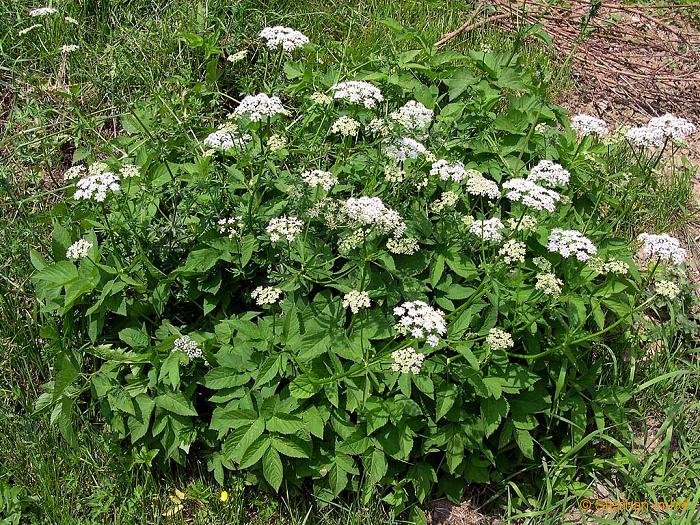
Gout Weed, Aegopodium podagraria
Gout Weed does not sound too appetizing. Nor do some of its other names: Ground Ash, Ashweed, Pot Ash, White Ash, Ground Elder, Dog Elder, Dwarf Elder, Garden Plague, Farmer’s Plague, Snow-on-the-Mountain, Jack Jumpabout, Jump About, Goat’s Foot, Bull Wort, Bishop Wort, Bishop Weed, Herb William and Herb Gerard…

Saint Gerard Majella
Herb Gerard? I happen to know this one: Saint Gerard, 1726-1755. His gout was reportedly cured by the plant but it was tuberculosis that got him at age 29. He’s the patron saint of expectant mothers. Gerard was a man of the cloth for only three years but managed to make a name for himself. He was nominated in 1893 for sainthood for a miracle that helped a pregnant woman. He became a saint in 1904. Another attribute was he named the day and hour of his death. What I would like to know is how he managed to get gout as such an early age?
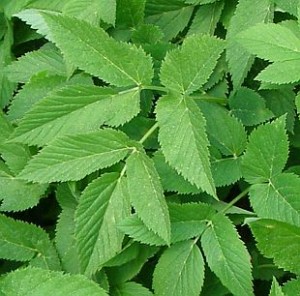
Usually compound leaves of three, sometimes five and seven
Gout Weed has a long history of medicinal use besides being cultivated for food. It was the main gout treatment. One theory is the clergy got a lot of gout because they ate better than most but reports about St. Gerard say he lived poorly, giving half of what he ever made to his mother and the other half to those more poor than he. All parts of the plant are diuretic. It has been used to also treat rheumatism, arthritis and bladder disorders. Some credit consumption of the plant, others external use in the area of the gout, such as crushing the root and holding it at the joint.
While it may have indeed been medicinal it was also a prime salad ingredient and pot herb in Europe. It is now naturalized in many areas of North America including most of Canada, the eastern United States excluding most of the Old South and West save for Oregon, Washington, Idaho and Montana.
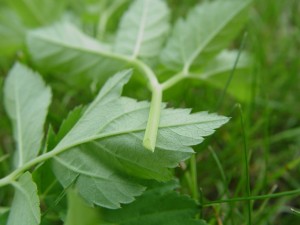
Note the veins of Gout Weed leaf terminate at the tip of a tooth. In the toxic hemlocks the veins terminated between the teeth.
The young leaves of the Gout Weed are translucent and shiny green. Tender and aromatic, they are excellent additions to salads as are young stems. When older they are often cooked with cheese. They have been added to fritters as well. In northwest Germany Gout Weed is made into grune suppe, green soup. As for taste, opinions are divided. You either love it or hate it. As a vegetable it is very prolific and spreads by rhizomes.
Botanically Gout weed, or Goutweed, is Aegopodium podagraria, ee-guh-POH-dee-um pod-uh-GRAR-ee-uh, or, ee-go-poh-DEE-um pod-uh-GRAR-ee-uh. The genus, Aegopodium, is from the Greek words “agios” meaning goat and “podion” which means little foot. Little Goat Foot, so named because the shape of the leaf resembles the shape of a goat’s foot. Podagaria is also Greek and means “gout of the foot.”
DO NOT CONFUSE THIS PLANT WITH THE DEADLY TOXIC WATER HEMLOCK.
Green Deane’s “Itemized Plant Profile: Gout Weed
IDENTIFICATION: Small, white, five-petaled flowers mid-summer, arranged in flat-topped clusters a leafy stem up to three feet tall. Seeds small, elongate, similar to carrot seeds, ripen in late summer. Rhizomes — NOT EDIBLE — are long, white, and branching. Leaf veins terminate at the tips of teeth.
TIME OF YEAR: Late spring to early fall.
ENVIRONMENT: Gout Weed is very accommodating. It has no soil preference nor is soil acidity or lack there of a problem. It can grow in full shade to full sun but does requires moist soil. Makes a strong and invasive ground cover. Requires little maintenance.
METHOD OF PREPARATION: Leaves, raw or cooked, tangy, reminds one of incense. Like many plants the leaves are best harvested before the plant blossoms. They can be added raw to salads, cooked in fritters, added to soups or used as a potherb.

where can I buy seeds or seedling so that I may be able to plant and eventually injoy eating it.
Usually one finds the plant. Ordering them can be exensive.
http://b-and-t-world-seeds.com/carth.asp?species=Aegopodium%20podagraria&sref=15047
Beware, if you plant goutweed you may never get rid of it. It spreads rapidly everywhere and it impossible to eradicate. We covered our lawn for two years with black plastic and it still lived happily and prolific underneath. You cannot contain it to one area and the smallest piece of rhizome will spread almost instananuosly.
If planted between pavement, like a driveway and sidewalk, or a sidewalk and a house, it is easy to contain. In our area, mowing the grass regularly also keeps it contained. Grazing animals enjoy it, so those who live in rural areas can contain it that way.
The variegated form known as snow-on-the-mountain is beautiful, and grows less vigorously, and does not spread as strongly as the plain leaf type.
We could count our blessings and enjoy the food given to us freely, that withstands repeated harvesting, and requires no effort on our part except to step outside and cut it!
If you live in the Edmonton area or St. Albert, I can give you lots of the plant. Just send me a message.
Hey Tony, please come to our house. It has invaded our flower beds from the neighbors yard
Impossible to get rid of!
Hi Mr. Green Deane,
Thank you responding. I am from City of Riverside, southern CA. I tried looking for an expert on edible weeds locally sa suggested but has no luck. Maybe I don’t know how. I would appreciate it very much if y0u have any suggestion on how to find one. It is better to ask and expert than indentifying it by comparing it with a picture. All I know is dandelions which I eat every day. I think I have wild lettuce and other edible weed in my back yard that I would like to eat if I can, safely. Anyway Thank you in advance for your time and help.
Sincerely,
Tony
There are many teachers in California. Go to my website, run your coursor over “foragin.” A drop down menu will say “foraging instructors.” Click on it then scroll down to California. If there isn’t one near you email them and ask if they know of one near you.
Thank you very much for your help.
These websites sell a variegated form as plants if you’re not going to order the seeds: http://www.forestfarm.com/product.php?id=399 http://www.highcountrygardens.com/index/page/product/product_id/13
I have heard that the variegated form is less vigorous, equally hardy but less likely to spread beyond where you want it to grow.
I live in canada and from what I can tell you what you hewrd is not true. It is a weed and nearly killed our varigated red twig dogwood bush by strangling the roots. It is hard to get rid of and it took me three years to remove it from a section of our garden. We had the varigated variety and while it is beautiful it is hard ti kill and get rid of. It tried growing up between our hostas it grows where it wsnts to and unless you are constantly chopping up the roots to contain it good luck keeping it in check. NOTE: DO not plant if you live on a properth that backs onto a forest or a natural area! This plant should not be encouraged to spread intonour natural forests. It is invasive.
Well in my yard the Variegated variety is very invasive and has spread everywhere!
I have some of the varigated goutweed that my aunt gave me nearly twenty years ago. It did not spread very much and only gets about a foot or so tall. It is at the back of my house and I mow up close to it, so that may have helped to contain it. Also over the years the grass has almost smothered it out. I just now dug up what was left and am going to put it in pots to see if I can save it. I do not remember it ever having flowers, but it may have had. Does anyone know if the varigated variety has the same medicinal and food properties. I saw somewhere online it was described as an ornamental.
‘Ornamental’, like ‘weed’, is a totally artificial category we humans made up. Many ornamental plants are edible. Fruit and nut trees are the most obvious, but also Eastern redbud, hostas, the ‘cranberry bush’ viburnums (both American and European), and many, many more.
Yes, the variegated ground elder, usually called snow-on-the-mountain, is edible. I have no idea if the medicinal properties would be the same, but the variegated form is a less vigorous grower.
I live in a twin house in Philadelphia. Our hill in front is covered in pachysandra. Years ago, my neighbor had a tree cut down that had shaded the hill. While the pachysandra has endured, as soon as the tree was down, gout weed took over. From early spring until late fall, our ground cover is covered by a “volunteer” ground cover. We tried Roundup one year and almost killed off the pachysandra as well as the gout weed, but they both made a heroic comeback. Is there any way to control the gout weed short of denuding the hill?
Ground elder aka goutweed, is not poisonous. RoundUp is. Not just the glyphosate, listed by the manufacturer as the ‘active ingredient’, but the rest of the formula, even without the glyphosate, is toxic as well. Glyphosate is persistent in the environment, and is now contaminating nearly every body of water in the Midwest, plus groundwater and wells.
It is found in the tissues of animal that feed on plants that have been sprayed with RoundUp and other brands of herbicide containing glyphosate. If is found in the RAIN. Glyphosate has also been detected in the cordblood of newborn babies (the young of humans) and in human breastmilk.
It seems better to have accepted the bounty of an attractive groundcover that can withstand heavy and repeated harvest, and enjoy the free food! Unlike ground elder, pachysandra is poisonous.
Gophers love it. Darn!
I live in Burlington Ontario. I’m already growing green colored goutweed, which is edible. My neighbor gave me white tipped goutweed recently. But I couldn’t find any differnce but the color. Somebody says white tipped one is not edible. Is it true?
I have goutweed . . . and more goutweed . . . and more goutweed. Once it takes hold it takes over. My goutweed was planted in the 1880’s to feed the goats and sheep that grazed the area. If anyone wants seeds just let me know. I’ll keep a few flowering heads and dry the seeds. If one wants roots and is anywhere near Fergus, Ontario . . . . Just know that once goutweed takes hold, it S P R E A D S and is very difficult to contain. I’m not talking about the white/green leafed plant but the green plant which is very invasive. It’s a yearly “battle” to keep the plant contained!
Hard to feel sorry for someone who has free food, good both raw and cooked, nutritous and tasty – with no work but to harvest, prepare, and eat! 🙂
And, as you point out, it’s great for grazing/browsing animals, too!. Maybe a few of those solar-powered, self-repairing, minimal maintainence mowers could help you out: sheep or goats or alpacas, or…! One great features of these mowers is that they turn your unwanted ground elder into lamb, chevon, or ‘fluffy venison’! (Alpaca tastes a lot like venison, at least to us.)
All joking aside, hope you find a solution to your abundance problem that works for you.
I have tons tons and tons of gout weed! Call me and I will send you some 401-269-9226 or you can come dig all you want!!!
Would like some seeds pls
Just a note about ordered plants and seeds – in some areas, goutweed is greatly discouraged as it tends to take over parkland. It is so aggressive that native plants get displaced.
I have a few places neighbourhood where goutweed as spread beyond backyards and into large parkland areas. I harvest this. I would never plant it.
Note – I also harvest Himlayan Blackberry (another aggressive, non native species). I look forward to harvesting Japanese Knotweed (which is aggressively taking over the entire park near where I live)!!
Again, I would NEVER plant these on purpose! It is hard enough to erradicate where it has spread already.
Happy eating everyone. 🙂
Just found this site, wonderful, and yes gout weed is edible and rumoured to have been used to feed soldiers but OH IT IS SO INVASIVE. Fine if you have nothing else growing but an impossible thing to contain in a bed with anything else. Literally, grew up and over several small, 3 foot, evergreens and destroyed them by shading out every bit of light. It leaves nothing beneath it. IT SPREADS EXPONENTIALLY, other than removing the soil completely and deeply, the best control method we have found is to cover it with a dark plastic for, wait for it, up to four years. Or you can mow, mow, and mow to keep it in check. If it was the only edible I had I would give it a spot but I have much more lovely plants, including massive dandelions, throughout my yard and woods. IF YOU MUST GROW IT, GROW IT IN A CONTAINER with screening or landscape fabric over any holes, and if you sink it in the ground, at least 2″ above the soil line. In a container you can take it with you if you move and not leave it for the next owner or your neighbour to have to wage an endless war, once they realize to late that it is mega invasive.
Where I am ( western ny state) this plant is invasive to an obnoxious degree.
Despite that, it is not a terrible plant by itself, and has a not unpleasant smell and taste. But since they are so invasive in the damp woodland clearing where I am, I would not eat them unless forced to by starvation.
When i moved to this home ten years ago this weed was not present, i believe it crept in from the park behind my property. It took over the back of the yard and now is out of control. Is there any pet safe things to apply to this plant to kill the root system? I did notice that it says there are some medical uses also, which i may be very interested in, and if proven safe and effective, who knew the solution to my health problem was a weed growing in abundance in my own backyard… however with some searching i found this at wellness.com : “Bishop’s weed: Limited available human study used 8-methoxypsoralen (8-MOP), a photoreactive plant compound from bishopsweed, for the treatment of tinea versicolor. Clinical studies are needed before a conclusion can be made.
Use cautiously in patients with photosensitivity as bishop’s weed may be photoreactive, and cause phototoxic skin damage, phototoxic dermatitis, and pigmentary retinopathy. Use cautiously in patients with bleeding disorders or taking anticoagulants, NSAIDs/anti-platelet agents, or herbs or supplements that increase risk of bleeding because bishop’s weed may have additive effects and increase the risk of bleeding. Use cautiously in patients taking drugs or herbs or supplements metabolized by cytochrome P450 as bishop’s weed may increase the effects of these agents. Use cautiously in patients with eye disorders, as bishop’s weed may cause ocular toxicity. Avoid in patients with known allergy/hypersensitivity to bishop’s weed, its constituents, or members of the Apiaceae family.”
Never, ever, ever plant gout weed…. it is IMPOSSIBLE to eradicate! If you want to harvest it, just ask around there is plenty nearby that you can help remove. But I implore you not to plant it. Some was in a plant I received 20 years ago, and I’ve fought it every since. It has spread to 4 spots on the edges of our woods and I am working desperately to contain it. It will take over the understory and destroy the ecosystem.
Eat The Weeds!
We have gout weed in many beds on our property and as people described above, it is extremely invasive. It’s the worst plant I’ve ever dealt with, it’s only redeeming quality is that it actually tastes quite good, like a combination of carrot and celery. It covers the bottom of our raspberry patch and I’ve given up on trying to get it out of there. Next to the patch, where I mow, new sprouts pop up and these are the best tasting – about 3-6 inches high with slightly glossy leaves. The mature leaves are much too strong for me but my kids and I like the little ones. None-the-less, I would gladly be rid of it. The best thing I’ve found to combat it is persistence. Digging it out as much as possible, planting what you want, then for years … yes, years, persistently continuing to pick any that pop up on regular basis. I try to get every bit of root that will come. It’s soooo gratifying when you pull on a stem and a 12-18 inch length of root/rhizome comes out with it. But usually all you get is a little nub at the bottom of the stem and you leave with the knowledge that it’s still there and it’s probably never going away, at least not until the earth eventually gets encompassed by the expanding sun. Even then, this weed might just spread around the sun in a dense 3 foot mat and blot it out.
I wonder if the variegated kind jumps out of pots to grow in cracks on the driveway? I bought some for a pot which I have under an eave on my driveway, so it does not get a lot of water and nothing thrives there. Now I am beginning to re-think this plant and worry?
I think Bishops weed is beautiful !
More than 20 years ago I bought a pot of “bishop’s weed” from a garden center. At the time I was a beginning gardener, & wanted to try just about everything. Well, the goutweed (the all green version) quickly took over the rest of the garden. I tried pulling it, …it has long spaghetti-like roots..but it would pop right back up. When we were planning to move to a new area, about 2 hours away, I began digging up alot of my plants to take with me to the new house. I was determined to not bring the gout weed with me, so I carefully sifted through the rootballs of everything I dug up, and replanted in new soil, all ready for the move. Well, we have been here now 12 years, and the goutweed reigns supreme once again! I do my best to pull, and pull before it flowers as I believe it spreads by seeds as well as its travelling roots. I hate this plant! In areas where it has spread that I can mow, it’s manageable. But in flower beds it is a huge disaster. Wish I’d never bought it! UGH!!
I’ve had the variegated gout weed and it’s growing in rocky poor ground, and spreads, but is not overly aggressive, however does have a good root system going. It must be different than the solid green variety.
I’ve also had the all green gout weed that I brought home unknowingly from somewhere, and had a lot of grief getting rid of it. I put layers of cardboard in the grass where it was spreading and killed grass and weed alike, and in my beds I pulled them out tenderly, digging deep for the roots, a lot of work. after a couple of years I’m finally rid of it.
I’ve been digging at that marching monster for 2 days straight (the only two days of gardening weather this spring!!)…it could take over the world. I’ve almost divorced my husband over it…as he “gave me” some lilies from his infested area….telling me he was sure they were fine, only to discover the weed showed up the following spring in my previously uninitiated area. (it’s currently taken over half of our flowering borders). BUT, I’ve never tried eating it!! Wouldn’t it be a miracle if I loved it and it cured everything that ails me??? fat chance. GOOD LUCK FOLKS!
Please be careful when you plant gout weed.We are trying to contain it now for 25 years.Slowly it is spreading into our woods crowding out everything.We are trying to stop it by using black plastic on certain areas .My husband weed whips it to stunt the growth and slow it down.It’s practically impossible to stop it from spreading.We are afraid it will eventually kill the wild flowers in the woods.Our nightmare: a 5 acre woods with only goat weed ground cover!
Are goutweed flowers edible?
I live in NS, Canada. The property I tent has goutweed and I would never ever encourage someone to plant it because it will take out native species and anything else you have in your garden.
I’ve seen it extend many feet from where landscape fabric covered it at least 8 if not more than 10 yrs ago. I’ve seen it come up through 3 layers of landscape fabric, break through plastic within three seasons and I’ve seen the roots that I have previously ripped up grow laying on nothing but cement.
The only way to remove it is to dig and sift the roots (and destroy the roots). This is extremely labour Intensive and all of my neighbours have given up on it. I dig trenches to help contain the spread and it’s been a multi year strategy to remove and reclaim the garden
It’s like something from a Stephen King novel when looking at the the point where the ripped weed multiplied 2-4x per remaining ripped rhizome (easily viewable if you don’t get around to filling in the trench right away).
I would like to find more scientific data around the safety of eating it. Often the weed around us can help manage what ails us.
Until I find more information… I’ll be goutweeding. It really could be a ft job.
Property I rent* I would just tent elsewhere if I had to live among the weeds. Lol
NS near Lockeport….I bought an old house and it has goutweed. everywhere. I mow it, cut it, dig it out, spray it with vinegar. it keeps spreading and now I suspect I am allergic to it. My goutweed pulling hands are puffy and itchy. I cannot believe any place would sell this demon plant.
I had variegated gout weed in my garden and it was a god send. Many have said it’s really invasive but I didn’t have that problem. It came up every spring and was really low maintenance and looked good.
Will goutweed kill my other perennials? Ie: Hydrangea, Phlox, Hostas, etc.
Plants with similar or stronger root structure will coexist with Goutweed. In my garden Hostas killed Goutweed.
for your own sake – do not plant this stuff – it takes over eveything!! Impossible to get rid of once you have it. Mind you until today I didn’t know you could eat it. Maybe if I offer it to ALL the neighbours on my street I might get it under control.
TOTALLY GET ALL YOUR STORIES! Same thing for me….hours of digging up GW!
I’ll try to eat some though…good way to reconcile myself with it’s presence. And I’m getting lots of exercise!! :).
Unless you’re willing to eat just goutweed, don’t let this stuff anywhere near your land. I’ve been fighting goutweed for 30 years – it’s taken over a good 2 acres of my property. I can’t grow vegetables anymore – it took over all of my beds. It strangles out other plants and spreads like crazy. The only thing that has worked for me is keeping ducks on it for 5 years, but I don’t have enough ducks to handle all of it. My goats liked it, but didn’t make a dent in it. I never, ever use herbicides, but finally did resort to that for the goutweed – it just came back stronger the next year. I’m trying to regain some of my gardens now by aggressive sheet mulching, bought a couple of truckloads of hay and got all the cardboard and newspaper I could get my hands on and have mulched 2 feet past the edge of the goutweed – and am string trimming the area around that right down to dirt to make sure it can’t sneak out from under – figure I’ll just smother it and grow nothing for a few years! We’ll see how that works. Trying to keep the goutweed from spreading further has become a full time job during the summer months, and there are days I just break down in tears. It’s a nightmare.
i have a garden with goutweed; what a bitter taste – i minced it and added garlic and sugar to a tabouli made with some. i have started my attempted control/removal by cutting off the flowers – at least there will be fewer seeds. rather large hasta do well with the g.weed. but does anyone know if rhubarb can grow amongst it, if i keep the g.weed trimmed, perhaps?