
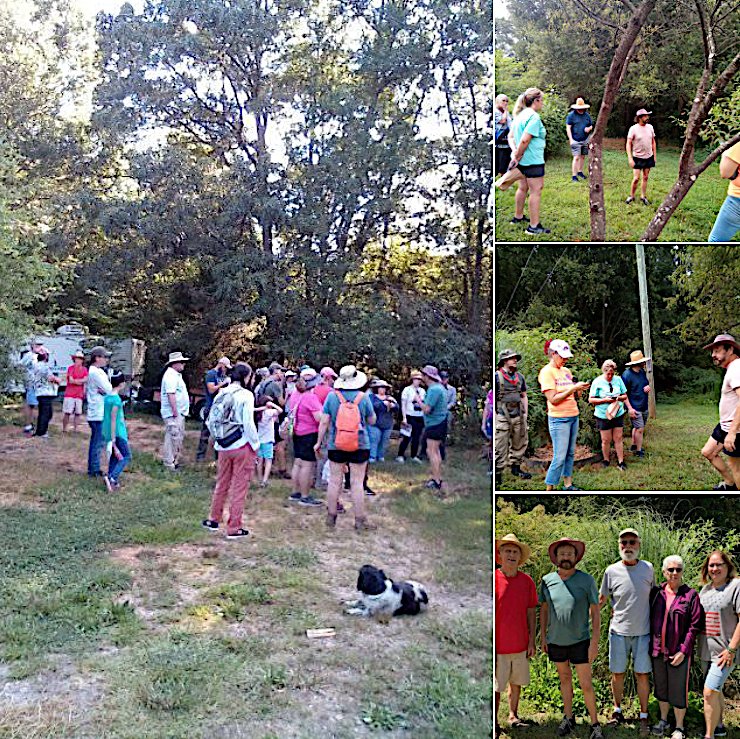
Foraging class with a group including five first cousins: Lenard, Deane, Scott, Charlotte and Cherri. Photo by Donna Horn Putney
Of all the “survival” skills foraging is probably the most difficult to learn, or certainly the one that takes the most time and personal fortitude. It is one thing to say “yeph, that plant is edible.” It is another to eat it with confidence.
Where you learn to forage makes a difference as well. The closer to the equator you go the harder it gets. (And if I remember correctly almost everything that grows in the arctic circle is edible, should you end up there.) When I say it is harder to learn I mean is harder to learn the way we do it now, more from books than growing up in the wilderness. The natives did not need books or botanists.
Florida, and perhaps Hawaii, are among the most difficult states to learn about wild edible plants. That’s the bad news. The good news is if you learn to do it in Florida everywhere else is very easy.
Why is Florida difficult? Two words, climate and geography. Some 450 miles long Florida, has temperate plants to tropical. Sixty miles wide on the peninsula brings influence from both coasts. Rain and geography can produce swamp plants where there are no swamps, and cactus in seasonal swamps. Hot summers distort common plants making them absolutely unlike descriptions, photos or drawings. Occasional light freezes modify tropicals. Then there are the ornamentals…. what a headache… hundreds if not thousands from far flung places, some edible, many of them toxic, several deadly, and a couple sudden death. Unlike up north an acre in Florida has totally unpredictable flora.
What I personally enjoy is wandering around any patch of ground in a northern clime. It’s quite thrilling and very consistent: The plants actually look like what they are supposed to look like and exotics are rare. That is so rare here in Florida. Oh bananas look as they should but not dandelions. If you didn’t know blackberries here were blackberries you might never eat one here. The up side is if you can forage in Florida you can forage with confidence anywhere. Florida is tough and probably has more wild (and escaped) edibles than any other state. I know of several hundred and I know there are at least a couple hundred more on the south end of the state that I haven’t explored. I’m still cataloging imported edibles on the warmer end and have a long ways to go.
How do you learn them? One at at time in season, season after season. Even here in Florida the demands of foraging require you should be able to pick a plant out of a landscape just as you would pick the face of a friend out of a crowed picture. You must come to recognize them. Watching a video or reading a book really isn’t enough. Find someone local who knows the plants and study them as they arrive each season. Knowing a few very well is better than knowing a lot poorly. Besides, in every locale there will be just a few prime plants. A local person can help you learn those quickly. Again, I recommend contacting the Native Plant Society in your area. They know what you want to know and the training is often free. More so, now is the time to arrange it so when your spring arrives you’ll be ready.
So nice work Deane.
While you travel towards the polar regions (such as Iceland where I live), there are much less plant species, but most will be edible. However the edible can easily make you starve 😉 because they will be mostly small leaves.
When you travel towards the equator, there are thousand times more plant species, way much more food. But many of them would be difficult to identify and many would be poisonous or even deadly. A more risky game. But there is WAY more edible species, and WAY more to eat. Much more fruits, seeds, roots or starch. It’s a big supermarket.
Here in Iceland, I find many species to be non-toxic, but their use is poor. There are few that would be pleasant to eat, and that would be filling. Still, tales of outlaws that survived on foraging on the polar winters made it with eating highland polar species such as angelica roots.
You can make a meal on blueberries and crowberries, though only in later summer. Dandelions, cooked sorrel and nettles are widespread, and rhubarb grows in lowlands (but must be cooked). These are angelica roots, which can provide a plentiful survival crop, but there is the minor but big danger of misidentification with new invasive poisonous carrot family species which are now coming to Iceland. But this shows that even in the polar regions you can still survive on plants (a bit extreme I know).
I am almost sure that many other wild species here can be edible, but there is little information on them. These include many succulent, and also sedum and saxifraga. I also never tried the silene acaulis (moss campion), which grows everywhere near the glaciers but I read it is edible if cooked. Maybe this information might interest you or others!
Keep the great work Deane!
cooked nettles
Very interesting…I come from the Mediterranean climate of Israel. There,too,the limiting factor is available water…. Though there are many edible plants, in the summer there are less…I enjoyed hearing about Iceland…
Fascinating! Living in NE FL with very limited knowledge, I have only been brave enough to try dandelion and wild blackberries. I enjoy hiking so much and have often wished I possessed the knowledge to distinguish dangerous and deadly plants from edible and medicinal. A friend in New Hampshire forages in every season! Nettles, wild blueberries, wild strawberries, wild blackberries and elderberries, fiddleheads and violets…she even stumbled on a wild cranberry bog!
I also live in NE FL.. I learned that dandilions were edible and found a dandelion like plant in my yard with prickly leaves. Turned out to be a Prickle Sow Thistle which the leaves are edible as well, (the young leaves taste much better than the larger leaves. I also believe dollar Weeds are edible as well and grow a lot in Florida…. Also, Check out wild onions/scallions. It looks like grass but has circular blades(Like a chive but thinner) .. you can smell the onion like smell. they are easily pulled from the ground in groups as they grow together… wash well, chop and use like you would any other onion… Have a great Day
I have an article on dollar weed on this website.
How do you get a permit to forage in the state of florida. A friend was out foraging last week off the highway and a state trooper stop them and told them to get a foraging permit. Please advise.
To my knowkedge there is no “foraging permit.” Some federal land might have that requirement but for the most part foraging is illegal in Florida except on private land with permission. That said I’ve had a lot of police officer in my class who say no one arrests foragers (except maybe park rangers.)
I believe this link may be what he was talking about:
https://www.fs.usda.gov/main/florida/passes-permits/forestproducts
Or this:
https://www.fdacs.gov/Divisions-Offices/Plant-Industry/Business-Services/Plant-Pest-Permits/Native-Plant-Harvesting-Permit
I’m trying to get clear pictures of opium lettuce,I need to know what I’m eating.
It is very rare in North America, found in only three counties or so, and not at all good for altering the mind. Vodka is far more available and works better.
I live in northwest Florida and have wild lettuce everywhere along with chicory, dandelion and poke salet. My spelling may be off on the last word.
Returning to Florida from a trip to eastern Canada. In northern Georgia, I found a snowball-white 7″ long x 3″ wide x 3″ deep, densely spongy on a dead oak tree. There were no “teeth” in evidence. Are there edentulous lions-mane-type fungi out there or a mimic of some sort?
I’d been admiring from afar (up north), and coincidentally I now live in Florida. My knowledge is zero and as your article suggests, I’m unlikely to do much legitimate learning unless/until I find a local guide/mentor.
I’m commenting simply to praise you and all of the work that you’ve done making information available on youtube (where I discovered you first) and further details on this website. It’s hard to imagine many “hobbies” more important and meaningful than being intimately familiar with the value of our local, natural, God given environments.
I am a member of a men’s club in Longwood, Florida and looking for a good fund raiser for our club. Do you have a program where we could get a group of 10 to 15 people and have some of the money go towards our club?
Mark Lichtenstein 407-687-0521
Please email me at GreenDeane@gmaili.com
I am trying to figure out if Flax lily aka Dianella ensifolia variegated berries are edible.. sources conflict.. it also says root is edible and medicinal..
I have spiderwort in the yard. I know the leaves, stems and flowers are edible. Right now I have flower buds hanging like a little cluster of grapes. Edible? Thanks!
Yes.
I would like to know if our native Jamaica caper (Quadrella jamaicensis) has edible flower buds, like the Mediterranean cousin, Capparis Spinosa?
We have family is Sicily and the two species flower buds look so similar!
They say that the seeds are not edible, but the flowers are just buds. No one seems to know the answer and when asked only about the buds, they say “I don’t think so.” No one can say why, though. Even the native plant people don’t know. Please advise.
Thank you,
Susan
No reference I have lists Quadrella jamaicensis as edible.