
Over looked seafood
Emerita: Mole Crab Munchy Crunchies
Mole crabs are probably the most common ugly food there is, though most people don’t know they’re edible.
Fishermen view the mole crab as great bait for such fish as pompano, red drum and kingfish. Sea birds find them a tasty morsel. Rakes are sold to specifically dig them out of the swash zone where they hide in the sand snagging little bits of food floating by. Not too many folks, though, also eat the bait. The main reason is they are small, but, big flavors can come in small packages. I have a video on Mole Crabs and Coquina here and an article on Coquina here.
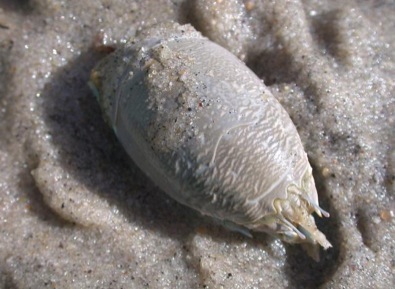
Mole crabs, also called the Atlantic Sand Crab, are certainly among the smallest of crabs. They are oval, usually some shade of beige, darker on top, lighter on bottom, and have five pairs of legs but no pincers. The females grow to about an inch long and the males half that size. On the east coast of the Americas lives the Emerita talpoida (above) and the on the west coast E. analoga. Emerita is latin for retired female professor. Talpoida is from the Latin root “talpus” and classical Latin word “talpa “ which came from the longer Greek word of tiflopodikas. It means “mole” and very apt because these little crustaceans are quick diggers. They dig into the sand butt first and face the incoming waves. Brave little beasts but they don’t want to be washed higher up the beach. When the wave recedes they pop up slightly to catch food in the outflow. Analoga means similar but slightly different. There are several species of Emerita and to my knowledge all edible.
Among the more interesting features of the mole crab is that some of them are bioluminescent when handled at night. Also, they eat bits of Portuguese Man of War tentacles. They wrap the loose tentacle around a leg like yarn and nibble away. While I have read of no warning it might not be wise to eat mole crab when there has been large seasonal numbers of those stinging jelly fish around. Incidentally, the mole crab is fastidious. It uses antenna to clean itself.
So, how do you eat them? Many ways but raw is not one of them. While most sea food is safe they can harbor parasites. Best to avoid any complications by cooking them. They are prepared three or four different ways.
One is to simply drop them into hot, deep oil and fry. When they float they are done and just pop them in, shell and all (I eat shrimp shells and find them delicious.) A second way is to pull off their small tail, which takes some of their digestive system with it, squeeze them to get more digestion out, wash them, and then fry them as is or in a batter. Another way is to cover them whole (or cleaned) with fresh water and bring to a boil and boil for about 20 minutes. Then put them and the broth in a large container and mash the mole crabs with a potato masher or the like. Then filter that liquid and use as a basis for various soups. (One similarly cooks coquina — minus the mashing — and just uses the broth.) When you cook mole crabs they turn red just like crabs and lobsters do and you will detect the definite aroma of seafood.
In southeast Asia they are deep fried then dipped in honey. In Brazil, where they are called Tatui (Emerita brasiliensis) there are many ways to prepare them. The simplest is to just fry them whole in a little butter. Another way is to boil them until red and then toss them in a pan with oil, salt and pepper. After stirring to coat flour is added to coat and cook. Then they are arranged on the plate in a whole with the seasoned flour on top. Natives also eat the roe raw off the large female3s.
The easiest time to dig them up in just before low tide or just after the low tide has turned and is coming in. They are found usually only on sandy beaches where the waves break. If you train your eye you will learn to see two little antenna popping up as the mole crabs senses the pressure of an incoming wave, and then disappearing as the wave recedes. You will also find them in the same spot as coquina who also use the wave action for food.
MOLE CRAB CHOWDER
1 to 2 pounds of live mole crabs
2 cups of water
2 to 3 red onions, chopped
1 tablespoon vegetable oil
1 tablespoon butter
½ teaspoon parsley, minced
2 to 4 more cups of water
1 cup noodles, rice, or potatoes, not cooked
flour or toasted wheat flour
Steam the crabs in a covered pan with 2 cups of water until they are tender, about 20 minutes. Remove from the stove and, with the crabs still in the broth, mash thoroughly with a potato masher. Strain through cheesecloth, retaining the broth and discarding the crabs. Next, fry the onions to a golden color in the oil and butter, and mix with the broth in a saucepan. Add the parsley and two cups of broth. Heat the broth and add either the noodles, rice, or potatoes. Remember to add sufficient water to cook the quantity of ingredient you add. The broth and chowder may also be thickened.

Well well well…
I never would have thought of that. I caught some at the beach in SC once and couldn’t figure out what they were till I got back home to my trusty pile of field guides. I suppose I wouldn’t have thought of eating them, but maybe now that I know, I’ll remember to bring a cooler full of Ice to the beach next time.
I saw Green Deane’s related video, and I’m excited to give this a try. But I’m a good three hours from an ocean.
Once I catch them, how can I bring them home? Treat them like crabs? Place them in a bucket of shallow water? I should keep them alive, no doubt.
They will stay alive quite a while in a bucket of sea water. Or you could toss them on ice.
Great. I can’t wait to try.
I read somewhere that you should use an aerator, as you would with bait fish or shrimp, to keep them alive longer in seawater.
I suppose… I mean… they were all alive when I got them home after a few hours but I do ice them.
The best way to eat them is too put them in a bucket with water and salt to let them filter out the sand in them. Then deep batter or pan sear with garlic and butter them and eat them whole……. They are amazing I love eating them
LOVE this website! So much great info. I was doing a bit more research on these little buggers and found that in Socal they may very well be toxic most of the time due to the toxins in the algae and such they eat. I want to try them..but don’t want to get poisoned. Ever hear anything about he toxins in the socal sand crabs? Before I moved out here from Long Island, NY …I used them as bait..and they were plentiful.
Thanks!
Mole crabs are edible. It is the environment that makes some not edible. Which is why I have my I.T.E.M. system. Every edible has an environmental component that must be satisfied before the food is considered edible.
Thanks much.
It’s best to check with your state’s marine toxin hotline (right now, June, 2015, the entire west coast is closed to gathering of any filter feeders, such as razor clams, mussels, and mole crabs). Best time to collect them is end of winter/beginning of spring, because they are larger then, and usually, the toxin levels are low enough to allow safe collection.
I found a beach that had so many of these right at the wave break area. It was a little disconcerting actually as I couldn’t believe how many I could see by just scooping my hand into the sand. Is this normal? Sand between my toes is great, feeling little critters beneath me was not…
Try scrambled eggs with mole crabs. Just smashed them a little bit just to flatten and tossed in the eggs. Is so delicious and crispy. I used to make a sandwich with the scrambled eggs.
Or add to boiling water and add angel hair noodles. Season as desired. The perfect chowder.
You can prepare any seafood you may know with them.
After enjoying this food all my youth, now at 61 I read that this specie is poisonous and dangerous. Enjoy life, before the air we breath poisoned by our industrial age kill us all.
My son found a crab in the weeds (over 4 miles from an oce an) there is a forest nearby with palm trees. What type of crab could this be? And what could we feed it ~ he wants to keep it as a pet and already named it! We have it in a glass jar w/air holes in the top & filled it with leaves and grass and 1/4 in tap water. The crab keeps crawling to the top of the jar. I’m sure it wants out. Please tell us a better way to care for this crab so it will survive & quick.
My first question is where do you live?
Florida produces a weekly report you red tide you can email subscribe to. Texas also does a report. Should take care of some of the NOT where and NOT when of these shellfish items.
my son’s Boy Scout Troop camped at Assateague State Park in Md this past weekend. All the boys had a blast spending hours on the beach digging up these crabs. They found hundreds–some as large as 2 inches! One of the parents had researched eating these crabs and brough along flour, old bay seasoning and oil. We had the boys pull off the legs, coat them in the flour mixture, and fry in hot oil. With some cocktail sauce, these little crabs became appetizers for those of us who were daring enough to eat them as “poppers”- just pop in your mouth and chew. I ate 2- definite seafood taste. Not too bad- one parent said they are very similar to texture and taste of soft shell crabs. We learn something new on each Scout outing!
I’m from El Salvador and we have this little ones too, we call them achiquiles and we use them to makes soups or added to fried rice. This is an excellent substitute for lobsters. I never though could be poison since its has a really good taste!
We just a bunch of these little critters for the fun of it. Then I read you can actually eat them! So I cleaned them boiled them and fried ’em up in butter and garlic. My kiddos munched them like popcorn chicken. Fun little experiment at the beach.
Cleaned them?
Cleaned them, yes. Remove the digger, yank off the tail, and squeeze out the “poop”. Not a meal I’d recommend on a daily basis but fun for an adventure.
I never clean mine. It all get’s cooked.
We love catching these small but yummy creatures. We saute them with lots of garlic, bell pepper, onion and sword pepper. Philippines has bountiful of Emerita emeritus.
I haven’t seen mole crabs where I live, but there are lots of Fiddler Crabs. Do you know if you can eat those?
Thanks!
Fiddler crabs are edible.
My husband and I are on our way home with a bucket of mole crabs we gathered. Can’t wait to try them! Unfortunately we weren’t able to procure any coquina this time 🙁 How exactly do you clean the little fellas?
I’ve lived in New Jersey all my life and we call them sand crabs. We would dig them up after seeing the little bubble holes they leave behind as the waves recede. My daughter has always loved digging for them too, and they tickle when they crawl around on the palm of your hand. In fact, on Mother’s Day we were in Asbury Park and there were tons of them at the beach. I wondered if they were edible, but sort of figured they could be. Then I saw an episode of Andrew Zimmern’s Bizarre Foods, which confirmed it. Now I can’t wait to forage for some and give it a try. I’ll make sure to clean them though. For me, that’s a must with shellfish. Our waters are very clean, but still.
Yes but I would add I wrote my article long before Zimmerman came along.
Ya know, I have lived in Florida most of my life but you would not believe the nber of Lifers down here that have never known that “sand fleas” are more than just bait for.bigger fish. We, my boyfriend and I, get looked at weird because we hace started to look at the world as though ” if the chain stores go under, would this help me survive?” Knowledge is always a yes when asked that question. Planning on taking a class with you very soon… if I can ever get my time out of work.
Saw these little critters in the bizarre foods program and it brought back memories. The trick is is to pick the ones that have changed their shell and they will be really soft. We used to pick them and my mom would make them with scallion pancakes
The other alternative is to use them in soups like a cioppino.
Cheers
I had a friend here in SoCal who would catch them, cook them over a bonfire and eat them. he would just slightly indent the long tube part of an empty soda can, lay it on some coals and lay the sand crabs on the indent till hot and crispy. never tried one but he loved them. thought it was really weird until I read this.
What about on the West Coast? I live in California and wonder if the sand crabs/mole crabs on my coast are just as edible. Your thoughts?
I live in delaware and we have them in abundance..me and my wife tried them and they are pretty Damn good…fry them with batter and sprinkle with old bay and they are tasty
I live in Wisconsin and I don’t think Mole Crabs live in lake Michigan so im looking to order some fresh online. I really wanna try some.
You probably won’t be able to maintain them for long. It’s very hard to recreate the ocean, especially because of their feeding habits. I hope they’re able to live, but it would probably be more humane for you to just eat them rather than letting them slowly die in a tiny bucket.
Where in Southern California can I find these ( Los Angeles areas)? What’s the best month or time of year to find these. I’d love to try them.
No restriction as far as I know.
Hi,
I have a question. We think we found a lot of mole crab eggs at the beach and have them in a container with sand and the salt water from the beach currently. We were wondering what we should feed them if they were to hatch. If you have any ideas about what to feed them that would be great!