
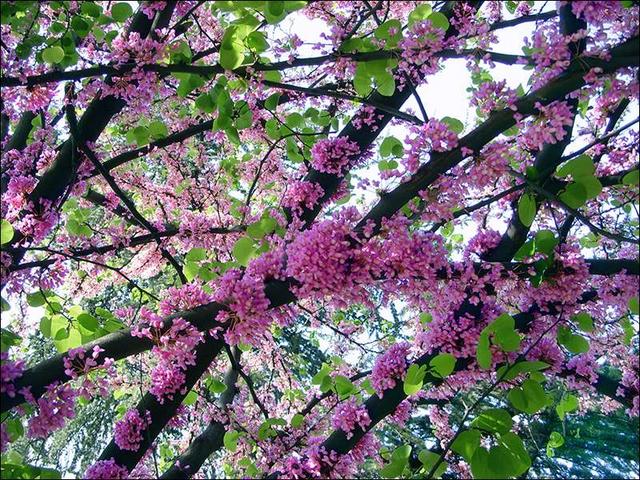
Eastern Red Buds can be showy in spring. Photo by Green Deane
Cercis canadensis: In The Bud of Time
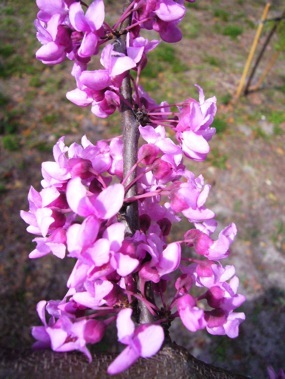
Eastern Red Bud Blossoms
It’s one of those trees that if you don’t see it at the right time you’re not looking for it the rest of the year. I had gone past it perhaps four or five dozen times over a couple of seasons, but never in spring. But one day the blossom caught my eye. I knew what it was I just hadn’t seen it there before.
Eastern Redbud trees are native across much of the United States and Canada, basically east of the Rockies. The most common species is Cercis canadensis (SER-sis kan-uh-DEN-sis.) They’re small trees in the pea family and among the first to bloom in the spring before they leaf out. They also produce large numbers of multi-seeded pods, from spring to late summer depending where it is.
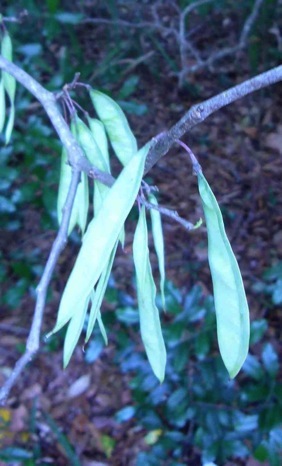
Red Bud’s Edible Pods
Native Americans ate redbud flowers raw or cooked as well as the young pods and seeds raw or cooked. The flowers can be pickled. They have a slightly sour taste and are high in Vitamin C . They’re a pleasant addition to salads and can also be used as a condiment. The unopened buds can be pickled or used as a caper substitute. The seed is about 25% protein, 8% fat and 3% ash. More so, a 2006 study show the flowers and the seeds to be very high in antioxidants as well as linoleic and alpha-linolenic acid. The seeds also have oleic and palmitic acids. Think of it as The First Forager’s Health Food Store. Young leaves are edible raw or cooked.
Redbuds were first cultivated in 1641 and even George Washington planted some around Mt. Vernon. The name Cercis canadensis, as usual, has living Greek and Dead Latin origins. Cercis is from the Greek “kerkis” which means “a weaver’s shuttle” and refers to the shape of the pod; canadensis means “of Canada.”
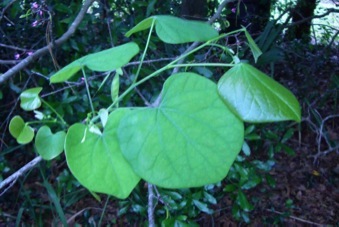
Heart-shaped leaves
The redbud’s native range is New Jersey to central Florida, west to Missouri and Texas and northern Mexico. It’s branches and stems also have been used for basketry.
Also edible are the flowers and pods of the C. occidentalis (found in western North America ) and the C. siliquastrum found in Europe. There are also several cultivars now of varying colors. One popular variety is called Forest Pansy. It has reddish leaves and pods. They are edible as well. Like all members of the pea clan the blossoms are a very distinctive “wings and keels” arrangement, keel in the middle, wings on either side.
Green Deane’s “Itemized” Plant Profile
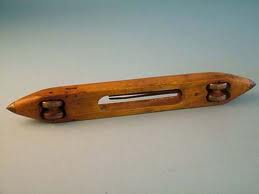
The Greek name for the shuttle — kerkis –inspired its botanical name Cercis
IDENTIFICATION: Small deciduous tree, typically 20 feet in height, gracefully ascending branches, rounded shape. Alternate, simple, broadly heart-shaped and 3 to 5 inches high and wide. Leaves emerge reddish, turning green. Flowers are pea-like, wings and keel, rosy pink with a purplish tinge. Flowers develop before the leaves in spring, in clusters along the branches.
TIME OF YEAR: Flowers in spring, followed by pods, seeds in fall.
ENVIRONMENT: Full to partial sun, well drained soil, often planted as an ornamental. I have also seen them growing, poorly, in total shade. They also seem to grow along the edges of open spaces.
METHOD OF PREPARATION: Buds raw, pickled or cooked. Flowers raw or cooked, young pods fried. Flowers fry nicely as well. Young leaves edible, raw or cooked. Regarding the flowers, the light colored upper part of the blossom is sweet, the darker lower part is bitter. Some folks removed the lower bitter part before eating. It’s a personal choice.
HERB BLURB
Herbalists say extracts from the inner bark and roots were used to treat colds, flu and fever. The Alabama Indians man a root and inner bark infusion for fever and congestion. The Cherokee used a bar infusion for whooping cough. The Delaware used an infusion of the bark to treat fever and vomiting. The Osage used charcoal from the wood for war paint.
Redbud Blossom Muffins
2 cups redbuds blossoms
2 tablespoons minced fresh sage or rosemary leaves
½ cup sugar
Minced zest of 1 lemon
1 ½ cups flour
2 teaspoons baking powder
½ teaspoon baking soda
¼ teaspoon salt
1 large egg
3/4 cup milk
1/2 cup yogurt
2 tablespoons melted butter or oil
1 tablespoon lemon juice
Topping:
1 tablespoon sugar
½ teaspoon ground cinnamon
Preheat oven to 375°F
In bowl #1, combine redbuds, herb, sugar, zest. Let sit 30 minutes.
In bowl #2 Sift flour, powder, baking soda, salt large bowl.
In bowl #3 Combine egg, yogurt, milk, oil, lemon juice.
Pour the content of bowl one in to bowl two and toss.
Add the wet ingredients from bowl three, stirring to just moisten. Do not over mix.
Fill your muffin tins 3/4 full.
Combine sugar cinnamon the topping sprinkle some each muffin Bake for 25 minutes, or until tops spring back when lightly touched.
Remove form muffin pan and cool on a wire rack.

I will have to try these, I have an abundance of these trees. I always thought they were beautiful but now my mind goes in a whole new direction when I think about them. Thanks for the information.
I was so excited about this plant we have an abundance of them around. I found this one out a day before our big trip to Texas, while our trees were not blooming yet they were in full bloom in Texas. I had all my sisters and my brother tasting mom’s redbud tree. When we got back to Georgia ours was in full bloom, I can’t wait to try the muffin recipe and the pods when they come out.
i think the redbud is also called the judas tree. or was it rosebud, in citizen kane?
It was or is called the Judas tree but it was actually a different species in the genus. As for Citizen kane… wasn’t “Rosebud” his sled?
great bookstore here in glebe neighborhood of sydney
Edible?
There are so many poisonous legumes that I’ve been fearful of experimenting.
While I appreciate the recipe for the blooms, what I really need is a recipe for the pods, and some kind of indication of when the cut-off (as far as eating them safely) is…
When new, young and not bitter. Raw or cooked, usually boiled.
Are “Don Egolf” redbuds edible?
Don Egolf is Cercis chinensis. I have no published reference that it is edible.
The redbud seed pods are ugly to look at all year. Can they be removed first thing in the spring?
Sure.
Good point, Adam! Funny how we humans tend to value plants that must be ‘babied’ and labored over- like plants outside of their normal range – but turn our noses up at beauty, and food!, that comes effortlessly. Ah, humans, that funny species…
I’ve been carving spoons out of redbud wood. It’s lovely wood.
Are the mature seeds edible? If so, how do you prepare them – I would guess by boiling them or grinding them into a flour. Can they be used as a staple crop? There are so many trees around now wit the pods very easy to flake off, that I think harvesting 20 or 30 pounds wouldn’t take more than a day. Do you know of any ill effects from making a real meal out of the seeds regularly?
To my knolwedge the mature seeds are not eaten.
I’ve eaten mature seeds. Prepared them like dry beans. Extremely labor intensive to get the tiny seeds out of the pods. I didn’t feel it was worth it. If you could automate that somehow. ….
The most efficient way we have found to get the seeds out of the pods is to fill a Rubbermaid trash can one quarter to one third full of dry pods and “thresh” with a weedeater. The chaff can then be blown off by pouring them into a bucket in front of a fan.
I am now disapointed. I got my hopes up that I was about to find out wheather the mature seeds were edible or not. if the are, agro-forestry has a major crop that would likely sell to U.S. consumers. the world may never know. I once hear the leaves are edible. any information about that?
I have never read anything about edible leaves. As for seeds, I know the young seeds and young pods are edible. Moerman mentions the seeds are edible but does not give any age of the seeds.
Go to Youtube.com and punch in red bud tree. There is a video a woman has that shows leaves, pods and flowers are eated.
I have a video on you tube as well about the red but tree. You are referring to my friend Blanche Derby.
Love your videos Deane!
You do note several times on the Redbud video that the flowers are pink or purple, not red – thus, you say, the tree perhaps would have been better named the pinkbud or purplebud. I found this particularly amusing.
Still, I would like to point out that the name Redbud does not refer to the bloomed flower, but rather the bud. And, in my part of the country, the bud appears to be more red than pink, and sometimes with a purplish hue, but not purple. Thus, the common name should stick! 😀
Locally the redbud’s buds are pink.
In bowl # 3 it says to combine yogurt, milk, egg. How much yogurt, since I don’t see it mentioned in the list of ingredients? The receipe sounds great and I can’t wait to try it.
Sorry for the omission. It’s been corrected/ 1/2 cup yogurt or a little more.
Redbud mature dried seeds are way, way too hard to be edible! In fact one way to make them germinate is to soak them 5 minutes in concentrated sulphuric acid to remove the hard, dense seed coat.
However, I’m very interested in trying the young pods. Thinking they ought to be something similar to snow pea pods. I’ll have to give them a cautious test, as I do for any new wild food plant.
My house mate tells me, when he was a child, he and his grandfather would pick the brown mature pods from a tree like this; and eat the juice or fleshy pulp-like insides. I am not sure we are identifying it correctly. We live in the up country of South Carolina. He explains the flavor of being like a prisimmon and slightly bitter at times with only small amounts available from each pod.
Are those locust pods that are dry on the outside, about an inch across by 6 inches long? Delicious dark brown paste all on the inside? They are good animal fodder but difficult to get the food out of for humans. Like tamarinds.
That is the Honey Locust, Gleditsia triacanthos, which can also be used to make beer. Pods will sour and can make one drunk from eating the fermented flesh, they say.
We have lots of this tree (Cercis canadensis) in Italy. I’d like to report MY experience to Steven’s question about mature seeds. I often pick a few in the morning and nibble them 1 at a time at work (spring through to December). They are rather on the hard side for your teeth but great dry nutty taste. Eating more than 10-20 dries my mouth a bit too much as they are a bit astringent. I have also boiled and prepared mature seeds as you would cook lentils. Very tasty and no negative issues to report , at least for me and my girlfriend. I suggest you try just a small amount first of course. (early December and they are still on the tree!)
My question is if the seed pods are usable to grow a tree after they have been dryed out over winter?
That I don’t know. Time for an experiment. They also might need a certain amount of chill hours.
As long as they are not mushy you should be able to, but no guarantees, if they are harder than Morning Glory seeds then no problem, I have found good and bad of those year after year, as with other softer seeds and have had no problems, just depends on how many you have to choose from, my Redbuds are still only knee and hip high so I am just learning about them, …. =)
All I can say is the Redbuds have no trouble seeding themselves. “Babies” pop up in every nook and cranny around our yard all spring and summer. Be aware if you do attempt to transplant one that the tap root is at least 4 times as long as the top growth. That being said, in spite of damage to the taproot, they tolerate transplanting well.
That’s very nice, thanks.
Wow. Beautiful idea
Love that idea as well as the edible information!! We’re rehabilitating a wetlands area and may need to put in native redbuds. Doesn’t hurt it’s our state tree.
The buds and flowers lightly chopped and mixed with cream cheese, a touch of heavy cream a bit if honey (to taste) make a delightful sandwich spread. This is excellent for tea sandwiches and is also very pretty.
Had these last night at a restaurant, used as an edible garnish. I thought they looked like Redbud flowers but had never heard they were edible! The server didn’t really know, told us they were a type of violet. They tasted like sweet pea to me, maybe slightly nutty. Not bitter. They were nice, a fresh “green” taste. Good idea for a very pretty looking edible garnish.
Those very well may have been violets. Those are edible as well and are used as garnish sometimes.
ould have been! But violets and redbud flowers don’t look much alike, at least not to me…
You can also use the flowers to make jelly, which is something I’m trying now for the first time. Will report back on how it goes.
Laura, how did your jelly turn out?
While out walking in the woods today, I had a couple of handfuls of flowered buds for breakfast- I could have stripped the tree, they were so tasty. Reminded me of very fresh florets from broccoli, with a slight tartness to them similar to wood sorrel. I wonder if my next door neighbor would miss any of his that I can reach over the fence… hmm? 🙂
Do the redbud flowers have any medicinal properties? We just put a lot in our morning smoothie today along with frozen banana, blueberry, dandelion leaves, nettle and raw carob. Good stuff!
I have a small permaculture farm and I’m planting forage trees for my sheep. Does anyone know if the pods can safely be fed to livestock? I also plan to plant Honey Locust as the pods are very nutritious feed for cattle, goats and sheep.
Thank you
Not sure if this was answered further down (didn’t see it mentioned), but can the flowers be candied or crystallized? I’d like to try but am worried they’d fall apart. Thanks!
No idea… but they seem rather study…
Sprayed some with alcohol eggwhite confectioners sugar wash and dusted with 10x sugar. Turned out great!
The redbud is an ideal tree for the yard where ever it will grow. It has interesting branch structure in winter, and it stunning in bloom.
As a smallish tree, it won’t be overwhelming in smaller suburban landscapes. Once established, it is basically care-free, though pruning off any dead or crossing branches is always a good idea. And some will want to remove seed pods, or maybe prune to keep it smaller – unless a smaller cultivar was planted.
Best of all, the redbud provides three different edible parts at different times of year – with no effort but to stroll outside and pick them: flowers in spring, followed by young leaves, with young pods coming later.
What a tree!
When can you pick the seed pods off tree.
The younger the pods the better. The older they get the more bitter they become and tougher.
so my wife and I are sitting here looking at our wild growing redbud trees seed pods and I say hey that looks like something you could harvest. sounds like i was right.
so my wife and I are sitting here looking at our wild growing redbud trees seed pods and I say hey that looks like something you could harvest. sounds like i was right.
Does anybody know anything specific about how deep the root systems of these trees go? I can only find general statements that they don’t need “especially deep” soil; about how deep is “especially”?
The root systems go deep, a large taproot. Where I live in the Piedmont of NC, they are like weeds in my yard. Hundreds of them! Pretty tree, but kind of a pain.
Green Deane POB 941793 Maitland FL 32794
I bought a house two years ago, and the original owners did a beautiful job landscaping. Unfortunately, the secondary owners let it all go. I have pulled up, chopped down, agonized over countless baby and adolescent red buds. I enjoy the mature ones in the Spring, but the rest of these guys need to go. Suggestions?
I made the muffins with 1 Tbls. Rosemary instead of 2. They smell interesting. However, I have been feeling nauseous for about 8 hours now. Can the flowers make you feel sick? We never use chemical treatments in our backyard an we live on 3 acres.
The seeds of redbud – are they edible only when young? Also the seed pods, are they only edible when young?
They get tough and bitter as they age… like me…
I have an Eastern Redbud bought in 2018, I have yet to see any blooms on it, however it does have the big heart shaped leaves and seed pods. I am so disappointed with it but now it is too big for me to do anything with it. Does anyone have any ideas why it does not bloom in spring as the tag says???? Thanks, Shirley Bruce
Here in the Ozarks we have lots of redbud trees. They will only make pods after they have flowered so if your tree has lots of pods, it had to first have had lots of flowers. The pods can’t form with the flower coming first. Maybe you were on vacation when they bloomed. They are so gorgeous it would be hard to miss if you were there.
Hi there, thank you for your excellent and informative site! I love that you include the latin name, clear photos and even recipes. One thing I noticed is that you sometimes refer to Indigenous uses of plants in the past tense, as though they no longer do so. It can make it seem as though Native Americans are no longer around, or no longer use their traditional knowledge, which is generally not the case. In fact, Indigenous communities have fought hard to keep their traditions alive, adapting, and relevant in the modern world. Would you consider using the present tense when talking about Native American plant uses, to better reflect their ongoing knowledge-keeping and relationships with the land? In our area many Indigenous people work hard to ensure their communities’ access to country food, and prioritize the sharing of this important bounty with elders, urban Indigenous people, and others who might not otherwise have access.
Thank-you!
What a great idea. Thank you for taking the time to share your thoughts with us.
Can the buds/blossoms be dried/dehydrated for later use? Unfortunately when I do a search for drying redbud flowers, I get a lot of articles about dry cannabis! 😁😂
There’s no problem drying them.
When redbud self seeds and grows more plants, try giving them away to schools or your cities park district. Arbor day gives free trees anywhere storms or fire have devestated neighborhoods. Millions of trees worldwide are needed to pull carbon out of the air and store it. So plant more!
Do know of any effort to cultivate redbuds specifically to enlarge the seed pods to make them more enticing to eat?
Newbie to foraging here (:
Can you cook the flowers with pectin and sugar to make a cooked jam instead of just a clear jelly? I know jelly can be made from blossom tea, sugar and pectin, but I’m wondering if it’s ok to make a cooked jam with redbud flowers? I haven’t been able to locate a recipe.