
Forage, Grain, Flour, Manna, Pest
Americans did two interesting things when they moved from the farm to suburbia after World War II: They surrounded their homes with toxic ornamentals and attacked edible plants as if they were life threatening.
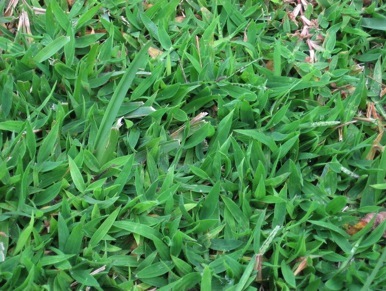
The Dreaded lawn Invader Crab Grass
Still on that list of dreaded home invaders is crabgrass. It would be difficult among the decapitated grass crowd to find a more hated grass than crabgrass. Multi-millions of dollars are spend annually trying to chemically choke it to death; uncounted hours are spend on hands and knees yanking it from yards. Air is polluted with crabgrass-inspired profanity. One of my neighbors spent the majority of her warm-weather weekends pulling crabgrass from her yard (which my little plot replenished!) Even the name suggests a loathsome disease: Your lawn has the crabs. My solution? Eat the weeds.
Let’s start with a basic question: Why do lawn folks hate crabgrass? Two main reasons: Visually it does not look like the other common lawn grasses so a patch of it stands out. Next, it does not grow consistently all season so a lawn with crabgrass can look patchy. It looks good in the warm months but can grow ratty in the winter in warm climes. That is, of course, presuming you have a lawn and care what it looks like. I don’t try to keep up with the DuPonts or put their chemicals on what little lawn I have.
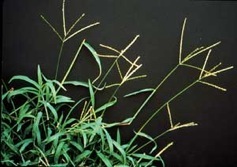
Crabgrass seed heads
Adding to the manicured mania is the fact crabgrass can produce some 150,000 seeds per plant. Nature plays hardball. Said another way, lawn grass is weak and crabgrass is strong and if folks don’t constantly fight crabgrass it will win. For that matter, the trees would win over lawn grass but grass has enlisted humans in its war against trees so we keep the trees at bay as well. Lawn grass survives because it has made human allies. For my audio editorial on that click here.
While we try to get rid of crabgrass in America in parts of Africa crabgrass (fonio) is a staple grain, and as forage it can produce a whopping 17 tons per acre. Crabgrass seed can be used as a flour, couscous or as a grain, such as in porridge or fermented for use in beer making. Now that’s a label I’d like to see: Crabgrass Beer. Crabgrass is not only nutritious but one of the world’s fastest growing cereals, producing edible seeds in six to eight weeks. It grows well in dry areas with poor soils, and fantastically in watered lawns. It’s a horrible weed and a wonderful edible, a great crop if you are starving.
Husking the small grains can be time-consuming, however. Traditional methods include pounding in a mortar with sand then separating the grain and sand. Another method is “popping” seeds over a flame and then pounding said which produces a toasted grain. If you have a LOT of crabgrass you can even buy a crabgrass husking machine.
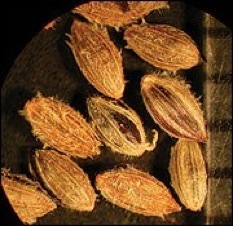
Crabgrass Seeds
Stone Age dwellers in Switzerland cultivated crabgrass and it was important food crop in China by 2700 B.C. It’s a traditional food in India and Africa. It was first introduced into the U.S. in 1849 by the United States Patent Office as forage for cattle, sheep, hogs and horses. Then the Department of Agriculture was formed and it took over making crabgrass a main agricultural crop. Immigrants from eastern Europe. Poles, Czechs, Slovaks, and Hungarians also relied on the traditional grain. They called it kasha/kasza and spread it around but then corn was developed as an agricultural crop. Growers soon learned that corn and wheat could be grown just as easily and was worth more money than crabgrass. The beginning of crabgrass’ transition from valued food to hated weed was born.
Digitaria sanguinalis (dij-ih-TARE-ree-uh san-gwin-NAY-liss) means red fingers. Crabgrass grows from a rosette (kinda looks like a crab) and the older leaves and sheaths can turn red to maroon. The Dogon of Mali, who call crabgrass “po,” believe the supreme creator of the universe, Amma, made the entire universe by exploding one grain of crabgrass inside the “egg of the world”.
The leaves can be used to make paper, and ten percent of people tested are allergic to crabgrass. Lastly, even if one does not eat crabgrass seeds, it can be gotten rid of by mowing techniques. Chemicals are not needed. Personally, I raid my neighbors’ lawns.
Crabgrass Muffins
1 cup flour
1 cup crabgrass flour
2 teaspoons baking soda
2 teaspoons ginger (optional)
3/4 cup water
2 eggs
1 teaspoon vanilla
1/4 cup oil
1/2 cup raisins
Preheat oven to 350 degrees F. Place flours and baking soda in bowl, mix in water, eggs, vanilla and oil. Fold in raisins thoroughly Fill muffin tins 1/2 full or pour in 8 inch square baking pan.
Bake 20 to 25 minutes
Let cool and remove from pan. Makes 6 muffins
Green Deane’s “Itemized” Plant Profile
IDENTIFICATION: A mat-forming grass, rooting at the nodes. Leaves alternate, long, grass-like, some parallel veins, pointed tip, toothless, flowers tiny, stalkless, flattened along branches. Sides minute.
TIME OF YEAR: Seeds in fall, best after a frost.
ENVIRONMENT: Sandy soil, poorly tended lawns, gardens, old fields, roadside and waste places.
METHOD OF PREPARATION: Stripped off seeds can be toasted and ground into flour, use as couscous, porridge or for making beer. Untoasted it can be used like rice. Avoid any crabgrass that has purple or black mold on it.

I have been interested in crabgrass because of it’s great nutritional value as animal forage. I tried looking up “crabgrass husking machine,” with no hits. Are you familiar with somewhere that they’re available?
Usually they parched the seeds in the husks to make the husks brittle then either flail them or put them in a motar and hit them with a pestil
Hey,
I think I have crab grass growing in my garden, but it has seeded in late March. Is this a possibility?
Does anyone know about the leaves? They seem so vibrant and rich with
nutrients when young, before getting coarse from heat and age……can we steam them, eat in salads…..any experiences to share? Thanks
Generallly said grass blades are not eaten because we don’t have the appropriate stomach(s) to digest them. However, blades can be dried and powdered and added to bread and soups for bulking and texture.
Perhaps the leaves could be simmered like tea which would break down the fibers. Also,the digestive acids in animals is much higher than humans,so maybe making a crabgrass ‘kraut’,i.e.,immerse the leaves in boiled water for a minute,then add some vinegar or lemon juice & salt. This should prep it for eating. An interesting experiment anyway.
the digestive acids in Carnivores are different and slightly more acidic than humans; the digestive acids in Herbivores are different and more alkaline than humans. But another relevant point to digesting grass is that, like Dean said, we also do not have the right system of stomachs and colon that vegetarian animals have–which contain a much larger and more varied number of bacteria that do the ”digesting” and fermenting of grasses and other such plants. Humans (and Carnivores) don’t have that capability in our GI tracts, vegetarian or not. –Doc Johanna, VMD
I’ve been juicing the crabgrass and other grasses / weeds in my backyard. I’ve gone from being on the verge of death with disease to being pill free. our indoctrination / culture tells us not to eat greens and stick with the processed foods, however, our culture is completely wrong. Many mammals thrive on greens. Yes, our stomachs cannot break the cellulose in many grasses, but with juicing the cell wall is broken and we can enjoy free nutrition. I have only heard two logical arguments against juicing the grasses in your backyard. One is possible pesticides and the other is urine from your pets. Hypothetically, if a person does not spray pesticides and does not have a pet then there is zero logical arguments against juicing.
I juice the crabgrass. It makes weeding less odious because I use the plant
Does anyone have a crabgrass beer recipe that would be willing to share? I’ve never made beer before but i think it would be fun to try to make crabgrass beer.
Crab Beer:
1. Harvest the immature seed heads of the crab grass plant, that is the seeds and stalk. Gather them in bundles so that they can be held by the seedless end of the stalk, and tie with rubber band or string. Immature seeds carry the more simple sugars suitable for beer making.
2. Dry them in the sun until seeds (with husks) are readily falling off. Do this in a tray or container to catch all seeds.
3. When dry, rub each bundle between your hands over the tray to loosen the remaining seeds. The straw can be discarded when clean of seeds.
4. Toss the seeds about in the tray in light wind to remove some of the empty husks. Bits of stalk may also gather. Removing all fibre is not necessary but more efficient for grinding.
5. Grind the seeds in a processor or mortar and pestle. The result need not be very fine. You are only trying to shatter the seeds.
6. Empty the broken seed matter into a fine cloth and bundle it into a “tea bag”.
7. Soak this bag in a small amount of water, squeezing the bag thoroughly. Collect this water. Soak the bag again. Repeat until no more starch is leeching out. The remaining pulp in the bag may be discarded.
8. Pour the mixture into an airtight container or proffessional brewing apparatus.
9. Add hops, dandelion tea, pine resin, spices or any other addatives or flavourings you may desire. Yeast is optional as it occurs naturally in the grass seeds, though results may be more difficult to predict than if using brewers yeast.
10. Seal the container with an airlock, or simply a slightly leaky balloon. Store in a warm place away from direct sunlight. You may choose to cover the container in a black cloth to help it warm and block sunlight. Bottle the beer when you feel bubbling is starting to die down and leave the bottled beverage to carbonate for however long you wish.
~Enjoy!
I live in Wimberley, TX. We had our house built in 2007. There was no lawn to speak of, just tan dirt. I saw a few patches of grass and I started watering. My neighbor said you have crab grass like it was this terrible thing. I have a lot more grass now; I look out now my lawn is green. Why should I try to get rid of it? Is it destructive to structures or sidewalks or anything else?
Thank you,
Cyndi
No, crabgrass is not destructive to stuctures or sidewalks. People are mostly influenced by the millions (billions?) of dollars that the chemical companies spend convincing them that crabgrass is ‘evil’, and that they need to spray toxic chemicals – that are often tracked into their homes where they accumulate in carpets, and are not broken down due to lack of sunlight/UV radiation, rainfall, or biological activity. Not sure how you can overcome your neighbors’ brainwashing, but other than maybe making them mad because the seed can spread into their lawns, there is no harm in crabgrass.
Has anyone tried juicing crabgrass? It would eliminate the concern about cellulose digestion.
yes I juice it all the time. It needs to be cut because the long strands wind around the juicer’s auger. Otherwise it is fine to juice and I don’t mind weeding when I am going to use the plant
Deane – WONDERFUL comment about ‘not keeping up with the Du Ponts,
or buying their chemicals, either’ !!!
Many may be unaware that Du Pont also sells GMO seeds, under their ‘Pioneer’ label. At first glance, it may seem strange that chemical companies have invested so heavily in seed production (Monsanto, etc) until we realize that the GMO seeds create an on-going market for their toxic, synthetic chemicals.
Thanks for all the great info, Deane!!
Oh, and it is not just humans that grass has ‘enlisted’ to keep trees and brush from overwhelming and replacing it – at least in areas with enough water to support dense brush and tree growth.
Grass has also enlisted goats, sheep, deer, and many species of ‘grazing’ animals that also browse, expecially on young trees and brush. Even rabbits and other small rodents eat small tree seedlings and can ring the bark on young trees. The savanah and grassland thing had been well established before humans came on the scene – and long before they invented lawnmowers. (Smile!)
To make beer out of it you need to malt the grain, which means you need to harvest the seeds, sprout it, and then heat it up at the right time to stop the sprouting. That sounds like a fun experiment, might try it this summer when I have lots of crabgrass to play with. There is a lot of information online about malting grains. Good luck!
Are Bahiagrass seeds edible? Used in pastures here, they show up in lawns like they own the place. And the seed heads pop up a foot overnight right after the grass is cut. Once mature, the seeds practically jump off the stalk when I walk by. Just begging, daring to be eaten. Similar to crabgrass in that respect, only bigger and better. (And, at least in my yard, they are chemical-free.) Thanks.
Schery 1972: 440 says: In SE Eu. made into a flat bread or a porridge, or fermented as a beverage. In W China, India, Pakistan, S USSR, eaten as whole grain, ground into flour, or sprouted & eaten. What I don’t know is if there are any special storage or preparation methods.
Thanks. Since it is readily available most of the year, and due to the high humidity here, I think that it can be used fresh, or toasted, without worrying about storage. Now to see how it tastes!
I have a great ?? my garden boxes have been taken over by crabgrass the roots are running everywere as I was TRYINGING to get the handfulls of roots out the the best way to get rid of was to eat them !!!! washing and blanching maybe in a stir fry might try juiceing roots and grass help ?????
In thinking of taking out an ugly rock garden and bringing back the original surface. Crabgrass is growing through the rocks.
It’s still green during drought season and I wanna adapt it to my front yard.
I’d just make seed milk by throwing the seed antennae in the blender and straining out the husks and drink the liquid . I’d probably add some of the more tender blades and get a little chlorofil too.
How do you collect the seeds in the first place? They mostly stick like glue to the stalk and then seem to fall off and get dirty the minute they are ripe. I tried picking them green and drying but only about 5% fell off.
I usually just get lots of annual Bermuda grass. I’d welcome crabgrass… but it never seems to show up!
How many pounds of crabgrass millet grain can be harvested per acre? Or what is the yield of crabgrass millet grain per acre and how long will it take to mature from planted seed to harvestable grain? Please contact me at Starfleethighcom@aol.com if you have the information or know someone who is knowledgeable of crabgrass millet grain.
How many tons of European crabgrass seeds or grain can one single acre produce. The African crabgrass can produce per hectare are that good yields are normally 600-800 kg per hectare, but more than 1,000 kg per hectare has been recorded. In marginal areas, yields may drop to below 500 kg and on extremely poor soils may be merely 150-200 kg per hectare. But the imported European crabgrass known as crabgrass millet by the European immigrants, who brought them along for it will produce a reliable food source regardless of the conditions of their new home in America, the New World as they all called it, and I am curious on how much European crabgrass millet grain can be produced from one single hectare.
Does anyone have a recipe for crabgrass pickles. My great grandmother made them in a crock. They were awesome but no one got her recipe. Thanks. They were salty and crisp.
Will this grass grow in shade under live oaks?
Great comments!
As for Goldie,with all due respect, and I’m serious, ask the Crabgrass Diva, to allow the grass to grow abundantly in Winter.
You’ll find acknowledgement, in an unexpected way. In return, give a blessing.
Does anyone know how to grow crabgrass indoors? Or how or where to get seeds??
Whenever I’d let cattle into a nee field, the cows always ate the Crabgrass down to the ground first. Then they’d move on. One day I happened to stop my truck next to an exceptionally nice clump of Crabgrass. I bent down and plucked a few blades of the Crabgrass and popped the blades in my mouth and chewed on it. WOW! It was so, so sweet! I decided if I was a cow, the Crabgrass would be the first grass I ate, too.
I have had a crab grass lawn in Berkeley, Ca., for 42years that I have appreciated for its hardiness. I can let it “die” in the Summer, to save on water, and it comes back fantastically at the first rain. Unfortunately, most of it died with a recent house remodel. I cannot find out where I can get seed to reseed my great crab grass lawn. Can you help me?
Thank you, Lindy
2 Comments: 1. I mow my digitaria every week and use the clippings for high quality compost. 2. I wish lawn mower manufacturers made machines which could be set to a much higher deck…like 10″. Digitaria changes its character when allowed to grow deep. It becomes a vertical plant, like Fonio grass (edible seeds). It is very pleasant to walk barefoot in on a hot day. I had a mower I could put wheel extensions on to raise the deck but there is no longer a residential mower that can be modified. My son borrowed mine for his golf course type lawn. Destroyed the mower.
I found this article by attempting to research the reasons why I might want to embrace crabgrass as a lawn. Last fall I let the chickens destroy a rather large section of weedy lawn. (I didn’t realize how thorough they were going to be.) When spring arrived and it sprouted, it was incredibly thick, bright green, and soft and cool underfoot. It holds the dew in big drops and I noticed that drinking from it was a favorite morning activity of my hens. Because it sprouted so thickly, the plants didn’t look so ‘crabby’ in that it took them a long time to branch. I’m sure they benefited from all that chicken poop.
All summer, these patches were the only sections that stayed cool underfoot. Honestly, it was just SO soft and cool underfoot that I couldn’t quite believe I had never noticed before. Watering the lawn seems too wasteful in this sandy soil, so drying out is going to happen.
So while I have been fighting crab grass for years, I am considering leaving the battle to my flower and vegetable beds going forward. We live on a major river and should not fertilize beyond liming, so this fine textured lawn thing will never really work anyway.
It’s true that it is difficult to get a uniform appearance when mowing. The plants really hold on to moisture and the leaves don’t cut cleanly. Once it starts doing the crabby thing, the plants lay down too much. But I may work on this problem rather than the impossible dream going forward.
Thank you for this article! I did not know it was also edible!
this is interesting stuff, I actually like weeds!! weeds are cool!! I wish we wouldn’t/not have to use poison spray or sprays, on anything, ever, not even insects or other creatures either, nope…….
Music started playing as soon as I opened up this web page, so irritating!
What spam garbage. There are no audio files on my website. No music, ever.
Audio started playing any time I opened up this internet site, so annoying!
Lying spammer. There is no audio on the site.Your spam is so annoying.
Write more, thats all I have to say. Literally, it seems as though you relied on the video to make your point. You clearly know what youre talking about, why throw away your intelligence on just posting videos to your site when you could be giving us something enlightening to read?
Lying spammer. There is no video.
Lying spammer. There is no crabgrass video on the site.
Interesting article & website. Crabgrass (Digitaria sanguinalis) has also been called “Polish millet,” “sown manna” (makes one wonder how the taste compares to fonio, D. exilis, a personal favorite), and in a hill territory of Madhya Pradesh, “sikiya millet.”
Are you aware of any community of interest on food uses of this species in the US or Canada?
TIA
Today, I went to the beach front with my children. I found
a sea shell and gave it to my 4 year old daughter and said
“You can hear the ocean if you put this to your ear.” She put the shell to her ear and screamed.
There was a hermit crab inside and it pinched her ear.
She never wants to go back! LoL I know this is totally off topic but I had to tell someone!
Great website you have here but I was curious about if you knew of any message boards that cover the same topics discussed here? I’d really like to be a part of online community where I can get advice from other knowledgeable people that share the same interest. If you have any suggestions, please let me know. Cheers!
Yes, join the Green Deane Forum.
Hi there, i read your blog occasionally and i own a similar one and i was just wondering if you get a lot of spam responses? If so how do you reduce it, any plugin or anything you can recommend? I get so much lately it’s driving me mad so any help is very much appreciated.
I get about 1,200 pieces of spam a week, including your post.
Grasses can be difficult to identify. Good texts on them are rare, and they vary a lot region to region.
Does your blog have a contact page? I’m having problems locating it but, I’d like to shoot you an email. I’ve got some creative ideas for your blog you might be interested in hearing. Either way, great blog and I look forward to seeing it grow over time.
Yes, if your post wasn’t spam you would have used the contact page. Looking forward to see it growing over time. It been growing for some 20 years.
Write more, thats all I have to say. Literally, it seems as though you relied on the video to make your point. You definitely know what youre talking about, why throw away your intelligence on just posting videos to your site when you could be giving us something enlightening to read?
Pointless spam. There is no video with the article.
Hi, i read your blog occasionally and i own a similar one and i was just wondering if you get a lot of spam remarks? If so how do you prevent it, any plugin or anything you can recommend? I get so much lately it’s driving me crazy so any support is very much appreciated.
Counting your spam, 1,200 pieces of spam a week.