
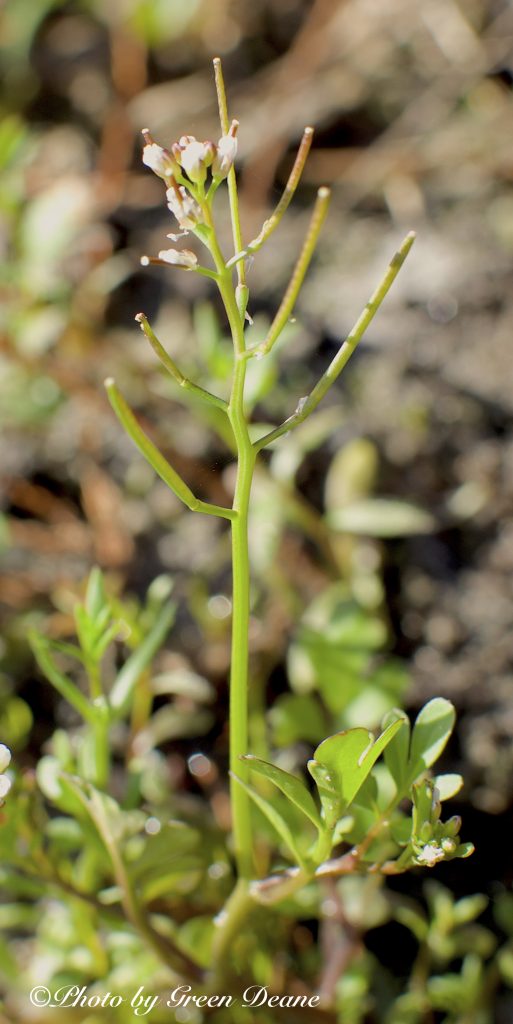
Little Mustards are seasonal like this Hairy Bittercress, Cardamine hirsuta. Photo by Green Deane
Coronopus, Descurainia, Cardamine, Erucastrum and Sibara
There are numerous little mustards that show up seasonally populating lawns and fields with spots of green against dead winter grass, and then they are gone. Their variety is rich and variations are many. You may never know exactly which one you have. With most, not all, look for the four-petaled flower with six stamen, four long, two short. Blossom can be yellow, white or pink. The seeds pods can be long like tooth picks or short little hearts or round scales.
This quintet of little mustards shouldn’t be dismissed but they are easy to miss. Their season is usually as short as they are. Locally the little mustards pop up in our cooler months, carpet some areas, and then are gone before one gets around to study or harvest them. There are many of them and variations are seemingly endless, which mean you can easily reach the conclusion you’ve got a little mustard but exactly which one it is will be open to debate. Fortunately, in small amounts at least, there are no toxic mustards. Huge amounts of any mustard, however can upset the human digestive system (and cows, too.)
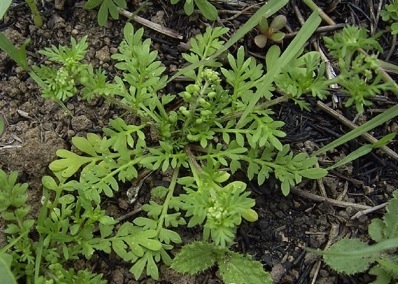
Swinecress has distinctive seed pods.
Swinecress (Coronopus didymus, koh-RON-oh-puss DID-eh-mus) is called said because pigs like it. Low growing, it’s usually a bright green rosette against the fading grass of cold weather. Locally it is found at the same time and with wild radishes. Flowers are greenish and minute. The entire plant very pungent when crushed. From a consumption point of view it is a trail-side nibble, a salad addition, and if cooked in at least one change of water, a pot herb. How many changes of water depends upon your tastes and how strong a tummy you have. In small amounts it is considered by farmers to be good cattle food but in large amounts toxic because it upsets their cows’ chambered stomachs. So find out how you and it get along before indulging greatly.
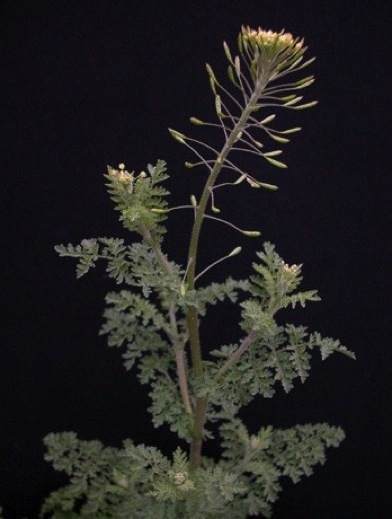
Tansy Mustard
In this particular case, the botanical name is actually helpful. Coronopus is a forced amalgam of two Greek words meaning Raven and foot, or in English “crow foot.” And indeed the three-pointed leaves resemble a three-toed bird foot. Not only does the end of the leave look that way, but the little leaves off the side of the main leaf do as well. Those little leaves alternate, barely. At the end of the leaf they are without stem, near the base of the leaf they have a little bit of stem.
And as is the case quite often, the second part of the name is a bit earthy, though references try to make it politically correct. Didymus is often rendered as Greek for “paired.” That is not linguistically accurate. While there are many words for “paired” in Greek one of the most common is ζεύγος, ZEE-ghos which means “yoke” as in a yoke of oxen. In fact the word for spouse is σύζυγος, SEE-zee-ghos. Got the idea? That is not the kind of pairing didymus means. Strictly said didymus means testes. And indeed the seeds of the Swinecress resemble two little you guessed it. Coronopus didymus. Crow Foot Testes. And you thought botany was sophisticated….
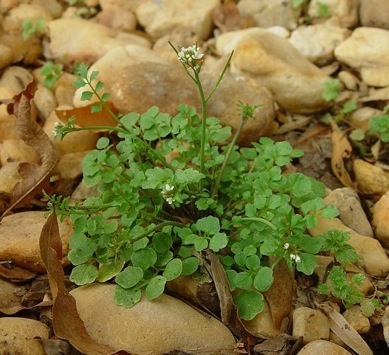
Hairy Bittercress like to grow in damp areas.
Our next little mustard is the Tansy Mustard because it, yep, resembles the tansy. Apparently botanists, when not thinking up dirty names for plants, aren’t too creative.
Exactly which Tansy Mustard you have will be a bit of a guess as well. Locally, here in Florida, I seem to find the Western Tansy Mustard. (It is called western so not to confuse it with one growing in Europe which is not called the Eastern Tansy Mustard.) And although I sit on the semi-tropical temperate line the tansy mustard is known as a plant found around the top of the world, not the equator. There are also a lot of subspecies so you may never know exactly what tansy mustard you have.
Botanically it is Descurainia pinnata, des-koor-RAY-nee-uh pin-NAY-ta.) In this instance, the name doesn’t help much. The first part honors Francois Descourain (1658-1740), a French botanist, physician and pharmacist. The second part, pinnata, means feather-like, or feathery et cetera and this is true in the sense that the leaves are wispy.
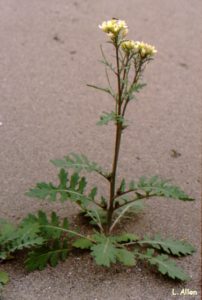
Dog Mustard is perhaps the least common of the little mustards.
Perhaps I’m not looking for Tansy Mustard, but it does not seem to me to be as common as other little mustards but it certainly likes the same environment: Think dry pastures. Six to 20 inches tall or so, fine, delicate, and like the other little mustards a nibble, a salad addition and when cooked to tolerability, a green. Its texture is mealy or hairy… kind of both.
The tansy mustard, also tansymustard, has one to several densely hairy stems, giving it a different texture than most Little Mustards. The basal leaves are divided twice into small segments, very hairy, stem leaves are divided into small segments once, very hairy. The flowers are bright yellow to almost white, fruit stalk long, elongated dark red seeds. If it looks like a tansy but is peppery like a mustard… it just might be the tansy mustard.
Quite common locally is the Hairy Bittercress, or Cardamine hirsuta, kar-DAM-en-neh her-SOO-tuh. Unlike the Tansy Mustard, it likes to grow where it is damp. In northern climes it germinates in the fall and stays green under the snow. Here in Florida we see it popping up in our winter, which is Christmas to Valentines Day. But it can be found in cooler shady wet spots for perhaps nine month of the year.
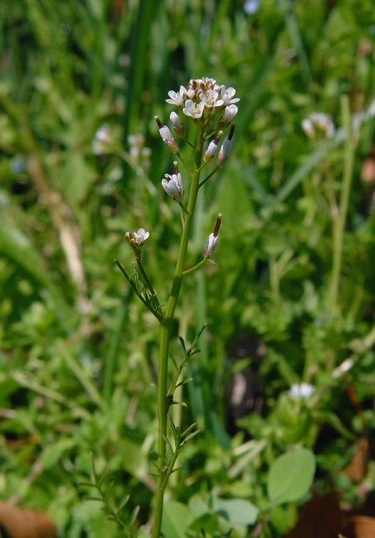
Sibara virginica
This little mustard is nearly hairless, stems are green or sometimes purplish in strong sun, not hairy, circular, tapering towards both ends, from a tap root. Usually many stems growing from a tap root. Basal leaves, however, have hairy stems. Leaves can be rounded to wedge-shaped, with little hairs, can flower when very small. Each leaf generally contains 4 to 8 leaflets arranged alternately along the leaf stem (rachis.) Seed capsule is 10 times longer than wide. Unlike other little mustards it looks like something one might grow in an herb garden. Flowers are small, usually a group of them, four white petals, on the ends of wiry stems. The long narrow seed pods (siliques, said sah-LEEKS) and alternating round leaflets are prime elements of identification. The little siliques tend to grow upright.
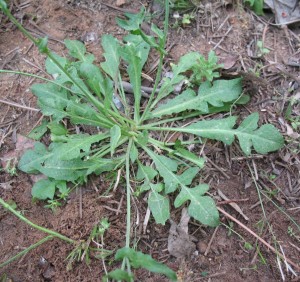
Shepherds Purse is another mustard clan of spring.
It is also often found in garden centers because of the watering, or in lawns. If you are an organic gardener, aphids love the Hairy Bittercress meaning you can use them as a trap crop. Leaves and flowers – raw or cooked — have a hot cress-like flavor, often used as a garnish or for flavoring. Can be used as a potherb but as with the other little mustards, proceed carefully.
Dog Mustard, also called the Hairy Rocket and French Rocket, is our least common little mustard, and the largest, getting up to a scraggly two feet under optimum conditions. To my eyes it looks like a ratty wild radish. It was introduced into the US and Canada in the early 1900s and spread along the railroads. It can cross with the rape plant (from which seeds we get canola oil.) This is viewed as good and bad. It can cross on its own and change the plant for the worse or it can be a source of genes should the rape need a shot of new genetics.
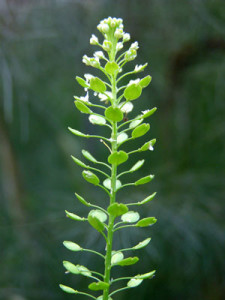
Poor Man’s Pepper Grass can be short or tall.
The Dog Mustard grows upright from a foot to two feet tall, pale yellow to whitish flowers, 4-petals to a half inch wide, petals rounded at on top, narrowing at the base; in a cluster. The seed pod is thin, long, four-angled usually curving up. Lower leaves are oblong, deeply pinnately-divided, end leaflet the longest; stem leaves not clasping, leaves get smaller toward the top. In northern areas it usually begins to blossom in June or so.
Botanically it is known as the Erucastrum gallicum, er-roo-KAS-trum GAL-ee-kum. This time the name tells us little. The first word means resembling the Eruca, which was some ancient plant mentioned by Pliny the Elder. Gallicum means from France. It is used as a pot herb but may need more than one change of water. Try sparingly.
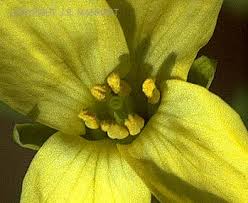
Mustard Blossoms, regardless of size, have four petals and six stamen, four long two short. Here the short ones are on the sides.
Now we get to the mustard that is coming and going. If you think you have a Sibara (SIGH-bar-ah) , you might actually have an Arabis (ARE-uh-bis or ARE-you-bis.) Arabis means from Arabia (read Eurasia ) and both the genera Arabia and Sibara used to be all Arabias. Then it was decided six species were native to North America, which hardly made them from Eurasia or Arabia. So those Arabis were renamed Sibara, which is Arabis spelled backwards. Ain’t that almost clever. They are Sibara deserti, Sibara filifolia, Sibara grisea, Sibara rosulata, Sibara viereckii, and Sibara virginica.
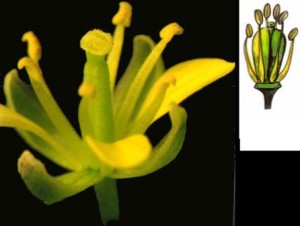
This close up shows the female part of the flower in the middle, four tall stamen and two short ones.
This is a winter annual from a rosette of deeply dissected leaves, five to 14 divisions on each side of the main leaf stem. The leaves at the base of the plant are slightly hairy. Leaf segments are narrow, the terminal segment though is somewhat larger, or broader. Flowers are white with four small petals. The fruit (silique) is stalked, long, very narrow with around 15 flat seeds. You can tell it from the Hairy Bittercress above (Cardamine hirsuta) by having larger siliques and narrow leaf segments. The rosette overwinters. It likes disturbed, waste ground, unused fields, and roadsides.
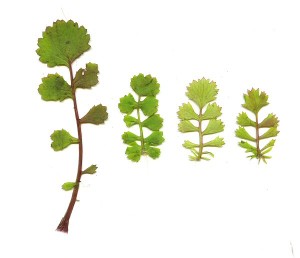
Senecio glabellus often grows the same time as mustards and is toxic. It has a yellow daisy-like blossom.
Lastly, a common toxic look-alike in the rosette stage is the Senecio glabellus. When dried and fed to rats 20% of their body weight killed them. While the blossom is different than the mustards, the basal rosette can look similar. S. Glabellus leaves are toothy and mild whereas the mustard leaves are not toothy and are usually peppery. It has pyrrolizidine which is a chemical that can clog up small veins in your liver causing fluid retention and death. The Senecio yellow blossom is daisy-ish whereas mustards have a four-petal X or H shape blossom.
Great article – thank you. I’ve seen some of these before but didn’t pin them as mustards. I need to watch for the blooms. Dead giveaway for sure.
Thanks for this ray of hope at the end of an unusually greens free winter (the freezes even took out our greenhouse greens). I’ll be picking a potworth soon!
I just tried a nibble of the raw hairy bittercress. It was like a salad green with a mild bitterness at the end. It’s such a cute little plant… I’ll need to watch the yard this Spring for what else is out there.
You have a good grasp of the evolutionary history of a lot of your subjects: Im seeing a rather large (but vague) similarity between mustards, dandelions and even plantains, though you have to squint a little. Especially within the early growth stages due to the basal rosette leaf formation. I may even go so far as to say seed formation as well but to a lesser extent. Is there some common ancestor or is this more like (somewhat) parallel evolution? I am no botanist by any degree.
Neat post, great way to enhance our anticipation of spring plant life!
I tend to have trouble definitively ID’ing these little plants. I thought I’d pegged some as Wintercress, Barbarea vulgaris or B. verna, but looking at your article now I’m not so sure. Of course, that was last year and I don’t have examples handy to take back to the field guides. Can anyone comment on this? Thanks!
While on a hike with my daughter this weekend I saw a plant that I haven’t seen since childhood. We used to call it “wild mustard” because a small round fruit or pod grows on it that is about the size and shape of a small grape but is the color of yellow mustard. We were up on Max Patch mountain in the Pisgah National Forest in North Carolina. This is at about 4600 feet above sea level and is a large wild grassland. I recognized the plant because it used to grow in the pastures around my neighborhood when I was a kid. This would be metro Atlanta. It seems to prefer grassland. I’ve never seen it anywhere else.
Do you recognize the plant I am describing and is it a true mustard? My daughter is really into organic food etc. and wanted to know if it could be eaten. I said it was a bad idea because I had no idea what it was but that we just called it wild mustard because of the little yellow pods are the color of mustard. Please let me know what this wild plant is.
Sincerely,
John Hawkins
Perhaps the toxic Solanum carolinense?
Dear Green Deane,
In the woods and gardens near my house in Western PA, there is a great deal of garlic mustard (Alliaria petiolata). Do you have any tips on gathering, preparing or storing the plant? Are there toxic look-alikes? — Mike S.
Michael,
It’s been some since you asked your question, so I thought I’d include a link to an article Deane has written:
https://www.eattheweeds.com/garlic-mustard-jack-by-the-hedge-sauce-alone/
It has a reputation as an aggressively invasive species, but I find I have to put out some nurturing effort if I want it to stay around long. Maybe that’s just the way it is when you *want* weeds to grow 🙂
does any of the toxic look alikes have the bean type seed pod that all cruceferis have?
If one looks closely enough there are no look-alikes. If you are asking do any toxic plants have siliques this website suggests no. http://waynesword.palomar.edu/fruitid7.htm
i want to tell you that one side of our home is full of mustard exactly as you described, 4 petals etc. we eat the leaves for salads or cook with fish or meat for soup. the flowers can be mixed in salad or cook it too. it is so beautiful and yet very nutritious. this kinds of plants are so overwhelmingly beautiful and nothing is wasted too. you can eat the flowers, leaves, seeds….. and yet you dont have to take care of it because it is to me like a miracle plant. i dont need to plant maybe for hundreds of years. i only planted once and my yard will be filled with so much of yellow flowers …. i dont even have to water them because God waters them with rain. beautiful. thank you for your wonderful article. i love it. thanks for the sharers.
easy to plant and easy to grow… with Gods help. i am enjoying this plant every year. 🙂
Thank you for hosting this website – this is one of my favorite interests! Today, I ran across a plant I’m unable to identify (it’s leaves look a lot like parsley – but they grow in a rosette fashion.) Would you mind if I emailed some photos? By the way, I found them growing in a field that has recently been discontinued being used as cow pasture.
Sure, send them to GreenDeane@gmail.com
I like nibbling on these little cresses and mustards in spring. Many are pleasantly peppery.
I do love swinecress (“mastruço” in Brazilian Portuguese). My mother used to search for it to make delicious salads! Now it is so rare…