
Foraging Class Schedule
Below is my upcoming class schedule which is updated weekly. Please make reservations. For payment methods, see below. Walk-in’s are accepted if the class is not full. To make your reservation send me an email. Please include date(s) desired, number of people, and contact information. Class size is limited to assure personal attention. Cost is $30 per adult.
The class is usually around three hours long or so and covers edible plants, mushroom, and some medicinals that we find that day. Classes are held hot or cold, rain or shine except for hurricanes. Descriptions of each location and where to meet are below under additional information. Times and day of week can differ with each location and time of year. Double check. Hiking and clothes requirements change with each class as do facilities. Again, double check. More details about each individual venue — such as where to meet — are listed below the Pay Now button.
Payment method: Cash on the day of class, $30 per person 18 and over. Or you can pay by credit card by clicking on the Pay Now button below. Or, if you have a Pal Pay account email me and ask for the appropriate email address. No checks please. If you pay by Paypal or credit card there is and additional $5 charge.
Saturday, April 13th, Red Bug Slough 5200 S. Beneva Road, Sarasota. 9 a.m. to noon. Meet at the parking lot.
Sunday, April 14th, Bayshore Live Oak Park, Bayshore Drive. Meet at Ganyard Rd and Bayshore. 9 a.m. to noon.
Saturday, April 20th, Blanchard Park, 2451 Dean Rd, Union Park, FL 32817, meet beside the tennis courts, 9 a.m. to noon.
Sunday, April 21st, Wickham Park: 2500 Parkway Drive, Melbourne, FL, meet at the dog park. 9 a.m. to noon.
Saturday, April 27th, Mead Garden: 1500 S. Denning Dr., Winter Park, FL 32789. Meet at the bathrooms. 9 a.m. to noon.
Sunday, April 28th, Colby-Alderman Park: 1099 Massachusetts Street, Cassadaga. Fla. 32706. meet at the bathrooms, 9 a.m. to noon.
Saturday, May 4th, Eagle Park Lake, 1800 Keene Road, Largo, FL 33771. Meet at the pavilion near the dog park. 9 to noon.
Sunday, May 4th, Boulware Springs Park, 3420 SE 15th St., Gainesville, FL 32641. Meet at the picnic tables next to the pump house. 9 a.m. to noon.
Bring cash on the day of class or click here to pay for your class
REGULAR CLASS LOCATIONS
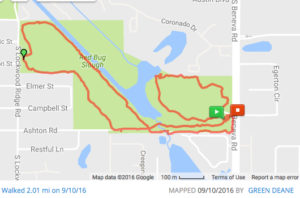
Red Bug Slough 5200 S. Beneva Road, Sarasota. There are about 12 parking places and a residential street across the street that can be used. Among the edible there are pokeweed, pepper grass, pines, sida, tar vine, Spanish needles, fireweed, amaranth, puslane, bitter gourd, horseweed, sow thistles, plantagos, native and non-native grapes, smilax, sumac, cabbage palms, oaks, magnolias, gallberry, caesar weed, beautyberry, willow, sword ferns, hairy cowpea, wax myrtle, elderberry, pellitory, saw grass, true thistles, blackberries, sweet bay, sweet clover, panic grass, water shield, wapato, black medic, day flowers, dollar weed, dock, bottle brush, epazote, silverthorm, saw palmetto, maypops, ground cherries, porter weed, black nightshade, False Hawk’s Beard, Oxalis, creeping cucumber, and a few toxic ones such as poison ivy, coral bean and rosary pea.
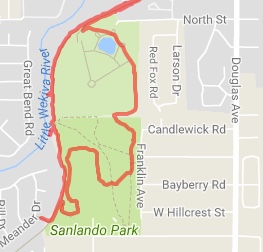
Seminole Wekiva Trail, Sanlando Park, 401 West Highland St. Altamonte Springs, Florida 32714 (at the intersection with Laura Avenue.) We meet in the first parking lot on your right immediately after the entrance. This class involves about two miles of walking over several hours , some of it on an active bike trail. There is parking, drinking water and several bathrooms. We visit the immediate park area near tennis courts then north through park woods to a softball park. After that we walk the bike trail south back to the park seeing about 60 edible species depending on the time of year.
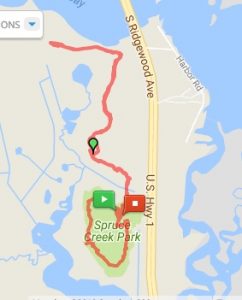
Spruce Creek Park, 6250 Ridgewood Ave. Port Orange, 32127. GPS: N 20°05’35.4″ W080°58′.26.2″ Entrance is on the west side of southbound Ridgewood Ave (which is also US 1) Northbound traffic will have to make a U-turn. For southbound traffic, after passing Nova Road and the twin bridges the park entrance is 1/2 mile south on your right. The park, not far from Daytona Beach, has 1,637 acres and three miles of “nature” trails. It combines in a small area three different plant environments; a small patch of weeds common to urban areas, coastal hammock growth, and plants tolerant of the salty environment. Most are noticeable four species of hollies including the infamous Ilex vomitoria, the North American equivalent of Yerba Mate. Two common brackish water edibles, Saltwort and Sea Purslane, are also abundant. We will meet at the restrooms (it’s actually it’s a pavilion but the direction sign says restrooms.)
Tide Views Preserve, 1 Begonia Street, Atlantic Beach Fl 32233 (near Jacksonville Fl.) This is a new location still being explored.
Treaty Park, 1595 Wildwood Drive, St. Augustine, Florida 32086. Go past the dog park, the skate park and the racket ball courts. We’ll meet at the pavilion near the pond.
Turtle Mound: Canaveral National Seashore Park. While there are plenty of plants to look at we will probably have to change locations in the park at least once during the class. Because of parking this may require car pooling. There is also a fee per car to get into the park. For a preview see my video on You Tube entitled Turtle Mound. We will meet at Turtle Mound parking area. Among the edible species growing there are: Ground cherries, saw palmettos, eastern coral bean, wild grapes, seablight, sea purslane, salicornia, searocket, Persea, cabbage palm, smilax, black mangrove, Ilex, feral citrus, spurge nettle, papaya, wild peppers (in season) sea oats (protected) crowfoot grass seaside bean, opuntia, nopalea, toothache tree, seagrapes, purslane, hackberry, sedges, Spanish needles, sweet bay, and oaks,
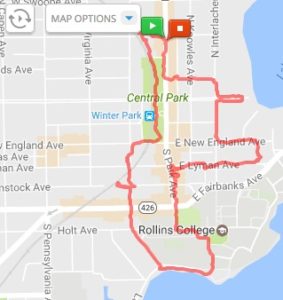
Urban Crawl, meet in front of Panera’s, north end, 329 N. Park Avenue, Winter Park. Free parking in the parking garage, levels four and five behind Panera’s. The Urban Crawl is designed to help you identify edibles found in a city environment. We will see edible natives, imports, ornamentals, and neglected landscaping. We’ll also discuss issues with foraging in an urban area. Afterwards we can talk plants over coffee at Panera’s. We will walk approximately 2.5 miles most of it, but not all, on sidewalks. The following edibles can be seen: Dandelions, Podocarpus macrophyllus, false Hawk’s Beard, cabbage palms, white clover, the bottle brush tree, Bidens pilosa, various Oxalis, pellitory, dollarweed, night blooming cereus, oaks, camphor trees, sword ferns, pepper grass, hairy bittercress, roses, cherries/plums. saw palmetto, dwarf and full grown Ilex vomitoria, pines, skunk vine, Turks cap, two species of sow thistle, Nandina, beautyberry, smilax, cattails, koontie, pickerel weed, dock, Micromeria brownii, bulrush, yellow pond lilly, water shield, shell ginger, Chinese elm, natal plum, Stachyis floridana, pansies, canna, lantana, purslane, wax begonia, sedges, pindo palm, American holly, spiderwort, goose grass, mulberry, chickweed, and tansy mustard. Non-edibles worthy of mention: Rosary pea, the most toxic seed on earth, dog fennel and mexican poppies.
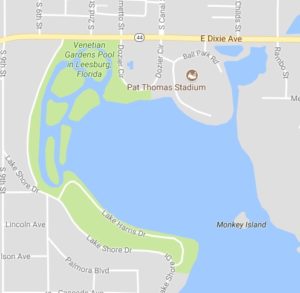
Venetian Gardens, 201 E. Dixie Ave, Leesburg, FL 34748. What do you do with low islands that flood regularly? Add some bridges and call the park Venetian Gardens, which is about a half mile west of Leesburg Regional Medical Center. It’s a 100-acre park on Lake Harris and is also adjacent to a ball park. The flat landscape lends itself to easy walking but we’ll cover about three miles during the class walking about the park. As it is lake side the list of foragables leans towards the aquatic and we might get our feet wet. There are also many freeloading birds and squirrels in attendance… will beg for photo opt.
Wekiva State Park, 1800 Wekiwa Circle, Apopka, Florida 32712. There is a park admission Fee: $6 per vehicle. Limit 8 people per vehicle, $4 for a single occupant vehicle, $2 pedestrians or bicyclists. Meet at the Sand Lake parking lot. Unlike city parks or the urban area, Wekiva Park is “wild” Florida. There are very few weeds of urbanization. The edibles are mostly native plants and far between. This class is recommended for anyone interested in what the natives used. We will walk about four miles roundtrip. The plants are sporadically located. We will visit upland scrub and river bottom ecological zones, and then we will retrace our path and ”test” everyone. The walking is on trails and depending on the weather, at times it can be taxing. Bring water, appropriate clothes, and hiking equipment.
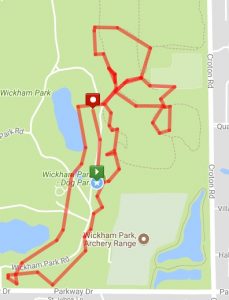
Wickham Park: 2500 Parkway Drive, Melbourne, FL 32935-2335. Meet at the “dog park” inside the park (turn right after entrance, go 1/4 mile, dog run on right, parking at run or on previous left.) This park is a recreational area more than a wildlife habitat, Wickham Park still offers several dozen edible species in two distinct habitats. We will walk about 1.5 miles. Among the edible species are Oaks, Cabbage palm, Crowfoot grass, Pines, Centella erecta (Asian Dollar Weed) Pennywort, Dollarweed, Plantains, Bidens pilosa (Spanish needles) Saw palmetto, Caesar weed, Grapes, ( native and hybrids) Smilax, Yucca filamentosa, Gopher apples, Wax myrtles, American Beauty Berry, Poke weed, Sumac, Saw grass, Elderberry, False hawks beard, Pellitory, Creeping cucumber, Oxalis, Bitter gourd, Cattails, smooth-leaf bacopa, Gallberry, Wapato, or wapati, Bull thistle, Ground cherry, and Purslane.
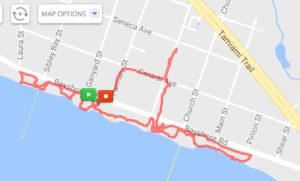
Port Charlotte Foraging Class path
Bayshore Live Oak Park, Bayshore Drive. Port Charlotte. Part of the original Port Charlotte Harbor this long and narrow park still sports many edible wild plants and ornamentals. There are numerous parking lots and facilities. We will meet at the parking lot east of the last fishing pier. Among the interesting plants we will study are elderberry, caesar weed, palms, sea grapes, Spanish needles, sea purslane, wild cow peas, red and black mangroves, oaks, railroad vine, saw palmettos, firebush, epazote, sida, Ilexes, Canaveral Rose, fig, smilax, crowfoot grass, loquats, coco plums, wild grapes, opuntia, Cereus, pines, horseweed, bitter gourd, and a few toxic plants. There are bathrooms and water at the park. Because of the distance this class has to have 10 confirmed students ahead of time.
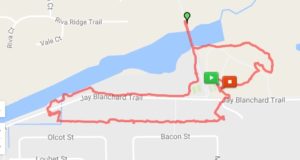
Blanchard Park, 2451 Dean Rd, Union Park, FL 32817 This is a large park with a YMCA facility built in as well as play grounds, tennis courts and soccer fields. It also runs along a the Little Econlockhatchee River so there is an opportunity to see some water plants as well. One down side is the only bathroom open a 9 a.m. is about a quarter mile west from where we meet. By the end of the class the YMCA is open. Jay Blanchard Trail runs east-west south of University Boulevard. The park can be entered on the west side by Dean Road (thus you dive by the bathrooms) or from the east side off Rouse Road.
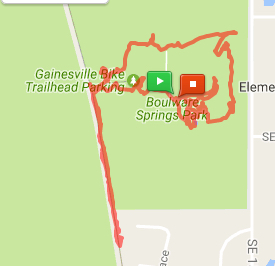
Boulware Springs Park, 3420 SE 15th St., Gainesville, FL 32641. Meet at the picnic tables next to the pump house. We start at the park and on a small portion of the Gainesville-Hawthorne State Trail, total distance 1.8 miles. Because of the distance this class has to have confirmed students ahead of time. DIRECTIONS: Take 4th Street off State road 331 (SE Williston Road.) At SE 15th Street (a T-intersection) turn right. In less than a mile you will see the entrance on your right to the Hawthorn Trail, pass that. Take the immediate next right into the Boulware Springs parking lot, adjacent to SE 15th St. Besides studying the area around the spring we also walk along the Hawthorne Trail and side trails.
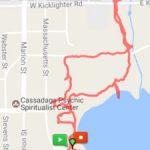
Colby-Alderman Park: 1099 Massachusetts Street, Cassadaga. Fla. 32706. Situated on Lake Coby and sometimes called Lake Colby/Royal Park, the 124-acre historic site was recently renovated with a quarter million dollar grant. It has a pavilion, bathrooms, boat ramp, plenty of shade, parking and a nature walk. It is the most handicap accessible site for studying wild edibles. A July survey showed at least three dozen edible species growing, from fruiting persimmons to spurge nettle to blossoming kudzu. Directions: Take Interstate-4 to Exit #114 (formerly Exit #54.) Turn west onto Highway 472 (toward Orange City/Deland. That is a left if coming from from the south, a right if coming from the north.) Once on 472 and leaving the interstate behind go to the first traffic light and turn right onto Dr. Martin Luther King Parkway. After you are on the parkway, turn right at the first street, which is Cassadaga Road (Country Road 4139.) Continue 1.5 miles to Cassadaga. You will pass the Cassadaga Hotel on your right. While the main road immediately turns left you will go straight (which is where the GPS puts you.) Go down a short hill where the road bears right and ends in the park. Meet near the restrooms. We will walk 1.8 miles with most of it on a paved walkway or a sand path.
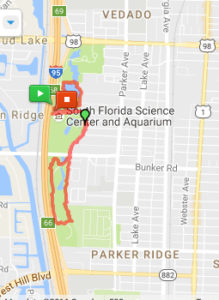
Dreher, 1200 Southern Blvd., West Palm Beach, 33405. Take exit 68 (Southern Boulevard) off Interstate 95 and go east. Entrance to the park is an immediate right at the bottom of the interstate bridge. Follow the convoluted signs to the science center (which is not where the GPS puts you.) Park anywhere. We meet 300 feet northwest of the science museum near the banyan tees. It’s a noisy area but early in the morning isn’t too bad. The amount of plants we can see depends upon the season and how much mowing they do. Among them are: American beautyberry, malaleuca, pigeon plum, pines, caesar weed, elderberry, wild grapes, citrus, oxalis, conyza, smilax, passion flowers, sandspurs, koontie, ipomoea, oaks, commelinas, Emilias, purslane, amaranth, figs, Bauhinia, crowfoot grass, surinam cherry, bitter gourd, red spiderling, sea grapes, sida, cattails, yellow pond lillies, Spanish needles, mangos, sedges, wapato, firebush, pickerel weed, sabal palms, royal palms, queen palms, bamboo, traveler palms, coconuts, date palms, dollar weed, water hyssop, mahoe, varigated mahoe, seaside mahoe, fishtail palm, podocarpus, lichen, pellitory, porter weed, pepper grass, smartweed, false hawk’s beard, sow thistles, epazote, sword fern, juniper, Ilex, cocoplums, bittercress, and two of the most toxic seeds on earth and an iguana or two.
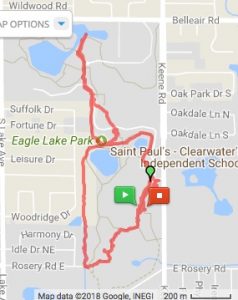
Eagle Park Lake, 1800 Keene Road, Largo, FL 33771. Meet at the pavilion near the dog park. Situated in Largo on the Pinellas peninsula it’s a large park with a variety of different environments. On my first trip there I found: Amaranth, American Beautyberry, Bacopa Monnieri, Bitter Gourd, Brazilian Pepper, Bull Thistle, Burn Weed\Fire Weed, Caesarweed, Camphor Tree, Creeping Cucumber, Crowfoot Grass, Dollar weed, Duckweed, Eastern Cedar/Juniper, Eastern Gamma Grass, Eastern Redbud, Elderberry, False Hawk’s Beard, Ganoderma, Gotu Kola, Lantana, Latex Strangler Vine, Magnolia, Sweet and Southern, Nopales, Oaks, Palm, Panic Grass, Pellitory, Pines, Pokeweed, Pony Foot, Poor Man’s Pepper Grass, Purslane, Red Bay, Saw Palmetto, Simpson Stopper, Smartweed, Sow Thistle, Spiny/Common, Stinging Nettle, Sweet Bay, Sword Fern, Tansy Mustard, Wax Myrtle, Yellow Passionflower, Yellow Pond Lilly, Yaupon Holly.
Florida State College, south campus, 11901 Beach Blvd., Jacksonville, 32246. We meet at Building A next to the administration parking lot. This is a pleasant wander around the campus with environments ranging from pond to woods and in between. There are also a good complement of edible ornamentals. We walk about two miles over three hours.
Ft. Desoto Park, 3500 Pinellas Bayway S. St. Petersburg Fl 33715. There is an entrance fee to the park. Meet at the fishing pier parking lot. It’s a large parking lot, meet near the bathrooms. This is a compact area with a lot of poison ivy so we have to be alert. Among the forageables at this location is a hurst of Persimmons, numerous Seagrapes, native Blue Porter Weed and a planted Chaya. We will also see some salt-tolerant edibles and perhaps some seaweed as well.
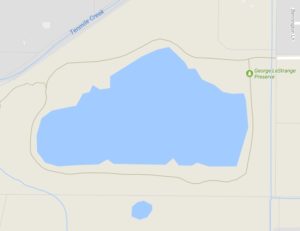
George LeStrange Preserve, 4911 Ralls Road, Fort Pierce, FL, 34981. The preserve is only about three miles from the junction of the Turnpike and I-95. It has no bathroom or drinking water so take advantage of the various eateries and gas stations at the exit. After exiting either the turnpike or I-95 go east on Okeechobee Road. Turn right onto S. Jenkins Road. Then left on Edwards Road. Then right onto Silvitz Road. After crossing the small St. Lucie River (a small S-curve among those straight roads) turn right onto Ralls Road. Go to the end of Ralls Road then turn left into the preserve. Part of the trails through the preserve take you along ox bows of the St. Lucie River and Ten Mile Creek. During my last visit I saw a lot of Ground Cherries, Amaranth, Purslane, Barnyard Grass, Dollar weed, Spanish Needles, Gopher Apples, Sow Thistles, native and escaped grapes, Smilax, Poor Man’s Pepper Grass, Pellitory, False Hawk’s Beard, Water Hyssop, Coral Bean, Hairy Cow Pea, Southern Wax Myrtle, Fireweed, Epazote, Catails, Willows, Pines and a lot of fish.
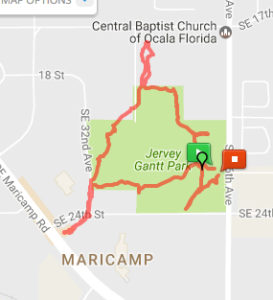
Jervey Gantt Recreation Complex, 2390 SE 36th Ave., Ocala, FL, 34471. Meet at the entrance to the pool, aka Aquatic Fun Center. This walk is about a mile long and mostly on well-graded paths. While there are no immediate aquatic plants at this site there are numerous wild edibles. Among them are: plantain, epazote, oxalis, sycamore, pepper grass, hickory, usnea, pines, oaks, amaranth, Chinese elm, Florida elm, Hercules club, smilax, blackberries, wax myrtle, eastern red bud, spurge nettle, sumac, magnolia, tansy mustard, paper mulberry, sow thistles, Florida betony, camphors, ground cherry, red spiderling, podocarpus, Spanish needles, milkweed vine, muscadine grapes, summer grapes, palm, persimmon, beautyberry, dandelion, false hawk’s beard, plum, cherry, hawthorn, and henbit. Because of the distance this class has to have confirmed students ahead of time.
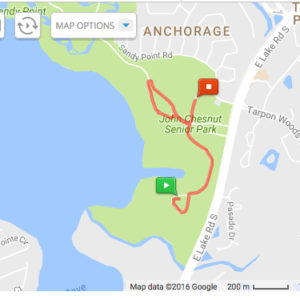
John Chestnut County Park: 2200 East Lake Road, Palm Harbor, FL 34685. Meet at the trail head of the Peggy Park Nature Walk, pavilion 1 parking lot. This is a very nice, small county park on Lake Tarpon with part of the walk being lakeside. We will walk the Peggy Trail backwards, then visit the boat launch area, then an observation tower, then wend along the board walk lakeside. At the end of the boardwalk we will go through the center of the park back to where we started. That’s about a mile walk. Among the edible species there are: beautyberry, bitter gourd, blackberry, dayflower, caesar weed, cattails, chuffa/sedges, crowfoot grass, dahoon holly, false hawks beard, fireweed, Florida betony, Florida elm, grapes, cultivars, grapes, muscadines, groundnuts, heartleaf drymaria, hickories (water and pignut) dwarf ilex vomitoria, maples, oxalis, palms, panic grass, pennyworts, persimmon, pickerel weed, pines, oaks, reindeer moss, red bay, saw palmetto, smilax, Spanish needles, smart grass, sumac, sycamores, usnea, water hyacinths, wapato, water shields, wax myrtle, and willow.
Mead Garden: 1500 S. Denning Dr., Winter Park, FL 32789. Meet at the bathrooms. The garden has been around for some 80 years through various stages of attention and neglect. It has over 100 edible species on an annual basis. Mead Garden has natives, exotics, now-banned plants, once-common plants, and just plain old weeds (often removed from more-attended gardens.) Among the edible species in Mead are: Amaranth, American Burnweed, American Eelgrass, Beautyberry, Bee Balm, Bitter Gourd, Blackberries, Black Cherry, Black Tupelo, Bulrush, Cabbage Palm, Caesar Weed, Camphor Tree, Cattails, Ceriman, Chickasaw Plum, Chinese Elm, Commelinas, Crowfoot Grass, Creeping cucumber, Dayflowers, Eastern Coral Bean, Elderberry, Epazota, Feijoa Tree, Florida Elm, False Hawks Beard, Florida Betony, Gallberry, Goose Grass, Goto Kola, Grapes, Ground Nuts, Guinea grass, Heartleaf Drymaria, Hibiscus, Hickory, Ilex vomitoria var nana and pendula, Koontie, Lemon Grass, Lantana, Loquat, Magnolia, Maples, Melaleuca, Micromeia brownii, Monkey Puzzle Tree, Nagi Tree, Night-blooming Cereus, Oaks, Oxalis articulata, intermedia, stricta, Paper Mulberry, Pennyworts, Pickerel Weed, Pindo Palm, Pines, Podocarpus macrophylis, Poke Weed, Queen Palm, Red Bays, Red Bud, Red Mulberry, Reindeer Moss, Rubber Plant, Sand spurs, Saw palmetto, Seagrape, Shell Ginger, Skunk vine, Smartweed, Smilax, Sow Thistle, Spanish Needles, Spiderworts, Surinam Cherry, Swamp lilly, Sweetgum, Sycamore, Tulip Tree, Usnea, Violets, Wapato, Water Bacopa, Wax Myrtle, Wild Pineapple, Willow, Yam, Dioscorea alata.
Red Bug Slough 5200 S. Beneva Road, Sarasota. There are about 12 parking places and a residential street across the street that can be used. Among the edible there are pokeweed, pepper grass, pines, sida, tar vine, Spanish needles, fireweed, amaranth, puslane, bitter gourd, horseweed, sow thistles, plantagos, native and non-native grapes, smilax, sumac, cabbage palms, oaks, magnolias, gallberry, caesar weed, beautyberry, willow, sword ferns, hairy cowpea, wax myrtle, elderberry, pellitory, saw grass, true thistles, blackberries, sweet bay, sweet clover, panic grass, water shield, wapato, black medic, day flowers, dollar weed, dock, bottle brush, epazote, silverthorm, saw palmetto, maypops, ground cherries, porter weed, black nightshade, False Hawk’s Beard, Oxalis, creeping cucumber, and a few toxic ones such as poison ivy, coral bean and rosary pea.
Seminole Wekiva Trail, Sanlando Park, 401 West Highland St. Altamonte Springs, Florida 32714 (at the intersection with Laura Avenue.) We meet in the first parking lot on your right immediately after the entrance. This class involves about two miles of walking over several hours , some of it on an active bike trail. There is parking, drinking water and several bathrooms. We visit the immediate park area near tennis courts then north through park woods to a softball park. After that we walk the bike trail south back to the park seeing about 60 edible species depending on the time of year.
Spruce Creek Park, 6250 Ridgewood Ave. Port Orange, 32127. GPS: N 20°05’35.4″ W080°58′.26.2″ Entrance is on the west side of southbound Ridgewood Ave (which is also US 1) Northbound traffic will have to make a U-turn. For southbound traffic, after passing Nova Road and the twin bridges the park entrance is 1/2 mile south on your right. The park, not far from Daytona Beach, has 1,637 acres and three miles of “nature” trails. It combines in a small area three different plant environments; a small patch of weeds common to urban areas, coastal hammock growth, and plants tolerant of the salty environment. Most are noticeable four species of hollies including the infamous Ilex vomitoria, the North American equivalent of Yerba Mate. Two common brackish water edibles, Saltwort and Sea Purslane, are also abundant. We will meet at the restrooms (it’s actually it’s a pavilion but the direction sign says restrooms.)
Tide Views Preserve, 1 Begonia Street, Atlantic Beach Fl 32233 (near Jacksonville Fl.) This is a new location still being explored.
Treaty Park, 1595 Wildwood Drive, St. Augustine, Florida 32086. Go past the dog park, the skate park and the racket ball courts. We’ll meet at the pavilion near the pond.
Turtle Mound: Canaveral National Seashore Park. While there are plenty of plants to look at we will probably have to change locations in the park at least once during the class. Because of parking this may require car pooling. There is also a fee per car to get into the park. For a preview see my video on You Tube entitled Turtle Mound. We will meet at Turtle Mound parking area. Among the edible species growing there are: Ground cherries, saw palmettos, eastern coral bean, wild grapes, seablight, sea purslane, salicornia, searocket, Persea, cabbage palm, smilax, black mangrove, Ilex, feral citrus, spurge nettle, papaya, wild peppers (in season) sea oats (protected) crowfoot grass seaside bean, opuntia, nopalea, toothache tree, seagrapes, purslane, hackberry, sedges, Spanish needles, sweet bay, and oaks,
Urban Crawl, meet in front of Panera’s, north end, 329 N. Park Avenue, Winter Park. Free parking in the parking garage, levels four and five behind Panera’s. The Urban Crawl is designed to help you identify edibles found in a city environment. We will see edible natives, imports, ornamentals, and neglected landscaping. We’ll also discuss issues with foraging in an urban area. Afterwards we can talk plants over coffee at Panera’s. We will walk approximately 2.5 miles most of it, but not all, on sidewalks. The following edibles can be seen: Dandelions, Podocarpus macrophyllus, false Hawk’s Beard, cabbage palms, white clover, the bottle brush tree, Bidens pilosa, various Oxalis, pellitory, dollarweed, night blooming cereus, oaks, camphor trees, sword ferns, pepper grass, hairy bittercress, roses, cherries/plums. saw palmetto, dwarf and full grown Ilex vomitoria, pines, skunk vine, Turks cap, two species of sow thistle, Nandina, beautyberry, smilax, cattails, koontie, pickerel weed, dock, Micromeria brownii, bulrush, yellow pond lilly, water shield, shell ginger, Chinese elm, natal plum, Stachyis floridana, pansies, canna, lantana, purslane, wax begonia, sedges, pindo palm, American holly, spiderwort, goose grass, mulberry, chickweed, and tansy mustard. Non-edibles worthy of mention: Rosary pea, the most toxic seed on earth, dog fennel and mexican poppies.
Venetian Gardens, 201 E. Dixie Ave, Leesburg, FL 34748. What do you do with low islands that flood regularly? Add some bridges and call the park Venetian Gardens, which is about a half mile west of Leesburg Regional Medical Center. It’s a 100-acre park on Lake Harris and is also adjacent to a ball park. The flat landscape lends itself to easy walking but we’ll cover about three miles during the class walking about the park. As it is lake side the list of foragables leans towards the aquatic and we might get our feet wet. There are also many freeloading birds and squirrels in attendance… will beg for photo opt.
Wekiva State Park, 1800 Wekiwa Circle, Apopka, Florida 32712. There is a park admission Fee: $6 per vehicle. Limit 8 people per vehicle, $4 for a single occupant vehicle, $2 pedestrians or bicyclists. Meet at the Sand Lake parking lot. Unlike city parks or the urban area, Wekiva Park is “wild” Florida. There are very few weeds of urbanization. The edibles are mostly native plants and far between. This class is recommended for anyone interested in what the natives used. We will walk about four miles roundtrip. The plants are sporadically located. We will visit upland scrub and river bottom ecological zones, and then we will retrace our path and ”test” everyone. The walking is on trails and depending on the weather, at times it can be taxing. Bring water, appropriate clothes, and hiking equipment.
Wickham Park: 2500 Parkway Drive, Melbourne, FL 32935-2335. Meet at the “dog park” inside the park (turn right after entrance, go 1/4 mile, dog run on right, parking at run or on previous left.) This park is a recreational area more than a wildlife habitat, Wickham Park still offers several dozen edible species in two distinct habitats. We will walk about 1.5 miles. Among the edible species are Oaks, Cabbage palm, Crowfoot grass, Pines, Centella erecta (Asian Dollar Weed) Pennywort, Dollarweed, Plantains, Bidens pilosa (Spanish needles) Saw palmetto, Caesar weed, Grapes, ( native and hybrids) Smilax, Yucca filamentosa, Gopher apples, Wax myrtles, American Beauty Berry, Poke weed, Sumac, Saw grass, Elderberry, False hawks beard, Pellitory, Creeping cucumber, Oxalis, Bitter gourd, Cattails, smooth-leaf bacopa, Gallberry, Wapato, or wapati, Bull thistle, Ground cherry, and Purslane.
I’m coming to tomorrow’s walk. Can I pay you there?
yes, no problem. It will be a good class with a variety of people and plants.
Hi! I’m so excited about learning about edibles in my area! I was surprised to see that you go to Jervey Gant in Ocala, it’s not very natural. I think you might be interested in the Cross-Florida Greenway that comes through Ocala. We have an amazing area off of 475A right next to the Belleview/Dunnellon exit. The entrance is near the horse-park and intersects biking/riding trails. It passes through new pine growth, tall pine forests, and old-growth hammock and can be done in under 2 hours. If you are interested in more information, send me an e-mail and maybe we can connect and really get you a great spot for foraging!
I go to old city parks rather than state parks because that is where one finds far more wild edibles. At Jervey Gant I can easily find about 60 edible species in a mile walk. In a wild park nearby we have to walk six miles or eight miles so to see maybe 30 species. Urban areas have the native wild edibles and the imported wild edibles, and also what most folks find in their neighborhood and around their homes. I know it seems counter intuitive but there is far more edible species in urban areas than in natural areas.
Thanks for responding. I’ll definately deffer to your wisdom in these matters. Too bad I missed the Ocala class, I definately want to be in the next one-if possible! I may drag a few others along with me. Do you have field guides you suggest?
Hi,
I am interested in signing up for the West Palm Beach class on Dec. 9. It would be 2 adults. Please let me know if you have space for us and how you would like to be paid.
Thanks,
Dallas
I’ll put you on the class list. Cash the day of class or via pay pal is fine.
Hi, 🙂
Do you think you’ll be heading north any time in the future…really north…say, Canada?
Smiles
Carolyn
Hello, I am interested in signing up for the DEC 10 2011 class in Winter park? I want to make sure it is still going on before I pay and double check that I can make the date too. Thanks
Yes, that class will go on barring accident or illness because someone is coming from out of state for it.
Please sign me up fo December 10, 2011 at the Winter PArk Location. Mead Garden. at 9:00AM.
Hi Chris and Dean,
I’m in Polk too and I know of at least one other person that would be interested in a class here. A park that comes to mind is Saddle Creek.
I was in Poke County two weeks ago checking out a site for a class. I think it was Alligator Reserve or the like in the beginnins of the Green Swamp. It had edibles but not enough for a class per se. Let me check out site. Usually foraging is better in suburban areas.
I’ll definitely be at a Polk county class. I can probably find a few people to come too to make it worth your while.
The probelm I have had in Polk County is finding a suuitable place for a class. If you have any recommendations let me know.
I’ve thought about the Lakeland scrub because it’s so big and has such a variety of terrains. I’ve been through a good portion of it, and I keep thinking it’d be something that you might like. The first type of terrain you see is a forest type area. Then you’ll come to a clearing and swear you’re at the beach…white sand and all. Go one direction from there and you’ll walk along a path with a neighborhood on the right… Some people even grow plants on their fences. If you keep straight from there, you’ll come to a golf course neighborhood. If you were to go the other way from the forest area, you’ll eventually come to a big area full of palmetto bushes (it looks a lot like an area of Wekiva). There are lakes too!
You told me that scrubs aren’t usually a good place to find edibles but I’m hoping that maybe the one here is special LOL. I hope that after the Winter Park class I can identify more plants so I can offer more help for this location. I know I’ve seen beauty berry, hollies, cattails and various grapes, but I know that that’s not really that special. If you want me to take pictures of the different areas, I’d be happy to do so.
thanks so much for yesterday’s class. It was alot of fun and I learned alot! I am so amazed at all the edibles and medicine values that these plants contain. I bring this knowledge to my family which makes it fun for us too. Thanks again for your time. Have a great weed. I mean week:} Deb
How about the lake Tiger area? I know of a fish camp on the lake that might serve you well. It has year round residents as well as vacationers and weekenders.
Well Dean, my yard has a few things. Purslane, pellitory, oxalis, spanish nettle, dandelion, mouse melon, stinging nettle (yikes!), ivy gourd, bitter melon, wild onion, nasturium, lab lab, guava, musk mallow, crowfoot grass, nutgrass, society garlic and a few things I think are wild lettuces or mustards come to mind. A papaya popped up just on the other side of the fence and I think there’s wild grape growing on the fence next door. I’ve even found lichen here once in a while. I saw some Ceasar weed and golden rod not far from here. Alas, the yard is way to small for a class. lol
If it weren’t for your site and vids, most of these things would still be a mystery to me. So — thank you!
Hey Green Deane
Just curious…are you ever in the NY/ Long Island area holding foraging classes?
You guessed it…a LI girl
Would love to know more about what grows in my backyard : )
Bye Peg
I do get there now and then… but if you want to find someone who is closer and has regular classes in the search windown type in “Resources” Then scroll down to New York. You will find several foraging instructors there.
when will you be having a class in Port Charlotte .
Dec 18th 2011, please tell some friends as it is quite a drive to get there for me.
Thanks will book next week and will check and see if can get more people
I may do the port Charlotte class too. I will make a decision after next weeks class and hopefully be able to set aside time to do Port Charlotte too on the 18th. Let you know next week! I live in Venice so that would be convenient. See ya Sat. 10
will pay cash on the 18th for the class. Will be two of us
Do you ever teach classes in or around Fort Lauderdale, if so when?
Yes, I have classes in West Palm Beach regularly, which is just up the road from Ft. Lauderdale. I should be there in January.
Hey Dean,
Just got back to SWF and so happy to find a class coming up on the 18th in Port Charlotte. I will definitely be there as I am in Cape Coral right now, waiting to move to Pinellas county. Really enjoy your site and lookin forward to becoming more involved soon as i get settled in. See Ya Sunday, Peace.
He Greene Deane, I just wanted to tell you how much I enjoy and appreciate your informative and down-to-earth videos. I stumbled upon one of them nine months ago and have now watched them all at least once. I recently moved to the USA and am looking forward to taking some of your walking classes when I can get to Florida. Until that time do you know anybody out my way who I could take a such a course/walk with? I’m near San Jose California and would drive some distance to get some knowledgable instruction : )
Thanks for writing. Go to my home page and in the search window type in “resources” On my resource page there is a list of foraging instructors including several in California. If there isn’t one near you I suggest you contact them as they might know one who is.
There are no resources for Louisiana. I’d really like to forage here
The plants are just about the same in all the states around you. Is there someone nearby in another state?
Again a great class on a beautiful Port Charlotte Day! Thanks for all your time. Maybe a few more classes, and the edibles will sink in for me! :>)
Me and my son enloyed the class and look forward to more. Thanks Shane
Hey Greenman,
Really enjoyed the class in Port Charlotte, Will be movin to Pinellas county 1/1 so you can count me in for the class Jan. 7th in Palm Harbor. Wishing you a very happy New Year. Peace,
Billy
Just wanted to say thank you for the class today I learned a lot from you and my other class mates, and yes my brain is still over loaded.Looking forward to the next time.
Rick.
Glad you made it home alright this holiday weekend. I enjoyed your company.
I live in Dixie County, along the Suwannee River. I would like to eat healthier, but living in a very rural area I would have to travel to Gainesville to find a “whole foods” market with a decent variety of organic produce. Not to mention the added expense of buying organic. I am not a great gardener (as I always seem to spend more on the garden than I get out) so I would like to learn more about foraging. Being surrounded by forest and not far from the Nature Coast State Trail (following an old railway) I was wondering if foraging has the potential to provide a significant portion of my family’s dietary produce or if it is mainly only good for medicinal/ augmentation purposes. Which of your upcoming classes would provide exposure to an ecosystem similar to mine? Gainesville or Live Oak? Here we have live oaks, pine trees, saw palmettos, muscadines, blackberry, cat briar, bull nettle and some cactus. Prime gopher tortoise habitat. How many people would have to commit to attend in order to have a class out this way?
Either location is similr to yours. For that distance I usually ask for a class of at least 10.
Becky and Dean I also live very close to the Suwannee river,and very close to Ivey park in Branford. I think if we put our heads together we may be able to come up with at least 10 people to attend. I too would love to find the things we can eat that grow in our rural area. I think the Suwannee would be a great pace for a class. I even own a pontoon boat that will hold 12 adults if that will help make it anymore interesting, or easier.
Hi Deane,
I am a huge fan of yours and I may be taking a road trip to Florida soon and I’d like to attend one of your classes. However, I will be staying in my camper van and will have my very sweet, very loveable, and well behaved puppy with me and I refuse to leave her in van etc. Is it okay if she can tag along? I know some parks have restrictions, but what about your rules?
No problem. I’m an animal person.
Fantastic!!!! 🙂
I may come this month or next. I currently live in NC and would prefer a class that isn’t mostly coast plant related… I’d like to learn of Floridas of course, but may not ever live there, you know. Also I need to map out dog beaches etc to a close place you have classes and I prefer not to drive all the way south, but I am flexiable. I know Daytona beach has some dog beaches. I’ve been researching some.
If you have any recommendations please let me know, or If I don’t hear back I’ll give a heads up when I am road tripping to see if all is okay etc.
Thanks
Mead Garden is dog friendly.
I very much want to take classes. Right now my schedule is very hectic. I am scheduled to work on Saturdays from 10-3 too but can put in for a vacation day. I am in Dade City but do not see any for Pasco Co or Hillsboro Co for the next Quarter. Ocala is about a hour away. Before I put in for classes further away are there any scheduled nearer to my area later on. I hope to take as many as I can. It would be great to have a weekend event.
Linda Roberts
I will be giving a class march 10 in New Porty Richy, at John Chestnut Park. I am also in town that day for a wedding in Clearwater.
Hi, Deane. I’ve been watching your YouTube channel for a while now, but I only just now got to take a look at your website and I really like it! I actually live in the northwestern part of Alabama, so it’s a little difficult to get to your classes. But, I’ll keep an eye on this page so that if you ever happen to come as near-by as Panama City, I’ll definitely be there with a few people. And, thank you for all the work you do to put this information out there for people to learn from.
I was at Mead last Sunday and you pointed out Richardia sabra – do you know any differences between that and R brasiliensis (except structurally where there seems to be bumps on the fruit of sabra and short stiff hair on the fruit of brasiliensis along with a thickened, woody root stock?) I found a 2000 Nigerian study of R brasiliensis which shows an alcohol or water extract to be far superior to pharmaceuticals against some fungi such as Candida. Go figure. Can’t find any information. Thanks – Fran
Out of my herbalistic league on that one. Sorry. And thanks for coming to the class.
Hi Dean,
Will you be doing any classes in the Kissimmee area in the near future?
I do them in Winter Park nearly every week, which is botanically the same as Kissimmee.
Hi fellow foraging friends!
My name is Korbin and my 3-4 friends and I plan on coming to a class either this Saturday in Winter Park or this Sunday in Jacksonville. My boyfriend Dylan will be headed back down to Fort Lauderdale area while the rest of us are heading back to Minnesota. Dylan is looking for a ride – even if someone from the class is heading down to West Palm Beach where he can hitch the tri-rail down to Dania. Please post or e-mail back if you know of any rides…
Thanks a lot
Korbin
Hello, I am writing to reconfirm a spot in the April 1st, Dreher Park class. The email my wife sent had the wrong date. Just me and I will pay in cash. Looking forward to meeting you. Please let me know if you cancel. 561-635-3302. Regards, Jerry.
Green Dean,
We had an awesome time today, so much information to process but we took lots of notes and lots of pictures. We can’t wait to start foraging around out area, but only with plants we can clearly identify. Thanks to spending time with you taking you class their are many more plants we are confident with. We look forward to attending more classes in the future and I can’t wait untill I can purchase your videos on DVD.
Keep up the good work,
Sorry for my tardy reply. I enjoyed your company. The DVD are nearly ready.
Would love to take some of your classes, do you ever get to the Sarasota area?
Nearly every month right up the road in New Port Richy, which has the same plants as Sarasota.
Deane, will you be adding more classes in May? I’m hoping to head over there in May from California and would love to take a few of your classes at that time but see currently you have 2 listed. Thanks, Jill
Yes… I just need to sit down and do it.
Hi Green Deane,
There is a group of people in Columbia, SC who are interested in learning how to forage for wild edibles. Do you know anyone in this area who teaches plant identification? Thanks for your help!
On my Foraging Instructors page I don’t have anyone in South Carolina. However, I have four under Georgia. What I would do is email each of them and ask the same question. No doubt they do know of someone, or they might be close enough to do so as the plants would be the same.
Hi Green Deane,
Thanks so much for your help. I have just one more question. I have checked the distance from my home, and the closest instructors are in Dahlonega, Ga, Union Mills, NC, and Asheville, NC. Which place would have plants similar to the Midlands of South Carolina? The two places in NC are the closest.
Plants don’t recognize state boundraries. They will all be about the same.
Hi, Deane!
Just wanted to thank you again for the awesome class at Dreher Park! We had a great time and learned so very much. We “knew” most of those plants well as weeds, but had no idea how useful they actually were. Thanks for being here and for sharing your knowledge with the rest of us!
Dear Deane,
Your site is wonderful, in design and information…but why do you live in Florida? I lived there for 30 years, now I live in the mountains of North Carolina and I think I am already in heaven! This is the most beautiful place in the world and has over 2,000 species of wildflowers.
Sometime I hope you will have a class here, if so let me know.
God bless you for your concern for others. Vicki
I grew up in snow and ice and loathed it. That is why I live in Florida and hope to move to the very southern end of it. I don’t do winters any more. As for North Carolina… I have a friend in Boone who wants me to visit for a couple of weeks in August.
I’m a big fan of your website and youtube videos. I saw your video about pine trees and want to ask you a question that I’ve had for a while about them. Can Fir trees be used in the same way as a pine tree? Where i live in Utah we have a lot of fir trees, that everyone calls pine trees, but very few true pines.
Thanks in advance
No. Pines and firs are different. While some firs have some uses they are not pines nor should be used as pines.
There are many pine and spruce trees in Utah in landscapes and in the wild along the Wasatch Front. Most firs are at higher altitudes.
Dear Mr. Green Deane, could you please tell me if parsley seeds are edible? My parsley plants are going to seed early this year and I do not want to waste any of the plane, but, being a transplanted city girl I am still learning about plants and what one can eat. Thank you so much.
Well… a little yes, more than a little no. A few seeds perhaps. Too many can cause liver, kidney damage, and bleeding. Never eat parsley (any part of the plant, but particularly roots and seeds) in any quantity, and especially not any amount if you are pregnant. It can acuse abortions.
The culinary parsley, sold in grocery stores…? It is toxic to eat, the leaves? I had no idea, unless this is a different parsley like plantain (the fruit) versus the green plant plantain.
Do you ever give classes in the Miami area? I’ll bet the Tamiami canal has lots of wild edibles!
No, but I do get to West Palm Beach which has the same plants. I am trying to arrange something in Miami.
Hi, I know you are doing the lake Alfred lecture tomorrow, July 22, but I have to work. Do you know of any other times you may be around the Polk County area. I would think we would have lots of sites for this kind of thing. Lots of water, disturbed areas, with the phosphate mining and all. I could probably get a couple of people to attend, besides myself. I am so anxious to do this, have been interested for a long time. If I have to drive way out of the area to attend, I will but, I hope to get something closer.
I love what you do.
I’m hoping to get to Polk County more often but finding a suitable location is difficiult.
Deane, we really enjoyed your class today at Mead Garden in Winter Park. Everybody should take your classes…perhaps we would all have a healthier regard and appreciation for nature. Thanks so much and we look forward to having you come back to Brevard county sometime in the future.
thanks again for the class in Gainsville,well worth the drive and money.No disappointments here.your I.T.E.M system is easy to remember and covers the basics for anyone new to wild edible plants.i will continue to study your website and videos until i am able to attend another class. “I definitely recommend this class to anyone wanting to learn from the best in the business “
I would love to see a foraging class in turtle mound, its so close and the area is nice. I hope you do one there soon!
Im glad you are having so many classes this month. I am going to be attending at least 1 class this month for my birthday with my uncle. Cant wait.
Can you tell me if you have any classes in Texas? If not do you know of anyone teaching similar classes in the Houston area… Thanks
Go to my website, hover your cursor over foraging, there’s a drop down menu called foraging instructors. Click on that then scroll down to Texas. Merriwheter holds classes in Houston.
How often do you have classes in Palm Beach? Unable to make th September 30th date and really interested.
About every six weeks.
Do you (would you) ever hold any classes in Northwest FL? Anywhere from Tallahassee to Pensacola? Would love to attend some of the walks. Keep doing what you do.
I’m really trying to… the hard part is to find a place to hold the classes. State parks are not the best locations. Usually an old city park is better.
Thanks to your vidoes i was able to identify a plant that has recently been taking over my aquarium….watercress. And i was also wondering, do you make trips to Kentucky any?
Who teaches these classes in the Houston area?
Google Houston Wild Edibles
After eating the weeds in dreher park, don’t forget to check out the exotic meats and bugs on the menu at the South Florida Fair.
Jungle George’s food truck should be there. Eat the scorpions and rattlers too!
Thanks for the tip. It’s just a couple of miles from where I hold my West Palm Beach classes.
Great class today Deane. I enjoyed walking the FSCJ south campus with you.
I went out after class and found quite a few of the edibles we discussed on the abandoned golf course I live on. Sheep sorel, non-native sorel, poor mans pepper, false haws beard, chickweed, lantana and quite a bit of nightshade, didn’t eat any of that though. I hope to join you again when you come in few months. It’s gonna be hot!
Wonderful… that’s what it’s all about…
Have you ever been to Pine Island in SWFL? Just wondering if that would be a mecca for wild edibles?
I have a great site in Seminole, FL. My yard! And it is a stone’s throw from Boca Ciega Millenium Park, a very short drive to Walsingham Park, Heritage Park, Botanical Gardens and the beach. Would you like to meet here? One acre with a swamp and a pond. Lot’s of ‘weeds’ and critters.
Green Deane, 4-24-2013, 1000
I have been around Plants and their use for about 13 years.
It is because of Ms.Hilla Futterman (rest her soul) that I can use the out doors the way I do. I live in Southern California, and need to find a new plant whizzard.
I found you mentioned a woman in Topanga, California, named Sunny som thing. Would you be so kind and tell me how I get in touch with her.
You really are fantastic at doing what you do, Please keep it UP.
O. Douglas Ceissman
Sunny Savage. Just google her name.
Wish you had classes closer to my home in Alexandria Va.!! I love your website. I have learned a lot and have been eating dandelion salads which I shared(along with your website) with my neighbors. I took a photo of a weed in my yard that I would like to identify. I think it might be in the plantain family? Is there a way to send you this photo in an e-mail? Also I have realized how arbitrary our use of the classification of “weed” is! THANKS SOOO MUCH.
I took a wild edible foods course through Volusia County in the mid 70s.
We went to several different locations over several weeks and I still recall a lot. Could I have been your student then? I’m just curious. Your site is fascinating and I am sooo happy you are located and teach here in Volusia.
Mike Lowe, Ormond Beach
Mid-70s…. no. It might have been Dick Deuerling or someone from the Native Plant Society.
I have no formal education of plants….but I am very interested in learning about wild local edibles….is this a good choice for me and my high school aged child to attend? Also do you recommend any books to bring for your class?
All the plants I cover in walks are on my website. So most folks just bring a small note book and or a camera. Some tape samples into a notebook.
is it safe to use citrus leaves as spices in tea and in cooking?they smell good when crushed,but no gardeners I’ve spoken with have any idea of their edibility.
Usually citrus leaves are not used.
Kaffir lime’s leaves are used for culinary purposes in Thai and other Asian cuisine. I live in Florida and am growing this tree for its leaves. The fruit is not edible, except for the zest.
Hi!!! So excited to do a plant walk with you….will you be in the West Palm Beach area anytime soon on a Sunday?
I’ll get back to WPB in mid-August but this weekend I am in Ft Pierce which is an hour’s drive north. Not a bad distance, same plants.
Please respond to this question of – When and/are you planning to conduct a class on foraging and wild edibles in the Pensacola area? There are quite a few people interested and would gladly come to this class!
Thanks and look forward to your comments.
Thanks for writing. I really want to hold them there. What is holding me up is finding a suitable location. State parks are usually rather poor places for such classes. Old city parks do well, places with differing environments (not just pine/oak scrub) ponds, lawns, trees… parking and bathrooms. Drinking water is nice as well.
Hi Green Deane, I’m looking forward to your September class in Palm Harbor. Did you get my reservation?
Also, if you’ve been to Howard park in Tarpon Springs, could you recommend other edibles I can search for there? So far I’ve eaten beauty berry and Spanish needle from there because I was confident in Iding those. I really enjoy Spanish needle leaves!
I’ve never heard of the park though with relatives in Tarpon Springs I visit often.
Aww in that case you should visit one day. It’s a park with a causeway leading to a small beach, minutes from Tarpon High School.
Hi Deane,
I really enjoyed your class in Palm Harbor last week. Since then, I’ve been hunting for bitter gourd with no luck. I wish I’d gotten some leaves when I was there. I’d appreciate any advice on where to look or where at John chestnut I can find it please. All the chain link fences I come across look pristine. Thanks!
Hi again… the main entrance to the park is shaped like a Y. The right side if the southern entrance, the left side the northern entrance. If you take the northern entrance the Bitter Gourds will but about 150 feet ahead on your right (before you get to the flag pole.) Hope that helps.
Hey, Dean! Are you planning to come to Port Charlotte again any time soon? If you don’t have a set date planned, I will try to get a group together. Have you ever been to ECHO in North Fort Myers? http://echonet.org/ They are pretty cool, but I really want to take one of your classes.
Thanks for your time! Loved the bunya video. 🙂
Cindi
My 3 boys and I really enjoyed the class this weekend in Palm Harbor. My second oldest boy still talks about the wild cucumber…lol I am sure they will talk about it at their next Boy Scout meeting. Hopefully we can up to central Florida soon again. Thank you !!!!!
Hi Green Deane! I love your videos. Do you know of any foraging teachers in the Pittsburgh PA area?
If you go to my home page find a drop down menu under the foraging button. That will say foraging instructors. Go there and look up Pennsylvania or near by states. You can also email those instructor if they know of any as well.
I am very interested in your classes. Any idea when you will have another one in the Orlando area?
I will be having a class in Winter Park on Feb. 23rd.
Dear Deane,
I own an acre of weeds in Tampa so I thought I’d check to see what was edible. The only thing I can identify, however, is a mulberry tree. I am looking at pictures of mulberry leaves used in salads, but I am then reading that you can’t eat full sized leaves. You have to eat them when they aren’t much more than buds. Which is correct? Thanks for any help you can give me.
Yep, that’s about right. You might want to read some of my recent newsletters because they deal with stuff in season. You can find them in the Archive under Newsletters.
Any Sundays planned for Dreher park sometime soon?
If it made it through the winter it will take off.
Green Deane, does Florida Betony grow as far south as palm beach county?
It grows as far south as Dade County but it mostly favors the soutwest coast not the east coast south of Volusia.
Dean, It is unlikely you remember me from a year ago as I took your class in the Tampa area, but I set in motion a request for your class in Wilderness Lakes Preserves with our Lodge Manager.
I have since moved to Tallahassee, but I see she has scheduled you for earth day class. I hope it goes well and your group enjoys your training. If you get to this area, please shoot me a line. If I can get off work, I would love to further my learning of foraging. Paul Swanson
Thanks… that is supposed to happen Tuesday.
I just came across your site. I am interested in your classes. are you taking any classes in Tampa/brandon. Please let me know and I would like to attend
thanks
ooha
I have classes near Tarpon Springs and in Sarasoata. These are basically the same plants.
Yea sorry about, I read most of your dates as on sundays and I guess thought that the west palm class was today instead of saturday 🙁
Am interested in seeing about a private class for this week. How do I set that up (if your available)?
I’m in Orlando, but I go to college out in St. Pete so there are a lot of locations that would work for me.
Thanks,
Taylor
hi, do you ever have classes anywhere in Mississippi? I was reading on an old forum, and it said that you had held classes here. I may be completely mistaken. Do you know of anyone that holds classes near Central Mississi, near the Jackson area? Thank you.(sorry if this posted multiple times, my phone is acting strange)
Hi there! I’m curious as to why old city parks are much better than state parks for finding variety of wild edibles?
Thank you
Old city parks have the native plants, the agricultural weeds, the weeds that come with domestic people and edible ornamentals. There is a far greater variety of edible plants in suburbia than in the wild, or at least most wilds in North America. I can walk a mile in a city park and see over 100 different edible species. I can walk eight miles in a state park and see 17 different edible species. 10,000 pine trees counts as one edible species.
If your ever in the Pensacola area please please email me. I know for sure I could get 5 people.I’ve been trying my best to find wild edibles here but pretty tuff so far.
I want to hold classes in that area. It is finding a suitable location that is the stumbling block at the moment. Hopefully I can do it this fall.
Do you have anything close to Pensacola?
I’ve been trying to hold classes in that part of the state for a couple of years. Finding a location is a stumbling block. But I hope to do so this year.
Hey Dean I’ve been to three of your classes in port orange and DeLeon I have a weed in my back yard it has big leaves a red stock and black Berry’s with a crown maybe you could tell me what it might be Thank you
My guess is mature poke weed, too old to eat. It’s a toxic plant without proper harvesting and preparing.
Pokeweed is usually my first guess.
Hi Green Deane,
Do you have a book? I live in So. Calif. and would like a good field guide to the local edibles in this neck of the woods. Any recommendations?
Thanks in advance for you guidance.
Sincerely,
Dick
i live in Applegate , Mi how and where do i find classes on mushroom hunting and identification. could you please let me know if you ever come to mi for a class.
Let me know when you are in Tarpon Springs again. I am a “foodie” who just got turned on to foraging by Top Chef Duels.
I’ll be in Sarasota Sunday… same plants…
Do you ever come to Long Island New York and if so when? Thank you
No but there are several foraging instructors who do. Under “foraging” on my main page there is a drop down menu of foraging instructors.
Green
I have seen all your videos thanks for making them. I am a fan. I don’t however see anything on sunchokes, Jerusalem Artichokes which provide huge gains in food. Can you make a video of those?
Thanks
Mike
I don’t have a video but I do have an article on them. They really aren’t wild food.
Love your videos. Love your website. I would love to take a class. I live in Mobile, Alabama and am curious if you ever come out this way. Perhaps Pensacola or some place on the Pan-Handle? How many folks would you need for a class to make the trip? Thanks for all the wonderful information and Happy New Year.
Thanks for writing. I’d like to hold classes in the Pensacola area but I need to have a suitable location to hold the class.
Today’s class at Wickham was very good…. I was so glad to be able to get good photos and take notes. Thanks again. Hope you enjoy your basket.
Thank you. I love the basket and plant on taking a lot of light box pictures of it.
Is the April class in Port Charlotte on Saturday the 4th or Sunday the 5th? Your notice stated Saturday the 5th. 🙂
Thanks for pointing that out to me. It’s right on the main page. I am in Port Charlotte on Saturday for an event at Bamboo Grove with ANdy Firk. SO I thought I would overnight and so a class on SUnday the 5th. I did not know it was Easter.
Have you ever done a canoe or kayak foraging? Just wondering.
Yes but it is not as interesting as one might think because it is a monoculture and after an hour the plants don’t change.
Do you have any plans of doing a class in the Jacksonville area in 2015? I’m having problems locating anybody who teaches foraging.
I hold classes there regularly about every six weeks. I need to schedule one in April.
I hope you will consider Peggy Park Trail, when you go to John Chesnut Park in Pinellas County. I have given walks there in the past, and I had met Peggy Park back in the old days
I hold classes at the Peggy Park trail regularly, the last three weeks ago.
I found a few more wild edibles growing in abundance at Wickham park elderberry, blue berry low bush form,watercress, cattail, prickly pear, sumac, wax. myrtle, reishi mushrooms and bi color bolete in season.
Watercress… hmmmm, where was that?
I found clusters growing in a small seep in between archery range and ponds then returned and it was eaten to the root. it might return next season. Watch out for stray arrows.
Hello Green Deane, I just recently discovered your YouTube video’s. I also just bought a new book, “Florida’s Edible Wild Plants”, written by Peggy Sias Lantz. In the book she mentions you. I thought that was pretty cool considering I just started watching your videos a few days ago. Do you ever do any classes in the Ocala national Forest or along the bike trail in Citrus county?
All the time. In fact I have one in Ocala next week.
We, Susan and I attended your class this past Sunday at John Chestnut Park. We found it very informative and entertaining. As a native “outdoorsy” Floridian and military trained in multiple survival courses I am comfortable away from the house. This class has helped much in furthering my Florida edibles knowledge and Susan’s comfort level “on the land”. Thanks.
Green Deane, Have stumbled upon your site. very informative. I grew up in Pompano Beach. We had a lot of saw palmettos. We called the berries roach eggs. I guess we saw a lot of roaches in those trees. We all tried those berries, once. Yuck.
Roach eggs might taste better.
Hi Green Deane, I see that you had a class in Gainesville (couldn’t tell if it was this year or not). Wish I could have attended it. Will you be having any other classes in the Gainesville region any time in the near (or not so near) future?
Thanks.
Yes, all my classes listed are this year. I can get back to Gainesville in September. By they way I got a Lone star tick while I was there and I am half way though the waiting period to see if it is going to make me allergic to red meat.
When will you be on the SpaceCoast again?! If not anytime soon, I would love to book a private class!
I went on your walk sept.5th in Cassadega. (I wore tye dye). It was a most educational, fun 3 hours!!! You were very easy to understand, and very funny!! I WILL be joining you on another hike. This time with a pad and paper. Totally worth it. Thank you!!!
Is there any place in Johannesburg South Africa where I can meet up with people to go foraging?
Do you visit New Orleans, will like to take a class, or any recommendations, thanks
Hi,
I took part in your class in Dec 13 2015 in Winter Parks. There I learnt to identify a plant that you called Green Viagra. Could you please, write to me its scientific name. I found it also in Lake Worth.
Best wishes
Mauri
We were talking about Dollar Weed, or Pennywort, which is Hydrocotyle umbellata. It increases Nitric oxide to the system.
Hi, I was wondering if you guys ever hosts tours near Jacksonville Florida orrrr… I was hoping maybe other people might be interested in doing some sea side forraging. I honestly love kyaking and getting kelp and Wakame right out of the water but I have not done so on this coast because I just moved out here from Cali and I’m so glad I’m not the only one interested in forraging! I like exploring areas as I travel and finding things I can eat. I ate hibiscus flowers off of the trees in Hawaii and people thought I was weird.
There’s only guy, me. And I have a class scheduled in Jacksonville March 6th (2016)
Mr. Green was awesome and very well educated throughout the entire trek. I was trying to get a class for my wife’s birthday, and he made the experience wonderful. Thanks for all you do Mr Green! We appreciate you very much!
Dangit, I just missed your Sarasota class, and it looks like its the most South you usually go… Ever considered doing a class below Sarasota? I’m right at the upper edge of the Everglades.
I have regular classes in Port Charlotte.
What is your closest location to Fort Lauderdale?
FOr the moment, West Palm Beach which is a short drive up I4.
Hi I have been interested in foraging for many years. I currently live in Tallahassee, and I am a member of the FTA (Florida Trail Association) as well as several other local clubs. I was wondering what your criteria would be for setting up a class/seminar in the Tallahassee area?
I’m vacationing near Orlando first week of August. Do you do any foraging this time of year? Classes?
Thanks for writing. I am usually in the Carolians in August but that might not happen this year.
Hello,
Glad I found you! Just moved from the Denver area, very excited about learning foraging here in the abundant Florida landscape. Are you planning any classes in around the Bradenton/Sarasota area? Looking for a good spot to forage sea beans/glasswort. Looking forward to joining a class!
-a
I have on in Port Charlotte on the 17th of this April. But, I don’t recall Glasswort growing at that location.
My husband and I met you at Andy Firk’s place several months ago; you gave a plant walk and then we sat in his yard talking for some time. How much would you charge to come to our property (5 acres, but 3-4 acres is left wild, so there is only 1-2 acres to walk around on for plant identification)?
We live in south Sarasota county (North Port estates). We could possibly wait until you do a walk at Bayshore Park in Port Charlotte and then you could come here? Or not.
Barbara Rendell
Dear sir,
I don’t know who else to ask and since you spend much time outdoors perhaps you know the answer to my question.
Walking on a secluded country road this eve , a strange small mammal crossed the road in front of me. I am an avid outdoor person and thought I knew the animal kingdom well but this creature has me stumped. It resembled a meercat, or pine martin with a very bushy tail. As it loped into a field it stood on it’s haunches like a prairie dog. The tail was like a skunks, only in shades of brown. Any clue as to what this was?
I have just spent too much time researching on the internet with no answer.
Thank you for your time,
Sincerely,
Cheryl Kumiski
Sounds like a Sherman Fox Squirrel. I had a similar encounter and it freaked me out, as it looked so unusual. Check them out; they are awesome!
Hi! I am thrilled to have found your website and class list! I am so interested in this subject. I am familiar with some wild edibles but I want to learn so much more. I live in St. Augustine. Do you have any plans to come to this area soon? Thanks!
Not until August and then it will be in Port Orange or in Jacksonville. Which are you closer to?
I am closer to Jacksonville.
Do you have experience with panamanian weeds? We struggle to find a local knowledgeable in the edibles outside of culantro and the obvious stuff. I’m trying to figure out the ground cover edibles. Stuff that grows in Florida seems similar to here. Any suggestions on where I could find some guidance? Much appreciated! Love the videos, taught us about coco plums that we discovered growing on our property. I also think we may have elderberry too, among other things.
Do you have any familiarity with Panama edible weeds?
Do you have any classes near Fort Lauderdale / Miami ?
I get down to West Palm Beach regularly. I need to find a good location for a class further south.
Deane do you ever have classes in the upper hillsbourgh or green swamp areas
I looked at the Green Swamp area but it is not a mono-culture but is much like a river in that it has a set number of natives edibles and not much else. I used to do a class in east Hillsborough County but it was on private estates and I had to move.
I can do such classes in such places but such places usually don’t let me because they are manned and controlled. I do have a class a LaStrange Preserve, however.
Hello
Could you tell me when you next will be in either the Port Charlotte or Sarasota location? I live between the two and would love to take your class.
Thanks
It should be soon. I will let you know.
Hello! I love just outside Tallahassee. I was curious if you’ve done any classes in or around tallahassee. My family lives in Bradenton, so I can got to a Sarasota class. But I’m sure we will have some different plants where I live.
The difficult part is finding a suitable location in Tallahassee.
I live in Tallahassee, Piney Z. , Southwood, Tom Brown Park or maybe even The Apalachicola National Forest just South of Tallahassee might be possibilities.
Hey Matthew, will you be attending the Jacksonville class on Oct. 16th?
I would be interested in a class in or near Tallahassee, too!
I’ve recently relocated to Tally, and would love to know what some of the different plants are here as well 🙂
So far Tom Brown park or the Lake Jackson Mounds would be my suggestions…
I’M IN OCALA AND WOULD LOVE TO ATTEND THE JERSEY GANT FORAGE WALK. I KNOW TWO LADIES WHO WOULD ALSO ATTEND. I’M 100% SURE I COULD EASILY FIND MORE. CAN’T WAIT!! GOOD DAY
-CANDY
Any chance you would be able to find time and a location in the Panama City/ NW FL area
Respectfully
Ed
Wanting to learn hands & eyes on
That would be awesome. I hope I get the invite if a Panama City class is scheduled
Looks like you were up in the panhandle of Florida in 2013. Do you know when you will be here again? I live in Panama City.
Do you ever do classes in the Carolinas or Tennessee? We’d be interested! 🙂
Very interested in a private class in Polk County, just south of Orlando on a weekday if that is something you could do in the near future!
Mr. Deane, a friend of mine talked about you when we were discussing about weeds. She said she knows somebody who is expert on this subject. I found your website and i am very glad to know that you offer foraging classes. I see that you are having a class at Orlando this coming Sunday and was wondering if you can drop by Haines City to do a class for my group. A friend has a property we can visit. We are looking at doing it on Monday if you give us the chance. Thank you in advance
Hi Deane,
Thank you for all of the great info on wild edibles. I’m new to foraging and would like to know more about what I can eat growing in my own yard! Do you have any classes in the northwest part of Fl? I live north of Destin, FL.
Respectfully,
-Jason
I plan to hold some there, yes.
Dear Greene,
Hi, I hope you are well, just wanted to get a date you may have set up
for your next nature walk at John Chestnut County Park, Palm Harbor. Fl.
The last time I saw you I was studying herbs with Bob Linde’s group. I really enjoyed your presentation & walk around, it was so informative and fun. I live in Clearwater, it is so close to Palm Harbor, this would be such a great opportunity for me to spend time with you and learn from your experience and expertise that you share so openly. May I register for this class, please get back with me at your convenience, Thank you and much appreciation. Peace.
This is my first class. What are the clothing and other requirements? I am going to the Red Bug Slough Preserve on November 6th. Any information on this trip would be appreciated. Thank You.
Babe
I’m sorry I didn’t see this until today.
I just found this website. Love it, by the way. I live next to John Chesnut Park in Palm Harbor, FL, and I see that you have it as a location on your class list. Will you be doing a class here in the near future? Carin
Thanks for writing. I have a class in Melbourne (FL) on Jan 15th, 2017.
Hi Greene,
I just heard about you and your talents today here i Sarasota. Would you let me know the next time you are planning a trip to Sarasota? I am involved with the Florida House Institute and would like to have you talk to some of the members. I also just bought a large ranch near Myakka State Park and would like you to give a tour around there looking for edible weeds & identifying what I ve got out there.
Thanks!
I will be in Sarasota this Saturday.
Hello, We live in Lakeland, Fl. and are interested in finding out which class would be the most educational as far as variety of specimens. We don’t mind traveling to attend. Thanks and have a wonderful day.
Vickie
Hi Green Deane,
I am going to Central Florida, Ocala national forest, in a couple weeks and I am hoping that you could point out some good wild edibles I could search for this time of year. It would be much appreciated. I love your website.
Joel
I don’t have credit card. Do you accept cash or a check? I live in Gainesville, Florida.
Most people attend class pay cash on the day of the class.
Hi,
When do you expect to have a class in West palm beach, fl Dreher Park?
I have one scheduled there this weekend, March 19 (2017)
I’m so stinking excited to have found your classes, I can’t hardly stand it!
I’ll see you at FSC in a few weeks!!!
Would anyone be interested in attending a class in Apopka ?? It’s a small park with two lakes and some urban woodland just off of Huntclub Boulevard near HY 436. If enough people commit I will contact Dean to schedule.
Yes, Sunny Savage and Net Bletter both give classes. You can find them on my foraging instructor page which is on the drop down menu under foraging.
Hi, Greene,
Do you know the next time you’ll be offering a class in Sarasota? My wife and I would love to attend. Thanks so much!
I will be there April 2nd and 29th. (PS: Your email bounces back as unknown.)
I’m just moving here to Central Fla and have a home that has almost a full acre of overgrown forest. I recognize some as invasive but would love to know what food is here as I permaculture it over the next gazillian years. Do you want to come see if you can do a class here? hint hint…
Hi
I am looking for a class just as you have describe to learn about the edible weeds and where to find them in your local area. I am in the York SC/Charlotte NC area. Are there any sites or classes you know of here so I can get started in learning how to identify and forage. I have been worried about picking things out in fields as I don’t know if they have been sprayed or poisoned by some well meaning person. Are there any sources you know to buy weed seeds and grow them yourself?
Thanks
Sarah
My wife is wondering if we could invite you to our property to educate us on what we have here. We live on an acre and a half in Homosassa, FL.
Can I bring my autistic son with me? He is hi functioning and 10 years old. I can’t wait to join one of your classes with my 12 year old daughter ☺☺
Sure, no problem.
I see there will be a walk on April 9 at Wickham Park in Melbourne. Are you planning any walks in a less urban part of Brevard County?
That is a common misconception. Suburbia has a greater selection of edibles than most state parks et cetera. In a park you have the native plants, the plants that come with civilization and agriculture, and edible ornamentals. Depending up on the season we can see between four and five dozen different edible species in Wickham Park.
Are you still doing Jacksonville this Sunday? Are spaces open? What time is the walk?
Thank, Tim
Yes, the walk starts at 9 a.m. but is a large class.
Do you have any space available for the April 9 class at Wickham Park?
I would like to attend
Plenty of room…
Do you ever have any classes in north central or north west Florida? Possibly close to Tallahassee?
I took a class with you on Ocala about two years ago and loved it.
I live a few blocks from Wickham park and would love to attend your class there on the 9th I will bring 1 guest ?
See you Sunday…
Green Deane,
Are you coming back to West Palm anytime soon?
Best,
Daniel
I would not eat it.
Enjoying your newsletters) every month. We are still in Maritime Canada (Newfoundland and Nova Scotia till the end of the month, searching for a more benign summer climate. I bought a book on edible plants of Newfoundland and Labrador. It was a little scarce on the foraging side- several new to me berries, several old to me berries northern subspecies, fiddleheads of 3 ferns, and orach. Just a little disappointing, I am sure there are more, plus edible seaweeds. BTW Maritime Canadian cooks use a lot less sugar than I am used to and the end result was that I found partridgeberry inedible. Dandelions of course are prolific along the roads and far more huge than I have ever been used to seeing them.
I know you grew up in Maine. I am figuring that hot weather comes earlier and lasts longer up here than it used to when you and I were kids. I was surprised at the high humidity in NF and NS-it made the 75 *F day today feel like a Florida day in the high 80s. But I loved the landscape, most all the people have been wonderful, and I am hoping for a longer period of time to visit each summer.
when are you going to be at Wickham park again? My husband and I are very excited to learn about foraging.
I’m from WV but plan on a trip to Fort Pierce Florida in October. Can you tell me if you will have a foraging class in FP at that time?
Your class on Sunday, the 16th was great. I learned A lot as usual. Can’t wait to see ya again.
Thank you for your kind words and for attending the class.
Hello Deane,
I’m on the west side of state (Naples). Do you ever get down this way and have you anything that caters to exploration of the Everglades and it’s edible varieties?
One day in the future, I’d love to do the kayaking trip down through the 10,000 Islands……but I’d want a thorough knowledge of the edible varieties (and perhaps best water gathering methods).
Despite the lofty eventual goal, I’d still appreciate knowing the best foraging options for my area.
Thanks.
When in Facebook just search for Orlando Mushroom Group.
Yo “Deanester”,
The class in Ocala was a blast ! Thank you for sharing your vast knowledge, your passion. & your wit. I learned a lot and gained more confidence in my foraging skills. Looking forward to attending future classes ….. God willing & the creek don’t rise. LOL !
Until then,
God bless and keep on foraging,
Bob Franz, Dunnellon, Fl.
Mr. Dean, I work at the Canyons Zipline and Canopy tours in ocala fl.
I would love to take you around our property, zipping and walking. I think you would enjoy your time here with us!
Please let me know, and I can work around your schedule.
Sorry for my tardy reply. I will be having a class in Ft. Pierce on Nov 11th (2017)
Do you ever come to Indian River county? I live in Sebastian (the north end of the county). We have a variety of environments.
The Saint Sebastian State Preserve is nearby and is huge (22,000 acres). Sebastian itself is a suburban area with several walkable “wild” areas. I am looking at your class in Melbourne on the 28th. Is it full already?
I was wondering if you do any classes in the Panama City area? If so, when will be your next class date/times? Thank you!
I have really enjoyed your website and Youtube videos. Do you have any plans for an up coming class in Jacksonville, Fl. I would love to attend a class. Thank you in advance.
Thanks for writing. I am in Jacksonville regularly, and will be on Nov 12 (2017)
Good morning, Green Deane, and Happy Thanksgiving.
I enjoy your classes at John Chesnut Sr. Park, and will keep attending. But, could I ask a favor?
Would you do a class in the Tampa area where you are not familiar with the available plants? Like, could we do a class at Hillsborough River State Park? Or anywhere that you don’t already know. But here, near me.
I just want to watch what you do when you don’t know the area.
Thanks. And thank you for your classes. I stayed after my last class and gathered wild cucumbers. I made my first pickles ever out of them and they were pretty terrific. You are so great. Happy Thanksgiving, dude.
Hello green dean, my name is Chuck. I recently took a survival class up in the north part of Florida and your name came up a few times . I would like to go on one of your walks.. I walk several times a week at seranova tract on Sr 54 in pasco county . There is several lakes , plenty of plants and wildlife along the trails .. I love to hike , I love the wild and I would love to pick your brain about wild plant life .
Thank you Chuck.
Do you forage mushrooms?
Yes but only a few species. We have about 89 edible species in Florida.
Your class on March 17th was excellent. Your knowledge of all these plants is amazing. Thank you for sharing your vast knowledge and educating us. I look forward to taking future classes.
Thank you Deane for making the scientific discussion portion palatable and enjoyable. You took your time explaining so many aspects of the edible plant life. Until next time! 🙂
my interests in botany started with looking down at the ground so I went to YouTube and found your eat the weeds videos which led me to your site. As an aspiring botanist I can’t wait to Join one of your Expeditions one day.
I was wondering if you have any more foraging hikes coming up in Jacksonville?
Had one two weekends ago… I will reschedule another one.
Your newsletter subscription doesnt seem to work.
Do you have anything in Miami-dade/broward this year?
Thanks. I’ll look into that. Go to my class page. It is updated weekly.
Hi Deane
Im interested in your classes at Wekeiva Trail and Mead Gardens.
When will you have classes there?
I find your site very interesting, thank you
Lucy
I recently had a class on Wekiva Trail (my schedule is updated weekly.) Mead Gardens wants to charge me some $700 a year to hold classes there so I stopped several years ago.
Hi Deane,
I’m having such a great time letting birds surprise me in my back yard in lakeland, fl with all kinds of new type of weeds. I can’t find an app. that really works to I.D. the plants so I truly need a good guide! I have two other friends that do children’s ministry taking children out fishing, and looking at birds but in one of their tours at Colt Creek, I realized we are missing the opportunity to teach kids about plants that are edible in the wild and which are poisonous! They were asking about some of the flowers and we couldn’t teach them the values. We saw passion flowers which surprised me!
Anyway….I have seen some of your posters who want you to come to polk county ! We are in Lakeland, fl and we have a lot of water around with lots of birds and plants popping up everywhere. What are you looking for to do your tours? People love their wild lands here and want to preserve them in our reserves and parks. I think there might be a great trail to show us what is edible and not. Have you toured this area in and around Lakeland, fl? We have Colt Creek Park, etc. Surely, if the birds are dropping seeds of these weeds Im finding in my back yard, there must be a good place for you to do a tour. I’ve got three people already who would love to take your tour. We need to meet on a Tues, Thurs. or Friday. Keep us in mind and let us know what you find out. It’s your expertise in what you see that calls for the location. We are the ones that don’t know. 🙂 I’ve love to pass this on to our children in the area! So many don’t even know how to fish or to I.D. fish and birds and my friends minsitry reaches a great amount of children over the summer. It would be wonderful that kids knew more about plants as well! Plants attract deer and all kinds. Some foods humans can eat and some not. It’s all very interesting! As a kid I ate “sour grass” in Ohio and no one taught us this. We just did it as kids!
Thank you,
Helen Jones, Lakeland, fl
Hi Deane! Wondering when you might do the Wickham Park foraging again? Hoping to join you..
Have a class there weekend after next, Saturday, December 1st, Wickham Park: 2500 Parkway Drive, Melbourne, FL 32935-2335. 9 a.m. to noon. Meet at the “dog park” inside the park.
Hi Deane, What would be the best location to sign up for with the greatest chance of finding elderberry? Thanks! Angela
Elderberries are everywhere in Florida. And while they can fruit any time of year they favor middle-spring to early summer. I see them in my classes in Blanchard Park, Port Charlotte and Melbourne.
We plan to have Green Deane here in North West SC; Anderson County on Oct 13; correct Deane? Contact us at putneyfarm@aol.com Subject Upstate herb, Homesteading, and Foraging Festival
Correct.
Hi GD, I’ve been trying to reach you about a private group foraging class in Brooksville. If you are too busy, just let me know. We have a grant that needs to get spent soon. If you are too busy now (or if conditions aren’t great now), maybe we can schedule for next year. Thank you!
My apologies, I just saw this. I drive by Brooksville fairly often when I teach on the west coast.
Wondering if you would ever consider offering a class here: Caloosahatchee Creeks Preserve, 10130 Bayshore Rd, North Fort Myers, FL 33917? It has an almost 2 mile (pet friendly) trail encompassing wetland, hammock, and pine flatwood ecosystems. There are several species of plants within this preserve I have often wondered about edibility.
If you ever do, please put me on the mailing list. My wife and I will definitely attend – schedule permitting.
Just signed up for your newsletter, looking forward to it. I’m in Goodland near Marco Island/Naples, any possible foraging trips down here? If not Port Charlotte isn’t too far, any trips there in the near future? Thanks so much, I’m so excited to learn more about native plants. Right now I’m eyeing the porter weed in my garden! Cheers, Juliet
Hi Deane,
I know we have not met yet, but I love your work. We both have a big passion for the wild plants and especially the weedy ones! I authored the Wild Wisdom of Weeds book in 2014 through Chelsea Green.
I may be coming to Florida in late February of 2020 and would love to connect if there is an opportunity. I will likely be teaching in Tallahassee and potentially visiting the Herbal Conference as well in Orlando. Let me know if you have any opportunities to get together or collaborate.
Many blessings, Katrina
The herbal conference is in Lake Wales the end of February. (Its parent group is based in Orlando.)
Hi Deane, I hope this message finds you well. I’ve been enjoying your videos on YT and reading your blog. I am wondering if you have any future plans to meet in either Jacksonville or Gainesville in 2020? I would love to take your class and I bet my mom would as well.
I’m in Jacksonville this coming Sunday, Jan 19th, 2020.
when is the next time you will be in Tampa FL. me in my husband would like to take your class thank you
I’m in Largo this Sunday, Feb. 16th.
I have been on your field trips over at John Chestnut park a while back I have a root that I hope you could help me identify. Can I send an image to you?
Sure, GreenDeane@gmail.com
Looking forward to attending your class. Do you have a scheduled day in mind this summer for the Sarasota to Venice area?
I was in Sarasota last Sunday. So it will be about six week before I am there again.
HI when will you be back to west palm or even south of that? Thank you
Late June or July. I was supposed to be in Ft. Pierce tomorrow but that class had to be canceled.
Thank you
Hi Deane, I was wondering when you will be at Treaty Park in St. Augustine? I am a beginning forager and am very interested in attending your classes. Also can you suggest any particular books or guides I could get to start familiarizing myself with foraging and plant identification in Florida. Thank you for your time.
Took my 22 year old daughter to the Mead Garden class today. Had a great time and met a few great people including our host. I’ve been trying, with minor successes, to get my kids into learning about edible and medicinal plants over the years and I can thank Green Deane for a major success today. I can’t recommend him more highly to anyone who is interested in learning from a great teacher and very nice guy. We’ll be taking other classes in other areas in the near future. Thanks Deane.
Would like to attend your class on Feb. 6th in Gainesville, Florida
Thanks for writing. I have you down for the class. See you then.
Hey Dean, I just went thru Mykel & Douglas’s book, Foraging for Survival & loved it! Buying a copy now. I’m a Mushroom hunter, John Chestnut park expert, know Ft Desoto & Eagle lake very well. Know many edibles & want to learn more & attend 1 or more of any events near Clearwater. Please add me 2 your email calendar. Thx, Bill
Hi! I was trying to confirm through the email link I’m not sure it worked. I would like to attend the March 21 class in Gainesville. I live in Ocala and I’m super excited to meet you and to learn! Will you notify those who reserved if the class gets canceled? Ty!
I have emailed you.
Where can I find your schedule in advance, one month or so? I am a Altamonte Springs resident and I would love to book a date for my family (4-5 people) but it needs to be relatively local or won’t be able to persuade them. It can be as far as Apopka or maybe Leesburg. I’d like to plan for April, latest May.
Good Morning, I’ve really enjoyed the foraging classes in Gainesville at Boulware. I have the last weekend in April off. A rare event in my life. I’m really hoping that one of those days the class is at the Seminole Wekiva Trail in Altamonte. Even if it isn’t, I still plan on joining a class on that weekend. See you then. Deb
Done.
I am in Polk Co. what about Circle B or Carter Rd park?
Are there any upcoming classes in Red Bug Slough/Sarasota?
I will schedule one there June 19th (2021.)
Hi Deane –
I’m curious if you ever get up to the Panhandle area of Florida? I live in the Tallahassee area and am new to foraging. Would love to take one of your classes.
Thanks!
Julie
I want to hold classes in the panhandle. I just need to identify a good location which is usually not a state park. Large old city parks are usually the best (they have different geography, lawn, lakes, parking and bathrooms.)
Do you ever venture to the panhandle to give classes? I have a few people interested. If not, what is your closest class to Navarre, Florida. I may gather a few to make a road trip.
Have you been able to check out Starkey Park? 11115 Wilderness Park Blvd, New Port Richey, FL 34655
Hi Deane,
My friend Rodney Welch speaks highly of you and your walks. When will you post the next schedule after Oct 10?
Thanks
Hi, I live at the county line between Bay and Washington Counties or halfway between Panama City Beach and Alabama. I live across the road from a wildlife management area. Tragically, St. Joe just cut down all of the state owned pine trees and clear cut to the horizon. This is a wildlife management area! I guess the wildlife can manage without trees. Anyways, there are so many plants here growing wild. Taro grows wild here. I worked at the beach with some girls from Guam and I dug up a Taro and potted it and gave it to them and they were delighted to meet an old friend from their homeland. It’s real taro. Chufa follows Hwy 77 for miles and miles. I’m pretty sure that I have Amaranth and wild lettuce all over my land. We have several volunteer or wild Bronze Scuppernong grape vines and they deliver gallons of grapes. Opuntia the Mexicans call them Nopales abound here. There’s one behind a restaurant out on the island that is as big as a car. In season it’s covered in prickly pears. Dozens of them, bigger than a ping pong ball. But there are plants everywhere I look that I don’t know what they are. If you’re interested to see some of them, I could email pics of them from my cell phone camera. Blackberries and blueberries thrive wild here. Persimmon and plum trees grow wild here, but not as common as blueberries. So much saw palmetto grows here that buyers set up in parking lots along highway and buy the berries from gatherers by weight. It’s a fascinating place, botanically.
I live in the Augusta, Georgia area. I really would like to attend as many classes as I can. I also have an AIRBNB you would be welcome to stay at for free if you come to this area. We have wetlands nearby my house which I think would be a fruitful area.
Are these classes for 2021? Noticing these comments date a few years back
Yes, I have classes every weekend.
Greetings, would you be open to doing classes in Walton or Okaloosa County Florida? I live in Okaloosa near Walton, Walton has a biophelia center that may find this sort of thing beneficial and in line with what they teach https://www.eowilsoncenter.org/about-us
Hello Deane, I know it’s a long shot – are you planning any classes the last weekend of December? Specifically on 12/26 – we will be visiting then.
You mean Sunday Dec. 26th? I usually don’t because folks are holidaying. Where in Florida will you be?
Yes, I meant Sunday. We will be in Orlando from the 23rd and thought I would check to see if by any chance there were any classes on the day after Christmas.
In the past classes the day after Christmas have never worked out, no attendance.
Hi! Just wanted to know if you ever make it down to broward county or Miami Dade area? Thanks!
I teach regularly in West Palm Beach which is an hour away (but a 200 mile drive for me.)
East side or west side?
Thank you for the class on December 26th! I am still processing all the rich information we covered. It was a pleasure to meet you and all the other participants. We thoroughly enjoyed the entire experience and look forward to the May session in SC.
Hi Dean,
My friend Megan and i are interested in having a private class with you. Before this weekend would suit is best if that’s not too soon for you. Are your rates the same for week days? We are flexible on the location… Wherever would be convenient for you and also give us the info we are wanting to learn.
Can you email me. I don’t have a phone. GreenDeane@gmail.com.
What days and times do the classes at Florida State College, and Tide Views meet?
Can you sign Jose Benitez up for your class April 30th at Jervey Gant in Ocala. We’ve attempted to contact you by email but it doesn’t seem to be working.
I just learned of your classes today and you happen to be in West Palm Beach, fairly close, but I cannot make it on such short notice. When is the next time you will be in southeast Florida; Miami, Broward or Palm Beach?
Are you planning on having a class in Jacksonville anytime in August?
Hi I am in LaBelle. When will you be doing a class in Port Charlotte? You are always welcome down here🤗
when will you next be in Jacksonville FL?
Hi! Anything in Broward County?Thanks in advance!
Hi Dean,
Will you be teaching any classes in the Fort Myers area? I would love it if you could do a class at Six Mile Cypress Slough but would be willing to go anywhere in Lee, Collier or Charlotte counties.
Aloha! When might your next Gainesville class be?
Aloha! Any Gainesville classes coming soon?
Hi I wanted to find out when you would be in Ft Pierce again. I hav red bought the books and done research but nervous I will pick something that is poisonous thank you
Reserving 2 spots; for myself and my grown son, Phillip. We will pay you there.
Please which class will you be attending?
Hi I would like to reserve 2 spots for my husband and my 6 years old son on April 7th in west palm beach please
Thanks for writing I have you down for the class.
I’d like 2 spots for Saturday April 13th at Red Bug Slough.
Thanks for writing. I have you down for the class.