
Caryota: Fishy Toxic Palms
Often the botanical name of a species tells you nothing about the plant. Magnolia comes to mind. It’s a person’s name. However “urens” does enlighten, Caryota urens specifically.
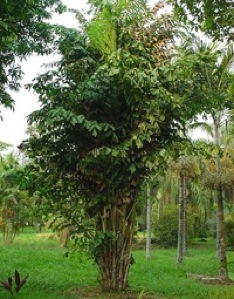
Multi-trunk fishtail palm
Caryota urens is the Fishtail Palm, so called because the bi-pinnated leaves resemble the back end of a fish. Urens means “stinging” and the fruit does contain a chemical that does sting. That said, the kernel of the fruit is edible but it has to be cleaned completely of the stinging outer flesh.
One of the odd thing about the genus is when it fruits the trunk the fruit is on dies. The single trunk Caryota urens grows fast and lives to between 20 and 25 years old but when it fruits, that’s the end of it, though it can take years to die. The multi-trunk species, Caryota mitis does better and grows a source of more trunks. But, they too die, fruiting from the top down.
As a forager I am used to being told this or that species is toxic. This was one so-called toxic plant that was true. However, that did not keep natives from using this palm. The primary product of the genus is a sugar substitute called kitul honey or jaggery. The juice from the flowers is boiled in a large wide-mouth vessel making golden syrup. The fruits have raphides of calcium oxalate and are not eaten. The seed kernel is edible, however.
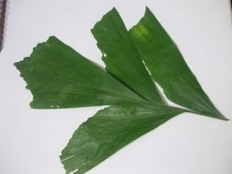
Fish tail looking fronds
The growing tip of the palm is also edible as is the palm heart. The sap can also be fermented. Leaves are used for animal fodder, being 2% protein and 9.3% fiber. The sheathing leaf bases provide a strong fiber for brushes. Wood is used to make spears and used like gutters or pipes to carry water.
There are about 15 species of Fishtail Palm, C. urens is used the most. C. mitis has become an invasive in Florida. The botanical name, Caryota, (kair-ree-OH-tuh) is from Greek and means “nut.” Urens (UR-ens) means burning. Mitis (MIT-iss or MY-tis) means soft, referring to the sheathing leaf bases particularly found on the smaller species.
Green Deane’s “Itemized” Plant Profile
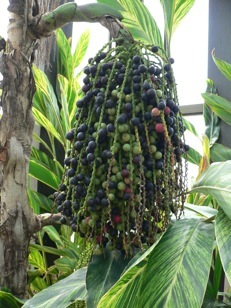
Seed pulp is toxic, the kernel is edible
IDENTIFICATION: Fronds resemble fish tails. Inflorescences can grow to 10 feet long emerging at the nodes, from the top of the palm down.
TIME OF YEAR: Fruits after 15 to 25 years then continuously until it dies.
ENVIRONMENT: Prefers rich, moist soil and much sun but can tolerate some shade and dry conditions.
METHOD OF PREPARATION: Sap is boiled into a syrup or fermented into wine or a spirit. The growing tip of C. urens is edible as is the heart and young leaf shoots cooked. The seed kernel of both are also edible but the pulp of the fruit of both is not. The bud of the C. mitis is edible after cooking but remains bitter.

Dont some folks also make jewelry out of the mature dried seeds? Again thanks for the good info
What do the seeds taste like? Do you have any pictures of the prepared sees. What is the best way to remove the pulp from the seeds? Is there any histical information about how the seeds are eaten or recipes for using them.
The seeds burn your mouth. They are not eaten, per se. The seeds have to be cleaned of all pulp and then the kernel removed.
are these trees toxic for dogs if they eat the berries
I would think so.
If you eat a single berry, what can happen?
Your mouth will feel like it is burning. Lime juice might help, or lemon juice.
Donald Trump, both our Golf Course, and promised to do something nice, and give value to our property’s, here in south Florida. fortunately he is planting this type of trees to block our houses, and day light in our back yards. Can this plants be dangerous to our kids and pets?
No way!!!! Donald Trump did something to hurt someone? Can’t be true! :-))
I have four trees in my garden in Kathmandu , Nepal. And there are lots of seeds from two years back. My trees is almost 25 years old. But i don’t know for what purpose it uses and how to remove or the clean the seeds from pulp. If hand is used it burns. So please write me the best way to remove the pulp from the seeds?
When I was a kid a long, long, long time ago, the school had plenty of these palm trees. Of course, once the kids found out that the ripe berries could be weaponized.. The palm trees were chopped off day after a messy recess full of crying children with purple stains all over their uniforms.
All it takes is to pull a berry, gently squeeze it until a drop of the juice oozes from the part that was attached to the stem, then surreptitiously smear that liquid on someone’s skin. The moment they try to rub it off seals their fate. Within minutes you develop a rash along with an itchy and burning sensation akin to being stung by a horse fly.
I ate fishtail palm seed, and it was a memorable lesson. The shell of it came off like a liche, and the fruit that surrounds the seed is delicious. I tasted it and then I popped it into my mouth and started to strip the fruit off with my teeth and spit out the seed (ironically, the edible part). I immediately noticed a light stinging in my mouth, but not bad. It reminded me of the leathery skinned grapes my mom likes, which would burn around my mouth when I was a kid. But I knew something was up quickly when I began to feel stinging itches all over my arms, back and chest. It came on within 15 seconds of spitting out the seed. It came on gradually, but quickly became unbearable within a three or four minutes. Luckily, I was at an event with a medical tent 20 yards away and walked right there, and within a few minutes they had given me a Benadryl and began rubbing my skin with anti itch cream. I spent about 10 or 15 minutes lightly rubbing my skin constantly because of the stinging itches as the medicine gradually took the sensation away. If you crave adventure or are just a little masochistic, a ghost pepper challenge is way more fun.
i will call you out as this is not possible unless you got the juice on you body
Heart of palm with palm oil makes a gud sop