
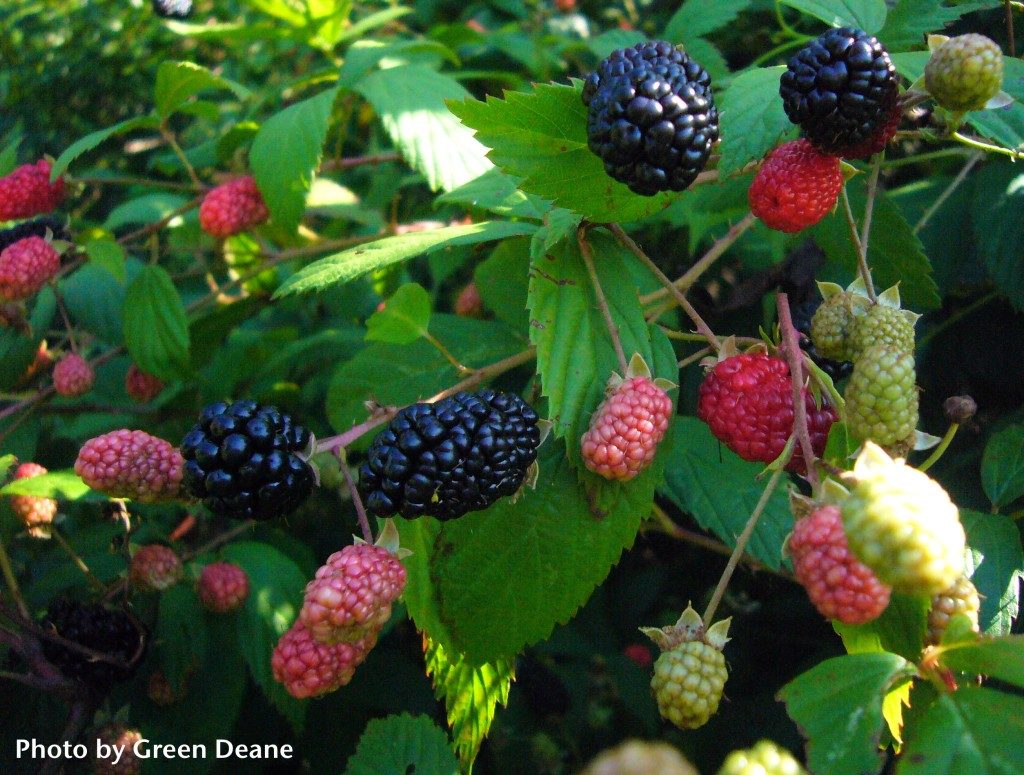
The center core remains when blackberries are picked making them slightly bitter. Photo by Green Deane
Blackberries: Robust Rubus, Food & Weed
Anyone who forages will eventually collect blackberries and blackberry scratches. These aggregate fruit are among the best-known berries in North American, if not the world.
As a kid I can remember collecting wild raspberries long before wild blackberries, though I don’t know why. Blackberries are standard foraging fair (see my article about Dewberries.) What most people don’t know is that blackberries are a two-year plant, some say three years. The first year it sends up a tall cane, replete with thorns. The next year it flowers and has blackberries then dies. Some would add that the cane stays on another year and with its thorns to protect the patch. (I should add though that there are some naturally thornless blackberries.)
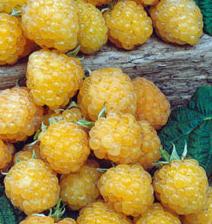
Ripe blackberries can be yellow or red but usually they are black.
Blackberry leaves were in the official U.S. pharmacopoeia for a long time treating digestive problems, particularly diarrhea. Their dried leaves make an excellent tea even when you’re healthy. We presume blackberries have been eaten for thousands of years by native American tribes and used medicinally. The ancient Greeks considered the species good for ailments of the mouth and throat and for treating gout. Interestingly blackberries were found in the stomach content the Haraldskaer Woman, an iron age bog body found in Denmark in 1835 but killed around 500 BC. Her last meal was millet and blackberries. Scholars think her death was probably a religious ritual. The millet would have been standard Iron Age fare. Maybe the blackberries were a special treat. Those blackberries would have also put her execution in early summer, perhaps to ensure a good fall harvest by appeasing an agricultural god.
For all their antioxidants and vitamins blackberries will mold within a couple of days of picking if not refrigerated. Do not wash until time of use because that, too, promotes mold. They ripen around June in the south, July in the north, give or take a few weeks. Locally they can be ripe by early May or totally past season by the Fourth of July. Picked unripe berries will not ripen. Black berries are also a good source of potassium, phosphorus, iron, and calcium. The seeds have Omega 3 and 6 fatty acids. Blackberry buds can be used as a flavoring like capers.
Insects and wildlife like the blackberry as well. This includes honeybees, bumblebees, Little Carpenter bees, Nomadine Cuckoo bees, Mason bees, Green Metallic bees (my favorite) flies, wasps, small to medium-sized butterflies, skippers, hairstreaks, and several species of moths. Fowl like the berries such as the Greater Prairie Chicken, Wild Turkey, Bobwhite, Ring-Necked Pheasant, and various mammals from the bear to rabbit. In fact I recently saw a rabbit nibble on blackberry along a local bike trail.
 In the rose family, just how many species of blackberries there are is anyone’s educated or non-educated guess. Some argue a few species with a lot of varieties and others argue for 250 or so species. Generally, ones that crawl are in one group and those that form canes are in another group. Then there are numerous unintentional and intentional hybrids, such as the Loganberry, Youngberry and the Boysenberry. Even the raspberry is a Rubus. The name, Rubus (ROU-bus) is the Dead Latin name for the blackberry and it means red hair. There are several native local species. R. argutus, R. cuneifolius, R. flagellaris and R. trivialis (see the above Dewberry entry.) The ones I harvest annually I think are escaped cultivars in that they produce large, sweet berries consistently year to year.
Russia grows most of the world’s commercial blackberries, some 24 percent. Next is Serbia and Montegegro at 23%, the United States with 13%, Poland 11% and Germany 7 percent. Blackberries are native to every continent except Australia and Antarctica. However, in Tasmania and Australia the species are officially noxious weeds. Think about that: And edible plant on the noxious list. Must not be too hungry in those countries. In 2003 the Blackberry, Rubus occidentalis, became the official fruit of Alabama.
Lastly there is one interesting note about aggregate fruit. At least one expert says 99.99 percent of aggregate fruit are edible (such as blackberries, mulberries, logan berries et cetera.) Personally I would have liked to have seen listed the non-edible .01 percent.
Green Deane’s “Itemized” Plant Profile
IDENTIFICATION:
A woody shrub with canes that grow up but often bend over sometimes re-rooting. The canes grow the first year and fruits during the second year, then they die. Canes are 3-6′ tall/long; green at the growing tip, elsewhere brown or reddish brown with stiff prickles, straight or slightly curved. Can be an inch through at the base. Leaves alternate, usually trifoliate or palmately compound; long petioles. Leaflets up to 4″ long and 3″ across; can be twice as long as wide. Leaflet is usually oval with coarse, doubly serrate edges; may have scattered white hairs on the upper surface, lower surface light green and hairy. Flowers, to an inch across, have 5 white petals and 5 green sepals with pointed tips; Petals longer than sepals, rather rounded, often wrinkly. Numerous stamens with yellow anthers. Blooms late spring to early summer for a month; little or no fragrance. Drupes, actually aggregate fruit, develop later in the summer; ¾” long and 1/3″ across,size varies with moisture levels. Berries at first white or green eventually turn red then black. Seedy, sweet.
TIME OF YEAR:
Depending on climate, spring to late summer
ENVIRONMENT:
Full sun, neither too wet or too dry, mesic conditions
METHOD OF PREPARATION:
Numerous:; Fresh, frozen, canned, used for wine, making ice cream, juice, pies, jelly, jam, and best of all when eaten fresh on the trail. Dry leaves can be used for tea. Leaves can be dried as is or fermented which improves the flavor significantly. Fermented or not they should be dried. Young shoots can be peeled and boiled in one or more changes of water. Running the fresh leaves through the rollers of a pasta machine is a good way to crush them for fermentation. Buds used like capers.

I eat them fresh off the trail also. I sometimes see someone with a cut open plastic milk jug full of Blackberries tied to a bungee cord around their waist. If you ask what they are using them for, the answer will almost always be pie.
The green stems of the Blackberry Briar/Bramble can be used to make woven baskets but I have found that it is more trouble than its worth dealing with removal of the thorns first. A good set of thick gloves and a knife to scrape off the thorns. Even then it is hard to escape the briars/brambles unstuck and they are vicious.
hello w Im new to blacberries Id like to know if they need to be stemed before using them in a cake?
No, Blackberries do not need to be cooked before used in cakes or muffins et cetera.
No, you do not need to remove he middle section as you do with raspberries.
The middle comes with the blackberry when you pick it (and we eat the core.) When we pick the raspberry the cores stays with the plant.
If I send you a picture of a wild berry plant, (grown in nys), can you I.D. it for me?
I was on a bike trail the other day and I believe I came across some blackberries, but I was uncertain if it could’ve been a poisonous look-alike.
Hmmmm… leaflets for three, five and sometime seven, aggregate berry, spines… can’t think of any toxic look-alikes. I have read that 99.99% of aggregate berries are edible.
Hey Deane, what if you are harvesting the leaves in the spring before the flowers or berries set in?
As long as you dry them, no problem.
I can’t think of any poisonous look-a-likes of blackberry either, all species in the Rubus genus are edible. The only thing I can think of that might be close is poison ivy, but that doesn’t have spines or aggregate berries.
As a Seattleite, I have a love/hate relationship with blackberries. Himalayan blackberries are very invasive, and of course they are spiny. They fill in the undergrowth of forests making it hard to navigate off-trail. On the other hand, they produce some of the sweetest, juiciest fruit, and are abundant and easy to ID. Many of the blackberry bushes are being cut down in the city and replaced with native plants. The restoration ecology educated side of me rejoices in that; the foraging peak oil side of me is saddened that such an abundant source of urban food is being taken away. 😛
I live in Oregon. We have the same problem with Himalayans. They were an invention of Luther Burbank. He wanted big berries, easy to grow. They choke out our native Rubus, which is a crawler, blooms now and is,ripe in July. Smaller berries, better flavor. Not that I’m complaining about Himalayas to eat. We made pie and jelly. And just ate them. I wish I could get the roots out. I wonder how.
For Tenn. So es 6&7 it is by the 4th of July that I go looking for blackberries. If drought I go sooner.
That should be zones 6 & 7.
Green Deane, I was hoping you could help me with a brambly vine I came across on the edge of a wooded area in Plant City. The leaves were oval shaped, shiny and bright green, no teeth or lobes, but with fine, almost invisible hairs on the top and bottom, and thorny stems. I couldn’t find any buds, flowers, or fruit so I can’t help there…What would your expert guess be? I’ll keep researching in the meantime.
Oops I should have added they were in leaflets of three. No 5 or 7. At first I thought it was a poison oak but they never have thorns…or so I’ve been taught. Any thoughts would be appreciated!
A pciture posted on the Green Deane Forum would help.
Look at Greenbrier Smilax . It has tendrils and thorns. See if that is what you got.
Thank you for the explanation on what makes blackberries bitter. My son just brought in some thornless blackberries from a neighbor and they tasted absolutely terrible. However, if you simply roll them around on your tongue to get all the berry bits off the core and spit that part out, they are quite tasty! But still not as tasty as the wild blackberries we’ve also been picking and freezing.
I’ve got a mess of Himalayans growing on my property, that I’m slowly trying to eradicate. Or at least get under control! I’ve been making cobblers and jam for the past few weeks.
Have you ever dried the fruit to use in tea?
When we were children (in the late 1970s/early 80s) my mother would keep my brother and I busy picking blackberries all summer. She’d boil them down into a sort of concentrated pudding called “kunkalink” (sp?), most likely from her RussianLatvian grandmother. Sadly, my mother died very young, and so I don’t have the recipe. If anyone out there has a recipe for a traditional blackberry pudding I would love to have it.
I’m amazed that anyone would have any difficulty at all recognising blackberries of all things. They look (and taste) more or less the same everywhere. In some parts of Europe, brambles are the dominant plant by default in hedgerows and untended land. Ubiquitous and delicious!
It’s the second week of Sept & still blkberries! I juiced the last batch & got 2-qts of the best thick juice. I was tempted to make cider,but oh well. I did notice it was constipating which accounts for its ‘medicinal’ use,of course I probably drank too much at one time,close to a full glass. Like Pooh bear in the honey pot! I used a champion juicer which removed the seeds….& good oils,but did not have to remove seeds from my teeth for a week!
We have a patch of wild blackberry growing on the boundary of our property. Every year it flowers, sets fruit and starts to ripen and then the fruit dry out, go brown and eventually fall to the ground. We have only ever had about 2 edible blackberries. Today we inspected some dried berries mroe closely. One had some sort of worm or caterpillar in the core and the others were bug free but they were dried right through and brown in colour. Any ideas what could be causing this and why we aren’t getting any berry crops? Incidentally the foliage is lush & green.
Hi Nina, not sure if you’ll see this because it’s so long after you posed your question. I would guess that what your blackberries need is more bees! If you have healthy, flowering plants, and fruit starts to set but then dies, it’s likely that those flowers were inadequately pollinated and the plant basically discards them. If you don’t want to keep honeybees, you might consider raising Mason bees, which are early (before most bees are active) and wonderful pollinators.
Thank for leaving this reply, even well after the original comment, as it helped me! I have bush cherries planted, and we keep having this problem. (I *thought* we had plenty of bees — my kids step on them! — but maybe not enough to keep up with the dandelions, clover, AND cherries!)
Thanks for answerring. Another year has gone by and this seasons fruit have done the same thing. Flower, set fruit, plump up and go red then drynout and die before ripening. The vege garden isn’t far away and all my tomatoes have ripened, plenty of pollinators seen buzzing around and even added a butterfuly and bee friendly flower garden just a few metres away but same thing is happening.
Here in East Texas there are three types of “blackberries.” The dewberry which trails along the ground, a smaller upright blackberry which we call mixed berry and the blackberry which usually grows in damper locations on erect stems. In days gone by it was easy to find terrapins around the berry patches but now the coyotes have decimated the population.
I live in rural Ga., and love wild blackberries. In the part where you discussed the wildlife that enjoyed eating blackberries, you didn’t mention snakes. My grandfather always used to warn me as I picked the berries: “Now, snakes like blackberries, too, so watch where you step. Rattlers in those bushes!” So stomp as you enter thickets to reach the tastiest ones, and walk slowly so the snakes will have time to exit.
If you want your wild food harvest to last more than a few days, dip them into Fresher4Longer. This natural antimicrobial is made from essential oils from ordinary herbs and spices and kills the fungi that make fruits and vegetables rot.
Food I forage include mulberries (black and white) and a host of wild Australian fruits – Illawarra plums, riberries, bunya nuts, midyim berries, warrigal greens and more. They produce in huge quantities as most are trees or productive shrubs and so storing part of the harvest is the norm.
Dipping in Fresher4Longer vastly improves the shelf life and preserves the nutritional quality, sometimes for months for chilled fruits. It is also brilliant on store-bought cherries, strawberries, melons, fresh herbs and salad greens.
I have many fond memories about blackberries from my childhood in Oregon. They would grow in every hedgerow along with the poison oak so harvesting blackberries came at a price but that did not stop my mother from send us kids out to pick as many as we could and she made the best pies, jellies, and sauce out of our harvest. She would always freeze some of the sauce so we would have something to put on vanilla ice cream when it was out of season. Flocks of cedar waxwings would descend on the bushes when the berries had fermented in the sun and get drunk such that they would fly into the side of our house. We would leave them alone and soon they would fly away. I also remember that my mom always soaked the berries in cold water for awhile before doing anything with them and we were always amazed by the number of small insects that floated to the top of the pot after hiding in the lobes of the berries. I supposed they were harmless protein when eaten off the bush.
Can you pick blackberries (early) while they are red and then have then ripen off the vine? Or do they really need to ripen on the vine?
I am having a bumper crop this year !
They do not ripen well off the vine. The color may change but they do not sweeten.
I have several acres of Himalayan blackberries at my home in Skamania county, Washington. They produce new plants by seeds or from their roots (rhizomes). These are locally considered a curse which requires a lot of effort to control.
But the berries are good.
Hi, I live in the UK and we tend to have blackberry bushes in abundance on wasteland. I have fond memories as a child of picking blackberries and my mother making pies and jams from them. I have always carried on this tradition only now I’m not only picking the berries but its me that’s making the jam. There is nothing more satisfying than having picked your bounty for free, cooking the berries and the wonderful aroma of warm blackberries filling the kitchen, then when the washing up is all done, seeing the jars neatly stacked away and knowing that you have this harvest treasure to fall back on all winter. In the UK this year we seem to have had a bumper crop but its sad that many people don’t seem to be picking them, maybe jam making has gone out of favour? I think home made is certainly better than shop bought and I will always continue to make jam.
i forage for for (in order in which they ripen) wild strawberries, sweet cherries (risky biz though…very wormy), wild eastern black raspberries, wild red raspberries ; wild blackberries, wild spiny gooseberries and wild elderberries.
a perfectly ripe, eaten right off the bush blackberry is one of the sexiest fruits i’ve ever tasted…its a shame blackberries are cultivated poorly year round and shipped everywhere… gives them a bad name…when a perfect specimen tastes like cotton candy!!! (southern ontario)
I read on the Guardian that the blackberry leaves are edible raw, what do you reckon?
Thanks!
I think they are better dried.
Is that the only reason for drying them? We just made blackberry tea last night from freshly picked leaves and it was delicious. …but now you have me wondering, could that bad for our health?
Hi, I was wondering about raspberry shoots. I’ve read that when peeled, wild raspberry shoots are edible – have you tried this? As well, is the same true for ‘domesticated’ raspberries?
Thank you 🙂
Yes, peeled raspberry shoots are edible…. but I think that is the opinion of someone who has spent a winter without fresh food….
Here in the Puget Sound region, Himalayan (Chinese/Asian/etc.) Blackberry is on County and State noxious weed lists because it is a true curse on the land, rapidly choking all pasture, streambanks, road margins, and backyards with thorny canes, outcompeting everything and destroying all other plant life, even English Ivy. It only takes a few years for impassible Blackberry thickets to completely cover undefended ground.
The plant is horrible even though the berries can be delicious (some cultivars produce better berries than others).
Since much of the plant is subsurface, it cannot be removed by weeding or mowing or burning unless those are repeated meticulously every few weeks for several years.
Only chemical weeding is effective. The best agents combine triclopyr and 2,4-D with a detergent or solvent (avoid glyphosate/Roundup; it does not bother Blackberry). I recommend “Crossbow” brand herbicide. It is properly applied selectively to Blackberry leaves and canes in the late spring on days when rain is not expected.
I myself have never found it necessary to use chemical poisons on BlackBerry patches. A pair or more goats will take care of them with minimal maintenance. There are folks out there that will rent goats for that purpose even. As to the plant itself, the berries are indeed excellent. The taste will vary from habitat and such. Also the first year shoots can be peeled and eaten either raw or blanched. The leaves are very high in protein and good for the goats (they eat stem, leaves, thorns and all). The leaves can be used for a tea and the root bark can be used to stop diarrhea. So if my book, Himalayan BlackBerry in one awesome plant, if consciously controlled. llamas will also take care of the BlackBerry and are easier to fence, but perhaps slower than the goats. Blessings all.
I’ve been using a combination of goats and digging with great success. Because the goats eat everything I don’t let them in certain areas. In those sections I dig down and remove the crown. It’s labor intensive, but beats poison any day.
People think pigs are the scavengers of the world. Pigs can’t hold a candle to goats. They are the champs (but they are allergic to avocados.)
Has anyone heard of blackberry scratch poisoning? I had a knot come up on my arm where I had been scratched while picking berries. It is the size of a half dollar now and very hard. I haven’t found any thorn in it. Have put antibiotic ointment on it but hasn’t gone away for a week now.
hi,
I once was picking a plant and got a rash, and found out it was not THAT plant, but another, or a bug. I then went back to the spot it happened, and found a bad plant. it was so long ago, I don’t remember the exact details.
hope this helps!
Is the white in the center of a blackberry safe to eat or is it some sort of mold. this is the first time I have noticed it. I bought them I a grocery store. Thank you
The white center is edible but bitter.
Hi Deane!
I have thorny vines with three leaves in my field, but the leaves are red. It’s winter (well, it’s spring weather in the middle of “winter”…), And my husband is confident these are blackberry vines. I want to harvest the leaves for tea, which I think is done in spring, and I also want to yank them out of the ground and start planting them along a fence.
I just can’t find information about wheterblackberry leaves turn red in the winter. I am sure these are not Virginia creeper, which we do have, and because I don’t know much about marijuana, I always notice the Virginia creeper thinking it’s something else and worrying that a SWAT team is going to parachute out of helicopters and take me to jail. But I’m glad it’s just Virginia creeper! It’s also not greenbrier.
My daughter found a long cane in the field, but most of it grows right at ground level like strawberries or something.
Am I on the right track thinking this is blackberry? They do grow elsewhere nearby in actual thickets…I guess I should check to see if their leaves are red.
Still waiting for your book – even just collated print outs of your webpages would be awesome! You are my very favorite forager, and your work is very valuable to myself and my family.
Thanks!
Thanks… Yes, blackberry leaves can turn red in the fall.
Is it possible for blackberries to grow on a tree? My neighbor has a tree that keeps dropping what looks like blackberries and making my driveway and house dirty. Jusy wondering if they might be edible ? There might be some poison ivy there as well.
Those are not blackberries. Those are probably mulberries. I have an article on them.
We found blackberries growing on our property a few years ago- really nice, plump berries bigger than my thumb. I don’t bother too much anymore with trying to make the area more manageable. I pick them when they’re ripe and make jam- the seeds are so big and hard, it’s the only way you can enjoy them. Last year we found a large area along a fence on our farm that looked to be blackberries plants but I never even went back to check later in the summer- too busy and forgot.
We just checked them yesterday and they are LOADED with almost ripe berries- they have reached the darkest red before they turn black. The only thing is that these are very small- like the end of my pinky small. Are they blackberries? Poisonous? Everything about the plant and leaves say “blackberry” but I’ve never seen them this small. There are literally thousands of berries on the plants. Just small blackberries? So many that they didn’t get bigger? I’ve been searching on line and none of them look this small. They are not raspberries- we have those, too.
Hello, Could someone please tell me if the white flowers from the blackberry Bush are edible? All I can find anywhere, is that the berries and leaves are, I can’t find any info on the flowers! Driving me a bit mad to be honest. Lol I can’t find them listed on any edible flower lists, so I’m assuming not but I can’t think why they would be poisonous…. Thanks ?
They might have a little cyanide in them.
Hi Dean!
Can blackberries climb 8-12 feet up through a tree? Not much vining/winding, more cane-like, but very much above 6 feet. It looks like blackberry leaves and flowers and has thorns.
Yes.
Can you dehydrate blackberry leaves and use them in a green smoothie powder? The same as raspberry leaves?.
Yes. But dehydrate them first.
Can you eat the Himalayan blackberry canes in spring when the new shoots are soft?
Knoxville TN. Zone 6 & 7. In 2021 berries are ripening around July 4th. And the chiggers are too. I’m freezing a lot of berries this year and drying a fair amount of leaves and stems for tea.
The only poisonous aggregate in North America is Goldenseal. It’s an aggregate, but has 2 seeds in each little berry rather than the 1 seed in each druplet in blackberries. It has a completely different growth form than that of Rubus species, even the leaves look different. Also you wrote that “In 2003 the Blackberry, Rubus occidentalis, became the official fruit of Alabama” and that specific species is the Black Raspberry. Great post love your work.
hi, can you share your method of fermenting blackberry leaves for tea?
I think the process is to crush them with a roller and let them sit.