
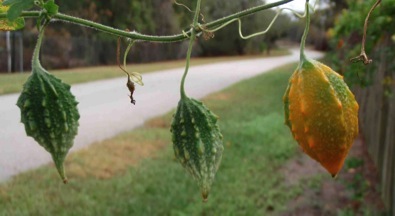
Bitter Gourd, edible only when green and cooked
Bitter Melon, Bitter Gourd, Balsam Pear: Momordica Charantia
If the Balsam Pear did not exist a pharmaceutical company would invent it. In fact, there have been some ten studies published this past year about it, the latest as of this writing in February 2008 in the Journal of Food Biochemistry about its potential in diabetes treatment.
A very common, bitter vegetable in Asian cuisine, the Balsam Pear, Momordica charantia, is a natural drug store for diabetics and others. It’s not a pear at all but a fruiting gourd and vine that smells like an old, well-used gym shoe. Don’t say you weren’t warned.
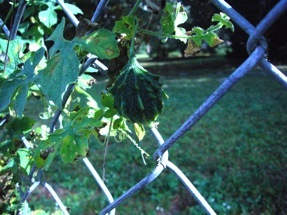
Young, green fruit are edible cooked
The warty gourd is edible when green (and cooked) but turns toxic/medicinal when orange ripe. It then splits characteristically into three parts, revealing red arils (fleshy seed covers). The ripe seeds inside the arils and orange flesh of the gourd are toxic and can make one violently lose fluids from both ends, and induce abortions. The red arils around the seeds, however, are edible. And note this: The arils are 96% lycopene, which gives them their color. Just remember to spit out the seed from each aril.
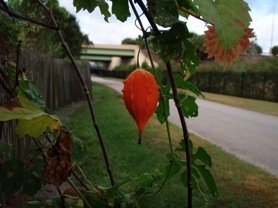
Fruit is toxic (or medicinal) when yellow or orange
M. charantia is found Connecticut south to Florida, west to Texas, also Puerto Rico and the Hawaiian Islands. Incidentally, the bitter melon has twice the potassium of bananas and is also rich in vitamin A and C.
The Latin genus name, Momordica, (mo-MOR-dee-ka) means “to bite,” and refers to the jagged edges of the leaves, which appear as if they have been bitten. Charantia (char-AN-tee-ah) the species’ name, comes from Greek meaning beautiful flower. It’s native to tropical regions of the world though no one knows where it came from originally, best guess Old World Tropics. Gray’s four-inch thick Manual of Botany, started in 1850 and revised in 1950, makes no mention of M. charantia in the United States but it is currently a serious crop weed in Florida and to 21 other crops around the world, bananas to soybeans. It’s a late comer to Florida or Gray was in the dark about it. In the Amazon, and as far away as India, it is used very much by local populations for food and medicine. Apparently a dynamic chemical factory, the M. charantia is being tested for treatment against cancer — leukemia in particular — AIDS, as an analgesic, and to moderate insulin resistance. It is often called the vegetable insulin. It does not increase insulin secretion but “speeds up carbohydrate use of the cells by affecting membrane lipids.” Seems like the smelly gym shoe hanging on the fence has a great future. But, it is not for everyone: Don’t eat the vegetable if you’re hypoglycemic or pregnant. In diabetics it can lower blood sugar too effectively. It also reduces fertility in men and women. And, it contains vicine: That can cause favism in people who have a variant glucose-6-phosphate dehydrogenase. (I presume if you don’t know what that is you don’t have it. Favism is a severe reaction to fava beans and or their pollen. Occurs most often in men of Mediterranean background.)
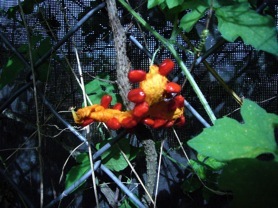
Red coating on the seeds is edible raw, but not the seeds
Cultivated versions of the M. charantia, also called Bitter Gourd or Wild Balsam Apple, are found in most Asian markets, and they, too, smell like an old gym shoe. The odor, thankfully, almost all goes away when cooked and the bitterness moderates, but does not go away completely. If you are not yet brave enough to pick your own, you can buy some or grow it yourself. There are many varieties and numerous recipes are on the Internet. The M. charantia is indeed bitter. Some cut up the vegetable and soak it in water, or salted water and or blanch it to reduce the bitterness. (See recipe below.)
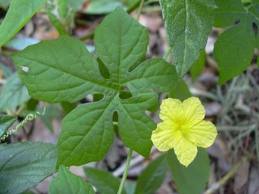
Bitter Gourd leaf and flower
While I have never seen an Asian family picking M. charantia off local fences here in Florida, I have seen many Hispanic families doing so. Dr. Julia Morton, a plant professor in south Florida, says besides the green fruit, the young leaves when cooked and drained are also edible and nutritious, with iron, phosphorous, calcium and vitamin C. I have never managed to get past the locker room bouquet to toss ‘em in a pot. The ripe fruit pulp has been used as a soap substitute, which should give you some idea of the flavor. In India and Africa the cooked leaves are canned like spinach. The fragrant flowers can be used as seasoning when cooking.
Incidentally, if you have a glut of green Bitter Gourds, you can slice them, partially boil them with salted water, then dry them, sun or otherwise. They will last for several months. You can then fry them and use as you like. Also, drinking the fresh bitter juice is recommended by some naturopaths. That ain’t going to be easy, it’s really bitter…. much easier to tell someone to do it than doing it yourself. Also there is one report that drinking vine juice killed a child. Caution is called for.
REMEMBER: From my point of view as a forager no part of the Momordica charantia is to be eaten raw except for the red arils (and remember to spit the seeds out.) No part, other than the arils, is to be eaten when ripe which is when it is turning from green to yellow to orange. Do not eat the yellow or orange fruit raw or cooked. It is medicinal and or toxic. That said let me qualify it some: I have met folks who eat the orange flesh raw and cooked but they have various medical goals which is beyond my pay grade and expertise. For that visit some herbalists publications or sites. Lastly, the green fruit is suspected in the poisoning of dogs and pigs.
Relatives: Momordica balsamina, which has longer spines on the fruit and can ripen to red, grows only in St. Lucie County in Florida and only a smattering of places in the southern U.S. M. balsamina fruit can be pickled or after soaking used as a cooked vegetable. Young shoots and tendrils are boiled as a green. The seeds are eaten in cooked young fruit. Momordica cochinchinensis produces a huge round fruit that is red when ripe. Young fruit boiled, not as bitter as M. charantia. Momordica dioica, small and roundish, is more esteemed than the rest. It is not bitter but sweet. Fruits, shoots, leaves and roots are boiled for food. There are also at least seven commercial cultivars of the Momordica gourds
Green Deane’s “Itemized” Plant Profile
IDENTIFICATION: Momordica charantia: A slender, climbing annual vine to 18 feet with long-stalked leaves and yellow flowers where the leaf meets the stem. Young fruit emerald green turning to orange when ripe. At maturity, fruit splits into three irregular parts that curl backwards showing many reddish-brown or white seeds encased in scarlet arils.
TIME OF YEAR: Fruit, summer and fall in warm climates, fall in northern climes.
ENVIRONMENT: Love to climb, found in hammocks, disturbed sites, turf and ornamental landscapes, and citrus groves . It seems to be the most common vine on chain link fences in Florida.
METHOD OF PREPARATION: None of it ripe except the arils. Boiled green fruit (including seeds) leaves and shoots, boiled twice. Or, cut open and remove seeds and fiber and parboil. Ripe parts toxic are too bitter to eat. (An adult can swallow hole two ripe seed and not have much distress.) Young leaves and shoots are boiled and eaten as a potherb. Flowers used as seasoning.
HERB BLURB
Herbalists say the charantia has long been used to treat diabetes and a host of other ailments from arthritis to jaundice.
Karela Bhaji (Pan-fried Bitter Melon)
By The Domestic Man
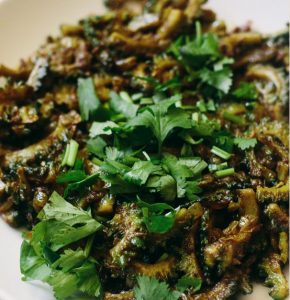
Karela Bhaji Pan Fried Bitter Gourd
1 lb Indian or Chinese bitter melon
1 ½ tsp salt, divided, more to taste
1 tbsp ghee
2 tbsp avocado oil
½ tsp cumin seeds
¼ tsp fennel seeds
1” ginger, grated
2 cloves garlic, minced
1 onion, finely chopped
½ tsp garam masala
½ tsp ground coriander
¼ tsp ground turmeric
¼ tsp kashmiri red chili powder
¼ tsp black pepper, more to taste
1 tsp amchur (green mango) powder
2 tsp coconut palm sugar
½ cup chicken stock
fresh chopped cilantro to garnish
1. Slice the bitter melon in half lengthwise; using a spoon, scrape out and discard the seeds and pith. Slice the melon into ¼” slices, then transfer to a colander suspended over a mixing bowl; sprinkle with 1 tsp of the salt and drain for 30 minutes. Gently squeeze and blot the melon dry to extract some of its bitter juices.
2. Warm the ghee and oil in a large skillet over medium-high heat until shimmering; stir in the cumin seeds and fennel seeds, and toast until aromatic, about 30 seconds. Stir in the garlic and ginger and saute until aromatic, another 30 seconds, then reduce heat to medium and add the onion, coriander, turmeric, chili powder, pepper, and remaining ½ tsp salt. Saute until the onion is softened, about 6 minutes. Stir in the bitter melon and chicken stock, and saute until the melon is tender and the liquid has mostly evaporated, about 10 minutes, stirring often.
3. Stir in the amchur powder and sugar; increase the heat to high, and pan-fry until any liquid has evaporated and the melon and onions begin to crisp, about 3 minutes, stirring often to prevent burning. Season with salt and pepper to taste, then serve garnished with cilantro.

My Jamaican neighbors know this plant as “cerasse”. It is sold in Caribbean stores for about $2 or less. They either buy it, grow it themselves, or forage for it in vacant lots. They claim that tea from the vine and leaves (without ripe fruit) is good for whatever ails you, but it’s EXTREMELY bitter! No amount of sugar can change the taste. Personally, I only drink it if I am really sick, but it serves its purpose. Thanks for the great article, just please leave some vines out for other foragers!
My Jamaican neighbor taught me about Cerasse, and I drank the tea for awhile, heavily flavored with lemon and sugar. They use it as a tonic. It is said to be a vermifuge, meaning it kills intestinal worms. I must not have any, because it didn’t do that for me. She also said they sucked the seeds to get the red off, much like we do pomegranate seeds. She didn’t say anything about eating the green fruits, so I don’t suppose they do that. I read that you have to take the seeds out of the green fruits to eat them, which is a lot of trouble.
Who ever wrote that you have to take the seeds out of the immature green fruit before cooking is wrong. As for pomegranate seeds I eat the entire seed, always have, more than 60 years now.
There are many species and varieties of the genus Momordica. I suspect that some of them may possess seeds which when ripe are toxic. Momordica charantia or the actual large leaf chinese or indian bitter melon is not the usual species found in the Caribbean islands. There and in Panama there is a much smaller leaved and fruited species: Momordica balsamina whose green pods are used in stir fries and curries. The green leaves, vines and tendrils are made into a tea said to be effective in enhncing the ability of naturally produced insulin to control blood sugar levels in diabetics. More at comment no. 57.
I just stumbled on this site and read the comment. I almost fainted from laughing too hard. Don’t put sugar in the tea, put a bit of “salt” in it, not sugar. Hope you read this.
I’ve been looking for this for a long time now. Where is the location of the Caribbean store?
Locally the bitter gourd can be found in all Asians markets. I would check out the produce section of your nearest large Asian market.
Awww, thanks. Now this is going to sound strange, but I only want the leaves. Whose fence can I go to & get some leaves to boil for tea? lol.
I’m covered every year about this time. I have worked hard to get rid of it but it keeps coming back, it’s currently climbing my duck’s fence…. darn thing
Using a weed is the best revenge.
For tea, you can also use the rind of the green fruit. They usually have the fruit at the Food Town supermarkets. Just split the green fruit down the middle after washing the outside carefully. Scrape out he seeds and interior white pith. Cut the rind into half circles and each half circle into 5 or 6 little pieces. Boil about 3 or 4 halves worth of little pieces in about 2 – 3 cups of water for 2 – 3 minutes. After that I strain the boiled pieces off and add the water to a tea bag, sweeten with stevia and take the resultant slightly bitter remedy in the morning and evening.
How do you make tea with the leaves? Do you just boil a few leaves with water and drink it?
Do you mean 3 or 4 halfsw worth of the entire fruit? Or 3 or 4 half circles worth?
They grow everywhere in Florida. The fence in my backyard was filled with this plant and orange fruits with red seeds when opened. I made tea all the time and learned to eat the seeds from watching the squirrels doing it.
You can also find them in the Latin American grocery stores, under the “Angel ” brand. Or try cerasse / bitter gourd tea bags. Good luck!
Gilles,
If you are in Orlando, you get get a lot free as they grow profusely on chain link fences.
My back yard chain link fence is covered with this vine! Lucky me 🙂
Awesome ill have to try it cause my sugar basically never goes on the low side excellent article thank you green deane,i chew tobacco so ill see how much of the bitterness I can take 🙂
My experience is this: the wild momordica is far less bitter than cultivated varieties. Definitely a delicious vegetable. I steam them whole and then add them to scrambled eggs with garlic and ground pork. A little cilantro and some lime and you have great Thai dish.
You actually crave it’s unique taste after a bit.
Dan, do you steam the leaves or the fruit?
Deane…. I’ve always heard of boiling…
Raised on this in South Florida as a legacy of my Bahamian and Southern U.S. family lineage. Used mainly to treat colds, flu and digestive ailments – along with the equally abundant aloe and citrus. We did go to conventional doctors for more serious concerns but these were the mainstay.
Same here, James, glad to know that I’m not alone in the bitter gourd/cerrasse drinking department. I was made to drink this daily growing up, for colds, digestive ailments, shockingly high cholesterol, and anytime I looked terrible. We used to gather it from chain link fences behind the stores in the Orlando area or parking lots until someone gave us seeds. I remember I had a middle school biology teacher telling us what a horrible poisonous plant it was, and how I later told her that it was a good medicine, as a tea, and I was living proof that it didn’t kill you. She was shocked, and my classmates bullied me from then on for “drinking leaves”. Now I got tons of it in my yard, so if anyone wants some seeds, please let me know. I didn’t know the arils were edible raw, wonder if they can be added to cooked food, smoothies, etc. Thanks again, Green Deane, for a great article that brought back memories!
I ate seeds as a child –looks almost like pomegranate seeds– and have been looking for them now for over 10 yrs. We sucked the seeds only the red part is sweet and then spat the seeds out–for some reason never ate them. Would like some seeds though. I grew up in the Bahamas and know them as cerasee. Whenever we were sent to gather vine the pods were always a treat. Would be extremely grateful. Thank you so much for posting.
YHWH’hadassah
If you still have some of the seeds,I definitely would like some. I am trying to adopt a healthier lifestyle now that I’m pushing my mid 40’s.
My husband is type 2 diabetes and high blood pressure along with diabetic neuropathy, and want to try this for the qualities associated with aid in the glucose levels. If you have seeds or want to sell some I live in Bradenton Fl. Really want to give him some quality to life now as he is in such distress with daily living.
You should be able to find it nearly everywhere in Bradenton. Also the tea can be bought at most Caribbean markets.
I hope you give it a try. It actually work at reducing blood sugar it is also believed to help in burning fat. The bitterness is short lived, so it should not be an issue except if this is peculiar to the variety obtainable in Nigeria. Give a shot.
,
Found this plant growing on a wooden fence behind Doggy Day Trips dog spa in Valrico. Lots of seeds there!
My husband had trouble with peripheral neuropathy as well. After doing a lot of rescearch I had him start sublingual b-12 500mcg am. and pm. In three months the peripheral neuropathy was gone and his bad cholesterol had droped so low the doctor wanted to know what statin drug he was on. He was not on a statin drug. Thats when I remembered reading an artical and also hearing on some news program b-12 is more effective than the top statin drug.
Green Deane,
Does this tea/plant have any fat burning properties as Ayo Martins mentioned is possible?
“Ayo Martins
January 31, 2015, 3:24 pm
I hope you give it a try. It actually work at reducing blood sugar it is also believed to help in burning fat. The bitterness is short lived, so it should not be an issue except if this is peculiar to the variety obtainable in Nigeria. Give a shot.”
That’s a difficult question to answer. I think the mechanism is that it reduces gluconeogenesis, that is, it reduces the amount of glucose the liver makes.
Would like to have some fruit and/or seed to plant in my yard against the fence.
I live in Texas, does anyone know if it will grow here?
Family members have diabetes and I’m trying to find natural ways of healing ailments of the body.
Oops… I’ve been munching on the fresh leaf from time to time for over a year… never had any problem with it. I normally only eat 1 to 3 at a time but it is very very bitter and best to follow it with something a bit nicer on the taste buds. I don’t know if the raw leaf in quantity would be harmful but I’ve yet to have any negative issues from eating a leaf here and there.
Hi, I have been growing it here in Ky in a BIG flower pot on my front porch. I have had nothing but super comments about an analgesic rub I make. The instructions and first sample came from a 91 year old lady who was a friend of a friend of a friend. The plant popped open easily when I grew it in my garden a few years ago. Now it seems to dry up before popping open. When it pops open with those pretty red seeds inside thats when I take it of the plant scoop out the seeds and the immerse the pod in a jar full of rubbing alcohol. When the pod turns white, loses its yellow color, thats when you can rub it on arthritic joints with a cotton ball and be surprised by how fast and well it works. Relief Lasts for hours. My question is, If they all are drying up ,should I pluck pods from the plant before it pops open with the seeds all red, rather than let it dry up on the vine with no medicinal results?
I don’t know about medicinal uses but I do know when orange the gourd is toxic whether recently turned orange or dried and orange.
Crazy thing is today I dicovered this plant growing wild in my garden in St Lucie County, FL. I had neglected the garden for several months due to a broken foot and let everything grow wild. It’s very pretty and alien looking when it opens. I don’t have enough green one’s to try and cook them, maybe in time.
Trust me, you will have them in profusion. I love the yellow flowers. The fruit is pretty, but they take over EVERYTHING!!! I have tried to get rid of them but it is impossible on 5 acres of woods.
When i looked in my garden at my bitter melon plant, i thought someone had spray painted them because i had never seen an orange bitter melon
I have a ton of this stuff growing. Can someone direct me to a recipe. I need step by step instructions…I’m not the greatest cook unfortunately
hey i just wanted to let you know that we in Barbados and the Caribbean know this plant as cerasee bush. We also eat the seeds of the ripe fruit which is called lizard food. It is a main ingredient in bush teas for colds and flus. Love the site!
This shows up every summer in my Port St Lucie yard. You can smell it before you see it.
I too live in PSL and this disgusting plant is everywhere. There is no way that I would ever consider eating any part of this vine. I hate to even touch it to pull it out of the ground to throw in the trash, because it stinks so bad. Hopefully someday I’ll be able to rid my property of it, but it grows really well and the Mockingbirds eat the seeds and spread them around.
Two days ago I found some bitter gourd tea at a local asian shop. I tried it yesterday night and it is rather good. I find the BG tea comparable to a pale green tea. Now the interesting part is that the tea is made from sliced and dried pieces of the gourd and not the leaves.
A box of of tea was about $3.50
Interesting… tea from the leaves can lower blood glucose levels.
How do you make the tea from the flesh.
I do not know about making tea from the fruit flesh. Tea is made from the leaves.
Your Camillia-flowered Balsam is a totally different plant. Momordica charantia will grow in your area but I would start it in pots ionside and over winter its seeds.
Bitter gourd is a popular vegetable in India. Some people love it and some hate it. I hated it at first because of the bitterness (never noticed a foot smell though) but somehow got to like it, and now it has a certain compulsive deliciousness. You definitely start to crave it. Indians make all sorts of curries or stuff it, which I like, but myself, I just slice it and fry in some oil till cooked or even crispy, salt it, and gobble it up. It is the size of a cucumber, always used while green, and you cook the seeds right with it. When cooked they are nice nuts like pumpkin seeds.
We also dry it for the winter, No blanching, just slice it about 1/4 inch thick (a little less than 1 cm) and lay it out in a well ventilated dry place. It dries quickly, and for later use it soaks up quickly, and when cooked is virtually indistinguishable from fresh.
I’ve seen the little wild ones growing on the fence of a garden in Nepal.
@ becky ladakh and all the foragers, especially Green Dean; Becky you are so right. It is one of my favourite veges and yes, all the seeds can be stir fried and eaten. Perhaps the big long chinese bittergourds are cultivated and therefore less bitter. I soo wish I could come for the february session.
I have a decent sized..aggressive growing bitter melon plant in my back yard (South west Florida). I have eaten the seeds whole, raw..picked right off the vine..from an orange fruit many many times..my family as well. I also cook with both green & orange fruits..and the seeds. Not once over the past 4 years have any of us suffered any reaction or discomfort to toxins. I’m surprised to read they are toxic. Even a very small framed 7 year old boy ate them regularly..raw off the vine with ease. I was originally trying to find out if the flowers were edible (of which still no answer found). So reading this is very interesting.
Interesting. I’ve met folks quite sick from seed injestion.
We may be looking at allergic reactions here. Allergic reactions are often provoked by seeds, nuts and flowers of many different species. Someone becoming ill from seed ingestion amy be experiencing an allergy which can be just as nasty as a chemical toxicity.
Well, it is a bit confusing because you get different reports from different places. This cancer center says the red arils are very toxic http://www.mskcc.org/cancer-care/herb/bitter-melon . I tried the red arils (not seeds) and they were very sweet and I had no side effects at all. Hmm, wish the different data and experiences others have had would line up a little more. Maybe people are not talking about the same plant? I have not tried the melon, seeds or leaves yet. It would be great if it can be eaten raw and/or ripe but I think I’ll err on the side of safety for now 🙂
They don’t know what they are talking about because they are copying internet nonsense. I eat the arils all the time and have done so for years.
Since I was born in the Philippines, I’ve been eating bittermelon (Ampalaya) as one of our regular dish…yes, we call it “Ampalaya”…very true that it will cure the diabetic person…the leaves are also edible…you can stir fry them just like the other greens…very tasty! The easiest way to cook the Ampalaya is to slice them up and stir fry w/ shrimps and added some eggs (kinda scrambled) add salt and pepper to seasoned. I lived here in Japan now, in Yokosuka Navy Base…and found out that the Japanese people also planted some Ampalaya …and not only that, they like to sliced them thinly, dried and eat them like a potatoe chips…
Question, does anyone tha lives in Orlando have a bitter melon vine worth of leaves? I’m more interested in the leaves than the fruit/veggie….sorry #teamleaves lol
I have a whole lot of vines trying to take over my food forest! Looking for people who want the leaves/vines and can give me tips on how to use some too. Email me if you want to take some!
I’ve been eating bitter melon in China (where they are called ku gua in Mandarin or fu gua in Cantonese) for the last 12 years and, like Christine above, have not found them to be toxic when raw. Frying them with egg is common here too, but they are often served raw, sliced or shredded and dressed like salad. Here, raw bitter melon and cooked bitter melon are eaten for different medicinal purposes, so doctors/books/the internet specifies whether you should eat them raw or cooked depending on your ailment.
I’ve eaten two this week, both raw, but I’m wondering if you might not have a different variety in Florida as ours are much longer than in your photos and ours don’t smell like gym socks.
My Japanese and Okinawan friends all believe that the reason why Okinawan life expectancy is longer than that in Japan has to do with the enhanced use of the bitter melon in Okinawan cuisine.
In Japan these are quite a common food. Originating in Okinawa the people there eat them like fruit. In other parts or japan people cook them. I just pick em from my garden and eat em off the plant raw green yellow or orange. I highly doubt they are toxic and that sounds like misinformation or disinformation. Remember garlic is toxic and that’s exactly why it is so healthy for you. Also digesting a toxic substance is extremely different from having it put directly into your blood stream. In the example of garlic the toxins kills germs and viruses in your body. So where-ever you got your sources from about orange bittermelon being toxic you should double check from a different source, and also see if the effect of those toxins are beneficial or harmful. I see eat it like I or many others do. Many extremely healthy benificial toxins are attacked by the media in order to scare people and keep them sick so the medical industry can make big bucks. Examples are apricot, apple peach pits, seeds because they have an anti cancer agent vitamin B-17 medically concentrated it’s called Laetrille. This cures cancer the trillion dollar industry say it’s dangerous because it has cyanide but that cyanide is bound to other elements and only separates at the cancer tumour where it dissolves it.
There are different varieties as well as cultivated versions. That can account for their use in Japan.
My ex-husband would slice them thin, ‘sweat’ them with salt in a colander, rinse/pat them dry then fry the disks in ghee with garam masala, ground chili, mustard seeds, ginger (and more, I can’t remember) until they were crispy, then shake them in a bag with some salt. In the end they were like a salty, slightly bitter chip. They still had some bitterness, but it was a pleasant bitterness, like chocolate or coffee. This was the only way I found them edible…
Yeah, I’m kind of wondering where you got your information that they are toxic as well. I’ve heard many people talking about eating them when orange and raw and no issues, and I’ve read 10+ articles already, none of which mention this. One would think that if it’s true, it’d be talked about more in the gardening groups and whatnot.
Most if not all reports about eating the orange parts are from the Caribbean islands, usually in a medicinal context. My site is not about hebalism or medicine per se but edible plants. There is quite a difference between eating something expecting a medicinal effect and eating something and not expecting any effect except to have one’s appetite satisfied. I don’t recommend eating the orange parts because it is a medical application.
This is a popular vegetable here in the Philippines; the gourds I find in the supermarket are generally longer than in the picture, like wrinkly cucumbers. The variety we have here doesn’t smell at all. I’ve eaten this folded into an omelette with some crunchy garlic bits on top, and a bunch of other ways. I remember my grandmother used to make us drink horrid little “shots” of pure, fresh-squeezed juice when we were sick with a large glass of water to chase it down. The bitterness made the water taste really sweet though.
Since it’s pretty much a staple vegetable in these parts, most of the ampalaya dishes here are simple family recipes for every day use, handed down from someone’s mom or grandma or a neighbor who has a vine they want to trim down. I’ve never seen these in a cookbook, but they sure are a delicious way to clean up the garden!
Sharing a couple of recipes:
SALAD (gourd) – light, crunchy and very refreshing appetizer or side dish
* There are several variations of this floating around the web; some versions call for thinly sliced radish, some add chilies or even bits of green mango. This is the standard recipe I like to pair with a whole crispy fried fish.
1. Slice charantia gourd in half lengthwise and scoop out the seeds (carve a little half-moon at one end of the white part with a spoon and scrape it down).
2. Cut up the gourd into little half-moons and toss them in a handful of salt. Let them sit for a while to remove the bitterness.
3. Slice up some tomatoes into wedges and an onion into thin pieces.
4. Rinse off the salt from the charantia and add them to the tomatoes and onions.
5. Dress with a splash of vinaigrette.
* For best results, chill before serving. Delicious paired with something salty and savory, like fried tilapia.
BEAN STEW (leaves and stems) – a hearty, high protein dish; similar to dhal
* rule of thumb when harvesting stems: only get the parts that you can pick off with your hands. If you need scissors to take it off, it’s probably too tough to eat.
1. Fry up a bit of sliced onion and minced garlic in a pan, with a bit of tomato if you happen to have some handy.
2. When the onions have begun to separate, you can add in some chopped bacon or thin strips of beef. About 100g is fine, just to flavor it really. Some people add more. You can even use shrimp or bouillon cubes.
3. Give the meat a minute to render and brown a bit, and then add a few cups of boiled mung beans. I suppose any type of small beans would be ok to substitute. Pour in a cup or two of water, just enough to cover the beans, give it a quick stir and let it simmer for a few mins.
4. When the beans are nice and soft, toss in as much of the young charantia stems and leaves as you can fit in there and wait for them to cook down. Switch off the heat and serve warm with boiled rice or a generous chunk of crusty bread. Awesome on a rainy day or as a nutrient-rich power lunch.
* dried salted fish flakes or chopped pork rinds are sometimes used as a garnish, but generally I just sprinkle on a bit of sea salt. Yum!
Enjoy!
Just saw these growing on the bushes by the fencing. I would just like to know if these poisonous to dogs?
They are reported by vets to be toxic to dogs.
I found some today growing on a bush. I made tea with the leaves and it wasn’t bitter to me. I tasted more bitterness afterwards when I ate the tea leaves. I was expecting something bitter like aloe, but this is palatable. Now as for the green fruit, I have yet to try it. I only found a baby one on the vine. I also found a mostly eaten ripe fruit with two seeds that I’ll try to plant. I’m looking forward to testing my blood glucose to see if it makes a difference. In Haiti this is called asorosi, FYI.
Thanks Natasha for mentioning the Haitian naming of this tea. My mother had me drink this growing up in Florida and I can not remember being sick, ever. As an adult I searched everywhere for the English wording so I can locate it because it’s hard to find once you leave Florida. Now that I know it’s name, I can start tracking it down.
This is called Karela in India and by some West Indians too. The ones you see growing wild are called “ban” karela. We always remove the seeds before cooking the green ones, always sucked on the red arils and never ate the yellow or orange flesh or the seeds. The leaves of the cultivated or wild “ban” karela are boiled, cooled, and downed quickly to lower blood sugar levels. I used to find them too bitter to eat when I was a kid growing up in South America. Now, I don’t mind eating them as long as it is as a side dish sauteed with onions, a tad garlic, pepper, salt, a little tomato and shrimp. It does not remind me of gym shoes although the smell takes getting used to I guess. You will never find these wild ones in Asian or Spanish or Indian markets. You will find the cultivated bigger version. Both the leaves and the cooked green fruit are good for diabetics but the leaves are more potent in lowering blood sugar.
The boiled leaves (vines) made into tea is a natural tonic for cleansing out bloodstream of impurities such as/or masking marijuana in your system! I have yet to fail a drug test! lol
This plant is locally call “nyenya” in Akan. The leaves are traditionally use to treat many ailments including diabetes.
My uncle brought some bitter gourds seeds from the New Zealand. After cultivating, I found out that the plant has the same aroma as our local nyenya plant. Now I know that the fruit can be consumed when it is green and crooked. M. charantia. is very common in Ghana.
I have for the past 10 years taken Nexum which I believe have been causing me to have some really bad headaches. My mom told me about the Carasee tea which she had been drinking every morning. I have been drinking it for 3 weeks now and have not need to take the Nexum nor have I had any problems with the acid reflux. I can live my life not taking any medicine. If anyone want me to come pull it out of there fence I will.
My husband is Puerto Rican, and he picks the ripe ones right off the vines and eats the seeds, no sickness follows.
As I have students, I have to be more cautious.
Growing up in Florida with Georgia parents we called it saraseed, which seems to be a variation on the Carribean Cerrasse. Oddly enough, my girl was sick this weekend and I asked her mom if they had saraseed growing in their backyard half expecting her to ask me what it was, and she said nope but thought it might help (stomach issues). Her family is from South Carolina and calls it saraseed!
I wonder if it there is an African root name at work here (Carribean black and American black with homophones for the same plant).
Either way mom used to give it to us to help with stomach issues when we were sick. We always had saraseed and alum (aloe) at the ready.
In Puerto Rico, Momordica balsamina is an absolute plague, impossible to completely kill and found island-wide. There it is called cundeamor. In Panama it is called balsamina. The red seeds from ripe pods, taken before the pods explode are never eaten but the covering of the seeds is sweet and edible. In Puerto Rico and Barbados, the fresh or dried leaves and vines and tendrils are boiled for several minutes (2 cups of water + 1/4 – 1/3 loosely packed leaves and vine) then the filtered or strained water extract is added to a cup with a teabag. The tea is sweetened with stevia sweetener. Said to be very good as a morning and evening tonic for diabetics and pre-diabetics.
I’m a sugarcane farmer in Northern Australia and have done battle with this invasion weed for decades, it is very tough and costly to control here, left unchecked it totally smothers everything, I’ve heard of people eating it before and now am wondering if I should change track and embrace the bloody thing ie harvest . Does anyone know what soil. Conditions it prefers like ph , nutrients and the like, cheers
You’ve made me reconsider my invasive vine problem. I may just containerize the plant and add a trellis.
Hmmm? I plucked an open fruit and vine yesterday from a fence and tried to identify it. It was bright orange, has beautiful red seeds, but I did not think it smelled bad. Checked online and believe it the balsam apple or balsimina. Looks like it, but the bumps on the seed pod were longer, maybe slightly “spikier” and the fruit was brighter orange. Saw it was poisonous on other web sites.
So fry or boil the green fruit, but not the ripening or ripe fruit. I saw that some Asians like this as a delicacy. Anyway, it sounds like the leaf tea would help me as a borderline or pre-diabetic.
Has anyone thought about taking this after chewing a miracle fruit?
Once again, Deane, best information on this fruit. Many thanks!
Can I containerize this and grow on the patio? Any thoughts? The only thing I don’t like is the idea that it could be eaten by kids and pets. (Attractive pods and seeds)
Going back over what you stated, Deane, the one I found in Lee County may be M. Balsamina instead of M Charantia. It has longer spikes instead of bumps. It is not red, but is bright orange. It may have been introduced by accident or on purpose.
I grew up on the Philippines and we love our bittermelons, fruits and leaves. I’ve eaten the fruit raw as in salads, and the
leaves boiled, squeezed, and prepared as a salad dish with slices of tomato, onions, garlic and fish sauce.
As far as the orange parts of fruit and seeds being toxic, that’s news to me. Please double check your information. Thank you.
Hello, thanks for the great article, and to all those that commented for their very useful information. We found this growing and fruiting in our garden today. The pods were orange. We were going to yank it all but will keep it contained to use the leaves for tea. I’m not sure what interstate laws are concerning shipping these seeds but if anyone wants any, we have a few pods worth (so far). We are in the Treasure Coast area of Florida.
A follow up. I took an almost two foot section of the vine with leaves and yellow flowers attached and threw it into a pot of boiling water. I also added:
1/2 half Orange.
1/2 pitted and peeled mango.
1/2 lime
two tablespoons of honey.
one tablespoon of ground ginger.
one cup sugar. (or no sugar. Or a Sugar substitute.Up to you.)
Once boiled for approx 10 minutes removed from heat and 8 single served orange Pekoe/Black tea blend tea bags were added. Steep for 4-6 minutes.
Strain into Half gallon Tea Pitcher of choice.
Add filtered water.
Sweeten further to taste if needed, and serve iced cold.
The Bitterness is there but it is very slight having been cut by the oils from the rinds and the acid provided by the fruit juices. The honey rounds off the sharp edges of that peculiar weedy taste quite well. The tea I made gives the plant a taste somewhere between a mild Darjeeling and Yerba Maté. At least to me. I have been fighting a bad cold the last several days so I will add any more information if this tea has any sudden positive effect on my condition. Hope this information helps.
The Best Smoothies; Good n Healthy”
bitter melon green cumcumber mixed with: hemp protein or natural peanut butter, wheat grass, strawberries, green apple, 2 banannas, pear, pineapples ( all fresh fruits), 3 tablesp. CORRECTS UNWANTED HEALTH PROBLEMS & Metals: bleeding hemorroids (do not take eat or drink anything 2 agitate); skin problems; diabetes/lower blood sugar; nails fungus, ulcers, gastro problems; eyes (cateract surgery is fakin the patients. Mucous infection); ears balance; arthritics; etc.
I found this statement about bitter melon on Wikipedia… seems they have the exact opposite opinion of this article.
“Some parts of the plant including arils (seed covering) are toxic, causing vomiting, diarrhea, and even death in children.”
Wikipedia is not allowed to be referenced on my websites because it so poor regarding foraging. In fact, a filter is supposed to block event the name. I will have to check on that. The assertion that the arils are toxic to children is pathetic nonsense. I know children who eat them all the time, and at least one nursing mother who eats them. Julia Morton, who was a professor of botany, wrote extensively about this plant and lived with people who used it. She makes no reference to aril toxicity. The ripe orange rind is a different matter.
As I can remember growing up in the village there are wild bitter melon along our fences. The fruit are smaller and bittteres than the bitter melon grown in the garden. We eat the leaves,flowers and the fruits as a vegetable.
How do you get rid of it?
Eat it.
I live in Panama where this plant is called balsamina. I grow a Chinese variety. I boil the leaves and make tea. I also use a blender to make juice out of the fruits. The tea tastes better than the juice. This plant is very useful in the tropics since it loves the heat and has very few pests. I plan to grow it year around. I have heard that this plant fosters good health and is actually a super food, meaning it has lots of healthy vitamins. The locals say it is good for ya. I don’t believe any part of the plant is poisonous. I have been using this plant for awhile and have nothing negative to say about it. It fosters good health. It also has improved my digestive problems that I have suffered for many years. I believe that this plant is well worth growing and consuming. I prefer the Chinese variety over the wild variety that grows on peoples fences all over Panama but they say that the wild variety is healthful as well.
Whoever wrote this is not Chinese. The ripen yellow fruit is not toxic. This is total nonsense. The ripen yellow fruit is best for soup and is not so bitter. There needs to be better fact checking.
I am the writer, I am the fact checker, I am the forager and the eater. I think you are referring to cultivated varieties. They are different than the wild species, bred to be more edible and also less bitter. Should you eat yellow wild ones, let me know.
Green Deane,
Please confirm… are the wild small green fruit toxic to eat raw? I have been eating them after washing them in hot water and have even begun to crave them. I am also pickeling them and they are great! My only concern would be if friends come over and eat them. I do not want to put anybody else in harm’s way. I however will continue to eat them raw
Aunt John: EXACTLY! See my other comment that mentions Elderberries: I think people react differently!
And there are other things that are weirdly uneven in their toxicity. I have read that both true Lilies (Lilium) and Daylilies (Hemerocallis) are remarkably toxic, and frequently fatal, to cats, but as-yet the exact chemical constituent is unidentified despite considerable effort (can I post links here?). Since both are staples of salads and stir-fries, I worry about sharing a “lick-off” with my darling furrface. I have also read that ONIONS, whether cooked or raw, are toxic to dogs (DOGS? I thought they ate ANYTHING!). I recall an article listing a fatality due to a dropped bag of frozen onion-rings. Also, I dimly remember horses being poisoned during wartime by being fed onion “culls.” And we all know that Chocolate is toxic to pets (and chickens), probably due to the theobromine, which is a very similar chemical to the theophylline in Tea and the caffeine in Coffee. Cola is similar. Many Asians have a hard time with alcohol (“Alcohol Flush Reaction”) because of a particular enzyme make-up controlled by genetics.
I live in Seychelles Indian Ocean and seen the plant for the first time in in my backyard. Can someone confirm if it is toxic or not. I ‘ve seen contradicted comment in the post.
Where did you get your information about the orange/red flesh being toxic? Is this documented medical or science based, or word of mouth?
It is used medicinally not as food.
Interesting that there is contradiction as to whether and which parts are toxic, and how much. Up-thread the possibility of allergy was mentioned, but there’s also the possibility of metabolic incompatibility; I know from experience that I and my family have no problem whatsoever with Elderberries, but we had to put-up a guest who almost immediately experienced prolonged catharsis from sharing our dessert smoothie.
All the more reason to look for well-documented primary sources, rather than hearsay. SCIENCE!
What is that advertisement showing fungus-infected (smut) corn and blaming on Monsanto?
First-of-all smut is a pest, but valuable (it’s a delicacy to some), and has nothing to do with Monsanto. The few seconds I could stomach of the attached video were painfully full of lies. Can you provide me with info on who made that so I can pursue and shame them?
I live in Charlotte County Florida–I have climbing and trailing vines and am now seeing bright orange pods with bright red seeds. Is this the balsamina or the charanchia? It is very invasive. This is first year I have seen the orange pods (flowers). How do I destroy them (seed pods) as I pull this plant?
Thanks.
http://article.sciencepublishinggroup.com/pdf/10.11648.j.ijnfs.20150401.21.pdf
Been growing the small, wild bitter gourds/melons that are shown in your pic. Purportedly better healthwise than culinary varieties which are more common in a plethora of multi cultural dishes across the Hawaiian Islands. I started eating them whenever I felt a herpes outbreak coming on. No more outbreaks!
I pick the partially and fully ripe bright orange melons daily. Rinse & accumulate in an open bowl in the refrigerator until I have enough. Best cooked in non-reactive cookware using non-metal utensils, kind of like cooking with tomato which is also a good source of the carotenoid Lycopene. The key is to flip gently but never stir the bitter melon while cooking or the bitterness goes ballistic! After a while, the bitter taste becomes somewhat addictive as IPA drinkers may attest.
Quick Saute
1 cup ripe wild bitter melons cut or torn lengthwise
handful of sliced onion
2-4 cloves minced garlic
1/2 tablespoon butter, sesame, coconut oil or oil of your choice
Saute everything (including any optional additions) except the bitter melon on medium heat until hot & fragrant; Season with salt & pepper to taste or use a favorite or momentary fancy: curry powder, Garam Masala, white wine & basil, sherry, dash of beer, shoyu, lime & cilantro…. the possibilities are endless.
Add the bitter melon and saute just until wilted, flipping occasionally, but gently, and NEVER STIR OR THEY GET VERY BITTER.
Every good dish has seasonal options like a big toe of peeled, chopped ginger is an excellent addition! More:
Julienne vegetables, tofu chunks, shrimp, chopped tomato, peppers, cooked chicken, pork, fish…
Also great in chicken soup made with ginger, onion & tomato with the melon added at the end.
If you don’t mind the crunch, eat seeds and all for optimum health benefit.
Refrigerate leftovers promptly but never in metal or foil.
Aloha!
You eat orange ripe ones coooked? What about unripe green ones?
Yes! They’re sweet, delicious and full of health benefits.
Bitters are woefully missing from modern diets.
The green ones are delish too but not as sweet or as bitter and the seeds aren’t red. To me, that means the green are lacking Lycopene so I assume also likely to have less of the phytochemicals the tasty. bitter morsels can offer at their ripened state. I cook with both!
The link included in my original post cites a lot of research studies, especially concerning cancer and diabetes. So far, it’s the most informationally accurate and factual publication I’ve found on the health topic of bitter melon/gourd online.
Nature provides us with what we need.
So many are suffering from health issues across this great nation.
Nobody ever thinks they’re eating they’re way to ill health and that the best solution is to eat their way out!
This lovely little bitter gourd is growing like a weed, readily available to people heading for or stuck on the hamster wheel of drugs associated with the economics of modern medicine.
As with all foods, I wouldn’t recommend more than a small handful of ripe bitter melon per day.
On occasion, I’ve eaten more than half a cup during a meal. The bitterness permeates your body, lingering on the tongue for a couple days! I suppose that’s why it’s the one-time dosage for parasite problems, yet another usage in the bitter melon folk medicine category that, to my knowledge, remains untested, without modern research to back it up.
As with all things, MODERATION IS THE KEY!
Aloha & Mahalo (Thank you)!
The miracle of sharing feedback, info, ideas, discussion… is one of the best ways to foster education!
Keep up the GREAT SITE!
Peace, happiness and good health to all!
I have eaten the ripe orange as well cooked, and even heard of people eating the green and red raw. What do you think of this article that said when bitter melons turned ripe, they are toxic? Why is it toxic, based on what, the chemicals changed when they turn ripe?
Thanks very much for your experience with the bitter gourd. Also for the link. I have this is my yard and had read not very positive things about it. Now to get some, I will have to compete with some critter that is gutting them
Great info thanks!
An elderly friend mixed the flesh of the (yellow/orange) gourd after the pods broke open with rubbing alcohol, making a great elixir for wasp and bee stings. I got stung 5 times this past summer and the result from when I used it and when I didn’t were amazing – I am growing it now to make more elixir later.
I would like to know if you could be able to send me some I can buy some on let me know how I can get a plant seed
There are a number of vendors on eBay (based in China, mind you – shipping takes a while) that sell packets of seeds under the item name “Balsam Pear Seed Bitter Melon”.
I will be happy to send you all you want…free …..just email me to work out details.it’s growing wild on our fences in south fl.
I would like to start growing them. Please let me know.
I can send u some but they rippen very fast n split open a few hrs after picking
I noticed this vine growing inside my bougainvillea tree. Should I be worried about my (outdoor) cats eating it and poisoning themselves?
No, cats tend to leave it along and it is mostly toxic to dogs. Daylilies however are extremely toxic to cats. The pollen on their fur can destroy their kidneys.
My grandmother grew these in a bottle ,filled bottle with whiskey and used as tonic and a rub for scrape and small cuts. I have grown these and done the same for several diabetics.
I grew bitter-gourd from seed this year. I have been eating Green Skin bitter-gourd raw and cooked. I have eaten yellow fleshed bitter-gourd, the red pulp around the seeds, and immature seeds raw too. I didn’t get sick.
I have been eating it pretty frequently too. But I certainly don’t want to get sick, or worse, make my family sick.
By the way. Green Skin bitter gourd is an open pollinated bitter-gourd and the color of the unripe vegetable too. Just to clear up any confusion.
.
Thank you for the informative page on bitter-melon. I will still probably eat a few slices of raw bitter-gourd. But avoid the ripe vegetable.
Thanks again.
I have had a similar experience when using a tea made with the vine for insect bites. I do a lot of gardening in central Florida. I frequently get bites from spiders and other insects. I was introduced to the tea by a lady whose grandmother was from Mexico. She said it was a common remedy for insect bites and itchy problems. I decided to try it myself after several days of trying benadryl, vinegar, alcohol, witch hazel, lidocaine, etc. to stop the awful itching of some (what I suspect were) spider bites on my neck area. I tied a big handful of the vine in cheese cloth and boiled it in a gallon of water, then turned the heat off and let it steep until cool. I poured it into a clean jug and put it in the refrigerator. It will develop bacteria if it isn’t refrigerated. Anyway, it worked like a miracle when I applied it to the bites before bedtime. The next day the itching started again after my shower so I applied some more and once again the itching stopped. I am now bringing it to my gardening friends. I wonder what compounds in the plant could be responsible for this result?
I’m Asian and LOVE bitter melon. But I stopped eating it for a while bc I developed a condition where my insulin was so high it was causing blood sugar crashes. So one day I consumed a lot of cooked bitter melon and it immediately brought my blood sugar down too low. I was pretty scared, so have been reframing from eating it until three months ago. I made a dish with beef and sour cherry tomatoes (stir fried) and it was awesome! I ate in moderate amounts this time and was fine. My husband and I usually think it’s a plus when the bitter melon is just turning a bit yellow, that means that it’s sweetened up a bit and less bitter. We never consume the seeds. In our Hmong culture people have been eating it for centuries, and there has never been a warning about it causing miscarriages. Although I know bitter melon has that warming in India and America. You can chop the green mature bitter melon into slices and freeze it. Though it carries a lot of water when you thaw it, you can squish it out like frozen spinach and use it. It retains its shape.
I’m glad I found what this weed is. My friend from Jamaica ask me if he could have some for his mother, he called it another name. She use it for high blood presser. So I look for it, not knowing the name, and I tell you its’ like Gods’ sent. My blood sugar is out- of -control. The first thing I see is, this weed is good for people with diabetes. I’m going outside and get some of the leaves wash it and boil it I’m going to drink it and pray that this will help me. I see the orange melon but not the green. So I’m kind of confuse about picking and cooking them. Please let me know if its okay to eat. I see the yellow flowers and I will use it for seasoning . Thanks again for the info, I’m very excited.
Within my area of knowledge I know the green fruit cooked is edible. The orange fruit is eaten medicinally but that is beyond my area of expertise.
its other name is cerassee
I have an outbreak of yeast coming out of my skin causing white blotchy patches that itch sometimes. A neighbor of mine from Honduras recommended me to drink it as a tea. How would I prepare it? And how do I make it taste better?
You can collect it from the wild or buy it in West Indian stores. As for taste… it tastes like a rubber gym shoe.
Boil twice ad a dribble of salt to water drain leaves then ad honey u can drink 1 cup a day its very good just remember too much of one thing is never good so limit use
Have you heard of soaking the fruit in whiskey and then using it on sores? My mother had some, we were from Illinois and it was used by her family for generations but no longer had any more available. They would grow it. It would be used as a drawing agent, you placed on wound and bandaged and the next day, the fruit would be dried out and the sore would be better
Yes, our neighbor did this and my grandparents were glad to always have some available in case someone needed it.
I have it in my fence and garden overgrown i want to get rid of it is some special way to handle it
Eat it is the only solution I know.
My grandmother raised these vines when I was little. I think she lost the seeds when she moved. I have been unable to find seeds. I would love to have some and willing to pay postage. My brothers use to throw the pods at the house to hear the pods pop. Grandmother was always after the twins. I live in California and do not remember the vine being a problem. These comments habeen so interesting. Thank you all so much.
My grandfather raised also… He put the cut pieces in Wich hazel and used as a rub..Found seeds on ebay ..They ship from Thailand.
I’ll send you some seeds ….
Balsam pear vine.
I have many in my backyard here in St. Lucie county. Perhaps I can send some to you.
Did you get any? I have a plant in my backyard. I’m on google now to find what that plant is. Now that I know, I have no use for them.
I have some
I can send u these also they are all over my fence
Visiting California in a couple weeks. Just picked three while playing golf. Let me know I can bring some to you
The Jamaican name is Cerasee. I once, accidentally, gave some leaves to my rabbits and it did not seem to bother them, though I didn’t repeat. Purportedly, drinking tea of the leaves lets you pass a marijuana drug test, but I can’t verify.
Bees also love the flowers, which is a reason to let them grow. Just pick the fruits to control.
Great article! I really luv the fruit. Now I wonder if it will grow and thrive here in New Orleans. I would really like to also consume the flowers and leaves. Plus if the bees luv it in need to get it going.
That’s what Jamaicans say about Cerasee tea, I think it’s quite important information: “Overall, cerasee is a very useful herb; however, with the speculation of possible liver damage with long and continuous use, I would suggest that the cerasee tea be taken for a nine-day period and then given a break”. from here, along with some other medicinal info: http://www.jamaicaobserver.com/magazines/allwoman/Cerasee-benefits_57058
I’m from the island of Grenada in the Caribbean and we use this plant for pretty much everything. We boil the leaves and make a tea – for colds, high blood pressure etc. the fruit my family have never cooked, but we would suck the seeds.
Vine itself when we had sun rashes a bunch of fine pimples that will cover the body in the summer – we would use the vine squish it together with water and use it as a soap. The rash is normally gone after a few baths.
It is vine that is widespread in Grenada and now I’m curious to know how else people on my island use this plant.
Yes the tea is really bitter, but just think of the benefits to your body. Good for diabetes as well.
Bitter? No need for sugar, or other substitutions. 1 miracle fruit (Synsepalum dulcificum) before consuming, should do the job.
Stinks!! Covers all my fences/bushes all summer. I don’t think I could get past their noxious odor long enough to experiment medicinally!! Lolol
I’ve recently found a vacant lot behind Tropicana Field in St. Petersburg, FL that’s thriving with these vines. I’m interested in the medical applications since I’m both in the medical field and family includes some untreated Type 2 and pre- diabetics. Are there any local experts who could teach me how to prepare and administer this herb? I don’t feel like just reading about this without clear and targeted instructions on preparation and safety is adequate background for me to feel comfortable experimenting with this drug independently, although I will be looking up the contemporary research on the plant’s medicinal uses as best I can.
Bob Linde is in your area. I think he is Traditions school of Herbal Studies.
Hello! I just foraged some green fruit. Must I cook them and for how long before pickling them?
Bitter melon seeds including some Okinawan varieties can be bought at Baker Creek Heirloom Seeds:
https://www.rareseeds.com/store/vegetables/bitter-melon
I was contracted to help set up a trellis for one of the community gardens in our town. Ironically they grew bitter melon too. Could never stand the bitter taste though. Any strats on how to tone that bitter taste down?