
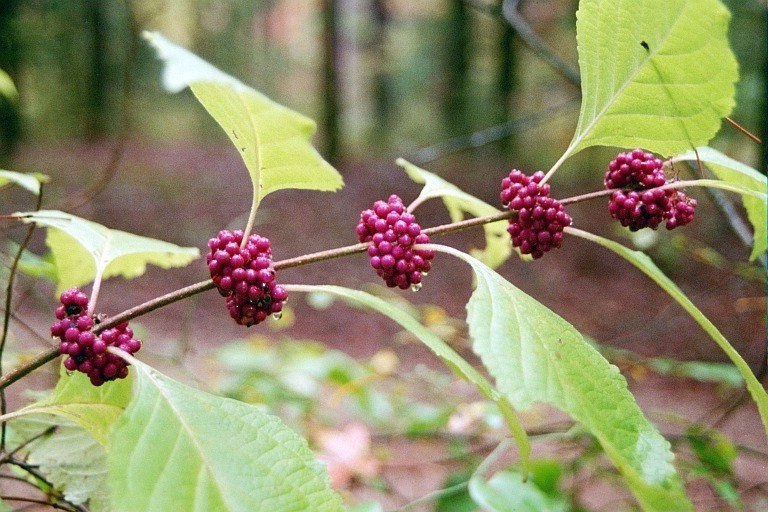
American Beautyberries cluster around the stem
Beautyberry: Callicarpa Americana
The Beautyberry is squirrel’s version of take out.
Squirrels will often break off a branch a foot or two long and carry it to an oak tree penthouse to enjoy. Mockingbirds and other birds are also exceptionally fond of the Beauty Berry. Humans are not as enthusiastic.
“Insipid” is the word usually used to describe its gustatory qualities. The truth is the berries of the Beauty Berry, or Beautyberry (Callicarpa americana, (kar-lee-KAR-pa a-mair-ee-KAY-na) while an attractive magenta, are mealy and almost flavorless. Their only immediate palate character is a little texture from a tiny seed. But, this is not to say the Beautyberry– also called the Beautybush — is worthless to man nor beast. While this writer knows of no nutritional analysis of the Beautyberry, it might have similar antioxidant and vitamin properties as other colored, edible fruit. Many web sites warn not to eat the berries, and some call them poisonous. They are not poisonous but I suppose if one is going to make a mistake it is better to say something is poisonous when it is not than edible when it is poisonous. And for the record, worldwide there are about 140 different species of Callicarpa. The leaves of this one, incidentally, make an excellent fish poison for stunning them.
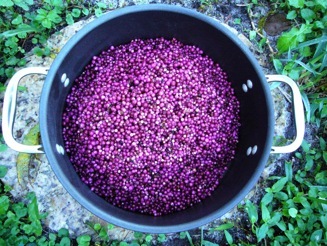
Berries ready to be made into jelly
Blooming pink in spring and fall, the Beautyberry has fruit clustered along the stem. The berries are slightly astringent and best eaten raw only a few at a time. Where Beautyberries excels is in making jelly. Beautyberry jelly is exceptionally good. (See recipe below.) Perhaps drying or cooking eliminates any astringency. I make Beautyberry jelly nearly every weekend it is in season as well as Pyracantha jelly (see my blog Firethorn and Santa Claus.)
Dr. Julia Morton, a famed research professor of biology at the University of Miami said this about the Beauty Berry in her book ‘Wild Plants for Survival in South Florida:” “The rank odor of the plant makes nibbling of [berry] bunches on the stem unpleasant.”
Her point was well taken: There are three chemicals in the leaves scientists are trying to replicate for mosquito repellent. They may be as effective as DEET, according to researchers with the USDA. The chemicals, particularly one called callicarpenal, showed significant bite-deterring activity against the yellow-fever mosquito and the mosquito that spreads malaria. Callicarpenal and other compounds isolated from the plant also repelled fire ants and ticks.
Natives had many uses for the Beautyberry, among them: A decoction of the root bark as a diuretic; the leaves for dropsy; a tea from the roots for dysentery and stomach aches; a tea made from the roots and berries for colic; and, the leaves and roots in sweat baths for the treatment of malaria, rheumatism and fevers. This author can only speak to the use of berries in jelly, and leaves as an external mosquito repellent. However, a study published 6 Feb 2007 Journal of Natural Products suggests the C. Americana has anti-cancer potential.
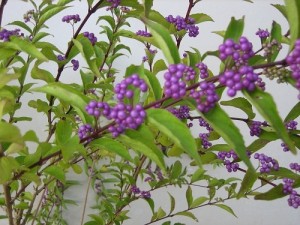
The Japanese Beautyberry’s fruit is on stems away from the main stem.
A fairly common Beautyberry that is an ornamental is the Callicarpa japonica. It is easy to identify from the American Beautyberry because its fruit are on long stems away from the main branch. American Beautyberries wrap around the main stem. More so, the C. japonica is long branched, slim, skinny-leafed and weeping, the C. americana is not. While I am not aware of any nutritional reports (in English) about C. japonica’s berries that I know of, animal studies report the leaves are high in protein. Human’s don’t eat the leaves.They are dried and used to make a tea. I do know of one person, however, who tells me she makes jelly out of C. japonica berries. There are also a few other Asian Callicarpas that have edible or medicinal parts. Callicarpa dichotoma berries are too bitter to consume.
The Beautyberry is a cousin of the smelly Lantana and the Oaxaca Lemon Verbena, which I also have in my yard. I got the Oaxaca from a Greek friend of mine who got it from a Hispanic neighbor. How this supposedly exceptionally rare plant got from one particular isolated spot in southern Mexico to Central Florida I do not know. It doesn’t even have an established common name, but it makes a nice lemon-flavored herbal tea. (See my article on Oaxaca lemon verbena.)
The following jelly recipe is from “Florida’s Incredible Wild Edibles” by Richard Deuerling and Peggy Lantz. The book is for sale on Amazon. Many years ago I used to wander through the Florida landscape with Dick and Peggy and others on outings with the Native Plant Society. They taught me a lot. The only problem with going into the wilds with such folks is it takes about an hour to go a hundred feet because there is so much to be said about the plants one knows, and debates, usually over some unidentifiable “dirty little composite.” Here is a link to their book: http://www.amazon.com/Floridas-Incredible-Edibles-Richard-Deuerling/dp/188525802X
Beautyberry Jelly
1 ½ qts. of Beautyberries, washed and clean of green stems and leaves. Cover with 2 qts. water.Boil 20 minutes and strain to make infusion. Use 3 cups of the infusion, bring to boil, add 1 envelope Sure-Jell and 4 ½ cups sugar. Bring to second boiland boil 2 minutes. Remove from heat and let stand until foam forms. Skim off foam, pour into sterilized jars, cap.
UPDATE: One of my students, Fred, does a lot of foraging and has lived his life in mosquito-ladened Florida. He reports: [Beautyberry’s] “jelly is awesome but I really love the beautyberry for its insect repellent properties. After learning about this from a Green Deane class and being an avid forager myself I decided to use the beautyberry as a bug repellent so it wouldn’t slow down my summer foraging (Florida summer mosquitoes can be horrible). I pretty much chopped up a plant(leaves and stems) and boiled it in a pot and let it cool and strained the brown liquid into my blender, about 1 1/2 cups. In a separate pot I warmed some organic neem oil (1 cup) with 1 ounce of beeswax until melted. Then you turn the blender on and pour in the oil mixture very slowly and it becomes a cream. I have to say hands down the best insect repellent ever! Because its a creme on july/august days one application is all you need for the entire day even when your sweating.”
Green Deane’s “Itemized” Plant Profile
IDENTIFICATION: A small, deciduous shrubs 1 to 2 m in height, leaves opposite, elliptical to ovate, large, with saw-toothed edges. Flowers cluster around stem, funnel-shaped with four clefs. Fruit magenta 2 to 4 seeds, White fruited ones are an escaped cultivar and edibility is unknown.
TIME OF YEAR: Spring and fall in Florida, late summer to fall in northern climes
ENVIRONMENT: Dry,open woods, moist woods, thickets and hammocks, adapted to climates with hot, humid summers and moderate winters
METHOD OF PREPARATION: A few berries can be eaten raw, depending upon your agreeing with the flavor, otherwise makes a great jelly. The berries can be used to make a tea with antioxidants.
HERB BLURB
Native American Indians used the roots and leaves to make a tea to treat fever, dysentery, malaria and rheumatism

So Beautyberry leaf juice has to be processed for insect repellent and oil and wax ingredients added. No wonder it hasn’t worked for me “as is” in the woods. I have used Beautyberry leaf juice smeared on and frankly Dog Fennel leaf juice has worked better for me. If it doesn’t work for me as is or very little processing with what is in the woods, its worthless to me for repellent unless I make it at home first. I will stick with smeared on Dog Fennel if I don’t have anything else. But thanks for the bug juice recipe.
No, it does not have to be processed but apparently it is more effective if it is…
Well, well. I was in the deep Florida woods walking without remembering to bring my repellant – I make my own, and encountered swarms of mosquitoes big as helicopters. Had I sprained an ankle and been left out there, I would have died. I plucked one beautyberry leaf – one – and rubbed it on both arms, legs, forehead and the monsters backed away like they were shot. One leaf inactivated them. I was still attacked on my stomach through my t-shirt as I had not applied anything beneath my clothes. The beautyberry leaves in the woods are amazingly effective. As they are. I make some beautyberry salves and also tinctures, but in the wild, prefer a leaf, and it’s more convenient too.
Haha! You should be a novelist!
Entertaining!
I was wondering about the idea of using dog fennel as a repellent. The stuff we have growing here called dog fennel smells so bad it sure repels PEOPLE. How come it works for you? I can guarantee it doesn’t work with mosquitoes as while I’d be busy wrestling with uprooting the stuff, they’d take advantage of the situation and come in for a fill-up!
However, this shows the importance of using Latin names rather than just relying on a common name. The plant referred to above is not the stinkbomb we have out here. Our dog fennel is Anthemis cotula and looks similar to my nice smelling chamomile plants. (DON’T confuse it with chamomile FYI…makes a nasty tea….) It also is supposed to be an insect repeller (due to its smell 😛 ), but well, why smell abominable if (in my experience) it doesn’t work? I’ve had better luck repelling skeeters by smearing myself with the lemon balm that happily reseeds itself all over my garden area. (Yea, and then had people ask me why I’m using lemon furniture polish as a perfume…)
I’ve got to get some beautyberry growing, though. I’m a serious mosquito magnet. Wonder if it’d work as a ‘Beautyberry Balm’ combination…
Hey, just a thought. R us taking any “B” vitamins? Most of us need it for stress & B 6 (or B2) is good to give ur body natural repellent properties
[quote=”Green Deane”]No, it does not have to be processed but apparently it is more effective if it is…[/quote]
Yeah, Deane. Just that I am always looking for something to use for a “better” natural repellent. Either as is or processed by what is also natural at hand in the woods. Can’t very well go to the store when I’m in the woods unless I bring it with me and that kind of defeats the purpose. Might as well get a bottle of DEET. I am not about to raid a bee hive for wax so maybe some kind of leaf wax? Not too many Indian Neem trees here abouts either but maybe some other evergreen might work?
[quote=”Beth”]I was wondering about the idea of using dog fennel as a repellent. The stuff we have growing here called dog fennel smells so bad it sure repels PEOPLE. How come it works for you?[/quote]
This is it. The long stringy leaf stuff.
http://plants.usda.gov/java/profile?symbol=EUCA5&photoID=euca5_006_avp.tif
It does indeed have a strong odor. But it is not obnoxious. I did not say it works 100% effective. It does help keep most skeeters away temporarily. I just take a handful of the stringy leaves and rub them between my hands with a little water, spit, whatever and smear it on about once every hour just like the Seminoles do. Put it on a fire for smudge fire like the Seminoles do. Use it for a soft springy bedding to repel insects and critters like the Seminoles do. It does not deter gnats though. Its better than mud or nothing. Pick up a copy of Reid F. Tillery’s “Surviving the Wilds of Florida.” Good practical book by the trained former US Army Medic/S&R and made specifically for Florida survival.
http://www.floridaadventuring.com/survivingwilds.html
[quote=”Beth”]I’m a serious mosquito magnet.[/quote]
Same here. Little tormenters. lol
LOL I was just looking at the USDA geographical map and it says we don’t have any in our county. Well……..we do….and lots of it.
Those USDA maps can be so wrong… and when you write to them about it all you get in return is a ration of royal attitude.
Sorry for not being clear. I live in California. I am gleaning a lot from this incredible website as many items covered are found here, also, growing wild, in cultivated areas, or found in some of the local nurseries (that employ people that know their plants, unlike some of the big box Home Depot scarily clueless wonders).
I don’t do DEET even if I’m driven to the point of insanity but the monsters (and believe me CA mosquitoes are HUGE, smacking one that just tanked up is VERY messy.) Had some government issue DEET. Unlike most of the bottles you find in the stores, they had a serious warning on them: “Do not get on plastics. Melts plastics.” (They were in specially formulated plastic-like bottles that weren’t meltable.) And we’re supposed to believe it’s safe and HEALTHY to rub DEET all over as a mosquito repellent?????
So I’m looking for a viable homemade alternative. Will try Fred’s remedy up top–when I get some Beautyberry plants grown next year. A local company, jdhudsonseeds.net sells Callicarpa americana seeds and a bunch of other useful ones. I think we have an abandoned wild bee tree up the hill also that the black bears got into but left some comb fragments for wax…at least they left most of the tree intact…
I use it as a spray on repellent. It won’t keep everything from biting you but reduce it greatly. I soak it in rubbing alcohol for a few days and works great! The leaves that were soaked I keep to rub on as well. I eat the berries in smoothies and infuse them and drink the infused water. Also I make a tincture (just a small jar) as it will settle my stomach. Who knows if any of my ideas will work for others but they do for me😉
Well Beth, the point I was trying to make about the Dog Fennel above is that there is a definite difference between having it on and not. I don’t get bit nearly as much as if I did not have it. The Native Seminole Indians have been around long enough to know what works and what doesn’t. It is not total protection though so you have to keep that in mind. You may not have this variety out in CA. There are other natural skeeter fighting methods mentioned in Tillery’s book used by both the Seminoles and the pioneers but they may turn your nose up at most of them. lol
I have not had a problem with the effectiveness of DEET and I have used full strength 100%. The stuff that will kill skeeters that are foolish enough to ignore the stuff and try to bite anyway. This does happen with mangrove skeeters along the coast. It probably is not the best thing for skin that is for sure but it had to have been good enough for the GIs in Vietnam. Most DEET nowadays is only about 30 or 40% strength as it has been said that more does not improve protection. I understand you not wanting to use DEET though. Florida has a big skeeter problem in more ways than one and it has been jokingly suggested that the skeeter be made the state bird.
The Neem oil costs about $8.99 per ounce at the local health food store here. They do not carry larger quantities (1 cup above) and I am not paying that price. Might as well get a bottle of DEET. Its cheaper. I don’t have the luxury of carrying it with me usually so I need a good natural repellent. I will stick with Dog Fennel until a better natural repellent comes along. Best of luck.
When I first came to Florida if a mosquito bothered you all you had to do was step out into the sun and the mosquito would go away. But then one was imported that flew in the sun and life has been miserable since…
I think it took two. 🙂
As for the cost of Neem at health stores, I am in Landscaping and use Neem oil for pest and fungal problems with plants. I get a container that resembles a motor oil bottle for about $17. And the directions call for something like a Tablespoon per gallon of water for plant use. I will sometimes take the bottle and turn it upside down on my thumb and use that to spread around my ankles and again up on arms and neck and ears. It works well. I live in Georgia, and I use paw paw leaves crushed and rubbed for repellent. Also hickory leaves and sassafras leaves for beddin. g. Helps deter chiggers. Hope this helps.
If I were you Beth, I would dig into the local Native American Indian and pioneer methods of California for combating skeeters naturally. They would have been in a position to know what works there. Try to find some literature on it. Western sources. Some western survival books might also help. I was reading a western survival source “Outdoor Survival Skills” by Larry Dean Olsen (considered the father of the primitive skills movement) that says that the mashed leaves of wild onion, Onion, Wild Garlic, Nodding Onion; Allium rubbed on the arms and neck are an effective insect repellent but also warns it is a very effective people repellent. Page 110. Again best of luck.
As the warnings have stated in some sources, do not confuse Wild Onion with Death Camus as they may look similar. Onion has odor, Death Camus doesn’t. Don’t want you to get Zigadenus or Death Camus poisoning if you happen to eat one.
Make that Death Camas.
Yea, I’m pretty good about identifying my plant life. I usually get in trouble going on hikes with people cuz I tend to stop and check things out, take samples, collect things, thus slowing down the hike.
Your point to check on local native resources is good, and I try to do so. The Bay Tree (Umbellaria californica) has been used to repel insects, but for some susceptible people, like me, its nickname, “Headache Tree” is more appropriate, as the crushed leaves cause an instant headache, and inhaling a handful can cause some to faint (I’ve seen it happen on a hike, knocked a guy out, just one big whiff.) There are others, like various Artemisias and White Sage, but I haven’t found a noticeable difference between applying them–and mosquitoes…well, I just guess our mosquitoes appreciate ‘fine cuisine’, dining on herb-seasoned humans…
Thanks for the tips, though!
if mosquitoes are that bad, drink a table spoon of apple cider viniger daily. soon your skin will smell like viniger, and no more mosquitoe bites! I once found a patch of beautyberry with lobed leaves, almost like large red maple(acer rubrum(?) with with teeth sightly larger than those of red mulberry(mora). any idea about what that might be? it was on a sandy hill, in almost full sun, surounded by pine and kudzu, in north alabama. I realy would like to grow this plant!
I’m so happy to have found this website – so much great information on native plants and their uses! On the subject of effective natural mosquito repellants: I’ve also been looking for one, and came across this study a few months ago: http://www.sciencedaily.com/releases/2001/08/010828075659.htm From the article: “Researchers report that nepetalactone, the essential oil in catnip that gives the plant its characteristic odor, is about ten times more effective at repelling mosquitoes than DEET…” The article also states that catnip can be found wild in most parts of the U.S. I haven’t tried catnip out myself yet, so I can’t vouch for it personally, but I plan to try! Thanks to everyone for sharing their questions and knowledge, and thanks for this fabulous website!
It’s funny to think that I was told that beautyberries were poisonous when I was a kid, but that’s obviously not true since I’ve eaten plenty over the years.
However, it’s never been clear to me about edibility of the unripe beautyberries. Are the unripe beautyberries lethally toxic like the unripe lantana berries, or are the unripe beautyberries just extremely astringent like unripe persimmons? Or, is it somewhere in-between with the unripe beautyberries being both astringent and only mildly toxic? I really have no interest in eating the unripe beautyberries. I’m just looking for clarification. Thank you.
Do not eat unripe beautyberries. That entire group of plants tend to have toxic unripe seeds.
Hello again. I’ve been getting tons of beautyberries ripening over the past few weeks. When I pick them or knock them off the bush, many of the berries still have the tiny green sepals attached to the ripe berry. Are the sepals of the beautyberry harmless when making jelly?
My question too! I’ve been taking them off, but oh what a pain!
We are blessed to live on 5 acres in zone 6b, heat zone 7. There’s an entire colony of mockingbirds next door who sing loud and long. When I’m outside planting, pulling weeds or filling the bird feeders at least one of those clowns follows me!
Next year we will be planting several beautyberry bushes to thank them for the songs I’ve enjoyed so often. Is there any other plant they like?
Vickie
can i plant the berries to grow a plant and when is the best time to harvest the berry to plant it. if not the berry then what part of the plant do i use to start my own beautyberry plant.
yes you can plant the berres. Pick them when they are magenta color, let them dry out of the sun, then plant under an inch of soil.
Hi,
From what I read above, it sounds as though what I have growing in several spots in my yard (northwest of Houston, TX) is the C. Japonica variety. It fits the description well, and has bunches of purple berries this time every year. I am curious how to tell for sure if they are ripe? I’d love to make jam or something with them, before the squirrels eat them all in their Oak Treehouse (ha ha).
Can you tell me how to be sure they’re ripe? Don’t want to be feeding myself and the kids toxic berries, obviously.
Thanks!
How do you know it is C. japonica. The term “bunches” bothers me. The different species produce “bunches” differently. One clusters the stem like a muff, the other is little clumps on the end of stems. They are ripe when they are lavender, or magenta.
Stacy,
The leaves in our area are a little smaller than the ones Green Dean shows in his video-probably because it is a little cooler here in winter.
There is a ton of C Americana around north Houston (The Woodlands/Conroe/Magnolia area). I would think it is likely growing wild in the Cypress area too.
google goggles confirmed my plants as C. Americana. I thought they were, but it was nice to get that extra assurance.
I made the jelly last year – it was delicious! This year we picked way too many berries to go through in a weekend..took us forever because I get a little carried away (maybe) ditching the little green caps that attaches the stem to the berry.
I let my infusion sit almost three weeks. Is it mildewed or is it sugar coming to the top? (good size white “flecks” -some together, some by themselves) We just had a wild three weeks since making the fusion and couldn’t find time to finish it all.
I hate to waste it, but if it is mildew, its best. If it is sugar, well, that is another story entirely.
*infusion
Does anyone have any idea of the acidity of Beauty Berry? I pretty much only make preserves with enough acidity so that botulism is impossible. I did see one jelly recipe where someone added lemon juice. Wondering if it is necessary. Thanks! Kim
Thanks tons to all of the people above who contributed to this discussion. It took me about an hour to stumble upon an article about this berry’s eating qualities, etc., and you all rewarded me.
Do American Beauty Berries self pollenate?
Do you need more than one or a male/female combo?
They self-pollenate. You only need one.
Thank you for another great video. Used this with other sources to confirm that I had a Beautyberry bush “volunteer” in my yard. After your video, was compelled to make some jelly and was pleased to harvest 1.5 quarts of berries from a single plant. Your recipe produced 10 pints of a soft set, mild yet distinct sweet jelly with a beautiful red/pink color. Everyone that has tasted it loves it. Saving berries as seeds for next year. What a fantastic weed 🙂
Beautyberry will self propagate and in a few years you can have many bushes and a bumper crop!
Thank you so much for this web site. I am new to plant identification and eating weeds. We live on 45 acres in a hammock and I have always wondered what this plant growing all over was. It likes to get along our horse fence and the roots and plant are a pain to get out. But now I can make jelly out of it and mosquito repellant, how neat.
Mr. Dean do you ever go to people’s property for identification of plants? Maybe hold a class here, we are only an hour from Gainesville. Students would be welcome to take as much of the plants as they wish.
Yes I do, and often I try to arrange it when I am teaching in the area.
Are there any classes in the Fort Myers, FL area that teach about finding/recognizing edible plants. I recently bought a book on the subject but with all the weeds around, I’m not sure what is, or is not edible to try.
I threw some bird feed over the fence one time. Then these pretty berries grew. I told my son go show your mom these because they were beautiful. Well, needless to say he messed up the translation of what I told him. He told her to try them I sent them to her. I later went in the house and asked her what she thought of them. She said they tasted ok but not great. I about fell on the floor. I didn’t know what they were. she was still feeling ok so I went online to see if they were edible and what the were. The rest is history, needless to say we get a laugh out of it now. But at the time i panicked.
Do any of you have some seeds you could possible send me, I would truly love some. Thanks
I am about to head into the woods to harvest some for jelly. I can send you some.
I have plenty now, thank you.
Robert m you can get a viable wax from the wax myrtle berries
When are these available usually? I have a Myrtle tree, is that the same thing? Also, I found a “loan” beauty berry in my driveway, in bloom. I would love to spread it over my 80 acres! It’s a beautiful plant. What’s the best way to cultivate it?
Lots of stuff gets named “myrtle” (for having cute/smallish foliage?). True myrtle is a Mediterranean plant, Myrtus communis, and doesn’t have wax. “Wax myrtle” is just the Southern/evergreen bayberry (Morella/Myrica cerifera). Northern/deciduous bayberry (M. pennsylvanica, I think) would work the same. They have pleasantly fragrant, grayish wax around the tiny drupes of female plants. You can liberate that wax by boiling and straining lots and lots of the “berries” (drupes). (Male plants also have fragrant leaves, but no fruit thus no wax.)
you can get a viable wax for this purpose from the wax myrtle berries
Your recipe said:
1 ½ qts. of Beautyberries, washed and clean OF green stems and leaves.
Does this mean to remove them FROM the green stems & leaves or to boil them WITH the green stems & leaves? I’m sorry but this is confusing me.
You make the jelly just with the berries. No green parts or stems. I have a video on You Tube showing how. Search for Green Deane beautyberry jelly.
We live on 45 acres, 35 acres are woods and we have over 100 Beautyberry bushes. Since we don’t eat much sugar we don’t make much jelly. We don’t want the berries to go to waste so I have fed the berries to our chickens, they love them. It cuts down on the feed bill too.
Have you tried stevia? I’m a diabetic and hope you look into this.
Do you mean to make jelly? No.I have mede jelly from the berries but as a day to day practice I do not eat jelly, or simple carbs. I consume only about 32 carbs a day on average.
What is the clear liquid you pour over the jelly before capping in your video? Lemon juice?
Hot paraffin wax. It cools to a hard plug.
I crumble the leaves and rub on my legs, neck and arms to keep away skeeters! Is there a way to make a spray? Can I use it around my chickens and bunnies? Sorry, haven’t had time to read everyone’s comments, but I will. Forgive me if I am asking something that has already been replied too! Nance
Hello, Thank you very much for this helpful article! I’ve made a few jars of jelly with your recipe, and they’re delicious! But I do have a concern that was also asked here, but never answered, do you know if the beauty berries are acidic enough to ward off botulism? Or do you need to add some acidic to the jelly?
I’ve never heard the issue brought up and my answer is I don’t know.
Amazing! I just learned a few years ago about the mosquito repelling properties of the beautyberry, but had no clue that you could make jelly from it. Here in south Alabama, they are everywhere! I’ll be making some of this jelly next year. I love making “weird jellies”. I think I read somewhere that jelly can also be made from pyracantha berries? Please correct me if I’m wrong. The weirdest I’ve made so far is corncob jelly…and it was delicious!
I made my first batches of Jelly last year with the plants on my property. I harvested the berries as they became more purple. The first batch was a hit as Christmas presents and everyone wants more this year. I picked some before the Freeze last year and froze them for future makings. I’m experimenting with how long to let the berries stay on the bush as they remain purple for a long time. I’m wondering if anyone has notice a difference in taste or quality the longer the berries stay on the bush. Also, I’m not agreeing exactly with the recipe. It seems that I have to use more Sure-Jell than what the recipe calls for. Almost double and it only happens when I’m making Beauty Berry Jelly. Any comments?
Out of my cooking league… but my experience was a lot of pectin is necessary…
I macerated the leaves of my blackberry in a quart bottle of apple cider vinegar, which I shake daily. I am letting it sit 3 weeks and testing as a pest repellent, will let you know if it works,
how can you tell when the berries are ripe for picking?
They turn magenta color, as in the photos.
my uncle gave me this plant before he died an ive just found out what it was The Beautyberry i cant believe i have such a wonderful plant because i named it after him and i always name my plants and they grow so much better. I wanted to use some of the branches to make decorations and flower arrangements do you have any suggestions on how i can perserve them so that they dont turn colors or dry out.
I am not an expert on preservation but I do know the plant gets rather ratty when it dies. Maybe drying it when it is healthy might make a difference.
Green Deane, re: your student Fred’s homemade beautyberry cream:
I wonder if Fred would consider selling a jar of his cream? The 25-year old me would have had it made already, but the 64-year old me is seeking an alternative way! Would happily reimburse Fred for his creation if he could spare some
I’m gonna be makin some for my kids since one is highly allergic to red ants so I’m gonna give the cream a try post your email an I’ll contact u since I don’t mind I’ll make u a cream to no charge though I don’t mind will be fun new experiment with kids.
I love the taste and smell of this jelly. Experimented with the recipe initially provided in this page to be able to make a little over 4 pints per batch!
Ingredients
11 cups ripe beautyberries
6 cups water
juice of 3 yellow lemons = 1/3 to ½ cup
7½ cups white granulated sugar (Domino)
2 packages Sure-Jell pectin (49 gr. ea = 1.75 oz. ea)
Procedure
Remove pieces of stems, leaves, and immature chinch bugs and spiders! Rinse well, 3X on colander. Bring 11 cups of cleaned berries and 6 cups of water to a boil in a SS pot. Slow boil and cook, partially covered for 40 minutes. Stir every 10 minutes. Color fades and becomes somewhat off-color.
After 40 minutes, remove from heat, strain and press through a fine sieve—or use a jelly bag. Pressing through a fine sieve like a Chinois, yields more pulp. Pressing through a jelly bag yields less liquid, but makes a transparent jelly.
Medium/high boil the liquid and reduce it to 5 cups. Add the fresh juice of the 3 lemons, stir well. At this point the color transforms back to the magenta color of the skin of the fresh berry!
Return to a rolling boil.
Immediately add 1 cup sugar mixed with the pectin powder from the 2 packages, stir well and return to a rolling boil. After one minute add remaining 6½ cups of sugar. When it is again on a rolling boil, cook for only 1 minute.
Remove from the heat. Let the foam come to the surface (1 min), skim off (you lose too much good stuff this way), or slowly swirl in pan to make foam cling to the sides (pot with high sides is desirable), pour into clean jars. Or just push foam back with a spoon while pouring into jars! Yields a little over 4 pints.
Process in boiling water for 15 minutes.
My family and friends love Beauty Berry jelly. I have only been making it for four years and it is frustrating. Some batches come out perfectly, others very soft set. I have increased the acid level with lemon juice and have begun increasing the pectin. It may be the berries. I had frozen several batches of infusion. I defrosted 2, made 2 separate batches of jelly with increased pectin, one set perfectly the other is almost syrup. I wish I had noted which plants and how ripe the berries were. It must be the berry or plant.
Could I be allergic to them? When I bit one my mouth felt really painful and that feeling persisted for about ½ an hour. After that my mouth was numb for about 1 hours. I do not thank I got the wrong plant. I would like to make jam but I am afraid it might be to it of a risk.
There is no accounting for personal allergies but I have not heard of anyone having such a reaction.
You may have picked the similar looking pokeweed/pokeberry/inkberry. The berries are somewhat toxic. The root more so.
It is possible that someone picked pokeweed/pokeberry/inkberry instead of beautyberry – but pokeweed is a herbaceous plant, and beautyberry, aka beautybush, is a woody shrub. The berries of the American beautyberry are magenta or lavender, while pokeberry berries are a deep, dark nearly black color when ripe, and are never the color of the berries in the photos on this webpage.
That said, the ability of people to confuse plants that are very different should not be underestimated.
I picked my berries yesterday. I will be adding apple peel to the mix that will be removed later. Also I will be using apple cider as part of the liquid. Making sure it will gel.
Hiw did this turn out? Can you post a recipe?
Thanks Green Dean I found this plant today on my walk I did not know what they were until now thanks
I love this site. My husband and I forage frequently as a shared hobby. I have used the beauty berry to make my own ink for years and always just called it the ink berry. Now I know! We will be making Jelly, insect repellent, fish stunner and ink. 🙂
How do you make ink?
I have a little story to share about my experience of making the jelly.
Last week I was teaching a permaculture/gardening class for elementary students, and one of the boys came up to me with a few beautyberries that he had picked from the woods nearby and asked if they were edible. I had previously read about it here on eattheweeds.com so I told him that they were edible and that we could make jelly from the the berries.
I have been planning to try making the jelly for a while because I have a bunch of plants in my backyard so I decided to attempt it in today’s class. It was so much fun to see the kids’ excitement when they came out and saw bags of beautyberries.
Most of the kids were suspicious though since the common belief among them was that the berries were poisonous. After I reassured them, they excitedly tried them raw with varied opinions about the flavor.
The kids all helped pick out the good berries. Since I didn’t know what to expect, and you said that not everyone likes the taste, I started to get a little worried when the smell began wafting from the boiling pot, and the color of the liquid became an unattractive brown while the berries began to look more like fish eggs. After we poured in the sugar and pectin, though, the liquid instantly became a beautiful rich red and the smell became pleasant.
In the end, the jelly came out perfectly, and everyone loved the flavor. I will definitely be making it again and highly recommend it. Thank you so much for sharing your recipes and knowledge of our rich environment. I love visiting your site and watching your videos!
What an informative site you have. All my questions and more were answered here regarding the beautyberry. Thank yoy
Do you know the quantities in u.k. measurements for both the jelly and the insect repellant please.
We have been plagued by mosquitoes and those biting deer and horse flies while riding our horses in the woods. Last week we had to dismount and brush about 30 of them from underneath our horses bellies just in order to keep them from going crazy and bolting off. Even though we don’t like using the traditional store-bought horse fly sprays, we did try several over the last couple of years and none of them really work all that well. After reading this we experimented this weekend with the beauty berry. We cut small branches we tucked into their tack. We also rubbed some fresh leaves all over ourselves and the horses. We could not believe the results! We had a 2 hour ride each day this past weekend and we’re not troubled by any biting insects. There was an occasional fly that attempted to make a problem but was easily shooed away. We are so lucky to have tons of this bush growing all over our pastures. It is also along every trail that we ride on so it is easily acquired along the ride as well. THANK YOU!!
This is one of my favorite plants, they volunteer here in South Georgia. If they are related to Lantana, I can understand an allergic reaction to Beauty Berry. I am very allergic to the Gold dwarf Lantana, also Artichoke plants.
…question on making jelly… I usually never use sure-jel or pectin when I make other fruit jam, is it really necessary with beauty berries?
I just discovered lots if it’s bushes growing on our recently acquired property. Very happy to hear of it’s mosquito repellent properties!:-) thank you!
I just made regular jam with my beauty berries (blended the whole berry in a food processor for a few seconds) rather than making jelly from the juice. I’ve never had to use any pectin or sure-jel either. I usually add a bit of tapioca starch just in case it doesn’t gel enough.
Worked out just fine! It has a slight flowery taste, but otherwise is similar to other berry jams
Thanks for so much informative information. I really enjoyed reading about the beautyberries and all the comments. I was looking for information to find out if the berries were poisonous for dogs as we have one that eats everything. I now assume that since they are safe for people, they are probably safe for pets?
If I find information about toxicity regarding pets I add it. As far as I know the berries do not bother dogs.
Can the berries be frozen to use in jellies/jams later?
Yes.
I think the article does the flavor of these berries a disservice – I’d call it fascinating.
The first impression is a pithy sweetness, followed by a slight tang and a surprising herbal flavor – almost but not quite like celery. This fades to a mildly astringent aftertaste.
I made this jelly this weekend – and it was amazing. It will be one i make for many years to come, thanks for sharing this information!
had these berries growing in my yard for years cant wait to try them , thank you for sharing . monstera delicious or swiss cheese plant . the fruit is delicious however you must research it because prior to fruit being ripe it is toxic , axylic acid .best i ever had . any questions buford1129@msn.com
sam
I used ripe berries in a beautiful salad yesterday for a holiday lunch at our Extension Office.
Has anyone made jelly from the berries of Mexican Beauty Berry (‘Black Beauty Berry’) , Callicarpa accuminata.?
Produces HEAVY berry crop every year.
My mom has, it tastes a little like strawberries.
My dog keeps eating the leaves off the callicaapa Dicchotoma Plant. He later looks down and out until he throws the leaves back up. Are they bad for dogs?
Have you ever made Wine from them ?
They have a licorice taste to me, I think that would make a great Wine.
I have maybe three hundred growing on my property.
I can’t even begin to imagine how awful this must smell. Neem is expensive, but also stinks enough to turn your stomach. It’s no wonder it repels bugs, I’m sure it repels people too.
Just a note…I live in Texas and we have an abundance of what I call Beauty bushes…love your site!
I like the taste of beauty berries, as well, and don’t find them mealy. Sort of like elderberries in texture, but not in taste. Also the astringency seems to come and go between different days on the same bush. Perhaps in correlation to timing of rainfall. In my backyard, we purposely propegate beautyberrys
I can verify from personal experience as well as on behalf of my husband and son that a cold infusion (3 days) of beautyberry leaves is an excellent mosquito repellent. They buy around still, but won’t land.
Does anyone have a recipe for making wine from beautyberries and willing to share?
You can also clean the leaves (no chopping); shake off excess water; place them in a crock pot; add solid coconut oil for a solid result or fractionated for a liquid final product; and turn crockpot on to Warm (Not low). Let it steep for a few hours and you have a beautiful green result with either method. Remove the leaves and strain the liquid through a coffee filter to remove any remaining leaf bits. To the liquid version, I add some ethyl alcohol to help preserve it longer.
We find that coconut oil alone is very effective for preventing most ‘bugs’ from landing or crawling on the skin. Mosquitos, flies, gnats, and ticks
all avoid oily skin. Among herd animals, some always have fewer flies and other insects on and around them, and these are usually the animals with slicker, shinier coats. The shine is from the natural skin oils on the haircoat.
We’ve all been conditioned to think that oil on the skin is ‘yucky’, and sold chemical detergents to remove it (nearly all ‘soap’ sold in supermarkets is actually detergent) – and then we are sold petroleum-based ‘moisturizers’ and lotions. Sigh. We find the coconut oil on the skin is much more pleasant than commercial lotions, including suntan lotions and sunblock lotions.
We plan to try infusing Callicarpa leave into coconut oil to boost the insect repellent property, but the coconut oil works so well by itself and has remained effective all day. Recently we were reminded of just how well it works when the small areas we missed with the oil were bitten terribly, but the areas where we had applied the oil remained bite free.
I’ve been making beautyberry jelly for years now. I love your article, I learned some new things about beautyberry. We live in FL and use the leaves to help repel mosquitos too. It work pretty well, however has no effect on gnats! 🙁
All plants reproduced from seed will have some variation from one plant to another. If you have found a particular beautyberry bush with especially tasty berries, it may be worth propagating that bush from cuttings or ground layering to make more bushes that are exactly the same.
Growing conditions can also make a difference in the flavor of fruits, including the amount of sunlight they receive, soil alkalinity/acidity, and fertility.
It’s fun to have edible plants in our own yards, especially plants like the beautybush that are ornamental as well as edible.
Respectful harvesting of beautyberries growing naturally on their own is fine, too, since this shrub is plentiful in its natural range. It is always a good idea to leave some berries for other foragers and wildlife. Birds and other animals will certainly harvest the berries from bushes in your yard, too.
Coconut oil alone has been very effective for us for preventing most ‘bugs’ from landing or crawling on the skin. Mosquitos, flies, gnats, and ticks
all avoid oily skin.
Among herd animals, some always have fewer flies and other insects on and around them, and these are usually the animals with slicker, shinier coats. The shine is from the natural skin oils on the haircoat.
We’ve all been conditioned to think that oil on the skin is ‘yucky’, and sold chemical detergents to remove it (nearly all ‘soap’ sold in supermarkets is actually detergent) – and then we are sold petroleum-based ‘moisturizers’ and lotions. Sigh. We find the coconut oil on the skin is much more pleasant than commercial lotions, including suntan lotions and sunblock lotions.
We plan to try infusing Callicarpa leave into coconut oil to boost the insect repellent property, but the coconut oil works so well by itself and has remained effective all day. Recently we were reminded of just how well it works when the small areas we missed with the oil were bitten terribly, but the areas where we had applied the oil remained bite free.
A question: Is the root of the beautyberry poisonous if accidently chewed?
How many half-pints does this jelly recipe make? I have a LOT of beauty berries on our property.
I will warn others since this happened to me. I once used beauty berry leaves to get rid of mosquitos by crushing the leaf of one of the plants and rubbing it on my skin. Yes the mosquitos left me alone but I had what looked like 2nd degree burns form on my skin. a burning and itching red patch appeared anywhere I had rubbed the leaf. It took me a while to figure out what had caused it. Actual small boils appeared. So please be careful. It may work out better to rub on your clothes than on bare skin. Yes I am positive it was American beauty berry that I used and nothing else.
Speaking from Illinois here. I’ve got a similar plant that appears to be like a beauty berry, but with a berry that has both a lighter color purple and light green (like a turnip). The berry also has a little stem on each berry, and are clustered from 8-12 around the wooden stem, under leafs that directly face another. The berries are also more dried in texture, but I’m looking at them in the Fall. Any chance there are beautyberry lookalikes? I’m pretty sure this is not E. Japonica.
Margaret, I purchased the Japanese beautyberry (Callicarpa dichotoma ‘Early Amethyst’) and it looks like you have described. I made jelly with my beautyberries and it turned out very well.
Does anyone leave the berries in the jelly like a preserve?
I live in an area where deer frequently browse and eat the bushes and flowers in my yard. I read that deer like to eat beautyberry foliage. Does anyone have a remedy that leaves the berries and foliage okay for humand use?
I can not even fathom a year of not picking the berries…boiling mashing straining and adding sugar. The fruit punch is so unique. I have heard of it making a fabulous wine. Thanks for the cream idea I will be using that for sure! A delightful plant.