
Asclepias: Some like it hot, some like it cold
The question is to boil or not to boil.
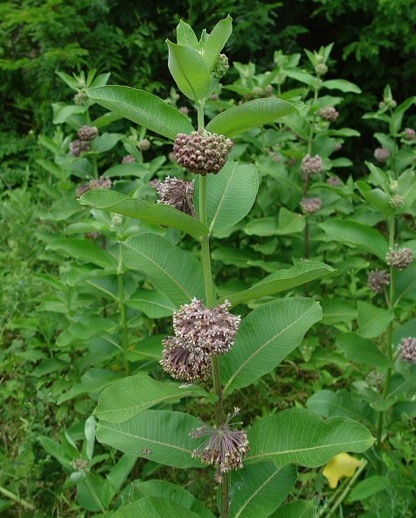
Milkweed in blossom
Actually that’s not quite accurate. There is general agreement that young milkweed shoots, leaves and pods are edible after boiling. The two questions are how many times should you change the water and should the water always be boiling or can you put them in cold water to start? Worse, at least two authoritative sources disagree on those exact things, and exactly the opposite. A third authority considers them famine food only. It is best to say you will have to experiment. We want to get rid of the bitterness because it is toxic. Said another way, don’t eat any milkweed that is bitter after cooking. Taste it and wait 30 seconds or so. Regardless of how cooked, they give me a significant stomach ache. Others folks they don’t bother.
If you read only medical references they will frighten you with talk of cardiac glycosides and one gets the impression that if you as much as look at a milkweed you will drop dead. The state of North Carolina says milkweed is toxic but only in high amounts. That’s good news. The University of Texas says North Carolina also says all milkweeds (Asclepias) shoots, leaves and pods are edible cooked. To quote them:
“Although milkweeds are poisonous raw, the young shoots, leaves and seed pods are all edible cooked. When placed in cold water, brought to a boil and simmered till tender, milkweeds are said to be delicately flavored and harmless. (Poisonous Plants of N.C. State) The flower buds, nectar-sweet flowers and seeds are also edible.”
That may be so but personally, I doubt it. I would not try any milkweeds with skinny leaves. They tend to have more of the bad stuff and I have not as of yet met an edible skinny-leaf milkweed. Again, do not eat any bitter parts of the milkweed.
When most books talk about edible milkweed they are referring to Asclepias syriaca. (ass-KLEE-pee-us sihr-rye-AK-ah.) It’s the most common particularly up north and was all over the place where I grew up, its rough pods unmistakable. Here in central Florida they are no where to be seen. The one I notice the most often here in the wild is Asclepias humistrata. Actually five were in medicinal use in Florida with no mention of them as food.The pods are small and they taste awful.
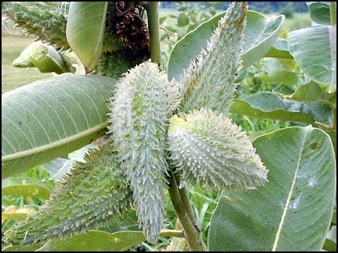
Milkweed pods
As for the A. syriaca the young sprouts, buds and immature pods were eaten by the Iroquois and prairie tribes. The Chippewas stewed the flowers. The cooked buds taste like okra. Flowers were also dried for winter use. It was also used as a fiber and medicinally as an urinary aid, a contraceptive and the sap as a wart remover.
Asclepias was the name of a legendary Greek physician and god. That is the name the Greeks used for the plant. Syriaca means of Syria, which it is not. In fact, A. syriaca is a native of eastern North America but Linnaeus thought it was from the Middle East. Curiously the rules that govern the naming of plants do not allow a name to be changed because a geographical mistake was made. There has to be a botanical reasons to change a name. The name Pinus palustris means swamp pine yet the tree (the Long Leaf Pine) grows only in high dry areas. It has been denied a name change. Remember that the next time you think botany is a rational science.
And while I had hoped to avoid a particular controversy I get emails on the topic of whether the common milkweed is bitter or not and comments that if my milkweed is bitter I must have made a mistake and picked dogbane. I know two things: 1) The milkweed that grew in our pasture in Pownal, Maine, from the 1950s through the 1970’s was Asclepias syriaca and 2) it was bitter, not horribly so, but bitter. Other areas of the nation Asclepias syriaca is not bitter and people write to me telling me milkweed is not bitter. How can we reconcile this? Sam Thayer, author of Forager’s Harvest and Nature’s Garden, has a possible answer: Introgression. Specifically that is the incorporation of genes from one species or subspecies into another related species or subspecies. We would commonly call it cross pollination.
Said another way where the common milkweed is not bitter it tends to be the only species of milkweed around. Where it is bitter it tends to be one of many species around, the others of which are bitter and not eaten. Plants can’t be choosy. If the pollen fits fertilization takes place even if it the suitor is a bitter relative. This also happens locally among certain palms such as the Pindo Palm and Queen Palm sharing traits. So yes there is non-bitter common milkweed, and there is bitter common milkweed, and there is poisonous bitter dogbane. Ya have to be careful.
To help you tell Milkweed and Dogbane apart, the underside of the milkweed leaf and stem are slightly hairy. Dogbane is not. Veins on the top of milkweed leaf are light green and prominent, on dogbane they are not as prominent and are cream-colored. Milkeweed leaves do not squeak when rubbed, dogbane leaves do. Milkweed leaves grow smaller as you go up the stalk, dogbane leaves grow slightly larger. The milkweed stalk is hollow, the dogbane is solid.
Green Deane’s “Itemized” Plant Profile
IDENTIFICATION: A. syriaca, the most common northern milkweed, is an erect perennial. Three to six feet tall, milky juice, mostly single, stout, hairy stems. Flowers are pink to pink, 5 parted, densely-flowered drooping umbrels. A. syriaca has rough fat pods and leaves with short stalks. Make sure you have the right species. It can mean the difference between a pleasant meal or a bitter pile on your plate.
TIME OF YEAR: Early to mid-summer
ENVIRONMENT: Upland prairies, fields, meadows, waste places, prefers full sun
METHOD OF PREPARATION: Young shoots, leaves and pods boiled in several changes of water. That can vary greatly, some are not bitter some are. Bitter ones should be boiled in copious amounts of water at least once. Whether cold water to start or boiling water to start will have to be learned by experimenting. If the cooked vegetable is bitter, try a different method. Gather leaves in early spring when they first open. Gather seed pods in summer. Parboil for three minutes, then discard bitter water and replace with clean boiling water. (Cold water tends to fix bitterness, other times hot water does.) Repeat this process three times, then cook the leaves for 15 minutes before seasoning them. A pinch of soda can be added during cooking to break down the fiber and improve flavor. The young shoots under six inches long, found during the spring are used as a vegetable. Remove the fuzz on the shoot by rubbing it off. Preparation is the same as for the leaves. Collect flower buds and flowers during the summer. Dip buds in boiling water for one minute, batter and deep fry. When cooked like broccoli, buds are similar to okra. The flower clusters may also be battered and fried. After cooking, buds, flowers and leaves can be frozen. Use like okra in soups. A bit of baking soda in the water will help break down the tough fibers in the seed pod. Parboiled for several minutes, the young pods may be slit, rolled in a cornmeal/flour mixture and fried or frozen for future use.

I blanch thrice (in water already boiling) and have had no problems – eating the very soft tender leaf tips, too.
Since Florida including my area down south of you, Deane, is suppose to be loaded with milkweed varieties I wonder why I am having such a hard time finding one in the wild. Even considering that milkweeds are perennial I should be able to find them year round. I tried high dry ground down to low wet ground and pine barrens including open sunny fields. From photos and other sites I see that not all milkweeds have opposite leaf arrangements. Some have alternate. I know that milkweeds have that latex type milky sap so I snap suspects to see if they bleed milk. None yet. Any pointers? Thanks.
Milkweed are sporatic and hard to find. As they are mostly not edible in this state its really not wortht the effort.
It is hard to find a verity of milk weeds because the state( Florida) and the various county’s under took some years back to kill off as much of the milk weed by spraying with herbicide , that is until they noted that the monarch butterfly population had been all but eradicated. You see the monarch butterfly as well others like the swallow tail eats Asclepias touberosa (milk weed) and use it to lay there eggs on and feed the little green striped worm that becomes a monarch. I am glad someone woke up.
To my understanding, after reading several primitive survival manuals, Milkweed makes an excellent cordage.
Use to make cords and string with it in high school. Worked pretty well. Not much of it around anymore, though.
If you don’t believe that business about the sap and wort removal… I can say I got to a large patch of pods and decided more for the white presilk, some of which I canned today. I usually don’t get a bushel of then but I was day tripping so I got a bunch. That exposed me to more sap. I got though quite a few processing them, but noticed it began to smart since it seemed to be dissolving the skin, particularly on my thumbs. Definitely a job that calls for gloves. Wart removal? Yes I can see that.
You may have a latex allergy.
There are no milkweed species listed in the ‘Handbook of Poisonous and Injurious Plants’ written by Lewis S. Nelson, M.D., Richard D. Shih, M.D., and Michael J. Balick, Ph.D. for the New York Botanical Garden and published by Springer in 2007. This is the 2nd edition of the American Medical Association’s Handbook of Poisonous and Injurious Plants, originally published in 1985. If it were poisonous it would be in the book. Even the most mildly irritating plants are listed. Onions are listed because they cause upset stomach when eaten in quantity. I still don’t wanna eat any milkweed. It just doesn’t look like it would make good food. If I were hungry I would eat it. If you cooked some I would try it. But I’m not gonna go out looking for it especially to make a meal, poisonous or not.
People who compile books usuallyy don’t eat wild plants. Omissions do not make something edible.
Those unwilling to try new things… oh, well. Milkweed is one of our favorite vegetables! A. syriaca, that is. In areas that have not been slathered in poisonous herbicides, or paved over, it can still be easy to find.
That said, we do not ‘make a meal’ of any plant, or plants. They are a side dish.
Do you boil it multiple times? I read somewhere they don’t need it. I don’t mind bitter so if it’s not to remove poison, I would want to saute it.
Just interested in making milkweed jelly
I love the flowers of milkweed ! Taste like a mild zucchini to me . It is filling too
Did you need to boil it repeatedly?
I noticed a large stand of common milkweed in a field this morning and, since I wasn’t seeing much else, thought I’d give it a try. It is late May in Louisville KY and most of the plants were about 3 feet tall, topped with large green, unopened flower buds. I collected buds and top leaves from the larger pants and some entire immature plants, soaked them in cold water, then boiled them in two changes of boiling water for 2 x 10 minutes. Prepared this way, they were very tender, quite pleasant and mild tasting, no hint of bitterness. No stomach ache either. You must be right about lots of genetic variability. I also wonder if the plants react differently to different soils (this is limestone country). In any case, I’d have to recommend the experiment, at least in this part of the country. It’s nice that the flower buds are ready for harvest when a lot of other greens have become rank. I’m looking forward to trying the immature pods from the same stand.
My grandmother prepared milkweed for me when I was a girl. She made a point to boil it for a long time to make sure that it was not bitter (poisonous) and served it with butter and salt. As well, whenever I went outside to play I would put the milky sap on my warts. I had a wart on my knee and one on the back of my leg. Eventually they disappeared. They just fell apart. I did nothing else, just used the milkweed sap.
We have a very fine restaurant in Ephratah, NY which has been in business since the 1800’s. They are famous in the Spring months for their milkweed. People come from all over to enjoy this vegetable. It tastes very much like asparagus. There is one woman who goes into the near by fields and cuts many bushels of milkweed. The tender stems are cleaned, cooked and prepared for many to enjoy.
Sounds like you have a lot of experience cooking milkweed. Please share how you prepare it. Thanks!
On my walk today I took some pictures of Hedge Bindweed choking out some Common Milkweed. Both slightly edible but why take the chance when so many other “safe” alternatives abound?
Here in the Midwest, as Samuel Thayer discusses at length in “The Forager’s Harvest,” there is no need to go through several changes of water. As the extended cooking time involved in changing the water results in a loss of nutrients, this is an important reason to NOT change the water! If in doubt, nothing is wrong with parboiling a single pod and checking the result; if edible, you’re good to go! If the pod is a hybrid between two species, one of them bitter, your single pod will tell you that water-changes are necessary.
Three minutes of parboiling, very young pods, this year’s harvest is early August 2014–I AM IN HEAVEN! These are SO delicious! I hope everyone reading this post finds themselves equally pleased with the result!
If I remember correctly he has since moderated his view in subsequent articles.
Excerpt from his site:
“Common milkweed contains a small amount of toxins that are soluble in water. (Before you get too worried, remember that tomatoes, potatoes, ground cherries, almonds, tea, black pepper, hot pepper, mustard, horseradish, cabbage, and many other foods we regularly consume contain small amounts of toxins.) Boiling milkweed parts until tender and then discarding the water, which is the usual preparation, renders them perfectly safe. Milkweed is also safe to eat in modest quantities without draining off the water. Do not eat mature leaves, stems, seeds, or pods.”
That seems to be his current stance. I’ve eaten milkweed pods and shoots raw and they are delectable. I’ve eaten the buds steamed which is equally as delicious. All are sweet, mild, and tender. I have not experienced any stomach upset although I do only eat it raw in small amounts. I’m in NH where common milkweed is abundant.
I find it a shame that people hold back from eating these due to paranoia. They are missing out on a delicious vegetable that you can eat throughout the spring and summer.
There is more to it. There is a question of species and varieties. It is not a settled issue. The milkweed I grew up with is not bitter but the purported same species elsewhere is.
Hi Deane-
Also in NH, we have found Asclepias syriaca in a field where some of the pods are very rough, as shown in the photo in your article above, while the pods on other plants in the same field are smooth. There is also some very slight variation in the general appearance of the plants, and some of the blossoms are very dark purple, some lavender as in your photo, and some nearly white.
The buds, small young leaves growing at the tips of the plants, flowers, and young pods have all been delicious with no hint of bitterness, but out of an abuncance of caution we boil in at least two changes of water. The result is every case has been some of the finest vegetables we have ever eaten. We also appreciate that this plant generously provides us with several harvests of really good food from late spring through late summer. Now, when we think of how much effort we put into trying to eradicate it (via repeated mowing, vinegar on the roots, and light exclusion, NEVER with syntetic chemicals!) from fields in several states, we blush.
Best regards-
I pick the young leaves of Asclepias syriaca and nibble on them. I eat them raw and they are not bitter. They taste mild and good.
Very interesting, particularly the idea that bitterness is caused when a. syriaca has been cross-pollinated by other milkweeds. I can testify that southwest Missouri is one of the places where milkweed does taste bitter. (I had to eat plenty of it when I was growing up there!) And, Tom, that was also limestone country, so . . . I guess the soil theory doesn’t hold.
FYI; Since this article is written to supply info on how to consume milkweeds for humans. Please consider this fact. Milkweeds are the ONLY source of food, as in “host” plant for the Monarch butterfly caterpillars. The female Monarch deposits her white/ creamy colored eggs on the underside of the leaves. When the eggs hatch in 4 to 5 days the tiny caterpillar is only less than a 1/4 inch long. Very tiny. It grows to over 2000 times its size in 2 weeks time , from consuming only milkweeds. I am hoping that those of you that care about this magnificent insect are aware, and also, respect the fact that their migration phenomena is dangerously close to becoming extint. They need our help. So, IF , by chance, you come across the tiny eggs, or caterpillars, in your pursuit of eating/ drinking milkweeds, (delicacy or not.)..please do not destroy them. They deserve to live and I’m sure there are plenty of people willing to take them and raise them, so they can complete their life cycle. You are dealing with an important migrating pollinator responsible for over 2000+ miles (one-way) of pollination across our beautiful country. If you enjoy foods like blueberries, squash, almonds, apples, mangoes, peaches. Plums, chocolate and coffee….just to name a few…then please don’t harm the monarch eggs or caterpillars on milkweed. Please consider that we could lose hundreds of our favorite foods( that are not poisonous to eat or drink) if we lose our pollinators. Milkweed is the ONLY food source for Monarchs. It is scarce and they depend on it for their survival. So if you eat or drink it, maybe consider planting some seeds to replace what you take and be mindful of the tiny caterpillars on them as well. I urge you to Google what the eggs and caterpillars look like. Educate yourselves. Thank you for your time. If it saves one egg or caterpillar…my rant was worth it.
Bon appetit’ !
If you cared about bugs, you would eat more wild plants than you do GMOs from monoculture fields from Monsanto.
Milkweed is a native, yes, people should eat more invasives and less natives it’s true. But eating a pod every once in a while if you stumble on a lot is a treat..
You can continue eating chocolate made by African labor for European gourmet factories for your treats while THINKING you care about pretty butterflies
I am happy to see a post about monarch eggs and small caterpillars that could be on milkweed that’s harvested for your table. They are quite small and not easy to see. I don’t think the commentor intended to preach at anyone. And it is clear to me that she cares very much about monarch butterflies, that are endangered now….and whether she eats chocolate or not could not possibly change the fact that monarchs need our help! Grow milkweed! I do and I’m happy to find out that it is edible! I have lots of it now, but a California species, A. speciosa. I had no monarchs at all last summer, after the fires in 2018. And might not have any this year.
This is a great discussion. I know that once I realized that milkweed was such a great perennial vegetable I invited it to roam through my forest garden where it is multiplying quickly. My hope is that others will learn to love it as a vegetable and invite it into their landscapes too. This seems like such a wonderful way to ensure that this plant is abundantly available for the Monarchs and other insects that rely on it. We get a decent number of Monarchs here now. I promise to be careful and always look them over before harvesting!
I live in Southern Ontario Canada and milkweeds are very commonly this time of year (June). I have often eaten the flowers and flower buds raw during hikes. They are quite tasty and satisfying. Just a small handful is nice. There are not bitter what so ever. Never had any ill effects over the many years.
I love Milkweed. I boil water, dump the milkweed in (all parts by the way) and let it cook for 3 minutes, bring more water to boil and redump the milkweek in the water. After those three minutes, I bring water back to boil, cook for 10 minutes but I also put some curry power and hot power and paprika and salt for 10 minutes. My 13 year old daughter and I can’t get enough of Jersey Milkweed and it grows all around us, block after block in Ocean County. We like a little bit in our veggies so the hot power and curry power. There is no right or wrong way to finish it off. It’s what you like. Still going to try Poke. Tons of that growing around here also.
be careful with poke. if i remember right the stage of growth is very important for safe eating.
One more thing. Ticks and Milkweed seem to go together. After getting back to the house. Take your clothes off and put them in the dryer on high for 10 minutes. Burns them to death. In the meantime, check yourself over well for ticks. No one wants Lymes.
Boiled and finished with a saute in olive oil, I found the leaves to taste appetizing–like a cross between kale and basil. However, that’s just one experience.
Green Deane,
Good article, very informative, including the comments! I’m currently researching milkweed toxicity for horses and cows, since I bought a load of hay that contains a lot of it. It’s not just whole plants- the leaves are crushed into small pieces and scattered throughout every bale, so the horses can’t help but eat it. The farmer must not have been paying attention when he cut and baled that particular hayfield; either that, or he didn’t know or care.
Every article I’ve read so far says milkweed is pretty toxic to horses, especially – consuming as little as a pound of it can be fatal.
So, how can it kill a horse but not hurt humans? I’ve yet to find an answer, so I hope you can help.
I can’t specifically address the issue of milkweed toxicity to horses because I don’t personally know though I have some questions. I grew up in Maine with horses. We had pastures and we did our own haying. The milkweeds and haying weren’t usually in the same season or environment. I don’t recall ever seeing any milkweed in hayfields. That said milkweeds — several species — are mentioned in Poisonous Plants of United States and Canada by John Kingsbury. The book was specifically written regarding farm animals. He writes on page 267 that all of them should be suspected of toxicity. The problem is the amount of fatal plant material varies with the species with some needing only 0.2% others 2%, and several in between. In most references he refers to green plants (which one would think means fresh.) He says approximately 0.2 percent of an animal’s weight in green plants of A. subverticillata produces death. If my math is right a 1,200 pound horse would have to eat 12 pounds of the 0.2% plant to be in the realm of dying from it where as 2% would be 24 pounds of A. pumila. Symptoms appear within a few hours, death in one or two days. The symptoms are profound depression and weakness accompanied by staggering. After the animal goes down tetanic seizures occurring repeatedly, labored respiration, elevated temperature, dialation of the pupils. Death follows being comatose.
Here in Quebec we eat Asclepias syriaca raw or cooked. It’s a very good and abundant wild vegetable here. When cooking we don’t change the water. Simply cook for a short time and consume happily. Growing up in Alabama, I ate a milkweed species there a few times which was good also. That I prepared in the three boilings fashion. I do not know which species it was.
I grew up in Maine and they were abundant there in our sandy horse pastures.
Not having a specimen though I suspect it was Asclepias viridis.
Could the bitter flavor be specific to the individual? As an example there has been recent studies that say some people taste a soapy flavor when they eat cilantro other people taste a Citrusy flavor. It is thought to be a genetic thing. Also as to why horses may have ill effects and people do not bear in mind that certain animals cannot eat grapes, raisins, onions or chocolate without killing or making them very ill but people caneat these foods. Many examples of this in the animal kingdom versus the human population.
I recently thought I had pokeweed growing in my yard but it had very large leaves for its height and no purple stems. I cooked it like poke sallet and ate a good size portion and found out it wasn’t pokeweed. I started studying to see what it was and came to the conclusion it was poke milkweed. That was over 4 hours ago and no ill effects yet. It was tender and tasted like a milder poke sallet, not bitter at all. I boiled it, drained the water and poured more boiling water over it 2 more times and drained it before eating it. I am hopeful there are no ill effects to come.
Oh my… are you okay? There isn’t a “poke milkweed” as far as I know. Can you send me a picture of the species? GreenDeane@gmail.com
Hey, in case you check back on these older posts, there is a milkweed called “poke milkweed”: https://www.minnesotawildflowers.info/flower/poke-milkweed
I don’t get too involved with local common names because there are so many.
I have another possible explanation for bitterness. Some people are more sensitive to bitter qualities. I love winter squash, but my daughter complains that it’s bitter. I don’t notice bitterness in squash.
I blanched and then breaded some young pods and about an hour later threw them all up. My stomach felt terrible for two days. I don’t remember this happening when I tried these the first time. BTW the flavor was quite nice.
Please, what species? Where do you live?
This happened to me today with Common Milkweed from my garden. Blanched young pods for 2-3 minutes, then battered and fried in oil. Ate about 20 pods. Felt mild nausea in a few hours, then vomited 5 hours after eating.
I ate young seedpods breaded and fried like this last year without symptoms. I ate bowl-fulls several times this year of the flower bud clusters & tender tops after blanching & seasoning without symptoms.
Maybe I’ll choose even younger pods next time, blanch then for longer, and eat no more than several.
I am just getting to know more about herbs, edible plants, flowers and such. I remember up north the Milkweed was a toy when I was young. We used to break open the pods open and throw them into the air and watch them scatter in the wind. We never though about eating them. Good information. Thank you