
Books could be written about amaranth alone
Amaranth, the forgotten food
A book could be written about amaranth, and probably has, if not several.
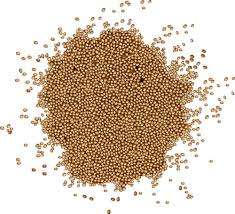
Amaranth is a seed used like a grain.
A grain, a green, a cultural icon, a religious symbol… amaranth is colorful plant with a colorful history. It’s also nutritious. Amaranth was a staple of pre-Colombian Aztecs, who imbued it with supernatural powers and made it part of their religious ceremonies. They would mix amaranth flour and human blood then shaped the dough into idols that were eaten in their well-known sacrificial ceremonies. Human sacrifices were extremely common among equatorial jungle people around the world. The idea they shared was as decaying plants nourish living plants, decaying flesh, preferably the enemy’s, would nourish the people. Occasionally, however, only a young maiden would assure good crops. Spanish conquistadors, who saw no religious parallel with their own communion beliefs, thought eliminating amaranth would stop the sacrifices. The blood ceremonies did stop but for more reasons than the outlawing of amaranth. The plant’s use declined and was forgotten except in remote villages where it was still raised for food.
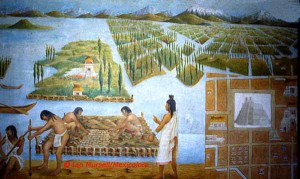
Aztecs farmed with floating mat islands.
Amaranth today is enjoyed many ways. In Mexico and India the seeds are popped and mixed with sugar to make a confection. In Mexico they are roasted for the traditional drink “atole.” Peruvians use the grain to make a beer. Elsewhere it’s used to treat toothache and fevers or to color maize and quinoa. Women performing native dances often wear the red amaranth flower as rouge. In many countries the leaves are used boiled or fried. In Nepal the seeds are made in to a gruel. Although amaranth seed and flour can be found in health food stores, if you want the greens you have to grow it yourself, or forage for it in season, which fortunately is long.
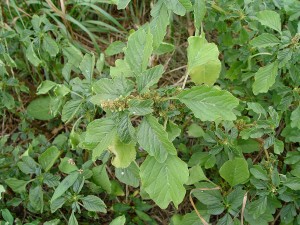
Note notches in the leaves, often present
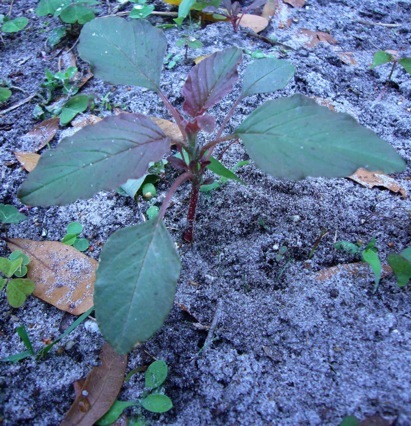
It’s a bushy plant growing 3 to 10 feet, depending if it’s wild or cultivated, a vegetable variety or a grain variety. Feral versions are green, sometimes with red stems, spindly and usually no more than two feet, rarely three. Cultivated versions can be all red, or all green, showy or dull. Grain varieties can be six or seven feet tall. The lens-shaped seeds are tiny — eye of a needle size — and can be gold to black. Plants produce on average 50,000 seeds each. If you have a calculator, that’s a line of 1/32-of-an-inch seeds 130 feet long. Amaranth will grow under a variety of conditions and climates. I always have some in my garden every year though I have not intentionally planted it for more than seven years. It reseeds itself, and if it sprouts where it’s convenient for me, I let it grow. While the grain is very nutritional and versatile I use amaranth mostly for a summer green because it is among the few plants that can take Florida’s high heat and humidity. It has no significant pests per se. Its leave are nutritionally on par with spinach, which is a relative. Also if you avoid spinach for health reasons you should avoid amaranth.
Amaranth seed is high in protein, some 16%, contains lysine and methionine, two essential amino acids that are not often found in grain, and is high in fiber, three times that of wheat. It also has calcium, iron, potassium, phosphorus, vitamins A, C and E.
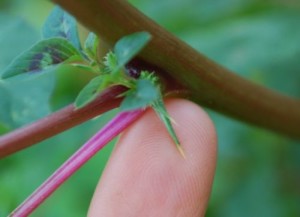
Spiny amaranth has edible leaves and might be a medicine and sex aid.
There are some 60 amaranth species, maybe 70 (it depends on who’s counting.) The botanical genus name, Amaranthus, (am-a-RANTH-us) comes from the Greek word “amarandos, (Αμάραντος) which means non-fading, since its flowers last a long time. Modern Greeks call it Vlita (VLEE-tah.) I see four kinds of amaranth sporadically here in Florida, one I’m sure is an imported version from up north, probably A. viridis (VEER-ih-diss, green, often with notches at the end of the leaf. ) Another is A. hybridus. (hib-RID-us or HYE-brid0-us, also called Smooth Amaranth, with trowel-shaped leave if not pointed.) A third is A. spinosus (spin-OH-sus, spiny.) The leaves and seeds of all three are edible. However, with the latter, the Spiny Amaranth, you have to fight the spines for them. But, the Spiny Amaranth has a very positive side. An article published 23 Aug 2007, in the Journal of Natural Medicines, reported an extract of the plant in rats “exhibited control of blood glucose… showed significant anti-hyperlipidemic … effects….” and increased sperm count and weight of their sex organs. That should make the spiny amaranth disappear as a road side weed.
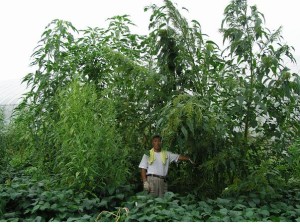
Amaranthus australis (southern amaranth) can easily grow 18 feet or more.
The fourth amaranth was a bit of a mystery for a while. A new bridge was build over the St. Johns River near Sanford and sod brought in for landscaping. Along with the sod came a big amaranth that I took home and transplanted just to see what it would be. Time revealed it to be Amaranthus australis, also called Hemp Amaranth and Southern Amaranth. Oddly it is the only amaranth I have run into that I can’t find an ethnobotanical reference to. It is native, and huge, 15 feet tall is common. Surely it would have been used if usable. But, search as I may I’ve not come up with much about it. It’s not even mentioned in the 70 year index of the Journal of Economic Botany. I have read there are no poisonous amaranths but it is curious that such a large and obvious plant has left not usage trail. My friend Andy Firk down in Arcadia, Florida, reports he eats all the time with no problems. It’s absence from ethnobotanical records and foraging books is a mystery to me.
As with most plants used for “greens” young and tender leaves are usually best, take them from the top. Leave the older, larger leaves to collect energy for the plant. If you want to collect the seeds after they form, take a large, non-porous bag, put it over the top of the plant, gently tip the plant to the side, and shake. The seeds will come loose. What bugs you might get is free protein. Then winnow because you’ll get some seed heads and flower debris.
As for cooking the leaves, I use them like mustard greens, boiling them for 10 minutes or so and then season with salt, pepper, and butter, or with some olive oil and vinegar. After boiling, the leaves can be added to various dishes that call for spinach. But do know that if amaranth is fertilized heavily or grows in drought conditions it can hold a lot of nitrates. If you are going to eat amaranth seeds soak them over night in water to reduce their saponin content.
Here’s an interesting recipe from Salt Spring Seeds.
Tabouli
1 cup pre-soaked amaranth seeds
1 cup parsley, chopped
1/2 cup scallions, chopped
2 tbsp fresh mint
1/2 cup lemon juice
1/4 cup olive oil
2 garlic cloves, pressed
1/4 cup olives, sliced
lettuce leaves, whole
Simmer amaranth in an equal volume of water for 12-15 minutes. Allow to cool. Place all ingredients except lettuce and olives in a mixing bowl and toss together lightly. Chill for an hour or more to allow flavors to blend. Wash and dry lettuce leaves and use them to line a salad bowl. Put the amaranth “tabouli” on the lettuce and garnish with olives.
Green Deane’s “Itemized” Plant Profile
IDENTIFICATION: Annual growing to three to six feet, is frost tender. Coarse, hairy, stout stems, leaves usually dull green on long stalks, prominent veins, oval to lance shaped, often notched when young; flowers clusters dense, bristly, small and usually green, terminal clusters and out of where leaf meets stem.
TIME OF YEAR: Spring in to summer for the leaves, summer or fall for seeds, depending upon the climate.
ENVIRONMENT: Full sun, rich to poor soil, as long as moisture is available. Found around and in gardens, stops signs, vacant lots, an opportunist. Will not grow in shade. Found throughout most of of the Americas. Has spread around the world. If harvested in fertilized area or in drought the amaranth can be high in nitrogen.
METHOD OF PREPARATION: Tender young leaves raw in salads, or cooked like spinach. Seeds eaten raw or ground into flour. There are no poisonous amaranths.
HERB BLURB
Herbalists say a decoction of Amaranth has been used for inflammation of the gums and as a wash for external wounds. Also internally as a treatment for diarrhea and dysentery

I grew up in South Africa where the natives would cook the Amaranth leaves as a spinach. They call it Marog. It was served with a stiff or crumbly maize porridge(Putu pap). Moving to the States I noticed these plants in my yard looking like Marog but was too scared to try it. Now I know it is Marog. Yeah. It brings back many happy memories.
Hi Patsy, Last had marog as a child west of Rustenburg in 1950′s, Blacks used to pick it wild in the “mielie lande”. Then I got the same taste 2 months ago at friends in Knysna. To my surprise seeds are actually available here in RSA. I have already sowed some and can’t wait for my !st crop. As you say the memories a taste can bring back
Hi Patsy, we also have that growing wild here in Auzzie, but guess what, i picked quite a bit, removed all the leaves ( took approx 1 hour, whew! ) washed it thoroughly, a number of times, then sauteed half an onion (sliced), about a few cloves of garlic, just cut in half, 1 roma tomato, few dried chillies, salt to taste, and cook until all the water has evaporated, slight drizzle of olive oil, and Wallla! done, so tasty. Reminds me of Durban days. Yes and the African people called it marog. It is very healthy also. Enjoy!
Oh you are just a joy to listen to. Thank you for your clarity & your sense of humor. I have saved your info, and thank goodness it came in handy today, when one of my sisters had a collision with some stinging nettles. OUCH! So, I sent her your video link that mentioned baking soda as a help.
I will come back to your site for further study on edibles.
Thank you & keep those smiles coming 🙂
Ildiko
Green Deane, I am such a glutton for info on weeds and you keep ever giving, with ever good humour. Thank you!!
I hear that leftovers should not be cooked again. it may or may not be true, but as spinich like as it is, I would not try it. like spinich, they say thay nitrates that were “locked up” can be released in excess. like mana, take only what you need for that day. god will provide.
Name- Thank you for this caution.
It would be wonderful to have the resources to study and either confirm or disprove this, but in the meantime, there is no harm in practicing a little appropriate caution.
Best wishes.
I’d like to send you a pic of my amaranth plant. ( also my tongue – in – cheek vid) I just discovered your website . You have a nice style as you dispense information. I have yet to eat the amaranth leaves or seeds as I pulled it from the crack in the sidewalk last summer although I have collected it’s seeds. Actually, I did grow it in a rooftop garden 20 plus yrs. ago – my first garden in containers- buying the seeds at a local hardware store. I had no idea what it was . ( called “love lies bleeding” ) I wonder if it’s too late to eat the leaves. Sending a pic next. Thanks! GD! Regards, Bonnie
I posted on our acorn thread but amaranth, love lies bleeding, seed is easy to winnow. Cook a small amount on a plate in the microwave for 1:30 minutes then grind it in an electric coffee grinder. Nice flour to mix in cornbread or for a gravy base.
I discovered amaranth growing in my vegetable garden. I thought it might have come from the bird seed as I have two feeders, but then I realized it was only growing in an area where I had incorporated a bag of Moonure. So now I think the seeds were in the dirt. Now that I know these “weeds” are edible, instead of pulling them all up to let the other stuff grow, I’m just letting them do their own thing!
Thanks for the very helpful info!
This first comment is about the heights discussed, particularly about the grain types being much taller than the vegetable types. We have vegetable amaranth that can get nearly as tall as our grain type, and usually much bushier. Happy plants will get to around seven feet, just short of the height of our happy grain amaranths (about 8 feet at the tip of the inflorescence). It is one of the things they call Callaloo in the Caribbean. A. australis can grow much taller than the grain types, but its seeds are about the smallest I’ve ever seen. I’ve eaten australis as have many of my friends. It might not be the best tasting, but is certainly edible. It’s usually only found in wetlands, sometimes in standing water. It has a wide buttressed base, like many of the wetland trees, and sometimes has an aquatic root mat as well. Also, I’ve harvested A. hybridus that were in the range of 4-5 feet tall.
The second comment is to add another part of the plant you can eat. The stems of young plants are eminently edible as well. They get fibrous as they age, but usually all but the thickest parts are good to eat if the plant has not yet begun to flower. They feel thick and hard when you prepare them, but after cooking, they’ll be no trouble to chew and eat.
I frequently see a fifth species of Amaranthus, which is a tiny creeping thing. It’s probably A. albus. I think I’ve eaten it, but my memory is foggy. It was growing in the same place I was regularly harvesting A. viridis, and I think I ate both of them at least once.
I meant to say a fifth species of wild amaranth. In total I frequently see seven, because I cultivate two additional species. If you add some species I’ve seen other people cultivate, it probably goes up to ten
Got some info about side effects to pregnant and breastfeeding women. Is there any side effects on babies six months old, especially the ground grains?
I’ve never heard of said but I really have no idea. I’s there is an answer In Spanish as it is a staple crop in South America but I don’t know that language well.
To prepare for babies, I’d recommend soaking the seeds overnight as Deane describes above to reduce the saponin content (assuming there really is any), then grind the seeds before boiling into a a porridge. As with any new food introduced to a baby, wait 3 days to monitor for allergies and don’t introduce any other new foods to baby during those 3 days so if baby does break out you know what food did it. Deane, are you sure amaranth has a significant saponin content? I know unscientific people tend to consider amaranth and quinoa to be related and so they just assume amaranth will have saponins as does quinoa. Personally, I’m skeptical about amaranth’s supposed saponin content. I have a coworker who was born, raised in Peru, did her graduate studies in Peru and wrote a thesis on preparing baby foods using Peruvian grains, mainly quinoa, kaniwa and I forgot what the other one was. I’ll have to ask but I’m pretty sure it wasn’t amaranth.
So stoked to find this site–great information and clarification. I’ve already sorted out many wonders I’ve long had about several plants, and I only discovered your site last night.
Amaranth greens rival only nettles for me in terms of favorites greens to eat, and here in California the nettle season is waning (sob.). I wonder if the amaranth seeds can be “popped” in an air popper to make the confection you describe that is made in Mexico and India?
thanks for all the great amaranth information. i am always trying new things with amaranth hoping to find a new delicious discovery. i was surprised to find it labeled a pest/weed in some places
Green Deane,
At least *some* of the wild amaranthe here is called pigweed. I thought it was oxalates, but per your article it must be the nitrates which are of concern for ranchers grazing livestock on it. It becomes pretty unpalatable after it gets older. I don’t know whether it becomes bitter or tough or the livestock can taste some toxins in it. I thought that the ‘pigweed’ was not edible for humans. ??? Now I guess I must try it? Thanks for your web site. [I can’t find Lamb’s Quarters???? in here]
Lambs Quarters is in there. Try looking for chenopodium album
Hi Kathleen,
I have frequently seen livestock eat pigweed, usually just the tender tips. You are right, though, livestock will usually avoid plants with high nitrate content- even the ‘choicest’ domesticated foragers that farmers & ranchers plant IF that plant is too high in nitrates (as when fertilized recently with chemical fertilizers, OR growing in or near manure) UNLESS they are not getting enough to eat… Also, some types of plants can tend to concentrate nitrates more under drought conditions, which can compound a problem.
People often assume that ‘weeds’ are competing with pasture grasses, though the roots of many weeds usually grow far deeper than most domestic grasses & forage plants. Some believe that the deeper root systems of plants like pigweed can help other plants’ roots delve deeper into the soil, finding water & nutrients they would otherwise miss (pasture forages & garden vegetables alike).
We are fortunate to have access to a resource like eattheweeds.com, eh?!
Plants can both accumulate nitrates (depends on soil fertility) and produce oxalate. Spinach produces oxalate (& might have a nitrate issue for all I know; nitrates are a bigger problem for ruminants than for us). Mr Deane said if you aren’t supposed to eat spinach (usually b/c of kidney stones, which is due to oxalates), you should also avoid amaranth. Low consumption as part of a varied diet should be perfectly safe for most people.
This summer we have discovered another good use for this weed in our garden. It seems to serve as a insect trap crop, particularly for cucumber beetles. They are absolutely devouring the wild amaranth but leaving the cucumbers alone!
We have found this to be true too, about Amaranth attracting cucumber beetles. In doing so, they serve us well as a trap crop. All of our amaranth ends up looking as if it were shot full of holes with BBs, so much so that we never are able to harvest any perfect leaves unless we catch the plants at 3 inches or less. At three inches or less, we harvest the whole plants while weeding or thinning, hold them in a bunch, and snip the roots off. After a good washing, into the pot they go whole, to cook up like spinach in omletes and stir fry. They have a very mild flavor and are fine raw in small quantities in salads when they are very small.
We usually leave a space for the amaranth and lambs quarters that reseed prolifically in our gardens and appreciate them as well as the domesticated greens that were planted on purpose.
I have tried to grow the grain here but should have eaten the green since the season is too short near Lake Superior. The sweetened confection of popped amaranth with honey, peanuts, pumpkin seeds etc. called alegria (cheerful, light spirit) in Mexico. Popped in a frying pan with the right timing but it would blow right out of an air popper. Wild amaranth (or seeds therefrom?) in Spanish is bledo. Supposedly Fidel Castro replied to journalists in Bs As who asked him about other world leaders’ comments re Cuba, “no me importa un bledo lo que disen los autros de nosautros.” I don’t care a wild amaranth-insignificant what they say about us.
Hello,
I have read your info on amaranth and have a question. Have you ever noticed amaranth seeds turning stool a red color? I recently ate some and my stool is turning the bowl water a red color. I do not think it is blood – am hoping that it may be a color from the plant. If I have to send it to lab for test I will but thought I would ask here first.
I realize this post is over a year old and may not receive a reply. Thanks for any help.
Red / colorful types have the same betalain pigments as beets, which also do that if eaten in excess. It is the pigment. Nothing to worry about.
If this was a red or otherwise colorful variety of amaranth (such as the ones like “Molten Lava,” “Illumination,” or “Joseph’s Coat,” which are often sold in flower catalogs as foliage ornamentals, sometimes called “summer poinsettia”), what you experienced was perfectly normal, passing the pigments in your stool (happens to urine also). Amaranth uses the same betalain pigments as do beets, and just as excessive consumption of beets (except the white ones) will color things, so will excessive consumption of any betalain rich foods, such as red/etc amaranth or even the fruits of red/magenta dragonfruit (such as Hylocereus guatemalensis). It looks scary but causes no harm unless by masking symptoms (if you never take a break from high betalain foods, things will always be that color, so you might not see color changes that could indicate something else).
I have recently discovered this having gotten into the herbs and weeds recently and between my local herbalist and you I have learned so much it’s not even funny. If you only knew how much of this I had to knock down with a yoyo as a kid in the bar ditch as one of my chores so my folks could see the road from the driveway LOL. I’m going to collect some seeds when my stuff is ready this year. Thanks for your teachings
We have “pigweed” in and around our garden. We have tried to keep it away, with no luck. Maybe I will try to harvest it and eat it.
Thank you, you have a great site. I will be back often to learn more.
It is extremely invasive, as you say. But I have also noted that the bugs go straight for it and leave my beans alone. So much so that eating the amaranth is almost out of the question because the bugs riddle the leaves so much. But it does serve well as a decoy. So I don’t fight it nearly so much anymore.
I just bought a stalk of red amaranth at a market in Chicago. It has some leaves, but mostly flowers?/seeds? i can’t tell. Should I just cook the leaves or the whole thing? I was going to wilt them in a skillet then add to a quinoa salad with beets. thanks!
Hi Green Deane,
Thanks for the wonderful and informative you tube videos!
I’m in need of some live plant samples of Amaranthus blitoides (prostrate pigweed). We are researching the nutritional qualities of this species and hope to make a tea from the plant. Do you have any suggestions on where I might obtain a sample for testing? We are in the Chicago area.
Many thanks!
Hello Terese
If you have done some research on Amaranthus blitoides and are willing to email me about your findings I’d love to hear from you!
Karen
I think it is called pigweed because pigs love it. When I used to raise two pigs every year, I harvested so much of it for them that after a while I hardly had any growing in my garden.
They like lambs quarters, too, but nothing will eat ragweed, not even pigs!
I have fed it to my chickens too. Then I read on a chicken forum that it is poisonous to chickens. Even though I never had any chickens die from it, I am nervous about giving it to them now. Do you know anything about this? Anyone?
Ragweed is a high-protein feed for quail.
My free-ranging chickens and ducks had no problem with the copious amounts of spiny amaranth (pigweed) they consumed.
Green Deane, This years gardening season is on it’s way out. The red stemmed pigweed that grows volunteer crossed with some of the love lies bleeding I planted last year making a nice purple bloom. So along with those three I also planted and harvested some Hopi red dye amaranth this year. The red stemmed pigweed has a black seed that when ground into flour makes a purple flour. I use it to make brownies but when used as a replacement for wheat flour in making gravy you get a nice blue colored gravy. Good with purple potatoes. Although the Hopi red dye does make a beautiful red color when the leaves are seeped ( like sun tea ) the color doesn’t hold up to high heat in baking . The ground seeds aren’t as colorful as the red stemmed pigweed, still my favorite. Sometimes when I get lazy and don’t want to go thru the trouble of grinding seeds I put a half cup of seed and a cup and a half water into a double boiler and cook it about an hour. It makes a thick paste that I use in making brownies. Easy and retains a nice texture ( little popping things that pop in your mouth kinda like caviar). Gluten free.
I harvested my amaranth and there were not a few bugs but tons of every bug imaginable – from millipede like worms to tiny green spider to squash like bugs and lots of spiders. I seem to be the only one with this problem. They are too small to sift out, even the worms. I live in Kansas and harvested before the first freeze since the heads were hanging over so far. It was in October. It was not a buggy year at all with my other produce. Just don’t know how to get the bugs and lots of flower head parts to sift out of the grain.
This is precisely the problem I am having, and have searched the web for answers but no one seems to have mentioned the bugs! I tried harvesting one plant, and had more bugs in my bowl than grain! Spiders, mites, and some teeny tiny black bugs that were smaller than the grain. I’m going to be very disappointed if my 25 plants are all a waste. 🙁
Bugs are edible…
Try soaking in salt water-bugs should come to the top.-Might be worth a try.
I believe my wild amaranth/pigweed came in on round hay bales I bought for my horses. Its growth is concentrated near where the hay was stored or fed. After my initial horror at seeing ugly, spiny invaders popping up en masse around my fence lines, bale feeders, and run-in sheds, I started learning more about the plant, empirically and through research. A few observations:
1) It does not seem to inhibit grass growth. So when it populates a section of overrused pasture, it seems to serve a protective function for grass, shielding it from the livestock as it regenerates and providing some cover from the summer sun. If I cut down or pull a swath of pigweed, I often find reasonable-looking pasture coming up beneath.
2) The goats are happy to nibble the leaves, which improves the diversity of their forage (otherwise somewhat limited by the size of their paddock).
3) The roots are quite easy to pull up. And I practice mowing when the plants are flowering, thus reducing their ability to develop seed or re-grow before the end of the season.
So it’s not bothering me so much now, and as I’ve learned about the free food it may provide me I become even more forgiving. FYI, I do not fertilize my pastures nor do I use chemical weed control.
What I’d really be interested in is whether the plants can serve as a reasonably efficient biofuel. Heaven knows they grow easily in wasteland.
Re domestic amaranth, I’ve not had much luck growing it in my gardens. But I regularly buy amaranth seed to add to oatmeal and corn bread– great crunch and flavor. Next I’ll try it in polenta.
I have a small farm stand and would like to grow Amaranth for its leaves.
I have many people that visit our stand from India. I have heard that from
their part of the world they like Amaranth green leaves. Does anyone know
if this is true and where can I find seeds. Thanks,Mike
Amaranth is a highly important food for people who are allergic to gluten as it is 100% gluten free. Amaranth is actually not a true cereal grain but a seed of an annual plant which related to spinach. The green part of amaranth is eaten as vegetable and the seeds are utilized as grains. The seeds of amaranth are a boon for those allergic to grains.
Interesting ive grown amaranth (right by lentils) for years and never realized I could find it in a wild setting here.
I appreciate your curiosity about the giant amaranth. I’ve wondered about it, too. I’ve sen here here and there usually in roadside ditches or water retention areas.
In the south a problem has been causing problems in soy and cotton fields known as glyphosate-resistant Palmer amaranth (Amaranthus palmeri). The Palmer (Pigweed) variety of amaranth is shutting down entire areas of the south for many crops.
I have a huge article on exactly that. Search the archive for it.
I get a twisted kick out of it though, the weeds best Monsanto!!!
As for wild amaranth growing a spindly 2 feet, I once left a lone plant (commonly known and hated locally as ‘red-rooted pigweed’) to grow in my front yard just to see how it would turn out. Imagine my chagrin later that summer when I realized the weed was taller than I and sported a huge, plumed seedhead visible to all my farming-community neighbours. The stalk had become a ‘trunk’ which I had to cut down with a handsaw!
Thank you for the assurance of information.
In the Andes of Peru was the first time ( more than 30 year ago )I notice that this plant was eateable. The farmers and poor people used to eat in soups and stews mixed with quinua, potatoes, chiles (aji ) and meats. I did not notice they used the seeds, but probable they did or continuing using.
I have amaranth in my small yard and my husband and I are enjoying spreding the word about its uses and properties.
Everithing that God created is good. We only need to investigate in which way we can use.
Thanks again.
Brilliant info thanks so much. I am currently identifying local native plants to help me design my permaculture guilds.
oh, wow! I have not see such a tall amaranth plant ever before! very cool! here is an infographic that gives a basic overview about it. hope you like it! http://www.5-am.de/5am-amaranth-infographic/
I live in S Fl now but come from CT. We lived in the city and still always had a small garden, but my brother lived in the country and his soil was ideal, and everything in his garden grew like weeds…including of course the weeds! He would use bails of hay between the rows to keep in moisture and discourage the weeds, but with the hay came pasture seeds from amaranth, lambs quarters and others. Once they found purchase, they grew happily, which made him crazy! Once when visiting I learned of his plight, and happily joined him in “weeding” his garden for the free takings! It got to be a semi-ritual for him to “offer up” the free food that crowded out his beloved tomatoes, peppers, and other cherished crops, that I was more than happy to help him with! His “weeds” were 3X the size of ours in the city and absolutely delicious! When he finally got brave enough to sample them, as I recall, I didn’t get that call as often! But that was a long time ago! Love this site Deane, I can never learn enough about the produce that exists for the taking. There is something so primal and satisfying about being able to provide for yourself from nature…not to mention economical when you are scraping by!
Thank you!! I absolutely love your site!
I have used amaranth weed leaves in smoothie with Apple, great. I am in Outback Queensland Australia. I want to use seeds as a porridge. Do you have the brownies recipe with amaranth seeds and could it be emailed to me. Madonna
I took a bunch of wild amaranth from a neighbor’s yard that was fixing to be mowed, is it safe to eat the seeds while they’re still green? I’ve only ever eaten the leaves before.
It’s a little hard to harvest “green” amaranth seeds. Sure you have the right plant?
It’s whatever variety the first picture here is: http://www.foragingtexas.com/2008/08/amarath_20.html
I was thinking of snipping the ‘spikes’ off and just steaming them a bit. They’re probably closer to flowers than actual seeds at this point.
Steaming the seed spikes is fine, But the seeds usually have not developed yet.
hi I have kids with bone marrow failure. .. i need this plant to help build their blood cells..i am in durban south africa. ..we’re could I get this seeds as soon as possible. ?.Please contact me as soon u get this mail..It would be very kind of u…Thank u
I know this is an old comment, and I don’t know if someone has helped you out yet, or if you have already found Amaranth seeds, but I live in South Florida USA and cultivate Red/Green Leaf Amarath. I have pleanty of seeds and would be more than happy to send you a bag in the mail, no charge whatsoever. Let me know if you need them and I can put them in the mail.
Hi John what part of Florida are you in? I live in Sarasota and would like to try growing Amaranth. I have bought Amaranth in bulk online for eating never thinking it would grow in Florida as I read it natively grows in Chile or in mountainous regions with much cooler temperatures than Florida. How easy is it to harvest the seeds without all the chaff or whatever you call the frass etc.? If you could email me I would like more info as this is a nutritious staple I would like to grow and add to my regular diet. Thanks!
It’s a common weed here, several species actually.
Hello – where can i purchase Amaranth Flour from – I reside in South Africa. Any counsel would be great and thanks for this informative page:)
Hello, Deane!
I can’t remember where I recently published a comment on your site asking about a weed that reminded me of amaranth, but was obviously not.
While watching one of your videos on lamb’s quarters last night, you happened to come across the weed in question, which is curly dock!
Thanks for the videos and work you do. We do homeschool lessons with your videos and are hoping to join a local group of foragers that happens to have a few area experts.
I am not very good at botany or plant identification (sadly), but I hope it’s something my kids pick up. I really believe it is so valuable…it’s actually invaluable.
Thanks a lot and God bless you!
Several months ago, I purchased and transplanted some small organic amaranth plants (Opopeo). They are a beautiful whorl of about half a dozen dark ruby leaves on a 4″ stem topped with a fuchsia-colored “feather.” I gave them ample room to reach for the sky. They have received plenty of water and sunshine. Still… nothing. They have barely grown or changed since I put them in the ground months ago. Do I need to snip off their top-knots? Fertilize? Pray more? Please advise. I was expecting a bounty as well as a beauty. Thank you.
It could be the soil. Are they in the ground or in a container? My soil was potting soil from two years ago. But, I usually try to feed mine every two weeks. They are in 18″ containers. But, this year, I have only fed mine three times.
The amaranth do like the heat. They also need the sun. They like warm, damp soil is what I have discovered. If you place rocks around the base of the plants, they thrive! Again, it keeps the soil warmer. This was an accidental discovery. And, this gentleman lives in Florida. So, maybe that makes sense.
How much sun are they getting? What location of your yard are they in? Morning sun, afternoon sun???? It really does matter. Mine are located on the west side of my house. They receive sun from 11 am – 7 pm. They reseeded themselves and they are currently 3-4 feet tall and growing. And, I have tons of little starts growing around the larger plants. I think I might try them in a salad. 😉
Why, after I cook this grain would I have a feel of sand in my mouth?
Do I have to rinse the grain before I cook it?
Thanks
Liz
It’s small like sand.
can you eat all types of amaranth??
thank you so much
So I’ve been in love with this plant since I first ate it. Not too long ago I learned it’s related to our modern vegetable, beets! So my question: do you know if the roots would be edible, similar to beets? I can’t find any credible information for or against this, so I might have to carefully experiment myself. Thanks!
There are YouTube videos where people use the roots in soup.
We have Amaranthus australis in the entire coastal area of Suriname. I have seen it growing up to 3 meters high on floating weed islands in canals in the north of Paramaribo . In marshy areas it grows up to 4 meters high with a very thick stem. I have eaten the leaves of young plants: they looked quite palatable and tasted very good too. The plants emerged from the bags of humus and soil which I bought some time ago (and that probably originated from composted plant material that was gathered from the canals). The main Amaranthus species eaten in Suriname are A. dubius, A. lividus and, to a lesser extent (because of the spines) A. spinosus. A. australis is sometimes eaten by few people. the majority of people here don’t know and have never seen the latter species: one has no easy access to it. Besides, the variety of vegetables is enormous so why bother to sample and eat those giant leaves when you have over 100 other veggies available (wild and cultivated).
Does anyone know if the A. asutralis seeds are edible and if yes, how to use those?
Are there any dangerous look alives? When pulling weeds I though I had found Amaranth except the leaves were serrated and not as round. Almost like nettles but not so elongated (and didn’t sting). Actually at first I thought it was cat nip or a mint relative but the stem is not square. The stem also had course hairs on it. Needless to say, I chose not to cook and eat it.
dear thank you amaranth is interesting to feed local and scientifically also produced as supplementary food ,medicine packed food to make eaten measly but generation not adapted it to feed in my area the local people adapted this food. it can be produced at dry season and dry land it doe not need much water means it is very preferable to produced in now a days weather condition. if any any partners needs to product with me i have readiness well com
My chickens love the amaranth that grows here in The Dalles, OR
i was curious if you every tried to make flour from the seeds and if so what variety, have been making flour from other grains and have not found a lot of sources for armanath. Thinking of growing my own, any input would be appreciated
Thank you
Thanks for your blog & the wealth of information it has.
The seeds i got looks all white seeds, the plants grow 6 foot or more when fully mature. Sets seeds, looks more like the grain variety.
In India, I was eating fresh leaves in soups and the kind of seeds i saw for those were typically black and tinier than the white seeds. Moreover, the foliage in those leafy greens variety are more denser.
While, I find the grain variety to start off with lesser leaves and then growing more bigger leaves as the plant matures.
Where can I get the seeds from a variety that is best of leafy greens?
I live in Sacramento, CA.