
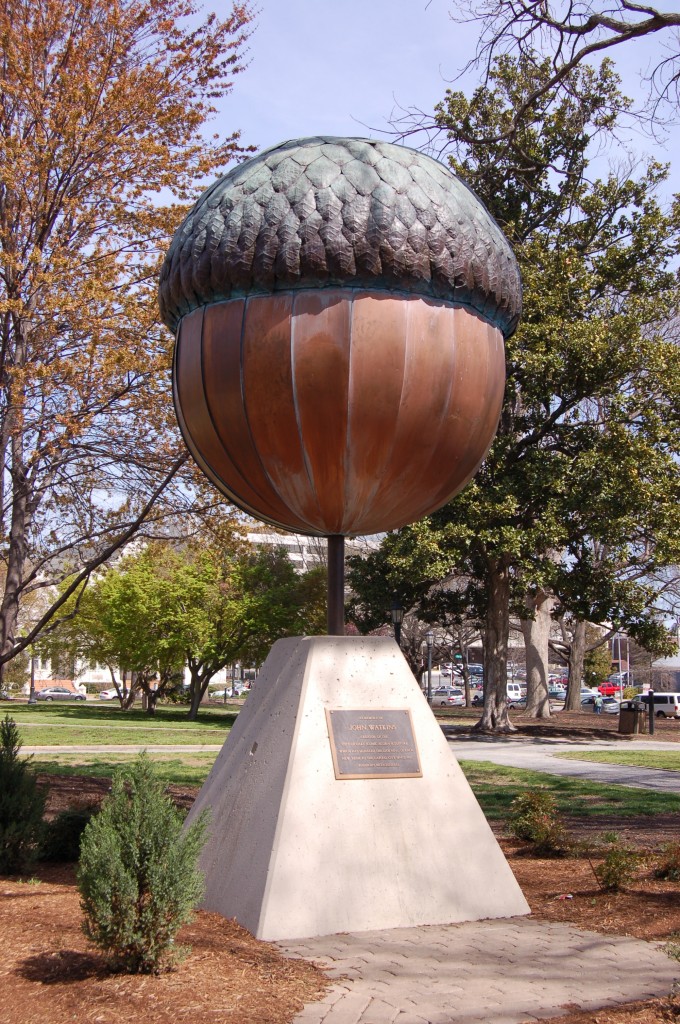
World’s Largest Acorn
Acorn: More than a survival food
The first time you eat an acorn it makes you wonder what the squirrels are going nuts about. As the bitterness twists your mouth into a pucker it reminds you that animals can eat a lot of things we can’t… unless we modify them.
Much has been written about acorns in foraging publications. I’ll try to say a few things that haven’t been said. Let’s start with that fact that the world’s biggest acorn is in Moore Square Park in downtown Raleigh, North Carolina. Raleigh calls itself “The City of Oaks.” The “Big Acorn” is 10 feet tall and weights 1,250 pounds. I’d hate to meet the squirrel that can carry it away. But, it does remind me of a general rule of thumb about acorns: The bigger the cap on the acorn, compared to the size of the nut, the more bitter the nut will be.
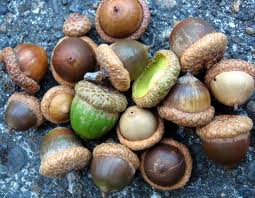 The English word “oak” is some 1,260 years old. In German it was “eih” ending up “eiche.” The Dutch extended it to “eychen” or ” eychenboom.” (I went to school with a “Cossaboom” meaning cherry tree.) Oaks are also mentioned in ancient texts. Greeks of old said “dryas.” Modern Greek say “dris.” It was the preferred tree of Zeus (whom the Greeks call ZEFF, rhymes with Jeff. Zeus is mangled through Dead Latin then into English.) Those faithful to ZEFF… ah… Zeus… gathered around oak trees. The Celts preferred to knock on oak wood. One variation of their word for oak was “dair, the fourth letter of the Celtic alphabet and part of the name of the city Kildare (which means “Church in the Oaks.”) Often associated with strength, the US military awards gold “oak leaf clusters” for exceptional bravery. Oaks have been a significant part of every culture around them.
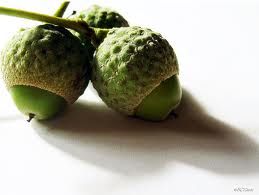
The larger the cap the more tannic acid
The word “acorn” is a combination of “ak” for oak and “corn” meaning seed thus acorn means “oak seed.” The Greeks say velanidi, the Spanish bellota, the French gland, Italians glanda, Portuguese, glande, and in the forgotten fifth romantic language, ghinda in Romanian. Those Romans got around. All the Romantics come from the Dead Latin word for gland, which also lent itself to the medical term for a certain acorn-like part of the male anatomy. The acorn is also one of the few nuts or fruits that is not directly named in Modern English after the tree it comes from. This is why one does not hear of oak nuts… walnuts, beechnuts, hickory nuts, oak nuts… gland… it could all get rather naughty.
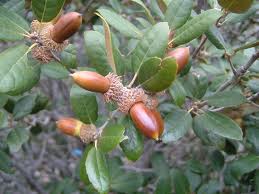
The smaller the cap, the less tannic acid
At least 450 species of oak populate world wide. Some 30 species in the United States have been used for food and oil. The Live Oak is the most prized, not only for food but particularly ship building. Its very long, graceful limbs were ready-made for boat keels and ribs. In fact, the U.S. Navy once had its own Live Oak forest just for boat building. Sold off long ago, the Navy began stockpiling Live Oak in 1992 for restoration of the USS Constitution. It got 50 live oaks from Florida in 2002 of 160 that were cleared for a golf course near Tallahassee. Just as 200 years ago, the trees were selected for their natural curves for the ship. In the white oak family, the Live Oak’s acorns are among the mildest one can collect. Botanically the Live Oak is Quercus virginiana. Quercus (KWERK-kus ) was the Roman name for the tree and virginiana (ver-jin-ee-AY-nuh) means North America and usually where the species was first noticed, such as Virginia. (If you want to get confusingly technical “Ilex” — the genus name for Hollies — also means “oak.” Early botanists thought the Hollies in North America were oaks so they called them Ilex, which was the name of an evergreen oak. When the mistake was found out Hollies kept the oak-genus name and the Oak genus was changed to Quercus.)
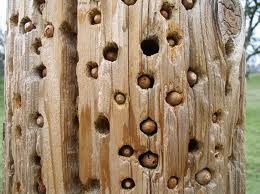
Storing acorns the Acorn Woodpecker way
The seed crop from an oak, the acorns, is called a “mast” which means “food” and putting on a crop of acorns is masting. It is tempting to say it is probably related to the word to “masticate” meaning to chew but it isn’t. Mast came from the Middle English word “mete” meaning meat, which at that time meant any food, and we still use it abstractly in that way, as in “Education became his meat and experience his drink.” Mete came from the Italian word madere which came from the Greek word, madaros, meaning to be wet. That takes a bit of explaining: Ancient Greeks divided food into two large categories. “Wet” food was food fit for humans and pigs. Dry food was fit for cattle and fowl. Now you know. How many acorns a tree produces is directly related to the amount of rain in the spring time of the year it is supposed to mast. The more rain the more acorns.
Acorns are quite nutritious. For example, the nutritional breakdown of acorns from the Q. alba, — the white oak — is 50.4% carbohydrates, 34.7% water, 4.7% fat, 4.4.% protein, 4.2% fiber, 1.6% ash. A pound of shelled acorns provide 1,265 calories, a 100 grams (3.5 ounces) has 500 calories and 30 grams of oil. During World War II Japanese school children collected over one million tons of acorns to help feed the nation as rice and flour supplies dwindled.
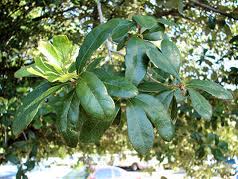
Live Oak leaves have no teeth
Oaks fall into two large categories, those that fruit in one season, white oaks, and those that fruit after two seasons, the black oaks and the red oaks. The latter category can be more bitter than the former. The first category have leaves with round lobes and no prickles at the end of the leaves. The black and red oaks have prickles at the end of their leaves. They also have scales on the caps of the acorns, hair inside the caps, and a sheath around the nut (which always throws a color even when the tannin is leached out.) Sometimes those in the first category don’t need any leaching, or very little. The rest always do. But first, separate the acorns.
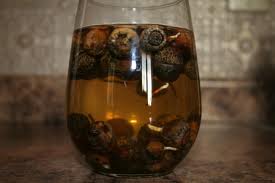
Floaters are bad or have a usable grub in them
To separate acorns dump them into water and remove the ones that float. Take the ones that sink and dry them in a frying pan on the stove or in the oven at 150F or less for 15 minutes, preheated. Or put them in the sun for a few days. You don’t want to cook them yet, just dry them off and shrink the nut inside making them a little easier to shell. The yield, not counting bad acorns, is 2:1. two gallons of usable acorns in the shell will yield a gallon of nut meat. We must leach out the tannic acid it can damage our kidneys, Most unleached acorns are too bitter to eat without leaching.
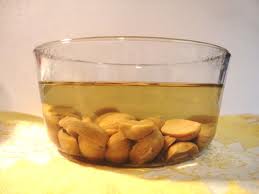
Soaking in cold water, minimal energy and the starch is not cooked
There are three general ways to leach acorns. The least common way is to bury them whole in a river bank for a year, which turns them black and sweet, good for roasting. The other method is to grind them into a course meal and soak several days or weeks (depending on the species) in many changes of cold water until the water runs clear. These will be slightly bland but good for making acorn flour. (Sometimes the leached acorns will be dark but sweet afterwards.) The third way — boiling — is least preferred because if done wrong it will bind the tannins to the starch and they will not lose their bitterness. Also, when you boil the acorns you also boil off the oil with the tannins, reducing their nutrition. That oil, however, is very nutritious. At this writing it is selling for about $10 an ounce. You can make it for far less. There is actually a fourth method of processing that requires lye but it is not commonly used nor have I tried it.
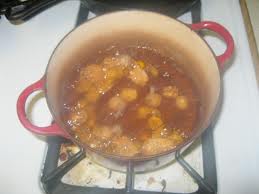
Boiling speeds up the process but cooks the starch
The boiling process requires two pots of boiling water. Put the acorns in one pot of already boiling water until the water darkens. Pour off the water and put the hot acorns in the other pot of boiling water while you reheat the first pot with fresh water to boiling. You keep putting the acorns in new boiling water until the water runs clear. Putting boiled acorns into cold water will bind the tannins to the starch and they will stay bitter. So always move them from one boiling bath to another. Putting acorns in cold water and bringing the water to a boil will also bind the tannin. So it is either use all cold water and a long soaking or all boiling water and just a few hours of cooking. There is one other difference between the two methods.
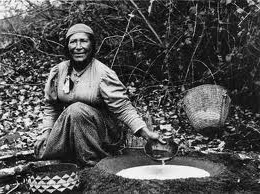
Mrs. Freddie, a Hupa, pours water over ground acorns in a sand basin
The temperature at which you process the acorns at any point is critical. Boiling water or roasting over 165º F precooks the starch in the acorn. Cold processing and low temperatures under 150 F does not cook the starch. Cold-water leached acorn meal thickens when cooked, hot-water leached acorn meal does not thicken or act as a binder (like eggs or gluten) when cooked. Your final use of the acorns should factor in how you will process them. If you are going to leach and roast whole for snacking then boiling is fine. If you are going to use the acorn for flour it should be cold processed, or you will have to add a binder.
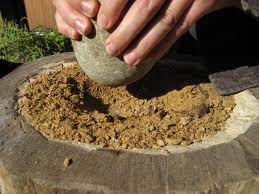
The finer acorns are ground the quicker they leach
Personally, I grind mine in a lot of water to a fine meal, let it set, then strain. I add more water to the meal, let set and strain. I do that until the water is clear or the meal not bitter. That takes a few days to a week. Then I dry it in the sun, unless there are squirrels about, then in a slow oven (under 150º F.) I end up with a meal or flour, depending on the grind, that will not crumble when cooked.
There are nearly as many variations to leach acorns as there are opinions about acorns. Another way is to put the shelled acorns in water in a blender or food processor and blend them into a milk-like slurry. Put that slurry in a fine mesh bag and then massage that under running water like a faucet. It works very quickly but of course some meal and oil is lost in the process. But it turns hours of leaching into minutes. Of course, leaching them in an unpolluted stream is the easiest way but you can also arrange for a container to leak slowly. Simply put a cloth on the bottom to hold the meal in and fill the container when it is empty, or run the faucet slowly to maintain the leaching. Another ways is to clean out the tank on your toilet and put the shelled acorns in a mesh bag in there. Every flush will remove tannic water and bring in fresh.
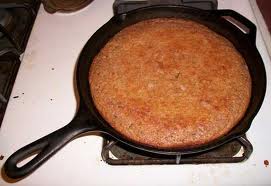
Acorn bread in a classic cast iron pan
Many Native Americans preferred bitter acorns to sweet ones because they stored better. If after leaching there is just a hint of bitterness that can sometimes be removed by soaking the acorns in milk for a while. The protein in the milk will bind with the tannin in the acorns and can be poured off, if there is just a little. To get oil from the cold-leached acorns, boil them. The oil will rise to the top of the water. Also, charred acorns can be used as a substitute for coffee but really nothing is a substitute for coffee.
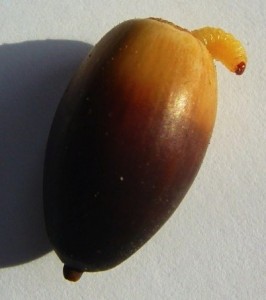
Acorn grubs are edible raw or cooked
Whole leached acorns can be roasted for an hour at 350º F, coarsely ground leached acorns slightly less time. They can then be eaten or ground into non-binding flour. To make a flour out of your whole or coarsely ground acorns, toss them in a blender or food processor. Strain the results through a strainer to take out the larger pieces then reduce them as well. Acorn flour has no gluten so it is usually mixed 50/50 with wheat flour. Since acorn flour is high in oil it needs to be stored carefully and not allowed to go rancid. Remember cold processed acorn flour has more binding capacity than heat processed acorn flour.
Live Oak acorns top the food list for birds such as wood ducks, wild turkeys, quail and jays. Squirrels, raccoons and whitetail deer also like them, sometimes to the point of being 25% of their fall diet. Interestingly, the tannin tends to be in the bottom half of the acorn which is why you will often see a squirrel eat only the upper half of the acorn. Squirrels are also not fools. They will eat all of a white acorn when they find one because it is the least bitter. They will bury the very bitter red and black acorns so over time some of the bitterness is leached into the soil. Raiding a squirrel’s hoard will get bitter acorns. By the way, acorns shells and unleached nut meat have gallotannins which are toxic to cattle, sheep, goats, horses and dogs.
If you use the boiling method don’t throw away the tannic water. The water has a variety of uses. With a mordant it can be used to dye clothing. The tannic acid also makes a good laundry detergent. Two cups to each load but it will color whites temporarily a slightly tan color. Tannic water is antiviral and antiseptic. It can be used as a wash for skin rashes, skin irritations, burns, cuts, abrasions and poison ivy. While you can pour the tannic water over poison ivy, if you have the luxury freeze the brown water in ice cube trays and use the cubes on the ivy eruption. If you have a sore throat you can even gargle with tannic water or use it as a mild tea for diarrhea and dysentery. Externally dark tannic water can be used on hemorrhoids. Hides soaked in tannic water make better leather clothing. Using the brown water turned hides tan-colored and that is why it is called tanning and from there we get the words tannins and tannic. In traditional tanning methods, whole hides are soaked in a vat of tannin water for a full year before being processed.
Besides dyes paints have also been made from the oaks. It also a dense wood for working and weights 75 pounds per dry cubic foot. The hull of the US warship, USS Constitution, was made entirely of oak, white oak covering over a live oak core. At the waterline she was 25-inches thick. Eighteen-pound cannonballs bounced off the oak, notable in the 1812 battle with the HMS Guerriere. That battle and the subsequent loss of British ships caused the British to issue the order that no ship was to attack the Constitution singlehandedly. The Constitution, as of this writing, is still on duty and berthed in Boston.
Oak trees begin to produce acorns at about 20 years old but usually the first full crop won’t happen until the tree is about 50. The average 100-year old oak produces about 2,200 acorns per season. Only one in 10,000 will become a tree.
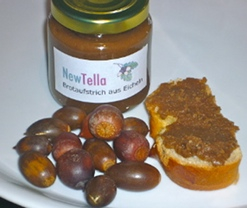
Peter Becker’s “Newtella”
Sprouted acorns are also edible as long as they haven’t turned green. I’ve heard from German forager Peter Becker who has a slightly different view of what to do with acorns.
“What I do to prep acorns for consumption is let them germinate, so the starches turn into malt sugar. I’ve only just developed a new product with acorns to introduce this precious nut to public because acorns are generally considered inedible here in Germany. NewTella is a sweet bread spread just like Nutella, the famous hazelnut creme, except that all ingredients are locally available, it has less sugar and the only fats are from the acorn. The basic preparation is to roast leached, peeled and germinated acorns, boil 1 part acorns with 3 parts of apple juice, when soft process them smoothly, add 20 % sugar with pectin. This bread spread is also a great way to preserve acorns and can be used for cookies. It’s a great way to promote this gigantic untapped resource and jazz up general nutrition.“
A few exchanges about Peter’s process is below in the comments. He shells them, leaches them (cold water) and sprouts them before using them to make his NewTella. That helps convert the starch to malt, which is sweet.
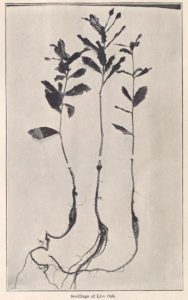
Older oaks with swelling.
What about other parts of the oak? Get ready for some official hearsay… A century ago a pamphlet was published by a W.C. Coker on “The Seedlings Of The Live Oak and White Oak.” Coker referenced an article called “The Acorns And Their Germinations” by a Dr. Engelmann in Vol IV, 1880, of the Academy of Science of St. Louis. He in turn was referencing three fellows in South Carolina one of whom, William St. John Mazyck, made the original observation. Englemann wrote: “The structure of the acorns and the germination of the oaks seem to be so well-known, that I did not pay much further attention to it until my interest was excited by the information that the germination Live Oak developed little tubers, well-known to … children and greedily eaten by them….”
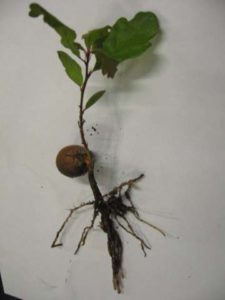
Is this oak seedling creating a starchy swelling that’s edible?
Essentially they write that after the acorn sprouts and sends up a young shoot the root develops a small elongated swelling that is edible. They agreed the swelling contains starch. The question they were discussing was when does the “tuber” form and how long does it last? They suspected it formed before the young shoot developed many true leaves. The swelling persists but grows woody in a few years. The “plate” in the pamphlet (above left) showed older oaks shoots but was used to show the swelling location when younger. One question was why would some species do this and the possible answer was hard times, or if you’re an oak, bad weather. The starchy swelling would help feed the seedling.
Lastly you may have a use for those acorns mentioned above that float when tossed in water. Most of them have a weevil grub in them, the Acorn Curculio. Look for a little 1/32 inch hole. In time that grub will crawl out and burrow into the ground for a couple of years turning into a full-fledged insect. You can use that grub in the acorn as bait for fish. Or, you can let it crawl in to a bucket of dirt or sawdust or a container of oatmeal where it will make a cocoon which you can then open later and use for bait. Store live in the frig. Also, squirrels like the grubs so it is not beyond reason to use them for bait for squirrels. And to answer your question, the grubs are edible by humans raw or cooked. I like them cooked in butter though bacon fat might do as well. You may also find a little worm with legs in an acorn. My entomologist friends tell me they are edible, too.
One more thing you should know is acorn four and acorn starch are not the same thing. The internet sells acorn “flour” but ships acorn starch. The flour is good for bread-like creations, the starch is more suited for sweets.
Acorn Bread
2 cups acorn flour
2 cups cattail or white flour
3 teaspoons baking powder
1/3 cup maple syrup or sugar
1 egg
1/2 cup milk
3 tablespoons olive
Bake in pan for 30 minutes or until done at 400 degrees.
A far more simple form of acorn bread is to make a thick acorn porridge out of cold processed acorn flour. Take a large tablespoon of the porridge and drop it into cold water. This causes the porridge to contract. Take the lump out of the water and dry.
Green Deane’s “Itemized” Plant Profile

Autumn Acorns
IDENTIFICATION: Acorns, small nut with cap. Rough and larger caps belong to the more bitter acorns.
TIME OF YEAR: Usually late summer, fall, tree do not produce every year.
ENVIRONMENT: Oaks inhabit all kinds of environments.
METHOD OF PREPARATION: Numerous once leached of tannins.: out of hand, flour, candy.
HERB BLURB
The tannins have been used as an astringent as well as antiviral, antiseptic and anti-tumor but could also be carcinogenic. The mold that develops on acorns has antibiotic properties.

In my backyard is an Oak. It is a member of the White Oak family but I am not that good at all the Oak distinctions other than just knowing some of the red, black, and white varieties. Anyway I picked up right away that the acorns had “small” caps in relation to the acorn size so I knew it may have less tannin. I opened one and sampled the meat. I was amazed that it had no tannin. No bitterness at all and I can eat them raw as is. This is how I know it must be a member of the White Oak family. But I don’t know the exact name yet. So now the squirrels have competition. lol
Is it really safe to eat white oak acorns raw? What are the possible dangers? Are there any poisonous fungi we should watch for?
Is there the risk of tannin poisoning if raw acorns are consumed in excess?
Tannic acid irritates the kidneys. At some point irritation become a toxic issue. This is why they are leached. White oak acorns are safe if they are low in tannins, but usually they have to be leached. Fungi is usually not an issue.
I have heard that there are some acorn trees that bear acorns that have no tannins in them. It is rare and it is almost impossible to create a seed strain for them as there are so many of the tanning bearing varieties that have their pollen in the air.
Thank for the great info on oaks and especially live oaks and the Curcuilo.
I started collecting acorns from the two beautiful trees in back of our house, the Oyster Catcher, after reading Euell Gibbons book, “Stalking the Wild Aspararagus.”
Is there a time limit after the acorns fall before there no longer useable?
They tend to go bad in a few months if left on the ground. However, propery stored they can be good for a couple of years.
Hello there, I was just wondering if I could store already cold-leached and dried acorn flour? And if so, how long will it stay fresh?
Stored well a couple of years.
It depends on the type. White oak acorns go bad fairly quickly. All those tannins in the red/black oak acorns inhibit bacteria/fungi from attacking them, so they can last a lot longer.
Howdy Green Deane, Greetings from the Knottyfood Manufactory
Thanks for the mention. Peter Becker
My pleasure Peter. I have three question. In preparation you say you roast “leached, peeled and germinated acorns.” What is the exact order? 1) germinate, shell, leach then roast? 2) Shell, germinate, leach then roast? 3) Shell, leach, germinate then roast? And is that cold water or hot water leaching? And how much of the shoot do you use? You don’t have to give away trade secrets but a hint would be nice.
First I leach them in several changes of water, until it remains clear. By the time the shoot usually appears and storage componants transform to sugar, the vitamins multiply and the malt sugar upgrades the flavour when roasting. So after germination they`re peeled and roasted for 15 min at 160 ° C. Then they´re cooked in 2 parts (meaning twice the amount than acorns) of apple juice until soft (apple juice will be mostly reduced), cooled off because the pectine sugar has to be added that way with the third part of apple juice, then cooked for another 4 min., processed and filled into sterilized glasses.
I hope it all makes sense now. I use dandelion root syrup as a spice, because my goal is a healthy sustainable regional alternative to commercial brands of hazelnut spreads with all sorts of imported ingredients.
But when you try this preperation you can certainly also add vanilla or chocolate.
One more interesting thing: Quercus robur, the most common oak here in Germany peels the easiest, because germination cracks the shell into three pieces.
So if you`re only just starting to explore the properties of acorns; soak a handful of each kind and look for the ones that peel real easy. Other kinds can be a real pain becauce you have to scrub off the shell and the “endotesta” (brown inner skin) sticks to the nut.
so you shell them, leach them and they still germinate… Interesting.
Peter, is this a method that you have developed, or was it passed down to you? Interested to see if it might be an ethnic European approach. Thanks!
Adriane, He didn’t say how long he left them in the water before each change so maybe it does leach the tannins. Also, most seeds have enzymes in them that convert their stored starches into sugars when they start to sprout. Malted barley in beer making is just that. Barley that has started to sprout then roasted to different temps for different effects (colors, flavors etc.). Also he said 160 degrees C. That would be 320 degrees F.
I would like to try it to but any acorns that may have fallen this fall have about 2 feet of snow on them right now. lol Oh well there is always next season!
Not really surprised that they still sprout after leaching and shelling them, probably because I’ve seen plenty of chick peas starting to sprout after being soaked for few hours.
The acorn’s shell isn’t involved in growing roots or anything of the tiny new oak tree, it’s there for protection. Removing should make it easier for the nut itself can soak up water and sprout roots quicker.
Similar for removing the tannins: like the shell, they are for protection, not because they are needed for growing.
On top of it, they make great food for your chickens. No leaching required, just crack the shells and you have a feeding frenzy! It sure helps cut down on feed costs. (I’m using Q. lobata out here–and they sure have a mouth-puckering bitterness fresh.)
Does any animal eat the cap of a Valley Oak’s acorn? The caps seem to be ignored by squirrels, deer, and birds, yet they disappear somehow. What happens to them?
Maybe they are stole to make whistles…. that’s what I use them for. (As far as I know they are not edible except by litter denizens.)
How do you make whistles out the caps? Please. : ) I am doing a puppet show on Quercus Agrifolia and I bet the audience would love to know, and me too! Thanks.
It’s how you hold the cap. Making fists, you put the fingernails of both forefingers together. You put the acorn cap, cup up, on top of the end of those two fingers holding the cap down with your thumbs. You hold your thumbs so to cover the open cup leaving a V space. You blow into that V space and it whistles.
http://www.sciencetoymaker.org/acorn/assembl.html
Hi Green Deane,
I collected some acorns yesterday and tried to sort out the good ones from the grub-infested ones by submerging them in water. Much to my surprise, they all sank to the bottom, suggesting that they were all good. I had probably 50-75 acorns. Is this just great luck or a red flag of some sort? I tried this with another batch from a different tree about two months ago and more than half had grubs inside. If the grubs aren’t eating these new acorns, should I?
Thanks for your help.
Great that they all sank, though you will still find a few that aren’t edible. Lack of grubs isn’t an issue. It might be past grub season in your area. You should, however, collect mostly brown acorns, not green ones.
Oops! I thought I was on Peter’s site… Nevertheless, I am very interested in learning more from you, as well. Do you ever offer classes outside of FL? MD, specifically?
James
No problem… he knows his European Oaks.
Hi Neil, I have heard of the leaves being used to make wine.
The wine is made with oak leaves, sugar, oranges, yeast and pectional. You can find the recipe in Wild Food from Roger Phillips. Cheers!
Thanks for writing… I think “made with” states the involvement of leaves too much. The leaves have tannin in them and that is often added to wine to improve the flavor. They were added for flavoring.
It turns out there is a well-established acorn liquor, mainly out of Spain. I’ve never been able to find anyone selling it in the U.S. This is the website of one of the main producers — be sure to check out their little promo video — most glamorous acorn I’ve ever seen 🙂
http://www.saboresextremenos.com/web/
http://www.saboresextremenos.com/web/index.php?option=com_content&view=article&id=85&Itemid=104&lang=en
I saw you mentioned leaching acorns by “burying them in a river bank.” Do you know any details about this method? It sounds like it could really conserve water and result in a better tasting nut.
I have 44 acres of post oaks in sandy soil. If I buried the acorns, then the rains would wash out the tannins as they soaked into the sandy soil.
However, if I didn’t do it right, I could imagine that I’d lose the whole crop to mold or insects! So please tell me your source.
Thanks!
It was not the rain the leached the acorns but the water seeping thorugh the river bank.
Hi Deane,
Will the green acorns turn brown (ripen) if picked or do they have to remain on the tree to become brown? We are in competition here with the squirrels and was just trying to one up them.
Thanks
Green ones will trun brown in time, but the brow of going bad rather than ripening. I used to know an old Italian organic gardener named Rudy Picconi. When it came to insects and squirrels and the like he used to say “you just have to let them have some of them.”
Green Deane. Just wanted to say how excited I am to find your site and videos. I’ve been interested in this for a couple of years now but have had no luck trying to identify plants using a field guide. So far, I’ve found poke, ground cherries, may pops, of course dandelions. There’s so many more plants out here that I can’t identify though. I THINK I have mares tails! It’s frustrating trying to look them all up. How can I find someone in my local area who could help me in this area (Identifying.) I’m in south ARkansas near Hope. OH and I’ve turned my step-son to your site as well since he lives in central FL and is wanting to learn as well. THANKS AGAIN!
If you go to the main page and type “resources’ in the search window you will go to a page that has foraging instructors listed by state and town. If there are none near you I suggest you email the nearests one and ask them if they know of any one near you. Often that works.
In Korean culture (and i think this is also done with other oriental countries), we actually make this acorn jelly known as mook. to be honest, it’s kind of bland but strangely addicting when eaten with a sauce made of soysauce, vinegar, korean red pepper flakes, and sesame seeds.
Hi, Justin! Yes, I’ve bought acorn flour at my local Korean market many times, though I’ve never used it for mook (or, to be fair, even tasted mook). I use it mostly in baking. I assume, since mook will “set up” like Jello, that the acorns must be cold-processed, though I’ve never tried acorn flour in a sauce or gravy.
an acer of oaks will feed a bunch of hogs. unfortunantly, it will feed a bunch of hogs.
If no one else has already mentioned it, let me be the first to tell you that the idea of leeching the acorns in the toilet tank is an awesome one. Actually even if someone already has, it is that great of an idea that it deserves re-acknowledgement.
Yes – but then you lose the tannin water!
We have found cold leaching acorns from the ‘red’ oaks to be much simpler, easier, and less time consuming than we expected (sure it may take several days or a week for the water to run clear and the bitterness to disappear but it takes only minutes to dump and refill the water twice a day). We save the dark water that is rich in tannins from the first pourings in glass containers, and are as grateful for it as the edible portion of the acorn.
Ummm… Can anyone tell me when my oak is going to ease up on the masting? I am under a constant barrage of ping panging for weeks already. While it is quite fascinating, it is also distracting, loud, and messy.
Thanks
Soon, and not again for at least two years.
What a strange species we humans are. If we have to struggle for it, we appreciate it, but it seems that if food falls on us, we consider it ‘distracting, loud, and messy’. Not just acorns, but Deane notes many times in his articles and videos the prejudice our society has against plants that are edible or otherwise useful that grow on their own without human help.
I found grubs in my red oak acorns this week 9/25/12 early fall. Will all the red oak acorns have grubs in them or will the acorns that drop later not have as many? Its a fairly large tree about 42 inc diameter. I have lost 2 large red oaks 6 to 8 ft in diameter in the past 3 years that I think were due to stress/drought. I live in east Tennessee close to Gatlinburg. Thanks
Acorns on the ground have more grubs than acorns on the tree.
Hi Green!
I collected oak acorns from the ground here in Texas, but they are all green. Do I dry them in the oven now or wait for them to turn brown? If I wait, what is the best way to store them in the meantime? Thanks for all you do, it is a lot of fun to try your suggestions!
Kim
It’s better to collect brown ones on the tree or newly dropped on the ground. The green ones won’t ripen to brown but they will age to brown, which we don’t want. Process the green ones.
Green Deane, thanks for all the great information. Sorry if I missed this but are there any variety of oaks in N. America that are poisonous due to substances other than the tannins?
No. Tannins are the only bug-a-boo.
Arthur Haines, botanist and wild food expert says, “Aside from tannins, acorns (like other nuts, legumes, seeds, etc.) contain phytic acid, another antinutrient that binds with minerals. The leaching is taking care of both antinutrients. I soak all acorns, tannic or not. If I am only worried about phytic acid, then I will simply soak overnight (not necessarily for days as I would when leaching for tannins).”
Whether or not phytic acid is considered a ‘toxin’, it seems wise to note its presence and remove it, especially if we are planning to consume acorns or acorn meal in quantity.
Wow! what a fun read this has been!! I found a bunch of really good sized acorns at my work the other day, here in Sandy, Utah that had fallen from a neighbors tree on the other side of the wall and thought I would gather them up rather than let them go to waste didn’t really know what to do with them but figured I could get on the internet and find out if they had any nutritional value and how to use them, well here I am, I am always tasting things and wondering about all those long forgotten wild foods….and I have become more health conscious for myself and nature, have to tell ya my husband was a bit worried though when I brought a few home and was chewing on them…..gees dear he said what if they r poisonous?? My reply was,”hey the squirrels eat them so how sick could I get?” The foods we eat today seem to be doing a lot of harm so maybe we should take a step back to more nature. Any way I gotta tell ya I am really excited to try sprouting them as I seems my body does really well on sprouts!! And thinking the roasted ones might be a great treat as well as another tasty form of nutrients and some protein. Who said eating couldn’t be so fun…makes ya feel like a kid again exploring and tasting new things. Kind of a bummer I will have to wait another 2 years though for more….is that just for that tree or could other trees be on a different cycle? And 50 to 100 years?? Better get busy sewing seeds for future generations!!! Oh and can’t wait to read up on your Amaranth posting. Seems I will be a regular reader. Thanks again.
“gees dear he said what if they r poisonous?? My reply was,”hey the squirrels eat them so how sick could I get?””
Say and do the same about squirrel and mushrooms and you will die soon!
hi i live in santa barbara ca and on the property is a oak tree the leaves are small and pointy what kind of oak tree is it it is about 100 years old and just got trimmed this tree drops nuts every year and tons of them are they eatable.
Hi there, thanks for the interesting info on acorns. I collected a bunch of seeds from the bur oak, they’re nice and big. I leached them by putting them in a mesh bag after shelling and placing them in the tank part of the toilet. They were left for a few weeks. With every flush they were washed free of their bitterness. This is a great way to use the clean water from the tank of the toilet. Afterwards, I dried them in an open oven at 170 degrees F and blended them in a blender.
The flour makes awesome pancakes and muffins, although I have been using half and half wheat flour with acorn. Not sure how straight up acorn flour works. I need to experiment some.
I loved reading all of these posts. I have 2 Texas Live Oak trees. One in the backyard and one in the front yard. I have no room on my property for any other tree, as they are huge!
My puppy, Dusty loves to play with the acorns by throwing them up in the air, then he either catches it or bats it with his paw. He also likes to roll on his back, using his paws, Dusty juggles the acorn, throws it up in the air, then catches it in his mouth! He got one stuck in his ear and we had to go to the vet to get it out. Dusty is also a chewer. The vet said as long as he doesn’t eat a bucket full within 3 days, and has no side effects, that Dusty was one of those dogs that acorns don’t seem to affect them. I still watch to keep him from getting too many of them.
I have several immune diseases. I have to be on a diet called the Inflammatory diet. Basically, I can only eat foods that people could eat before the 1600’s, and all my fresh food has to be prepared by me. I can not have anything from a grocery store or restaurant that is pre-made, processed, canned or frozen from the food companies.
It sounds like I have an immune patients equivalent of gold in my yard. The tannin could help me naturally with my inflamed joints. I would love to get more information on this and making food from acorns.
Thank you all! 😉
Hi Deane,
Can you tell me if it’s really necessary to remove the testa from white oak acorns, or is it OK to eat? Thanks.
You do not have to remove the testa but it can make the nut more bitter.
My neighbor found the largest acorns I’ve ever seen. The cap is more like a hard hat than a cap, and covers almost then entire acorn. The acorn itself is 1-1/4″ long and approx. 3/4″ in diameter. We are located in southern Indiana and are used to the pin oak and white oak trees and they have the small acorns with small caps. Any idea what type he has discovered, and are they edible as is ?
Thanks
Perhaps it’s a burr oak.
How do I tell what kind of Oak trees I have and is there an optimal time to let the nuts stay on the ground before I gather them? Should I be out there every day as soon as they start to fall? Also, if the bad ones float in water, does that mean all the others are good to eat? I picked up almost a half gallon and most of them were mushy, grey in color or had black streaks in them. Are the ones that are black good to eat?
Generally white oaks have round leaves, red and black oaks have pointy leaves. Acorns on the ground attract weevils which lay the eggs that turn into grubs. And acorns on the ground get eaten by woodland creatures. So sollecting them often is good. The acorns that float usually have a grub or a worm. The grub is edible. The acorns that sink usually are good (if you get them fresh. If they are gray or musty in side they were collected too late. A small gray area can be cut out but if the nut is all gray toss it.) Black ones that you have not personally leached in good water for a year or two are NOT edible.
I have enjoyed making acorn muffins for the last month here in Buellton Ca. Placed groundcloth under good calif. Liveoak, knocked acorns down with a pole. Sundried until nuts separated from shell. Crack and skin a cup or so once a week. Pound to a pulp in a mortar n’ pestle . Put pulp into a mason jar and fill with water. Refridgerate.Change water once or twice a day for 4 or 5 days,keep in fridge. Recipe. 1 cup fresh stoneground cornmeal, 1 cup drained leached acorn pulp, 3/4 cup wheat flour, 1/4 amaranth flour, 3 tablespoons melted butter, 3 teaspoons baking power , 3/4 cup milk, two eggs, and 1/2 cup diced walnuts. Cook in well greased muffin pans at 400 for 15 minutes.
So I want to do the cold leaching process, but I’m worried about fungus growth, especially anything that produces mycotoxins. Am I being over paranoid? Would soaking in saltwater or adding some hydrogen peroxide prevent spoilage?
As long as you change the water once a day there should be no problem. Twice a day is the usual.
We’re here in the foothills of central California near Kings Canyon-Sequoia. Our sweat leader tosses acorns into the fire and roasts them for a few minutes. He takes them out when they’re black and smoking. He cools them for a few minutes. Then we crack them open and eat them. They’re delicious. I was looking for information about processing them this way for food. Does anyone have any information?
No I haven’t … I am a far better cook than baker. But, I do know acorn flour has to be mixed wiht 50% wheat flour or more. If a dough is more than 50% acorn flour it will crumble.
When it comes to pie crust crumble is good. I had a bag of frozen nightshade berries from last year, and decided to go with 3/4 cold leached acorn for crust. It was a good decision. It was easier not having to worry about over working it. So for pie crust make sure its over 50%. Great flavor as well.
I thought nightshade was poisonous! How can you tell which nightshade berries are safe to eat? I think I get a wild false nightshade plant in my yard. I have grandchildren come to play and have tried to pull it all out but it keeps coming back. Are these the plants from which you get your “nightshade berries”?
This article is about acorns, but many nightshades are indeed quite toxic. If in doubt tear them out.
When I was in college for Natural Resource Mgt., I learned that sometimes where the nightshade grows depends on whether or not it’s poisonous. In central Minnesota it is edible. Also it is also possible that different varieties may be more likely to be poisonous than others.
Also in regards to acorns I picked up some White Oak acorns in southern Iowa, and tasted one, which turned out to be only mildly bitter. so only a little leaching would be needed. I want a whole yard fell of those.
i am trying to use live oak acorns some of the acorns when shelled are brown and some of them are a yellow color , are the yellow ones good to use ?
tia
Brown usually means they are too old to use. Yellow usually means a low amount of tannins.
Hello all! Great site. I finally collected acorns from my heavily covered yard. I checked them for holes and put them in water and only a few floated. I got sidetracked and came back about 10 min later. Now I have a few grubs floating and no more acorns floating. How do I hunt down the acorns that had grubs? Am I just supposed to pull every one of them with a crack? I guess I’m really asking how perfect do these little guys need to be for consumption. I read the grub is actually edible but I dont really want to be eating them or any thing they left behind in the nut!!
You throw them in water. Acorns that float usuallly have a grub or a worm or have been compromised in some way.
Hello i would like to know wich species of oak is native in the island o Kea in Greece Thank you
Seven pine species grow naturally in Greece. Pinus halepensis, P. brutia and P. pinea are low-altitude. P. nigra, P. heldreichii, P. sylvestris and P. peuce grow at higher altitudes…. oopse … you asked about oaks… there are eleven oaks. You will have to look at them to sort out which ones. They are Quercus cerris. Q. frainetto, Q. infectoria, Q. ithaburensis subsp macrolepis, Q. robur, Q. trojana, Q. petraea, Q. coccifera, Q. ilex, Q. suber, and Q. pseudosuber.
Sorry for that previous message! Major brain fart there! Obviously you’d see a healthy acorn from one that has had a worm in it when it’s opened. So . . .I’ll try to not leave you anymore retarded messages!! Thanks anyway!
I was wondering if there was a YouTube video on these different methods of processing? I’m more of a visual learner and am interested in experimenting with my acorns.
Arthur Haines, botanist and wild food expert, has an excellent video on YouTube on gathering and processing acorns for food. Enjoy!
This seems like a LOT of work for a small yield..BUT in times of hunger one might resort to it…Not crazy about anything remotely bitter, but if someone prepared some, I’d give em a try
Its not a lot of work when you crack the acorns with a machine. Check out the ‘dave bilt’ hand crank machine. they claim 50 pounds of walnuts per hour cracked, and I tell you from experience it works well for acorns of different sizes.
Different fineness of flour or meal can be done with blenders and food processors. It is a lot of work changing the water regardless of batch size, that’s why its better to go big.
I don’t really understand the concern about ‘cracking’ acorns. If they are fully ripe, and then allowed to dry completely, the shell is easily peeled.
Pouring the water off the acorns and adding fresh once or twice a day is dead simple and takes just minutes. Anyone interested can check out Arthur Haines YouTube video titled ‘From Tree to Table: Gathering and Processing Acorns’.
Can acorns being used to dye the hair? If yes,how?
Hi, Just read your article. I am starting to make my own salves and lotions. I would very very much like to make a safe, natural tanning lotion that temporarily tans your skin. I am not sure if this is possible. The article says that the brown water is safe for a skin wash, but what about lathering it all over your body 3 times a week during the summer? Wonder if the tannic acid would build up in your body and become toxic?? thanks for any info!
Ashley,
First, the brown water will not lather… and the acid in it will prevent many soaps from lathering. Yes, it is an acid! It can burn you.
Second, it may not give you the golden sun goddess skin tone you want, if you decide to try this as a tanning solution, try it at your own risk (it is an acid), and try it on an otherwise unexposed (if possible) part to see…
Third, the tannins are an acid. They will not build up in your body, but rather will act as an acid. They will dry your skin out. Depending on the concentration of tannin, it could cause chemical burns.
Finally, did I mention it is an acid? Did I tell you it can burn you? Did I explain that it may not give you the skin tone you want? If you decide to proceed, do so at your own risk.
Ashley, tannins in plants, like oaks, are used for the preservation of hides harvested from dead animals – quite a different process from the stimulation of pigment cells in live human skin.
Why not tan naturally, with limited but gradually increasing exposure of your skin to sunlight? Overdoing anything is probably not a good idea, but except for albinos and others with extremely light skin who never really tan, reasonable amounts of sun exposure is both natural to our species, and beneficial. (Except in countries where avoiding the sun is difficult, babies, the elderly, and the ill have traditionally been put out in the sun- even in England and the US, as recently as the 1950s or later.)
Humans, and animals, generate Vitamin D via sun exposure to the skin. (I’ve also read that skin cancer rates are lowest near the equator, where the sun is most intense and people receive more sun exposure.)
I’ve seen how long an oak might wait to start bearing acorns, but is there an upper limit, when live oak trees get too old to bear nuts?
I’ve read they mast for centuries.
Is it possable to buy white oaks
Hi Mr. Deane! Question: at what point should you shell the acorn? I’m assuming after leaching and before processing??? Thanks for all you are teaching us!
Shell first, the leach.
Hi Green Deane,
How do you separate acorn starch from the rest of the flour? I would like to attempt to make a acorn liquor this year with just the starch and see what I get. Thanks for the article.
I’ve never been asked that question and I’m not sure I have an answer. There’s also protein and fat. It would take a lot of work but probably the hot method would work. It would be much easier to buy the acorn flour at Korean markets.
I usually end up with starch when processing my meal in the cold leach process. The acorn “milk” which passed through the cloth will settle after a day or two on the bottom. Its too fine to catch with the cloth but its stil heavy enough to settle and become very dense. This year was no different and I ended up with it several inches thick. So for about each sack of flour worth I get a cup of starch as a by product. Not much but that is how I end up with it for making pudding and thickening.
Thanks for the forum, Green!
Lots of great reference…
I know that processed Acorn Meal needs to be kept cold, which makes transport difficult. I was wondering if you know of a bulk supplier of fresh/kinda fresh raw acorns. I have Oaks nearby, but many are on someone else’s property. I could try a cattle-feed supplier, but the quality might be in question. Online would be ideal… but I could deal with a strong contact.
Again, thanks for the Excellent Info Page…
Viva the Forager!
If you really want to buy fresh raw acorns, I’m sure an online search will yeild results – or contact me! 🙂 But it’s best to gather your own. Ask the nearby property owners, and find out if any chemicals have been sprayed on the land. Unless they run hogs or hunt deer, I’m sure you will be welcome to all the acorns you want.
Anyone interested in processing acorns for human use, or as feed for tannin-sensitive animals, should see Arthur Haines video showing the entire process on YouTube. While each soaking phase takes some time, the actual amount of time one has to spend on the leaching and processing is fairly brief.
Hi Ajay – Haven’t looked at this article in awhile, so I just saw your message. If you are still interested, you can contact me at silage30452@mypacks.net Still, your best bet is to find acorns in your area. The acorns from the red oaks are still good this time of year, even if you have to dig down under a bit of snow!
Acording to Arthur Haines (search for his website and/or YouTube videos, including an excellent one on preparing and using acorns) this is one of the advantages of red oaks over white.
Haines also recommends leaching ALL acorns, even those that do not taste bitter because they have low levels of tannins, because they contain another anti-nutrition factor, that ties up minerals.
Arthur Haines and Green Deane are national treasures! Enjoy exploring the acorn, and those other wild foods.
My son heard about acorn pancakes when he attended the “primitive pursuits” summer camp put on by our local cooperative extension and he was hooked on the idea of trying them when we read My Side of the Mountain by Jean Craighead George. We collected some from red oaks but didn’t find a big cache and they were incredibly bitter unprocessed. Today we hit the jackpot with a mature white oak (much less bitter raw!). The problem is that we collected fallen acorns and some still on the tree and put them in the same bag. Now that I have read several sites I am concerned that the ones from the tree may not be safe to eat. Most are still green both on the ground and from the tree but many are splitting (not infested with beetle grub) and all slip easily from their caps. My question is – do we need to ditch this whole batch and start over or can we process them either by letting them ripen first or straight to leaching. Great site!
If they separate easily from the cap they are usable.
So is the Quercus_virginiana acorn species ok to use in the way mentioned in this Article ?
Yes, those are live oaks.
The white or live oak is tasty raw.I grab a handfull when outdoors,cut open & scrape off the brown outer coating containing the tannin,which exposes the light tan nut meat. Never had a bitter one,except from the other oaks which I don’t mess with. Can’t eat too much due to the fat content which is rich. Roasting makes a more nutty flavor & is good! Be sure to scrape then roast though.
Would you know anything about little brown and black marks on the inside of live oak acorn meat? is it mold? If you know what it is, is it safe to cook and eat?
It’s usually tannin stains, a little is alright but usually one tosses those acorns.
Hello Green Deane,
Super site and comments. I was wondering : I made meal by blending red oak acorns in water, keeping it in the fridge and changing the water many times. Unfortunately, being an office-guy-by-day and a dad-and-husband-by-night has only left me with about 2 1/2 minutes a month to actually do something with my poor acorn meal. Alas, it has been in water in my fridge for at least 6 weeks, though I still change the water once in a while. Is it still okay? (Smells okay… tastes okay… looks okay… but IS it really okay?)
Thanks,
Ron, from Quebec, Canada
It should be okay. The tannic acid you haven’t been removing hasa been keeping it safe.
Hello Green. Thanks very much for your published information on processing and cooking acorns. I am currently researching the use, specifically of the Bur Oak, acorns by aboriginal (native) cultures in Texas. My research led me to your website. I would be very pleased to receive any additional information regarding Bur Oak acorns from you or your readership that would like to provide helpful information. BTW, I have to disagree with one assertion you make, that the smaller the cap, the less tannin in the acorn. In the case of the Bur Oak, also known as Mossy Cup or Over Cup Oak, the caps are huge and sometimes almost entirely cover the acorn of a seed that can approach 2″ diameter. These acorns are noted for their low tannin content and require much less leaching prior to consumption.
My understanding is that if the leaf lobes are rounded it belongs in the white oak subgroup, and if the leaf lobes are bristled coming to a point it then belongs to the red oak subgroup. 🙂
SDavis, I’m curious if you received much more information from this request? I’ve been studying oaks and their pests for a couple of years and I’ve made some interesting observations about the oaks, the acorns, the squirrels, and the various agents that cause acorns to be damaged / inedible.
The acorn is an oak’s baby–looking at it in that context, many other things make more sense. The oak wants to protect its baby, give it a chance against predators and molds, etc. As a result, there is more tannin in the embryo end–the point–than in the rounder part of the acorn that fits inside the cap.
When an acorn lands, its shape will often orient it so that, as it sinks into the soil, the pointy end is oriented upward. The growth of the embryo emerges from this point. There is more fat and starch–energy–in the cap end. When the seedling is getting going, it can reach back into the bottom of the acorn cap for the extra energy it needs for its initial growth-spurt.
Squirrels will often bite off the cap end of the acorn and discard the embryo end. Discard? NO–they THROW them at me! At first, I wondered why they were being so wasteful–weren’t they chucking things at me because I was stealing their food? Then why give me even MORE food?
Then I remembered that bit about the tannin load, which even a squirrel will avoid if it can. Eating the cap, but not the pointed embryo end, allows squirrels to get the maximum amount of fat for the least amount of tannin. Sometimes, the embryo they discard has enough total acorn mass remaining that the acorn still has a go at germinating.
Acorn-weevil grubs also take advantage of the difference in fat from top to bottom of the acorn. I often open a fairly healthy acorn and find that the fat cap-end has been eaten by a grub, leaving half of the acorn untouched. I cut the acorn into a good and a bad half, keep the good and throw the bad into the grub-bucket along with the grub. The cap-end is also the most likely spot that an acorn weevil injection and/or emergence hole will be located. A good reason to always take off the caps, because the holes are often found right beneath the edge of an attached cap.
Those patterns of consumption by both squirrel and weevil are much less pronounced for acorns with lower tannin levels. In low-tannin oaks, the grubs are found all through the acorn meat. Again, makes sense; no deterrent at the embryo end. What I find myself curious about, still, is why some oaks don’t feel the need to protect their babies with high levels of tannins. (Time for me to go off and research that.)
I have read several websites that say that the acorns MUST be ground or crushed before leaching. I was hoping to shell them, then leach them whole to be roasted. Do they HAVE to be crushed prior to leaching?
No, they can be kept whole and leeched but it takes longer… months longer…and usually they turn black.
Easier cap removal:
I went out today under the White Burr Oak and found a multitude of acorns today! When I go out I have a pot of water and a 5 gallon bucket. When I collect a handful I place it in the water and what sinks I keep and what floats I get rid of. Having the caps moist for a few seconds to up to a minute also made the caps MUCH easier to remove. Once my bucket was full I went up to the house, sat down and began removing the caps. Once that task was complete I again placed the acorns in a bucket of water to toss the floaters and keep the sinkers. (FYI: if you like to fish keep the floaters and wait until the little worms come out…great bait!)
At that point laid them in the truck bed to dry out… tomorrow I’ll de-shell ’em! Hope this helps!!
If it is a quercus the acorns can be leeched and eaten. The main difference is with some acorns (red oaks) even after leeching the water will have a red tint to it even though the acorns are sufficiently leeched of tannins and ready to eat.
No question, just wanted to thank you for this useful and informative thread. Now if this batch of acorn meal on my counter top can ever finish cold leaching I could stop staring at it and make something cool … How does that saying go? A watched pot never leaches?
Just a thought for those who leech their acorns rather than leach them: those leeches are probably nutritious once boiled, too!
Personally, I find it a lit easier to go to the Korean market to pick up a bag of acorn starch and make dotorimuk. But then, I live in an apartment and don’t have an oak tree, 😉
Hi Green Deane,
I recently moved and discovered today that my new home is surrounded by… Emory Oaks! They are everywhere and some are loaded with ripe acorns right now.
Since I don’t have to process these for tannins what is the best way to make acorn meal? Today I shelled them, roasted, then pulverized in a coffee grinder. Any other recommendations?
Also, I am wondering if it is ok to briefly freeze the acorns (for an hour or so) to make it easier to shell them? Or is sun drying the preferred method?
Hmmm… usuallly things expand when the freeze.
Actually I stuck a small batch of acorns in the freezer for an hour. The next day I harvested more acorns and didn’t put them in the freezer.
The acorns that had been in the freezer were much easier to shell and the meats popped out easily while the fresh acorns were stuck in the shells and came out in pieces. I’ll set out the remaining acorns today to dry in the sun and try that method.
Hi – I moved out to Comal County, Texas a couple of years ago. When I bought the property there were about a dozen rather nondescript trees here. The realtor said they were “scrub oak” and the branches are subject to a type of blue fungus that can eventually kill the tree. However, they produce lovely elongated acorns with tiny caps. If I stand under any of them when they are in acorn mode, I get clonked on the head with every breeze. The thought came to me that these nuts look like hazel nuts. I had once heard that they were edible. Are the scrub oak acorns OK to process and eat like any other acorn? Seems a waste that they are being used for purposes or annoying me and covering my driveway with crushed nuts.
As long as it is a true oak, a Quercus, the acorns are edible if not diseased and when leached of their tannins.
If not diseased? I was under the impression that there are no plant diseases that are also human diseases? Unless you mean moldy, etc.?
To clarify I know that molds and funguses will infect a plant and can be associated with harm like ergot or aspergillus (i think thats the big one in corn, aflatoxin?) but these are molds and fungi not associated with a diseased plant so much as a third party that feeds on the seed. I am not sure though ergot seems like it is feeding directly on the plant. Maybe I’m not so sure as I thought.
The way I was viewing the matter is that things like tomato blight or black spots on the leaves or fusarium etc etc would pose no risk to people who still harvest from the plant. And that the only risk were molds and fungi that colonize seeds and fruits under moist storage conditions after harvest?
Perhaps you can help here.
Hi from a gloriously war and very autumnal Kiev, Ukraine.
Thanks for the interesting stuff on acorns and especially all the info on winter foraging..the close-up photos are very very useful BUT oh dear…Peter’s site is fine if you speak German !!
Kind regards
Jackie
Wow a lot of comments on this one! Feel free to delist this if you have addressed it…
“There are three general ways to leach acorns. The least common way is to bury them whole in a river bank for a year, which turns them black and sweet, good for roasting.”
By whole I am assuming you mean “with shell” and not “shelled but unground”.
Along the same lines…
“He shells them, leaches them (cold water) and sprouts them before using them to make his NewTella. That helps convert the starch to malt, which is sweet. ”
How do they sprout if they have been shelled? I would figure taking the shell off damages the embryo?
Yes, they were soaked in the shells in the river banks. At home we soak them shelled. Our German friend is a bit different. He does indeed sprout them in the shell for his purposes.
Does anyone have any idea if their are books on organic living? Such as eating edible plants and foliage? * Still not too sure if oak can be used as tea or not… *
Hello, I have tried acorns raw all over the eastern half of USA and almost all of them are bitter before leaching. I did find one bur oak in Wisconsin that was as good as a pecan raw. Since then I have tried many bur oaks that were not good. Have you found many trees that were pleasant to eat raw? Also, I planted several varieties of oak (Bebbs and nutty bur etc.) from Oikos tree crops that are supposed to be low tannin but are not old enough to produce yet. Have you ever tried these? Thanks
There are some that are low in tannin, and a few with none but I’ve never met them.
http://winemaking.jackkeller.net/acorn.asp
For Acorn Wine. Haven’t tried it myself yet, but I hope to soon.
Don’t think acorns, even leached ones, would be a good material for wine. Beer, perhaps.
Interestingly, our Emory Oaks in Arizona and Sonora, Mexico are still eaten raw and sold on the roadside in Sonora as they are very low in tannins. The leaves are customarily pointed with less variation than other oaks in our region. The acorns are relatively small with small caps (they are most certainly White Oaks) and the inside of the shell is pubescent.
It’s hard (impossible) to apply absolutes to our wonderful world of plants.
I have a few questions about leaching acorns in natural bodies of water. I’ve heard about collecting acorns, shelling them, grinding them, the finer the better, then putting them in a cloth bag and situating it in a fast moving creek or stream, tied in place. The moving water quickly leaches the acorns by constantly desaturating the water of tannin. It sounds to me like possibly the quickest and most convenient way of leaching acorns.
Would you recommend this method over other methods like boiling them or soaking them? How long do you think they would need to be left in the water, provided it is moving relatively fast? Would it be advisable to boil them after soaking them in this way (to remove any germs picked up from the creek water)?
Thanks for the excellent writeup!
Boiling wastes a lot of energy. It will take a few days for the tannins to leach out even in fast running water.
I’m a high school student in Arizona. Several of my friends and I have been collecting the acorns from live oaks at our school, making sure to only collect acorns that had fallen within 6 hours to maintain freshness (We would brush away any that had fallen overnight so we would know) and to keep only the best ones. Originally we kept our stashes in coffee cans. We quickly out grew these and found a 2-3 gallon container that originally held powdered lemonade. This too we filled and dumped our original stash into. However, after coming back from fall break and opening the full lemonade powder container, we were quite surprised. It had a very distinct smell. This was puzzling. The acorns had never been wet, they were kept at a constant temperature, and they were stirred up regularly as well so we don’t think they could have gone rancid on us. The smell was familiar, but we couldn’t quite figure out what it reminded us of. When we did, we realized that it smelled exactly like a red wine. This is confusing to us how that would be a resulting smell. So we wanted to ask you what this could have possibly happened. We have not looked at the bottom of the the container yet because it is so full and deep so we do not know what is at the bottom. We made this discovery only yesterday. Thanks.
There could be several explanations or combinations. Acorns have tannins which is an important chemical in red wines. It could be just that. Or, you might have some fermentation going on as acorns have starch. You might have a lot of grubs rotting at the bottom or some other creature setting up housekeeping.
Green Deane – Are you familiar with the YouTube video Arthur Haines produced regarding acorns and processing them for food? He actually prefers the red oaks; he says they keep longer, and can be gathered throughout the winter, wheras the white oaks sprout soon after falling. And he recommends leaching even the ‘sweet’ white acorns.
Anyway, we have used the methods he outlines in that video, and have found it to be pretty easy – and fun!
Please keep up the wonderful work you are doing here on this site, and your videos on YouTube. Thank you!!!
Yes, I am familiar. That said where I live it is mostly white oaks.
Hello all!
I am allergic nuts. Are acorns something I should avoid since an acorn is technically a nut? I have always wanted to try acorns but my allergy has worried me
I cannot answer you question directly; but, if I were in your shoes, just to be safe I would ask your Doctor to perform a test to determine this for you; rather than, trying to eat some (with an Epipen handy just incase).
Hi! First I would like to say that I thoroughly enjoyed and was enlightened by your article! Secondly I have a question please: Are you aware of an aflatoxin affecting acorns anywhere in the US? I have a friend who rehabs squirrels, and has heard of several squirrels in captivity, dying from infested acorns. Any information would be greatly appreciated!
Thank you for your time and information….Lisa
An interesting question. Many foods humans regularly eat can, and often are, infected with aflatoxins with corn and peanuts being among the most common. Evidence of fungal infection of food plants is eaily overlooked in industrial food production and processing, but is often (usually?) apparent if examined closely – which is one of the reasons that Deane warns us to only consume ripe brown acorns that are normal in appearance, with no streaking, off colors, etc.
Hi, Green Deane. Thanks for this very helpful article. I was wondering if I cold leached whole acorns, would I have to worry about the acorns sprouting after I’ve stored them if I stored them whole as a food for snacking? Or for snacking should I just use the boiling method? Thanks.
Shelled and leached acorns don’t sprout. And usually acorns are not leached whole because that takes a very long time (on the scale of months.)
I was told by a little russian lady that eating acorns can help in regulating blood sugar. She didn’t tell me much more, but has anybody heard of this, and if so can you tell me how many, and what kind is best for this?
Just discovered your site. I was impressed by the fact that you knew the Romanian word for acorn and, furthermore, that you knew about Romanian being “the forgotten fifth romantic language” – few people know that, even in Europe! I have just moved to North America and started researching for plants that I can find here (I use them for medicinal purposes and also for quirky additions to the lunch/dinner menu). My internet search efforts led me to your site – will definitely use it extensively. Already read the I.T.E.M. steps to foraging in a new place and will maintain a safe approach. What I wanted to suggest to you is, since you already go to Greece, you could extend your trip to Romania for a change – it is the forager’s ultimate paradise! There are still vast unspoiled forests and grasslands, producing enormous quantities of: seabuckthorn berries, lingonberries, bolete (porcini) mushrooms, numerous other berries, nuts, roots, you name it! I wish you all the best and I will keep following your website.
How would I know if the acorns I’ve collected on the ground have aged brown rather than ripened brown?
In season nearly all brown acorns are good unless they have a hole or crack in the shell. Year old acorns unless well stored are empty or not edible.
I found out that acorns were edible last year through my encounters with a local lebanese lady who lives in the mountains; she told me she used to roast the acorns when the village was under a blockade and grind it to drink as coffee. Her humorous comment was that all the others in the village would roast chickpeas (for a coffee substitute) and would be passing gas all day, not her with her acorn coffee!http://www.tasteofbeirut.com/2013/02/acorn-coffee-ahwet-balloot/
Hi Green Deane , Great site I would like to know wich species of oak is native i n Bulgaria, and olso can i make a Acorn flour and feed the Ostrich.
I have a question regarding leaching acorns. If I put them in a mesh bag, say an empty bag of oranges, and put it in the toilet tank, do I need to grin them first? Do you grind them to leach and then grind again to bake? Or do they need to be ground to the consistency for baking. If using the toilet tank method, how long do you think it takes? Does it turn the water a tannin color and I’d wait until its clear? Btw, I had a friend who hid his wine bottles from his mother in the toilet tank. She never thought to look there and it chilled the wine. Genius
A round grind is good, a fine grind is better.
Excellent article! Such detailed etymology is rare and i find fascinating. Here in south east Massachusetts our oaks are starting to drop many green acorns, i would like to deprive the squirrels of these, after gathering what would be a Preferred method of processing?
Do acorns need to be brown before leaching or shelling?
how does one store while acorns for future use? A sealed (tupperware) container?
Thank you. Opinions vary but most think you should collect mostly ripe acorns, which are usually brown
Great article.
But please check your spelling when you translate something. Achorn in Dutch is “eik” and an oak is “eikenboom”. No weird spellings like eychen.. Pleeaaaaseeee.
Spelling often depends on which expert you consult.
A couple questions ..when you say “The other method is to grind them into a course meal and soak several days or weeks (depending on the species) in many changes of cold water until the water runs clear. These will be slightly bland but good for making acorn flour. (Sometimes the leached acorns will be dark but sweet afterwards.)”, ….beside that phrase you then place a picture of whole shelled acorns leaching- it implies both grinding first as well as grinding after leaching. My insticts say leach first, however, id like you to elaborate. Thanx Deane
It is as much a matter of taste as efficiency. A rough grind before leaching aids the leaching process. A fine grind would, too, but in subsequent changes of water you will loose some of that fine grind to pour off.
I would like to read the comments and ask if anyone has been able to order the NewTella from Peter Becker.
My wife ordered a couple last summer in Germany. We enjoyed it a lot and took a jar to our home in Colombia, South America and shared it with my family. My oldest niece devoured it.
By the way, Colombia has the only Andean Oak species in the world: Quercus Humboldtii, it grows between 6,000 and 10,500 feet above sea level and never loses its leaves entirely. Acorn season can start anywhere between December and February. We are eager to try for the first time our local acorns.
What are the options for grinding acorns (as for cold leaching)?
And, by the way, I can’t read the comments. I see where it says “164 comments… read them below or add one,” but the comments aren’t anywhere below. I’m hoping that posting this comment will make them appear.
Wow, amazing information! I wanted to know if I could make anything edible out of acorns, and how, and this is the right place. I will share with my gourmet cooking friend, they will be tickled.
Also great info on the USS Constitution, which I got to visit when I was 10, what a memory.
Thank you for sharing.
This is brilliant and as all “older knowledge”, it should be preserved and practiced as we will not always have the “corner grocery…chain” available. This is sustainable and non-GMO food and for those suffering from Celiac Disease, the acorn is gluten free.
Enjoy the bounty!
God bless.
Wow, this site has been so helpful . I can’t wait to start processing acorns to make some nutritious treats. Thanks to everyone who gave advice .
I was hiking through the woods with a friend a few weeks ago and saw a massive amount of acorns on the ground and decided to find out if they were edible. I looked it up on google and found your site. I decided to experiment with a few of the acorns. Ive tried soaking one (shelled) in water for 5 days and it is still extremely bitter. The tree’s leaves have rounded lobs like the description of white oak but the nut is so bitter that it makes you salivate then completely dry up when you taste it. I noticed that if you chew it for a bit it begins to taste like molasses. Is there any special way to process this type or are these just unedible. Are they unsafe to eat if they are this bitter even after 5 days of soaking? Is grinding them up and boiling the only option for this potent type. And how do I tell exactly what type of oak tree it is? The acorns are a medium brown colour with a very slight reddish tint. They are located in the Shorthills area of the Niagara region in Ontario Canada.
You have to unshell the nut, grind the nut up some then soak it changes of water.
This is my first time attempting leaching of acorns. At first I tried cold leaching of the pieces. It was clear that was taking too long. So I ground them. Mine were not finely ground (I just used my food processor) and after two weeks plus of dumping off 2 to 3 times a day they were still very bitter. I was out of time for my project (for a class), so I decided to run under cold water for a couple hours. Still bitter. Then I decided to hot leach. Nine hours of hot processing later, they were finally not bitter. I got some seriously bitter acorns. I have no idea what the problem was, but I am very much discouraged from ever trying this again. If I ever do, I will be sure to grind them much more finely and try to remove as much of that inner skin as I can first.
Which species can be quite important in that red and black oaks have much more tannin. Also red oaks have an inner red skin that colors the water red even after the tannins have been removed. Natives would bury red oak acorns in the river bank and leave them for a year or two.
I see that the tannic water can be used on poison ivy. Is it good for other itches and bug bites as well? I’m trying to decide on toilet tank rinses or a method that saves the tannic water- and I am also covered in hives so it would be pretty convenient if the acorn water could help my mysterious itch.
Any other great uses of the acorn rise water?
I was gathering persimmons today and noticided hundreds of acorns in the stream. Some probably have been in the water for 2 weeks or longer. I’m guessing this will just aid in the leaching prosses. I know they will be from a variety of oaks, white, red, and black. I’m assuming different acorns can be leeched together. However since the tannin levels can differ and the red oaks red skin causes the water to stay red after tannin is gone it probably wouldn’t be advisable to leech together. Is there another way to test for the tannin? Maybe a pH tester that can check the acidity in the leeching water. On a pH chart 7 is nuetral anything under 7 is acidic anything over 7 is alkiline. A pH of 7 at 77°F (25°C) is considered pure water. Can this also be done to test tannin water? If yes, what is a tolerable pH level?
Test by tasting. Try a little and wait several minutes. Sometime the bitterness takes a while to appear on the palate.
I have written couple of articles about oaks and acorns and their almost simbiotic link with people since paleolithic times. You might find them interesting.
Have you ever wandered why oak trees and oak groves were considered sacred in the past? Maybe the reason is that oaks are one of the most useful trees in the world.
You can read more here:
http://oldeuropeanculture.blogspot.ie/2014/10/oaks.html
In my last post I talked about Oaks and how useful they were and are to people. The last thing that I said in my last post is that acorns had been eaten by humans since at least late Paleolithic times right up to modern times, and that I would write about acorns and acorn eaters in my next few posts. In this post I will write about archaeological evidence we have for human consumption of acorns during the Paleolithic, Mesolithic, Neolithic, Copper age, Bronze age and Iron age. I hope you find the data presented in this post as eye opening as I did find it, and that you will start seeing acorns in a completely different light from now on.
You can read more here:
http://oldeuropeanculture.blogspot.ie/2014/11/acorns-in-archaeology.html
In my post about oaks I talked about the oak tree and how useful this tree was and still is to people. In this post I would like to explain why I believe that people were as useful to the oak trees as the oak trees were useful to people. I believe that the influence that people had on the distribution of oaks in Europe could have been far greater then it is currently accepted. I think that the northward spreading of oaks from their glacial refugiums after the last ice age was actually the result of the northward spreading of humans from the same refugiums. I believe that it was humans who brought the oaks to the north of Europe. Let me explain why I believe that that was the case.
You can read more about this here:
http://oldeuropeanculture.blogspot.ie/2014/11/how-did-oaks-repopulate-europe.html
I am continuing my oak acorn series with an article about primitive acorn cultivation and preparation…
You have not mentioned that the reason acorns must be leached thoroughly before using is that there is so much tannin in them they can, and do, cause kidney failure in humans and some animals (ruminant animals especially). This should be made perfectly clear in your article, as there are plenty of people who might take shortcuts before eating them. Please do correct this very important missing fact in your article. By the way, the same is true of fiddlehead ferns; they should be boiled in several waters, throwing out all the water each time before consumption. And the reason rhubarb leaves are highly toxic and should never be eaten is because of the high content of tannic acid.
Isn’t the toxin in rhubarb oxalic acid?
Yes, he did. He stated early-on that the tannic acid can damage our kidneys.
Hi
Many years ago, in my country (Iran) people used Oak for production bread. They removed tannin and finally made bread. Recently, researchers used Oak starchas substrate (carbon source) to produce Bio- Butanol and Xanthan gum . Iranian Acorn (Oak) has starch about 60%, tannin 10% and other components.
Hello. I just moved to Asheville, started planting in the yard, and noticed thousands of acorns out of their shells and sprouted everywhere. I have read every single comment on this and havent read anything about acorns that are naturally sprouting outside. They are beautiful. White with a thick sprout. I tasted it…no holes…no grubs…and its sweet. So what can i do with them at this point? Some have rooted in the ground which i am just pulling out. But ohers are just sprouting without roots all over the yard. Again, they are blemish free and taste sweet. My 4 year old wants to cook them up. Thoughts?
Hi.
You mention that the oil sells for $182 a gallon. I’ve been searching the web trying to buy some and find nothing. Does anyone know where to buy it?
Thanks for all this excellent info!! I have 11/2 acres of white oak about half produce 2-3 bushels yr… I’ve always saved them for winter, deer forage. I’ll try your process for people- winter forage… Thanks again!!
Another article full of fabulous info, thanks, just a quick add-on from an expat forager in Lisbon: the Portuguese seem to say “bolota” (I’ve just come across an article in a national travel mag about the renaissance of the bolota, as liqueur, flour, etc. The company is called Terrius).
There are so many nut milk options in stores now. Any tips of making acorn milk? I wonder how it would taste.
Generally speaking, wines, ciders, or melomels are made of the juices of fruits while beers are made from grains. Since acorns are seeds it would be more accurate to call it an acorn beer. In the article Mr. Becker states that once the acorns begin to germinate the starches are converted to maltose, a process that occurs in barley and wheat and is the first step in beer making. Since maltose is the primary fermentable sugar used by yeast to produce alcohol when brewing beer I suppose it would be possible to ferment acorn maltose into alcohol to produce a beer-like beverage. Assuming that the concentrations of maltose in the germinated or “malted” acorns was high enough to make it worth while. From there it would be a simple matter of mashing (soaking in hot water to dissolve the maltose into a water solution i.e. a “wort”), boiling the wort to sterilize it, cooling, and pitching a yeast culture to kick off the fermentation. I’d be willing to give it a try if anyone knows of a source of malted acorns, or better yet acorn malt extract.
Well-written article with historical and practical info. I’m partial to grinding, then leaching in scalding (not boiling) water, as seen in my video: https://www.youtube.com/watch?v=nupuF5fF4Og
Toasted meal in yogurt is good.
I have harvested a fair amount of acorns from what I am 95% certain is a willow oak. I have read in a number of places that drying them in the sun makes it easier to shell them, so I set mine out on a relatively mild middle-Tennessee autumn day (the high reached around 72) on some plastic container lids. By the time I got home from work, many of them had split open of their own accord. I shelled the split ones that night but noticed that several of them have black spots on the nutmeat.
Before I go through the hassle of leaching them, I’d like to know if these are useable, either as is or after cutting away any black spots. Anyone have any experience with this?
Just cut away any black spots.
I’ve been quite discouraged with my acorn processing so far. I put my raw acorns through a meat grinder to get a consistent, fairly fine grind. I’ve had them in my fridge for a week now, changing out the water every day. They are better than they were but still quite bitter. I decided to try blending them more finely in my blender today in the hopes that the rest of the tannins will leach out more quickly. I also tried hot processing the acorns, using the technique above (hot acorns in hot water.) I went through probably 12 changes of water and HOURS of boiling time and they are still inedible. It bugs me how many resources have already gone into trying to make them edible- so many changes of water and so much energy into heating! Am I doing something wrong? Are my acorns just inedible? Do I have to throw them all out? 🙁
Why refrigerate them? They can be left out, even in warm Florida. Cold slows all processes down. One of the problems with the heat process is that it can take up a lot of resources.
I have heard conflicting information on whether acorns have fiber or not. I wonder if they are including the hulls? Do you know the answer? What is the nutritional (protein, fat, carbs, fiber) value of acorns?
Food Values, which was originally published by the US government in the 1930s lists zero fiber for acorn flour.
Next question – I kept my shelled willow oak acorns in the fridge for a week or so then cut away the black spots and used my vitamix to create a slurry for making acorn flour this last Saturday. This morning when I went to change out the water, I noticed that the liquid was bubbling slightly. Is this a problem? Will the final flour still be usable?
Noooooo but..that is fermenting starch… One needs to change the water a couple of times a day or fermentation does begin. Just change the water and change it more often.
Does that mean that you could make an alcoholic beverage from acorns?
Yes but… besides starch they have oil and protein…. and that can be problematic. That said they will ferment and turn sour…. this is just a guess but if I were to use them to make booze I would leech out the acid and then treat/use them like I would sour corn mash… in that corn has oil and some protein and they make that into recreational beverages…
You had mentioned that acorns with rounded leaf tips had less tannins. This being said, I have not seen the chestnut oak mentioned as a preferred oak. The acorns are large and plentiful in my back yard.
I just harvested, shelled, and ground for flour a decent trial mast (should be about 7ish cups dry) of Chestnut Oak acorns that are from my front yard. This was from 1/3 full plastic shopping bag. I should be able to let you know how it turns out after leeching in about a week, maybe less, when I cook up some acorn bread and ashcakes.
I know the Chestnut oak is considered part of the white oak family, and that white oaks have the “sweetest” acorns. Figured it was worth a shot to find out some use for the mess (mast) in my front yard.
I tried to make acorn coffee, but it didn’t taste so good, and i was wondering if i made it wrong.
I think acorn “coffee” is quite over rated. Nothing tastes like coffee except coffee.
Putting acorns in the toilet tank…Not a good idea. Ruined my toilet bowl with brown stains.
It bleaches off….
I was checking your website as we are Korean and my mother picks acorns and makes a Korean dish “dotorimuk” out of them. (see under “Uses” and then “As Food” section of wikipedia article) She wanted to know the nutritional benefits of acorns and we found your article very interesting–
Thank you so much for sharing such useful information. We have so many acorns all over falling from the huge tree in our yard. I’m so excited! God bless you!
I am wondering about the riverbank method. Is this what Indians did? Is the magic lots of moisture and no oxygen? And if this could be recreated in a 5 gallon pale packed with moist sand etc? Any thoughts? Thanks
I was wondering about Coastal Live Oaks. They have smallish dark green leaves with spines along their edges–sort of like holly leaves. Can their acorns be eaten.? I actually tasted a bit of one raw (unprocessed) which was not very bitter at all. What do you think?
Parker if you’re talking about the California coast live oak, yes they are edible, as are all acorns.
The trick with coast live acorns is the tannic red skin inside the shell surrounding the nutmeat, which clings tightly to the deeply wrinkled nut (to protect it) and can be difficult to remove. It is necessary to remove it before grinding the nut and leaching the flour.
It’s softer and easier to remove if you soak the whole acorn in water for a few hours.
I would definitely recommend the grind-cold leach method for this one.
Thank you for sharing your experience and wisdom. I have been eating acorns and other natural foods. I feel happier and healthier, I am am saving on my food budget too. Peace
Awesome, thank you for sharing. I have a burr oak that I planted 20 years ago and this year is a bumper crop of acorns, thank you for all of your advice. I like your web site, it’s very informative.
Thank you for this information. I am looking for more sources for the riverbank method. My husband read about this a couple years ago and we have been wanting to try it. We are looking for the most traditional version… the one the Native American tribes in our area might have used. He had read that the acorns would be buried in a riverbank for one whole year to leach. Are there different versions of this method? When leaching for a whole year, are the acorns buried whole? Shelled? Shelled then mashed? Can you point to any books or more primary sources on this method? We are in the Midwest. Thank you!
We tried the buried-in-riverbank method with about a hundred pounds of shelled California Valley Oak acorns in 2013. We sewed the acorns into burlap bags and buried them in the wet sandbar of a creek.
When we retrieved them 8 months later, the acorns had blackened, as expected. What I didn’t expect is the smell – like the crotch of someone who has been weeks without bathing. Very, very rank. The smell stayed on our hands for many hours, even after washing.
However, I didn’t know if this was an expected fermentation or not. And I definitely didn’t know the next step was roasting. I’d like to hear from someone if that smelly state is what you want, pre-roast. We even tried eating them raw, as stinky as they were, and although they were no longer bitter I was afraid the black could contain mold aflatoxins, and we spread them out for the animals.
Hah! I see there were no replies here. Well, this is the first time I noted someone mentioning the word “black.” I tried some experiements with acorns a few years ago. I DID save the water and the water turned black. I intend to use this as hair dye. Haven’t done it yet though. I also have some acorns saved with water in my fridge. It took forever to get rid of the bitter after changing the water for a while. I finally gave up but kept the acorns. I think at least one of the jars grew a spongy thingy on top and I forgot what you call that.
This is a great article you’ve posted, so informative and helpful to my bank of knowledge ….and to think I’ve been gathering acorns a lot lately , thinking of using in an art project idea. Instead I will now think on flour!
Great article!
I have six – 1/2 gallon jars of shelled red oak acorns leaching w/ cold water that I change daily. They are currently on day 5 through day 10 depending on when I filled the jar. My question is that today I noticed that each jar is giving off gas bubbles as if they are fermenting. Is that a natural part of the process? … or is it possible something went wrong and they are spoiling as in botulism?
You might consider changing the water twice a day.
You say the Middle English word “mete” came from the Italian “madere,” but that’s not quite right. “Mete” is directly descended from Old English “mete” and, before that, from an ancient Germanic word. The Swedish word “mat” (“food”) is derived the same way. The Italian word was derived not from Greek but from a similar word in Latin and is only distantly related to “mete.” The Welsh word “mes,” which, coincidentally, means “acorn,” is also distantly related.
Posted this along with images on my homepage just now! My Medicinal Botany students will be assigned your “Acorns, the Inside Story, and hope others will enjoy it too!
Acorn times! Our White Oak has a bumper crop, mostly already on the ground. Few if any have weevils this year. They’re big, plump and a beautiful shade of brown. The tree, about 50 years ago, was brought from local woods to our yard by former owners. Medicinal Botanists will be gathering up a “mast” of these tomorrow, and begin the process of making a healthy acorn flour for bread or muffins.
Great article about acorns if you google “Acorns, the Inside Story” at Eat the Weeds!
Posted this along with images from my yard on my homepage just now! My Medicinal Botany students will be assigned your “Acorns, the Inside Story, and hope others will enjoy it too!
Acorn times! Our White Oak has a bumper crop, mostly already on the ground. Few if any have weevils this year. They’re big, plump and a beautiful shade of brown. The tree, about 50 years ago, was brought from local woods to our yard by former owners. Medicinal Botanists will be gathering up a “mast” of these tomorrow, and begin the process of making a healthy acorn flour for bread or muffins. We’ll have to look out for deer poop because these acorns are their favorites.
Great article about acorns if you google “Acorns, the Inside Story” at Eat the Weeds!
Just when I thought I had already learned a lot about acorns, you just blew the doors off of what I had known. Your knowledge and writing skills are above top notch. You don’t only educate, but you make it interesting in a story telling format. I enjoy your videos and your articles, tremendously. Thank you for all you do to educate us and keep the passion going. You are correct; nothing is a substitute for coffee. One question: Why do you end your videos with “Toodles?”
It’s just an old way to say good bye.
You mentioned in the Article of Selling the acorn oil how much it was selling for at time of this writing. My Question is where or who do you sell the oil to? Where did the Selling price come from you quoted at time of this writing? Who are the buyers of Acorn Oil if selling in quantity?
If you do an internet search for Buy Acorn Oil you will find some sellers.
We have one huge live oak in our backyard and every other year it produces an abundance of acorns, far more than the 2,200 you said was average. I am wondering if that is a typo. I think our tree produces 22,000 or more.
Unfortunately, we have no squirrels to help eat them!
I wanted to use them for crafts for my children’s ministry and I saw where I need to dry them out in my oven, they suggested at 175 for 2 hours. However, even after this process, I cannot store them in a ziplock bag, the will mold after a few days. It appears to me that they need air even after drying out. I see where you mentioned acorns can be stored up to 2 years if stored properly. Is that in burlap bags?
I wanted to see about donating my fresh acorns to a hunting camp for deers but when I put them in a garbage bag they spoiled quickly.
One more question, if we just let them lie on the ground, do they become good mulch for the soil? Right now, we are gathering them up and disposing of them because we don’t want tiny oak trees sprouting up all over our yard and in my planters!
Toxicity and animals:
Sheep and Goats absolutely LOVE acorns and Oak leaves, contrary to all the “toxicity” websites and books. the leaves are the first thing they browse in the pasture, yes more than the grass, and the acorns they eat by literally the bushel-full in the Fall. they fatten up beautifully on them, and the tannins therein are anti-parasitic. i have yet to deworm my sheep, likely partially at least, due to that.
so, for some reason, the tannins don’t seem to cause the kidney and other issues that they do in humans. now i can’t speak for other animals like cows and horses, but sheep and goats are fixated on them–from all kinds of Oaks here on the West Coast. i’ve also heard that pigs will run a marathon for them. acorn-fed Iberian Pork anyone?
This is such an old thread and I hope my question can be answered. Recently, oak blight/oak wilt has ravaged our 100+ Burr oak trees on our new property and I was curious if the acorns were still safe to eat. I have found no resources addressing the edibility of acorns from infected trees, maybe you can help!
Where did you go to school? I am Dutch on my father’s side and the spelling of our name was changed many times. The Dutch spelling actually starts with a k.
Judi Cossaboon
What a great article! So interesting and filled with fun facts. Thank you!
Great blog! Who would have taught acorn has many mind-blowing fun facts! Glad to stumble in this blog.
This post provides a fascinating deep dive into acorns, their cultural significance, and their culinary potential. I had no idea that the size of an acorn’s cap could impact its bitterness, or that oak trees have such a rich history in multiple cultures. The connection between acorns and ancient traditions is particularly intriguing!