Sorting Out Species
Sorting out wild lettuce is one of the more difficult foraging tasks and may require you to watch a plant all season. Complicating the issues are different leaf shapes, presence of hair or spines, and many closely related edibles. This page is an aid to identification. See other lettuce entries for more information.
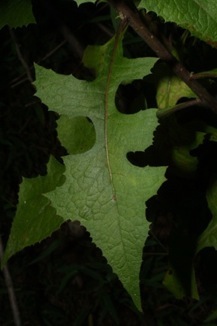
Lactuca floridana, Woodland Lettuce
Lactuca floridana: Woodland Lettuce, triangular leaf stem (V-shaped) pure white sap, usually a line of hair on the bottom of the mid-rib of older (lower) leaves. Stems, to seven feet tall, purple on lower portions, smooth, single from base, branching inflorescence. Blossoms look similar to chicory, 11 to 17 petals, no central disk. Leaves – alternate, long petiole, not clasping the stem. Basal leaves toothed, pinnately lobed, to six inches long and 3.5 wide, lateral lobes round to lance-shaped terminal lobe arrow-shaped. Vase-shape blossoms have overlapping vertical bracts with purple tips.
Click here for more photos of Lactuca floridana.
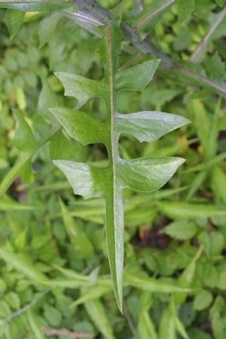
Lactuca canadensis, Canadian Lettuce, Yellow Lettuce, Wild Lettuce
Lactuca canadensis: Canadian Lettuce, Yellow Lettuce, Wild Lettuce, Similar to L. floridana, but notable differences. Leaf stems triangle (V-shaped) yellow flowers and a milky sap that quickly turns beige. Line of hair along bottom of leaf midrib. Leaves lobed, often sharply so, ending in a lance-shaped point. Younger leaves less lobs, pointed, often wavy. Leaf edges not spiny. Can be clasping. Some variations have small sparse hairs on and along the underside of the entire main leaf. Can have basal rosette first year, stalk the second year. While blossoms are yellow they also can be pinkish on tips. Blackish, flat dry seed with only one obvious line on each side.
Click here to see more photos of Lactuca canadensis.
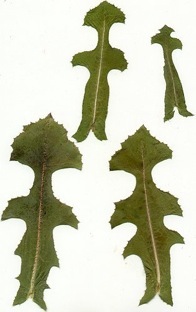
Lactuca scariola, L. serriola
Lactuca scariola, aka, L. serriola, and prickly lettuce, leaves alternating, grasping the stem, lobed or not, six inches long, 3 inches wide, distinct white midrib, hairless, whitish, edges spiny, bottom of midrid had numerous spines, quite prickly. Leaves have terminal lobes larger than lateral lobes, entire leaves usually oblong. Leaves often have red around the edges. Ray flowers yellow, no disk. Sap is pure white, and can be irritating. Plant will turn leaves toward the sun and often be on the same plane (vertical.) The plant resembles the spiny sow thistle (Sonchus asper) but has a solid stem where as sow thistles have hollow stems. Also the sow thistle does not have spines or hairs along the underside of the leaf midrib. Modern Greeks call this petromaroulo.
Click here to see more photos of Lactuca scariola.
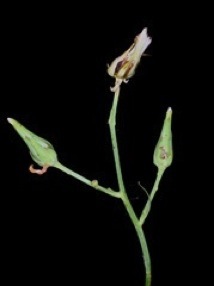
Lactuca graminifolia, Wild lettuce
Lactuca graminifolia: Wild lettuce with skinny glass-like leaves, some teeth/lobes on basal leaves. Bluish or white ray flowers, not disks. Found in dry fields and woods, to three feet tall. Smooth, greenish to reddish, milky sap.
Lactuca virosa is not included for a few reasons. It is an edible European species and rarely found in North America, just a half dozen isolated spots. It is NOT a wild opium or a good pain killer. In the 1930s America assumed a world war was coming and because of said opium sources might disappear. So the government hired two French researchers to investigate reports that L. virosa was a good opium substitute. They reported it was not. Resent research in Iran reached the same conclusion. The internet, which is managed basically by boys, is rife with reports of how wonderful L. virosa is. Like most wild lettuce a lot of dried sap and or an extract might help one sleep but it is a near failure as a pain killer, meaning a little effect with some people. Indeed, to get any effect from the natural plant would require eating many pounds of it at one time, such as ten or 12 pounds, traces of hyoscyamine might be the offending chemical. A small amount in a meal does nothing except provide some magnesium. Virosa means toxic in dead latin, as folks in the past knew to only eat a little at a time or it could make them ill. Ignorant internet juveniles took it from sickness inducing to getting high.
Click here to see more photos of Lactuca graminifolia.