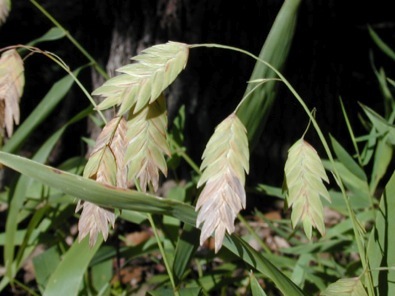
Oats worthy of sowing

Chasmanthium latifolium: Edible Wood Oats

Most people discover Wood Oats by mistake. They’re traipsing through the forest, come across a plant, and wonder “What are Sea Oats doing here?”

Wood Oats look very similar to Sea Oats except shorter, growing two to five feet tall, not three to eight. They are used the same way as Sea Oats, after windowed as a grain for cereal or ground for flour.  Neither plant, however, is a true oat. They are also no longer in the same family, per se. They were both Uniolas but now Wood Oats are a Chasmanthium. Sea Oats (see separate entry) are still Uniola paniculata but some are moving it, too, into the Chasmanthium clan. Think of it as a botanical warlette.

Edward Palmer (1831-1911)

Edward Palmer (1831-1911)

Wood Oats are native to southeastern North America. They grows in rich woods, along streams, rivers, and in flood plains. They’re a common ground cover in bottomland forests, sometimes growing in colonies. They do not grow near the sea. Wood Oats are found from Arizona to Florida, north to Pennsylvania, west to Michigan, then southwestward through Iowa, Nebraska, and Oklahoma. Additionally a relative that was thought extinct, now called  Distichlis palmeri, is being raised for commercial grain use in Australia. It was a staple of the Cocopah Indians in the desert southwest of the United States. The species named after plant explorer Edward Palmer not to be confused with Ernest Jesse Palmer who also had a lot of plants named after him.

Botanically, Wood Oats are Chasmanthium latifolium (kas-MAN-thee-um  lat-ah-FOL-ee-um) which means “gaping flower fat leaf.”  Chasme and athner are Greek for “gaping” and “flower.”  Latifolium is Dead Latin for fat leaf. The plant used to be Uniola latifolium. Chasmanthium latifolium and Uniola paniculata have so many common names I made the decision to call them by where they grow, Wood Oats because they grow in woods, and Sea Oats because they grow by the sea. It makes things a lot easier to remember. Perhaps Distichlis palmeri should be called Desert Oats.

Should you like the flavor and want to grow your own, Wood Oats are easy to raise. Give them moist soil, plenty of sun, and stand back. There are about six Chasmanthium species in the eastern and central  United States and northern Mexico. Three alone in Texas. Wood Oats are the only species under cultivation and none of the other Chasmanthiums look like Wood Oats (excluding Uniolas.)  One should also note there are no toxic native grass seeds in North America but be on the look out for ergot infection and some toxic non-native grasses. Ergot manifests itself as a fungus spur on the seed head ranging in colors from black to pink to green.

Lastly,the Wood Oats’ leaves are a host plant for Linda’s Roadside Skipper, Amblyscirtes linda.

Green Deane’s “Itemized” Plant Profile

IDENTIFICATION: A perennial, clump-forming grass, wide leaves, nodding clusters of flat, oat-like seed heads, two to five feet,   clump spread two or more feet, leaves are about one inch to eight inches long, flat, terminating in a sharp point. Leaves has distinct cross veining. Flowers flat clusters, spikelets, to two inches long, one wide, spikelets hang on thread-like stems in loose, open panicles above the leaves. Leaves and flower heads turn tan in autumn, reddish-bronze winter.

TIME OF YEAR: Blooms summer to fall, seeds summer to fall. Spikelets turn from green to tan to bronze

ENVIRONMENT: Moist but not water logged soil, full sun, will tolerate some shade.

METHOD OF PREPARATION: Winnowed grain as cereal or ground to make flour.


{ 6 comments }

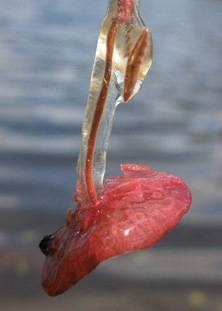
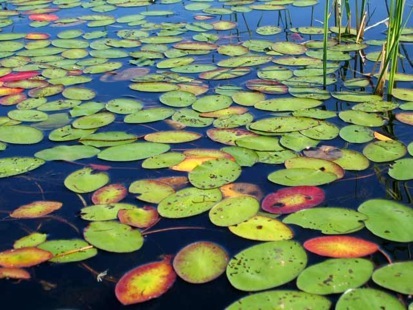
Water Shields, note oval in shape, no slit

Brasenia schreberi: Palatable Pond Weed

The Water Shield is edible. The problem is getting it sometimes. It likes water … up to six feet deep. On the good side, this is one aquatic plant that is found throughout all of North America and is edible from top to bottom.

On first glance it is easy to mistake the Water Shield (Brasenia schreberi) for a young Nuphar lutea, or yellow pond lily. They like similar wet environs. However, the Water Shield does not have a split leaf and the Nuphar does, or at least notched. Also, the stem of the Water Shied attaches to the middle of the oval floating leaf. I say floating so you don’t get it confused with the American lotus, which also has a round leaf with the stem attached in the middle. However, the lotus has leaves out of water whereas the Water Shield leaf is always floating.

The Water Shield always has clear gel on leaf and stem

The Water Shield can also be confused with the Fragrant Water Lily, Nymphaea odorata, or Floating Hearts, Nymphoides peltata, and several pond weeds such as the Potamogeton.  But only the Water Shield is covered by a clear gel coating on the underside of the leaf and stem.   Remember you are looking for an oval, floating leaf with the stem attached to the middle, no clef AND the leaf and stem have a gel coating.

The creeping rhizomes and young leaves were used for food by Native Americans. The Japanese use the young leaves and stems in salads and miso soup. The starchy roots can be peeled, boiled and eaten or dried and stored or dried then ground into flour. But they must be peeled or they are too bitter to eat. Nutritionally per 100g weight the Water Shield has 135 calories and is 9.5% protein; 2.7% fat; has 24.3 carbs; 1.4 grams fiber; 122 mg of calcium;  311 mg phosphorus; 27 mg Iron:; Vitamin A; 27 mg; thiamine; 135 mg; niacin, 0.41; vitamin C, 0.5 mg.

The Water Shield is also a habitat for fish and aquatic insects. Where there is Water Shield there is usually good fishing. Its seeds and vegetation are eaten by waterfowl. While found throughout most of North American including Alaska it’s also found in Central America, Cuba, Africa, East Asia and Australia.

The Brasenia (bruh-SE-nia) genus is named for Christoph Brasen, 1774, a Moravian missionary and plant collector in Greenland and Labrador. Schreberi, (shri-BER-ee) is Latin for, “of Schreber, or Schreber’s”. It is named for German botanist Johann Christian Daniel von Schreber (1739-1810), a student of Linnaeus.

 Green Deane’s “Itemized” Plant Profile

IDENTIFICATION: Water Shield leaves are oval with long, reddish leaf stalks are attached at the centers of the leaves. Its submersed parts and undersides covered with a jelly-like substance, flowers are small, dull purple, and emerge from the water on a stalk. They are not showy.

TIME OF YEAR: Best time to collect the roots is autumn to spring, leaves when young

ENVIRONMENT: Shallow ponds, lakes, slow-moving streams to six feet deep. Make sure the water is wholesome.

METHOD OF PREPARATION: Young leaves and stems raw or cooked, roots peeled, boiled and or dried and ground into flour.


{ 14 comments }

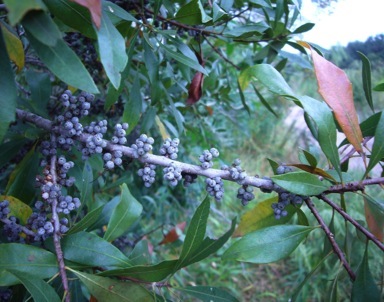
Ripe Wax Myrtle Berries

Myrica cerifera: A Tree That Makes Scents

Wax Myrtle was the natives’ minimart of the forest.

Need some spice? Drop by the Wax Myrtle tree. How about a little something for the peace pipe? Drop by the Wax Myrtle tree. Are the mosquitoes bothering you? Drop by the Wax Myrtle tree. Want to see a Tachycineta bicolor? Drop by the Wax Myrtle. Tree Swallows in winter love it, eating the berries in a whirlwind. If you’re a birder other winged-ones that like the high-energy berries include the Bobwhite, Wild Turkey, Wablers, Vireos, Kinglets and the tiny Carolina Wren, which is more tail than bird.

Native Americans used the leaves for seasoning as we would a bay leaf. The berries were used for seasoning as well but sparingly as they are waxy. Grind them and use like pepper. Though used as a seasoning, that was not the wax myrtle’s main value: The berries when boiled yield a green wax that is excellent for making candles. Indeed, that is reflected in the tree’s name Myrica cerifera, MEER-ih-kuh ser-IF-er-uh.

Cerifera means “wax bearing going back to the Greek word Keri for the small bees wax candles used in church services. Myrica is Greek myrike (μυρίκη) which was the  Greek name for the  “tamarisk” a tree that is aromatic like the wax myrtle. The aroma of the wax myrtle’s leaves can keep mosquitos away. Rub the leaves on you. The natives smoked the leaves for the same reason.

Also called the bayberry, as in Bayberry candle, the tree was used extensively by the natives for a variety of ways including as a pain killer, a pick-me-up, a diuretic, emetic, febrifuge, tonsil gargle, for headaches, stomach aches, to kill worms  and for dysentery.

And least you think your life has not been touched by the wax myrtle, its leaves are used to improve the foaming of beer. Think of that the next time you enjoy a stein of suds.

Although the berries are strong, they can be eaten fresh off the tree. They can be preserved or even made into a wine. If you don’t have a M. cefera near you don’t despair. There are others in North America and around the world of various uses. In fact some in Asia and Africa had edible leaves. M. gale fruit and leaves have been used to flavor soups, stews, roasted meats, and seafood. They have also been used for tea. When used to help beer foam the brew is often called Gale Beer. M. californica, M. heterophylla, M. pensylvanica, M. pusilla, and M. rubra have also been used like the M. cefera.

Southerners liked the Myrica (MEER-ik-uh) so much they changed Myrica to miracle and call it the Miracle Bush.

Green Deane’s “Itemized” Plant Profile

IDENTIFICATION: Large shrub to small tree, depending on climate, to 10 or 15 feet, six to nine feet across. Olive to gray-green alternate leaves, simple, half an inch to 1.5 inches long. to half inch wide, bayberry scent when crushed. Leaves are smooth on top, hairy below with orange scent glands on both sides. Berries in attached clusters to stems and branches, fall through winter, BB size,  light green to bluish-white strong bayberry scent.

TIME OF YEAR:  Leaves year round, berries in the fall and winter

ENVIRONMENT: New Jersey to Florida, west to Arkansas and Texas and down in to Central America. It will grow under almost any conditions. It makes a nice bush for xeroscaping as it needs no attention.  It can be planted as far north as Rhode Island. Tolerant of salt spray and wind.  First cultivated in 1699

METHOD OF PREPARATION: Leaves as is for seasoning, berries ground like pepper. Berries boil to collect wax. Some herbal applications use the bark of the root (which is said to induce labor.) The leaves have been used to smoke mullet.


{ 25 comments }


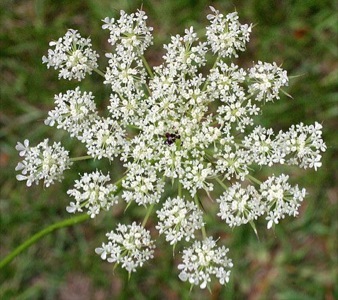
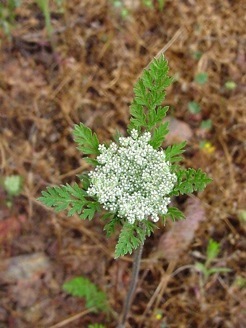
Wild Carrot, note the red spot in the middle

Daucus Carota & Pusillus: Edible Wild Carrots

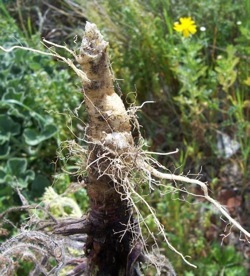
I’ve never understood the confusion over identifying the Wild Carrot also called Queen Anne’s Lace: It has a flat white blossom with a red spot in the middle, hairy stems and stalk, and the white root that smells like carrot. As the blossom ages it folds up looking like a bird’s nest. That seems quite easy to me, and was when I was a kid. Wild carrots were a common pasture plant. I tried eating more than one root raw, along with some dirt.  The key is to find them at the end of their first year before the roots grow woody their second year. However, often that woody part can be peeled off — as with wild mustard/radish — and the root made edible.

Dacus carota root

As straight forward as it seems some experts say the Wild Carrot only occasionally has a red flower in the middle. Really? I’ve never saw one without it when I was younger. That said, the above description is for the Daucus carota (DAW-kus ka-ROT-a) a wild carrot imported from the Old World and known everywhere in the United States as “Queen Anne’s Lace.” But, there was a native carrot in North America when the Pilgrims arrived, the Daucus pusillus (DAW-kus pew-SILL-us.) It does not have a red dot.

Dacus pusillus

D. pusillus is found in the southern half of the United States and up the west coast to British Columbia. Much smaller than the D. carota, its root are none the less edible, though that is not saying much. It tends to have flowers that are white to pink and white, again no red dot.  Like the import, the stems are hairy. The hairy stems and stalk is a very important identification element and separates the two carrots from very deadly members of the same family, such as Poison Hemlock which has a hairless stalk, that is often purple.

The Daucus carota is loosing some of its luster. A majority of states (at least 35 of them) list it as a pest or a noxious weed. It is particularly bad in Missouri. Apparently D. carota germinates easily and mowing doesn’t get rid of it. Some say the dried seed heads are a fire hazard and a threat to the honey industry. Another flower of the field demonized. My advice: Eat The Weeds! (See recipe on bottom)

Daucus pusillus, also called the American Wild Carrot and Rattlesnake Weed (I think nearly everything has been called Rattlesnake Weed or Indian Potato) is a simple to few-branched annual that grows to three feet tall but usually less.  The stems are covered with stiff hairs. The leaves are alternate, pinnate and compound on stems to six inches long.  The umbrella-arranged flowers have five white petals and five stamens.  It has fewer florets per cluster than the D. carota, 5 to 12, instead of 20. It likes dry ground, rocky to sandy soil, oak forests. Blooming time is April to June. The roots are similar to the D. carota, just smaller.

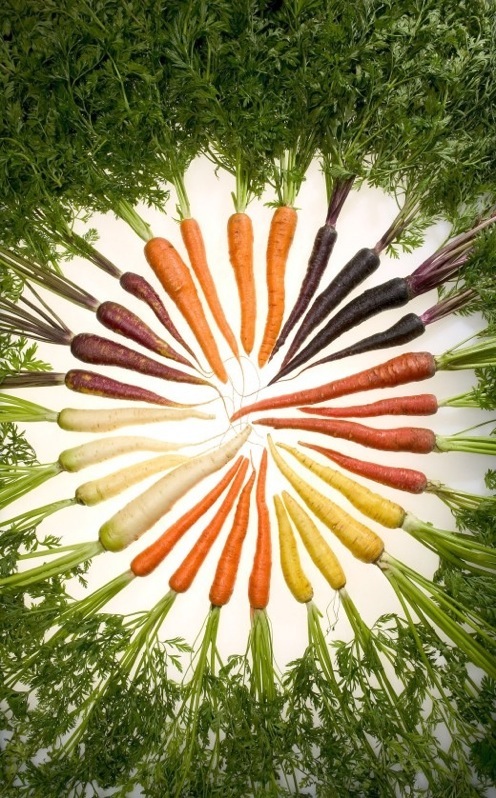
Cultivate carrots come in many colors

Unlike many native plants there’s not much evidence most Native Americans made much use of the D. pusillus. Eastern tribes ignored it, perhaps, records on them are scant. Only six western groups seem to have used it. The Nez Perce and Navajo ate the roots, boiled or raw. They also used it to ‘clean the blood,’ stop itching, treat fevers and treat snake bite. A decoction and or a chewed poultice was used to treat snake bite.  The Clallam, Cowichan, Saanich and coastal Salish also ate the root.

One way to get a steady source of good wild carrot roots is to grow them yourself. They sprout readily. Collect the seeds in the fall and set them out in the spring. Under cultivation they grow large, tender roots.  The root of Queen Anne’s Lace is likely a direct ancestor of the modern carrot which has been under cultivation for some 5,000 years, probably starting in Afghanistan. While the wild carrot root is cream colored to light orange there are a number of varieties including white, yellow, red, purple, green, black, striped and purple on the outside and orange inside. The orange carrot is believed to have been developed in the 16th century in Holland, where patriotic plant breeders developed it to celebrated the Royal House of Orange.

Incidentally, that cultivated carrot you bought or grew? The green tops are quite edible cooked. Add them to a variety of boiled dishes for flavor, or boil them separately and add them to other dishes as greenery.

The name Queen Anne’s Lace was adopted because Queen Anne of Great Britain was adept at making lace. They carried the allusion further by saying the red flower in the middle is when she pricked her finger and a drop of royal blood  fell on the flower.

Daucus is from the Greek word THAV-kon) meaning carrot parsnip and other similar food plants. Carota is from the Greek ka-ROW-ton, also meaning carrot is from the Indo European word Ker, meaning head or horn. Pusillus is Latin for tiny or puny.

Daucus plants can make cattle and horses “nervous.” The toxicity is consider mild. When I was a kid my mother told me wild carrot seeds were used for abortions.

Queen Anne’s Lace Jelly

18 Large Queen Anne’s lace heads

4 Cups water

1/4 Cup lemon juice (fresh or bottled)

1 Package powdered pectin

3 2/3 Cups

Bring water to boil. Remove from heat. Add flower heads (push them down into the water). Cover and steep 30 minutes. Strain.

Measure 3 Cups liquid into 4-6 quart pan. Add lemon juice and pectin. Bring to a rolling boil stirring constantly. Add sugar and stir constantly. Cook and stir until mixture comes to a rolling boil. Boil one minute longer, then remove from heat.

Skim. Pour into jars leaving 1/4″ head space. Process in hot water bath for 5 minutes. Makes about 6 jars.

Green Deane’s “Itemized” Plant Profile

IDENTIFICATION: Daucus carota: An erect, biennial herb; leaves basal and alternate, two-pinnately divided with narrow segments; flowers small, white, in a terminal, umbrella-shaped cluster;  20 florets, often with red spot in middle; seed small, dry, ribbed, with bristly hairs. Roots smell of carrots.

TIME OF YEAR: Roots in fall, blossoms in season

ENVIRONMENT: Full sun to partial shade, fields, pastures, meadows, rocky soil even clay.

METHOD OF PREPARATION: Roots cooked or if you have good teeth, raw.  Thin and stringy. The flower clusters can be french-fried for a carrot-flavored gourmet’s treat. Aromatic seeds good for flavoring soups and stews. Dried roasted roots can be are ground into a powder and used as a coffee substitute.


{ 35 comments }


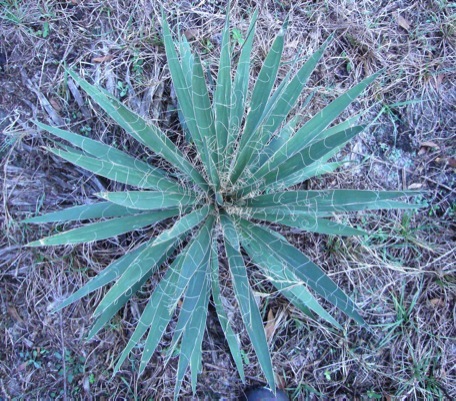
Yucca filamentosa leaves, great for cordage

Yucca, Yuca: Which is Edible?

When isn’t a yucca a yucca? When it is spelt with one “C” as in yuca.

What’s the difference? A belly ache, maybe more.

The yucca (YUK-ka) in the wild has several edible parts ABOVE ground. The yuca (YEW-ka)  in the grocery store is a cultivated cassava and has one edible part BELOW ground.

Yucca, two C’s, officially is native to the hot, dry parts of North and Central America and the West Indies.  However Y. filamentosa (fill-luh-men-TOE-suh) can be found as far west as Texas, north to Canada and east to Massachusetts. It is also found in humid Florida. So much for “dry”.  Other yucca, who do like it arid can be found across the desert southwest of the United States from Texas to California and parts south.

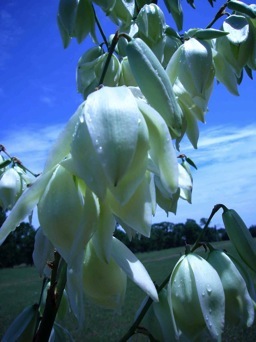
I’ve not met a yucca blossom I could eat raw

So, what parts of the yucca are edible? Flower petals, raw or cooked though raw they usually give me a stomach ache, at best throat ache.  Try your raw blossoms carefully. Try one — ONE — petal, not only blossom, one petal and wait 20 minutes. See if you throat feels dry or bitter. If so these flowers should be cooked, I recommend boiling. The young fruits raw or cooked, but they are very bitter raw, read another throat/stomach ache. They are far better roasted until tender. Scrape out the inside and separate from the seeds. The pulp, sweetened, can be use for pies or boiled dry to a paste, dry in oven as a sheet. Edible as is or mix with other food. The seeds can be roasted (375F) until dry, grind roughly, boil as a vegetable until tender. Young short flower stalks long before they blossom are also edible. Cut into sections, boil 30 minutes in plenty of water, peel. You can also peel first.

For you survivalists, the yucca provides more than food. Yucca wood — read the dry flower stalk  — has the lowest kindling temperature of any wood, desirable for fire starting, especially if you are using a bow and drill. Use the yucca stalk for the drill.  The roots and leaves can be rubbed in water to get a natural soap (that’s what makes the yucca bitter.) With some of the yuccas you can crush the root, and shampoo with the juice. Also the leaves can be made into extremely strong cordage. Many yucca come with a needle built in at the end of the leaf, and others like the filamentosa above, shed threads.

The Yucca is the state flower of New Mexico and is pollenated by a plant-specific moth…the nocturnal Yucca moth…

Sauteed Yucca Flowers with chipotle (or a chili of your choice.)

* 1/4 cup olive oil

* 1 Chipotle pepper in adobo sauce

* 1 clove minced garlic

* 1 diced onion

* 1 tomato

* One cup cooked Yucca flowers (boiled down from one quart fresh yucca flowers)

Salt to taste

Boil Yucca flowers in an abundance of water for about 10 minutes and drain well. Meanwhile heat the oil to medium heat, Sweat the onions and garlic then stir in everything except the flowers. Cook for about 5 minutes and keep stirring. Add flowers , stir until warm and mixed.

Green Deane’s “Itemized” Plant Profile

IDENTIFICATION: Erect plant with tall, thick central stem, 4 to 25 feet high, sometimes branched, long dagger-like leaves shedding threads, flowers tulip-like, waxy, drooping. Fruit cylindrical to 5 inches  with purple skin and pulp, many seeds

TIME OF YEAR: Blossoms in late spring, early summer, fruits later in the year in northern climes

ENVIRONMENT: Usually dry but not arid areas but some species like it arid

METHOD OF PREPARATION: Six-sided fruits edible raw or cooked, rubbery and bitter, cooking helps some, flower petals raw in salads, sparingly, or fried, may be batter dipped, boiled or roasted. Better boiled.  Very young flower stalk peeled and boiled. Roast seed, crush, boil until tender. Personally, I boil the  petals  for 10 minutes then use them. Occasionally I find a Y. filamentosa blossom I  can eat raw but only one. You simply have to try them carefully. They are sweet on first taste but leave a bitter residue.


{ 22 comments }