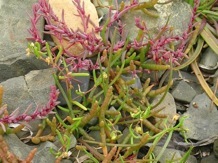
Silver head in blossom

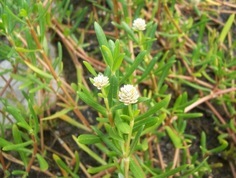
Blutaparon vermiculare: Beach Potherb

My first thought on seeing Silverweed “was what is clover doing growing on the beach.” Well, Silverweed isn’t a clover and I soon noticed it didn’t look like clover close up, but the association was made. The next headache was what was it called.

Silvehead can crawl over low obstacles

Some writers call it Samphire, but there are several seaside plants called that now. Saltweed is also common, and again several maritime plants are called that now. That leaves Silverweed and Silverhead. There are quite a few Silverweeds as well, so Silverhead it is. Botanically, it has changed names as well. It is currently Blutaparon vermiculare (blew-tap-AIR-on ver-mick-you-LAIR-ee) That means “near Amaranth wormlike.” Bluta is from the Latin word blitum for Amaranth. Paron or para is Greek for near. Vermiculare is Latin for “breeding worms.” In this case it is referring to how the plant grows along the ground. A second opinion says Blutaparon is a corruption of the Latin phrase volutum laparum which means “loose climber” and indeed it is often found climbing on driftwood and other plants nearby.

Like the amaranth, it’s in that family, the B. vermiculare provides leaves and stems are used for the herb pot.  Consider it already salted greens. No reports of it being eaten raw by humans. It is commonly fed to chickens in warmer parts of the world.  Should you be unable to find in books the plant used to be called Philoxerus vermicularis…. dry loving worm breeder.

Green Deane’s “Itemized” Plant Profile

IDENTIFICATION: Succulent, creeping, prostrate herb with branches one to six feet long. Leaves opposite, spindly or club shaped, from narrow to 3/8 inch wide, one half to 1.5 inches long, thick, fleshy. Flowers silvery white, a dense round or oblong spike. Fruit oval, flat, dark brown, the seed is glossy.

TIME OF YEAR: Generally year round

ENVIRONMENT: Dunes, waste places, inshore from mangrove thickets, keys and mainland.

METHOD OF PREPARATION: Stems and leaves boiled.


{ 1 comment }

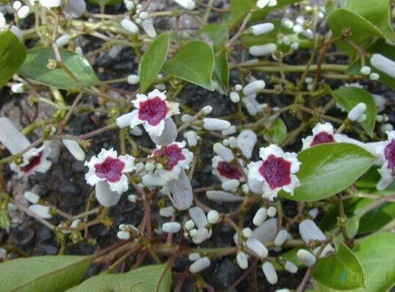
Skunk Vine's Lavender and White Blossoms

Paederia foetida: Much Maligned Skunk Vine

Sometimes botanists go a little too far, or at least Carl Linnaeus did when he named a particular vine Paederia foetida  (pay-DEER-ree-ah FET-uh-duh). It must have really offended him because that means, in English, stinking opals. Its common name is “skunk vine.” A close cousin, Paederia cruddasiana, found locally only in Dade County in south Florida, is called the Sewer Vine.  I’m not convinced such names are deserved.

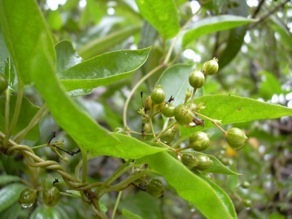
"Pearl-like" Skunk Vine fruit

Paederia is from the Greek word paederos meaning opals, for some of the species have translucent drupes. (Some say Paederia comes from the Latin paedor meaning filth or stench, but that would be over kill and I think the Greek is more realistic, particularly in conjugating, though dirty-minded Carl was not past using double entendres.)  Foetida means stinking. So stinking opals, or stinking filth, sums it up. Leaves can be eaten raw or cooked. The odor goes away on cooking but a slight bitterness remains. The leave are rich in carotine and Vitamin C.

Almost every website you go to — no, every website  you go to — says it smells awful. One gets the impression one has to hold ones nose to eat it cooked, and raw it would just about make you gag. As my late father would say, “it must stink to high heavens.” The Japanese are not poetic at all about it and cut to the chase: They call it the “fart vine” the Chinese the “chicken shit” vine.  I have shoveled a lot of chicken manure, and the P. foetida does not smell that bad.  But to be frank the aroma is more like someone who needs a bath than someone who has bad gas. I couldn’t get much smell out of some of the leaves I collected recently until I accidently ran over one with my desk chair. I certainly had the right plant. To me it is a persistent aroma but low grade… similar to kim chee but no where near as strong… call it kim chee lite…

I think the folks who write about the plant on the internet have never met it personally. It is aromatic but there are a couple of local edibles that smell far worse, the Passafloria incarnata and the Momordica charantia come to mind. Those two smell like moldy old gym shoes that have been in a damp high school locker for a few months with some underwear. To me the P. foetida raw smells and tastes similar to raw broccoli. Indeed, both plants get their aromas from sulfur compounds, the P. foetida specifically from carbon disulphide (some say dimethyl disulfide.) I don’t find the plant offensive raw and not at all when cooked, which is a good thing because there is a lot of it.

Paederia foetida was imported from Asia by the USDA to its Brooksville Field Station in Hernando County Florida before 1897. The reason given was that it was a potential fiber plant — read wild twine when you need it. Western nations had shown an interest in Paedera’s fine fiber since at least 1873. As for Brooksville, that area of the state was ground zero for several imported Asian plants later to be troublesome. By 1916 P. foetida had become a local nuisance. You would have thought they had learned their lesson but in 1905 they imported the Dioscorea bulbifera (air potato) to Orlando and let it crawl over the state. By 1933 the Skunk Vine was escaping the region via all points north, east and south. In 1977 it was recognized as an economic problem and is now found in all southern states though the USDA official maps don’t show that. Indeed, I have located it in several places in the county I live in yet the USDA says it does not exist in my county. In fact, it grows in my yard and I didn’t plant it. I sometimes think the USDA maps are a century out of date. And, if you write and tell them the maps are inaccurate about a particular plant in return for letting them know you get a load of bureaucratic fertilizer for your efforts. I wrote extensively to one agent about a tree and he wrote back telling me to write to him about the tree… With such federal employees on the job I don’t sleep well at night.

In 1999 the state of Florida estimated it cost $4,006 per acre to remove Skunk Vine ($5,138 in 2009 dollars.) The state has tried unsuccessfully for seven years to find an importable insect to prey on the two species of Paederia it has. So far the bugs also like a trio of native plants as well so no go. The Paederia, by the way, is the host plant of the Macroglossum sitiene Walker moth. Mockingbirds like its seeds, which I think explains how it got to my yard after 10 years of not being there.

There are some 50 species of Paederia, maybe 52, eleven in south China alone. I do not know the edibility of the others. Cornucopia II says of the P. feotida“Leaves eaten raw as a side-dish with rice, grated coconut and chili peppers. Minced leaves are steamed and eaten, added to soups, or mixed with various vegetables and spices, wrapped in a banana leaf and cooked over a fire.” I have them as cooked greens or salad additions. Since I use a lot of garlic, Paederia isn’t a noisome problem.

P. foetida is also called P. chinensis. P. scandens  and P. tomentosa. In Hawaii it is called maile pilau (the rotten maile.) Other names include:

Malaysia:         Akar sekentut, daun kentut, kesimbukan

English:           Chinese moon creeper, Chinese fevervine, king’s tonic

Indonesia:       Sembukan (Javanese), kahitutan (Sundanese), bintaos (Madurese)

Philippines:     Kantutai (Tagalog), bangogan (Bikol), mabolok (Pampangan)

Cambodia:       Vear phnom

Laos:               Kua mak ton sua

Thailand:         Kon, choh-ka-thue mue (northern), yaan phaahom (peninsular)

Vietnam:         D[aa]y m[ow] l[oo]ng, d[aa]y m[ow] tr[of]n, m[ow] tam th[eer]

Green Deane’s “Itemized” Plant Profile

IDENTIFICATION: A twining vine in the coffee family. At eye level it twines from your lower right to your upper left. young stems can be green, purplish- or reddish-brown, almost hairless to densely hairy. The old stems are yellowish-brown to grayish, smooth and shiny. Leaves opposite, occasionally whorls of three, lance to oval shape, abruptly tapering point, two to four inches long, conspicuous stipules. Stipules obvate to cordate, triangular, may nor may not have two notches at top. Leaves can be hairy and non-hairy, or hairy below, smooth above, or have tuffs of hair on the underside in axils of major veins. Leaves and stems have a disagreeable odor when crushed, flowers are small, grayish pink or lilac, in broad or long, curving clusters,  petals are joined to form a corolla with 5 spreading lobes. Fruits shiny yellow to brown, persists through winter, round, inside are two black seeds, round, often dotted with white, needle-shaped crystals. Seeds of the P. cruddasiana, which resembles the P. foetida, are oval, flattened and have little wings. To my knowledge the Cruddasiana is not edible.

TIME OF YEAR: Year round

ENVIRONMENT: Disturbed areas, tree gaps, may grow high into the trees creating dense canopies in a variety of habitats, mesic hammocks to xeric sand hill communities, prefers sunny flood plains and bottomlands, can even grow under water. Found in the southern United States, Hawaii, and as an escaped ornamental in warm areas of the world.

METHOD OF PREPARATION: Leaves raw or cooked.  The plant can be killed by chemicals so don’t collect where it might be sprayed such as along railroads, roads, bike paths or powerlines. It is used to make soups, is minced in steamed food.

 HERB BLURB

Long used in Indian folk medicine for aches and pains, a 2004 study in Bangladesh showed it has analgesic properties.  Nutritionally, besides, carotine and vitamin C, the P. foetida contains nonanoic acid, capric acid, lauric acid, myristic acid, arachidic acid, palmitic acid,conjugated dienoic acid and trieonic acid. It also has antioxidant activity. A 2005 study also showed it was good for lessening the symptoms of diarrhea. Traditionally it was used to treat dysentery but a 1991 study showed antibiotics worked better. Leaf juice mixed with garlic is a folk remedy for arthritis. Juice of the root is given for indigestion.

{ 15 comments }


Cladium jamaicense: Water finder

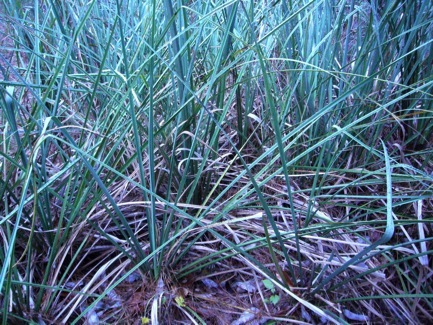
Very sharp sawgrass grows only where it is damp

In Wekiva Springs state park in Florida there is a high and dry stretch of scrub pine and palmetto bushes, and oddly, a bunch of water-loving sawgrass. The area is dotted with little and gigantic springs and the sawgrass pictured left, in that dry environment, is the only indication of the spring underneath. Normally it is found in standing water.

Sawgrass gets a lot of bad press. Even though it covers most of the Everglades and its relatives can be found in most of North America except the northern plains, few have anything good to say about it. Apparently even most animals avoid it. But, It is edible. However, I didn’t say it was easy to get at.

Sawgrass is correctly and incorrectly named. First it is not a grass but a sedge. Sedges have edges, grass have stems. But the saw part is right. In fact, in Haiti it is call the “razor herb.”

The sedge is armed with very fine saw teeth and will cut you quite easily (though a useable blade in nature if you need one.)  The heart of leaves at the bottom are edible. They taste similar to heart of palm but not as sweet. Some say the young shoots are edible but I don’t see how.  Elsewhere in the world some sawgrasses have edible roots. Sawgrass roots are too tough.

Its botanical name is Cladium jamaicense (KLA-dee-um ja-may-KEN-see.) Cladium is from the Greek word kladion, or branchlett, referring to the flower spike. It was named by botanist Patrick Browne in 1766. The other native species are C. mariscoides (latin: mar-is-COY-dees Greek mar-is-KEE- deez)  and C. californicum (ka-li-FOR-ni-cum.) Edibility unknown to me. A species in the old world is Cladium mariscus (mar-RISK-us.)

Oddly enough, the top of sawgrass often has little worms in it that are excellent bait for fresh water fish.

Green Deane’s “Itemized” Plant Profile

IDENTIFICATION: A tall, coarse,perennial to nine feet, usually three; leaves long and thin, flat V-shaped blades with sharp teeth on the edges and underside mid-vein. Flowers rusty brown spikes up to 3 feet long above the leaves. Leaves tend to cut one way, when pulling away from the plant.

TIME OF YEAR: Grows year round in Florida, summer and fall elsewhere.

ENVIRONMENT: Edges of wetlands or freshwater lakes. Grow in a scrub area usually means a spring nearby.

METHOD OF PREPARATION: Inner bottom white core of stalk, raw or cooked. WARNING: It cuts flesh very easily.


{ 6 comments }

Seablite, one of my favorite greens

Suaeda linearis, maritima: Edible Blite


While most people find Sea Blite next to the sea, I find Sea Blite on the other side of the barrier island, on the inland coastal waterway. Actually, Sea Blites, Suaedas, can turn up in the strangest of places.

The Southern Sea Blite, Suaeda linearis, (above) is found on the coast from Texas to Maine but not quite to Canada. The Annual Sea Blite, Suaeda maritima, (right) is found from Virginia north into eastern Canada but also two western counties in Florida, a county in the middle of Kentucky, one northern county in Washington, southern Alaska, and Manitoba. Suaeda californica, a marsh plant, is found in four counties in California and is not pictured because it is quite rare. Suaeda calceoliformis, the Pursh Seepweed is found peppered about all of North American except the old South, Iowa and Vermont. Formerly called S. depressa, it is no doubt in more places than that for the government maps are often decades out of date. Also edible in western North America are S. nigra, S. occidentalis, and S. palmeri. Elsewhere in the world they eat S. australis, S. corniculata, S. fruiticosa, S. glauca, S. japonica, and S. salsa.  In some areas the Suaeda is common, in others rare, so check out your local form and condition. Generally said, when a plant in the Suaeda genus is near the ocean it is a Sea Blite, when near salty water or land elsewhere, it is a Seepweed. All are related to the Chenopodiums if I remember correctly.

Suaeda is the Latinized version of the Arabic name for this genus, said soo-EE-duh. Linearis (lin-ee-AIR-iss) means narrow and maritima (mar-ih-TEE-muh) of the sea.  Californica (kal-lee-FOR-ni-ka) means of California and calceoliformis (kal-see-oh-lee-FOR-mis) refers to the plant’s flower that is shaped like a little shoe. Pursh is probably for Frederick Traugott Pursh (1774 -1820) a German-American botanist. Blite came from Blight which is a discoloring. S
Suaeda calceoliformis

S. californica and S. calceoliformis were eaten by western Indians, usually the young shoots and leaves, often combined with cactus. The seeds and leaves of the S. Linearis are eaten. Young shoots of the S. maritima are the prime edible of that plant, lightly steamed. Generally said inland version prefer salt lick areas and the like. As with many salt-tolerating plants, they often become tinged with red sometime in the season. While they can be eaten on their own, which sometimes requires boiling twice in fresh water to reduce the salt, they are also used as flavoring with other plants. Young shoots can also be picked as used alone or eaten as a relish.
Saueda maritima

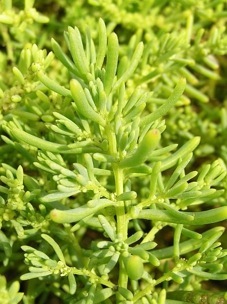
Imported from Europe, the Suaeda maritima is a bushy coastal annual, pale green with a whitish cast. Leaves narrow or almost cylindrical, long and fleshy. It has pale green flowers, blooming from July through October. You’ll find it dotting the higher parts of the beach. It can grow in gravel, sand, among rocks and around boulders. It’s a soft plant, often low-growing. The leaves are tiny, round, and pointed, reminding one of a spruce. Yellow-green flowers can be found at leaf axils. It can be bitter when cooked.

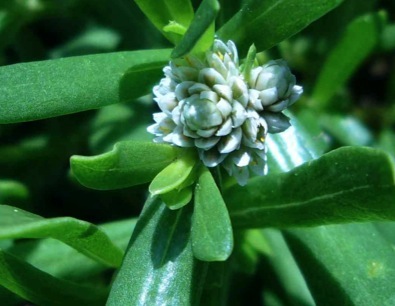
Suaeda calceoliformis is an annual herbs, low to erect, green to dark red,hairless, stems crawling to erect, green to dark red, usually striped, simple or branched. Leaves narrow, flatish. Flowers irregular, seeds like a tiny lentil, brown, dull. Flowers summer through fall, found in salty soils also around salted roads, salt piles, salt lakes et cetera.

Sea Blite is one of those plants that when you taste it your ancient food-detecting systems says “this is real food.” A lot of wild forageables are an acquired tastes. Fortunately Sea Blite, particularly S. Linearis, has the taste and texture of good food. I am surprised it is not mentioned more often and it should be a commercial crop. Its great green prime here in Florida starting around March.


Green Deane’s “Itemized” Plant Profile

IDENTIFICATION: Suaeda linearis, annual or perennial herb to three feet tall, branched, succulent, light green to almost white stems, leaves narrow, pointed, triangle shaped, almost, fleshy, to two inches long. Flowers have five lobes. Seed is glossy black, small.

TIME OF YEAR:  Flowers August to September, seeds September to October

ENVIRONMENT: Salt marshes, beaches, dunes,

METHOD OF PREPARATION: Leaves and stems refreshing to quite salty, depending on where collected and when, but can be eaten raw or cooked, sometimes requires a change of boiling water. It is absolutely excellent boiled. Boiled first-year tips are delicious and if known better would lead to the plant’s extinction. Can be used as a flavoring for other foods, seeds can be ground into mush or used to make bread.


Sea Blite and Sour Cream Salad

Four cups Sea Blite leaves, stems, or flowers, cooked, drained and chopped.

One tablespoon sugar

One cup sour cream

Three tablespoons grated onion

Two tables spoons vinegar or lemon juice

Two hard-cooked eggs, diced

Salt optional

Blend all ingredients and chill for two hours before serving. Serves four to six.

 Garnished Sea Blite

Four cups chopped Sea Blite

Six slices of bacon, chopped and friend crisp

Two tablespoons grated cheese, such as Parmesan

Two tablespoons vinegar, preferable a wine or light vinegar.

Boil or steam the Sea Blite. Drain and combine with remaining ingredients. Add some bacon fat if desired. Serve hot, serves four.

Sea Blite Chicken Soup

Two chicken breasts

Two quarts of water

One cup of Sea Bite leaves, washed and chopped

Three carrots diced

Two scallions chopped

Two celery stalks chopped

1/4 teaspoon each rosemary, thyme, and parsley flakes

One clove of garlic minced, or to taste.

One half cup Parmesan cheese or the like.

Boil the chicken in water for 30 minutes, remove chicken and cut into bite-size pieces, add all ingredients but cheese to the water and cook 45 minutes. Add cheese, serve.

 

{ 12 comments }


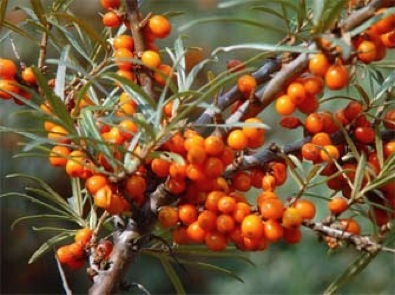
Ripe Sea buckthorn Berries

Sea Buckthorn: Sour Source of Vitamin C

If you are collecting Sea Buckthorn you’re probably cold.

Just as some edibles are found only in tropical areas, some are found only in temperate climates and the Sea Buckthorn is a prime candidate. It grows Canada, Great Britain, Europe, Russian, Mongolia, China and Japan. Usually near the sea, if found elsewhere it is a posing as an ornamental. It can be planted in the northern United States.

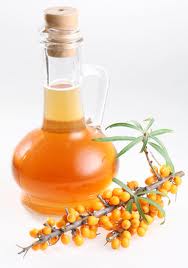
Medicinal Sea Buckthorn Oil

The Sea Buckthorn’s claim to botanical fame is that its berries, which are rich in Vitamin C, stay on the shrub way into winter. In such northern climates it was often the only source of Vitamin C to be had in the winter time and has more Vitamin C than strawberries, kiwis, or even oranges. In fact, the Sea Buckthorn is a powerhouse of nutrients.

It is estimated that the Sea Buckthorn by itself could provide all the Vitamin C requirements for everyone on earth. China alone has 2.5 million acres of Sea Buckthorn, none on the sea I might add. It is also rich in vitamins E, B1, B2, and several anti-oxidants. In fact, it has over 100 healthful constituents and is one of the most nutritious berries on earth. And while the berry is potent the plant seemingly knows it and protects them with vicious thorns.

There is no elegant way to collect Sea Buckthorn berries. Orange, juicy and fragile, you clasp the branch (to go with the thorns) and then strip the branch of the berries. They will break and release their juice which you will catch in a container. It is messy work but a lot can be collected in a short while. Then you must separate the seeds, thorns and other debris from the juice, either by hand or a strainer. Once cleaned, you’re ready to go.

Sea Buckthorn Booze

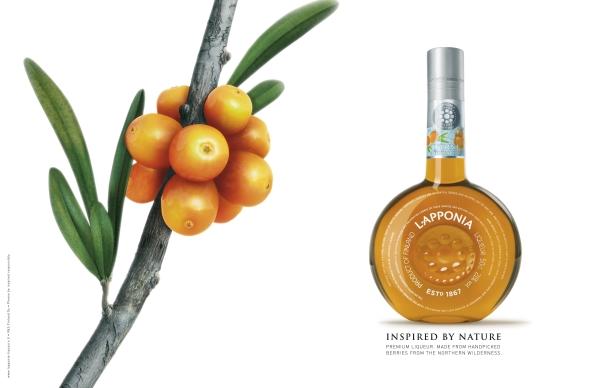
The juice of the Sea Buckthorn is too acidic for most people to drink fresh. But it is used to make jellies, marmalades, sauces, and liqueurs. Buckthorn booze is probably the most common top-shelf Russian gift. The juice can be used by itself or added to other juices. Some think it resembles passion fruit, others pineapple (after a lot of sugar is added. It is very tart with malic acid, the same acid that makes apples tart.)

Medicinally there are written records of it being used as early as 800 AD. Oil from the seeds are used to treat a variety of skin diseases and injuries. Cosmonauts use it for radiation burns.

Juice of the Sea Buckthorn

Botanically known as Hippophae rhamnoides, the Sea Buckthorn is closely related to the Elaeagnus genus which is found from temperate areas to tropical climes. (See separate entry on Silverthorn.) It is also called “Sallow Berry” because it can stain yellow, and the Sandthorn. There are actually five species.

Rhamnoides (ram-NOY-deez) means buckthorn-like. Hippophae (hip-POFF-uh-ee) however means “shining horse’ or ‘giving light to a horse.’  The name comes from the ancient Greeks who noticed horses fed Sea Buckthorn leaves had shinier coats and were healthier. The leaves contain 15% protein. No wonder Sea Buckthorn was the reported food of Pegasus, the famed winged horse.

 Green Deane’s “Itemized” Plant Profile

IDENTIFICATION: Thorny shrub, leaves pale silvery-green, lance shaped, 1.5 to 4 inches long, about 1/4 inch wide. Dense orange berries — egg-shaped drupes — along the stem. Single seeded. Under some conditions the Sea Buckthorn can reach tree height.

TIME OF YEAR: Blossoms in March or April, fruits September and October, fruit persists to March. Can survive temperatures from 45 below zero to 104 F.

ENVIRONMENT: Open well-watered spaces, coastal areas, is a non-legume nitrogen fixer

METHOD OF PREPARATION: Numerous. Tart juice is used to make jelly, sauces, juices, marmalade, liqueurs.


{ 7 comments }