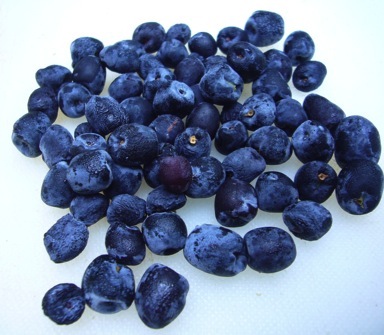
Ripe Podocarpus fruit without seeds

Podocarpus: Your Own Hedge Fund

One can’t learn everything at once, and so I came to know the Podocarpus macrophyllus late in my foraging career.

There were very good reasons for this. A similar looking shrub planted locally has toxic fruit, and parts of the Podocarpus are toxic as well save for the aril. So it was one of those plants I knew about but put off for another day. And I did until a foraging friend, Marabou, got me interested in them again.

Like so many other things on the Internet that starts out as a “warning” on one site becomes “avoid” on another, “toxic” on a third and “deadly” by the fourth. It is truly unfortunate that every new medium of communication invented by man becomes a heap of nonsense.  Most sites will tell you the fruits of the Podocarpus macrophyllus are toxic and avoid them. This is highly inaccurate. The plant and seed are toxic. The seed’s aril or “receptacle” is edible.  That aril can ripen to red, blue or dark purple. The point is the fleshy aril pulp is edible raw or cooked. The seed is not edible. I also think that if one is going to eat a lot of them one also should not eat the core found in the aril. I suspect that in ripe fruit the core (stem) through the aril is the source of occasional reports of toxicity, particularly among children who eat a lot of them.

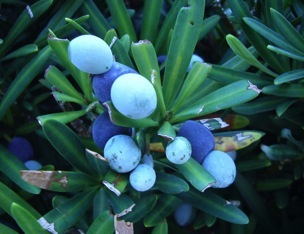
Seeds on the end are NOT edible

Podocarpus (pod-oh-KAR-pus) means “foot fruit” and macrophyllus (mak-roh-FIL-us) big leaved. The “foot fruit” is very similar to how cashews grow, seed on one end, fruit on the other. (Raw cashews by the way are toxic.) The strap-shaped leaves are skinny, and while much longer than wide, they are not greatly long, up to 3 inches.  The tree is native to southern Japan and China. In Japan it is called Kusamaki or Inumaki.  In China it is called Luo han song. It has at least eight names in English, best not used.  Kusamaki can mean “grass plant” in Japanese, a reference perhaps to the leaves.

There are about 100 species in the genus, give or take a half dozen either way.  The P. macrophyllus was introduced to the United States in the 1800s, probably before 1860, and no doubt no later than the Japanese Centennial exhibit in 1876 in which kudzu made its debut as well.  In its native wild P. macrophyllus can grow to an 80-foot tree. Locally it is a landscape standard and escaped opportunist (it grows quickly from seed.)  On a bike trail nearby there are two 40-foot Podocarpus trees. The P. macrophyllus with red fruit is usually the variation Maki.

While many authors say the fruity part is flavorless and slimy, I have found them to be sweet and juicy. They taste very much like blueberries to me, or perhaps red grapes minus the tartness though the texture is similar. But, not all palates agree. Locally they ripen around the end of July and the beginning of August, some years mid-August. Fruit left on the bush to dry have a texture similar to raisins with a hint of pine. Interestingly, the P. macrophyllus is related to the Nagi Tree which has an inedible blue fruit. The seed oil of the Nagi Tree is edible but not the seed itself or its covering.

Since the P. macrophyllum seed is not edible and must be separate from the aril, I have found the quickest and easiest way to do that is to twist the two parts apart, rolling one part one way, and the other part the other way. Keep the aril and throw away the seed. The wood is used in making furniture, paper, and farm tools

Green Deane’s “Itemized” Plant Profile

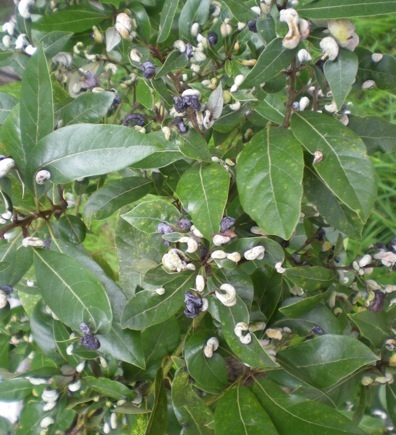
IDENTIFICATION: Erect, slim, evergreen shrub or tree with dark glossy green leaves with lighter underside. Two to four inches long, a quarter inch wide, tapering to a point, no veins except for prominent midrib. Attached in dense spirals. Fruit two parts, a fleshy receptacle then seed. Seed has blue sheen that rubs off to reveal a green seed. Receptacle can be blue to purple to red. Edible. The attached seed is NOT edible.

TIME OF YEAR: Fruits in summer, locally late July into August

ENVIRONMENT: Well-drained soil, but usually is found in landscaping. An extremely common hedge plant, found across the southern United States and up the west coast.

METHOD OF PREPARATION: Arils raw or cooked. Can be made into jelly, pies and the like. Seeds are not edible.


{ 26 comments }

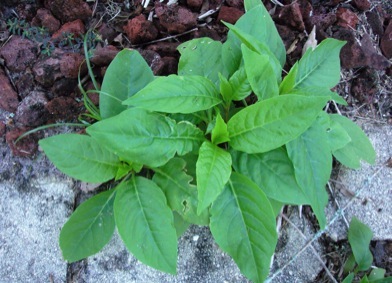
Ripe for picking young poke weed. Photo by Green Deane

Can Be Deadly But Oh So Mildly Delicious: Poke weed

Poke weed will challenge your commitment to foraging.

It is not the most commonly eaten food from a poisonous source. Tapioca, cassava, or cashews would probably take that prize. But poke weed’s in the running. If prepared incorrectly or carelessly it can make you quite ill, or worse, put a ‘k’ in front of ill as in kill you.  But when picked and prepared properly, as millions have done over the centuries, it is perhaps the most nice pot herb of all, one that makes you look forward to next season.

Phytolacca americana (fy-toe-LAK-ah  am-er-i-KAY-na) is native to the eastern United States. Americana means of America. Phytolacca is an international construct combining phyton (Greek for plant) and Lac (French for a dark red pigment.)  The word “poke” comes from the Virginia Algonquian (Native American) word “pakon” or “pucone” first recorded in 1708. Pakon refers to a plant used for dye or staining, and indeed a red coloring from the poke weed’s berries has been used as a dye for centuries. Natives used the juice to color feathers, arrow shafts, garments, even their horses. Berry juice was also used at one time to color wine, but as it did such a good job that practice was made illegal. In a modern twist, red dye from poke berries doubles the efficiency of certain solar cells. (Wake Forest University research.)

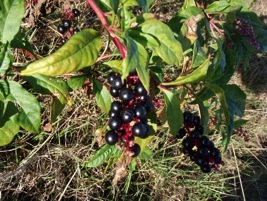
Ripe poke berries, do not eat

While coloring foods with poke berry juice has been banned, because it is reportedly poisonous, Dr. Julia Morton says on page 51 of her “Wild Plants for Survival In South Florida” 1982 edition,  “The strained juice of ripe fruits may be safely used for coloring foods.” During her lifetime, Professor Morton was the most authoritative source in Florida on toxic plants and her works still the main references. In theory the juice could be made into jelly. While the berries are the least poisonous part of the plant, never eat the seeds or the root. Accidental poisoning have happened by people getting a little root with the shoot. And never eat a mature poke weed. What’s mature? For safety, I would consider any poke weed over 7 inches mature and off limits. And, or, any poke weed with deep red stems no matter how short it is.

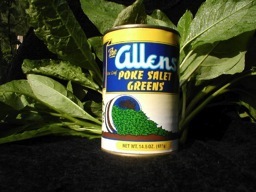
Commercial canning of poke weed ceased in 2000

Poke weed grew a good reputation centuries ago despite its dangerous side because it’s one of the first mild edible greens in spring, at a time when folks have been living on non-greens for several winter months or peppery members of the mustard family. Many attempts were made to move the weed into the mainstream vegetable market — as it is in parts of Europe —  but it just never took off in North America. However, the demand for it was enough to keep two companies canning it up into the 1990’s. That southern tradition ended in the spring of 2000.  In April that year the Allen Canning Company of Siloam Springs, Arkansas, canned its last batch of poke sallet. The reason why they stopped canning poke weed was there were not enough people interested in picking it for them. So, if you want poke weed you really do have to harvest it yourself or order it through boutique stores on line

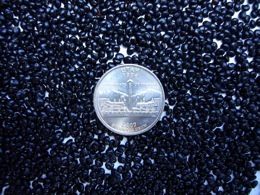
Toxic poke weed seeds and a quarter

A third alternative I’ve heard of which I haven’t tried because I live in Florida — where houses don’t have basements — is dig up a poke weed root and bury it in a sand box in a lightless area of your basement. In the spring it will send out white shoots which some say only need to be boiled once. While that may be theoretically possible, it would take a lot of roots to get enough shoots for even one meal. You’re better off harvesting it or collecting the seeds and growing your own. More on that in a moment.

When I go collecting poke weed, I take a ruler with me. It’s called my hand. From the tip of my middle finger to my wrist is about six inches. If the shoot is six inches or under, into the pot it will go, taller I leave it be. The second rule is pick nothing with red stems but that’s not so hard and fast because even two-inch shoots can sometimes be pink to red. And when I gather it I don’t pull it up, I cut it to avoid the possibility of getting any root. And do not handle raw poke weed if you have any cuts or abrasion on your hands.  It has mitogens which I will explain later.

The top picture of young poke weed is the appropriate size range. While I boil them twice. First time one minute. Then I change the water and boil for 15 minutes. That said, I know a southerner who not only picks red-stemmed shoots but boils them only once. That’s too brave for me but as of this writing she’s 70 and her husband 85 and they’ve been doing that every spring since they were kids in Kentucky. Merritt Fernald in Edible Plants of Eastern North America (1958 edition) writes young shoots need only to be boiled once. He also says they make great pickles.Unboiled poke leaves when eaten dissolve the mucus that protects your stomach et cetera from the hydrochloric acid there thus you begin to painfully digests yourself.  But there are complications. It may be that shoots from last year’s seeds only need to be boiled once, but shoots from old roots need to be boiled twice. 

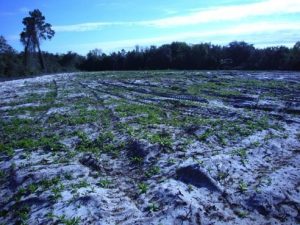
Poke, one of the first weeds to poke up after land clearing.

I like the 1/15 boiling method because it accommodates large quantities of poke weed. You can boil them for a minute and then freeze. Mark the package that it has to be boil 15 minutes after thawing. The 1/15 also helps with cooking large amounts of poke weed. Use two pots of boiling water: One pot should be the right size for cooking your poke weed and the other should be much larger. The larger pot is your reservoir of boiling water. When both pots are at a boil, drop the poke weed into the smaller pot with ample water and boil them for one minute. Throw away this first water then refill the cooking pot with fresh boiling water from the large pot and boil for a minimum of 15 minutes and enjoy. (I understand your trepidation. Long ago I used to cook poke weed in boiling water three times, 20 minutes each. Then I dropped down to two 30 minute boils, then two 20 minute boils. I read of the 1/15 method and used it successfully. (It was a misprint and was supposed to be 15/15) Thus I inadvertently I did 1/15 not 15/15. No harm done as far as I could tell and that is how I have been cooking poke weed for over a decade.

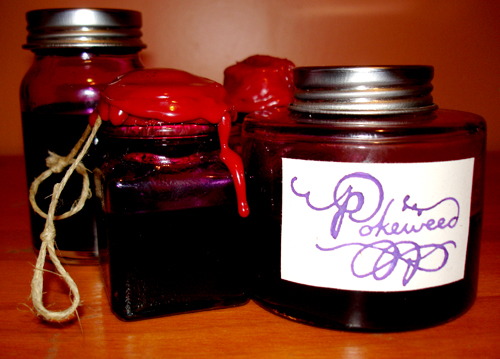
Poke weed ink, photo by CuriousGoods.co

A few folks also peel the stalks and fry them like okra. Some blanch them first, others do not. Seedless berries reportedly can be made into pies but before I do that I’d like to meet someone alive who has done that, eaten said, and is still among us. Read don’t do it because it was supposedly done. It would also take a fine mesh to separate the seeds from the berries, but not impossible. Also, if you are thinking about raising poke weed from seeds, they are resilient. The best germination comes after fermenting the berries then soaking the dried seeds in sulfuric acid (battery acid) for five minutes then washing thoroughly. That probably replicates conditions in a bird’s gut.  I tried that this last year and it worked very well with a full row of poke weed in my garden.

I like poke weed shoots just fine boiled then dressed up with salt, pepper and butter, or olive oil. Best guess: Boil it at least twice for insurance if not three times for assurance. I’ve come to prefer the one-fifteen method particularly for young poke. Older poke might need more boiling.  Some day, when you are an experienced poke picker, you can make up your own rules. Nutritionally, poke weed is a powerhouse: A half cup of the greens provides 35 calories (10 from fat), no cholesterol, three grams dietary fiber, and 90% of your daily need for vitamin A, 60% of vitamin C, 8% calcium, and 6% of iron. Poke weed has 8,700 IU’s of vitamin A per 100g serving. Vitamin A as Beta Carotene is not water soluble so boiling does not significantly reduce it. 

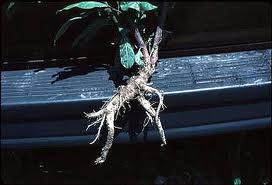
Poke weed root is very toxic. PHoto by Green Deane

Incidentally, you will hear poke weed called “poke sallet” which sounds like “salad.” That “sallet” and “salad” sound the same today has been the cause of a few poisonings because people did not cook the poke weed before eating it. Never eat poke weed raw.  NEVER. Always cook it. I know of someone who accidentally ate raw poke weed leaves and was wretchedly hospital ill. Some web sites say “Sallet” is an old English word meaning “cooked greens” but research does not bear that out. “Sallet herbs” were eaten raw and “pot herbs” cooked. “Poke sallet” is just a time-corrupted use of the term. Sometimes “sallet” is spelt “salet” but that’s not only incorrect but a “salet” is a helmet from a few hundred years ago.

Doctors — and here I will admit my severe bias against their dogma when it comes to food and nutrition issues — think the plant should be eradicated. This is the same group that told us transfats were good for us, and high fructose corn syrup. Not a good track record. The chemist in the kitchen has not worked out well. There’s some evidence that compounds in poke weed are antiviral and it has potential against AIDS. More so, poke weed proteins have shown fantastic clinical results in the treatment of childhood leukemia. A study published in the Journal of Natural Products 5 Jan 2008 shows one saponin might have a positive effect on ovarian cancer. Not bad for a plant doctors want eliminated. However, to be balanced, there is evidence poke weed constituents — mitogens — have the potential to cause cell mutations. That is why you don’t handle it if you have cuts on your hands. Mitogens can stimulate the immune system and also cause cancer. That’s why we boil it. A precaution: Those pregnant should not eat it or handle it.  That’s a lot of warnings, but it has also been eaten by millions for centuries.

Three historical notes: James Polk was a dark-horse candidate for president in the 1840’s. In one of the first PR gimmicks, his supporters wore poke leaves on their lapels. He became the 11th president of the United States. That’s Poke Power. And when the Declaration of Independence was written Tom Jefferson wrote it with ink made from poke berries on hemp paper… still legible after all these years. And during the US Civil  War many a letter was written home with a bird feather and poke berry juice ink. These letters, too, are extant for us to read because an herb called poke weed was valued not eradicated.

To make ink remember those ripe berries you brought home to rot for the seeds. You crush the berries, strain out the seeds, and let the rest ferment for a couple of weeks.  There is natural yeast on the berries or you can add a little wine or bread yeast. Then strain the liquid, once or twice depending on the thickness. You now have ink worthy of a constitution. You can mix fresh, filtered juice with vinegar to make a purple ink but it will fade. Fermenting turns the ink brown but sets it.

Cherokee mother and child

Lastly, I am doubtful about the presumed history of poke weed consumption. Poke weed certainly has been eaten for a few hundred years and that adds up to a lot of people. But I’m not sure about its use before the Europeans arrived in North America, that is, how the Native Americans used poke weed.

Consider: The Alabama Indians referred to Europeans as “those who eat poke weed.” That sounds as if the Alabama did not. In fact, of the dozens of tribes we only know of four that used poke weed as a food, and those uses seem to break down into pre- and post metal pots. Also consider that boiling was a difficult task before the introduction of metal pots, particularly for a green that has far less nutrition than say a rat. I’ve got a suspicion that poke weed was medicinal (worth the difficulty of boiling) but not a food until it became easy to boil poke weed in changes of water in metal pots. In their different uses you can read pre- and post-metal pot use.

The Cherokee crushed the berries and sour grapes together, strained, mixed that with cornmeal and sugar to make a beverage. Leaves were gathered into a bundle and dried for future use. Those two uses do not require cooking. Crushed berries were used to add color to canned fruit. Young shoots, leaves and stems were parboiled, rinsed, and cooked alone or mixed with other greens and eggs. Peeled stalks cut lengthwise, parboiled, dipped in egg, rolled in cornmeal, fried like fish. Those require cooking. The Iroquopis, Malecite and Mohegans also ate poke but how was not recorded.  That’s not a lot of ethnobotanical evidence that native were eating a lot of poke weed long before Europe discovered America. I personally know two people who swallow one dry berry whole (no chewing) to treat arthritis. Other than personal testimony I have no idea if it works or not. As I say Herbalism is outside my pay grade.

Green Deane’s “Itemized” Plant Profile: Pokeweed

IDENTIFICATION: Phytolacca americana: (See “Telling The Difference” below) Poke weed is rugged but not handsome. It’s four to ten feet tall, stout with reddish stems, leaves four to 10 inches long. The plant often has a scraggly look. It’s flowers can be green, white or pink on a stalk six to eight inches long.  The berries are globular, purple black, flattened on top and bottom. The root is so toxic if you handle it do so with gloves.

TIME OF YEAR: Blossoms primarily in spring but can blossom all year until interrupted by frost or winter.

ENVIRONMENT: Poke weeds are opportunists, disturbed land often produces huge amounts, but likes rich, moist soil.

METHOD OF PREPARATION: Never eat poke weed shoots uncooked. They can make you very sick. Never get any part of the root in with your greens. That can kill you. Boil short, young shoots at least twice, changing the water both times. Many writer recommend boiling them three times, which is acceptable, too. It does not change the flavor though drain your cooked greens well, they absorb a lot of water.  Poke berries, minus the seeds, have been mixed with grapes, sugar and cornmeal and fermented.

HERB BLURB

Foxfire II said hill people believed a home-made antidote for eating raw poke weed was drinking lots of vinegar and eating a pound of lard.

Telling the difference

Inkweed (Phytolacca octandra) is very similar to American pokeweed (Phytolacca americana) and Venezuelan pokeweed (Phytolacca rivinoides). These species can be distinguished by the following differences:

•    inkweed (Phytolacca octandra) flowers are borne on very short stalks (i.e. pedicels) only 2-3 mm long and usually have 7-8 stamens. Their ‘petals’ (i.e. tepals or perianth segments) turn red and persist on the developing fruit. The mature fruit are relatively small (4-6 mm across) and usually have eight slight lobes (i.e. they usually contain eight seeds).

•    American pokeweed (Phytolacca americana) flowers are borne on relatively long stalks (i.e. pedicels) 5-10 mm long and usually have 10-11 stamens. Their ‘petals’ (i.e. tepals or perianth segments) turn red and persist on the developing fruit. The mature fruit are relatively large (5-11 mm across) and have ten or eleven slight lobes (i.e. they contain ten or eleven seeds).

•    Venezuelan pokeweed (Phytolacca rivinoides) flowers are borne on relatively long stalks (i.e. pedicels) 7-12 mm long and have 9-14 stamens. Their ‘petals’ (i.e. tepals or perianth segments) fall off as the fruit begin to mature. The mature fruit are relatively small (5-6 mm across) and have 12-16 slight lobes (i.e. they contain 12-16 seeds).


{ 157 comments }

Rubus ideaus: Delicate Raspberry

Raspberries were the first wild fruit I noticed on my own and ate as a kid.

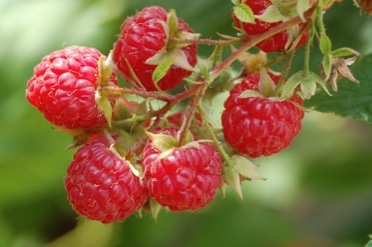
Wiild red raspberries

They grew on a forested mesic hillside near a woods road. They looked like the kind I saw in the store so I ate them. No asking, no checking. I just ate them. Kids do that. In hindsight, how frightening.

Most plant poisonings among kids involve very young children. Toddlers of any species, be they two or four legged, will chew on something no matter how awful it tastes. Older children usually won’t eat foul tasting stuff, nor will older animals. Almost all the cases of child plant poisoning involve the very young eating something ornamental from their own yard, or the neighbor’s yard. Then you have to skip a decade before the “I dare you” poisonings crop up. In between you can teach good foraging rules and what to not do.

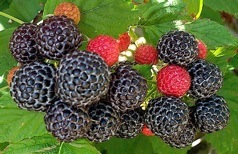
Wild black raspberries

Raspberries and blackberries are so close they are incestuous cousins. The same thing can be said of Plums and Cherries.  Despite the varieties of raspberries and blackberries, the easiest way to tell them apart is after you pick the berry. The raspberry will have a hole in it where the core and stem were and will leave a little cone on the branch. The blackberry will have a little stem where the raspberry has a hole. That little stem is usually slightly bitter. What the raspberry leaves behind is technically called a torus or receptacle. Raspberries are also hairy, whereas blackberries are not.

Like blackberries, raspberries fruit their second year and usually in mid-summer (in northern climates.) If you live in the right area and have two green thumbs you can coax them to fruit in one year, and indeed that is how some commercial production is done. Like the blackberry the raspberry’s leaves can be used for a tea and to treat minor cases of diarrhea. It is also suggested for regulating menses.

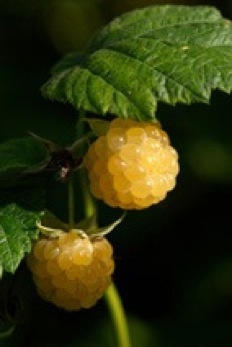
Cultivated yellow raspberries

While the common wild raspberry is rouge they can range from black to yellow, depending on the culitvar. On average a raspberry weights four grams and is made up of 100 little drupelets. It is an “aggregate” fruit, or a collection of many little fruits, which gives it (and the blackberry) their familiar shape. They’ve been under cultivation since at least the 4th century BC.

As one might expect from a member of the rose family, the raspberry is a nutritional powerhouse. They are very high in Vitamin C, fiber, potassium, Vitamin A and calcium. They are chocked full of antioxidants and very good for treating eye diseases.

Botanically they are in the Rubus genus, said ROU-bus which is Latin for red hair. There are some 200 species of raspberry, R. Idaeus (eye-DAY-ee-us, from Mount Ida) is the wild red one, Occidentalis (ok-sih-den-TAY-liss, of the west) is a black wild one. They are native only to the northern hemisphere.

Where the word “rasp” comes come is debatable but it seems to be related to “raspis” first in English in 1532 from Old French raspeit/raspise and Italian raspato, meaning red wine from Medieval Latin raspatum or raspa meaning a bunch of grapes. Perhaps that and the Greek word for a grape, rouga, had a similar linguistic ancestor.

Oh, when raspberries ripen the reds ripen first, then black, next purple (a cross between red and black) and lastly yellow.

Green Deane’s “Itemized” Plant Profile

IDENTIFICATION: Leaves alternate, pinnately compound leaf with 3 to 7 serrated leaflets, 5 to 8 inches long, green above and nearly white below, very fine prickles or glandular hairs on petiole. Flower: Greenish, with very small white petals that fall away quickly, not showy, appearing in late spring to early summer. Fruit: Juicy, red (or black) multiple of drupes, ripen in late summer. When picked they separate from the fleshy core forming a hollow shell. Twig: Arching “canes” 3-5 feet that are bristly hairy to slightly prickly and reddish green. Unlike blackberries canes do not root at the tips.

TIME OF YEAR: Depending on climate and variety, late spring to late summer, usually middle of summer, or two crops a year if husbanded correctly.

ENVIRONMENT: Full sun, neither too wet or too dry, mesic conditions. Found throughout North America except the Deep South.

METHOD OF PREPARATION: Numerous:; Fresh, frozen, canned, used as wine, ice cream, juice, pies, jelly, jam, tea, and best of all when eaten fresh on the trail.


{ 6 comments }

Galls and non-edible fruit on the Persea palustris

Persea borbonia, palustris, humilis, and americana, too

Having a famous relative can make one grow in the shadows, as three Perseas know too well.

There are four Perseas growing in Florida, three of them native, one an import. The  import is the most famous, Persea americana (PER-see-uh uh-mair-ah-KAY-nuh.) You know it as the avocado. The other three don’t produce an edible fruit so their drupes are left on the tree. But there is more to the native Perseas than meets the eye.

The unsung natives have leaves that can be used for seasoning, just like a bay leaf, and their leaves can be used to make a tea.  Better, no matter what your environment you’re in, one of those Three Leafleteers is near you.

P. humilis (HEW-mil-liss) likes it very dry and is found in scrubby areas. P. palustris (pah-LUS-tris) likes it feet very wet so it is a denizen of swamps. P. borbonia ( bor-BOE-nee-uh) likes it between. Fresh or dried leaves from all three can be used for tea and seasoning. But what of the avocado?

Spicebush Swallowtail favors Perseas

Leaves of the Persea Americana var. drymifolia (PER-see-ua  ah-mer-ree-KAY-nuh  drim-if-OH-lee-ah) have been used in the distant past for a tea and seasoning. Most of our present-day avocado leaves, Persia americana, are stronger because of breeding and are not usable. One way to tell if you have an ancient avocado tree (the Persea Americana var. drymifolia) is to crush the leaf and smell it. The crushed leaf of the older species should smell like anise or liquorish. The Aztex wrapped food in that leaf for flavoring and called that style of cooking tamale. Cooking with modern-day avocado leaves can make you ill… and don’t eat the avocado pit. It can make you sick or worse.  Also keep avocados away from your pets. There is good evidence that cats, dogs, cows, goats, rabbits, rats, birds, fish, and horses can be killed when they consume avocado leaves, bark, skin, or pit.

P. Borbonia is the best known native and is called the Red Bay. Why Red Bay? Bay is the English version of the Latin word Baca, which was the name of similar old world trees in the same family. The “red” comes from the wood of the Borbonia, which has a reddish luster and is prized in woodworking such as for interior finishing and boat interiors. The natives made spoons from it.  Oddly, one of the identifying characters of the Perseas are leaf galls, see picture above. Also, Persea borbonia on the east coast of Florida are dying out becaues of a disease.

Spicebush Swallowtail larva

Borbonia is a mixture of Greek and Latin, Bor — food —  and Bon — good,  food good, referring to the use of the leaves. Palustris means “of the swamp” and Persea palustris is called the swamp bay. Humilis means low growing. The P. humilis is also known as the “silk bay.”  Americana is from the Americas. Drymifolia, from the Greek, is a bit of a mystery. It can mean forest leaf or sharp/stinging/biting leaf.

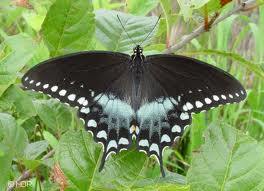
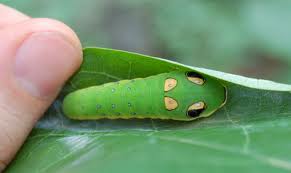
The Perseas are favored by the Spicebush Swallowtail butterfly. Apparently its concoction of chemicals doesn’t bother it. Oh, and one last thing: It appears that Persea tea provides some protection against giardia.

Lastly the Persea borbonia and the Persea palustris can be difficult to tell apart though they like slightly different environments, the former neither very wet or very dry, the latter can tolerate very wet. But another key is to look at a leaf petiole, main stem on the underside and the underside of the leaf. According to botanist R. P. Wunderling With the P. borbonia little hairs on the petiol lay down, on the P. palustris they stand up. What I have found locally is that P. borbonia has very little hair at all, and what few it has is generally flat. P. palustris is hairy, not only the petiole and the back leaf spine but the back of the leaf as well. To see the hair, or absence of hair, one needs about a 30x magnification.

Green Deane’s “Itemized” Plant Profile

IDENTIFICATION: P. Borbonia, the most common, has lance shaped 4-inch long leaves that are shiny bright green on top and light green on bottom. P. Palustris has leaves that are pale gray on the bottom with hairy red fringes, twigs are hairy. Crushing a leaf produces a very distinct bay leaf odor, the Palustis is not as strong as the Borbonia in aroma.  Borbonia can reach 70 feet high and three feet through. Palustris 30 to 40 feet. Fruit of both is a small bright blue to shiny black drupe — NOT EDIBLE. Twigs are slender and the bark reddish-brown and scaly. P. Humilis reaches 10 feet tall.  Its leaves are bronze on the underside. The leaves of all the Perseas are often covered with galls. That said it seems to me the P. borbornia seems the most affected by galls.

TIME OF YEAR: Fresh or dried leaves year round

ENVIRONMENT: P. Borbonia, like P. Palustris is found from Virginia south to Florida and west to Texas. P. Humilis is fond only in Central Floirda. Plustris is found in wet areas, Borbonia in neither wet or dry places. Humilis is found in sandy, dry scrub areas.

METHOD OF PREPARATION: Fresh or dried leaves used as a bay leaf or as tea. The fruits of the palustris, borbonia and humilis are NOT edible. Avocado leaves (variation drymifolia) can be used to wrap food if it smells like anise.

 HERB BLURB

The leaves have been used as an abortifacient, analgesic, emetic and febrifuge. They have been used to treat fevers, headaches, diarrhea, thirst, constipation, appetite loss and blocked urination.  An external decoction wash has been used for rheumatic joints and painful limbs.

{ 7 comments }

Reindeer moss is not moss but a lichen, photo by Green Deane

 Edible Cladonia: What’s not to Lichen?

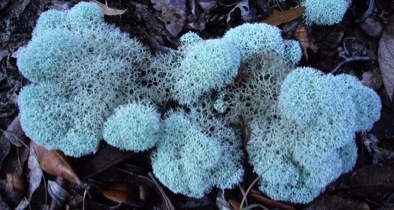
Lichen can be harder to tell apart than twins in the dark. My guess my picture above is of Cladonia Evansii (kla-DOE-ne-ah ev-AN-see-eye) which is a southern version of a common lichen that came down the Appalachians. It takes a lichenologist to know for sure, but fortunately lichen are not like mushrooms. While 96% of the 10,000 species of mushrooms are not edible (including the one to four percent that will definitely kill you ) only two lichen out of some 22,000 are what we would call poisonous, Letharia vulpina (leth-AH-ree-a vul-PEEN-ah) and Vulpicida pinastri, (vul-pis-EYE-dah pin-AST-try or wol-peek-EE-dah pin-ass-tree)) or Wolf Lichen and Powdered Sunshine Lichen… and conveniently they are both yellow, Wolf Lichen a greenish yellow and the Sunshine Lichen a sulphur yellow. And though internally toxic from vulpinic acid they can be used on external wounds and sores.
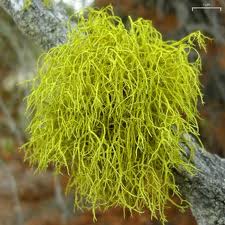
Wolf Lichen, one of the few toxic lichen

Most lichen are likable, but not exactly consumer friendly. What the lichen all share is acid and as such require proper preparation if they are to be eaten because unprepared and uncooked they will painfully attack your digestive track. Unprepared lichen taste like aspirin. That should motivate you to prepare it correctly. Never eat unprepared and raw lichen unless your life truly depends upon it.  It probably will not kill you but you will wish it had.

One of the most widespread and commonly eaten lichen, by beast and brute alike, is a northern version of what you see above, Cladonia rangiferina, (ran-jiff-er-EYE-nah or ran-ghif-er-EE-nah)  also known as Cladina rangiferina — both Latin for many branching reindeer-like.  That’s rather clever since reindeer eat a lot of it and its branching resembles deer antlers. C. rangiferina, however, stops its southward migration in the United States with the end of the Appalachian Trail. I can remember as a boy, living on the northern end of those mountains in Maine, not only playing with C. rangiferina but running through brittle beds of red-topped Cladonia cristatella . You could actually leave foot prints in the lichen like those left in snow… and unknowingly crushing centuries of growth at the same time.
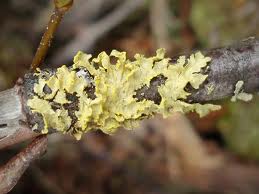
Powdered Sunshine lichen, also toxic

The two common “reindeer mosses” found here in central Florida are the Cladonia evansii and Cladonia subtenuis, with the subtenuis — which means thinner — being less compact than Cladonia evansii. C. evansii — named after North Carolina botanist Alexander W. Evans — has no official common name but it is called Powder Puff Lichen. C. subtenuis is called Dixie Reindeer Moss.

There are three surprising things about lichen. The first is lichen is a symbiotic relationship of two life forms, fungi and algae, with the fungus providing the form and the algae the operating system inside. That seems a lot more understandable than the creature normally used to explain symbiotic relationships, the Portuguese Man of War. It’s called a jellyfish but is really a colony of different life forms, one group whose job is defense and they sting painfully. Lichen are more likable. Heck even 50 or so species of bird use lichen for their nests. If ya can’t eat it, sleep in it.  By the way, it catches fire readily and makes great kindling, or a small hot fire.

The second surprise is folks used to make a lot of booze from lichen. For about 50 years in the 1800’s Sweden led the world in lichen alcohol production with the rest of Europe and Russia joining in. It was viewed as an alternative to grain alcohol. Lichen brandy was a big hit, and it was also used in the making of Akvavit, a traditional caraway-flavored spirit.  That said, I have to run off on a non-plant tangent here for a moment.

Akvavit comes from the Latin phrase Aqua Vite, which means “water of life.”  The Irish word “whisky” is from the same Latin phrase and means the same thing: “water of life.”  Akvavit/whisky…aqua vite….The obvious conclusion is the Irish spoke ancient Latin with more of an accent than the Scandinavians. Now, from a marketing point of view, you read it here first: They should reintroduce lichen into their Akvavit. Lichen is grown commercially in Scandinavia. It would make for great branding. Can’t you just see a clear vodka-like bottle with a lichen-esque label, maybe some stately lichen on some craggy gray rocks, maybe even a flake or two of lichen in the bottle…. it has to cost less than gold flakes….

Anyway…. Not only were lichen used to make alcohol but Russia managed to make a molasses out of it. I’m surprised the Russians didn’t try to make rum.  That alcohol and molasses could be made from lichen highlights their third interesting aspect: Most lichen, including most of those you see on trees, rocks and old cemetery stones, are some 94%  carbohydrates. That’s some 14%  more carbs than a potato.  But, along with those carbs is a lot of rock-dissolving acid that can burn your insides, which is why they have to be prepared a certain way.

The amount of acid varies from species to species with the Cladonias, especially C. rangiferina, being among the most nutritious and the least acidic. A combination of nutritional studies suggest Cladonias are, by dry weight,  1.4% ash, 5.4% protein, 32.9% fiber, 2.1% fat, and 0.501% niacin  3.7% calcium, and 0.09% phosphorus. They also have vitamin A.  Fiber, carbs, vitamins and protein. Maybe the Scandinavians of old were on to something.

In a severe survival situation lichen can be eaten unprepared and uncooked. You will survive but you will also have a severe stomach ache that will make you want to die. The amount of carbs per lichen species and its availability varies. To make the lichen edible they are soaked in several changes of water, better, several changes of water with bicarbonate of soda added to each soaking. Another method is to soak them with hardwood ashes.  The modern version of that is to soak them in a 1% solution of potash. A method used in China is to boil lichen for 30 minutes and then soak for two days in several changes of water. After discarding the soaking water they are boiled and that water discarded, or they are steamed. They are then ready to eat, plain or mixed with other things, or dried and added to flour or as a thickener to soups. Lichen is often cooked until it turns into a gelatinous mass. My mother remembers her mother using prepared lichen to make a pudding, probably as a thickener.  Cladonia islandica was used to thicken jelly until gelatins came along.  The point is the longer you soak them and the longer you boil them and the more often you change the water the more palatable they will be and the less acidic.

Yet another way is to take about three cups of lichen, cover with water, add about a quarter cup of bicarbonate of soda (sodium bicarbonate aka baking soda) put on a stove and bring to a boil and boil for about 15 minutes. Drain, replace the water, replace the bicarbonate of soda, again bring to a boil and boil for about 15 minutes. Drain, rinse, barely cover the lichen with water and bring to a simmer can cook until it is gelatinous. It is then edible but not greatly palatable.

Oh….You can also eat any lichen you find in the first stomach of a reindeer, but it’s messy and not too good tasting. To get around that you freeze the stomach and its content. Then you slice it off and put it in stews and the like. There it is far better, but not five stars.

I saw forager emeritus Dick Deuerling nibble on Cladonia evansii uncooked while out on the trail, just picked it up, crushed some in his hand and down it went. Once he also told me he just crumpled it up and dropped it into soup.  Woodsmen in northern Canada reportedly used rock lichen to make a “stimulating” tea by boiling it for 15 minutes. I suppose a stomach ache can be stimulating.

One point to consider is whether to eat lichen at all in populated areas. Lichens grow very slowly, one or two centimeters a year, and can live to be three thousand years old, and can stay in tact another 10,000 years. The lichen you may be thinking of partaking could be older than you are or was alive when the ancient Greeks were. Lichen can also collect a lot of pollution in those years. It just might be that it is good to know one can eat lichen but one doesn’t have to. In fact, they take very well to dish gardens and don’t have to be watered. They get all the moisture they need out of the air. It’s a pet that can outlive your parrot, and it talks less, too.

There are actually five different kinds of lichen: Those that grow in clumps as the one shown here, those that grow in flakes commonly seen on trees, crust lichen, often seen on cemetery stones, lichen that looks like a combination of flakes and crust, and a class called Leprous for powdery patches (so named by the ancient Greek Dioscorides because they resemble the lesions of leprosy.) Here are some more lichen that are commonly eaten.

Gyrophora,  aka Rock Tripe; Umbiliceria, also aka Rock Tripe, mucilaginous, used for thicken, has antibiotic properties; Historical Note: George Washington’s troops had to eat rock tripe during the deadly winter of 1777 at Valley Forge. Lecanora, aka Cup Moss, Manna, can be broken apart by the wind. This is the lichen mentioned in the Bible when it showered starving Israelis with “manna rain”; Alectoria, aka Black Tree Lichen, Nativess steamed it for two days in pits, ate it dried and powdered for mush or thickener. Also eaten are Evernia, Sticta, Umbilicaria esculenta, Peltigera canina, and Aspicilia esculenta.
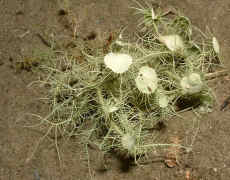
Usnea is antiseptic

Usnea is also edible but is more valuable as an antibiotic and antiseptic (see separate entry.)  In fact, it it estimated that 50% of all lichen have medical applications but Usnea are especially good externally on wounds and the like. Usnea lichens have an elastic white chord running through the center of the main stem. Lichen that resemble Usnea do not have this white cord. They also appear grey-green throughout. Also Usnea lichens do not change color during the growing season whereas lichen which closely resemble Usnea do. If you’re in the southern US and you think you’ve found Usnea and it has a black hair through the middle you’ve found Spanish Moss. Spanish Moss is not edible, except for growing green ends, but does have some medicinal applications.

There are two versions of how the word lichen came to be, both of them from the same Greek root.  λειχω (LEAK-ho) means to lick and  λειχην (leak-NEE) is an eruption. In modern Greek λειχην is what herpes is called. Theophrastus (371-284 B.C.), a Greek botanist, used the term to describe superficial growth on the bark of Olive trees, as if it had been licked up. The second version is that  flaky lichen looks like it is licking rocks and trees and were named lichen by botanist Joseph Pitton de Tournefort in 1700. He was on a two-year trip to Greece, which at the time was enslaved by Turks, a slavery that for Greeks overall lasted over 400 years. To demonstrate how the Greek linguistic ear works, LEAK-ho is to lick and GLEE-ko is sugar, or a sweet lick.

Joseph Pitton de Tournefort, 1656-1708

As for exactly how many toxic lichen there are, well, two for certain, and maybe a 100 more. No one really knows. But, if the lichen you are looking at has any yellow parts, or is yellow, it is best not to eat it. That’s easy to remember.

Lastly if you are not inclined to eat lichen, especially those found on cemetery stones you can use the lichen to calculate how long the stone has been in the cemetery, a useful genealogical tool if the date is worn off, as is often the case with marble. To calculate, measure the lichen in centimeters from a center point to the outside edge, then multiply by five and subtract the total in years from today to get the latest date that the gravestone could have been made. The size of the lichen directly reflects how long the stone has been exposed and is a common dating technique of natural events. Lihen on grave stones was common where I grew up in southern Maine.

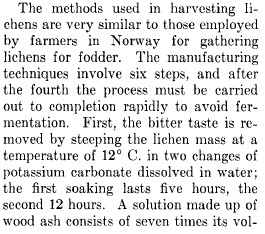
For the curious, here are two recipes using C. islandica (called Icelandic Moss.) Below the “profile” is an except from the Journal of Economic Botany on how they made molasses out of lichen.

Icelandic Lichen Flatbread

1 packed cup Icelandic moss (C. islandica after soaking)

1 1/2 c rye flour

1/2 c stoneground whole wheat flour

a pinch of salt

Boiling water as needed

One cup soaked Iceland moss is about two cups dried.

The Icelandic moss is soaked for a few minutes in lukewarm

water to soften it, then drained and chopped. Mix it with rye

flour, wheat flour and salt, then gradually add boiling water

and stir well, until you have a stiff but pliable dough. Divide

it into 12 equal pieces, roll them out thinly and cut out a

round cake, 7-8 inches in diameter. Prick them with a fork.

Cook on a griddle or bake at high heat until black spots

appear, then turn over and cook the other side. Store in a

damp cloth or plastic bag because they dry out quickly.

Lichen Milk Soup                                                                                                      

a large fistful of prepared Icelandic moss (C. islandica after soaking)

1 litre (4 cups) milk

1 tbsp sugar or brown sugar

salt

Prepared the lichen then dry it. Pour the milk into a saucepan and heat to the boiling point. Add the Iceland moss and the sugar and simmer for 10 minutes. Add salt to taste and serve. In another version, the soup is simmered for 2 hours, until somewhat gluey. Some versions add far more sugar but that is not traditional.

Green Deane’s “Itemized” Plant Profile

IDENTIFICATION: Cladonias: Spongy, grayish mass up to 4 inches thick forming extensive mats three or four inches  high, or clumps. Richly branched, each branch dividing into four, with the main branches distinctly curved in the same direction. Looks like the tubes inside a lung

TIME OF YEAR: Year round

ENVIRONMENT: Well drained open areas, sandy scrubland in Florida,  prefers acid soil, Alpine environments in the north. It grows where other plants will not and for virtually thousands of years so it can often be quite polluted including nuclear fall out. Choose carefully.

METHOD OF PREPARATION: Must be soaked/boiled in copious amounts of water, or water with wood ashes or water with sodium bicarbonate  or potash to get rid of acids. Then it can be added to various foods, wet or dry  but must be cooked well.

From the Journal of Economic Botany Vol. 10 #4 pp 367-392, 1956 by George Llano.
{ 20 comments }