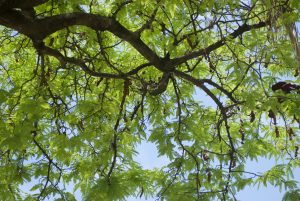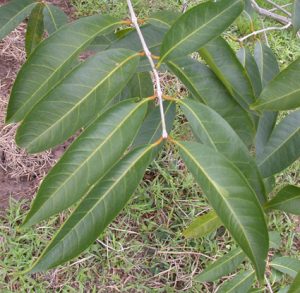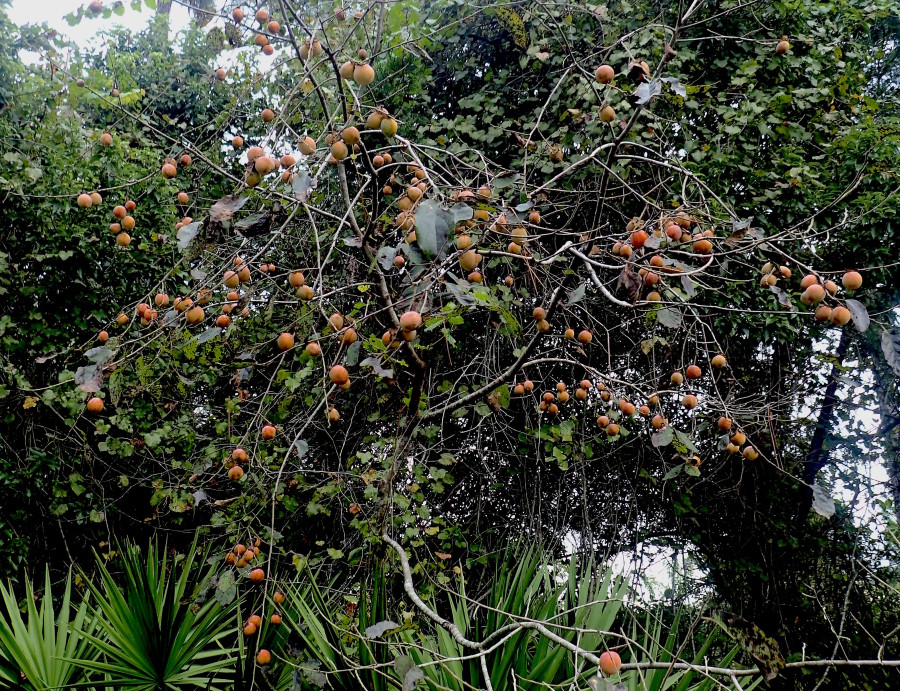
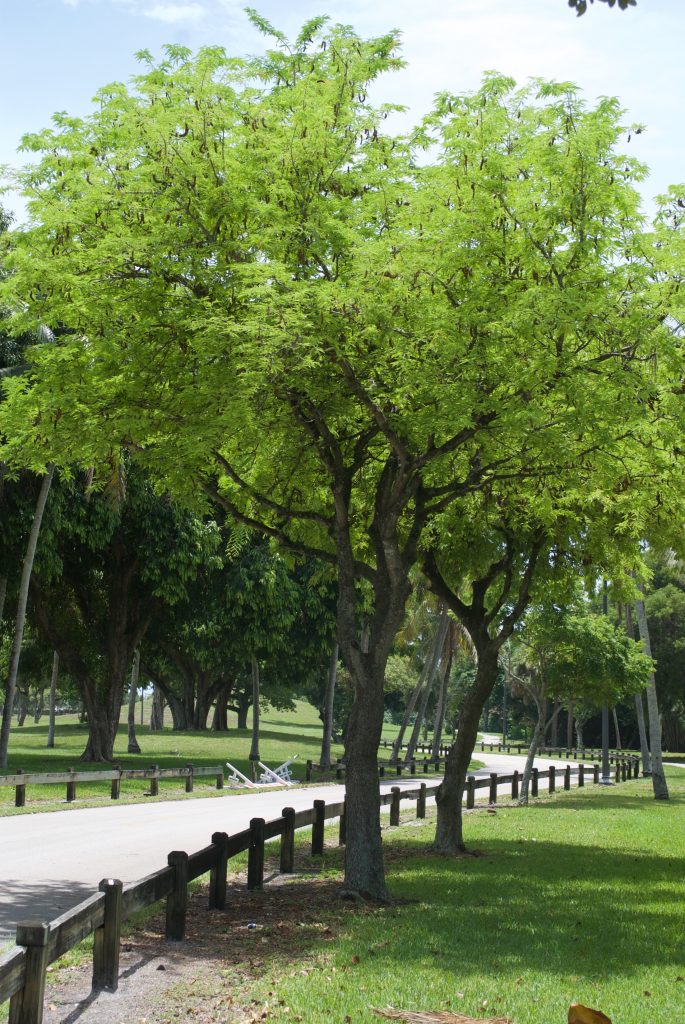
A pair of fruiting Tamarind Trees. Photo by Green Deane

I drove past a dozen Tamarind trees for a decade or so until I looked up one day. The lumpy brown pods on pretty trees had finally caught my attention.

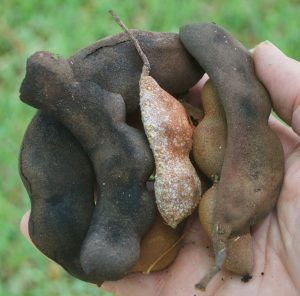
The pods stay on the tree a long time. Photo by Green Deane

As most folks know Tamarind is used as a flavoring though you can crack open ripe fresh pods and eat the pulp inside. I have not only picked them up off the ground — what’s a few bugs and bacteria? — but also climbed trees for them. The sweet and tart flavor that liven pallets everywhere is also nutritious. As you might expect that sweetness comes with an energy price: 239 calories per 100 grams. What most folks don’t realize is that Tamarind leaves are also edible raw or cooked. 

Once one notices it is easy to see the Tamarind (Tamarindus indica tam-ah-RIN-dus inn-DIC-ah) is in the greater pea family (and most pea trees not edible.) The Tamarind is native to Africa and is also monotypic, that is, it is the only tree in its genus. Some genus have hundreds of trees, the Tamarinindus has only one (the Ginkgo tree is also monotypic with only it in its genus.) Slow growing to 100 feet the Tamarind is a massive tree you plant for the next several generations.

Tamarind Pods naturally dehydrate. Photo by Green Deane

A mature tree can produce 500 pounds of pods a year. The pods themselves are collected when they’re cinnamon brown. The wood is yellow with red streaks and is termite resistant. As for the name it is part right and part wrong. Tamarind is said to come from the Arabic “tamar hindi” meaning Indian date. It was so associated with India the species was called indica which means from India. The botanist bungled it again and should have called it Tamarindus africana or the like.

And where are those dozen Tamarind trees? They encircle the first traffic circle at the north entrance of Dreher Park in West Palm Beach… Mr. Dreher knew what he was doing.  

Green Deane’s “Itemized” Plant Profile

IDENTIFICATION: Graceful strong tree with dropping feathery foliage of pinnate leaves three to six inches long, evergreen, dark gray rough bark, flowers small pink racemes. Lumpy four-inch long seed pods turning brown as they ripen.

TIME OF YEAR: As a tropical species it reported flowers in summer, green fruit appear around December or January and ripen April to May. But, I have picked ripe fruit September to November.

ENVIRONMENT: Tolerates most soil as long as well-drained and not crowded by other trees. While it is in the pea family it does not fix nitrogen.

METHOD OF PREPARATION: Young pods are used for seasoning, they can be roasted, peeled and eaten. Older velvety pods are eaten out of hand. Pulp from the dehydrate fruit — which they do naturally — is used in a wide variety of ways such as made into sauces curries, chutneys and bitters. It is also used to make candy. Flowers and young leaves are edible as are boiled or roasted seeds. You can also soak the pods, once soft remove the seeds, then dehydrate the rest. It will last for a year in the refrigerator. 

{ 2 comments }

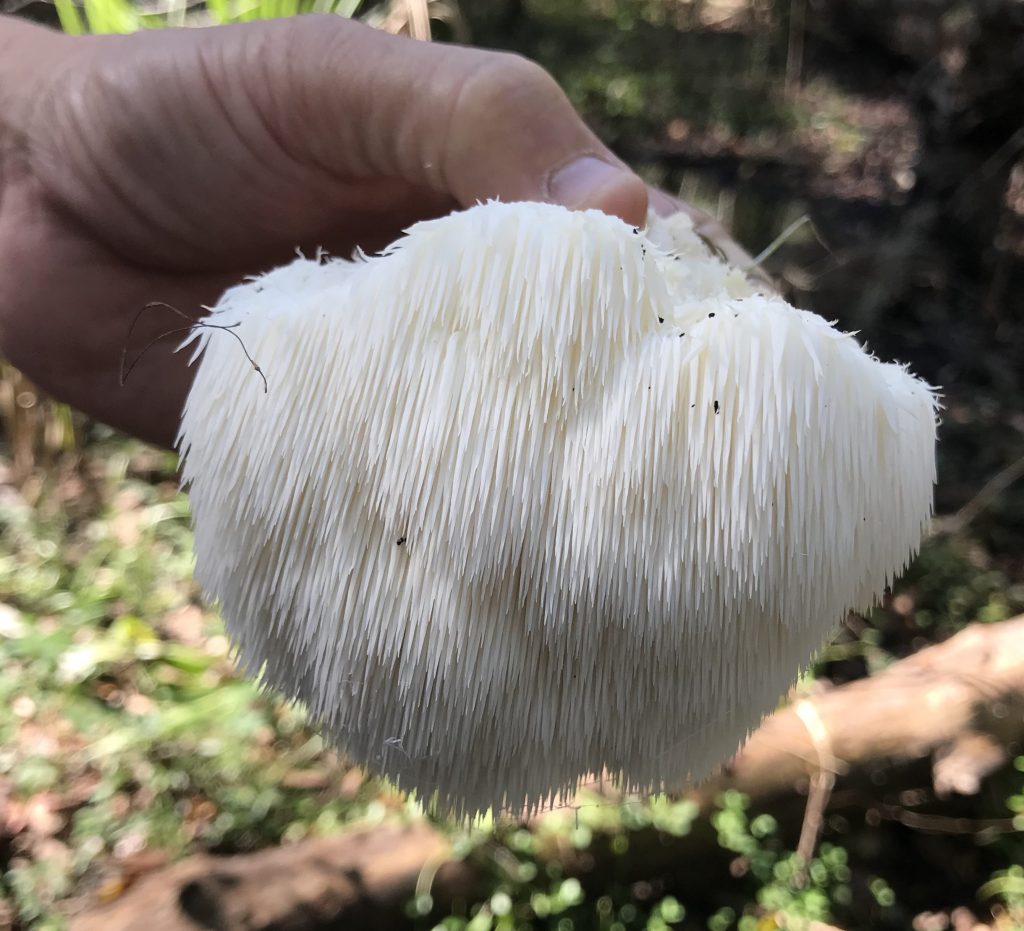
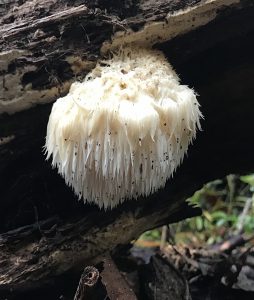
Lion’s Mane is tasty and medicinal. Photo by Green Deane

I see Lion’s Mane (Hericium erinaceus) on the same oak log every fall at the same time to the day. This is joyous and sad. I like finding it because I think they taste great. But it is also sad in that it and other fungi will do their job and reduce the log to powder and be gone. I have watched that happen to several trees with oyster mushrooms. Everything in life is temporary. 

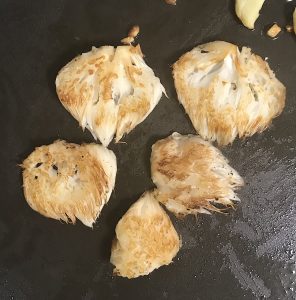
Sautéed in butter. Photo by Green Deane

I find this mushroom so tasty that I am not thinking about its nutrient content or it’s well-researched affects on brain function. Nutritional reports on Lion’s Mane differ greatly. This could be because wild and raised mushrooms vary. The raised ones tend to be higher in potassium than wild ones but lower in protein than wild ones. In general terms Lion’s Mane is about 43% protein, 61% carbs, 8% both fiber and fat. It has eight non-essential amino acids and seven essential amino acids adding up to some 14% of the mushroom’s dry weight. One hundred grams of Lion’s Mane has 65 grams of carbohydrates, 31 grams of protein, four grams of fat, and 35 calories. Ergosterol content is 381 mg, magnesium 123 mg, D2 (calciferol) 240 IUs, iron 20.3 mg, B3 (niacin) 18.3 mg, B1 (thiamin) 5.33 mg, potassium 4.46 mg, riboflavin 3.91 mg, calcium, sodium and phosphorus 1.2 mg each and folic acid 5.5 mcg. While there isn’t much sugar in Lion’s Mane two-thirds of it is glucose and ten percent mannose. Ergosterol has a similar function in mushrooms cells as cholesterol has in mammalian cells which is to maintain cell integrity (keep it from falling apart.)  It’s a pre-cursor to vitamin D2. Ultraviolet light changes Ergosterol to D2. This is how mushrooms get vitamin D. As for the brain…

Same Fungi, same log, a year apart almost to the day. Photo by Green Deane

Research says Lion’s Mane might protect against dementia by stimulating brain cell growth. It’s also anti-inflammatory and can reduce mild symptoms of anxiety and depression. Lion’s Mane may help damaged nerves recover and protects against ulcers. The fungi can have positive cardio-vascular effects and help to manage diabetes. Lastly Lion’s Mane might have some anti-cancer properties. Personally I just really like the taste and texture of it. I grew up on the coast of Maine and it does taste like carb or lobster to me. 

Hericium erinaceus  (Hair-REE-cee-um air-wren-NAY-see-us) means “pertaining to hedgehog” and “like a hedgehog.” That said it might also come from Hircus which mean goat. It is more like a goat’s beard than a lion’s mane. 

Green Deane “Itemized” Plant Profile

IDENTIFICATION: A white fungus though sometimes tinged with yellow or pink. It has soft teeth hanging from a center stalk (other species are branching.) The teeth can reach close to an inch long. It makes a white spore print. 

TIME OF YEAR: They are a cool weather mushroom but that can vary greatly. You can find them in northern climes on 40 degree days or in north Florida were the nights are just eeking into the 50s. 

ENVIRONMENT: They grow on hardwood, oaks, maple and beech. I usually find them on downed white oaks. They can be predatory on certain species of tree or ill trees. It decomposes dead wood. 

METHOD OF PREPARATION: Many. I just sauté them in real butter.

{ 1 comment }

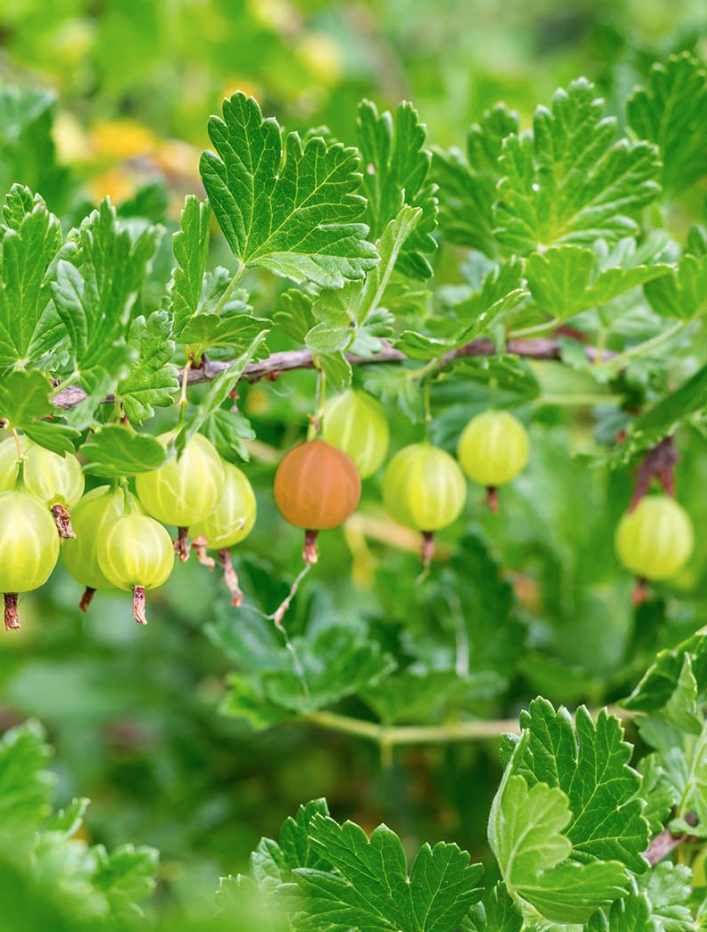
Ripe Gooseberries can be Green, Red, Purple, Pink even Yellow.

A century can make a lot of difference.

In 1911 the federal government banned Gooseberry production because they were the intermediary host for the white pine blister. It’s a disease that kills pine trees. As you can imagine in the Pine Tree State of Maine Gooseberries were more than banned. They were sought out and destroyed… but not all of them.

My mother had the habit of collecting horses (we had five at one time.) We rode everywhere and that included long-abandoned roads through large expanses of woods. They were they type of road a horse could pick their way through but rocks and ledges would hang up a vehicle’s undercarriage. In the early 60’s on one such road a caved-in farm house had gooseberries and their relative, currents, still growing next to the foundation.My mother identified them, as her mother made jelly from them, and she had to pick them. It was the first time I had seen currants and they probably escaped eradication because of the remote location.  (Carrying out that destruction incidentally were the Boy Scouts, the Civilian Conservation Corps, and the Work Project Administration.)

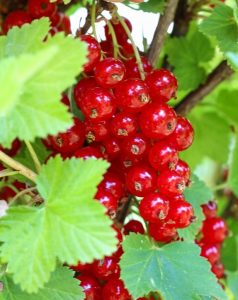
You can see the family resemblance with Red Currants

In 1966 the banning of gooseberry fell to individual states and now in more places than not a century-plus later you can plant them again. According to the University of Massachusetts Delaware, New Jersey and North Carolina prohibit importing and raising of all currants and gooseberries. Massachusetts, Maine, Michigan, New Hampshire, New York, Rhode Island, and Vermont allow planting in certain areas of certain varieties. There are Black, Red and White Currents besides gooseberries and the restrictions vary from variety to variety, city to city and state to state. I suspect gooseberries and currants are still growing in the wilds (though people might not admit they know where they are.) There are also farms now where you can pick them from Rhode Island to Washington State.

Gooseberries fall into two groups, North American (R. hirtellum) and northern European (Ribes grossularia var. uva-crispa) They like cool, humid climates such as the coast of Maine, points north, and the tops of mountains to the south. Merritt Fernald, who was the big botanist at Harvard from about 1900 to 1950, wrote about them as growing extensively in New England, Newfoundland, Labrador and as far west as Manitoba.

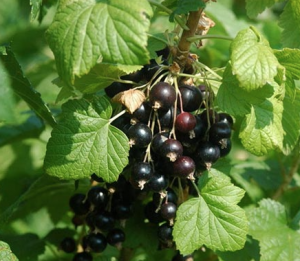
Black Currants still are on almost everyone’s hit list.

The fruit itself can be purple, red, pink, yellow, and green. Red and green are the most common ones — the ones I recall were green and red — and while you can eat them raw they are better cooked. They’re high in potassium. As for the names Ribes (REE-bess) is from the Arabic Ribas which means “rhubard.” The fruit can be sour. Hirtellum (her-TELL-um) is a little hairy (the fruit.) Grossularia (gross-ul-LAIR-ree-uh) is from the French for Gooseberry, Gorseille a’ Maquereau (meaning mackerel berries because they were used for a sauce on those fish.) Uva-crispa (OOU-vah CRIS-pah) means curved grape.

Green Deane’s “Itemized” Plant Profile

IDENTIFICATION: A very spiny branching shrub with deeply lobed, dark green leaves. The flower is bell-shaped in clusters of two or three producing inch-long berries with a lot of seeds. They can fruit for 20 years.

TIME OF YEAR: End of summer into fall. There are several pick your own operations in the U.S and Canada.

ENVIRONMENT: They like cool, humid locations, can tolerate some shade.

METHOD OF PREPARATION: Raw or cooked, used for pies, jams and fruit leather, wine even for flavoring cheese. They are not sweet but the red ones are sweeter than the green ones and they can be pickled.


{ 3 comments }
Persimmons can persiste after the leaves drop making them easy to spot.

Persimmons can persists after the leaves drop making them easy to spot.

Persimmons: Pure Pucker Power

About the only bad thing you can say about a persimmon is that it has pucker power, if you pick it at the wrong timeIf the fruit’s skin isn’t wrinkly it will be inedible.
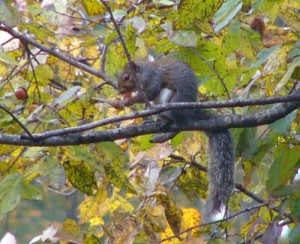
You'll have competition for ripe persimmons.

You have competition for ripe persimmons.

What most people don’t know is that the persimmon is the North American ebony, Diospyros virginiana (dye-OSS-pih-ross ver-jin-nee-AY-nuh.) There are few trees more versatile than the persimmon. The fruit, actually the largest native berry in North America, can be eaten out of hand or cooked in various ways. Its seeds can be roasted and ground for a coffee extender. The leaves are loaded with Vitamin C and the hard, closed-grain wood can be worked (often to be made into “natural” wedding bands. )
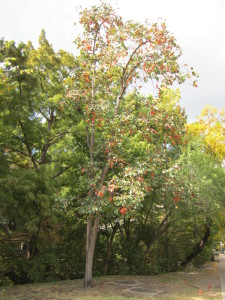
Persimmons do not like to grow in the forest. Photo by Pinnacle-Mountain.

Persimmons do not like to grow in the forest or field.

Persimmons like to grow along the edges of things; fields, roads, rivers, rail roads, fences, trails. They can be anything from a spindly shrub to over 80-feet tall. I can well remember the first time I found a green persimmon fruit on the ground locally. I was hiking in the Wekiva State Park in Florida along Rock Springs Run. What was memorable about the event was I couldn’t find the tree. I turned 360 degrees and still couldn’t see a persimmon tree until I looked up, way, way up. Competing with other trees river side they were incredibly tall, and not nine inches through. They were spindly 70-foot tall trees! Quite atypical.

Most of the persimmons trees you will see, especially in Florida, are only eight to ten feet tall, occasionally 15 to 20 feet. Persimmons are found in the eastern half of the United States excluding northern border states. They’re also found in Utah, California  and range into Mexico. Oddly, they are not naturally found along the Appalachian Mountains or the Allegheny Plateau. Perhaps altitude is an issue. 
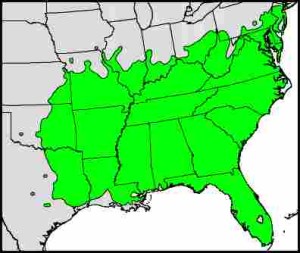
The Persimmon's native range.

The Persimmon’s native range.

The Persimmon is usually the last tree to leaf out in the spring and the first to lose it leaves in the fall, a strategy to thwart predatory insects.  The champion persimmon tree in the US, as of 2009, is in Yell, Arkansas.  It is 94 feet high, 12.5 feet around and as a crown spread of 78 feet. It’s been around since the first English settlers came to North America. One of them, Captain John Smith, wrote about the persimmon in 1608. He said it tasted like an apricot and by 1629 it was introduced into England. In fact that was a main part of Smith’s reason to come to the Americas, find new plants.
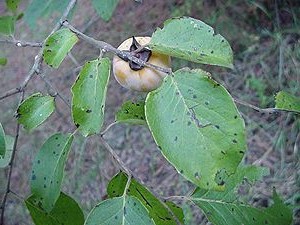
Persimmons get smutty but the black smut does not bother it nor us.

Persimmons get smutty but the black smut does not bother it nor us. Photo by Hillpond.org

While many authors say the ripe persimmon tastes like dates they taste like persimmons to me. I have no idea where they get a “date” taste unless they are just copying each other. Interestingly persimmons can be interchanged in any recipe with bananas, measure for measure, weight for weight. Yellow persimmons will ripen off the tree but the best ones are the wrinkly ones you have to fight the ants for. There is an old saying that persimmons don’t ripen until after a frost but that’s not true according to researchers nor here in Florida where any frosts show up a couple of months after persimmons fruit.   Shaking a persimmon tree is the standard way of collecting the fruit. Process them by rubbing them through a colander. The pulp can be used to make jelly, syrup, beer, wine, liquor, bread, pancakes, pudding, molasses, fruit leather, dried fruit and ink. The pulp can also be frozen and eaten like ice cream. A peanut-like cooking oil can be squeeze from the seeds. Each persimmon can have one to eight seeds. Happiness is finding a persimmon with one seed, when there are eight there isn’t much to eat. The seeds, however, were used as buttons by the Confederate Army during the American civil war.
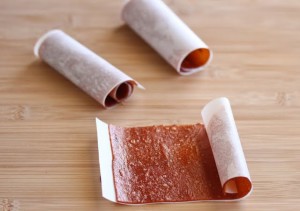
The fruit, especially the skin, can be made into fruit leather. Photo by KerbieCravings.

The fruit, especially the skin, can be made into fruit leather. Photo by KerbieCravings.

Another use for a persimmon tree is reportedly as a remedy for the itch of poison ivy. Remove a few twigs from a persimmon tree, cover with water, and boil for 20 minutes. Strain and cool the liquid. Several applications are said to dry the rash. By the way, persimmon tea is not universally praised. I have a friend who describes the taste of tea from green leaves as “dirty dishwater.”  Tea from dried leaves is better. In fact, the longer the dried leaves are stored the better the tea tastes.  Dry the leaves in a slow over for two hours. To make the seeds into a coffee substitute or extender clean them and roast them in the same slow oven. You can also throw the tough fruit skins into a blender, put the slurry on a cookie sheet and dry them along with the seeds and leaves in the same oven. Personally I eat the fruit skin and all but not the seeds

As an ebony, Persimmon wood has many uses.

As an ebony, Persimmon wood has many uses.

What Diospyros means is subject to a lot of mistranslation from Greek. The complicating factor is the distortion from Greek to Latin and the different alphabets and pronunciations. (There are five ways to represent the “ee” sound in Greek.)  Then there’s the translation into English and its use by those who don’t speak Greek or know Latin. Such is the headache with Diospyros. Briefly it can mean “what God has sown” “God’s Grain” or “God’s fire.” Making it worse, the most common translation “food of the Gods ” does not land well on Greek ears. Ambrosia means “food of the gods. Diospyros does not.

Theostratus

Theostratus coined the name Diospyros

In 300 BC or there abouts, Theophrastus called a local tree, the European hackberry, Diospyros.  The  fruits were astringent which ripened to sweetness and that is supposedly why Linnaeus called the persimmon tree Diospyros when he was naming plants. With that said lets tackle Diospyros. The disagreement is whether the two Greek words are “dio/spyros” or “thios/piros.”  It comes down to Greek spelling. The most common translation is the more unlikely. As mentioned, Diospyros is often translated as “fruit of the gods” or “food of the gods.” That would be very bad Greek.  Some translate Diospyros as “the fruit of Zeus” which is just plain silly. There’s also “heavenly plant”  “God’s fire” Divine pear” and “Jove’s pear.” Jove’s Pear? That’s expired poetic license.  Jove was the Roman equivalent of Zeus, or the Roman name for the top god. Where the pear came from I have no idea though in Texas the persimmon is sometimes called Jove’s Fruit.
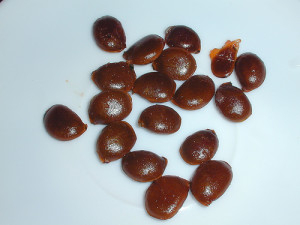
Roasted Persimmon seeds can be used to extend coffee. Photo by Really Raw Food.

Roasted Persimmon seeds can be used to extend coffee. Photo by Really Raw Food.

A third possibility is Diospyros meaning “God’s Fire” in reference to the astringent unripe berries of the European hackberry but that would require changing a plural to a singular which is not likely in this case in Greek. Carl Linnaeus, the fellow who started naming plants, had the right idea of calling the persimmon after the ancient hackberry because of the way it ripens.  He was not good at Greek yet his “food of the gods” has stuck. “God’s Wheat” is the closer translation for ancient Greek, which would mean the Diospyros in the modern vernacular means the “best food” or as Alton Brown says “good eats.”
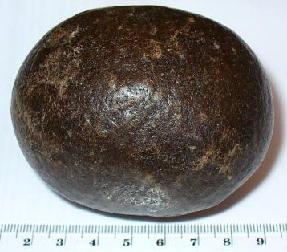
Horses should not be pastured with Persimmons or they can get bezoars, as can some people.

Horses should not be pastured with Persimmons or they can get bezoars, as can some people.

Virginiana is of Virginia but in botanical terms it always means North America.  Persimmon is the Anglicized version of an Algonquin name that means “dry seed” or “dry fruit” referring to the high level of tannins in the unripe fruit.  That tannin is a good substitute for oak tannin.  Persimmons do, however, come with two warnings. The first one is if you do not digest food well or have had gastric bypass surgery excessive consumption of persimmons can create intestinal blockage called a bezoar. It happens more in farm animals than man but people who consume huge amounts of persimmons or who have gastric issues are at risk.
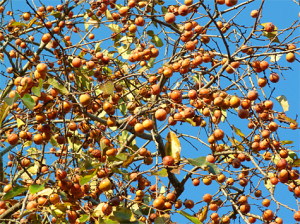
Nothing resembles a ripe wild persimmon tree.

Nothing resembles a ripe wild persimmon tree.

As for the second warming. While the seeds can be roasted then ground into a black powder to extend coffee there may be reasons not to use it exclusively as a coffee substitute. See the “letter to Green Deane” below. The writer mistakenly made “coffee” out of the seeds rather than using them as a coffee extender, like chicory. It is included here in its entirety should it be important some day.

There is hardly a woodland creature that doesn’t like the persimmon. Its waxy, fragrant flowers help produce honey. The persimmon is also sometimes called “possom wood” because opossums know a good food when they find it.  It even has entered the folky and now politically incorrect literature of Uncle Remus:
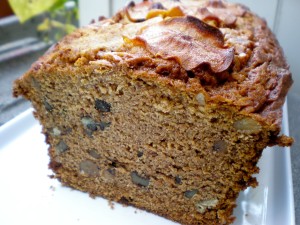
Even Green Deane breaks his no-flour rule for some hot Persimmon bread.

Even Green Deane breaks his no-flour rule for some hot Persimmon bread.

“B’rer Bear rushed into the patch and shook the persimmon tree. B’rer Possum dropped out from the ripe persimmons, landed on the ground and started running for the fence like a race horse. B’rer Bear chased him and gained with every jump. When B’rer Possum made it to the fence B’rer Bear grabbed him by the tail. B’rer Possum went between the rails on the fence and gave a powerful pull to get this out of B’rer Bear’s teeth. B’rer Bear was holding so tight and B’rer Possum pulled so hard that all the hair came off in B’rer Bear’s mouth, and if B’rer Rabbit hadn’t come along with a gourd of water B’rer Bear would have choked. From that day to this,” said Uncle Remus, knocking the ashes carefully out of his pipe, “B’rer Possum ain’t had no hair on his tail, nor any of his children.”

Persimmon Bread

3½ cups sifted flour
1½ teaspoons salt
2 teaspoon baking soda
1 teaspoon ground nutmeg
2 to 2½ cups sugar
1 cup melted unsalted butter and cooled to room temperature
4 large eggs, at room temperature, lightly beaten
2/3 cup cognac, bourbon or whiskey
2 cups persimmon puree

2 cups walnuts or pecans, toasted and chopped
2 cups raisins, or diced dried fruits (such as apricots, cranberries, or dates)

Optional: Orange zest or orange extract

1. Butter 2 loaf pans. Line the bottoms with a piece of parchment paper or dust with flour and tap out any excess.

2. Preheat oven to 350 degrees.

3. Sift the first 5 dry ingredients in a large mixing bowl.

4. Make a well in the center then stir in the butter, eggs, liquor, persimmon puree then the nuts and raisins.

5. Bake 1 hour or until toothpick inserted into the center comes out clean.

Persimmon Pudding

2 cups pureed persimmon pulp

2 eggs

1 3/4 cups condensed milk (unsweetened)

2 cups sugar

1/4 cup melted butter

2 cups flour

1/2 cup chopped walnuts

Stir condensed milk, sugar, butter, flour, and persimmon puree well and pour into glass baking dish. Sprinkle top with chopped walnuts. Bake for 35 to 45 minutes at 375F. Serve warm or cooled to room temperature. Delicious topped with a crème Anglaise or rum.

Green Deane’s “Itemized” Plant Profile

IDENTIFICATION: Tree, shrub size to 80 feet, usually 15 to 20. Leaves are oval, pointed, 3- to 6-inch long, lustrous dark green, sometimes covered with a harmless dark soot that can be washed off. Two handy identifying characteristics of the persimmon is young twigs are fuzzy and on new growth the branch will have leaves of different size. Bark on older trees is broken up into square blocks. D.  virginana has leaf tips that are pointed, on D. texana the tip is flat, rounded or notched,

TIME OF YEAR: Fruit ripens in September/October. Fruit is not ripe until the skin is wrinkled.

ENVIRONMENT: Grows along edged of fields, roads, rivers and the like. Will grow in dry ground and partial shade but prefers moist soil and full sun. Slow growing, hardy to Zone 4

METHOD OF PREPARATION: Numerous:  The pulp can be used to make jelly, syrup, beer, wine, liquor, bread, pancakes, pudding, molasses, fruit leather and dried.

HERB BLURB

The Native Americans had some herbal uses for the tree. The Alabama boiled the roots for a tea used in “bowel flux.”  The Catawba used a bark infusion to treat thrush in babies. The Cherokee used it for bowel problems, sore throats, heartburn, liver problems, piles, thrush, toothaches and venereal disease. The Rappahannock used an infusion for thrush and sore throats. The tannic acid in the green fruit was used to treat diarrhea, dysentery, and uterine bleeding.

I received the following letter in 2010 in response to my article on persimmons.  The writer says he made two pots of persimmon “coffee” rather than using the ground seeds just as a coffee extender. The first pot — four cups — was made from seeds fresh from ripe fruit off the tree, then roasted. No ill effects reported. The second pot was made from seeds picked up off the ground and/or from rotting fruit (enzyme action?) Then instead of directly into the oven the second batch of seeds were boiled first (taking something away? Changing something?) and then roasted. Two other possibilities are the first pot did not reach some critical chemical level and or he didn’t have an allergic reaction until a certain point with the second pot. And of course something else might be acting as well. I do not know the truthfulness of the account below but it seems reasonable to include it.  More so, if it is accurate it is something foragers and researchers should know.

“I just wanted to shoot you a quick note about my experience with Persimmon seeds last fall, sorry it took so long for me to write. I have several of the trees in my yard and near my home, and I always enjoy the fruit in the late fall after frost. But I had never heard of making coffee out of the seeds before. Being the adventurous sort I gave it a try, and my first pot of roasted and ground up seeds taken from the fresh fruit right off of the tree was wonderful, thank you.

“Later I began collecting the seeds off of the ground around the trees where the fruit had fallen off and rotted, carefully avoiding the piles of possum poo of course. When I had about a quart of seeds I put them in a small saucepan and boiled them for about 5-10 minutes to kill any bacteria and clean the residue off of the seeds, then I slow roasted them on about 250 until I could hear them steadily crackling and popping.

“After the seeds had cooled I anxiously ground up a handful for a full eight cup pot of coffee. My first pot from the earlier experiment was only about four cups. I brought my fresh, large mug of coffee (About 3.5 cups) to the computer and I enjoyed it immensely while watching videos. But almost as soon as I began the second mug full I began to feel a little funny. In a few minutes I became dizzy and stopped drinking. A few more minutes passed and I became very ill and evacuated my stomach of any remaining persimmon coffee lol.

“I have a heart condition so I made sure that I was not in cardiac distress, and when everything seemed OK i stumbled off to bed. The next day, after a very sweaty night, I still felt a little peculiar, which is not unusual for me. But I was no longer dizzy or nauseous.

“Now for the really interesting part. I have Cardio Myopathy and severe heart disrhythmias, so I can usually feel my heart skipping and pounding. But for about three months after this incident I was like a normal person, heart rhythm wise that is lol. I have actually been able to feel my heart beat since I was a young boy, and I have only rarely had a steady rhythm for short periods. So not being able to feel my heart beat or detect rhythm problems was phenomenal for me.

“My heart is back to its normal skipping and pounding now, and I have been trying to decide if it was worth the risk to try lowering the dose of persimmon coffee down to a sip or two and see if I get positive results. I am not writing for advice because I know that it would be too much of a liability for you to give me the go ahead on something like that, but I did want someone to know what had happened with my adventure in drinking persimmon seed coffee.”

{ 96 comments }

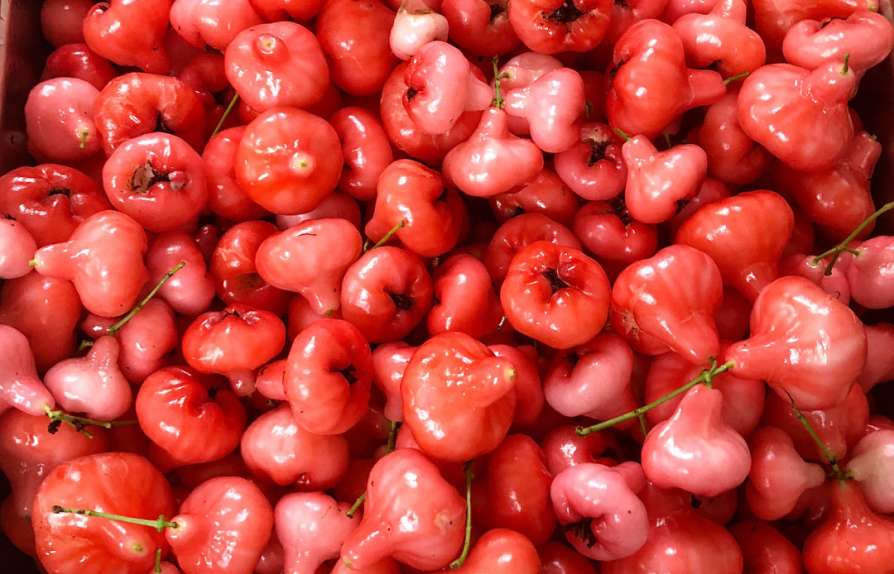
Fruits in the Syzygium genus come in make different shapes and sizes.

The apple is in the Rose family but the Rose Apple is not though it can sometime taste like rose water… and watermelon… but not apples.

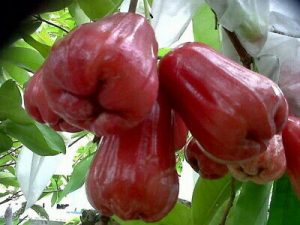
The redder the Rose Apple the sweeter.

Like many fruit of Asian origin this species and relatives have dozens of common name and a few botanical ones as well: Bell Fruit, Champoo, Cloud Apple, Jamaican Apple, Java Apple, Lembu, Lian-Woo, Love Apple, Makopa, Malay Apple, Mountain Apple, Royal Apple, Water Apple, Wax Apple, and Wax Jambul. Its most significant other botanical name is/was Eugenia javanica. That should tell you two things: It’s from the Java area and is related to the Suriname Cherry and the Simpson Stopper. How closely related is a good debate. The blossoms look similar and the leaves are aromatic. The genus is Syzygium — more on that later — and there are 1,139 members in that genus including the tree that produces the spice “cloves.” You will have to take the common names, as they say, with a grain of salt in that related genus-mates often have the same names. Add to that different botanical names and it is a drunk-botanist mess.

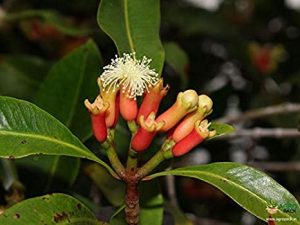
The flower buds of one Sygyzium become cloves.

As one night surmise the Rose Apple (Syzygium samarangense) has a long history in Southeast Asia. Not only does it have a wide range it is also the most commonly cultivated tree in that area of the world. Native from Bangladesh to the Solomon Islands it’s commonly planted in Malaysia, Indonesia, Thailand Cambodia, Laos, Vietnam, Taiwan, India, Zandibar, Pemba, Surinam, the Antilles, northern Australia, and the Philippines where it is naturalized. It was intentionally introduced into Florida in 1960 and some trees can be found in Arizona and southern California. The species does not like high altitudes (must be below 4,000 feet) nor temperatures below freezing though mature trees can take 28F for a while. It likes well-drained soil, morning sun and afternoon shade if temperatures are regularly over 90F. Self-pollinating the tree easily grows from the non-edible seeds, grows very fast, and can fruit within three to five years. It is not unusual for a five-year-old tree to have 700 fruit per season. The fruit can also grow on the trunk and branches and reach maturity in 63 days. As for the fruit…

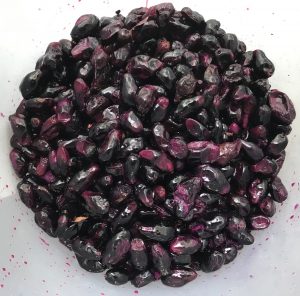
Jambul Fruit being made into wine. Photo by Green Deane

They range in color from pinkish white to deep red almost black. The darker the fruit the sweeter also the more ripe it is and the less citric and oxalic acid it has. Traditionally the bottom of the fruit is removed with the core and seeds as one often prepares a green pepper for stuffing, leaving it hollow. The fruit has more water content than an apple, on par with a watermelon, and the flesh is softer than an apple despite its name. They are eaten out of hand or made into jelly, juice, sauces and wine (fruits of different color produce different colored juice.) The fruit is a sliced addition to salads, can be pickled, and is use as a food decoration. Nutritionally per 100 grams they have about 0.3 grams of protein, no fat, 3.9 grams of carbohydrates, one gram of fiber, 253 IUs of vitamin A, traces of vitamin B1 and B2 traces, one milligram of vitamin C and 80 calories. It’s 90% water. A close relative of the Rose Apple is the Jambul or Java Plum. That is more commonly found in Central to South Florida. As far as I can tell all the species fruit at about the same time which can range locally from late July to mid-September.

Syzygiums have two equal leaves at the end of each branch.

As for the botanical name Syzygium is Latin-mangled Greek for “yoke mate.” Greeks call their spouse their yoke-mate. The genus got the name because at the end of the branch there are two equal leaves, see photo left. They are not off set but equal. It’s a good identifier. S. samaragense is more ambiguous. The central city of Java is Semarang and was perhaps named for that. S. jambous is from Indian names of that fruit (which can also means guava) and S. cumini… That’s bit more complex. It means “cumin” like the spice going back to the Greek Kimion but it also has the meaning of being a spice or a drug. The dried buds of S. aromaticum (aromatic) are “cloves.” “Clove” by the way goes back to Dead Latin and means “nail.”

Green Deane’s “Itemized” Plant Profile

IDENTIFICATION

The tree, 16 to 50 feet tall, has a short trunk, 10 to 12 inches, thick, and open, wide-spreading crown, pinkish-gray, flaking bark. Opposite leaves are nearly sessile (stem-less) elliptic-oblong, rounded or slightly heart-shaped at the base; yellowish to dark bluish-green; 4 to 10 inches long and 2 to 4 3/4 inches wide; very aromatic when crushed. Flowers drooping panicles of 3 to 30 at the branch tips or in smaller clusters in the axils of fallen leaves, fragrant, yellowish-white, 3/4 to 1 1/2 inches broad, four-petalled, with numerous stamens to one inch long. The waxy fruit, usually light-red, sometimes greenish-white or cream-colored, is pear-shaped, narrow at the base, very broad, flattened, indented and adorned with four fleshy calyx lobes at the apex; The skin is thin, the flesh white, spongy, dry to juicy, subacid and very bland in flavor. One or two somewhat rounded seeds 3/16 to 5/16 of an inch or none.

TIME OF YEAR

In its native range year round or late spring and early fall. In central Florida late July, August usually, some times September.

ENVIRONMENT

Rich, well-drained soil, morning sun, afternoon shade in hot climates, top of a hill rather than the bottom of a hill, temperatures not lower than 28F and elevations not over 4,000 feet.

METHOD OF PREPARATION

Fruit raw or cooked (not seeds.) Can be made into jelly, juice, wine, sauces, or pickled. A recipe is below. 

Herb Blurb

The flowers are astringent and have been used to treat fever and diarrhea. The principal compound seems to be tannin. The fruit also contains desmethoxymatteucinol, 5-O-methyl-4′-desmethoxymatteucinol, oleanic acid and B-sitosterol and show weak antibiotic action against Staphylococcus aureus, Mycobacterium smegmatis, and Candida albicans.

Stuffed Squash Blossoms with Rose Apple Filling

Ingredients:
2 bunches (approx. 20 pieces) squash blossoms
3 tablespoons oil, divided
1 medium white onion, minced
1 cup canned button mushrooms, drained and chopped finely
Salt and ground black pepper to taste
2 tomatoes, seeded and chopped finely
4 tablespoons minced Rose Apple
1/2 cup finely cubed soft, un-aged white cheese
3 egg whites, beaten lightly

Prepare the squash blossoms: Snip off the stems, wash, and carefully pat dry with paper towels. Remove the pistil from each flower. Set aside. In pan, heat 1 tablespoon oil. Sauté the onion for a couple of minutes. Add mushrooms and cook for about 3 minutes. Remove from heat and transfer to a bowl. Add tomatoes. Season it with salt and pepper. Add makopa, mabolo, and kesong puti. Toss well. By using a teaspoon, stuff it filling into the squash blossoms. In a nonstick pan over medium heat, pour remaining oil. Dip each stuffed squash blossom into the egg whites and pan-fry, turning once to make sure both sides are cooked through.

Crunchy tip: If you want it crunchy, combine rice flour, egg white, and water to make a batter with a pancake like consistency. Dip stuffed squash blossoms into the batter and deep-fry quickly.


{ 2 comments }