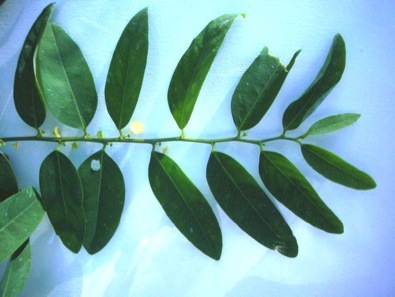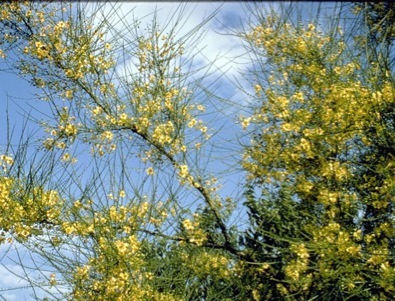
Jerusalem Thorn, Parkensonia aculeata

Parkinsonia aculeata’s Thorny Past

As foragers we are indebted to past writers and at the same time constrained by them.

People who chronicled how Native Americans used food brought a lot of attitudinal baggage with them even as professionals. They would put food and activities into different categories that can leave us confused all these years later.
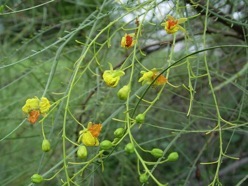
Jerusalem Thorn flowers

A good example is the Parkinsonia genus, with three species represented. One botanist will report that for one tribe a species would be a staple, another would report the same species was a famine food. Yet another will report it was eaten green and raw, another cooked until nearly burnt.

A few hundred years later we just don’t know why the reports vary. It could have been the botanist, or sometimes non-botanist reports. It could have been the time of year, or the weather that year. It could have been a mistake. And it also depended upon whom you found doing what. Even within a small group of professional foragers you will find multiple ways to make acorns palatable. So we end up knowing the seeds of three species in the genus of  5 to 12 (depending upon who is counting) are edible even if the how is a bit elusive. To confuse things more the Parkinsonias are closely related to the Cercidiums which they can hybridize with and which were also used for food. And… some Parkinsonias are called Cercidiums…. Botanists like to squabble a lot over genus and species names.
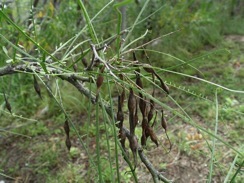
Jerusalem Thorn seed pods

Perhaps best known is Parkinsonia aculeata (park-in-soh-NEE-uh ah-kew-lee-AY-tuh, or a-kew-lee-AH-tuh)  also called the Jerusalem Thorn. It has no connection to Jerusalem but got its name the same way the Jerusalem artichoke did from corruption of the Spanish/Portuguese word girasol, meaning turning towards the sun.  P. aculeata has the greatest range in North America and is a common landscape tree as well as naturally occurring. Oddly, it is favored because it is so spindly. It can be planted in front of a large window and not obscure the view.  P. aculeata can be found from South Carolina to Florida and all states west at that latitude to California including Utah then south to as far as Uruguay. It is also found in the Virgins Islands, Puerto Rico, Hawaii, Australia, where it’s a troublesome weed in the northwest territories, as well as dry areas of Africa and Pakistan. (P. microphylla is found in California and Arizona. P. florida is found in those two states plus Nevada.)  The edible portion is the seeds, usually cooked sometimes raw.
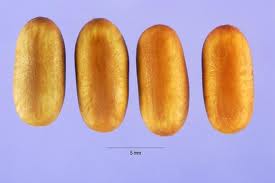
Jerusalem Thorn seeds

The Papago Indians used the P. aculeata seeds dry. They sun-dried them for storage and then parched them before eating them. Six tribes used the P. micophylla (aka Cercidium microphyllum.) The Mohave and Yuma parched the seeds until nearly burnt and considered them famine food. The Cocopa ground the dried seeds and used it as mush or to make cakes. The Papago sun-dried them before parching and considered the seeds a staple crop. The Pima ate them raw and the Pima of Gila River ate them raw or boiled. Five peoples used the P. florida (aka Cercidium floridum)  the Cahuilla, Cocopa, Mohave, Pima, and Yuma. The Cahuilla and Cocopa dried the beans, ground them into flour, and used the flour to make mush or cakes. The Mohave and the Yuma parched the seeds until almost burnt and viewed them as a famine food. The Pima, however, ate the green pods raw in the summertime.

John Parkinson, 1567-1650

The genus honors English pharmacist John Parkinson, 1567-1650. Parkinson was a predominant English botanist and apothecary to James I. He was a founding member of the Worshipful Society of Apothecaries and served as the Royal Botanist to Charles I.  He’s remembered for his two monumental works, Paradisi in Sole Paradisus Terrestris (Park-in-Sun’s Terrestrial Paradise, 1629) which describes the proper cultivation of plants, and, ‘Theatrum Botanicum (The Botanical Theatre or Theatre of Plants), the most complete and artful English treatise on plants of his time. Aculeata means prickly or thorny, microphylla is tiny leaf and flordium means free-flowering or many flowers.  Cercidium, sir-sid-EE-um comes from the Greek word cercidion, base word Kirkis, a weaver’s shuttle, in reference to the pod’s shape like a shuttle. The tree is also called Paloverde which  means “green stake.” It is a nitrogen fixer — if you’re a permaculturist — and has numerous medicinal uses among them boiling twigs to ease stomach pain.

Lastly, the Jerusalem Thorn had the fortune of growing in the right place, or we did. The vast majority of ethnobotanical information we have (read what the Native Americans ate and used) comes mostly from the western tribes. That’s because the original settlers in the east had little interest in cataloging what the eastern natives did for the most part. It took a couple hundred years before professionals took interest in such things and by then the western tribes were the ones still in tact.  That’s why we know how several tribes used the plant even if the uses contradict.

Green Deane’s “Itemized” Plant Profile

IDENTIFICATION: Small wispy tree or shrub. Flowers one inch wide, 5 petals. Top petal turns from bright yellow to orange as the flower ages. Flowers  followed by necklace-like, brown bean pods. Leaves bipinnately compound with 10 to 40 six to nine inch long leaflets, needle-like, green midribs, often quickly shed. Branches spiny, young bark can be green.

TIME OF YEAR: Blooms all year or in warmer months if temperate climate

ENVIRONMENT: Thrives in arid conditions, prefers neither too wet or too dry, with good moisture can become a 30-foot tree.

METHOD OF PREPARATION: Mature beans usually dried then parched. Can be used for mush or cakes. Some native ate the beans raw.
 

{ 2 comments }

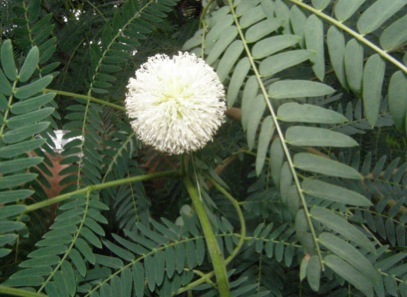
Jumbie Bean, photo by Donald Simpson

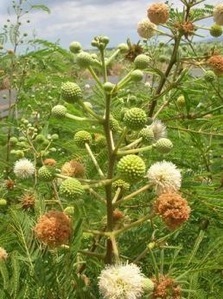
Leucaena leucocephala: Food and Fodder

Professor Julia Morton, the grand dame of toxic and edible plants in Florida, had this to say about the Jumbie Bean:

“The plant is toxic to horses, donkeys, mules, and pigs, even to cattle, sheep and goats in quantity. People should not eat any parts raw.”

Cooked young seeds only

Not exactly encouraging. But she also says: “Young leaves, pods and seeds cooked and eaten, Mature seeds roasted and used as coffee substitute or adulterant.”  Thus we start our review of the Jumbie Bean, the Lead Tree, The White Popinac, the Leucaena leucocephala.

Let’s start with the name. No great inspirations there. Leucaena (lew-KAY-nuh) means to grow white, as to flower. Leucocephala (lew-koh-SEF-uh-luh) means white headed.  (Also lew-SEEN-uh.)

Also called Jumbay and the White Leadtree, this native of Central America has sporadically spread its way northwest and east from California to Florida and to the rest of the warm world. The Jumbie Bean was taken to the Philippines in the 1500’s by the Spanish, probably as cattle feed. It spread from there and has become “invasive” in Taiwan, Hawaii, Fiji and northern Australia. In the United States whether it is an invasive is a matter of debate and location.

A different attitude prevails in India where it is well-established and viewed as a resource. There it is used for firewood, fiber, lumber, charcoal and livestock fodder, the latter reported in 1998 which conflicts with Julia’s 1982 comment. Apparently the ruminant bacteria, Synergistes jonesii, helps to detoxify the fodder in multi-stomached animals. It was transferred from American stock to Australia, Africa and China starting in the 1980s to make the plant acceptable fodder in those parts of the world, as it is some 24% protein and loaded with proto-vitamin A. The stomach bacteria helps explain the advantage of multiple stomachs and why the rest of us with only one stomach and no S. jonesii have to cook the plant.

Starting to blossom

As for toxicity in the raw parts to non-cud chewing mammals, the culprit is mimosine, an amino acid.  Wet or dry heat reduces the acid.  If you don’t cook it Jumbie vegetation can make you sick and lose your hair, hence the old saying that it causes tails to drop off one-stomach horses.

On the positive side again the tree is a nitrogen fixer and grows very fast, as much as 10 feet a year, which is why it is a renewable firewood and good at preventing soil erosion.  It is also used as a shade tree for many commercial crops including  coffee, cocoa, quinine and vanilla. It is also used as a hedge to grow passion fruit on.   It might be fair to suggest that whether it is a resource or a pest is a matter of attitude.

Don’t confuse this with the False Tamarind which has twisted seed pods, not straight, and cluster of flowers not solitary ones.

Green Deane’s “Itemized” Plant Profile

IDENTIFICATION: A shrub or tree to 60 feet, forked when shrubby, branching strongly after coppicing (cutting to a stump yearly.) Grayish bark and prominent lenticels. Leaves bipinnated with four to nine pairs of pinnae, variable in length up to a foot with a large gland at the base of the petiole, 11-22 pair , flowers numerous.

TIME OF YEAR: Depends on location. It can be year round in warm areas or summer time in more temperate areas.

ENVIRONMENT:Full sun, alkaline soil, enjoys humidity.

METHOD OF PREPARATION: Young leaves, pods and seeds cooked, usually boiled. Mature seeds roasted and used as coffee substitute or popped like pop corn. Dr. Morton say do not consume uncooked.  A related edible species is L. esculenta.

Lastly, Leucaena glauca and Leucaena latisilique are now Leucaena leucocephala. Cornucopia II disagrees with Morton and says  leucocephala young leaves, pods, and flower buds can be eaten raw, or cooked. Mature seeds but not dry seeds are eaten raw or cooked. Dry seeds are used as a coffee substitute or fermented into a tempeh like product. I’ve never tried them raw, preferring to err on Morton’s side.


{ 16 comments }


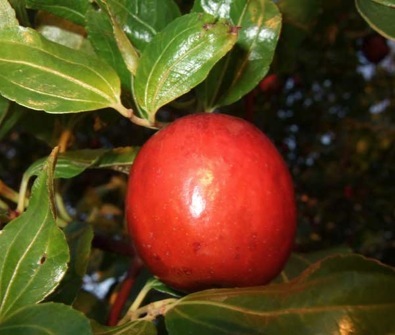
Jujube Tree fruit

  Ziziphus zizyphys: The Misspelled Jujube

If you don’t find the Jujube tree, it will find you. The Jujube is covered with long, sharp thorns. They hunt you down. They daw blood. They hurt. If I get within a yard of a Jujube Tree I somehow get skewered. Badly. Continuously. Inevitably.

Another little fact you are never told about the tree is if you plant it then move it the old roots, and the new roots where you plant it, will send up young shoots annually seemingly forever. You end up with a multitude of shin-high saplings puncturing your ankles. The Jujube is a pain but its fruit is tasty and versatile.

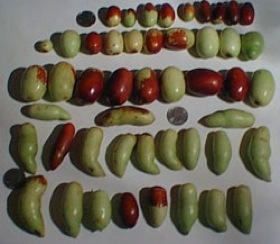
Jujube fruit varies in shaped

In the Buckthorn Family, the Jujube is distributed in warm-temperate and subtropical regions around the word. In the US it is naturalized in southern states from Georgia to California, excepting Louisiana and New Mexico but including Utah. Throughout the genus the leaves are quite regular and distinct. They alternate, are finely toothed, and have three prominent basal veins (coming from where the leaf meets the stem.) They also usually have two spines at the base of the leaf. The small flowers are chartreuse (yellow-green) with five petals. The fruit is a drupe, edible, that can range from green when unripe to yellow to brown to red or black. When green it tastes like and apple and has the texture of an apple. When ripe it is closer to a date in flavor and texture. A single stone contains two black seeds which are not eaten.

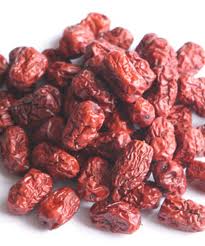
Fruit is often sold dried

The Jujube has been cultivated for over 4,000 years and there are some 400 cultivars, that is, specifically bred varieties. Native to China — it’s been called the Chinese date and Indian date — Jujubes got to southern Europe around the time of the Romans and to the United States in 1837. Starting in 1908 high-quality cultivars were also introduced, initially in Tifton, Georgia by the USDA.

The genus has an interesting naming history. It was originally Rhammus zizyphys. But 15 years later it was put into a new genus but misspelled as Ziziphus. Naming rules prohibit calling the genus and the species by the same  name. But since one was misspelled the name uniquely stands as Ziziphus zizyphus. There are many species including Ziziphus jujuba, where the common name comes from. It is said ZIZ-ih-fuss jew-JEW-buh (or SIZE-eh-fus.)

Ziziphus comes from two different words. Zizafun was the Persian word for the Z. lotus tree (Jujube.)  Phus is latinized Greek meaning “bearing.” So Ziziphus in English means Jujube bearing.  Jujube can be said two ways: JEW-jewb or JUJU-bee.

While Jujubes can be eaten out of hand they’re made into a wine, are cooked, and often are de-stoned and dried. A leaf extract, Ziziphin, alters taste perceptions of sugar in humans. It makes sweet things taste not sweet. Think of it as the anti-sweet. See recipes below. There are also numerous medicinal uses as well.

Green Deane’s “Itemized” Plant Profile

IDENTIFICATION: A small, deciduous tree to 40 feet usually with single trunk and rounded crown. Waxy leaves are simple and alternate, green on top, whitish green on bottom, in two rows on zigzaging twigs. They have hairy  stems, very fine teeth, and three prominent veins. The brown bark has vertical fissures. And while I say the tree has thorns they are rightly spiny stipules. Bottom line: At each leaf you will find a half inch to one inch long very sharp thorn. Beware!

TIME OF YEAR: Fruits late in to winter depending upon climate. The fruit do not all ripen at the same time.

ENVIRONMENT: Likes sunny locations and sandy soil. Like regular watering but is drought tolerant, hardy down to -25F but needs around 200 chill hours to fruit if planted in a warm climate. It does not like to grow in a container.

METHOD OF PREPARATION: Fruits are eaten raw, candied, made into drinks, and dried. They can eaten unripe, ripe and can be left to dry on the tree.  The ripe fruit is  very high in vitamin C.

Jujube Cake

1 cup sugar

1/2 cup butter

2 cups dried, minced jujube

1 cup water

Bring these to a boil then set aside to cool

2 cups wheat flour

1 teaspoon soda

1/2 teaspoon salt

Sift these together then add to the above mixture. Bake at 325° F

Candied Jujubes

Wash about three pounds dried jujubes; drain and prick each several times with a fork. In a kettle bring to a boil 5 cups water, 5-1/2 cups sugar, and 1 tablespoon corn starch. Add the jujubes and simmer, uncovered, stirring occasionally, for 30 minutes. Cool, cover, and chill overnight. The next day bring syrup and jujubes to a boil and simmer, uncovered, 30 minutes. With a slotted spoon lift jujubes from syrup and place slightly apart on rimmed pans. Dry in oven, or in sun for about 2 to 3 days. Check fruit frequently and turn fruit occasionally until the jujubes are like dry dates.

Jujube Syrup

Boil syrup remaining from the Candied Jujubes, uncovered, until reduced to about 2 cups. Use over pancakes and waffles. Store in the refrigerator. Other uses: Substitute the dried jujube wherever recipes call for raisins or dates.

{ 24 comments }

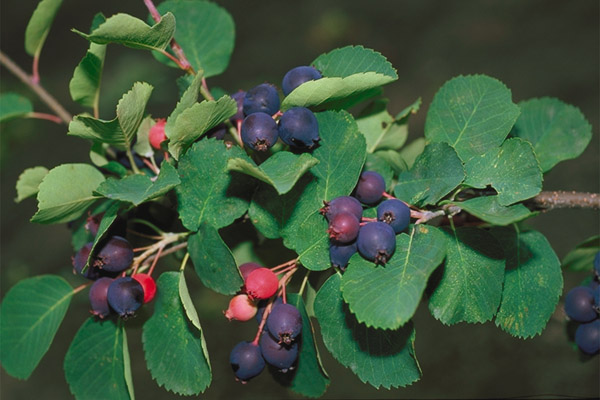
Juneberries, note "crown" at the end of each berry

Amelanchier arborea: Busting Out All Over

Juneberries are as American as apple pie. In fact, they are more American than apples.

While Juneberries are native, cultivated apples are not. When the Europeans arrived in the New World there were only sour crab apples, but plenty of sweet Juneberries,  Amelanchier arborea (am-meh-LANG-kee-er ar-BORE-ee-uh.) Juneberries, however, are a close relative of the apple and have been under cultivation since 1746.

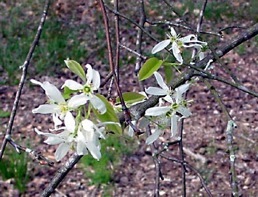
Juneberries in bloom

Juneberries were one of the famous traditional ingredients in pemmican, which was fat and powdered meat, or, fat, powdered meat and dried berries. Throughout the cooler areas of North America Indians made “pimekan.”  It was not only a staple for the northern Indians but became the main ration for European backwoodsmen and traders.  Interestingly the practice among the Indians of making pemmican did not go much farther south than Missouri or Nebraska, by Osage and the Omaha.  The Missourians also mixed their Juneberries with cornmeal to make cakes, which was more in keeping with what southern tribes did. Southern Indians also made more stews and used more plants in those stews than the northern Tribes.

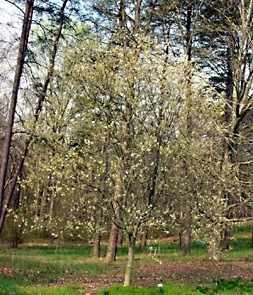
Juneberry Tree in spring

Opinions vary whether the Juneberry is better fresh or dried or cooked. It is a matter of personal taste.  Some recipes are included below. Several species have been used for food including A. alnifolia, A. bartramiana, A. canadensis, A. intermedia, A. laevis, A. lamarckii,  A. pallida, A. sanguinea, A. spicata, and A. utahensis.  Species in Europe and Asia are also eaten though there is only one naturalized species of Juneberry in Europe, A. lamarckii. The Juneberry can be a multi-branched shrub or a tree to 50 feet. Like the Eastern Redbud it usually flowers in the spring before leaving out. A. arborea can be identified from the others by fuzzy emerging leaves, greenish-yellow buds, and pendulous fruit.

Amelanchier is a French corruption of the Gaulois’ word “amelanco,” thought to be their name for that plant or a similar one. Scholars guess that “amelanco” is a combination word that means little apple or downy apple.  Arborea means tree-like. Besides Juneberry and Serviceberry the plant is also called Sarvis and Sarvis Tree. “Service” and “Sarvis” have the same origin in the written word “service.” Why “service?” The tree was called that be cause in Appalachia it was the only tree blossoming when it came time to bury in the thawed ground of spring those who had died during in the winter. Farther north along the coast it was called Shadbush, Shadblow, Shadwood because it

Jean Baptiste Antoine Monet de Lamarck

blossomed when the shad (migrating fish) were running. Other names include Saskatoon (a shortened Cree name) Sugarplum, and Wild-plum. It was called Juneberry because in many places the fruit ripens in June, usually the first of the new year for those weary of winter fare. The European species honors Jean Baptiste Antoine Monet de Lamarck, an 18th century French naturalist.

Nutritionally berries contain higher levels of protein, fat, and fiber than most other fruit but are low in vitamin C. They do have pectin, however. Lastly, the Juneberry reminds us that all berries with a “crown” on one end (like a blueberry) are edible.

Juneberry Pie

Pastry for 2 crust pie

3-4 c. juneberries, washed

2 tbsp. flour

2 tbsp. lemon juice

1/2 c. sugar

1/4 tsp. nutmeg

Sugar for sprinkling

Mix all ingredients together. Spoon into pastry lined pie plate. Top with pastry cut into strips. Sprinkle top with sugar. Bake at 450 degrees for 15 t minutes then at 350 degrees for 25 minutes more.

Juneberry Jam

4 c. Juneberries, cleaned

4 c. cut up rhubarb

4 c. white sugar

Grind Juneberries and add to sugar and rhubarb. Bring to simmer. Stir and cook until thick. Burns easily. Pour into jars. Seal. I like to add 1 teaspoon cinnamon and 1 tablespoon lemon juice to my jam.

Juneberry Muffins

2 c. flour

1/4 c. sugar

3 tsp. baking powder

1/4 tsp. salt

1/4 c. shortening

1 egg

1 c. milk

1 1/2 c. Juneberries

To dry ingredients add egg, shortening, salt and milk. When well blended stir in Juneberries. Fill muffin cups 2/3 full. Bake 20 minutes, 350 degrees.

Green Deane’s “Itemized” Plant Profile

IDENTIFICATION: A small tree or multi-stemmed large shrub, rounded crown with arching, spreading branches. Trees to 20 to 50 feet, short lived, rarely beyond 50 years, often an understory tree near stream banks. . Leaves resemble apple leaves, simple, alternate, oblong, one to three inches long, serrated, downy underneath, smoother above, silvery-gray and fuzzy when emerging, dark green in summer. Fall colors yellow to orange to red. Flowers blooms in clouds of white in early spring, five-petalled, dainty, like an apple blossom, in March and April, hang in elegant clusters. Fruit a small berry-like pome, ripens in June from green to red to purplish-black. Seeds, red teardrops.  An English cultivar has red berries (A. alnifolia, var. Ballerina.)

TIME OF YEAR: Usually in June in most of its range. Most of the berries ripen at the same time and can be harvested at the same time.

ENVIRONMENT: Grows best in full sun to light shade and moist, well-drained, acid soils. More common in northern areas.

METHOD OF PREPARATION: Many. Fresh berries or dried or cooked. Can be made into pies, jelly and jams; dried it can be made into cakes or used to make pemmican. Occasionally a tree will have foul-tasting berries. Find another. There are no toxic look-alikes.

{ 17 comments }
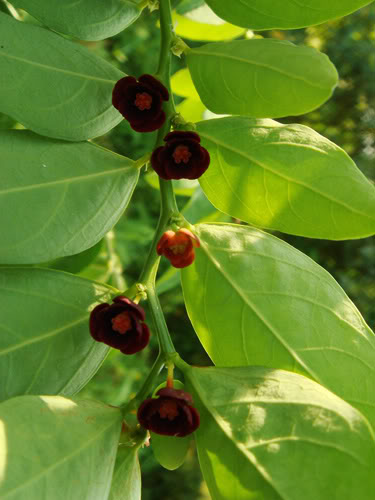
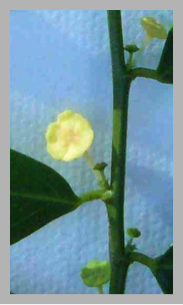
Katuk in blossom

Katuk in blossom

Edible Katuk: Sauropus androgynus

Katuk grows reluctantly in my yard. It likes truly tropical climes and I am on the subtropical/temperate line. But it’s still a favorite nibble and a staple vegetable in many parts of the world.

Katuk has a tasty leaf with a pea-like or nutty flavor. It’s also half protein, an amazing amount for a vegetable. More so, the leaves can be quickly stripped from the stem by pulling it between your fingers. Tender tips, leaves, flowers, small fruits and seeds of the Katuk are eaten raw or cooked, from soup to salad.

Also known as the Sweetleaf Bush, Katuk is native to lowland rain forests and prefers a hot, humid climate.  Hot and humid I’ve got, but not the lowland forest. I have not been able to get it above medium shrub stage here in central Florida, but from what I read it never gets much beyond a big shrub anyway. As mentioned I am exactly on the line between subtropical and temperate, which means an occasional freeze and one or two light frosts per winter. When a freeze threatens I take in clippings.

Katuk (ka-TOOK) will grow in shade or full sun, but it will not tolerate being dry. Under ideal conditions, it can grow up to a foot a week but it is never sturdy. Regular trimming assures optimal production of new tender shoots, prime food for Asian markets. One is supposed to keep it pruned to between 3-6 feet whereas mine has never exceeded four feet. The best way to propagate it is to take a cutting and put it in water, changing the water often. Another way is to take a stem and stick in the ground under some moist shade.

Katuk leaves

The leaves and the top four or five inches of a branch tip have a pleasant taste, similar to fresh garden peas, and slightly nutty. They are usually are eaten raw in salads, or steamed. You can add them to stir-fry, rice and egg dishes, soups or casseroles. The leaves retain their color and texture when cooking, which is fine for salads but you might want to chop them a little for soups or frying. They are often served in restaurants under the name “sayur manis.” The tiny flowers and fruit are also edible, though I have never noticed any fruit on my Katuk bushes.

Katuk is quite nutritious with the nutrient content higher in more mature leaves. Though it is dwarfed by the Moringa trees in my yard, I eat the Katuk far more often than the Moringa just out of taste.  Raw the Katuk has an after taste that sits well on the palate, the Moringa can be sharp and bitter, if not peppery. More so, the Moringa easily grows 12 feet a season, where as the Katuk just gets a manageable bushy. (My Moringa article is here.)

As to Katuk’s scientific name, Sauropus androgynus. (SAW row-puss  an-DROG-ah-nus.)  What it means is known, as both words are Latinized Greek. Why the plant is called what it is called is a little harder. Androgynus, in the plant world, means having flowers that are either male or female. Sauropus means “lizard-foot.”  Why “lizard foot” is anyone’s guess. By the way: Change the ending of Sauropus to Saururus and you have Lizard Tail, a different plant species with medicinal qualities.

By now you should know Katuk is one of the most popular vegetable in the world, particularly in Borneo and my home in Florida. Now some information to keep the lawyers happy:

Every now and then some people get suckered and become human lab rats. This happened in Taiwan in the mid-1990’s involving Katuk. Although Katuk has been consumed for thousands of years without issue, and is consumed daily by millions without a problem, there is always someone around to do something excessive and stupid. The rest of us end up with a warning and worry.

Katuk’s tiny blossoms

Some vendors in Taiwan convinced people that an extract of raw Katuk was good for weight loss… yep, a fad diet.  The vendors sold extract of ground Katuk leaves mixed with fruit juice. Fifty-four people, 50 females, four males,  developed lung problems, most of which went away upon stopping the diet. Four middle-aged women, however, who drank 3.5 to 7 ounces (100g to 200g) a day of the extract for up to two months had to have lung transplants within a year and a half of consuming the extract. This is the human equivalent of over-dosing a lab rat to induce disease. More so, not only did these four take the extract they also ate a lot more raw Katuk while taking the extract. Only mother’s milk wouldn’t hurt you at that rate, and maybe even that would. Despite proven dangerous, this fad diet persisted and 9 cases were found in Japan in 2006 causing one death and one lung transplant.

The  poisonings are believed related to papaverine in the plant, which makes blood vessels open up and is not an uncommon treatment for high blood pressure. There is about 580 mg of papaverine per 100g of raw Katuk leaf, or about the same as four prescriptions capsules of papaverine to 3 ounces of raw leaf.  The theory is in high doses it permanently damaged the tiny blood vessels in the lung. Researchers have not been able to recreate the symptoms in lab rats which has led some to think the problem might have a genetic component.

A follow-up study of 278 people in Taiwan with non-fatal symptoms found the median consumption of Katuk was 5.3 ounces a day of raw leaf for 20 days. Their consumption was about seven times the average consumption of Katuk by symptom-free Malaysians, which is three to six ounces a week, not a day.  It was, it seems, too much of a good thing done wrongly. A 2006 study on rats showed that in a controlled experiment Katuk did help rats lose weight and reduce their triglycerides. Clearly it needs more research.

So, what does all this mean, beside don’t eat Katuk if you are taking something to open your blood vessels or lower your blood pressure? Enjoy Katuk as an addition to salads, a lawn-side nibble, and cooked in various dishes like you find in thousands of restaurants. Just don’t consume a half a pound of it a day raw for weeks or months and/or while taking an extract as well. I have been tossing a dozen leaves in my weekly salads for more than five years. I ain’t concerned.

Katuk’s nutritional content is outstanding: 49% protein, 18% fiber, vitamins A, B & C, potassium 2.77% (more than bananas at 1.48%); calcium 2.77% (dried skim milk is less than half that at 1.3%); phosphorus .61% (dried soybeans are at .55%); magnesium .55%; and even enough iron to mention.

Incidentally, in beast and woman, Katuk stimulates milk production. And no doubt out there somewhere in the world a man will eat a bushel a day and start lactating then we’ll have that to worry about, too.

Green Deane’s “Itemized” Plant Profile

IDENTIFICATION: Bush, upright with multiple stems, three to six feet high; dark-green, oval-shaped leaves 5-6 cm long. Flat, round, yellow to red flowers, small 1-2cm across, form in the leaf axils. In tropical climates, a purple capsule forms with small, black seeds. May need two different trees to fruit.

TIME OF YEAR: Here in central Florida it loses its leaves for a couple of months in our light winters, but has leave available for the rest of the year, blossoms in summer and fall. It is pest free.

ENVIRONMENT: Understory tree, likes some shade or full sun, prefers hot humid climate, can’t tolerate frost or freezing.

METHOD OF PREPARATION: Leaves, tips, flowers and fruits edible raw or cooked, raw in moderation

{ 127 comments }