Cnidoscolus aconitifolius: Tree Pot Herb
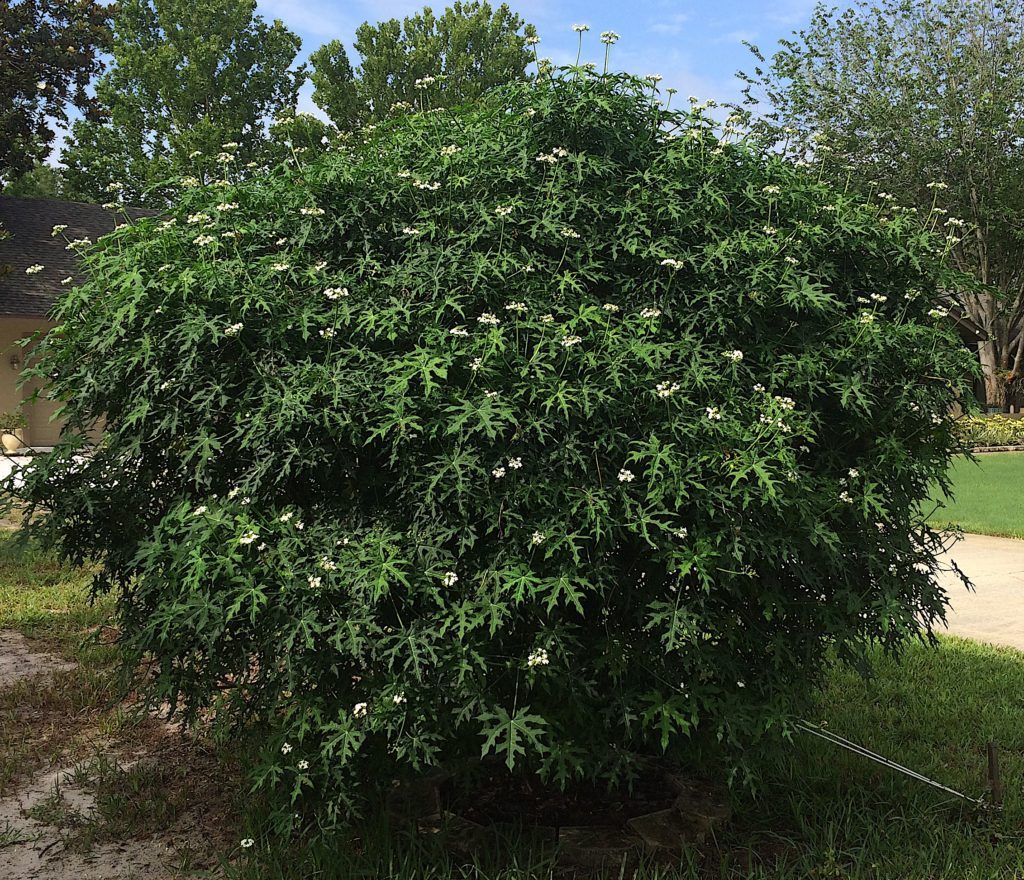
Chaya leaves are edible after cooking. Photo by Green Deane.

I knew about Chaya long before I ever saw one.

It’s in the Cnidoscolus genus and has two relatives in the southern United States, the Cnidoscolus stimulosus and the Cnidoscolus texanus. In researching and writing about those I learned about the Chaya. The problem with the two American plants is the C. stimulosus has an edible root and the C. texanus has edible seeds, but one never finds good evidence for the reverse. Are the seeds of the C. stimulosus edible? Are the roots of the C. texanus edible? There is also the possibility that the leaves of the C. stimulosus are edible. I know of four people who ate some raw (blended it) and did not get ill. Another person used to fry the leaves and eat them. This might suggest the same for the C. texanus as well.

Those are four issues that need to be sorted out with the North America family members, but there is no edibility issue with Chaya. Its leaves are edible cooked.  In fact, it’s an outstanding green generally twice as nutritious as spinach, Chinese cabbage or amaranth. The leaves are very high in protein, calcium, iron, carotene, and vitamins A, B and C. In fact, Chaya can have 10 times as much vitamin C as the orange.  There is no doubt about its nutrition, there is a bit of an issue, however, with how many Chaya there are. Whether there is one species of Chaya with several scientific names or several different species of Chaya is a bit of a debate.
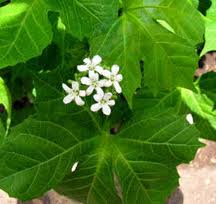
Chaya in blossom

A study as late as 1999 researchers recognized two species, Cnidoscolus chayamansa and Cnidoscolus aconitifolius.  At the time the C. chayamansa had maple-like leaves (now called the Chayamansa variety) and the C. aconitifolius had more indented five-lobed leaves (now called the Estrella variety.) Those two botanical names are still used, with some authorities saying they are two different species, and some– the latest view since 2002 — saying they are the same plant, just different varieties. You will also see Cnidoscolus aconitifolius ssp. aconitifolius, and Cnidoscolus aconitifolius ssp. chayamansa, and the reverse combinations. Botanists tend to defend their taxonomic turf while confusing the issue significantly.

As for varieties, some have stinging hairs like their American cousins, some don’t. So not only can you have multiple confusing names you can have edible Chaya with stinging hairs and without, and different shaped leaves. Often this is whether the variety is in the wild (Chaya brava) or under cultivation (Chaya mansa.) Regardless, all should be boiled or fried though there are some reports that some of the varieties can be eaten raw. I would be careful about that since cooking drives off hydrogen cyanide. You need to cook them ten to 20 minutes though some say five minutes will do. (The resulting broth is also often consumed because the hydrogen cyanide has been driven off and the water is full of Vitamin C leached from the leaves.)  The raw eaves can also be used to wrap food for cooking.

Drying the leaves also reduces the hydrogen cyanide significantly. Blending will do the same if the blended leaves are allowed to sit for several hours. The amount of hydrogen cyanide differs from variety to variety and may account for reports of some variety leaves being eaten raw.  Researchers say they have found no reports  of acute or chronic effects attributed to the consumption of fresh or cooked Chaya leaves. Still, it is better to err on the safe side.

While edibility is not an issue, finding Chaya may be. It’s native to Central America and endemic to the Yucatan Peninsula. The USDA maps show it naturalized only in Puerto Rico and Hawaii. It does grow in Florida and South Texas but is ill-suited to freezes though it does grow back from the root. One local specimen in downtown Orlando and has been there at least 30 years, surviving several light freezes. There are also two plants in Mead Garden in Orlando, the one above in Longwood Fl., and I have seen it in the wild north of the fishing pier at Ft. Desoto in St. Petersburg. There has been one plant in Sarasota for many years near Red Bug Slough.

As for the scientific names, again opinions differ. Since the name is from Greek first a little lesson in Greek. Greek verbs have a main part, the stem, and an ending. The verb stem “to sting”  is “tsou.”  To that is added endings telling you who or what is stinging. Tsouzo (TSOU-zoh) means I sting, tsouzee, means he, she, it stings. The word for nettles is tsouknitha (tsouk-NEE-tha) combining tsou with knitha, which might mean “it stings a little.”

So the genus name Cnidoscolus is from two Greek sources mangled through Dead Latin. Cnido is cleaved from tsouknitha (k-NEE-tha)  The Romans got rid of Greek “K” sounds and used C in front of the N to indicate it was from Greek and the C silent in Latin. Scolus is from the Greek word “skolop” meaning “a thorn” but with a Latin ending.

How that all is pronounced is a bit of preference. kah-knee-doe-SKOHL-us is close to the original Greek, if you don’t mind cutting a word in half and adding a Latin ending.  Anglicized Latin truly bastardizes the Greek, drops a syllable, changes the accent and pronunciation ending up with nye-DOSE-ko-lus. I have also heard sss-need-doe-SKOHL-us which offends both languages. There is no beginning SN sound in native Greek or Latin.

Chayamansa (chay-uh-MANZ-uh) a combination of the Mayan word for the plant, “chaay” and the Latin mansa meaning house, dwelling or farm, read Chaya a domesticated plant.  It is also said chay-uh-MAN-suh. Aconitifolius (a-kon-eye-tih-FOH-lee-us) means Aconitum-like leaves. Chaya is said CHA-yah.

Green Deane’s “Itemized” Plant

IDENTIFICATION: Shrub to a small tree, three to 12 feet high, stems leafy, with or without stinging hairs and or thorns. Leaves alternate, stalks two inches to a foot long, three to five lobes, two smaller lobes at base, leaf edges deeply, sharply lobed and toothed, veins palmate. Flowers white, in branched clusters, spring through fall. Fruit three-part capsule with stinging hairs. Sap milky. Rarely seeds.

TIME OF YEAR: Leaves and shoots year round. The best leaves are small to half mature size. Up to 50% of the leaves can be harvested at one time.

ENVIRONMENT: Will tolerate a wide range of environments from wet to arid, shady to sunny.

METHOD OF PREPARATION: Chopped leaves, stem tips and shoots boiled or fried. Cooking for 20 minutes destroys hydrogen cyanide in the tissue. Cooking broth is drinkable.  Leaves can be blended and consumed after letting them sit for several hours. Large leaves can be used to wrap food for cooking. The entire plant can be dried, ground, and used as fodder for animals or meal for fish.

Do not cook Chaya in aluminum containers. It can cause a toxic reaction. When collecting stinging varieties wear gloves. Avoid breathing in the vapors when cooking. Stir frying is not enough to render the Chaya edible. Cook it first then add to stir fries.
{ 128 comments }

Camphor barely makes it into the edible category

 Campy Camphor: Not Just For Grandma

One would never guess Camphor trees are not native to Florida, or the South. One also probably wouldn’t guess they are closely related to the cinnamon tree, either.

The Camphor has a split personality:  Folks either like a lot, or dislike it a lot. There’s little middle ground. First it grows huge, and fast. This upsets controlled garden folks who don’t like their planned pallet colored by a rambunctious upstart. Then there are the berries and hundreds of seedlings every year. Whether pal or pest is a matter of attitude and perspective.

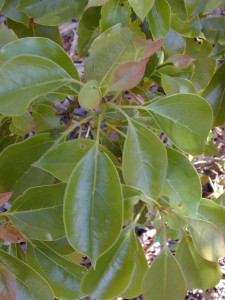
Young pink leaves can be cooked as greens

The young leaves and shoots of the Camphor can be boiled and eaten. The roots of the young shoots are used to make a tea. Older leaves can be used as a spice. But go easy, they are toxic in large doses. All parts contains chemicals that can stimulate the central nervous system. This can affect respiration or cause convulsions. In Chinese medicine, pregnant women are not allowed Camphor in any form at anytime.

While Camphor is not a common spice flavor today it has been used a lot in the past and was popular in Europe until the Renaissance. Camphor wood, or leaves and twigs, is used to make a popular Szechuan smoked duck. Camphor oil has been used in commercial baked goods, beverages, and candy. It has also been added to milk puddings and confections. In fact, it is an ingredient in Swedish Bitters. Why use camphor oil, or a fractal of it? It  contains safole, the essential oil in sassafras which used to be a main flavor in root beer.

Refined camphor

If you are not consuming parts of the Camphor tree it makes excellent wood for clothes bureaus, naturally driving away insects. Camphor is a native to Japan, China, Taiwan and northern Vietnam and was introduced into Florida in 1875, which is rather amazing consider how large some of the specimens are today, some 150 years later.  There were actually Camphor tree plantations. Now the state calls the Camphor an “exotic pest plant” yet it is still sold in nurseries and other stores. It is naturalized in Alabama, California, Florida, Georgia, Hawaii, Louisiana, Mississippi, North Carolina, Texas and South Carolina.  In Australia, where it was introduced in 1822, it is officially a noxious weed.  It also grows in the Caribbean. Camphor is, as mentioned earlier, a source of safrole, a banned oil that used to come from the sassafras tree. And of course the tree is the source of Camphor oil, which is one of the ingredients in Tiger Balm.

The scientific name is Cinnamomum camphora. Cinnamomum (sin-uh-MOE-mum) comes from the Greek word ‘kinnamomon’ meaning spice. Camphora (kam-FOR-uh in Latin)  is  also Greek and comes from the ancient word for the tree, kamfora (except the Greek pronunciation puts the accents the end, kam-for-AH.)

The wood itself, which is steamed to collected the oil, has red and yellow striping making it a favorite of wood workers.  The tree is also very resistant to hurricanes and is the official tree of Hiroshima, Japan.

Green Deane’s “Itemized” Plant Profile

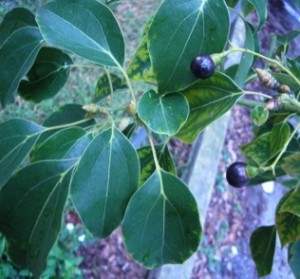
IDENTIFICATION: Leaves, alternate, evergreen, simple, oval to elliptical, 5 inches, usually less, edges can be somewhat wavy, dark glossy green above, pale below, with three prominent veins, camphor odor when crushed. Leaves are pink when young. Fruit appear in autumn, dark blue to black, round, fleshy drupes; usually produced in excess. Not edible. The bark is reddish brown and variable. The trunk can reach six feet through, and the tree can grow to 70 feet tall.

TIME OF YEAR: Young leaves anytime, shoots when sprouting, usually spring but not exclusively.

ENVIRONMENT: Open spaces with plenty of sun and adequate. Does not like its feet wet.

METHOD OF PREPARATION: Young leaves and shoots boiled. Shoots used to make tea, older leaves as a spice.  Use in moderation. Twigs, leaves and wood can be used to add a smokey flavor to food.The tea which has a rootbeer falvor when made from seedlings, fights the flu.

HERB BLURB

Camphor oil has a strong fragrance, a bitter flavor, and feels cool on the skin. It can irritating and numbing. It has been used to treat everything from parasites  to toothaches. Research shows Camphor is antiseptic and can be used for treating diarrhea, inflammation, itching, and some nervous conditions.


{ 65 comments }

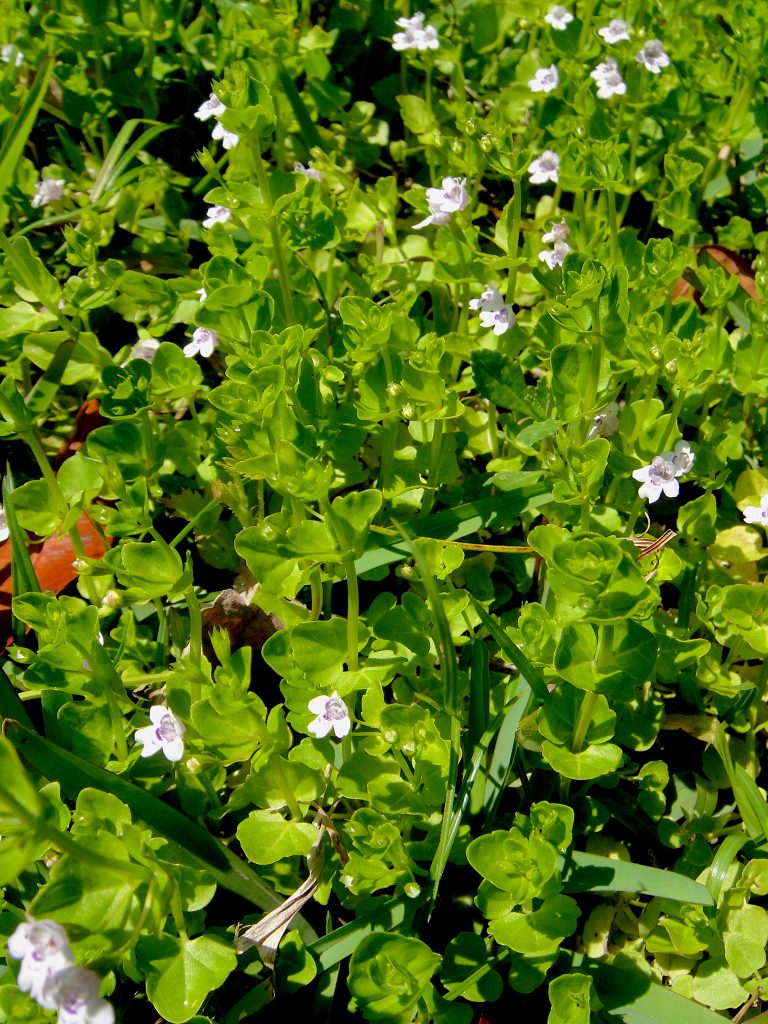
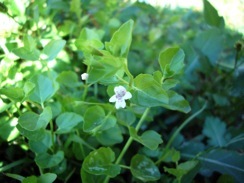
It’s a native little mint with a variety of names. Photo by Green Deane

The Mighty Minty Micromeria Brownei

Sometimes in central Florida you will drive past a car accident on the interstate, or another road, and smell mint. You’re not having sensory crossover: That’s Micromeria Brownei, aka Clinopodium Brownei. (klin-oh-POH-dee-um brown-ee-eye)

Micromeria Brownei (my-kro-MARE-ri-a) is a minuscule mint that likes swales and other wet places. It blooms all year and prefers its feet damp most of the time, hence its reference as the “aquatic mint.”  Some botanists say M. Brownei var. pilosiuscula (pye-loh-see-USK-yew-lus) can be found only in central and northern Florida, others place it in southern Georgia as well and around the Gulf of Mexico into Central America. Native flower books don’t list it as a native and Micromerias are found around the world, even in wet spots of desert countries.

This writer remembers many car accidents on Interstate 4 at State Road 46 in Sanford, Florida. Though the area has been re-engineered, that interstate’s intersection was a common spot of accidents and the median at the time was low. For about a half a mile to the south the entire center median was nothing but Micromeria brownei and a few other wet-footed plants. Any car that skidded or drove through that area threw up a hint of mint that lasted for days.

Flower color can vary

M. brownei has many common names. Browne’s Savory seems to be an old standby whereas Creeping Charlie is a favorite with the aquarium, build-a-pond crowd. St. John’s Mint is a recent and becoming popular name (the river that flows through the peninsula of Florida is the St. John’s.)   Micromera means little parts, or in this case little leaves and flowers. It is also called Clinopodium brownei, which means “slope footed.”   It was named after  Patrick Browne (1720-1790), who first desribed it as “THYMUS i. Minimus herbaceus, foliis orbiculatis crenatis, floribus singularibus ad alas.” Quite a lot for such a little mint. Browne’s major work was The Civil and Natural History of Jamaica (1756). Pilosiuscula means somewhat hairy but as I write these words I have a living specimen with me and it is nearly hairless.  Some references say the mint is very hairy. But even under magnification 30x the M. Brownei I have is not hairy.  If it is hairy the hair is extremely small, and “somewhat hairy” is an overstatement… or is it statemint?

If you live in the west coast states of the United States, you can use Clinopodium douglasii, or Yerba Buena, which was also the original name of San Francisco until 1847. It is slightly more tolerant of dry conditions. It can be found as far east as western Montana. Again, making tea is a matter of taste when it comes to amounts, and again, it should be avoided by pregnant women

Green Deane’s “Itemized” Plant Profile

IDENTIFICATION: A very sprawling, creeping and erect perennial with square stems and opposite leaves. Stems are nearly hairless,  flowers  have purple splotches on petals and in throat. Entire plant fragrant

TIME OF YEAR:  Available year round, blossoms year round.

ENVIRONMENT: Grows in all kinds of soil as long as it is constantly damp, full sun to partial shade.

METHOD OF PREPARATION:  Use fresh or dried, make a very nice tea or flavoring.

{ 2 comments }

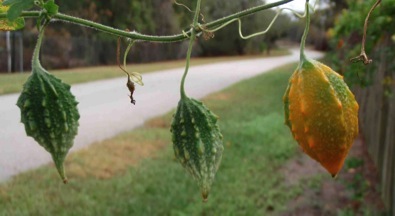
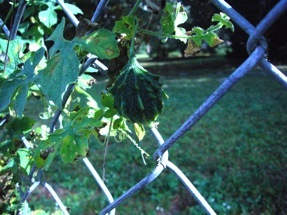
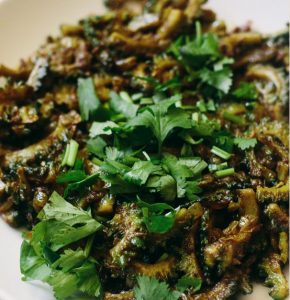
Bitter Gourd, edible only when green and cooked

Bitter Melon, Bitter Gourd, Balsam Pear: Momordica Charantia

If the Balsam Pear did not exist a pharmaceutical company would invent it.  In fact, there have been some ten studies published this past year about it, the latest as of this writing in February 2008 in the Journal of Food Biochemistry about its potential in diabetes treatment.

A very common, bitter vegetable in Asian cuisine,  the Balsam Pear, Momordica charantia,  is a natural drug store for diabetics and others. It’s not a pear at all but a fruiting gourd and vine that smells like an old, well-used gym shoe. Don’t say you weren’t warned.

Young, green fruit are edible cooked

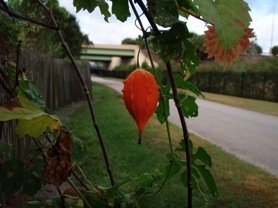
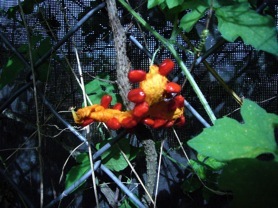
The warty gourd is edible when green (and cooked) but turns toxic/medicinal when orange ripe. It then splits characteristically into three parts, revealing red arils (fleshy seed covers).  The ripe seeds inside the arils and orange flesh of the gourd are toxic and can make one violently lose fluids from both ends, and induce abortions. The red arils around the seeds, however, are edible. And note this: The arils are 96% lycopene, which gives them their color. Just remember to spit out the seed from each aril.

Fruit is toxic (or medicinal) when yellow or orange

M. charantia is found Connecticut south to Florida, west to Texas, also Puerto Rico and the Hawaiian Islands. Incidentally, the bitter melon has twice the potassium of bananas and is also rich in vitamin A and C.

The Latin genus name, Momordica, (mo-MOR-dee-ka)  means “to bite,” and refers to the jagged edges of the leaves, which appear as if they have been bitten. Charantia (char-AN-tee-ah) the species’ name, comes from Greek meaning beautiful flower.  It’s native to tropical regions of the world though no one knows where it came from originally, best guess Old World Tropics. Gray’s four-inch thick Manual of Botany, started in 1850 and revised in 1950, makes no mention of M. charantia in the United States but it is currently a serious crop weed in Florida and to 21 other crops around the world, bananas to soybeans. It’s a late comer to Florida or Gray was in the dark about it. In the Amazon, and as far away as India, it is used very much by local populations for food and medicine.  Apparently a  dynamic chemical factory, the M. charantia is being tested for treatment against cancer — leukemia in particular —  AIDS, as an analgesic, and to moderate insulin resistance. It is often called the vegetable insulin. It does not increase insulin secretion but “speeds up carbohydrate use of the cells by affecting membrane lipids.” Seems like the smelly gym shoe hanging on the fence has a great future. But, it is not for everyone: Don’t eat the vegetable if you’re hypoglycemic or pregnant. In diabetics it can lower blood sugar too effectively. It also reduces fertility in men and women.  And, it contains vicine: That can cause favism in people who have a variant glucose-6-phosphate dehydrogenase. (I presume if you don’t know what that is you don’t have it. Favism is a severe reaction to fava beans and or their pollen. Occurs most often in men of Mediterranean background.)

Red coating on the seeds is edible raw, but not the seeds

Cultivated versions of the M. charantia, also called Bitter Gourd or Wild Balsam Apple, are found in most Asian markets, and they, too, smell like an old gym shoe. The odor, thankfully, almost all goes away when cooked and the bitterness moderates, but does not go away completely. If you are not yet brave enough to pick your own, you can buy some or grow it yourself. There are many varieties and numerous recipes are on the Internet. The M. charantia is indeed bitter. Some cut up the vegetable and soak it in water, or salted water and or blanch it  to reduce the bitterness. (See recipe below.)

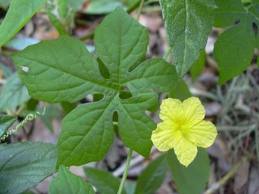
Bitter Gourd leaf and flower

While I have never seen an Asian family picking M. charantia off local fences here in Florida, I have seen many Hispanic families doing so.  Dr. Julia Morton, a plant professor in south Florida,  says besides the green fruit, the young leaves when cooked and drained are also edible and nutritious, with iron, phosphorous, calcium and vitamin C. I have never managed to get past the locker room bouquet to toss ‘em in a pot. The ripe fruit pulp has been used as a soap substitute, which should give you some idea of the flavor. In India and Africa the cooked leaves are canned like spinach. The fragrant flowers can be used as seasoning when cooking.

Incidentally, if you have a glut of green Bitter Gourds, you can slice them, partially boil them with salted water, then dry them, sun or otherwise. They will last for several months. You can then fry them and use as you like. Also, drinking the fresh bitter juice is recommended by some naturopaths. That ain’t going to be easy, it’s really bitter…. much easier to tell someone to do it than doing it yourself. Also there is one report that drinking vine juice killed a child. Caution is called for. 

REMEMBER: From my point of view as a forager no part of the Momordica charantia is to be eaten raw except for the red arils (and remember to spit the seeds out.)  No part, other than the arils, is to be eaten when ripe which is when it is turning from green to yellow to orange. Do not eat the yellow or orange fruit raw or cooked. It is medicinal and or toxic. That said let me qualify it some: I have met folks who eat the orange flesh raw and cooked but they have various medical goals which is beyond my pay grade and expertise. For that visit some herbalists publications or sites. Lastly, the green fruit is suspected in the poisoning of dogs and pigs.

Relatives: Momordica balsamina, which has longer spines on the fruit and can ripen to red, grows only in St. Lucie County in Florida and only a smattering of places in the southern U.S.  M. balsamina fruit can be pickled or after soaking used as a cooked vegetable. Young shoots and tendrils are boiled as a green. The seeds are eaten in cooked young fruit.  Momordica cochinchinensis produces a huge round fruit that is red when ripe. Young fruit boiled, not as bitter as M. charantia. Momordica dioica, small and roundish is more esteemed than the rest. It is not bitter but sweet. Fruits, shoots, leaves and roots are boiled for food. There are also at least seven commercial cultivars of the Momordica gourds

Green Deane’s “Itemized” Plant Profile

IDENTIFICATION: Momordica charantia: A slender, climbing annual vine to 18 feet with long-stalked leaves and yellow flowers where the leaf meets the stem. Young fruit emerald green turning to orange when ripe. At maturity, fruit splits into three irregular parts that curl backwards showing many reddish-brown or white seeds encased in scarlet arils.

TIME OF YEAR: Fruit, summer and fall in warm climates, fall in northern climes.

ENVIRONMENT: Love to climb, found in hammocks, disturbed sites, turf and ornamental landscapes, and citrus groves . It seems to be the most common vine on chain link fences in Florida.

METHOD OF PREPARATION: None of it ripe except the arils. Boiled green fruit (including seeds) leaves and shoots, boiled twice. Or, cut open and remove seeds and fiber and parboil.  Ripe parts toxic are too bitter to eat.  (An adult can swallow hole two ripe seed and not have much distress.) Young leaves and shoots are boiled and eaten as a potherb. Flowers used as seasoning.

HERB BLURB

Herbalists say the charantia has long been used to treat diabetes and a host of other ailments from arthritis to jaundice.

Karela Bhaji (Pan-fried Bitter Melon)

By The Domestic Man

  • Servings: 4
  • Difficulty: Easy

Karela Bhaji Pan Fried Bitter Gourd

1 lb Indian or Chinese bitter melon
1 ½ tsp salt, divided, more to taste
1 tbsp ghee
2 tbsp avocado oil
½ tsp cumin seeds
¼ tsp fennel seeds
1” ginger, grated
2 cloves garlic, minced
1 onion, finely chopped
½ tsp garam masala
½ tsp ground coriander
¼ tsp ground turmeric
¼ tsp kashmiri red chili powder
¼ tsp black pepper, more to taste
1 tsp amchur (green mango) powder
2 tsp coconut palm sugar
½ cup chicken stock
fresh chopped cilantro to garnish

1. Slice the bitter melon in half lengthwise; using a spoon, scrape out and discard the seeds and pith. Slice the melon into ¼” slices, then transfer to a colander suspended over a mixing bowl; sprinkle with 1 tsp of the salt and drain for 30 minutes. Gently squeeze and blot the melon dry to extract some of its bitter juices.

2. Warm the ghee and oil in a large skillet over medium-high heat until shimmering; stir in the cumin seeds and fennel seeds, and toast until aromatic, about 30 seconds. Stir in the garlic and ginger and saute until aromatic, another 30 seconds, then reduce heat to medium and add the onion, coriander, turmeric, chili powder, pepper, and remaining ½ tsp salt. Saute until the onion is softened, about 6 minutes. Stir in the bitter melon and chicken stock, and saute until the melon is tender and the liquid has mostly evaporated, about 10 minutes, stirring often.

3. Stir in the amchur powder and sugar; increase the heat to high, and pan-fry until any liquid has evaporated and the melon and onions begin to crisp, about 3 minutes, stirring often to prevent burning. Season with salt and pepper to taste, then serve garnished with cilantro.

{ 152 comments }

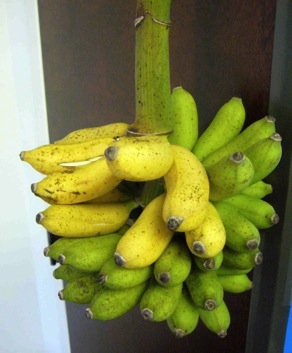
Home grown banana hand

Bananas Trees:  Survival Food

Yes, everyone knows bananas are edible, as are their starchy cousins, the plantains. One doesn’t think of banana or plantain trees as weeds or a wild food but they are. More than that, as a survival food I know they can save lives. I’ve met several they’ve saved.

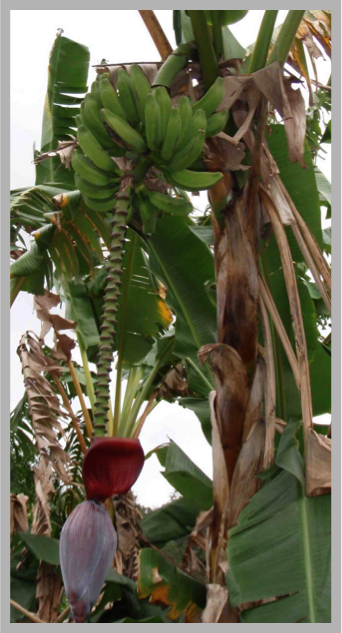
Banana tree and blossom

I have a friend who defected to the United States during the cold war. She did it while on tour as a national judo champion for Vietnam many years ago. She’s a pleasant woman, but not one to mess with for many reasons. She became a Judo champion in Vietnam after escaping Cambodia as an war orphan. The Khmer Rouge killed her entire family including cousins. At age seven she survived by traveling with other kids though the jungle from Cambodia to Vietnam living on whatever they could find for two years. There were just a few of them, none of them with any living relatives. They became their own family, and still are. In the jungle my friend learned that the banana tree provided more than just bananas.

Bananas are natives to Southeast Asia and are weeds. They’re also weeds in Florida. Many bananas have escaped cultivation, or were tossed in a compost heap and survived. I have planted a few cultivars and taken a few wild ones from hollows in abandoned orange groves. I have enough so that every year one or two will produce a stalk of fat, short, sweet citrusy bananas. Enter my friend: She still likes bananas.

As soon as one of my trees (correctly a pseudo-stalked herb) has a flower she lobs it off to take it home for a delicacy. She tells me my tree will have better bananas if she takes the blossom. I let her have them. I figure if she still likes them then she can have them. She earned the hard way the right to enjoy life.

The flower can be eaten raw or cooked. More so, the banana edibles don’t stop there. The core (and root stalk) of the banana’s trunk is also edible. It is used, notably, in the Burmese dish mohinga. Banana stalks are available year round where ever bananas grow. Incidentally, a juice extract of the core is used to treat kidney stones. Also, the sap of the tree makes an excellent glue as is. And I should mention the leaves. Banana leaves are large, flexible and waterproof. They can be used as umbrellas. One can often find holiday food wrapped in them in Oriental markets. Besides wrapping, they can be used to steam, roast, carry and pack food. They can be used as plates. They also contain a lot of oil and can be used like a frying pan to cook eggs.

And now a bit of botany. Bananas in the wild have seeds. Big seeds. There are about 1,000 different bananas and most of them have large, extremely hard seeds, from the size of a pea to the size of your thumb nail. More so, they also have bad tasting fruit. A natural mutation led to seedless bananas, but now the seedless ones are threatened by a fungus epidemic. In fact, in five years there might not be any seedless bananas. However, should you find a banana with seeds they can be ground into a flour. Should seedless bananas not disappear you can also make beer out of bananas… banana beer…No, I haven’t tried it, but I’m tempted.

There are two botanical names for most edible bananas. Commercial bananas are cultivars of the Musa acuminata. Musa (MEW-zuh) is from Arabic and means banana. Or, named for Antonius Musa (63-14-BC) a physician to the first Roman Empperor, Octavius Augustus.  Acuminata (ah-kew-min-AY-tuh) means sharp pointed, I imagine for the pointy fruit. Most of the bananas grown on private plots are cultivars of the Musa balbisiana (bal-bis-ee-AH-nuh) which was named for Giovanni-Batista Balbis, a 19th century Italian botanist. The word “banana” also comes from the Arabic word “banan” which means “finger.” One banana has about the same nutrition as a potato.

Incidentally, there are two known banana allergies. If you are allergic to birch you will probably be allergic to bananas, or vice versa. That seems strange but it is a fact. Also, folks with a latex allergy can be allergic to bananas.

As for my friend… the ones that survived the jungle escape, the ones with no family… They call each other “cousin,” and they keep in touch, visit, help each other, a “family” forged out of hardship, not kinship. Many of them now live in the United States. I’ve met a few… and argue with none.

Sauteed Banana Tree Stem

Banana-tree-stem  One pounds or so center core
Grated coconut – 1/4 of a coconut
Garlic cloves – 6
Chili powder – 1/4 tsp
Curry leaves – 1.5 teaspoons curry
Salt – to taste
Mustard seeds – 1/2 tsp
Coconut oil – 1 tablespoon

1) Peel off the outer layer of fiber from the banana-tree-stem and chop it into fine pieces. 2) Wash, drain and keep aside.
3) Heat half the oil in a pan. 4) Add mustard seeds and when they start to crackle 5) add the chopped banana stem pieces, curry, salt and chilly powder. For more yellow color add 1/4 teaspoon turmeric.  6) Cover with a lid and simmer until soft. This can take an hour or so. 7) Grind together the grated coconut and garlic in a mixer or blender. 8) When the stem pieces are almost cooked, add the coconut-garlic mixture to it and cook again with lid closed, till completely cooked. 9) When done, take off heat and sprinkle the rest of the coconut oil over the dish and mix. 10) Keep aside for a while with lid closed, before serving.

Banana Flower Stir Fry

* Banana flower – 1
* Lentils -1/2 cup
* Onion – 1 small
* Green chillies – 5 ( more /less according to ur taste)
* Garlic – 1
* Cumin powder – 1/4 tsp
* Turmeric powder – a pinch
* Coconut grated – 1/2 cup
* Oil -1 tbs
* Curry leaves
* Salt

METHOD:

* Cook the lentils, set aside.
* Remove the outside leaves (petals) until u get to the inside portion (cream edible portion) . Chop the edible portion finely . The chopped flower is in lumps because of the sticky fibrous material around it. To remove, apply a little coconut oil to your palm ,take a handful of chopped flower and rub to remove the lumps . Re-apply oil and repeat the procedure until you have removed all the lumps. Set it aside
* Dice the garlic
* Heat the oil in a pan and splutter mustard seeds. Add dry red chillies, chopped onion, green chillies, curry leaves and saute till the onions are light brown in color. Add the prepared flower, garlic, cumin powder, salt and turmeric powder . Cook it covered for 5 minutes in medium heat. Do not add any water. Add the cooked lentils and mix well. Cook for another 5 minutes until its completely dry. Note: Chopped banana flower can be soaked in milk to remove the bitterness.

Green Deane’s “Itemized” Plant Profile

IDENTIFICATION; Tallest herb on earth, often 12 feet high, leaves nine feet long comprised of upright concentric layers of leaf sheaths. Leaves can be to 12 ft (4 m) long and 3 ft (1 m) wide. The inflorescence is a long pendulous stalk bearing many purple bracts.

TIME OF YEAR: Year round in tropical and semi-tropical areas

ENVIRONMENT: Likes rich  soil,well watered, sun and warmth. Landscape plant, back yard decoration. Often escaped, discarded or abandoned.

METHOD OF PREPARATION: Fruit raw, or cooked. Stem core and rootstock cooked, seeds ground in to flour.  Banana leaves, stalks and skins can be burned to ashes to make a substitute for salt.  The leaves can be used for cooking.

{ 12 comments }