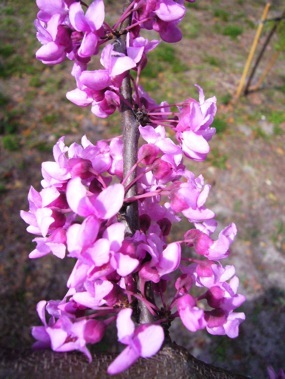
Eastern Red Buds can be showy in spring. Photo by Green Deane

Cercis canadensis: In The Bud of Time

Eastern Red Bud Blossoms

It’s one of those trees that if you don’t see it at the right time you’re not looking for it the rest of the year. I had gone past it perhaps four or five dozen times over a couple of seasons, but never in spring. But one day the blossom caught my eye. I knew what it was I just hadn’t seen it there before.

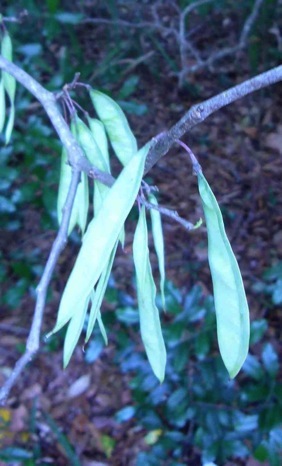
Eastern Redbud trees are native across much of the United States and Canada, basically east of the Rockies. The most common species is Cercis canadensis  (SER-sis kan-uh-DEN-sis.)  They’re small trees in the pea family and among the first to bloom in the spring before they leaf out. They also produce large numbers of multi-seeded pods, from spring to late summer depending where it is.

Red Bud’s Edible Pods

Native Americans ate redbud flowers raw or cooked as well as the young pods and seeds raw or cooked. The flowers can be pickled. They have a slightly sour taste and are high in Vitamin C . They’re  a pleasant addition to salads and can also be used as a condiment. The unopened buds can be pickled or used as a caper substitute. The seed is  about 25% protein, 8% fat and 3% ash. More so, a 2006 study show the flowers and the seeds to be very high in antioxidants as well as linoleic and alpha-linolenic acid. The seeds also have oleic and palmitic acids. Think of it as The First Forager’s Health Food Store. Young leaves are edible raw or cooked.

Redbuds were first cultivated in 1641 and even George Washington planted some around Mt. Vernon. The name Cercis canadensis, as usual, has living Greek and Dead Latin origins. Cercis is from the Greek “kerkis” which means “a weaver’s shuttle” and refers to the shape of the pod; canadensis means “of Canada.”

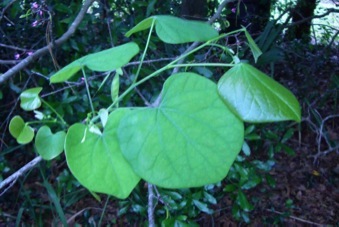
Heart-shaped leaves

The redbud’s native range is New Jersey to central Florida, west to Missouri and Texas and northern Mexico.  It’s branches and stems also have been used for basketry.

Also edible are the flowers and pods of the C. occidentalis (found in western North America ) and the C. siliquastrum found in Europe. There are also several cultivars now of varying colors. One popular variety is called Forest Pansy. It has reddish leaves and pods. They are edible as well. Like all members of the pea clan the blossoms are a very distinctive “wings and keels” arrangement, keel in the middle, wings on either side.

Green Deane’s “Itemized” Plant Profile

The Greek name for the shuttle — kerkis –inspired its botanical name Cercis

IDENTIFICATION: Small deciduous tree, typically 20 feet in height, gracefully ascending branches, rounded shape. Alternate, simple, broadly heart-shaped and 3 to 5 inches high and wide. Leaves emerge reddish, turning green. Flowers are pea-like, wings and keel, rosy pink with a purplish tinge. Flowers develop before the leaves in spring, in clusters along the branches.

TIME OF YEAR: Flowers in spring, followed by pods, seeds in fall.

ENVIRONMENT: Full to partial sun, well drained soil, often planted as an ornamental. I have also seen them growing, poorly, in total shade. They also seem to grow along the edges of open spaces.

METHOD OF PREPARATION: Buds raw, pickled or cooked. Flowers raw or cooked, young pods fried. Flowers fry nicely as well. Young leaves edible, raw or cooked. Regarding the flowers, the light colored upper part of the blossom is sweet, the darker lower part is bitter. Some folks removed the lower bitter part before eating. It’s a personal choice.

HERB BLURB

Herbalists say extracts from the inner bark and roots were used to treat colds, flu and fever. The Alabama Indians man a root and inner bark infusion for fever and congestion. The Cherokee used a bar infusion for whooping cough. The Delaware used an infusion of the bark to treat fever and vomiting.  The Osage used charcoal from the wood for war paint.

Redbud Blossom Muffins

2 cups redbuds blossoms

2 tablespoons minced fresh sage or rosemary leaves

½ cup sugar

Minced zest of 1 lemon

1 ½ cups flour

2 teaspoons baking powder

½ teaspoon baking soda

¼ teaspoon salt

1 large egg

3/4 cup milk

1/2 cup yogurt

2 tablespoons melted butter or oil

1 tablespoon lemon juice

Topping:

1 tablespoon sugar

½ teaspoon ground cinnamon

Preheat oven to 375°F

In bowl #1, combine redbuds, herb, sugar, zest. Let sit 30 minutes.

In bowl #2 Sift flour, powder, baking soda, salt large bowl.

In bowl #3 Combine egg, yogurt, milk, oil, lemon juice.

Pour the content of bowl one in to bowl two and toss.

Add the wet ingredients from bowl three, stirring to just moisten. Do not over mix.

Fill your muffin tins 3/4 full.

Combine sugar cinnamon the topping sprinkle some each muffin Bake for 25 minutes, or until tops spring back when lightly touched.

Remove form muffin pan and cool on a wire rack.

{ 73 comments }

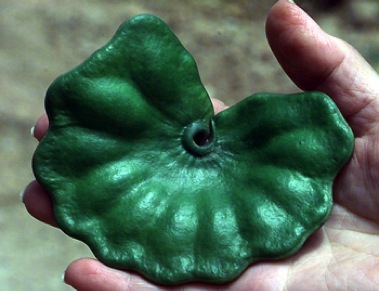
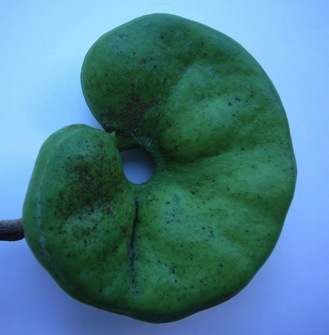
Unripe pod of the Enterolobium cyclocarpum

Lend Me An Ear Tree

Just about anyone who has spent anytime in a warm climate will some day find on a sidewalk a black seed pod that looks like a human ear…. or a miniature elephant’s ear. That usually leads to seeing a huge shade/food tree that seems to be more appreciated in equatorial countries than others. Here in Florida, where bellies are full, the Ear Tree is a trash tree and rarely tended.

Round seeds of the E. cyclocarpum

As a southern Greek of northern birth — hence my constant migration southward — the Ear Tree was my second introduction to warms climates after the palms.  Ear Trees get more respect the closer one gets to the equator.  It’s planted as a shade tree, a source of forage for cattle, and food for humans. It shades coffee trees and fertilizes the soil by fixing nitrogen. Outside of the United States you will find in cherished in parks and designed landscapes like majestic oaks are elsewhere. In the US it is a neglected opportunist often with storm-damaged branches and litter around its base.

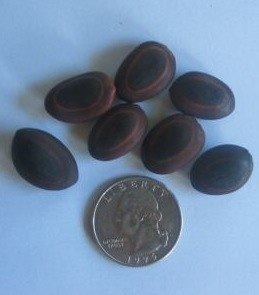
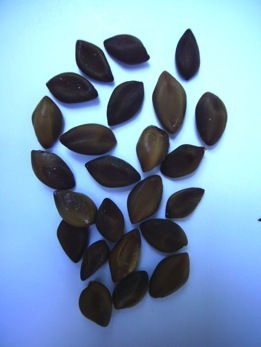
That said, there are actually two “ear trees.” One has edible seeds and the other probably not. So far experiments have not been successful. The edible ear tree, Enterolobium cyclocarpum, is pictured above. The questionable ear tree, Enterolobium contortisiliquum, is pictured below right.  To tell them apart, look for deep green pods with clearly marked seed pockets, also distinguishable when turned dark. More so, the seeds of the two are different. Round in the known edible, E. cyclocarpum, and pointed in the doubtful edible E. contortisliquum.

Pod of the non-edible E. contortislliquum

The flowers of the E. cyclocarpum (edible) are white and arranged like a spiked ball. The tree blooms February through April. The fruits take three months to ripen. The seeds are ripe when the seed pod (pericarp) turns from green to dark brown and by the noise the seeds make when the fruits are shaken. Each fruit 8 to 16 seeds.  A tree can yield many pounds of seeds. The seeds are ovate and laterally flattened. They are red-brown, smooth, very hard, and marked on one surface by a line that follows the contour of the seed.

I have several reports that the very young pods, the immature, unripe seeds are edible when boiled. The white pith of the black pod, however, and the roasted ripe seeds peeled are edible. In fact, the seed flour is 35 percent protein. That’s three times the protein of wheat flour. The unripe pods are full of a sugary dry pulp. The ripe fruits are collected from May through July, from the ground or from the trees. A pole with metal hooks can be used to remove fruits from trees. The seed pods have to be opened to get the seeds out. Small impurities are removed with sieves. Seeds from the mature pods average 1,100 to 1,170 per two pounds.   The mature black pods themselves are not edible but can be a source of saponins for soap making. The pods, by the way, are very sticky inside.

Seeds of the non-edible E. contortislliquum

The wood, similar to walnut, is water resistant and easy to work with hand tools. It is used for  furniture, cabinets, veneer, construction, panels,  posts, firewood and charcoal.  Natives used its trunk to make the famous dug-out canoes you saw in grade-B movies. Enterolobium cyclocarpum, (en-ter-oh-LOW-bee-um syk-lo-KAHRP-űm) also provides tannin for preserving hides and is a source of a gum similar to gum arabic. Without attention at ambient temperatures the seeds can germinate up to  a year later. With careful storage, at 5 C and 68 percent moisture, they will have an 80 percent germination rate after 11 years.

One of the more unusual aspects of the Ear Tree is that it evolved when there were large land mammals to spread its seeds. But, those were killed of by human hunters some ten to twelve thousand years ago. Smaller mammals did some spreading of the seeds after that until horses and cattle were introduced into the Americas. It is called  Corotu, Orejoni and more commonly, Guanacaste, which means ear-tree in Spanish. That comes from the Nahuatl word/phrase cuauhnacaztli which means “area where the ear tree grows.” The Ear Tree is national tree of Costa Rica and El Salvador.

Enterolobium is Latin meaning “in lobes,” referring to the seeds in the pods. Cyclocarpum is two Greek words used to mean seed/fruit in a circle, referring to the shape of the pod. Contortisiliquum is said kon-tor-tih-SIL-ih-kwoo-um and means twisted pod.

One last point: The non-edible species might be edible with proper preparation that I am not aware of. I think one offending chemical is calcium oxalate which can sometimes be dealt with by dry heat. But like many members of the greater family it could also have alkaloids that permanently damage the liver so I think it is a species best left alone.

Green Deane’s “Itemized” Plant Profile

IDENTIFICATION: 100-foot tall tree with broad spreading crown to 70 feet wide; bark with shallow longitudinal grooves.  A vigorous grower; looks feathery, fern like, leaves alternate, evenly bipinnate; leaflets oblong; flowers white, in powderpuff-like clusters; fruits reddish to dark brown with a yellow ring around. Easy to grow, may be grown indoors if kept pruned to size.

TIME OF YEAR: Time of year: fruits in spring, matures in summer (See photo below)

ENVIRONMENT: Likes warmth, bright light, moist soil. Native from Mexico through Central America, to Venezuela, Trinidad, Guiana, and Brazil where it is dispersed by horses, peccaries and now extinct large herbivore.  Introduced as a shade tree in the West Indies, South and Central Florida, and other tropical/subtropical regions.  It ranges at least as far north as Central Florida (Orange and Seminole Counties.)

METHOD OF PREPARATION: Reportedly the very young pods and Immature seeds from green pods are edible if boiled in plenty of water. I have not yet proven that. However the ripe seeds roasted and peeled are edible.  Pith of the mature pods is sweet and sticky. It can be eaten raw or cooked. In Columbia they mix the pith with sugar and eat the paste as a dessert.

HERB BLURB

Bark extracts have been used for colds, bronchitis and to reduce fevers.

{ 35 comments }

Dewberries are blackberries “lowly” cousins

Dewberries: Rubus Trivialis

Dewberries go far in the world, for a lowly vine. They can reach up to 15 feet long, one node root at a time.

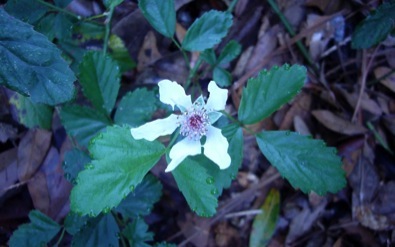
Essentially a blackberry on the ground, Dewberries are a delicious addition to any foraging. Besides me and thee, the Dewberry is very popular with bees. The flowers attract honeybees, bumblebees, mason bees, leaf-cutting bees, cuckoo bees  and miner bees. The flowers also attract butterflies and skippers. The berries, actually drupes, are important summer food for many birds including red-headed woodpeckers, bluebirds, northern cardinals, and wild turkeys. The raccoon, fox squirrel, chipmunk and white-footed mouse eat the fruits. The cottontail rabbit and white-tailed deer browse on the leaves and stems. In fact, during lean years the Dewberry is an extremely important deer food, but then again, so too is poison ivy. Only humans and primates are allergic to poison ivy.

The Southern Dewberry (Rubus trivialis, ROU-bus triv-ee-AY-liss) differs some from the more widespread Common Dewberry (Rubus flagellaris.)  While both have prickles, the Southern Dewberry has bristles, the Common Dewberry does not. What’s the difference between prickles and bristles? It’s the amount of little spines you catch your finger on. A few are a prickles, a lot are bristles.) Also, the Southern Dewberry is evergreen, the Common Dewberry is not. The family the dewberry is in in some 250 genus strong, 26 of them in the southern United States. And the family has been around a long time according to fossil records, some 30 million years give or take a million or two the experts tell us. A whole lot of creatures have enjoyed them over the millennia.

Per usual, the botanical name for Dewberry, Rubus trivialis, is part Dead Latin and bastardized Greek. Rubus is a Roman word meaning red, the hair and or bristles on the stems often make them look reddish. Trivialis refers to the common occurrence of this plant. While it’s also the source of the English word “trivial” it really means “three ways” or crossroads. In Greek Tria is three and Via is force or way. Why “crossroads” means trivial is anyone’s guess but I would suppose crossroads are far less important than the main road, thus we have mainline and trivial.

Dewberries specifically are found Pennsylvania south to Florida and west to Colorado and Texas. Blackberries are found around the world. For example, the Dewberry is listed as an noxious weed in Tasmania. Imagine, a people so removed from nature that an abundance of delicious berries is a nuisance.   Hmmmm…. A 2007 study showed a blackberry leaf extract was good at reducing the formation of wrinkles. Seems to me the Tasmanians have the opportunity to be the most wrinkle-less folks on the planet. See my article on Blackberries.

Green Deane’s “Itemized” Plant Profile

IDENTIFICATION; Trailing vine, often roots at the nodes, twigs have reddish hairs; prickles small and scattered. Leaves alternate, variable in size and shape; leaflets elliptic to narrow-oval, twice as long as wide; hairless, toothy. Blossom has five petals, white to pink; pistils many, stamens numerous

TIME OF YEAR: Spring in Florida, June and July in northern climes. Dewberries ripen before other blackberries.

ENVIRONMENT: Edges of woods, roadsides, old fields. Likes most soils, can grow in full sun or some much shade.

METHOD OF PREPARATION: Black fruit, off the vine or prepared like any fruit berry.  Leaves can be made into a tea, long used to treat diarrhea.

{ 21 comments }

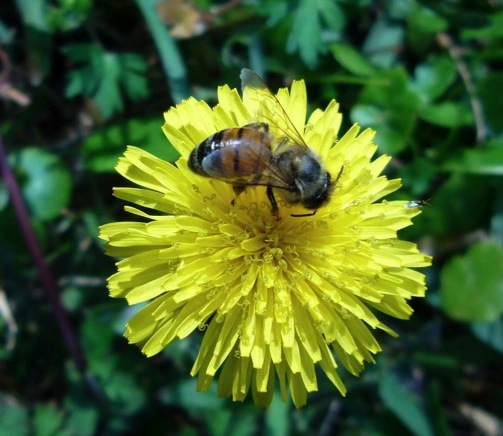
A dandelion blossom is a bee’s gas station

Dandelion Wine and Coffee and Salad

Dandelions and I go back a long ways, some 70 years.

When I was young in Maine my mother would hand me a knife and a paper bag and send me out to find dandelions for supper, not only in our yard but in the pasture across the road. My step-father liked the bitter green so I picked them often. What is most interesting to me about collecting them is how things have changed since then.

First, it was a big sharp knife. How many mothers trust their six-year olds with large, sharp knives now? Then I left the immediate area and went wandering around country fields alone. Those two things by themselves are now worth social services intervention, a trespassing charge, probably counseling, drug therapy and several local newspaper articles about the potential of child kidnapping. Then again, I was armed with a knife and always came home with a bagful of dandelions which brings up another point: The fields were not polluted and an abundance of wild edibles grew there. In fact, wild strawberries and checkerberries (wintergreen) grew in the same places in the spring. Heck, I was full of dessert before I came home for supper. There was also a large Hawthorn tree with three-inch thorns and edible fruit. I remember noticing how different species of birds liked to nest there. I inferred the thorns dissuaded would-be predators except perhaps for tree-climbing snakes.

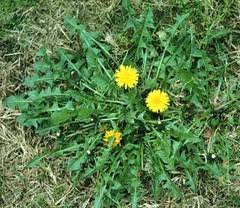
Leaves point away from the base

One year, when I was round 15, I made dandelion wine (after I had made two batches of beer with cooking malt, potatoes, and soft bread yeast.)  Bottled in returnable Cocoa-cola bottles tt was “dry” and perhaps an acquired taste but it went down easily enough and had a suitable kick. I remember a neighbor, one Mr. Bill Gowan, who dropped by one night, and downed a considerable amount, saying “that’s pretty good stuff” each time a new bottle was opened. Good thing he was walking. Dandelion wine is not living off the land but through dandelions I developed a kinship with plants as pets can help one have a kinship with animals.

What can be said here about dandelions that hasn’t been said in many other places? Well, how about they are pretty and free and on a windy day spreading their seeds is a fun moment whether child or not… Okay, okay… think of them as free chicory or escarole for your salad, a coffee substitute, wine flavoring, batter-dipped blossoms… a diuretic… Dandelion roots were eaten by man as long as 25,000 years ago. They were either hungry or liked the bitter flavor.

Classic powder puff

Dandelions also have a modern secret. You no doubt have seen “drones” proliferating the skies. In the future you might see miniature flying craft shaped like Dandelion fluff or maybe even large wind generators. It turns out that Dandelion fluff is aeronautically gifted.  Each seed is attached to a tiny parasol that is comprised of fine bristles. Those bristles deflect the wind and create a vortex that induces lift. And you thought they were just passively floating around...

A native of Europe and Asia, the name of “Dandelion” in English came from the French, dent de lion, or “tooth of the lion” referring to the toothed leaves. Dandelion’s other names are related to keeping the urinary system functioning, which a 1994 study demonstrated.  The French also called it pissenlit which lent itself to the English common name of Pissabed, which my mother called it.

The botanical name is Taraxacum officinale (tar-AX-a-kum oh-fis-in-AY-lee.)  Officianle means it was sold in state-designated Roman shops for food or medicine, now days the word is used for plants that had or have medicinal applications. As for Taraxacum, it has two possibilities. One is a name traceable through Arabic to the Persian word “tarashqum“, meaning ‘bitter herb.’  But since Latin is essentially a combination of hijacked Etruscan and bastardized Greek, it could also come from the Greek word “taraxi” to disturb, referring to its ability to get the water flowing again. That is in contrast with the latex sap of the Dandelion, which can be used as a glue, right from the stem. Modern Greeks call it Radiki (rah-DEE-kee) the same word the use for chicory.

And to stretch the vocabulary a little, Dandelions are also known as “ruderals.” That means they are among the first plants to shoot up after the ground has been disturbed. Of course, that’s up north. Here in Florida the delicate poke weed is the master ruderal. But that does bring up a point: Dandelions grow in Florida but they aren’t too common. They like cool weather and acidic soil. Florida is a hot limestone plate. Look for Dandelions near oaks and pines in cooler weather.

As for using Dandelions there are two recipes immediately below and then many more at the bottom of the page thanks to Rose Barlow. These recipes are for using only the yellow part of the flower, no green at all. All green parts are bitter.

 Dandelion Wine

* 3 qts dandelion flowers

* 1 lb golden raisins

* 1 gallon water

* 3 lbs granulated sugar

* 2 lemons

* 1 orange

* yeast and nutrient

Pick fresh flowers, trim of stalk, if extra careful trim off all green.  Put flowers in a large bowl. Set aside one pint of water,  bring the rest of a gallon to a boil. Pour the boiling water over the dandelion flowers and cover tightly with plastic wrap. Leave for two days, stirring twice daily. Pour flowers and water in large pot and bring to a low boil. Add sugar and the peeling of the citrus (peel thinly and avoid any white pith.). Low boil for one hour, pour into fermenter. Add the juice and pulp of the citrus. Allow to cool. Add yeast and yeast nutrient, cover, and put in a warm place for three days. Strain and pour into secondary fermenter. Add raisins and fit fermentation lock. Strain and rack after wine clears, adding water to top up. Leave until fermentation stops completely, rack again. Two months later rack and bottle. Age six months to a year.

Dandelion Burgers from Forage Ahead

1 cup packed dandelion petals (no greens)

1 cup flour

1 egg

1/4 cup milk

1/2 cup chopped onions

1/4 tsp salt

1/2 tsp garlic powder

1/4 tsp each basil and oregano

1/8 tsp pepper

Mix all ingredients together. The batter will be goopy. Form into patties and pan fry in oil or butter, turning until crisp on both sides. Makes 4-5 very nutritious vegetable burgers. No, they don’t taste like hamburger, but they ain’t bad.

Dandelion Blossom Bread

2 cups flour

2 tsp baking powder

1/2 Teaspoon salt

1 cup dandelion blossoms, all green sepals and leaves removed

1/4 cup oil

4 Tablespoons honey

1 egg

1 1/2 cups milk

Combine dry ingredients in large bowl, including petals making sure to separate clumps of petals. In separate bowl mix together milk, honey, oil beaten egg. Add liquid to dry mix. Batter should be fairly wet and lumpy. Pour into buttered bread tin or muffin tin. Bake 400F. For muffins 20-25 min, bread for bread up to twice as long. Test for doneness

MORE DANDELION RECIPES,  by Rose Barlow

 Cream of Dandelion Soup

4 cups chopped dandelion leaves

2 cups dandelion flower petals

2 cups dandelion buds

1 Tbsp butter or olive oil

1 cup chopped wild leeks (or onions)

6 cloves garlic, minced

4 cups water

2 cups half-n-half or heavy cream

2 tsp salt

1.  Gently boil dandelion leaves in 6 cups water.  Pour off bitter water.  Boil gently a second time, pour off bitter water.

2.  In a heavy-bottom soup pot, sauté wild leeks and garlic in butter or olive oil until tender.

3.  Add 4 cups water.

4.  Add dandelion leaves, flower petals, buds, and salt.

5.  Simmer gently 45 minutes or so.

6.  Add cream and simmer a few minutes more.

Garnish with flower petals.

Pumpkin-Dandelion Soup

Prepare in advance:

1 large handful Dandelion greens:

Chop leaves into bite-sized pieces.  Cook in boiling water until tender.  Pour off water and taste.  If they seem too bitter for your taste, boil again and strain.

1 small pumpkin:

Bake whole pumpkin on baking sheet at 350° for 1 hour or until completely soft, so that you can put a fork or knife easily through it.  Let cool.  Cut in half and discard seeds.  Rind will peel easily.

1 medium to large onion, chopped

6 cloves garlic, minced

2 Tbsp. butter or olive oil

6 cups water

4 cups mashed pumpkin, prepared as above

1 cup heavy cream

½ tsp nutmeg

1½ tsp salt

1. Sauté onion and garlic in oil or butter in a  heavy-bottomed soup pot.

2.  Add 6 cups water

3. Add dandelion greens and pureed pumpkin to soup.  Stir well.

4. Add salt.  Cook at a gentle simmer for 30 minutes.

5.  Just before serving add 1 cup heavy cream and ½ tsp nutmeg.

Dandelion Egg Salad

4 hard-boiled eggs

2/3 cup dandelion greens, chopped and cooked

1 tsp horseradish

1 Tbsp fresh chives

½ cup mayonnaise

1.  Chop eggs coarsely.

2.  Add Dandelion greens, chives, and horseradish.  Mix gently.

3.  Add mayonnaise and mix just enough to coat ingredients.

 Dandelion Pasta Salad

3 cups cooked pasta

1½ cups diced tomatoes, drained

1 cup dandelion greens, pre-cooked

2 wild leeks,  minced, greens and all or 2 Tbsp minced onions

8 olives, sliced

2 Tbsp vinegar

1 Tbsp olive oil

½ tsp salt

 Split Pea-Dandelion Bud Soup

1 cup split peas

1 tsp salt

6 cups water

1. Simmer split peas for 1½ to 2 hours until done.

2. Sauté in 2 Tbsp butter:

½ cup onions, chopped

4-5 cloves garlic, minced

½ cup celery, sliced thin

2 cups dandelion buds

½  tsp basil

½  tsp sage

½  tsp savory

3.  Add the sauté  to split pea broth.

4.  Simmer slowly ½ hour or so.

5.  Just before serving add:

1 cup milk

1-2 cups cubed cheese

Garnish with dandelion blossom petals and this hearty soup is fit for the finest table!

Dandelion Blossom Syrup

This is a traditional recipe passed down from the old world Europeans.  I use it as a substitute for honey in any recipe that I’m trying to make wild.

1 quart dandelion flowers

1 quart (4 cups) water

4 cups sugar

½ lemon or orange (organic if possible) chopped, peel and all

Note: The citrus is optional, it will give the syrup an orangey or lemony flavor.  If you want the pure dandelion flavor, you can skip the citrus.  I make it both ways each year.

1. Put blossoms and water in a pot.

2. Bring just to a boil, turn off heat, cover, and let sit overnight.

3. The next day, strain and press liquid out of spent flowers.

4. Add sugar and sliced citrus and heat slowly, stirring now and again, for several hours or until reduced to a thick, honey-like syrup.

5. Can in half-pint or 1 pint jars.

This recipe makes a little more than 1 pint.  I usually triple or quadruple this, and I make more than one batch when the blossoms are in season to have enough for the year.  The syrup makes great Christmas presents, so make plenty!

 Dandelion Baklava (as a Greek purist I must object, but try the delicious recipe anyway.)

This recipe involves using fillo leaves, which are extremely thin sheets of pastry dough, usually sold frozen in long thin boxes.  Fillo can be fussy to work with but the results are so worth it!  It’s actually a lot more forgiving than it seems, so don’t be afraid to try it!

1/2 box fillo leaves

1 stick butter

2 cups finely chopped hickory nuts (try walnuts or pecans)

1 tsp sugar

1/2 tsp cinnamon

1/2 tsp nutmeg

3/4 cup Dandelion Blossom syrup

1. Combine nuts with sugar and spices

2. Melt butter

3. Layer 8 sheets fillo into a buttered 9×13 pan, brushing every other sheet with butter using a pastry brush.

4. Sprinkle evenly with 1/2 of the nut mixture.

5. Layer 8 more sheets. Sprinkle the rest of the nut mixture.

6. Layer the rest of the fillo sheets, brush the top layer generously with butter.

7.  Cut carefully into 30 squares (6×5) with a sharp knife before baking.

8. Bake at 375 for about one-half hour.  when slightly browned, remove from oven.

9. Pour room temperature Dandelion Blossom syrup over the hot baklava, while it is still piping hot.

Note: Fillo leaves used to come with two packages per box, sized for 9×13 pans.  Lately it’s been all in one package and sized much bigger, so it is necessary to cut the stack of leaves in half before beginning. Half-sheets fit the 9×13 pans nicely.

 Dandelion Blossom Cake

2 cups flour

2 tsp baking powder

1½ tsp baking soda

1 tsp cinnamon

1 tsp salt

1 cup sugar

1 cup Dandelion Blossom Syrup

1½ cups oil

4 eggs

2 cups Dandelion blossom petals

1 can crushed pineapple

½ cup walnuts

½ cup coconut

1.  Sift together dry ingredients.

2.  In separate bowl, beat sugar, dandelion syrup, oil and eggs together until creamy.

3.  Add pineapple, walnuts, and coconut, and mix well.

4.  Stir dry ingredients into the mixture until well blended.

5.  Pour batter into a greased, 9×13 cake pan and bake at 350° for about 40 minutes.

Frosting

1  8-oz package cream cheese, room temperature

1 cup powdered sugar

1 or 2 Tbsp milk

Dandelion Blossom Pancakes

1 cup white flour

1 cup cornmeal

1 tsp salt

2 tsp baking powder

2 eggs

¼ cup oil

½ cup Dandelion Blossom syrup or honey

2 cups milk

1 cup Dandelion blossom petals

1. Mix dry ingredients first.

2. Add wet ingredients and mix together thoroughly  (Note: the secret of keeping pancake batter from getting lumpy is to be sure to add all the wet ingredients before mixing.)

3.  Adjust consistency by adding a little more milk or a little more flour if it’s too thick or thin.  Pancake batter should be thin enough to pour, but not runny.

4.  Cook on oiled grill.

5.  Top with butter and Dandelion Blossom syrup.

 Dandelion Cornbread

1 cup cornmeal

1 cup white flour

2 tsp baking powder

¾ tsp baking soda

1 tsp salt

2 large eggs

½ cup Dandelion Blossom syrup (or honey)

¼ cup oil or butter

1 cup milk (buttermilk is best!)

1 cup Dandelion blossom petals

1.  Mix dry ingredients together.

2.   Add all the rest of the ingredients and blend until smooth.

3.  Pour batter into a 9×9 pan, or 10-inch cast iron frying pan.

4.  Bake at 375° for 25 minutes.

5.  Serve hot with butter and Dandelion Blossom syrup.

 Dandelion Mustard

Homemade mustard is incredibly easy to make and endless in variations and possibilities.  Making them “wild” involves preparing an herbal vinegar ahead of time, and in the case of Dandelion Mustard, I also use Dandelion Blossom Syrup and fresh greens.

1 cup yellow mustard seeds (whole)

1 1/4 cups Dandelion vinegar

1/2 cup Dandelion Blossom syrup

1 cup pureed fresh Dandelion greens

3 cloves garlic, minced

3/4 tsp salt

1. Soak the mustard seeds in the Dandelion vinegar for several hours or overnight.

2. Add the rest of the ingredients.

3.  Let it all sit together in a covered container for several days to mellow.

4.  Put in small jars (1/4 pints work nicely).

Note: Mustard keeps well in the fridge for many months or you can can it in a boiling water bath for 10 minutes to seal.

Dandelion Vinaigrette

This recipe involves having some pre-made Dandelion products but it is delicious beyond belief and is guaranteed to convict any skeptic about the culinary virtues of Dandelion.

1 1/2 cup olive oil

3/4 cup Dandelion vinegar

4 cloves garlic

1/2 tsp salt

2 Tbsp Dandelion Mustard (or Dijon)

3 Tbsp Dandelion Blossom syrup

2 cups fresh, chopped Dandelion greens

Whiz everything together in a blender or food processor.

 Dandelion Chai

Chai is a Middle Eastern word that means “tea” but here in America we’ve adapted the term to mean a very spicy tea made with milk and sweetener.

1 cup roasted Dandelion root

6 Tbsp Fennel or Anise seed

36 green Cardamom pods

72 Cloves

6 Cinnamon sticks

2 Tbsp dried Ginger root

1½ tsp black peppercorns

12 Bay leaves

1.  Add 1 Tbsp tea mixture for each cup of water.

2.  Simmer 5 minutes, then let steep for 10 minutes.

3.  Add 1 Tbsp honey or brown sugar (or dandelion syrup) per cup.

4.  Add 2 Tbsp milk or cream per cup.

5.  Gently reheat and serve.

 Dandelion Chai 2

This chai is not as spicy as the first recipe but actually has a more ‘chocolatey’ flavor, kind of like an herbal hot chocolate.

2 cups roasted Dandelion root

½ cup Cinnamon bark

½ cup Ginger root

½ cup Cardamom seeds

½ cup Star Anise

Honey

Milk

1.  Use 3 Tbsp per  2 cups water.  Simmer gently 10 minutes.

2.  Add 1 cup milk and 1 Tbsp honey and heat through but don’t boil.

Serve hot or iced.

Warm Winter Spice Tea

1 cup roasted Dandelion root

½ cup dried Orange Peel

½  cup Cinnamon bark

¼ cup dried Ginger root

Use 1 Tbsp per cup water.  Simmer gently 10-15 minutes.  Sweeten with honey, if desired.

Roasted Dandelion Root Coffee Ice Cream

Here’s a recipe for the really adventurous from the Herbfarm :

2 ½ cups heavy cream

1 ½ cups half-and-half

1 ¼ cups sugar

5 egg yolks

1.  Grind Roasted Dandelion Roots roasted Dandelion roots into a powder using a coffee mill and sifter.

2.   Place cream, half-and-half and sugar in a medium pot (double boiler might be best, or perhaps a crock pot).  Bring it just barely to a simmer, stirring to dissolve the sugar.

3.  Add Roasted Dandelion Root powder.  Maintain heat at a bare simmer, be sure not to boil.

4.  Let the roots steep this way for 45 minutes.

5.  Strain out and discard root material.

6.  Whisk up egg yolks in another pot.  Gradually add the warm Dandelion Root cream.

7.  Heat gently and stir until sauce thickens enough to coat the back of a spoon.

8.  Strain one more time and chill.

9. Freeze in an ice cream machine according to directions.

 Dandelion and burdock beer

1 lb Young nettles

4 oz. Dandelion leaves

4 oz. Burdock root, fresh, sliced

-OR-

2 oz. Dried burdock root, sliced

1/2 oz. Ginger root, bruised

2 each Lemons

1 g water

1 lb +4 t. soft brown sugar

1 oz. Cream of tartar

Brewing yeast ( see the manufacturer’s instructions for amount)

Dandelion and burdock beer preparation:

1. Put the nettles, dandelion leaves, burdock, ginger and thinly pared rinds of the lemons into a large pan. Add the water.

2. Bring to a boil and simmer for 30 mins.

3. Put the lemon juice from the lemons,1 lb. sugar and cream of tartar into a large container and pour in the liquid thru a strainer, pressing down well on the nettles and other ingredients.

4. Stir to dissolve the sugar.

5. Cool to room temperature.

6. Sprinkle in the yeast.

7. Cover the beer and leave it to ferment in a warm place for 3 days.

8. Pour off the beer and bottle it, adding  t. sugar per pint.

9. Leave the bottles undisturbed until the beer is clear-about 1 week.

Dandelion Soft Drink

This recipe will make a strong syrup which will then need to be watered down with soda 1:4. Heat 1.5 litres of water in a pan, when boiling add:

* 2 teaspoons fine ground dandelion root (Might need a mortar & pestle)

* 1.5 teaspoons fine ground burdock root (Might need a mortar & pestle)

* 5x 50p sized slices of root ginger

* 1 1/2 star anise

* 1 teaspoon of citric acid

* Zest of an orange

Leave that little lot to simmer for 15-20 minutes, it will smell a lot like a health food shop, then strain through a tea towel, muslin isn’t really fine enough. Whilst the liquid is still hot you need to dissolve about 750g sugar. If you prefer is sweeter or ‘not-sweeter’ adjust the sugar. If you’re finding the drink a bit flavourless simply add more sugar, it accentuates the flavours of the roots and anise.

In the summer I mix it with plenty of ice and stir through borage flowers for the ultimate English soft drink! Enjoy.

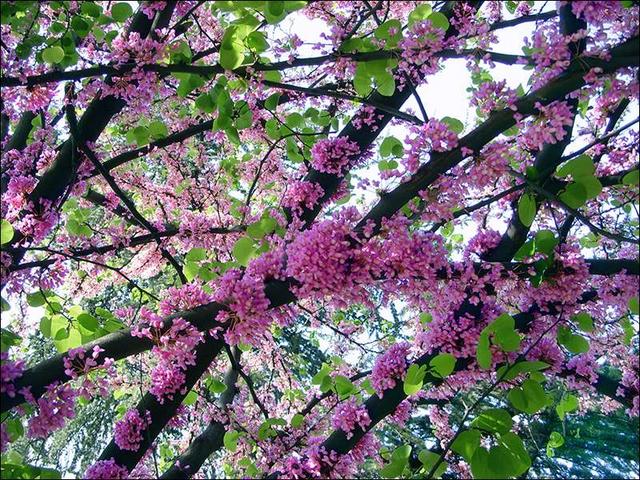
Dandelion Salad (added 2023) by Jacque Pepin

A few fillets of anchovies and their oil (can substitute smoked herring) , garlic, french mustard, salt, pepper, red wine vinegar, olive oil, bacon or pancetta fat, mix well, for garnish used boiled eggs, roasted croutons, and the bacon.  Does not wil quickly and can be kept for several days. Also works well with cabbage salad.

Green Deane’s “Itemized” Plant Profile

IDENTIFICATION: In the aster family, leaves are up to a foot long, always growing rosette at the base. Deeply indented leaves, like large saw teeth, the familiar flower is made of hundreds of little rays and turns into the well -known power puff. There are no poisonous look alikes, but some similar ones can be bitter and not tasty.

TIME OF YEAR:  February and March in Florida, later in the spring and summer in northern climes

ENVIRONMENT:  Lawns, meadows, fields, disturbed areas.

METHOD OF PREPARATION: Bitter young greens in salads, slightly older leaves as a potherb, root boiled or roasted, blossoms — yellow parts only — as a flavoring for wine. Flowers dipped in batter fried (no green parts.) When you cook the leaves drop them into boiling water. They will taste better than if you warm them up in cold water. Best salad use is with cooked, cooled greens. Incidentally, the root can be roasted or boiled like a vegetable and eaten that way.  It is bitter but edible.  Dandelion roots were eaten by man as long as 25,000

{ 42 comments }

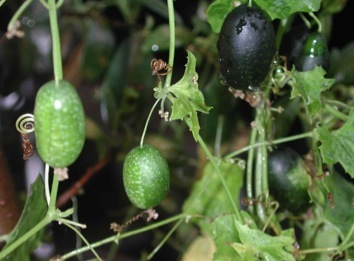
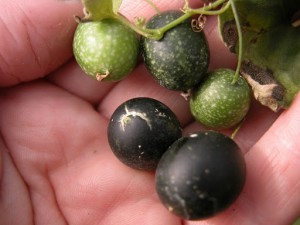
Green fruit is edible, ripe black fruit is not

Cute Cuke! Melothria Pendula

The Melothria pendula is a little cucumber with a big reputation.

That said, when it comes to the “creeping cucumber” I’m not sure you can trust botanists who never get out of the college classroom, or Internet experts who’ve never eaten a wild plant. It is one thing to copy, it is another to consume.

Crushed leaf smells like a cucumber

If you search the web for Melothria pendula (Mel-OTH-ree-uh PEND-you-luh) you will find two contradicting comments, that it’s edible and that it’s toxic. The state of North Carolina calls it mildly toxic, the state of Florida does not, one person says it is harmless, the other say it is harmful. Actually what they say in their own way is that at some point the Melothria pendula becomes the Mother of all Laxatives.

All I can say is I’ve eaten a lot of light to medium green M. pendula at a time with no apparent harm and have known others to eat them as well.  Many people put them in salads as they would cherry tomatoes. So where does the problem lie? Probably with the ripening fruit, or the one and only historical account was wrong. The little cukes turn black as they ripen and that’s probably a good sign to leave them alone. But green it’s salad here we come. The state of North Carolina adds its toxicity is low even if purgative.

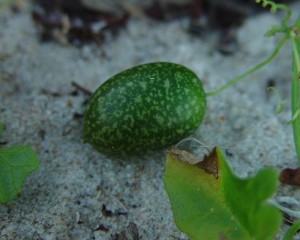
Think jelly-bean size watermelon

Professor Julia Morton, in the fifth edition of her book “Wild Plants for Survival in South Florida” says: “… the unripe fruit resembling miniature watermelons, are certainly eaten by children in South Florida with no apparent harm. F.P.Porcher in 1863 referred to the seeds  as ‘drastically purgative’; no evidence of that has come to hand to support that. In the West Indies and Central America, the fruits of M. guadalupensis are  eaten ripe and pickled unripe.”

In the 2002 edition of the academic journal Ciencia Ego Sum, authors Amaury M. Arzate-Fernández and Graciela Noemí Grenón-Cascales, investigated growing the M. pendula up to 8,500 feet.  Translated from the Spanish, with thanks from my friend, Manuel Mora-Valls, they say:

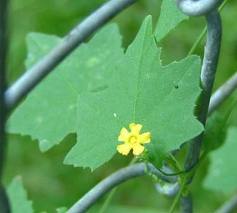
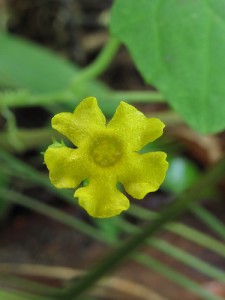
Dimpled five-petaled flower on a long stem

“Melothria pendula L. has been mentioned as a wild species of the Cucurbitaceae family in Mexico that continues without being studied to its full extend  (Lira et al., 1998). The necessity of proteins, for man as well as for the livestock, is of high priority, and for this reason that the production of plants as source of amino acids is researched.

According to the “chemical-bromatologic” analysis of this plant carried out in the present work, this vegetal species under study constitutes a source of water, vitamins, minerals and, amazingly, also proteins. The fruits of this plant, despite its reduced size, has a pleasant sweet flavor and are edible for humans. Besides, its foliage is given to livestock as forage.  For this reason, this “wild cucumber” could be an additional nutritional alternative for men and animals.”

They say it is 12.6% protein, 16.30% fiber and 56.8% carbohydrates. They also say the entire plant is good for ruminants. Propagation is by seed and cuttings. Not bad for a plant the Tarheel state lists as toxic. What I would like to know is whether the leaves cooked are fit for human consumption. I’ll have to find out some day. I know a couple of people who eat the leaves raw.

Of these five I would only eat the two light green ones.

There is also a lot of misinformation about what the plant’s name means. There isn’t much of a problem with “pendula” which means suspended, and indeed the little fruits hang on stems off the vine. Melothria is another issue. Carl Linnaeus, who invented Dead Latin names for plants, was the first to call the creeping cucumber Melothria pendula because it was similar in description to a plant of the same name referred to by ancient Greeks .Most contemporary references, which just copy each other, usually say the meaning of “melothria” is unknown but refers to a classical vine that may have been in the gourd family, the Bryonia Cretica. However, that’s not quite accurate. Melothria comes from the Greek word Melothron, which in ancient Greek meant “an apple” and where we get the word “melon” in English.  Milo still means apple in modern Greek. Thus the meaning of “melothria” is not at all unknown. It means apple, or little apple, but which plant it referred to is an educated guess. Both Theophrastes and Dioscorides referred to a particular plant as the Melothria, and it might have been, as mentioned earlier, the Bryonia CreticaB. Cretica is a little round gourd that looks very much like a tiny green apple that turns red when ripe. Calling it a “little apple” makes a lot of sense because it turns red. And, it definitely has toxic properties but is also edible in some ways. Yet here is where the academics always confound me: They say Theophrastes and Dioscorides might have been talking about a white grape rather than the red Bryonia Cretica.Let’s ponder for a moment… these Greeks called one of two plants a little apple. One of the plants has a small, round green gourd that turns bright red. The other plant is a grape that goes from green to whitish. So let’s ask ourselves the question: Would two botanical Greeks call a white grape a little red apple?  I don’t think so.  Where do academics get these ideas? Not in Greek class!The fruit of the M. pendula is only about one to two centimeters long and looks like a perfect, smooth, miniature watermelon. But, it has a definite “cucumber” aroma and taste, some times a slightly tart cucumber taste. They are crisp when light green, but grow mushy when dark green — like an overripe cucumber —  and not at all pleasant when black.  I suspect that if the seeds are purgative it is when they’re mature, which is what happens to another gourd, the Momordica charantia. M. Charantia is edible when green and cooked but quite toxic and not edible when ripe. To learn more about the M. charantia .Another little cuke that is close in size and use to the M. pendula but with no reports of laxative issues when ripe is Melothria scabra, or the Mexican Gherkin or Mexican Sour Gherkin. Its seeds can be ordered from a variety of seed-sellers online.

M. pendula (also called the Guadeloupe cucumber)  is a perennial vine with leaves that are palmately lobed — like a hand with pointed tips. The largest leaves, near the base of the plant, are about 2-inches long. The leaves grow smaller towards the tip of the vine. Like other members in the family, it has curly tendrils to grab other plants for support. The vines can reach many feet long and form mats or spiderweb-like drapes. The flowers are yellow and very small with five petals. Its preferred habitat is along the edges of marshes, sandy roadsides, low woods, parking lot shrubs, and almost any fence.

M. pendula is found from Pennsylvania to Florida, west to Texas and Nebraska, and throughout the world. Other scientific names include:  Melothria nigra, Melothria nashii, Melothria microcarpa, Melothria guadalupensis, Melothria fluminensis, and Melothria edulis.

Green Deane’s “Itemized” Plant Profile

IDENTIFICATION: Vine with slender, climbing stems and curled tendrils. Leaves dark green, three to five lobes, 1.5 to 3 inches, resembles English Ivy but more delicate. Flowers, small, yellow, five petaled, notched at the end.  Fruit looks like doll-size watermelon, green and mottled or lightly speckled when unripe, black when ripe, filled with juicy pulp and whitish seeds.

TIME OF YEAR: In northern climes in fruit in summer, like a cucumber. In southern areas it can fruit all year if no frost.

ENVIRONMENT: They grow from moist to occasionally watered spots, often found draping on shrubs.

METHOD OF PREPARATION: Young light green melon can be eaten out of hand or added to salads for a cucumber flavor and aroma. They can be pickled. Remember, do not eat dark green or black fruit. Otherwise they are a nice nibble.

{ 75 comments }