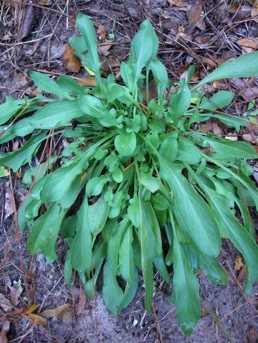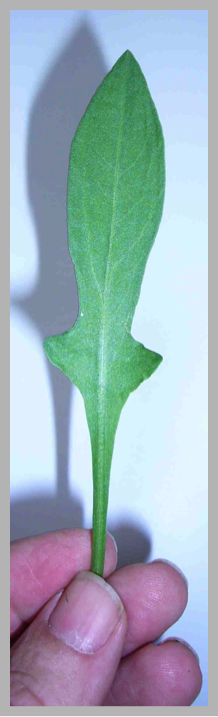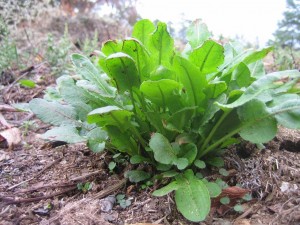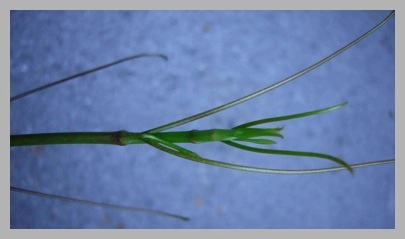
The stinging spurge nettle


Cnidolscolus Stimulosus: It’s The Real Sting

This is how to not dig up a spurge nettle root: Take a shovel, find a plant, and start digging.
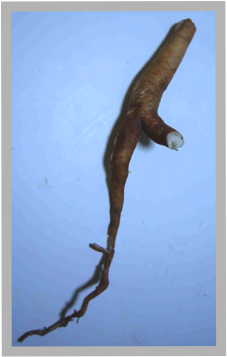
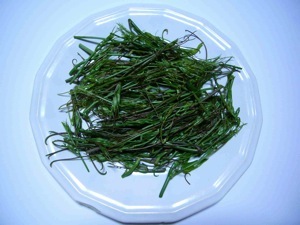
Root has a jacket that peels off when cooked

When I first started digging for spurge nettle roots (Cnidoscolus stimulosus) I couldn’t find any. I could locate and identify the plant with no problem. And, like many reports, I would dig and dig and dig and not find the root. In one account someone dug down six feet in a dune and still didn’t find the root. I spent more energy digging a hole than any root was ever going to give back in calories. I nearly gave up on ever actually finding a spurge nettle root. Then one day I was filling in yet another deep hole when I happened to notice a small piece of root was on the bottom of the huge heap of sand I had piled up…. and as they say, suddenly it all clicked and I have never failed to find a root since, and always within a foot of the soil’s surface.

What’s the secret? Well, the first thing is the spurge nettle root is, literally, fragile. It breaks very easily. Next, it tends to be, on the outside, the same color of the soil it’s in. When most people dig for the root they dig the wrong way and actually throw the root away with the dirt, never seeing the broken pieces.  Here’s the right way:
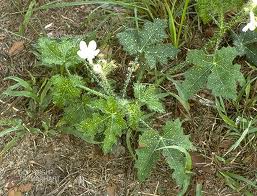
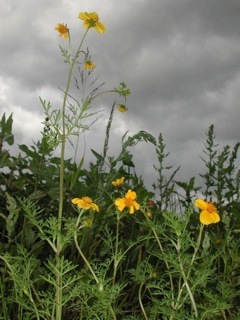
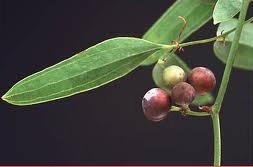
Cnidoscolus texanus

Find the plant. Using your shovel, measure out a shovel blade’s width away from the plant. Now start digging. You are digging a hole that is at least a half a foot or more to one side of the plant’s main stem.  Dig down a foot. By now you should have also gotten rid of all of the plant above ground (not with your hands!)  Using the side of the shovel at the bottom of your hole, start shaving the dirt away, horizontally towards the vertical root where the plant was. Take your time. By the the time you find the root, you will have a hole that is roughly shaped like a lop-sided triangle.
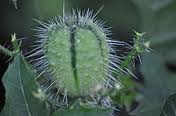
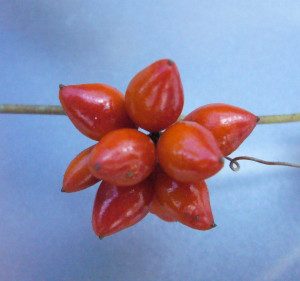
C. texanus seed pod, cover with stining spines

Reach in the hole now and then find the root. Don’t worry. The nettle stings only from just below the ground up. Once you find the root, finish digging by hand, or with a trowel. Remove all the dirt away from the root. If you pull on it in any way it will snap. Of course, you can cook it whole or in parts. It’s kind of shaped like a cross between a carrot and large sausage with a potato- or earth-colored skin. The bottom end does get skinnier so you will have to break it at some point and trim off the stem top.
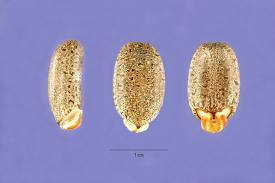
C. texanus seeds, edible

I boil the spurge nettle root then peel it, like a potato. Some times the outer cover come off more like bark, depending on the age of the root. It has a non-edible cord — read too tough to eat — up the middle that pulls out like a string. Once cooked, some folks put the root through a ricer to make it softer, I just chop it up. With butter, and a little salt and pepper, spurge nettle root tastes like pasta to me. Oh, and it is always al dente. It becomes edible but is never “soft” but rather like an old potato in texture.  I recently read one reference that said don’t eat the upper portion of the roots. Never knew that, haven’t been bothered by said. I don’t eat the stem but the upper part of the root is the main part. I shall continue to eat the entire root. Beside, if there are cyanonic glycocides present they will be driven off by the boiling.  Don’t cook in aluminum.

If you didn’t get rid up the above-ground part of the plant,  you will probably converge with the spurge and have the urge to submerge the spot stung in cool water. The spines are like little glass spikes full of acid.  Is the sting agony? No. Is it God awful? No. Does it burn? Oh, yes. Will it irritate you for an hour? Most certainly. Will you wish you hadn’t brushed up against it? Absolutely, but it is not horrible and it will be gone soon. (Our local “stinging nettle” in the Urtica genus is far, far worse.) Fire ants are far worse as well and they can make you itch for weeks. Be a man, even if you aren’t, and get on with digging up the root. The pain will pass in an hour or so. Eating the root will be just revenge for the sting.

That the root of the C. stimulosus is edible is not in question, but what about the seeds?  In the book “Edible and Useful Plants of Texas and the Southwest: A Practical Guide” by Delena Tull, 1999, the author tells how to harvest the seeds of the Cnidoscolus texanus, a close cousin of the C. stimulosus. No mention is made about eating the root of the C. Texanus. That’s a tad odd. So, what about the seeds of the C. stimulosus since we know the root is edible? There are some unattributed comments on websites that say they are edible but no authorities quoted and no one saying they in fact ate some of the C. stimulosus seeds themselves.

In Florida Ethnobotany by Dr. Daniel F. Austin, 2004, he quotes Professor Julia Morton — the grand dame of botany in Florida — as saying the roots and the seeds of the C. stimulosus are edible, referencing her 1968 edition of “Wild Plants for Survival In South Florida.” That would seem to settle it since Morton was and still is the authority. However….

My concern is I own the fifth edition of that very same book printed in 1982, and referenced by Austin and the Orlando Public Library also has the 1962 edition. Despite Austin’s reference to it there is no reference to edible seeds of the Cnidoscolus stimulosus in either edition. Perhaps it was included in the 1968 edition but not the ’62 or the ’82, which are identical. It could also be a mis-reference and she wrote about it in some other book, or Austin just got it wrong. Morton was very careful and her word on poisonous plants is still law more than 20 years after her accidental death… no, it was a car accident not a plant accident. I have seen one reference to C. stimulosus saying the seeds were edible but no mention of the root, which is odd. I have yet to find in the same reference say the root AND the seeds are both edible, which makes me think folks are copying information and don’t really know.  Incidentally, C. stimulosus is one of the few plants with milky sap that produces an edible root (cooked.)

There is a hint that the C. texanus root might be edible. A 1954 study said:  “The root of C. texanus, heretofore not examined chemically, has been found to be high in carbohydrate content with alkaloids and glycosides absent, or present only in negligible quantities. Other interesting facts observed in this investigation indicate that the root system as well as other parts of the plant might be worthy of further investigation.”

Lack of alkaloids and glycosides is good news.  I suspect the roots and seeds of each are edible but that is yet to be demonstrated. A 2007 study of the C. texanus root found 26 known compounds which included 15 flavonoids, three coumarins, three coumaric acid derivatives, four triterpenoids, one phytosterol and three new compounds… All flavonoids were found to be inactive against DNA topoisomerase. A 1957 study showed the seed oil of the C. texanus to be 28% protein, nearly 28% oil and 29% crude fiber. Ash 4%. The acids were oleic 24%, linoleic 59%, saturated 12%.

As for the scientific names, again opinions differ. Since the name is from Greek first a little lesson in Greek. Greek verbs have a main part, the stem, and an ending. The verb stem “to sting”  is “tsou.”  To that is added endings telling you who or what is stinging. Tsouzo (TSOU-zo) means I sting, tsouzee, means he, she, it stings. The word for nettles is tsouknitha (tsouk-NEE-tha) combining tsou with knitha, which might mean “it stings a little.”

So the genus name Cnidoscolus is from two Greek sources pulverized through Latin. Cnido is cleaved from tsouknitha (k-NEE-tha)  The Romans had no “K” sound so they got rid of it and used C in front of the N to indicate it was from Greek and the C silent. Scolus is from the Greek word “skolop” meaning “a thorn” but with a Latin ending.

How that all is pronounced is a bit of preferences. kah-knee-doe-SKOHL-us is close to the original Greek, if you don’t mind cutting a word in half and adding a Latin ending.  Anglicized Latin truly bastardizes the Greek, drops a syllable, changes the accent and pronunciation getting: nye-DOSE-ko-lus. I have also heard sss-need-doe-SKOHL-us which offends both languages. There is no beginning SN sound in native Greek or Latin.

The species name Stimulosus is from Latin stimul(us), meaning to “goad”, “prod” or “urge”.  Its nickname in Spanish is Mala Mujer,  “bad woman” but several plants carry that nickname. There are about 75 different spurge nettles worldwide.

Part of the common name, spurge nettle, reaches way back, about as far as records go. Spurge and purgatory come from the same Latin word, pugare, to purge. Nettle comes from Sanskrit which was nahyati. That passed into Latin as nassa, became nezzi in Old German and nettle in English. Nettle was a fiber plant and in Latin it meant fish net. So the spurge nettle captures you for pain…. sounds accurate to me.

Green Deane’s “Itemized” Plant Profile

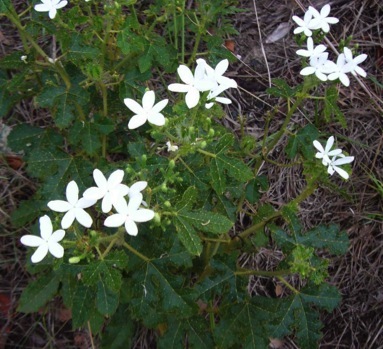
IDENTIFICATION: Perennial plant to a foot high covered with stinging hairs; leaves alternate, simple, palmately 3-5 lobed; flowers white, tubular, appear to be five petals, fruit three-seeded capsule. It is reported to bloom all year here in Florida but it is most showy in the spring and early summer.  (The C. texanus leaves are more crinkly than the leaves of the C. stimulosus.)

TIME OF YEAR: Gather any time, best in fall, the larger the plant the larger the tuber

ENVIRONMENT: Forest or other natural areas in sandy woods; old fields, roadsides, dry pastures, dunes. Its range is basically the antebellum South east of the Mississippi. C. Texanus is found west of the Mississippi. Louisiana has both.

METHOD OF PREPARATION: C. stimulosus: Boil whole like a potato, 20 minutes, does not get soft like a potato, has some tooth like undercooked pasta. After cooked, remove peel and stringy inner core, which is too tough to eat. C. texanus: Roast seeds after removing from their hulls. How to remove them from their shell? Put the seed pods in a paper back and leave in a warm, dry place. The pods will crack and the seeds can be shaken out.

{ 39 comments }

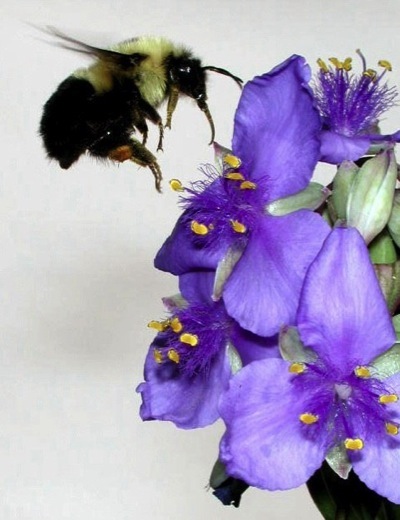
Bee landing on a Spiderwort blossom taken on film by Green Deane before there were digital camera


Captain John Smith, 1580-1631

There are 412 years, as of Dec 20th, 2017, between the sailing of John Smith to the New World and spiderwort gamma rays, but they are connected including Pocahontas.

Smith was a colorful character. He went to sea at 16, was a mercenary, fought against the Turks, was wounded, enslaved by them, escaped, killed three Turkish commanders in separate duals, was knighted by a Transylvanian prince, and by December 1606 at the age of 26 was sailing to America.  It was not a smooth voyage. The ship’s captain had planned to execute Smith on arrival for his bad behavior during the trip. But, when they arrived they opened sealed papers from the Virginia company: The man who was to be hanged was put in charge. Now that’s a reprieve.

“Sedgeford Portrait ,” said to represent Pocahontas and her son, authenticity debated.

Life was rough for the Jamestown Colony. Food was scarce. Sailors were reluctant to farm, which prompted now Captain Smith to make one of his more famous pronouncements: He who doesn’t work doesn’t eat. That got the weeds pulled. Smith’s dealings with the natives — where he met “Pocahontas” actually named Matoaka — were as strained. They were the only grocery within thousands of miles and he didn’t always pay. Indeed at one point Smith was to be execute for bad credit. It’s a good thing he wasn’t killed because Smith had other tasks, besides evading executions, and that was to collect seeds for his friend, John Tradescant, the elder.

John Tradescant, the Elder

Tradescant, a decade older than Smith, had fought here and there as well but he was also always picking up seeds and items of interest. He was truly the first naturalist of record. Because of that, Tradescant began gardening for various nobles and in time was the gardener to Charles I, a position his son John, equally as talented and famous, would also hold.  The elder Tradescent introduced many plants into England including Cos Lettuce from the Greek isle of Kos, birthplace of Hippocrates. Think of that the next time you have some Cos lettuce, or Romaine as it is called in America. 

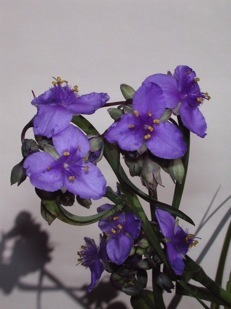
Flowers are only open for a day

Smith was able to return to England with seeds of what is commonly now know as the Spiderwort, which is still popular in English gardens. When plants were being named, the Spiderwort, because of its association with the Tradescant family, was given the Latin name Tradescantia virginiana (tra-dess-CAN-tee-ah vir-jin-nee-AY-nah (In the plant world, Virginiana means North America.) The Tradescantia is in the greater family of Commelinaceae, worthy of a separate article some day.

Why the Spiderwort is called that is in dispute. Wort is Old English for plant, so that part is not in contention. There are four reasons given for the “spider” part.  1) The viscous sap will pull out like a spider thread when a leaf or stem is broken. 2) The clusters of blossoms look like spiders hanging from a web. 3) The plant is leggy and in toto looks like a really huge spider on your lawn. (And my favorite, 4) dew on the plants stamen hairs look like drops of dew on a cobweb.

Flowers are always in clusters

The Spiderwort is sometime called a Day Flower, as is its cousin the much smaller Commelina, which is also edible,  Flowers on both stay open only one day. The Spiderwort has numerous family members, perhaps two dozen in the United States, many if not most of them edible. Check with your local expert because a couple of crawling siblings definitely are not edible and can also cause dermatitis — especially non-green and stripped varieties, Tradescantia pallida comes to mind. Most common edible on my postage stamp lawn is the Tradescantia ohiensis, though the truth is the species are harder to tell apart than twins in the dark. Here in Florida, the

Stems can be cooked like asparagus

height of its season is late in the spring but it also blossoms nearly all year, and more importantly, as it ages it does not grow rank. Its leaves do not change in flavor as the plant ages. The leaves are good for salads as well, or in soup and stews but they are mucilaginous. The stems can be braised like asparagus. Spiderwort remains a popular edible because they are one of the few salad greens that can take Florida’s summer heat. The flowers, at one time favorites for candying, make very pretty blue additions to back yard salads. There are white and rose blossoms, too, but they are too rare to eat. Also, Tradescantia fluminensis, which looks like a Commelina with a white flower is edible, too.

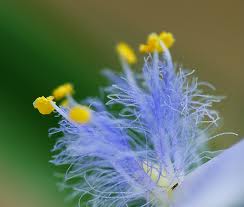
Radiation turns blue hairs to pink

Oh, and the gamma rays… The cells of the stamen hairs of some Tradescantia — the wispy hairs that look webesque when moist with dew — are “bioassays for ambient radiation levels.” Or said another way: The hairs are blue. When exposed to gamma radiation they turn pink. So if you think you’ve been near a nuclear explosion, just check your nearest Tradescantia.

To read about dayflowers, Commelinas, click here.

Green Deane’s “Itemized” Plant Profile

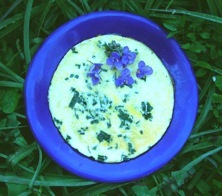
Tradescantia Omlet

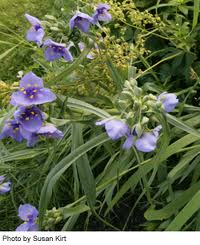
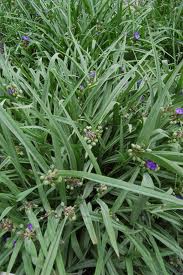
IDENTIFICATION: Clumpy perennial to two feet tall, violet-blue to purple, three-petaled flowers with contrasting yellow stamens, open up a few at a time for only one day, numerous flower buds. Flowers bloom year round in Florida, late May to early July in northern climes.

TIME OF YEAR: Leaves and flowers year round in Florida, leaves all but winter up north, flowers spring and early summer.

ENVIRONMENT: Grows in average, medium moisture, well-drained moist acidic soil, full sun to full shade. Tolerates poor soils. Lawns, roadsides, moist waste areas

METHOD OF PREPARATION: Leaves raw in salads —green tasting — leaves cooked in soups, stews, omelets, Spiderwort stalks cook well like asparagus.  Flowers in salads, or candied.  Doesn’t grow rank as season progresses. Sap used on skin conditions.

{ 28 comments }

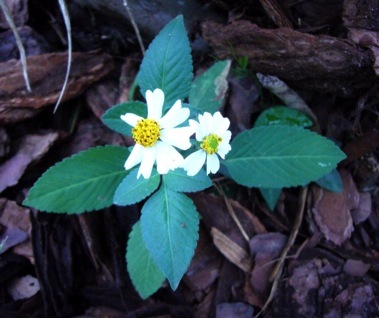
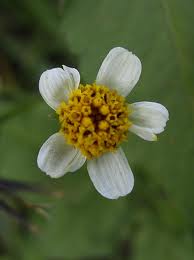
Bidens Alba, up close

Bidens Alba: Medical Beggar Ticks

Some edible plants just don’t get any respect. If there were a contest for under appreciated plants, Bidens alba, would be a heavy-weight contender.

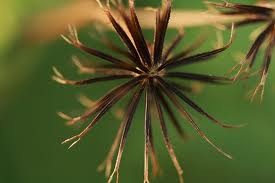
Biden alba seds, note the two teeth

Nearly anyone you ask about Bidens alba who knows it will say it’s a weed, not a pretty one, nor a useful one, not a nice one. Yet, honey production everywhere would be hurt without the Bidens family. In Florida, B. alba is the third most common reliable source of nectar. Quite an accomplishment for a weed growers and suburbanites are constantly trying to get rid of. Also, without the Bidens species many a butterfly would go to bed…ah…roost… hungry. (The second most common nectar producer in Florida is the saw palmetto and the top producer is the non-native, citrus which Greening might kill off.)

The B. alba aka Bidens pilosa (BYE-denz AL-bah, pil-OH-suh) also has an edible flower. It’s a tangy if not vigorous addition to salads. Bidens’ young leaves — a few at a time — are suitable for the salad. Shoots, tips and young leaves are good potherbs. It’s dried leaves are also a favored in Hawaii for tea. All of this, yet few guidebooks on wild edibles mention it.

TIMEOUT: Much confusion reigns whether B. alba and B. pilosa are the same or different species. One can find both references, and combinations as in B. pilosa var. alba. A 2006 genetic study showed they are separate species, even if

Bidens pilosa has shorter petals.

the difference is little. So, how can we tell them apart (though it makes little difference as both are eaten.) B. alba is the larger and better (I use “Big Al” to help me remember.)  Its blossom petals are usually a centimeter long or longer, and it has five to eight petals. Think of the B. pilosa as smaller and lesser. Its petals are under a centimeter in length, usually 8 mm or less. It has four to seven petals, or none at all. Some times the geography helps. In Brazil, for example, B. alba grows only on the coast and B. pilosa inland, at higher elevations. Realistically, the differences mean little to us as they are both edible.  Locally we have B. alba with B. pilosa occurring officially in only one northern county, Gulf County. We now resume our article already in progress:

As I  said on one of my videos nature doesn’t know the difference between a cultivated plant and a wild one: She only knows survivors. And Bidens alba — also called Romerillo — survives. It grows so happily in my yard I can’t keep up with it. Left to its own, it will take over any unmown spot and populate it with as many Bidens per square foot as possible. Now you know why it is called an “invasive” species. It can have up to 6,000 seeds per plant and the seeds can remain viable up to five years.

Bidens odorata

As for the edibility of the Bidens species, several are mentioned as edible. Find out which Bidens are in your area. The state of Florida does not list Bidens as a plant species that can cause harm, though it has had medical uses, and that in and of itself is a warning sign we shouldn’t ignore. There are at least two negative references I know of about Bidens pilosa. One is that B. pilosa is one of the few plants that can have a harmful effect on the skin because at least one of its chemicals reacts to light (some herbalists, however, consider that beneficial.) The other is B. pilosa (which is the most commonly eaten Bidens) may have a role in throat cancer in areas where opals are also found. This is because B. pilosa will uptake a form of silica — the same that creates opals — and that can have a topical cancerous effect. So if you have “Opaline Silica” in your area — they mine opals there — you might want to pass on the Bidens (I would presume B. alba would also uptake but I do not know.) On the other hand, however, Bidens is also shown anti-cancer activity.

Bidens is in the Aster family, a dicot with a root that goes vertical, not horizontal. That also makes it a composite and a relative of the sunflower. There are hundreds of species — authorities differ on the exact amount. The common names include beggar ticks, bur-marigolds, stickseeds, Spanish needles, tickseeds, tickseed sunflowers, and pitchfork weed.  This is because its seed has two prongs on it that (sometimes four) stick to almost anything. And in fact “Bidens” means two-toothed. Alba is white and pilosa means hairy, or the feeling of hairiness. The Bidens odorata, a frilly yellow version, is also edible though it is a diuretic.

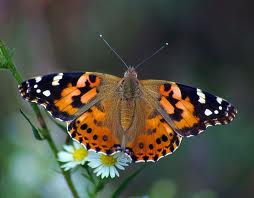
Vanessa cardui, the Painted Lady

By the way, Bidens are “zoochorous” which means the seeds are spread by animals, like the burdock. While the combination does not loose in translation from Greek, it does suffer in pronunciation. “Zoo” is not said like a collection of animals. Rather it is  zoh-OH, which means “animal.” And “chorous” does not sound like a singing group. It comes from the verb score-REE-zoh, which means “I disseminate.” So, if you want to use that word and be close to the original Greek, it is five syllables: zoh-oh-score-REE-zoh.

Several Bidens are food for the caterpillars of some Lepidoptera, such as the Hypercompe hambletoni and the Painted Lady (aka, Vanessa cardui, the brush-footed butterfly). It is said only Sulphur Butterfly feeds off the B. alba as it has phytosterin, which can be a central nervous system depressant and lowers blood sugar.

As for the medical implications, in 1991 Egyptian researchers documented Biden pilosa had antimicrobial activity against a wide array of bacteria including Salmonella, Staphylococcus, Neisseria Gonorrhea, Klebsiella Pneumonia, and against Tuberculosis. It is also good for malaria, snake bite and has anti-leukemia activity.  Research shows it lowers as mentioned blood sugar and blood pressure, stimulates the immune system and is anti-inflammatory. The powdered seeds are a topical anesthetic and aid clotting. There are also some reports the seeds might be good for prostate issues and use for lungs affected by COVID. And after all this the Bidens still gets no respect.

These’s between 240 and 280 known Bidens. Why they don’t know exactly how many Bidens there are is because of multiple and perhaps unnecessary names and or varieties. The nutritional composition of the Biden pilosa (and presumably the B. alba) per 100 g edible portion is: water 85 g, calories 43, protein 3.8 g, fat 0.5 g, carbohydrate 8.4 g, fiber 3.9 g, β-carotene 1800 μg, (Leung, W.-T.W., Busson, F. & Jardin, C., 1968). Another study found 111 mg of calcium and 2.3 mg of iron. These researchers also recommend you don’t eat the leaves raw because of a high saponin content. As a potherb they are excellent with many fine qualities: They are available all year round, keep very well, and don’t reduce in size when cooked. If they are a bit tangy, just let them sit cooked a few minutes. They store well. Cooked texture is good. Wine made from Bidens is called sinitsit. Incidentally, dried leaves of the B. Alba also make a good tobacco substitute. In 1962 Professor Julia Morton, who wrote many papers for the Journal of Economic Botany, recommended Bidens become a commercial crop.

B. pilosa also has 60 identified flavonoids including Quercetin and Luteolin. Among the micro nutrients are beta-carotene 1800 μg (which is pre-vitamin A) calcium 340 mg, phosphorus 67 mg and 2.3 mg of iron when dried. (Food Composition Table for Use In Africa, Leung, W.-T.W., Busson, F. & Jardin, C., 1968) Interestingly the dried plant has less calcium (111mg) and phosphorus (39) than the raw material. Usually dried “tea” material increases concentrations. 

There are many edible Bidens and they grow just about everywhere so check out your local species. Those with edible leaves include Bidens bipinnata, Bidens frondosa, Bidens odorata, Bidens parvifolia, Bidens tripartita and Bidens laevis.  Leaves of the Bidens aurea and Bidens bigelovii have been used for tea.

Synonyms for the Bidens Alba/Pilosa include:  Bidens abortiva, Bidens adhaerescens, Bidens alausensis, Bidens chilensis,  Bidens hirsuta,  Bidens leucanthus, Bidens Montauban, Bidens odorata, reflexa, Bidens scandicina…. and….Bidens leucantha var. pilosa, Bidens pilosa var. alausensis, Bidens pilosa var. bimucronata, Bidens pilosa var. minor, Bidens pilosa var. pilosa, Bidens pilosa var. radiata, Bidens pilosus, Bidens pilosus var. albus, Bidens scandicina, Bidens sundaica var. minor, and Coreopsis leucantha

 Green Deane’s “Itemized” Plant Profile

IDENTIFICATION: Compound leaves composed of 3-9 saw toothed oval leaflets. The leaves are one to five inches long and up to two and a half inches wide, bright green on top and hairy underneath. Plant tends to sprawl and root at the lower nodes if it touches the ground. The one-inche flowers in stalked clusters look like coarse daisies with five or more white rays and pale yellow centers. The ribbed seeds resemble flat black needles with 2-6 barbed hooks at each end.

TIME OF YEAR:  Spring to fall, but year round in warmer climates around the world

ENVIRONMENT:  Not fussy about soil but prefers full sun.

METHOD OF PREPARATION: Young leaves, tops, shoots as potherb. Some young leaves can be used raw in salads. Try a little first. Flower petals as a trail side nibble or a bit of white in salads. Dried, the leaves can be used as tea or smoked like tobacco. The flowers are mixed with sticky balls of rice and allowed to ferment in water to make a spirit. The leaves are also used in making  wine.

{ 80 comments }

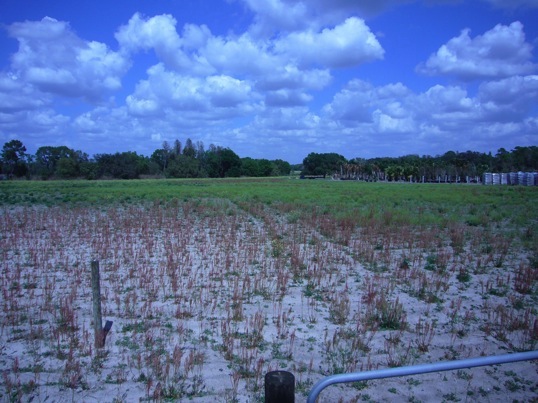
A field of Sorrel and Wild Radish


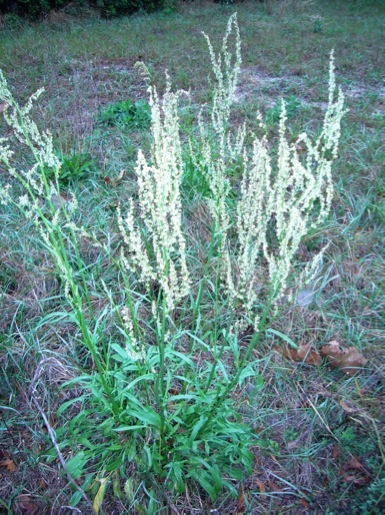
Sorrel putting on seeds

Of all the Rumex that grow in the South, Rumex hastatulus is probably the most pleasing. The tart-tasting intensely green leaves are hard to misidentify — edible wise — and the bloom that turns from white to red is pleasing to the eye. Its nickname is the Heartwing Sorrel, describing the mature reddish, winged seed pods.

Because of the leaf shape though, the R. hastatulus is sometimes confused with the also edible Rumex acetosella. R. hastatulus has a tap root and reaches two feet high or more. R. acetosella doesn’t have a tap root and is more mat growing rarely getting above 18-inches high. The R. hastatulus has broadly winged seeds, the R. acetosella does not.

Rumexes are also known as Dock. Actually tall Rumex are called dock and short Rumex are called sorrels. There are some 200 species in the genus. The word Rumex (ROO-mecks) was borrowed is from the Dean Latin name for a similar sorrel in Europe. It comes from Rumo which was taken from the Greek word Rufo, meaning to suck. Romans used Rumix leaves like lollipops. Hastatulus (has-TAT-you-lus) is shaped like an arrow or spear and refers to the shape of the leaves. Acetosella is said ah-kee-TOE-sell-uh, or, ah-see-TOE-sell-ah

A basal rosette of very tasty, tart leaves

Rumexes have long been used in salads and as a potherb. I think they are a great stuffing for that fish you just caught. However, they’re best known in a sorrel soup made by the French.  Here’s a sorrel soup recipe to serve six from Fernald and Kinsey’s Edible Plants of Eastern North America, 1958 edition, (though several sorrel soups recipes are available on the internet:)

“Wash (a handful of sorrel) and put in a saucepan with a little water (not covered.) Cook slowly for about a half an hour. Put four cups of milk with a small white onion (whole) in a double boiler. Add two teaspoons of butter, and two tablespoons of flower (blended to avoid lumps) to the hot milk.  Let stand and add sorrel. Strain, discard the sorrel, season the soup and enjoy.”

Note the hastate shaped leaf

Every book on wild foods warns us not to consume too much oxalic acid, but that’s to keep the accursed lawyers happy. ( Shakespeare was right.) It is true that folks with kidney stones, gout and the like should not over-consume oxalic acid. Yet, when was the last time you read or heard of such a warning for tea, parsley, rhubarb, carambolas, spinach, chard, beets, cocoa, chocolate, nuts, berries, black pepper and beans? They all have oxalic acid as well, but no dire warnings are given with them. The French are not succumbing from sorrel soup slurping. As my Greek ancestors used to say some 3,000 years ago, μέτρον άριστον, [ME-tron A-ri-ston] all things in moderation.

The word “sorrel” is from the High German word sur, meaning sour. Oxalic is from Greek — oksinos, όξινος  — and also means sour, and the rumex is mildly tangy because of …oxalic acid… now there’s a surprise.  They are refreshing to nibble on, are nice additions to salads. Their tart flavor is both positive and negative. A little is good, but a lot when eaten uncooked, to excess, can leach some calcium out of your bones. (Yes, you would have to consume it like a force-fed lab rat for months, but it can happen.)  Rumex, by the way, is in the buckwheat family. Lastly, research on Rumex induratus shows it has antioxidant properties. Let’s hope it runs in the family.

Green Deane’s “Itemized” Plant Profile

Rumex pulcher, native of Europe found through much of the east of the United States west to Texas. Look for hairy stems. Leaves and seeds are edible.

IDENTIFICATION: Moderate plant with white to greenish flowers on a long stalk. Young leaves shaped like a fat sword with hilt, older leaves long and lance-shaped, edges wavy. Great variety, your local rumex may look very different. Get proper identification. R. Hastatulus is a winter annual in Florida. However, I have seen it occasionally in late spring and early fall.

TIME OF YEAR:  In February in Florida, springtime elsewhere, can overwinter evergreen in warmer states, can last into summer. It ranges from Central Florida north to New England, west to New Mexico and Montana.

ENVIRONMENT: Old pastures, roadsides, sandy areas, can tolerate a dry conditions.

METHOD OF PREPARATION: Leaves in salad, or made into soup. See recipe.  If you  cook any Rumex best to use a glass or ceramic pot. Like all plants with oxalic acid should be used in moderation. Some people may be allergic to it.

HERB BLURB

A nettle sting is painful because the sting contains acid. Rubbing the sting with a sorrel leaf  or any of the docks/rumex can relieve the pain because they contain an alkali that will neutralize the acid and reduces the sting. The same leaves work well on bees and ants stings but soap or bicarbonate of soda are better, if you have either.  Sorrel will not work against wasp stings because they contain an alkali. To neutralize those you need an acid such as vinegar, citric acid, pickle juice even tomato juice.

{ 19 comments }

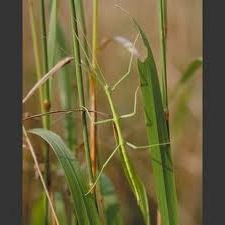
Smilax looks like the “walking stick” insect

For The Edible Love of Krokus and Smilax

No, that is not a “Walking stick” insect. It is the growing end of a Smilax, a choice wild food.

The Walking Stick insect

There used to be a field in west Sanford, Florida, near Lake Monroe and the zoo, that was nearly overrun with growing Smilax every spring. I could get a couple of quarts of tender tips daily over a few weeks, enough for many meals. Cooked like asparagus or green beans, they are excellent, and also edible raw.

The tip grows from the end of the vine and gets tougher as one goes back along the vine. Technically that is called

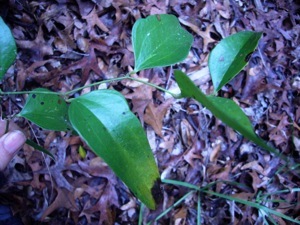
Bull Briar leaves, edible when young

the meristem stage, that is, the growing part is almost always the most tender because the cells haven’t decided what it is they’re supposed to do, such as get tough and hold up the plant or create an odor or the like. The way to harvest smilax is to go back a foot or so from the end of the vine (more if it is a very large vine, less if small) and see if the vine snaps, breaks clean between your fingers. If not, move closer towards the growing end of the vine and try it again. Where the vine snaps and breaks is the part you can take and eat. Well-watered bull briers (Smilax bona-nox, SMEYE-laxs BON-ah-knocks, that’s SM plus EYE) in a field or on a sunny tree can produce edible shoots a foot long and third of an inch through. Smilax is from the Greek smilakos, meaning twining but there is more to that story.  Bona-nox means “good night” and usually refers to plants that bloom at night.) The Spanish called them Zarza parilla, (brier small grape vine) which in English became sarsaparilla, and indeed sarsaparilla used to come from a Smilax.

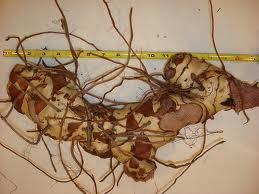
Large roots are fibrous. Photo by Green Deane

Often called cat briar or bull briar because of its prickles, Smilax climbs by means of tendrils coming out of the leaf axils. Again, technically, it is not a vine but a “climbing shrub.” I have no idea why someone thinks the distinction between vine and climbing shrub is important   Smilax are usually found in a clump on the ground or in a tree. They provide protection and food for over forty different species of birds

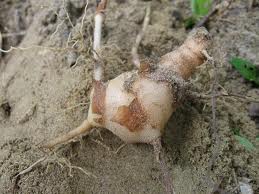
Young roots can be boiled or roasted

and are an important part of the diet for deer, and black bears. Rabbits eat the evergreen leaves and vines, leaving a telltale (tell tail?) 45 degree cut. Beavers eat the roots. Smilax also has a long history with man, most famous perhaps for making sarsaparilla. The roots (actually rhizomes) of several native species can also be processed (and are calorie negative requiring more energy to process than obtained) to produce a dry red powder that can be used as a thickener or to make a juice. Young roots — finger size or smaller — can also be cooked and eaten. While the tips and shoots can be eaten raw a lot of raw ones give me a stomach ache.

Fruits are edible when old. These are not old.

Medically, the root powder has been used to treat gout. A Jamaican species contains at least four progesterone class phytosterols. Some herbalists recommend that species for premenstrual issues. In 2001, a U.S. patent application said Smilax steroids had the ability to treat senile dementia, cognitive dysfunction and Alzheimer’s. A U.S. patent awarded in 2003 described Smilax flavonoids as effective in treating autoimmune diseases and inflammatory reactions. Note: These are patents claims in anticipation of clinical trials some distant day proving said claims by further research. So don’t start digging up Smilax roots for self-medication.  A 29 Feb 2008 study suggest Smilax root has antiviral action and a 2006 study suggest it is good for liver cancer.

It should be mentioned that early American settlers made a real root beer from the smilax. They would mix root pulp with molasses and parched corn then allowed it to ferment. One variation is to add sassafras root chips, which gives it more of the soft drink root beer flavor. Francis Peyre Porcher wrote during the Civil War in the 1860’s  “The root is mixed with molasses and water in an open tub, a few seeds of parched corn or rice are added, and after a slight fermentation it is seasoned with sassafras.”

Francis Peyer Porcher, professor of medicine

Can we take an aside here? Francis Peyer Porcher, 1824-1895, was a doctor, professor of medicine, and a botanist. Through his mother’s side, he was a descendant of the botanist Thomas Walter, author of Flora Caroliniana, the first catalog of the flowering plants of South Carolina, published in 1788. Peyer, as he liked to be called, was, as they used to say, well-to-do. He was professionally active in both fields — medicine and botany — when the American Civil War began. Because of the blockade of medical supplies he was ordered to write a field manual for doctors to help them find and make the drugs they needed in the

Dr. Porcher circa U.S. Civil War

absence of supplies. His work, Resources of the Southern Fields and Forests, is still a reference and I have an ebook copy of it. It was so popular in his day that newspapers carried excepts of it. His effort was credited with helping the South prolong the war. We are fortunate to have two photographs of him, one presumably around war time and the other when he was again a professor and active in medical circles.

There are about 300 or more species in the genus Smilax and are found in the Eastern half of the United States and Canada, basically east of the Rockies.  Fourteen species are found in the southern United States. Smilax gets its name from the Greek myth of Krokus and the nymph Smilax. The story is varied. Here’s one version: Their love affair was tragic and unfulfilled because mortals and nymphs weren’t allowed to love each other. For that indiscretion, the man, Krokus, was turned into the saffron crocus by the goddess Artemis (because she, too, was having an affair with Krokus but as a goddess that was okay.) Smilax, actually woodland nymph, was so heartbroken over Krokus’ reduction down to a flower that Artemis took godly pity on her and turned Smilax into a brambly vine so she and Krokus could forever entwine themselves. There are far less poetic and more naughty versions. Seems it was a popular story thousands of years ago with many variation and interpretations.

Oh, about that field in Sanford: A century ago it was a truck farm producing celery and other vegetables. Then it fell fallow growing Smilax. Now it’s an apartment complex. Dried Smilax root was also used to make rather poor pipe bowls. Wooden pipe bowls are made from Erica arborea, a shrub-like tree in the heather family native to the Mediterranean area. However, as the smilax root dries it shrinks dramatically making a pipe tiny, so start with a huge root and don’t fit it out until completely dry.

The red berries of Smilax walteri. Photo by Green Deane

Also the growing Smilax tips can become bitter and peppery in hot weather, it is best to boil those. I eat all of the ripe berries except for Smilax walteri (because they are red. I have no evidence they cannot be eaten, I just assume they are red for a reason and I am just following best practices. There is a red-berried smilax on Crete (Smilax aspera) which turn black with age and are not toxic but are considered unpalatable.

Green Deane’s “Itemized” Plant Profile

Boiled Smilax tips ready for butter and seasoning

IDENTIFICATION: A climbing shrub with tuberous roots, knobby white roots tinged with pink, bamboo like stems, more or less thorny, leaves varying with species and on the bush, tiny flowers, five slim petals, fruit round, green turning to black, one small brown seed.  Some species have red fruit, edibility of red fruit unreported.

TIME OF YEAR: Starts putting on shoots in February in Florida, later in the season as one moves north. Seeds germinate best after a freeze.

ENVIRONMENT:  It grows best in moist woodlands, but can tolerate a lot of dry and is often seen climbing trees. Left on its own with nothing to climb it sometimes creates and brambly shrub. Thicket provides protection for birds.

METHOD OF PREPARATION: Beside making sarsaparilla, the roots can be used in soups or stews, young shoots eaten cooked or in small quantities raw,  berries can be eaten both raw and cooked. The best use is to dry ripe berries then consume them. Pounds of roots to pounds of flour is a 10 to one ratio.

{ 126 comments }