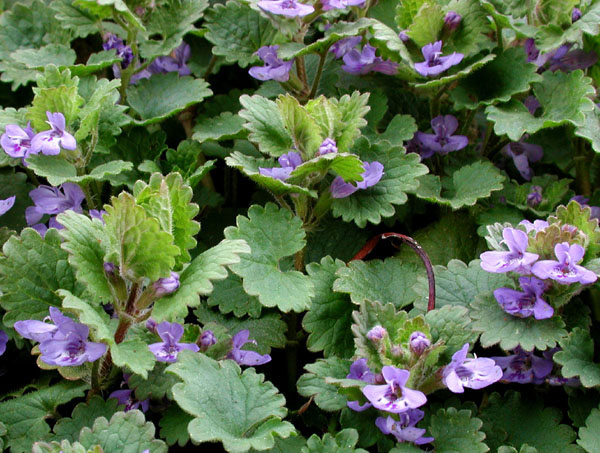
Ground Ivy has scalloped leaves like Henbit and Dead Nettle

Most of the time when someone mentions Ground Ivy the comment usually is something like “How do I get rid of the damned stuff?” Here at ETW we have have the solution.
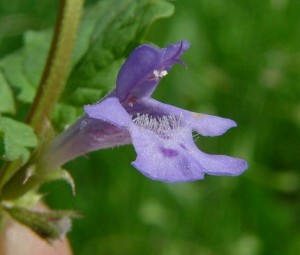
Ground Ivy Flower

Ground Ivy, Glechoma hederacea, is a creeping perennial that roots at the nodes and smells similar to mint when crushed or mowed.  It’s a prime weed of turfgrass and landscapes. If you like well-behaved English type gardens then Ground Ivy will drive you insane because it may be small but it’s the Botanical Bull in the China Shop. It doesn’t take over, it takes command. While there are no look alikes — if you look closely enough — there are four species which from some distance might be mistaken for Ground Ivy. It is often misidentified as a Common Mallow (Malva neglecta), but the square stem of Ground Ivy distinguishes it from the Common Mallow which has a round stem.  Henbit (Lamium amplexicaule), Purple Deadnettle (Lamium purpureum) and Persian Speedwell (Veronica persica) are somewhat similar in appearance to Ground Ivy, but none of them have creeping stems that root at the nodes. Of these four all but the Persian Speedwell are edible.
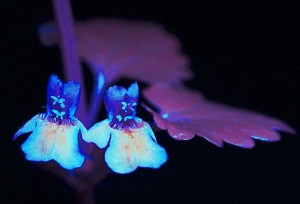
What Insects See in Ultraviolet Light, Photo by Bjørn Rørslett – NN/Nærfoto

Ground Ivy, once known as Nepeta glechoma and Nepeta hederacea in the Catnip genus, is a native of Europe and southern Asia. It was introduced into North America by 1672, probably earlier, for medicinal uses. Ground Ivy moved west and was naturalized in Indiana by 1856 and Colorado by 1906. How and exactly when it was distributed is not known. While it concentrates in the deciduous and riparian forests of the Northeast and around the Great Lakes it is now found throughout North American except for the desert southwest (New Mexico, Arizona, Nevada) and the three top tier northwest Canadian Providences (the Yukon, Northwest Territories, Nunavut.) It also surprisingly missing on the east end of the continent from the islands of Saint Pierre and Miquelon.
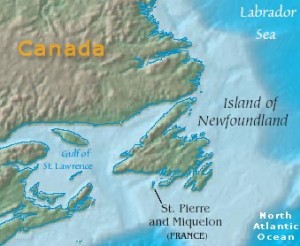
Saint Pierre and Miquelon

Don’t know where Saint Pierre and Miquelon are? This is your lucky geographic day: The islands are situated at the entrance of Fortune Bay off the southern coast of Newfoundland. They are not part of Canada but still part of France, a leftover toehold in the New World from colonial days. Residents are French citizens and vote in French election though the home county is more than 4,000 miles to the east. It was from these islands that a large amount of Canadian whisky was smuggled into the United States during prohibition. Makes you think they should have called it French Whisky, or at least French Canadian Whisky.

Though you may think Ground Ivy’s botanical name has some Scottish influence it’s totally Mediterranean…well, almost. Glechoma is latinized Greek, or in this case very bastardized Greek for pennyroyal. The Greek word is  Βλήχων, said VLEE-kon, yes, with a V. How that got mangled into gleh-KOH then gleh-KOH-ma is any linguistic guess. This also why the genus spelled Glechoma and Glecoma because there is no good agreement on how to translate the Greek X into Dead Latin or English. The X is close, though, to the CH as in a Scottish “loch” but not as hard.  Hederacea (head-er-ah-SEE-uh) is Dead Latin for “like ivy” read creeping. When all put together it kinds of means Pennyroyal Ivy. Common names include Alehoof, Catsfoot, Field Balm, Run-Away-Robin, Lizzie-Run-Up-The-Hedge, Herbe St. Jean, occasionally Creeping Charlie — which is the name of many plants — and Gill-Over-The-Ground, the latter perhaps being the most common after Ground Ivy. “Alehoof” means “ale herb” a time when Ground Ivy was used like hops.

While humans can consume it within reason ground Ivy is toxic to horses in large amounts.

 Green Deane’s “Itemized” Plant Profile: Ground Ivy

IDENTIFICATION: Glechoma hederacea: Flowers usually in clusters of three in the axils, the area between the stem and petiole.  Flowers blue-violet, 3/8 to 5/16 inch long. Leaves are opposite, nearly round or occasionally kidney-shaped, on long petioles. Edges scalloped, large rounded teeth. Leaf veins rise from the same point. Stems square, trailing, rooting at the nodes, mostly hairless but with occasional short, stiff backward-pointing hairs. Seed, tiny nutlets, egg-shaped and brown in color. Each flower produces four seeds.

TIME OF YEAR: In cooler climes blooms later spring to early summer. Here in Florida it is a spring and fall plant, avoiding the hot summer. In Canada it can be found September to November.

ENVIRONMENT: Thrives in moist not saturated shaded areas, but will also tolerate sun. Common plant in grasslands, wooded areas disturbed ground, around damns. Because of rooting at the nodes it survives mowing, is found in lawns and around buildings. Has no particular soil requirements but is difficult to permanently remove from any soil other than very loose.

METHOD OF PREPARATION: While it is in the greater mint family Ground Ivy is not a gentle mint as many are. Use very young Ground Ivy for greens and soup et cetera, older leaves for tea and medicinal applications. Fresh or dried leaves are used for herbal tea, bitter, young shoots and leaves eaten like spinach, cooked in soups which they flavor, try first. The Saxons added it to their beer for flavor like hops, to clarify the beer, and add shelf life. It is very high in iron.

Herb Blurb

A 1986 study found that Ground Ivy’s ursolic and oleanolic acids inhibited the Epstein-Barr virus and protected mouse skin from induced tumor growth. A 1991 study showed the species fatty acid stimulated enzyme activity in blood platelets. Traditionally it was used to treat sciatica, ringing in the ears, constipation caused by lead poisoning, kidney disorders, indigestion, coughs, and tuberculosis. Animal research has not supported its use for cough. Leaves, dried or fresh was stuffed up the nose to relieve headaches.
{ 48 comments }

Edible Flowers Make Every Dish Festive

Burnet, Magnolia, Fennel, Garden Sorrel, Tansy, Pink Wood Sorrel, Sunflower, Pineapple Guava, Prickly Pear, Pansies

Burnet Blossom

Burnet  (Sanguisorba minor) is very easy to grow whether in a flower pot or a garden. A native of Europe it came to early settlements North America and has escaped naturalize. So is it a wild edible or a cultivated edible? You can buy the seeds or good look for it. I take it from my garden, dice it, and sprinkle it on salads especially when I don’t have an cucumbers because Burnet tastes like cukes. Burnet blossom also have a hint of cucumber flavor as well. It was the favorite herb of Francis Bacon, and Thomas Jefferson mentioned it. A tea made from the leaves has medicinal uses. It’s naturalized in North America except the south and the middle third of the U.S.

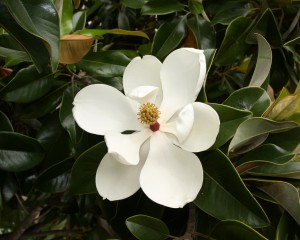
Magnolia grandiflora

Magnolias are one of the iconic trees of not only the South but exported to many non-hard freeze areas of the world. And people have admired the huge magnolia blossoms for a long time. Few folks know the blossoms of the Magnolia grandiflora are edible, however their flavor is intense and they taste similar to how they smell. They are not eaten raw per se. They are pickled. Oddly the practice started in England and you only use the petals, not the entire blossom. What works best is to pickle the petals in a sweet/sour pickle recipe. Then take out one petal, dice it, and use it sparingly as a flavoring in salads. The flavor is strong so go easy. Also, M. grandiflora‘s leaf can be used just as Magnolia virginiana‘s can as a bay leaf, that is to flavor soups and the like. However, don’t use the entire leaf because it is way too big. Cut it into smaller pieces when used like a bay leaf.

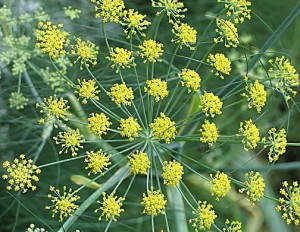
Fennel Blossoms

Another plant I saw growing wild in Greece but is mostly cultivated in the United States is fennel. In fact, at one mountain pass not far from Sparta the only weed growing in the crack of the curb along the road was fennel, and most of it close to a yard tall. I’ve always included fennel in my garden because it’s so versatile. Fennel’s blossom is an explosion of yellow and the flavor is of mild fennel. It’s the hint of anise appreciated in cold soups and many desserts. Incidentally, fennel is the only species in its genus, Foeniculum vulgare.

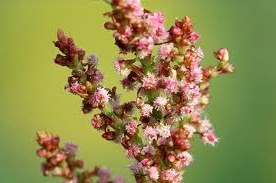
The many blossoms of garden sorrel

You can have a lot of motivation to plant garden sorrel. It’s a Rumex and many of the wild sorrels are too bitter to eat, as are their blossoms and seeds. While there are exceptions — I know of only one locally that is pleasant — you can have a steady supply of sorrel leaves and blossoms if you include this old world flavor in your kitchen garden. Rumex acetosa is used in nearly every ethnic cuisine in Europe, from being mixed into mash potatoes to flavoring reindeer milk. The blossoms are tart like the rest of the plant, lemony. Use as you would a lemon.

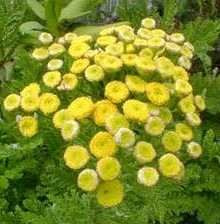
Rayless Tansy Blossoms

Another escapee from Eurasia now found over most of North America and the rest of the world is the Common Tansy. First mentioned for medicinal uses by the Ancient Greeks, the “bitter buttons” by the 8th century were in Charlemagne’s herb gardens and used by Benedictine monks in Switzerland. In 16th century England it was a “necessary of the garden.” Tansy, related to the thistle, even been used as an insect repellent. In fact, meat (and corpses) were wrapped in it for preservation and keep insects at bay. It is not a good repellent against mosquitoes but does a good job with the Colorado Potato Beetle.  Like chamomile it contains thujone so it should be used very sparingly. But then again, that’s what spices are for. The blossoms’ flavor is bitter, camphor-like.

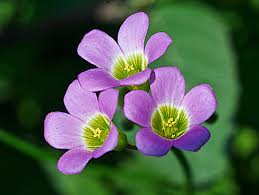
Pink Wood Sorrel

Wood sorrel was probably the first wild food that I ate while my parents weren’t looking. A childhood chum of mine, Peter Jewet, and I used to spend summers wandering around the woods and it was he who showed me wood sorrel, though he called it “sour grass.” We didn’t notice that it didn’t look like grass at all. Locally there is one native wood sorrel with a small yellow blossom — edible — and several sorrels from the Caribbean Islands and beyond. They all have large pink blossoms are make nice, tart additions to salads. They are like rhubarb lite. See my full article and video.

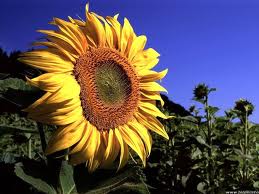
Sunflower

Nearly everyone knows you can eat sunflower seeds. There are actually two general kinds of seeds. There are black seeds with a white stripe. Those are the ones you usually buy in the store. Then there are Sunflower seeds that are smaller and totally black. Those are used for oil (and those that don’t make the oil grade end up in bird seed.) But there’s more to eat on a sunflower that seeds, no matter which kind. The unopened buds are edible cooked. They taste like artichokes, to whom they are closely related. And once the huge blossom is open the petals can be eaten, though they are bittersweet. They’re often mixed with pasta. The full article on site is here.

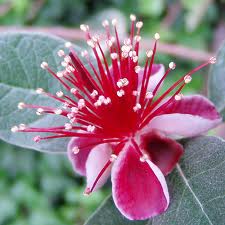
Pineapple Guava Blossom

Pineapple Guava’s are becoming a popular ornamental with an unusual flower and fruit.  In fact, there is one where I teach regularly. The blossoms are striking and reminds one of several cactus blossoms, in its own way. The fruit, equally unusual, ripens in September or October here. It stays green but does get soft enough to eat. There is a bit of pineapple in the fruit’s flavor if one uses the imagination. I have a Strawberry Guava in my yard and its even more difficult to taste “strawberry” in its fruit. The flower of the Pineapple Guava, Feijoa sellowians, is sweet. Like the fruit it says tropical reminding one of papaya.

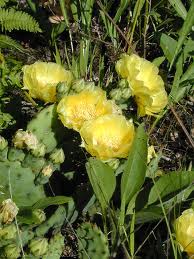
Tap to dislodge bees

I have read there are no toxic Opuntias. With some 300 of them I don’t personally know. I do eat cactus pads on a regular basis. I fry and grill them. But, as with most cactus, one has to contend with glochids and spines. The spines one can see. It’s the tiny hair-like glochids that can make one semi-miserable, tolerable in a finger, maddening in your tongue. Duct tape removes them moderately well. Wear gloves harvesting. The best approach is to use a long shap fillet knife as the flowers are surprisingly thick. Also tap them first to dislodge bees. Among all the Opuntia the Prickly Pear Cactus flower is the most often eaten, not raw but cooked, usually boiled. Their flavor leans towards tart. The blossoms also make a good wine.

Happy Pansie Faces

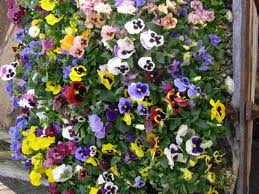
The problem with Pansies is the same problem with Begonias: Getting them from a wholesome source. Pansies are actually violets and descended from the much-loved Viola tricolor aka Johnny-Jump-Ups. There is always the question if one should lump all violets in together or do some sorting. I chose to sort a little. Pansies are extremely common bedding plants but they are commercially raised so that can mean some chemicals you don’t want to consume. it is best to raise your own so you know exactly what you’re eating. Like most short violets pansies tend to have a nice scent and are sweet to the taste. There are only two cautions. The root is definitely not edible. The American natives used them for insecticide. And, yellow violets tend to be laxative in less than moderate quantities.

See Edible Flowers: Part Seven

{ 12 comments }

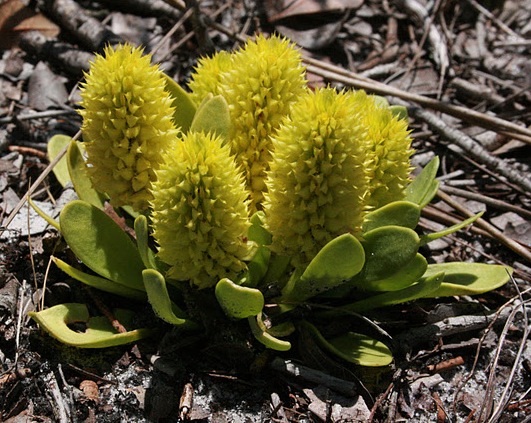
Candyroot, Polygala nana, sometimes Polygala lutea var. nana

I will be the first to admit my experience with Candyroot is very limited. In a flower book I carried with me on field trips some 33 years ago with Florida forager emeritus Dick Deuerling I have written: Root chewed, can also make a tea.

That is scant. I did not note it is edible, just chewable. I can remember where we found it, a single plant growing in the middle of a woods road. Getting an elaboration from Dick isn’t possible because he passed on some twelve years ago at age 92.   It’s low profile might explain why little is published about the plant regarding edibility… well, it’s not really “edible.” Chewable and drinkable are more accurate. Dr. Daniel Austin who managed to write more than two pages about the genus in his book Florida Ethnobotany, writes: “Milkworts are everywhere in the pine flatwoods in late April. Sometimes thousands of plans belonging to nine species will be in view on ridges and swales.” 

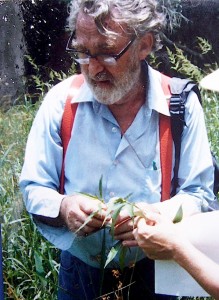
Dick Deuerling, 1990

Generally said there are two groups of Polygalas in North America, those that have roots that smell like wintergreen or licorice, and those that don’t (nose opinions vary.)  Florida’s Seminoles had specific plant names but also used them generically making it confusing as there are 23 different species of Polygalas in Florida. The Creeks used Polygala lutea for medicinal uses but also had just one word for all the Polygala species, hi:lamásî, meaning roughly medicine, use, tea. The Choctaw called P. lutea “kwonokashaipsa” which means “little people eat it.” Incidentally, Polygal lutea means “much milk yellow” and it is called the Yellow Milkwort though it can also reach orange in color.

The Polygalas certainly have been medicinal — including emetics — and have a variety of names around the region including: Bachelor Buttons, Drum Heads, Gay Wings, Bird-on-Wings, Baby Toes, Baby’s Feet, Baby Slippers, Satin Flower, Indian Pink, Maywing, Procession Flower and Rogation Flower, the latter two for making garlands to wear in religious ceremonies.

In northern climes of North America Polygala seneca, aka Snakeroot, was a common herbal medication and is the only member of the genus in the new world to be written about to some extent. It contains, among many chemicals the wintergreen smelling methyl salicylate. Snakeroot has been used to treat not only snakebite — questionably — but colds, croup, pleurisy, rheumatism, heart issues, coughs, convulsions and externally for swellings. It can be an emetic, an expectorant and a diuretic. Florida’s Polygala boykinii also has methyl salicylate. NOTE: If you are allergic to aspirin you might be allergic to methyl salicylate.

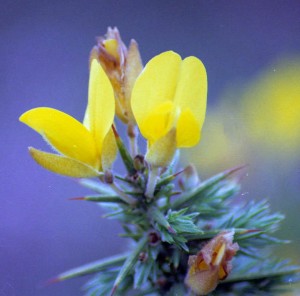
Gorse seeds are spread by ants

Like Gorse, the seeds of the Polygalas are spread by ants, which is called, myrmecochory (myrme means ant, and choreia dance or moving in a circle.) No ants, no Polygalas. As one might imagine that means the plants don’t move too far too fast. The seeds have elaisomes, which are fleshy structures attached to seeds that are rich in oil and proteins. Indeed, “elaisome” comes from two Greek words, “elaion” meaning oil and “soma” for body. The ants take the seeds into the nest, eat the elaisomes, then dump the seeds outside the nest. The seed then finds itself in an open space sitting in rich decaying material, not a bad start in life when you’re a plant.

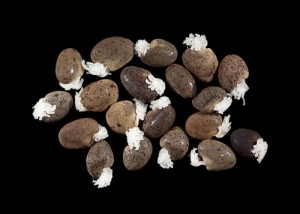
White Elaisomes on Silky Bushpea Seeds

Elaisomes is said ee-LAY-eh-psalms, which isn’t good Greek but it is far better than Dead Latin’s ee-LIE-eh-psalms. The native Greek ear would prefer a third way,  eh-LAH-ee-shoms as oil is LAH-dee and body is SHO-ma. Of course, Candyroot is much easier.

Botanically this Candyroot (several are called Candyroot or candyweed) is Polygala nana (poh-LIG-uh-la, NAh-nah.) Polygala means much milk. The species in the genus, some 550 of them, were thought to increase lactation. Nana means small.

To help you sort out some species: Polygala cruciata, Drumheads, flowers pink-violet in tight cylindrical raceme. Polygala cymosa, Tall Pinebarren Milkwort, plants two feet tall. Flowers yellow in cymes. Polygala incarnata, Procession Flower, violet, in narrow cylindrical heads much longer then wide, individual flowers angled upward. Polygala lutea,  Orange Milkwort, four inches tall, a tight raceme, orange. Polygala nana. Candyroot, plants four inches tall, flowers in a tight raceme, yellow. Polygala rugellii, Yellow Milkwort, flowers in dense yellow raceme, looks like P. nana but is much taller than four inches. Polygala violacea (P. grandiflora) Showy Milkwort, flowers purple, with two large ears. P. nana does not grow south of Broward County but P. smallii does, however it is endangered. P. violacea will make you vomit and P. rugelii is a laxative among other things.

Green Deane’s “Itemized” Plant Profile: Candyweed

IDENTIFICATION: Polygala nana: A small rosette of spatula-shaped nearly succulent basal leaves about 1-2 inches tall.  Rabbit’s-foot heads of flowers within the rosette a few inches taller that the leaves. Flower petals are lemon yellow united to form a tube in compact racemes. Leave mostly sessile, succulent, spathulate.

TIME OF YEAR: An annual, it blossoms in spring but can extend into summer

ENVIRONMENT: Moist soil, usually open pinelands in low pockets. This particular species if found in the Old South from the Atlantic seaboard to Texas.

METHOD OF PREPARATION:  Roots chewed for flavor, not consumed. Or root soaked in hot water for a tea. As the genus can be emetic and medicinal, caution is recommended. Again, if you are allergic to aspirin you might be allergic to methyl salicylate, which is chemically very similar.


{ 9 comments }

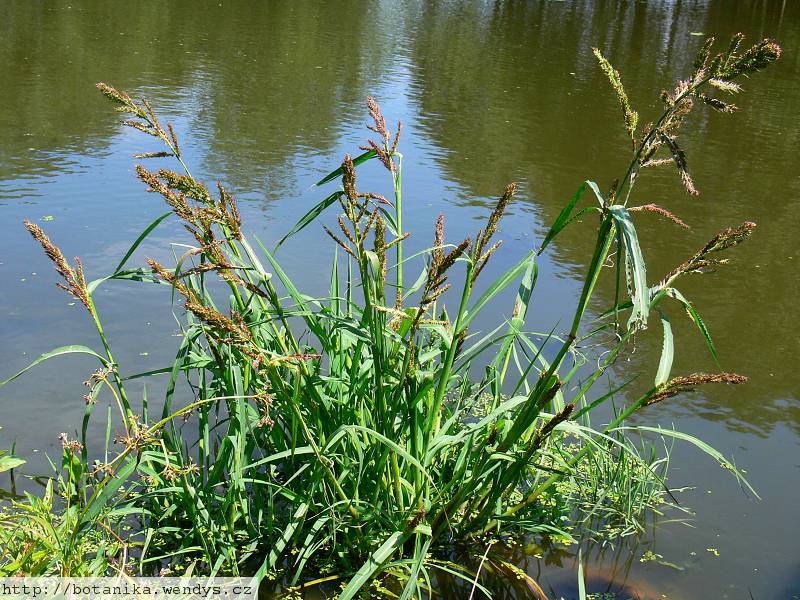
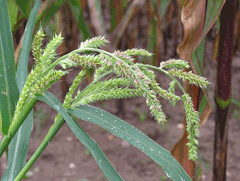
Barnyard Grass likes damp soil and can tolerated some flooding

Note seeds turning purple

The first time I saw Barnyard Grass was decades ago in a real barnyard near a drain spout. I was with forager emeritus Dick Deuerling who identified it for me. The next time I saw the plant it was nearly a different color completely. Purple. Very confusing.

Barnyard Grass, also called Cockspur Grass, is a hated weed around the world. It can mature in as little as 42 days producing some 40,000 seeds on each plant (good news for us.)  It is a severe problem in rice production with one plant per square foot reducing production 25%. It can reduce corn yields 20%. While it likes damp places it is also not bothered by elevation and will grow to 5,000 feet.

A native of Asia, Barnyard Grass is found not only around the world but throughout North America save for Alaska, the Northern tier of Canada and Newfoundland. And although it might be from somewhere else Native Americans knew a good thing when they saw it. The Cocopa, Paiute and Tubatulabal used it for food and stored it for winter use. The Yuma, however, really liked it. They pounded the seeds, winnowed them, ground them and made a meal and mush out of it. They also preferred to cook fish with the grain.

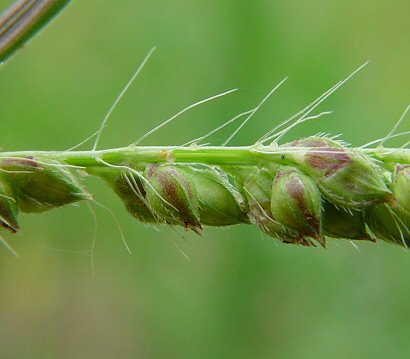
This Barn Yard Grass Has Straw-Like Awns.

Botanically the grass is Echinochloa crus-galli, eh-kye-no-KLOE-uh  kruss-GAL-eye. That pronunciation is close to Greek. Anglicized one also hears ek-ih-NOK-loh-uh  krus GAL-ee. Echinochloa is two Greek words meaning Grass Hedgehog (porcupine.) This is because the seed head can have awns, straw like bristles sticking out of the seed head, or just one at the end, or none.  Crus-galli — also without the hyphen — is dead Latin for Cock Spur, again a reference to the seed spike, see below.

Seeds and base can be purplish

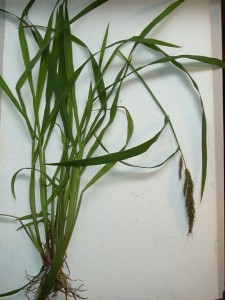
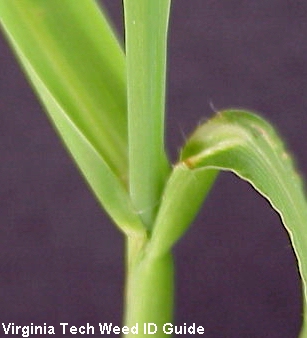
There are about 20 species in the genus with great variability. One has purple stripes on its leaves. But one thing they do have in common, or don’t depending on how you want to say it, is barnyard grass does not have a ligule. It is the only common summer grass with no hairs or membranes at the collar. What does that mean?

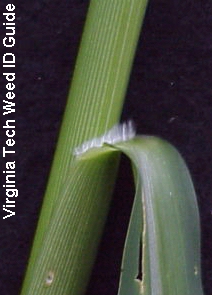
The Fall Panicum Has A White Ligule

Grasses are nearly as bad as mushrooms to sort out. They’ve an argot all their own and field books are wildly expensive often costing thousands of dollars. Usually when a blade bends away from the stem, right where it bends there is a small vertical structure, like a collar or a tuft of hair (see photo right). All common grasses have it except the genus Echinochloa. It’s absence is a major identifying characteristic of the genus. For example, the Fall Panicum, right, resembles Barnyard Grass but has a white legule The Echinochloa crus-galli below has no ligule. Barnyard Grass also resembles Junglerice, Echinochloa colona, but has no purple bands on leaves.

Barn Yard Grass Does Not Have A Ligule

Here is a research tip when you’re trying to figure out what grass you have in front of you. Do a google search using the botanical name you think it might be then add the name: Umberto Quattrocchi. He’s a grass expert with definitive publications, and fortunately not a common name. Usually you will get an except from one of his (rightfully) expensive books on the first page of your search. Once you go to the reference you sometimes have to page up or down a page or two because his entries tend to be detail heavy and long. But it is a way to access expert material on grasses without spending thousands.

Green Deane’s Itemized Plant Profile: Barnyard Grass

IDENTIFICATION: Echinochloa crus-galli: A summer annual to five feet. Seedlings hairless, leaf sheaths often tined red or maroon at the base, often growing outward before turning up. Stems thick, often branched at the lower nodes, may be tinged red to maroon at the base.  Leaves four to 20 inches, 1/4 to 1.25 inches wide. Leaves have a distinct white mid-vein. Near the stem end the vein becomes keeled. There may be some short hairs at the leaf base. No ligule. Flowers knot-like. Seed head a terminal panicle, four to 16 inches long, green to purple, may have individual spikelets with a long terminal awn (like a thin piece of straw from a broom at the end of the seed spike.) Lower branches of flower spread farther apart than the upper branches. The head can be erect or drooping, sometimes purplish.

TIME OF YEAR: Flowers June to October, seeds in fall, germinates from late winter to early spring. In warm areas the process can be continuous throughout the year.

ENVIRONMENT: Roadside, ditches, irrigated crop fields, pastures, orchards, vineyards, margins or ponds and rice fields. Tolerates poor drainage and flooding, usually found in wetlands and wet places, rich soil, swampy ground, brackish marshes, swamps, disturbed sites, poorly drained areas et cetera. Intolerant of dense shade.  Can take up to 80% of the nitrogen out of the soil.

METHOD OF PREPARATION: Winnowed seeds used as a staple grain, parched, roasted, boiled, ground into flour. Young shoots are eaten as a vegetable, raw or cooked. Roots are boiled to temper indigestion in the Philippines. Seeds can be popped like popcorn. In Japan it is used to make macaroni and dumplings. Seeds are roasted and used as a caffeine-less coffee substitute.

{ 17 comments }

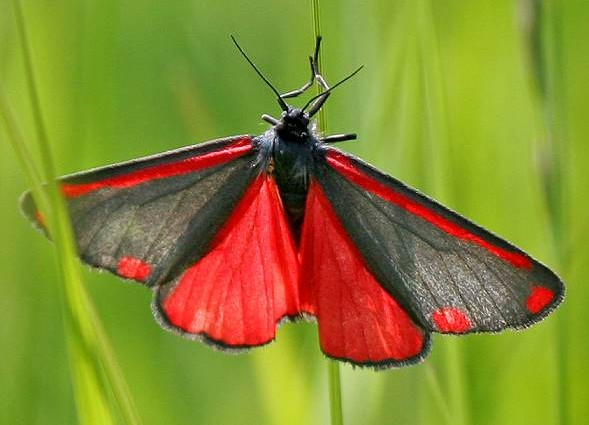
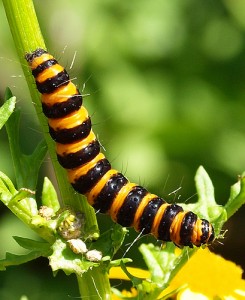
The Cinnabar Moth Lays Eggs on Pyrrolizidine-Rich Plants

How much pyrrolizidine is too much? Or perhaps the better question is how little is too much?

Cinnabar Lava Toxic With Pyrrolizidine

First, what is pyrrolizidine? Pyrrolizidine (pie-row-LIES-ah-dine) is an alkaloid which is a chemical many plants make that is incompatible with mammalian and avian life. Basically it is how those plants, as a group long-term, keep from being eaten into extinction. It’s a strategy of Eat Us And You Die. They do that by damaging the liver.

Pyrrolizidine through low-level, long-term use can cause veno-occulusive disease (it clogs up small veins in the liver causing fluid retention.) Large amounts can also bring on quick and acute symptoms. A 49-year old woman affected by it was taking comfrey-pepsin pills for four months with an average daily dose of 15 mg per kilo of body weight. And while I refer to pyrrolizidine in the singular there are several hundred in as many plants but they act in a similar way.

Most of the plants with pyrrolizidine we don’t eat. However, there are six we should concern ourselves with. Two are used a herbal medicines, one is used as a potherb, one as a potential potherb, one as a spice, and one is a tempting look alike for an edible.

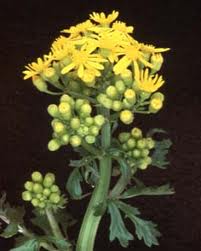
Toxic Senecio glabellus

I became interested in pyrrolizidine when I realized that three local plants in my area had it. One is definitely toxic, Senecio glabellus. The plant caught my attention because it has a similar season as wild mustards/radishes and from a distance resembles them. A closer look at the blossom shows it clearly is not a mustard. The petals are all wrong, daisy-ish not a four-petal cross. But its fleshy leaves lobe like a mustard and look very tempting. Odd to say but the plant just plain looks like it should be edible. It is not. Its flavor is good (note I did not consume it. I tasted it, a different activity by far. DO NOT EAT IT.) It is also well-armed with pyrrolizidine, some 0.2%. In lab tests it kills rats. That got pyrrolizidine on my mind.

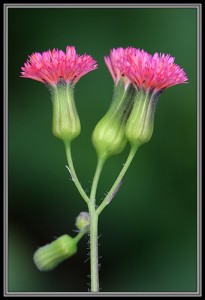
Emilia: Edibility Questionable

It arose again when the question was asked is the Florida Tasselflower edible, Emilia fosbergii. I know someone — late 20’s — who has tried its leaves once with no apparent ill-effects. It was a few leaves raw, ten if I remember correctly, but not a steady diet of said, which appears to be important. Its relative, Emilia sonchifolia, which also has pyrrolizidine, is a common green in Java. Leaves of the not-yet-flowering plant in Java are eaten in salads, soups or steamed, most commonly used as a side dish. I know of a woman not yet 30 who ate many Tasselflower blossoms as a child while playing with her dolls. She has on-going liver issues.

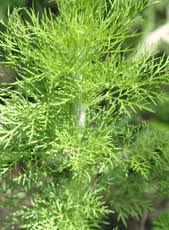
Dog Fennel: Edibility questionable

Our next local plant with pyrrolizidine is Dog Fennel, Eupatorium capillifolium, often used as external medicine and a good fire starter. I never considered it an edible until I heard of park rangers in the Everglades using it as a spice in their salads. Then I had two students — again in their 20’s — who told me for years they had been mincing the hair-thin leaves and adding them to mash potatoes for flavor. As a spice, or an occasional green, perhaps some pyrrolizidine can be tolerated but still is not wise. (I mention age only because I have many decades of enjoying dry red wine behind me so who knows how my liver might react to some pyrrolizidine. I avoid it.)

Comfrey is “Unapproved”

The two other common plants with pyrrolizidine are comfrey and anything in the Borage family. Borage is on the German Commission E’s list as “unapproved” though the total alkaloid content is very low, less than 0.001%. Comfrey has been blamed for liver damage in humans and at least one infant death. It’s alkaloid content varies but is around 0.25%

Another plant used more in the past than now is the dye alkannet/alkanet, once used for lipstick coloring and in the greater Borage family. It is 0.12% alkaloid and is available over the internet. Other common plants with pyrrolizidine are Coltsfoot and Forget-Me-Nots.

As foragers the issue of toxicity is a relevant one. Yet toxicity is more a continuum than a line in the sand. Onions have some pyrrolizidine, comfrey a lot, and not all forms of pyrrolizidine are toxic. You can poison yourself with onions, though it is not easy. Then there is daily dosage. Is comfrey tea once a year bad? How about some dog fennel as a spice or Emilia as an occasional side dish? Between totally safe and totally toxic sometimes there is a fog bank.

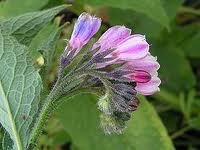
As one might infer pyrrolizidine is a significant issue with livestock, particularly in northwest United States where pyrrolizidine can also work its way into cows’ milk and chicken eggs. Plants with pyrrolizidine can also contaminate human crops, such as grains. A 25-year-old book on topic, Naturally Occurring Pyrrolizidine Alkaloids, sells for (at this update*) $450 not including shipping. For more information and a list of common plants humans might run into with pyrrolizidine click here.

*When I first wrote this article in November 2011 the books was selling for $375.

{ 47 comments }