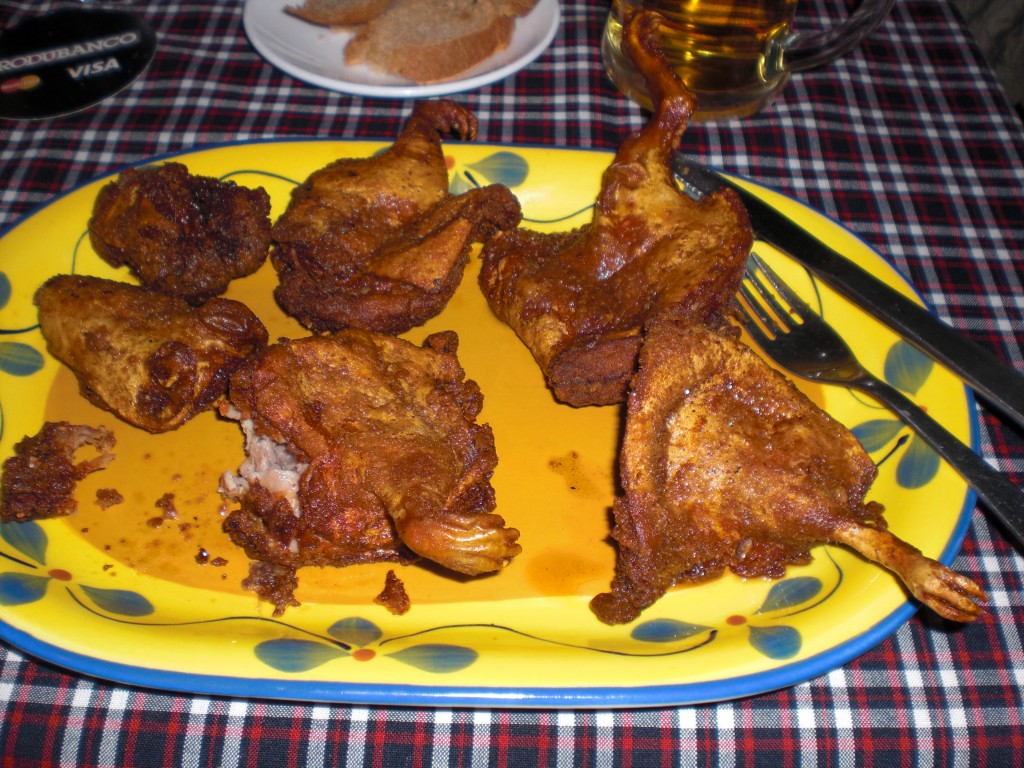
Deep Fried Guinea Pig Dinner

Peruvians eat more than 65 million guinea pigs every year. That should answer any question about edibility.

Sixty-five million guinea pigs (a 2005 figure) is more than two rodents for every every man, woman, and child in that county. Peruvians have been consuming the pseudo-porcines for some four thousands years. The furry piglets… (figlets?) …reportedly provide half of the needed daily protein for Peruvians. Known as Cavy, Cuy and a lot of other native names, they have more protein and less cholesterol than beef, pork, or chicken (21% protein, 8% fat.)  They’re also vegetarians, eat grass and behave much likes cows… except they aren’t milked…  While run-of-the-house Cavy weight one to two pounds specially bred livestock guinea pigs can weight up to seven pounds. And they aren’t pigs, nor are they from Guinea.

Just like Ma used to make

Scientifically they are Cavia porcellus, and are not found in the wild. Cavia (KAY-vee-ah) is Dead Latin for Cabiai which is what the Galibi Indians called them. The Galibi Indans were once native of French Guiana, which is possibly where the Guinea part of the name came from. Porcellus (poor-SELL-us) is Dead Latin for “little pig.” Cavy are somewhat shaped and colored like pigs and have among their various sounds grunts hence porcellus. When all of that is combined and abused into English we get Guinea Pig. They also have a huge number of names mangled in various other languages ranging from Meerschweinchen in German (sea piglet, because they also make grunting noises like a dolphin) Helanzhu (荷蘭豬) in Chinese (which means Holland Pig) to the Spanish conejilo de Indias (little rabbit of the Indies.) Later the ruderal rodents were used for a lot of medical research and lent their common name to anyone who was being used for an experiment.

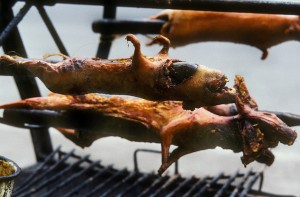
Guinea pigs on the Barbi

As you may guess I am in contact with a lot survivalists. I have talked with quite a few who have argued earthworms are a good thing to raise for food. I will admit native American ate them, and you can read about that here. And some have argued mushroom raising is the key to survival should society fall apart, or aquaponics. But none have ever mentioned raising guinea pigs yet they are among the most prolific, easiest and least costly of all table meats to raise. They outbreed rabbits and can be raised indoors in suburbia on vegetable table scraps. A concern of 22 breeding guinea pigs (two guys and 20 girls) will meet the protein requirements for a family of four annually producing 160 to 200 guinea pigs a year. That same stock if not eaten immediately can produce 6,000 guinea pigs within two years. Many Peruvians have a home business of raising guinea pigs. However, it must be said they are not neat animals and do require cage policing. One of the odd things about guinea pigs is like humans they cannot make vitamin C and must get enough of it in their diet or get scurvy. Some common plants are toxic to guinea pigs. They include: Parsley, wild mustard, dandelions, blackberries, coriander, and green potato peels. And like humans and monkeys, they can also get poison ivy rashes.

Part of the world views them as pets

Of course the other culinary issue is they are cute, in a Bambi’s-not-for-dinner sort of way, and are pets. Eating or killing them for food in California is illegal because they are a pet animal. While they are edible in New York State the city of New York made them illegal… too salty? No, they were being served at Euadorian festivals in the city and someone frowned upon food that resemble the city’s infamous wharf rats. I can hear the bureaucratic argument now: Without proper inspection you don’t know whether you’re eating a wholesome guinea pig or a disgusting wharf rat thus…

California law “prohibits any person from possessing, importing into the sate [or exporting from the state] selling, buying, giving away, or accepting any carcass or part of any carcass of any animal traditionally or commonly kept as a pet or companion with the sole intent of using or having another person use any part of the carcass as food.”  The same law also prohibits the killing of pet/companion animals for food. That would cover not only guinea pigs in California but dogs, cats, pot-bellied pigs, horses, pet chickens, iguanas, pigeons and the like…  thought you Californians should know. Oh, and deceased, flash frozen, ready to cook guinea pigs cannot be imported into Canada, as of March 2011. The problem is not the guinea pig per se. Canada does not allow any meat to be imported from Peru as of this writing. You can read about the official Canadian Guinea Pig Swat Team here. On the other hand, raising and dispatching guinea pigs for food for your own personal use is allowed in Australia. Guinea pig meat can also be imported into the United States, where not prohibited.

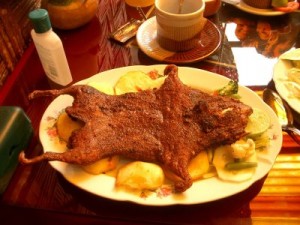
Guinea pigs are usually served flat with head and feet on.

Two-month old guinea pigs that will be used for food are not fed for at least 15 hours. They are then knocked senseless from behind, their jugular cut then hung upside down to drain. This renders the meat white when cooked. The whole guinea pig is dipped in near boiling water for 20 seconds. This makes the hair easy to remove. The hair is then removed. The animal is slit from anus to neck without cutting visera to avoid cutting the gall bladder. The visera is removed and the cavity rinsed (also the site of where much stuffing is stuffed or to hold  sauce.) Head and feet are removed for aesthetic reasons but there is no consumption reason to remove said. Head, heart, lungs, liver and skin are also edible. In their native countries guinea pigs are usually cooked and served splayed. Different sensibilities determine plating in other areas. Younger guinea pigs are fried or grilled and the like. Older ones are roasted or stewed. Guinea pig is somewhat chewy and is usually served hot because the meat softens on cooling. The morsels are served numerous ways and when folks in Peru wax on about how their mother used to cook the guinea pig is the topic de jour. Down home cooking, Peruvian style.

If you prefer guinea pigs in your lap as pets and find the notion of eating one close to cannibalism there are many non-profit havens for the rescue, rehabilitation and adoption of guinea pigs, particularly in California. It is a good cause because we humans have a tacit agreement with the animals we domesticate as pets. They give us companionship and in exchange we don’t eat them. There is probably a guinea pig rescue near you if you want a little pet rather than a little meal. Just search for guinea pig and rescue.

For the more cuisine minded:

Cuy Chaqtado

Fried Guinea Pig (Ayacucho-style)

1 guinea pig, de-haired, gutted, and cleaned

1/2 c. flour

1/4 – 1/2 t. ground cumin

salt and black pepper to taste

1/2 c. oil

Pat dry the skin of the guinea pig and rub in the cumin, salt, and pepper. Preheat oil. Dust the carcass with the flour and place it on its back in the oil, turning to cook both sides. Alternately, the guinea pig can be cut and fried in quarters.

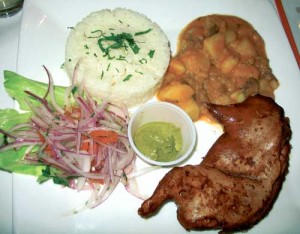
Serve with boiled potato or boiled manioc root, and a salad of cut tomatoes and slivered onions bathed in lime juice and a bit of salt. 

Cuy Picante Huanuqueño Style*

*Ingredients: *

*- **2 large guinea pigs*

*- **1 tablespoon crushed garlic*

*- **1½ teaspoon salt *

*- **1½ pepper*

*- **1½ teaspoon cumin powder*

*- **2 tablespoons aji panca (a Peruvian deep-clay red chile, liquefied in a blender)*

*- **2 tablespoons aji mirasol (a Peruvian dark yellow chile, liquefied in a blender)*

*- ** 1 cup cooking oil or margarine *

*- **10 scallions *

*- **The guinea pigs’ hearts, livers (and in an authentic version, also the intestines, thoroughly cleaned) *

*- **1 tablespoon of crushed peanuts*

*- **8 yellow potatoes boiled and skinned*

*Preparation: *

*Cut and quarter the guinea pigs, salt and pepper, then fry until golden brown. Put aside in a warm dish. In a heavy skillet, lightly greased with a few splashes of oil, combine the garlic, aji panca and aji mirasol over high heat. Mixing and scraping the ingredients from the bottom of the pan to keep it from sticking; continue until the mixture is thoroughly cooked to a golden brown. Chop the scallions, separating the white bulbs from the green stalks. Add the finely chopped scallion bulbs to the pan with the cumin. In a separate pan, combine the hearts, livers and peanuts and cook until thoroughly done, then place in a food processor or blender to liquefy. Add and mix with aji-garlic mixture in heavy skillet. Add guinea pig pieces, cooking for 10 to 15 minutes. Let stand for at least 15 minutes. Serve over sliced boiled potatoes sliced.
Serves four.*


“Picante de cuy” – Guinea Pig with spices

The whole guinea pig is marinated overnight in spices, including cumin, black pepper, paprika and dried red chillies.

Red and yellow peppers are also liquidised and added to the marinade just before cooking.

After marinating, the meat is barbecued and served whole, but split in two like a fillet.

“Cuyes en salsa de mani” – Guinea pigs with peanut sauce

The guinea pig is seasoned whole with salt and pepper and then slowly deep fried in vegetable oil.

It is then served with a creamy peanut sauce and traditionally accompanied by white rice, fried yuccas and boiled sweet potatoes.

{ 31 comments }

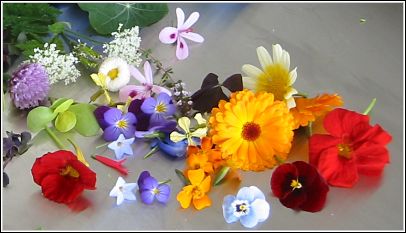
A Spray of Edible Flowers Gladen the Day

Mahoe, Moringa, Pineapple Sage, Plum, Hawthorn, Cattail, Papaya, Purslane, Tuberose, Wisteria

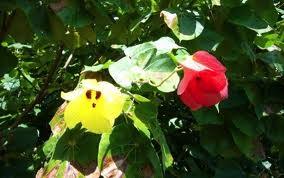
Mahoe’s Blossoms Change Color

One of the more fascinating flowers found in warm climates is that of the Mahoe, or the Sea Hibiscus. In the morning the blossom is yellow but by late afternoon it is red. The working theory is the shrub changes color to appeal to two different groups of pollinators. If one doesn’t get it in the morning, one might in the afternoon. The change in color also increases the amount of antioxidants. It also helps that almost the entire shrub is edible some way. The blossoms, yellow or red, can be eaten raw or cooked. Their flavor is mild. Incidentally, the Portia Tree, aka Seaside Mahoe, can be used the same way, flowerwise. Here’s an article on it.

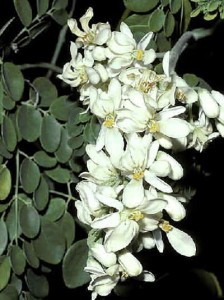
Moringa Blossoms

I think besides an edible flower nearly everything else is also edible on our next species, the Moringa Tree. It is difficult to overstate the value of the tree. If a panel of experts were to design a nutritional, easy to grow, life-saving species it would be the Moringa. Indeed, it is being planted in many places around the world to not only fight hunger but malnutrition as well, ’cause they ain’t necessarily the same thing. I planted one on my property several years ago and it begate itself. Here in subtropical Florida the tree easily grows 10 feet a year. I coppice it every season, and feel he-man in the process because the tree is extremely brittle and one can break a three-inch branch easily by hand. I should do a video of that some year because it is rather amazing. The flowers are eaten cooked, usually boiled, and taste like mushrooms. To read about the Moringa click here.

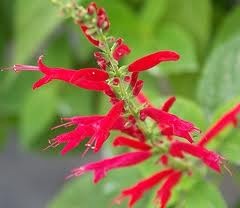
Pineapple sage

Our next edible flower comes with a warning. Don’t eat its similar looking relative. How can you tell them apart? The one you want smells of pineapple, which is why it is called the Pineapple Sage, Salvia elegans. Sometimes it is also called the Tangerine sage. The point is crush a leaf and you will smell pineapple or tangerine. The one you don’t want is Salvia coccinea, also called the Scarlet Sage, the Texas Sage and the Hummingbird Sage. Crush its leaf and it smells grassy or slightly sage-like.  Flowers of the Pineapple Sage, which taste like a hint of pineapple, are quite edible. However, even a quarter-inch square portion of a Salvia coccinea blossom will give you a big stomach ache and make you more than mildly ill. It’s not go-to-the-emergency-room ill but close to it.  I know this from personal experience because once, for lack of a better word,  I titrated the S. coccinea for potential edible use. It quickly let me know it is definitely is not an edible, raw at least. After my experience I had no interest in seeing if S. coccinea had any uses cooked.

Chickasaw Plum Blossom

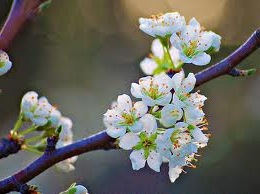
Read this next entry as carefully as the last: You can eat some plum or peach blossoms, a few, a half dozen, but not a lot. Why? Because they have a chemical which when it goes through your tummy tum tum produces cyanide. A little cyanide we can tolerated, a lot will make you ill. Too much and you are deceased though admittedly it would take a lot of plum flowers to do that. Plum and peach flowers are a trail side nibble, a sprinkle in salads or on a dessert. Sparingly is the key. They are sweet, taste like nectar. Which ones? As far as I know any plum that produces plums and any peach that produces a peach that is edible. It should hold true for cherry blossoms as well as they are in the genus Prunus as well but I really don’t know. I would avoid the Laurel Cherry as it does not produce edible cherries. To read about Chickasaw Plums click here.

Hawthorn Blossoms

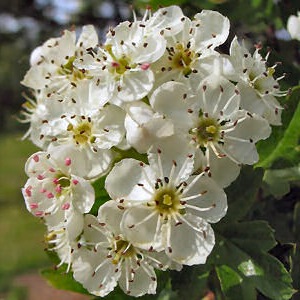
When I was growing up I lived on a dirt road out in the country. Across the road, kitty-corner, where two pastures met, was a Hawthorn tree. It was old and large and had two-inch thorns in grand profusion. It was also ladened every year with several families of birds because few predators would brave the thorns. As to which Hawthorn tree it was is anybody’s guess, even for a Hawthorn expert. It is one of those genus in which there may be a 100 species or a thousand. It is supposedly a professional joke in the botanical world to send a known Hawthorn to some one rather new and ask them to identify it to which the often reply is it must be a new species. Long ago someone discovered that very young Hawthorn leaves and blossoms in the spring could be eaten together right off the tree, thus the “Bread and Cheese tree” was born. Young leaves can be added to salads or nibble on. The blossoms, which have a peculiar taste, can be added to salads, desserts and drinks. Interestingly old leaves and fruit (minus seeds) are a natural beta blocker for high blood pressure. Two teaspoons of either or mixed ground up in a cup of hot water morning and night is the herbalist’s usual prescription. Read about Hawthorns.

Immature Cattail Blossom

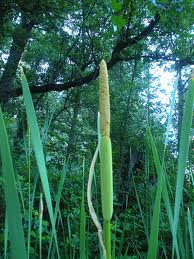
You many not think of a cattail as having a blossom but it does and before it matures it is edible. In fact, both the male part of the flower and the female part of the flower are edible. Later when the male part produces pollen that’s edible as well. When the female parts turn brown it’s way past edible. The male part is the spike on top, the female part the wider portion below the spike. When both are green they can be boiled. The rest of the plant has edibles as well and is a well-known staple of the forager. The cattail rhizome is full of starch. In fact, no plants produces more edible starch per acre than the cattail. Read about them.

Papaya Blossom

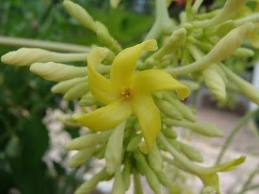
This won’t make much sense to those who live where there is a winter but the first time I climbed Turtle Mound — not a great feat as it is only 80 feet high — I was surprised to see papaya’s growing on top. Turtle Mound is a midden, an ancient trash heap made mostly of millions of oyster shells dumped there by ancient natives. It’s been more than three decades since my first visit and the papayas are still there, self-seeding as papayas do. A native of Mexico they are naturalized in warm areas of the world. Papaya blossoms, like very young leaves, are edible cooked, which is usually by boiling.  Actually cooking the yellow flowers is a lot easier than pollinating them because there are female blossoms, male blossom, and male/female blossoms, kinda you, me and us. You have to move pollinating material around correctly or you don’t get fruit (also edible.) To read more about papayas click here.

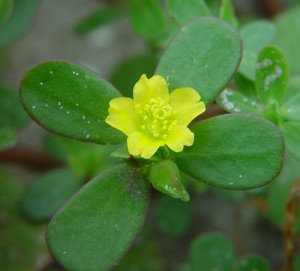
Purslane's Small Blossom

It was something of a debate, to make this entry or not. After all, purslane is one of the most esteemed wild and cultivated edibles in the world (except oddly the United States.) It is used as a salad ingredient, a vegetable, a soup thickener, a flour, and a pickle. And yes, the flowers are edible but they are only open for a day. And when I say purslane I mean Portulaca oleracea, the kind with yellow blossoms only. Yes, I know there are commercial cultivars of multiple colored blossoms and they might look wonderful in a salad. But, I don’t know if they are edible. The Moss Rose/Rose Moss, another wild Purslane, Portulaca pilosa, is in my estimate not edible. So I stick with the original, common purslane with the yellow blossom. They are edible raw and cooked. Incidentally, the tiny pink blossoms of the sea purslane, Sesuvium portulacastrum,  is also edible raw or cooked. Click here to read more.

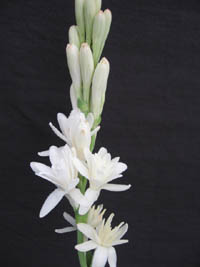
Tuberose Blossoms Moving Up

Tuberose has been put to a lot of uses. The Hawaiians used it to make leis. In Victorian times it was the funeral flower of choice. Then it spent a long time helping perfumes smell the way they do. Now it can be found as a food in five star hotels, well… at least those in the Orient. Botanically it is Polianthes tuberosa and might be a native of Mexico.The flowers open from the bottom of the flower spike up and can last a couple of weeks if you remove the blossoms and eat them. The Aztec so liked the flower their used its oil to flavor their chocolate. They are eaten cooked and are traditionally added to vegetable soups. They are also used to flavor some soy sauces

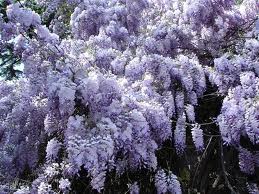
Chinese Wisteria

Wisteria is a nibble of spring, here for a few weeks and then gone. The blossoms of various species are edible cooked — some raw — but they are usually blanched in boiling water, strained, and mixed into salads or the deep fried. The rest of the plant is toxic per se. In fact, as little as two raw seeds can kill a child. That is not uncommon for a member of the pea family which ranges from edible to toxic. See my full article on wisteria here. One of the most common of the 8 to 10 species of wisteria is Wisteria sinsensis, or the Chinese Wisteria. It’s a vigorous, fast grower that doesn’t need fertilizer and fixes nitrogen. In fact, abuse improves blossoming as does pruning. It can live at least 115 years (as of April 2011) and is consider an invasive species is some areas.  It has naturalized from  Maine to Florida and as far west as Arkansas. Not bad since its arrival in 1816. Another one commonly eaten wisteria is Wisteria floribunda from Japan, also escaped in the US.

See Edible Flowers: Part Ten


{ 1 comment }

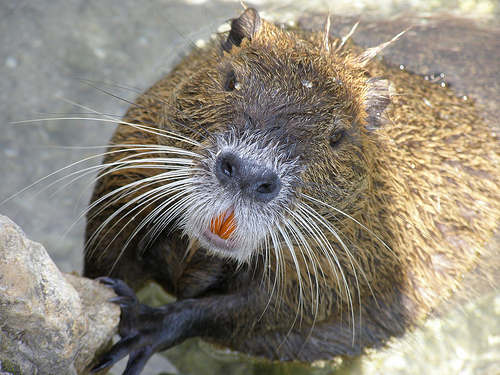
Nutria, or Coypu, are close to beaver size but have round tails

I have a close friend who’s Cajun. He said his family was so poor growing up in the bayou that if anything moved they cooked it and threw it on rice. That included Nutria, or as a good portion of the world calls it Coypu.
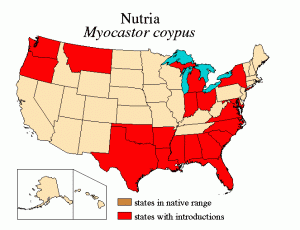
Nutria distribution as reported by trappers

You can think of the Nutria as a large rat or a beaver with a small tail. Indeed the Italians call it Castorino (little beaver) the Dutch Beverrat (beaver rat) and the French, Ragondin.  It’s been on the menu in its native South America ever since man was hungry. It got to most other countries as part of the fur trade, and that’s where the name became confusing. “Nutria” is actually the Coypu’s fur and for several different decades  in the 1900s it was popular. In North America, particularly Louisiana where the rodent is a pest, it is called Nutria. The unwanted water resident has had a long history.

Nutria fur, Germany, 1966

First introduced in California in 1899 between then and 1940 they were imported for fur use not only California but Washington, Oregon, Michigan, New Mexico, Louisiana, Ohio, and Utah. When the Nutria Fur trade collapsed in the United States in the early 1940s business owners simply let the animals go free.  State and federal agencies as well as individuals relocated Nutria in the 1940s to Alabama, Arkansas, Georgia, Kentucky, Maryland, Mississippi, Oklahoma, Louisiana, and Texas to control vegetation. Always a dollar to be made these nocturnal vegetarians were also sold to the public as  “weed cutters.”
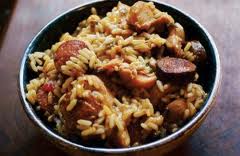
Nutria Jambalaya

Louisiana became ground zero when the state intentionally introduced 20 Nutria into marshes there in 1938 and made them a protected species while promoting them as biological agents for controlling aquatic weeds, primarily water hyacinth, an invasive that arrived there in 1876. Further Tabasco sauce tycoon E.A. McIlhenny imported some Nutria from Argentina in the 1930s for a fur farm. Some of his Nutria “liberated” themselves during hurricanes in 1937 and 1941 but the main escalation happened when Nutria fur market crashed soon after. It is estimated that Louisiana fur farmers released about 150 animals. Those in northern Louisiana did not survive their first cold winter but those in the southern part of the state did. By the mid-1950s those few animals had some 20 million descendants calling Louisiana home and causing huge environmental damage. In 1958 the marsh muncher was taken off the protected species list. For the next three decades the state promoted the animal as a source of fur. Some 1.3 million of them were taken each year mostly for fur use in Europe but that market began to wane with the anti-fur movement in the 1980’s. As an alternative Louisiana then promoted Nutria consumption knowing Cajuns are palate to palate with the Chinese on culinary adventurism.

Unlike beavers Nutria tails are round

Nutria are still damaging 7,000 acres of wetlands in Louisiana. They have been reported in at least 40 states and three Canadian provinces adjacent to the U.S.  They are in many ways a curious creature. Mama Nutria has mammary glands on her sides so the little ones can nurse nose above water while floating. They are ready to start their own family at age four month and pregnant 80% of their lives, essentially they mate for life, just with different mates. As a species about 70% of them don’t make through even one year. In the wild a three-year-old Nutria is ancient. In captivity they can live 15 to 20 years. Besides man alligators, eagles, ospreys, turtles, snakes and several carnivores find them quite acceptable for dinner.
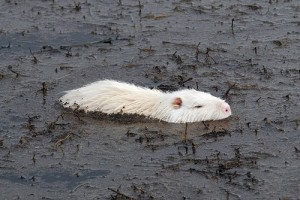
A rare albino Nutria

Nutria have short legs and highly arched body that is approximately two-feet long. Their round tail is a little over a foot long with little hair, average weight is 12 pounds but they can plump up to 20 pounds, sometimes 30 to 40. Their dense grayish underfur is overlaid by long, glossy guard hairs that vary in color from dark brown to yellowish brown.  Forepaws have four well-developed, clawed toes and one vestigial toe. Four of the five clawed toes on the hind foot have webbing. A fifth outer toe is free. The hind legs are much larger than the forelegs giving them a humped look particularly on land. Like beavers, Nutria have large incisors that are yellow-orange to orange-red on their outer surfaces. They are very well adapted to aquatic life.
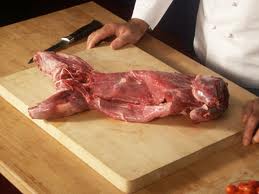
Nutria dressed, cuts are similar to rabbit

Nutria are almost entirely vegetarians and only eat animal material by mistake, such as insects on the plants they feed on. Freshwater mussels and crustaceans are occasionally eaten. Gluttons, they eat approximately 25% of their body weight daily and prefer several small meals to one large one. The plump base of plants are preferred as food, but they will not pass up choice entire plants or several different parts of a plant including roots, rhizomes, and tubers. Important food plants in the United States are cordgrasses (Spartina spp.), bulrushes (Scirpus spp.), spikerushes (Eleocharis spp.), chafflower (Alternanthera spp.), pickerelweeds (Pontederia spp.), cattails (Typha spp.), arrowheads (Sagittaria spp.), and flatsedges (Cyperus spp.). In winter, the bark of trees such as black willow (Salix nigra) and baldcypress (Taxodium distichum) may be eaten. They also eat crops and lawn grasses found adjacent to aquatic habitat. Like raccoons they have quite dexterous front paws. They leave tracks that are four-toes and webbed, often with a tail dragging mark. Dropping are long, cylindrical and grooved.

Front paws are dexterous

When trapping them cracked corn is the preferred bait along with sweet potatoes and carrots. Floating the trap on a raft eliminates capturing most other animals. Nutria, like rabbits, can carry Tularemia. Trapping regulations vary state to state. In some states no license is needed for live traps and live animals cannot be returned to the wild. If you are hunting them after dark you have to be careful where you shoot them or they will sink out of sight. Less humanely they can also be taken with gigs on very long poles, or clamp traps. The state of Maryland has been waging a war with Nutria since 2002 in the Chesapeake Bay region. By November 2011 it had killed some 13,000 of them and was trying to eliminate small remaining pockets.  As of 2016, all of the known Nutria populations had been removed from over a quarter million acres of the Delmarva Peninsula but the wetland may take another 40 years to recover from the damage. Also called Bayou Rabbit, Nutria can be found not only in North America but Europe, the Soviet Union, the Middle East, Africa, and Japan. They have been introduced to every continent except Antarctica and Australia.

Nutria taking a handout

Scientifically the water rat in North America is known as Myocastor coypu var. bonariensis. There is only one genus and one species — monotypic —  but there are four variations.  The genus is two Greek words mashed together to mean Mouse Beaver. Coypu is what the Mapuche Indians of Chile and Argentina called it though typical of Dead Latin their “Koypu” was changed to Coypu. This is the same part of the world that gave us Araucana chickens which lay light green eggs and the Aracarua araucana, and the Monkey Puzzle Tree which has pine cones the size of softballs and edible seeds.
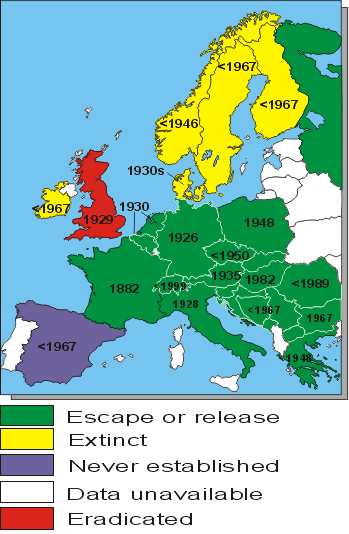
Nutria in Europe, see below

While Nutria meat can be cooked a wide variety of ways it can be on the tough side thus improves with low, moist heat. One common meat it is compared to is rabbit though the taste is closer to dark turkey meat. According to a state analysis, raw Nutria meat has more protein per serving than ground beef and is much lower in fat than farm-raised catfish.

The recipes are from Nutria.com, a site sponsored by the state of Louisiana. Below the recipes is a round up of Nutria in Europe.

Heart Healthy ‘Crock-Pot’ Nutria


2 hind saddle portions of nutria meat
1 small onion, sliced thin
1 tomato, cut into big wedges
2 potatoes, sliced thin
2 carrots, sliced thin
8 Brussels sprouts
1/2 cup white wine
1 cup water
2 teaspoons chopped garlic
Salt and pepper to taste
1 cup demi-glace (optional)

Layer onion, tomato, potatoes, carrots and Brussels sprouts in crock pot. Season nutria with salt, pepper and garlic, and place nutria over vegetables. Add wine and water, set crockpot on low and let cook until meat is tender (approximately 1-1/2 hours). Garnish with vegetables and demi-glace. Makes four servings.

Nutria Chili

Recipe by: Chef Enola Prudhomme

3 tablespoons vegetable oil
2 pounds nutria ground meat
1 tablespoon + 1 teaspoon salt
1 teaspoon red pepper
1 tablespoon + 1 teaspoon chili powder
1 cup diced onion
1 cup diced green bell pepper
1 cup diced red bell pepper
1 cup tomato paste
4 cups beef stock (or water)
1 can red kidney beans (opt.)

In a heavy 5-quart pot on high heat, add oil and heat until very hot. Add nutria meat, and cook and stir 10 minutes. Add salt, red pepper, chili powder, onion and both bell peppers. Cook and stir 15 minutes. Add tomato paste and 4 cups stock. Cook 30 minutes; reduce heat to medium. Add red kidney beans; cook an additional 10 minutes. Serve hot!

Enola’s Smothered Nutria

Makes 4 Servings

2 tablespoons vegetable oil
1-3 pound nutria, cut in serving pieces
2 tablespoons Enola’s Secret Seasoning + 2 teaspoons
2 cups finely chopped onion
1 cup finely chopped green bell pepper
1 tablespoon flour
1 teaspoon salt (opt.)
3 3/4 cups chicken stock or broth

In a heavy 5-quart pot on high heat, add oil, heat until very hot. Sprinkle seasoning on meat; stir well. Add meat to pot, brown on all sides. Cook and stir 10 minutes. Add onion, bell pepper and flour, cook and stir 10 minutes. Add salt and chicken stock to pot cook and stir occasionally, (about 15 minutes) scraping the bottom of pot to remove all the goodness. Serve over hot cooked rice, pasta or cream potatoes.

Ragodin au Choux Rouge

(Nutria with caramelized red cabbage and honey mustard sauce)

2 hind saddle of nutria (available at Calvin’s Bocage Supermarket)
1/3 cup chopped celery
1/3 cup chopped onion
1/3 cup chopped carrots
Bouquet garni

1 branch french thyme, 1/2 bunch of parsley, 2 fresh bay leaves
1 1/2 teaspoons vegetable oil,
2 teaspoons flour
4 teaspoons Dijon mustard and 1/2 cup honey
1 cup red wine
1 teaspoon olive oil
1/2 teaspoon crushed fresh rosemary
2 cups hot water
Season to taste

Caramelized choux rouge: 1 thinly sliced red cabbage, _ cup sugar, 1 teaspoon vegetable oil, season to taste.

Saute red cabbage with oil, sugar and seasoning until sugar is caramelized (4 to 5 minutes).

Place oil, chopped vegetables and bouquet garni in a large saute pan. Rub each hind saddle with mustard, honey and rosemary. Place hind saddle into large saute pan with the vegetable and saute on medium high heat, until golden brown, sprinkle flour and stir will until flour disappears, deglaze with red wine, stir well then add hot water, simmer on low heat for 1 – hours. Remove hind saddle, strain juice into a sauce pot, bring to a low boil, skim the fat off of surface, add cream, reduce for 5 minutes and correct seasoning. Remove meat from bones and plate, top with sauce, garnish with caramelized red cabbage.

Nutria Sausage

Recipe by: Chef Enola Prudhomme

2 pounds nutria meat
1 pound pork meat
10 1/2 ounces potato, peeled
2 1/4 teaspoons salt
2 teaspoons Enola’s Secret Seasoning (or Creole Seasoning)
1 teaspoon sage

Ground nutria and pork with potato. Add all other ingredients mix well. If using a
bar-b-que pit to smoke, build fire on one side of pit. Place sausage on the other side of pit; this will allow smoke to get to sausage without cooking to fast. If you have used bacon fat, put on your fire this will create lots of smoke. This will take less time to get a good smoketaste. Let sausage smoke 1 hour and 15 minutes; turn, let smoke 1 hour; remove from pit; letcool. Makes 4 pounds 5 ounces.

Stuffed Nutria Hindquarters

Recipe by: Chef Enola Prudhomme

Stuffing for nutria:
3 tablespoons butter
1 pound nutria meat, ground
4 cups chopped onion
1 cup green bell pepper
1 cup red bell pepper
1/4 teaspoon red pepper
2 1/2 teaspoons salt
1 teaspoon Enola’s Secret Seasoning (or Creole Seasoning)
1 cup stock or water
1 10 3/4 ounce can cream of mushroom soup
2 cups fresh Louisiana crawfish, peeled, deveined and chopped
13 slices of bread (stale)

Preheat oven to 350 degrees. Put bread in food processor; press pulse button several times. Bread crumbs must be course; set aside.

In a 5-quart pot on high heat melt butter. Add meat, onion and both bell peppers, cook and stir 10 minutes. Add red pepper, salt and seasoning; cook 5 minutes. Add stock; cook stirring occasionally for 10 minutes. Reduce heat to medium. Add cream of mushroom; cook for 7 minutes. Add crawfish, reduce heat to medium, and cook 5 minutes. Remove from heat, add bread crumbs, stir until mixture is moist but holds together.

Preparation of hindquarters:
15 nutria hindquarters
5 tablespoons Enola’s Secret Seasoning

Remove the large leg bone, then pound out legs, sprinkle seasoning evenly on both sides. Lay leg flat, stuff inside, roll and tie with cooking string. Place stuffed legs in oiled baking pan. Bake at 350 degrees covered, cook for 1 1/2 hour or until tender. Uncover; cook an additional 10 minutes or until brown. Makes 15 servings.

Smoked Nutria and Andouille Sausage Gumbo

Recipe by Brian Berry from Hotel Acadiana’s Bayou
Bistro

2 smoked nutria, cut into serving pieces
1/2 pound sliced andouille sausage
1 cup vegetable oil
1 1/2 cups flour
2 cups chopped onion
1 cup chopped celery
1 cup chopped bell pepper
1/4 cup diced garlic
3 quarts chicken stock
2 cups sliced green onions
1 cup chopped parsley
salt and cracked black pepper to taste

In a two gallon stock pot, heat oil over medium high heat. Once oil is hot, add flour. Using a wire whisk, stir until roux is golden brown. Do not scorch. Should black specks appear, discard and begin again.

Add onions, celery, bell pepper, and garlic. Saute approximately three to five minutes or until vegetables are wilted. Add smoked nutria and andouille sausage. Saute in roux approximately fifteen minutes.

Add chicken stock, one ladle at a time, stirring constantly until all is incorporated. Bring to a rolling boil, reduce to simmer.

Cook until smoked nutria is tender, adding additional stock to retain volume of liquid. Once tender, approximately one hour, add green onions and parsley. Season to taste using salt and pepper. Cook additional five minutes and serve over cooked rice.

To see a video on cooking Coypu/Nutria, click here.

Coypu in Europe

Austria:Nutria have been bred in Austria (Laurie, 1946). The capture of free-living nutria began in 1935 (Aliev, 1967)

Belgium: Nutria have been bred in captivity since the 1930s and are now feral (Laurie, 1946; Aliev, 1967; Litjens, 1980). Nutria occur west of the Maas River near the city of Limburg (Litjens, 1980).

Bulgaria: Aliev (1967) did not report nutria here. Mitchell-Jones and others (1999) reported nutria along the borders with Greece and Romania.

Former Republic of Czechoslovakia (Czech Republic and Slovakia): According to Kinler and others (1987) and Aliev (1967), nutria have been raised in captivity.


Denmark
: Stubbe (1989) reported nutria were observed in the wild in Denmark in the 1930s and 1940s but could not survive subsequent harsh winters. Currently, no nutria are reported in Denmark (Mitchell-Jones and others, 1999).


England
: The first nutria were imported into Great Britain in 1929 for fur farms (Laurie, 1946). A 10-year eradication campaign was started in 1981 that employed 24 trappers (Gosling and Baker, 1987). On January 10, 1989 no nutria had been trapped in 21 months and the trapping campaign was declared a success and terminated (Gosling and Baker, 1989).


Finland:
Aliev’s (1967) range map indicated wild nutria populations in Finland. In the early 1990s nutria were reported escaped from fur farms, and wild populations existed in the south of Finland near Turku (K. Jutila, oral communication.). Nutria were even listed as a game species by a hunting organization (Finnish Hunters’ Central Organization, 2000). However, Mitchell-Jones (1999) classifies them as extinct in the wild. It is hypothesized that harsh winters caused them to die out in the area (K. Jutila, oral communication.).


France:
Introduced into France as early as 1882, fur farming began in earnest from 1925 to 1928 (Bourdelle, 1939). Some nutria escaped captivity and became feral (Bourdelle, 1939). From 1974 to 1985 they increased in number and have been controlled with anti-coagulant poisoning (Abbas, 1991).


Germany:
Nutria were first introduced into Germany in 1926, and by 1935 small wild colonies began to appear in the Elbe-Trave Canal (Van Den Brink, 1968; Stubbe, 1992; Gebhardt, 1996).


Greece
: Nutria have been raised in captivity in Greece (Aliev, 1967). Between 1948 and 1966 they were observed in the wild in a variety of habitats such as ponds, lakes, ditches, rivers, swamps, marshes, meadows, and wooded areas (Ehrlich, 1967).


Hungary:
Nutria have been farmed in Hungary (Sztojkov and others, 1982; Kinler and others, 1987; Salyi and others, 1988). However, Mitchell-Jones and others (1999) list them as present in southern Hungary on the border.


Ireland:
Aliev’s (1967) range map showed their presence here, but he provided no further information. Mitchell-Jones and others (1999) reported them as not being present.


Italy:
First imported into Italy in 1928 for commercial use (Cocchi and Riga, 1999). Nutria were first reported in the wild in 1960 (Reggiani and others, 1993). Nutria have spread from Italy to Sicily and Sardinia and are presently regarded as a pest species because of the damage they cause to rice farms (Cocchi and Riga, 1999). Piero Genovese (written communication, 2003) calculated that between 1996 and 2000, nutria caused 14 million euros in damage, and losses from nutria are projected to rise 9-12 million euros/year.


Netherlands:
Nutria were introduced into the Netherlands around 1930 for fur farming, and by 1940 were observed in the wild (Litjens, 1980). Because they damage levees and the sugar beet crop they are considered a candidate for eradication by European agencies (Litjens, 1980). Control is by trapping (Litjens, 1984). Despite population losses from trapping and harsh winters nutria persist in the Neatherlands because thermal pollution in rivers allow some to survive harsh winters and immigration from Belgium and Germany replenishes the population (Litjens, 1980).


Norway:
Captive breeding has been practiced in Norway (Aliev, 1967; Laurie, 1946; Van Den Brink, 1968). However, Mitchell-Jones and others (1999) list them as extinct in the wild.


Poland
: Bred in captivity but also managed in a semi-wild state on ponds in Poland (Ehrlich, 1962; Kinler and others, 1987). Observed in the wild there since 1948 (Ehrlich, 1967). In a semi-captive system ponds are drained in the winter to protect the nutria from freezing in the ice (Ehrlich, 1962).


Romania:
Aliev’s (1967) review did not indicate the animals were present in Romania. In Stubbe’s (1989) review of nutria in Germany, he noted they had been observed in the wild. They are now on the southern border with Bulgaria and along the Black Sea (Mitchell-Jones and others, 1999).


Spain:
Nutria were captive bred in Spain (Aliev, 1967). In 1999, (Mitchell-Jones and others) they were listed as extinct in the wild in Spain. However, recent correspondence (Piero Genovesi, written communication, 2003) indicates that small populations of nutria have become established in northern Spain along the border with France, where they apparently migrated from.


Sweden:
A range map indicated their presence in the wild in 1967 (Aliev 1967), and they continue to be raised on farms. However, Mitchell-Jones and others (1999) list them as extinct in the wild.

Switzerland: Mitchell-Jones and others (1999) reported coypus within Switzerland, although Aliev (1967) did not.

Former Republic of Yugoslavia (Serbia, Montenegro, Bosnia – Herz., Macedonia, Croatia, and Slovenia):
Nutria were raised in captivity in Yugoslavia (Aliev, 1967). Their current status is unknown.

{ 11 comments }

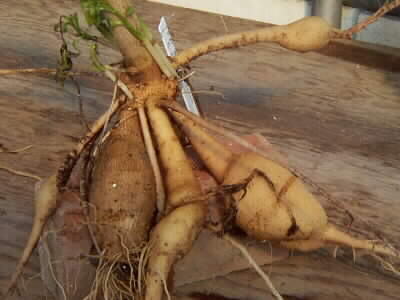
Dalhia tubers can range from bitter to sweet

Here’s the good news: At least one species of Dalhia has edible roots. Here’s the bad news, there are some 20,000 cultivars, maybe even thousands more. A short botany lesson to make things easier to understand:

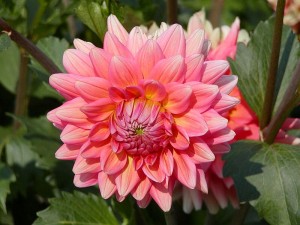
The original Dahlia pinnata was probabably pink and double blossomed

The genus is like a family. Species are like brothers and sisters. With humans the breakdown stops there but with plants there’s another level down. If natures does it they are called varieties, a few changes but not enough to be a different species. If man does creates the next level down they are called cultivars. So within the Dahlia family there are 27 to 36 species — depending on who’s counting — and 20,000 or more cultivars or hybrids (that guess-timate is some 80-years old.)  There are so many varieties because Dahlias have eight sets of homologous chromosomes rather than the usual two most plants have. Said another way, it is a natural hybrid. That gives plant breeders a lot more to work with thus a huge amount of different cultivars.

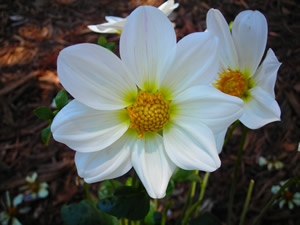
Native Dalhias were single petaled

The edibility of the 20,000+ cultivars is for the most part unknown though that point might be moot and academic. Most of these cultivars are from crossing Dahlia coccinea and Dahlia pinnata, the latter is certainly edible. The three Dalhias most often mentioned for edibility are Dalhia pinnata, D. coccinea, and D. varibilis, the latter of which I have grown. That keeps my lawyer happy. However, I note that the botanist they are named for, Andreas Dahl, tried to popularize Dahlias by saying they were an alternative to potatoes. Dahlias as food had some success in France and the Mediterranean area but their slightly bitter flavor (then) kept them from going mainstream. However, their flavor can range from bland to bitter. The size of sweet potatoes they are still eaten in Mexico, their native range. They may indeed all be edible but I don’t know as there are so many of them. Perhaps some readers can add some insight in that area. At least one cultivar/hybrid, the Yellow Gem introduced in 1914, is edible and currently tops the list as “choice.”

South African author Margaret Jones Roberts says on page 25 of her book “Edible and Medicinal Flowers” Spearhead Press, 2000, that “all the dahlia varieties are edible…” I don’t know that so if you experiment with Dahlias other than Dahlia pinnata or the Yellow Gem you are on your own. Sue her not me. I don’t think toxicology is a great issue I just personally don’t know about the multitude of other varieties.

Dahlia illustration from 1554

Dahlias are in the larger Sunflower family and are closely related to chrysanthemums, daisies, marigolds, dandelions and zinnias, all edible except for zinnias. Europeans knew of the flower from at least the early 1500s. It was included in an Aztec Herbal Medicine book, the Badianus Manuscript, in 1554.  That manuscript, by the way, disappeared for nearly 400 years. Francisco Hernández de Tole, personal physician to Spain’s Phillip II, visited Mexico from 1570 to 1577 and noted two species, maybe three. Unfortunately Hernandez returned to Spain and died the following year, 1578. Part of his work was published in Spain in 1615 but the entire book did not get imprinted until 1651. Hernandez wrote:

Dahlia imperalis is a good source of water from stems

“This plant, which the Quauhnahuascenses call ACOCOTLI and the Tepozthlanenses call CHICHIPATLI, is soft-tissued, its leaves similar to the leaves of Mountain Nard, but cut, some being fine cut, bearing at the ends of the stalks, which are nine inch, slender and rounded, stellate flowers, pale to reddening, with double roots of the size of acorns, ending in ever so many fibers, on the outside black, within white. This seems to belong to the order Ligusticum. It is found in the mountains of the Quauhnahuacenses. In taste the root is smelly, bitter, sharp; it is hot and dry in the third degree, one ounce eaten relieves stomach ache, helps windiness of the stomach, provokes urine, brings out sweat, drives out chill, strengthens a weak stomach against chill, resists the cholic, opens obstructions, reduces tumors.”

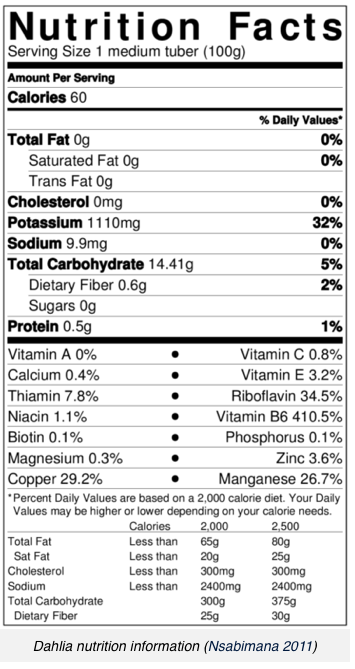
Dahlia Nutrition

I wonder if the good doctor was referring to a raw root or cooked? We shall never know.  One hundred and fifty years later there are Dahlia seeds in all the important places in Europe and hybridization underway. From the area near Mexico City Dahlias have become a staple of flower gardens worldwide. D. pinnata is the national flower of Mexico. Oddly, Dahlias are also naturalized in North Carolina and Mississippi. They are also nutritious. As you can tell from the table at right they are very high in potassium (about four times that of a banana) and high in Vitamin B 6. 

As mentioned the genus is named for Dahl who was an 18th century Swedish botanist. He was also a student of Linnaeus who invented the bionominal naming (two names) of plants. Dahlias, which for a long time were also called Georgias, were also the favorite of the first Mrs. Bonapart, Napoleon’s Princess Josephine. By the way Corsicans argue that Napoleon was Greek in that he came from a section of Corsica that was inhabited by diaspora Greeks from south of Sparta. In fact, I’ve been to the small village in southern Greece, Paomia, and seen the commemorative plaque. You can read about that here. While there I also met one of my father’s first (and last) cousins. 

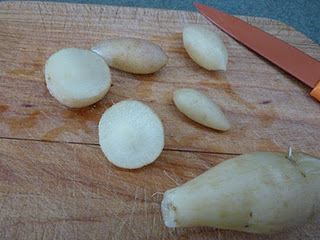
Dahlia tubers washed and sliced, spicy, with fiber

Plant genera can get iffy and for a while Dahlia zimpanii was in the Bidens genus, which if you are follower of these pages you also know as an edible, though usually only the leaves and blossoms.

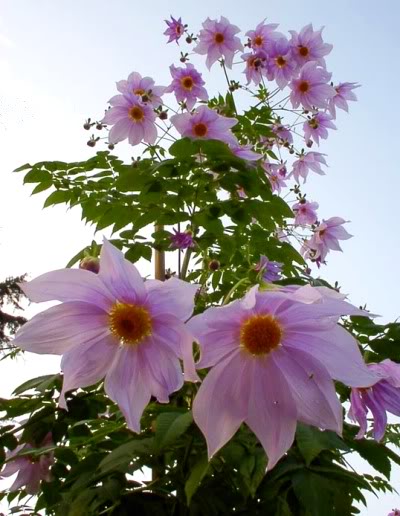
Incidentally, Dahlia imperalis, which can grow to some 20 feet tall, is a good source of drinking water. Indeed, one reason why Dahlias are sensitive to winter cold is because they store a lot of water in their stems. Lastly, don’t forget to see recipes below.

Green Deane’s “Itemized” Plant Profile: Dahlias

IDENTIFICATION: Dahlia pinnata is a double blossom version that can grow to six or seven feet tall, deciduous, with simple leaves arranged alternately along the stems. They’re elliptic with serrate margins. The original was many-petaled and pink.

TIME OF YEAR: They are perennials from tubers and are usually a summer flower but can extend into the fall.

ENVIRONMENT: The best environment replicates Dahlias native environment, which is growing on volcanic soil near Mexico City. Well-drained land in full sun works well.

METHOD OF PREPARATION: Tubers, washed, peeled, washed again, then roasted or boiled or eaten raw. You can also just wash them and not peel them before cooking. Flower petals can be used in salads. A sweet syrup is made form the tubers and is made into a beverage or used for flavoring. Dahlia seeds are 31.9 percent protein and 17.8 percent fat but I don’t know if they are edible.

Dahlia Bread

The tubers should be just dug so there’s not a thick skin on them. Washed well. Peeling is optional.

Preheat oven to 350*
3 eggs
1 cup veg. oil
2 cups sugar
2 cups grated Dahlia tuber
2 tsp vanilla
3 cups flour
1 tsp salt
1/4 tsp. baking powder
1 tsp. soda
2+ tsp cinnamon
Beat eggs until light and foamy. Add oil, sugar, grated dahlia tuber and vanilla. Mix lightly but well. Sift dry ingredents together. Add to wet ingred. Mix only until blended. Put into greased loaf pans. Bake in 350* oven for 1 hour.

Dahlia Salad

3 large carrots, diced, preferably a mix of yellow and orange
1 pound dahlia tubers, pared and diced
1/2 pound fresh green string beans, cut into diamonds
1/2 cup virgin olive oil
3 tbsp vinegar (tarragon, chervil or dill vinegar recommended)
Mayonnaise to taste
Salt and pepper to taste
1 hard boiled egg, quartered
Mixed herbs (dill, parsley, chives), chopped

Steam the carrots, Dahlia tubers and beans for 5 minutes or until still slightly “al dente.” Put the vegetables in a large mixing bowl and add the oil and vinegar while still hot. Let the vegetables cool, and then add mayonnaise to taste so it coats all the vegetables evenly. Transfer the vegetable mixture to a serving bowl and garnish with the egg and chopped herbs. Serve slightly chilled or at room temperature. Serves 4 to 6.

{ 8 comments }

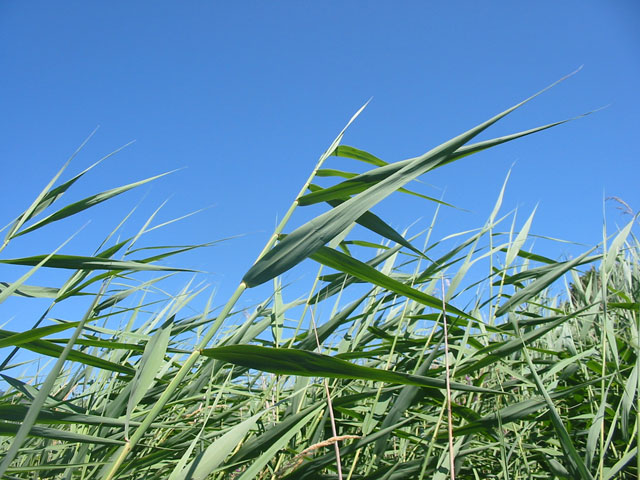
The Common Reed has a common look

Some 20 years ago I pondered upon the identity of what appeared to be a very tall grass in a former marlpit in Port Orange, a few miles south of Daytona beach. One would think there can’t be that many tall grasses locally but you would be surprised in a state with virtually thousands of non-native species. Further grasses can be maddening to identify, more so than mushrooms. They have a descriptive language all their own, the experts are few, and their books sometimes cost thousands of dollars. It took me three seasonal tries to get it right. First I thought an Arundaria, then an Arundo. I settled on Phragmites australis, the Common Reed, Wild Broomcorn… almost…

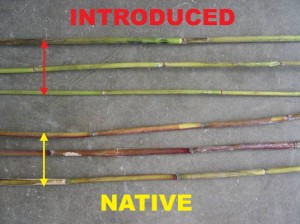
The nonnative is blue gree, the native yellow green

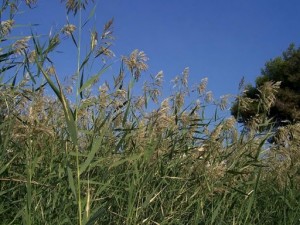
There’s one species — they think — and many varities, perhaps as many as 12 genetically different ones in the North America, eleven maybe native and one Eurasian. For me the question was Gulf Coast variety or Eurasian? Talk about a pain in the grass. Identifying it should have been easy. The Gulf Coast Common Reed has red stems where exposed to the sun —think sunburn — smooth stems, and a non-fuzzy blossom head that hangs to one side. The Eurasian Common Reed has green stems where exposed to the sun, lightly ribbed stems, and a fuzzy blossom head that goes out in all directions. Also the native tends to be yellow green and the non-native bluish green. I had three out of four. What an irritation but a change season produced the right fuzzy blossom. If it hadn’t I’d still be ignoring it. Even though the Gulf Coast Common Reed is native here my local one appears to be the non-native Eurasian Common Reed.

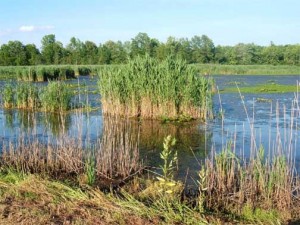
Typical wetland stand of common reeds

While the identification was difficult it turned out to be a good find because the Common Reed, which ever variety, has many edible uses. It’s also been around a long time, say the experts. They found evidence of it in 40,000 year old sloth dung…  (Now there’s an occupation for cocktail party chitchat…) Besides sloths humans have eaten it for a long time as well. Just about every where it grows the plant has been used and consumed. Indeed, it is perhaps more versatile than cattails. The Common Reed has been harvested for building housing, thatching rooves, making boats, fire drills, flutes, splints, pen tips, weapons, hunting spears, arrows, rope, snares, mats, baskets, prayer sticks, jewelry, smoking implements, clothing, medicine, and food as well as sugar and salt. Boys of all ages used mesquite (Prosopis spp.) spines attached to common reed stems to catch small fish and crabs. It can also be used to clean heavy metals and sewage out of contaminated water.

Nonnative stems also have more prounounced vertical ridges

As mentioned the Common Reed is Phragmites australis (frag-MY-tees oss-STRAY-less) which means “screen” and “south” or southern screen. It’s one of the most common flowering plants on the planet and is found throughout North America, Europe, Asia, Africa, America and Australia. In fact it is found on all continents except Antarctica. Hasn’t made its way to Alaska yet nor I think the Yukon and Nunavut. Usually a stand of Common Reeds are all clones. Each separate clone reed can live from five to eight years. The clone itself may reach a 1,000 years old. A stand provides shelter for various creatures but is not a major food source for any.

Green Deane’s “Itemized” Plant Profile: Common Reed

IDENTIFICATION: Phragmites australis: FloridaGrasses.org says it better than I:  Enormous cane often seen rising with a plumose inflorescence from wet ditches.  Ligule small (1 mm vs. > 2 mm in Saccharum).  Leaf blades not auriculate (as opposed to Arundo and Hymenachne) and without the light basal coloration characteristic of Arundo.  Spikelets unawned (vs. Saccharum giganteum).  Internodes pubescent (vs. glabrous in Neyraudia) and lemmas glabrous (vs. pubescent in Neyraudia). Plants of Phragmites are similar in overall appearance to Arundo, but the latter has subequal glumes, a glabrous rachilla, and hairy lemmas. Vegetatively, plants of Arundo, but not those of Phragmites, have a wedge-shaped, light to dark brown area at the base of the blades. They also tend to have thicker rhizomes, thicker and taller culms, and wider leaves than Phragmites, but there is some overlap. Phragmites is much more widely distributed than Arundo in North America.

Not so easy to read. Here’s one from the US Forest Service: Common reed produces stout, erect, hollow aerial stems. Stems are usually leafy, persistent, and without branches. At the base, stem thickness measures 5 to 15 mm. Leaves are aligned on one side of the stem, flat at maturity, and measure 4 to 20 inches (10-60 cm) long and 0.4 to 2 inches (1-6 cm) wide. Leaf margins are somewhat rough, and leaves are generally deciduous. Common reed flowers occur in a large, feathery, 6- to 20-inch (15-50 cm) long panicle. The panicle has many branches and is densely flowered. Panicles are up to 8 inches (20 cm) wide after anthesis. Spikelets contain 1 to 10 florets. Floret size decreases from the base of the panicle upward. Lower florets are staminate or sterile and without awns. Upper florets are pistillate or perfect with awns. Occasionally all spikelets are abortive. Sometimes spikelets are reduced to a single glume and floret, causing panicles to lose their feathery appearance. Seeds are small, measuring up to 1.5 mm long.

“Rhizomes are thick, “deep seated”, and scaly and can grow to 70 feet (20 m) long. Rhizomes may grow 16 inches (40 cm)/year and live 2 to 3 years. Rhizomes in soil are commonly long, thick, and unbranched. In water, rhizomes are more slender, produce multiple branches, and are often shorter.” The roots can be eight inches to 30 feet deep.

Locally the one reed we would confuse it with is Arundo donax. Arundos have auricles and a light to dark brown wedge shape at the base of the leaf. Phragmites do not. Said another way. When the Phragmites leaf leans out from the stem the transition is smooth, well tailored. When the Arundo leave leans out there’s a wrinkle or extra growth beside or around the main stem.

TIME OF YEAR: Varies greatly. Year round in warm climates, season in northern climes, flowers from early to mid-summer into early or late fall. Seeds, shed in the winter, can float in water up to 124 days.

ENVIRONMENT: Wet areas, ditches, roadsides, median strips, railroad tracks, marshes, river banks, lake shores, tidal wetlands. The reed can grow 1.6 inches a day.

METHOD OF PREPARATION: From Cornucopia II, page 178: Young shoots are eaten like bamboo sprouts [read cooked] or pickled. Dried stems were made into a marshmallow-like confections by North American Indians. In Japan, the young leaves are dried, ground, and mixed with cereal flour to make dumplings. The partly unfolded leaves can be eaten as a potherb. A sugary gum that exudes from the stem is rilled into balls and eaten as a swewet. The rhizomes are sometimes cooked like potatoes. Although difficult to remove from its hull, the grain is said to be very nutritious [ and high in fiber.]

The Paiute used common reed’s sugary sap to treat lung ailments. The Apache used its rhizomes to treat diarrhea, stomach troubles, earaches, and toothaches.

A very extensive report on said can be read here.

{ 13 comments }