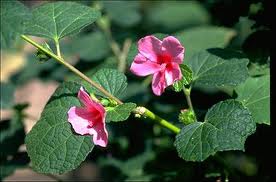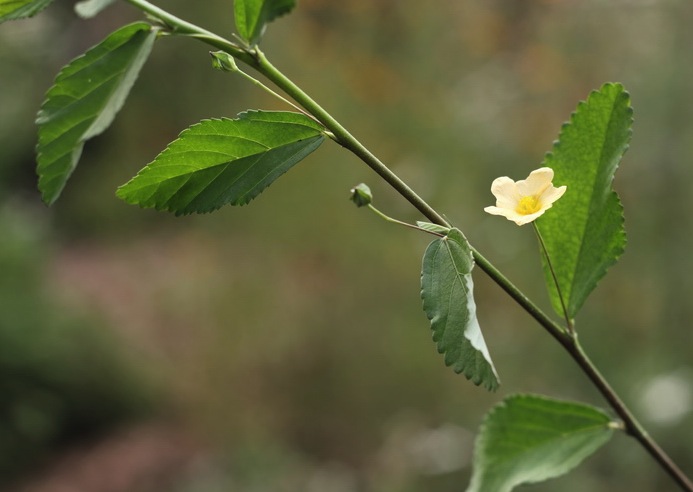
Sida rhombifolia, note long flower stalk and leaves only half toothed

Sida is barely edible. A member of the Mallow mob it’s an object de interest because it is also a significant herbal medication, of which I am totally unqualified to write about: So here goes…

There are at least twelve Sida regionally, some say eight because four of them are rare. It’s called wireweed because if you’ve ever tried to pull one out of the ground it’s a strong as any left over fence wire and why it is also used for cordage. Two Sida should be mentioned: Sida acuta and Sida rhombifolia. Dr. Daniel Austin, author of Florida Ethnobotany, says on page 53 of S. acuta: “Branches are made into brooms; smoked as a stimulant and adulterant for marijuana, leaves contain ephedrine.”  For S. rhombifolia (Indian Hemp, Indian Tea, Cuban Jute, Queensland Hemp) he writes: Same use as S. acuta.

Cornucopia II fortunately comes to the forager’s rescue. On page 148 in reference to S. rhombifolia it says: “The leaves are used as a tea substitute in some parts of the Canary Island and Mexico. As a leafy vegetable they contain about 7.4% protein.” There is no mention of S. acuta in Cornucopia II. I know someone who ate 10 Sida leaves raw and didn’t experience anything. Then again he’s a young man who drinks a lot of coffee so the effect of the ephedrine might get lost.

It is because of the ephedrine that the species come with many warnings. Ephedrine is used to dilate asthmatic lungs, and can drive up your heart rate and blood pressure. In Florida, for example, ephedrine is a prescription drug. However over the counter preparations for medicinal uses can be sold if they have no more than 5 milligrams per dose. In Florida it is illegal to give ephedrine in pill form to anyone under the age of 18. The statue also specifically mentions Sida cordifolia, as if it is the main culprit. Pill form seems to be the only illegal delivery method and then only to those under 18. The fine is small, $100 first offense, $1000 fourth offense.
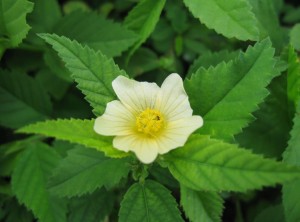
Sida acuta’s blossom is on a short stalk and leaves are almost entirely toothed.

While ephedrine can be used by asthmatics it can have side effects. Preparations say don’t use if: You have high blood pressure, heart disease, an irregular heartbeat, thyroid disease, diabetes, or difficulty in urination due to enlargement of the prostate gland or other severe heart problems. It should also be avoided if you are taking a MAO inhibitor. Ephedrine and pseudoephedrine are closely related drugs and similar to the hormone epinephrine. When I did a lot of diving and snorkeling I used to take a half a dose of Sudafed to keep my sinuses clear underwater. While such preparations in low-doses are not prescription they are controlled and have to be handed over from the pharmacist personally. The chemical is used to make illegal stimulants so tabs are kept on how much is purchased and by whom.

The Sida genus is fairly easy to identify, having yellow/salmon pinwheel blossoms that open around solar noon. Individual species is a bit more challenging. The two telling elements between the two here is this: S. rhombifolia has long stems on the flowers and the half of the leaf (closer to the main stem) do not have teeth. S. acuta blossoms have very short stems and the leaf margin is nearly all teeth.
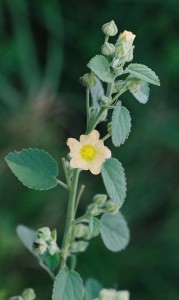
Sida cordifolia

S. rhombifolia is erect to sprawling, branched, growing 20 inches to four feet (50 to 120 centimeters) tall, lower sections woody,  dark green, diamond-shaped leaves arranged alternately along the stem, 2 to 4 inches long (4 to 8 centimeters) with petioles less than a third of the length of the leaves. Leaves pale underneath, with short, grayish hairs, outer half of leaf toothed, inner half not toothed. Petioles have small spiny stipules. Flowers on long stalks, five yellow/salmon petals, overlap to create a pinwheel effect. Blooms throughout the year, usually around noon. Found in waste ground, along roadsides and in pastures as livestock don’t like it but deer do. Found in the southern half of the United States and is pan-tropical.
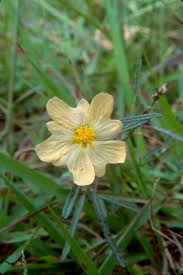
Sida elliottii, note very thin leaves

Sida acuta erect to three feet, stems woody, branching several times, well-developed tap root. Leaves lance- to diamond-shaped with serrated margins. Small yellow flowers on short stems. Ranges from South Carolina throughout Florida and west into Mississippi, late spring until frost. Grows in dense stands along highways, agricultural land, edges of woods.

Sida (SEE-duh) was a Greek word used for a particular water lily. Now it is used for this genus. Rhombifolia (rom-bif-OH-lee-uh) means diamond shaped. Acuta (a-KEW-ta) means sharpened to a point, in reference to the tip of the leaves.

Method of preparation is as Cornucopia II said above: “The leaves are used as a tea substitute in some parts of the Canary Island and Mexico. As a leafy vegetable they contain about 7.4% protein.”

Medicinal or other uses are beyond my experience to comment on as ephedrine and I are no longer compatible. If you eat any leaves they will have an okra-like texture after a few chews.
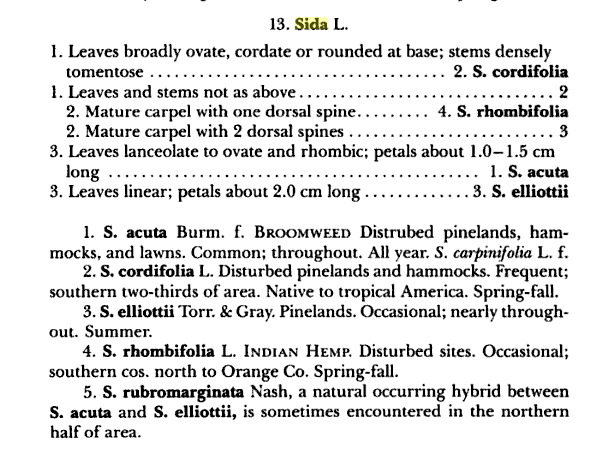
Sida Key by Wunderlin
{ 62 comments }


False Roselle Leaves Are Excellent In Salads and Stir-Fries. Photo by Green Deane

False Roselle Leaves Are Excellent In Salads and Stir-Fries. Photo by Green Deane

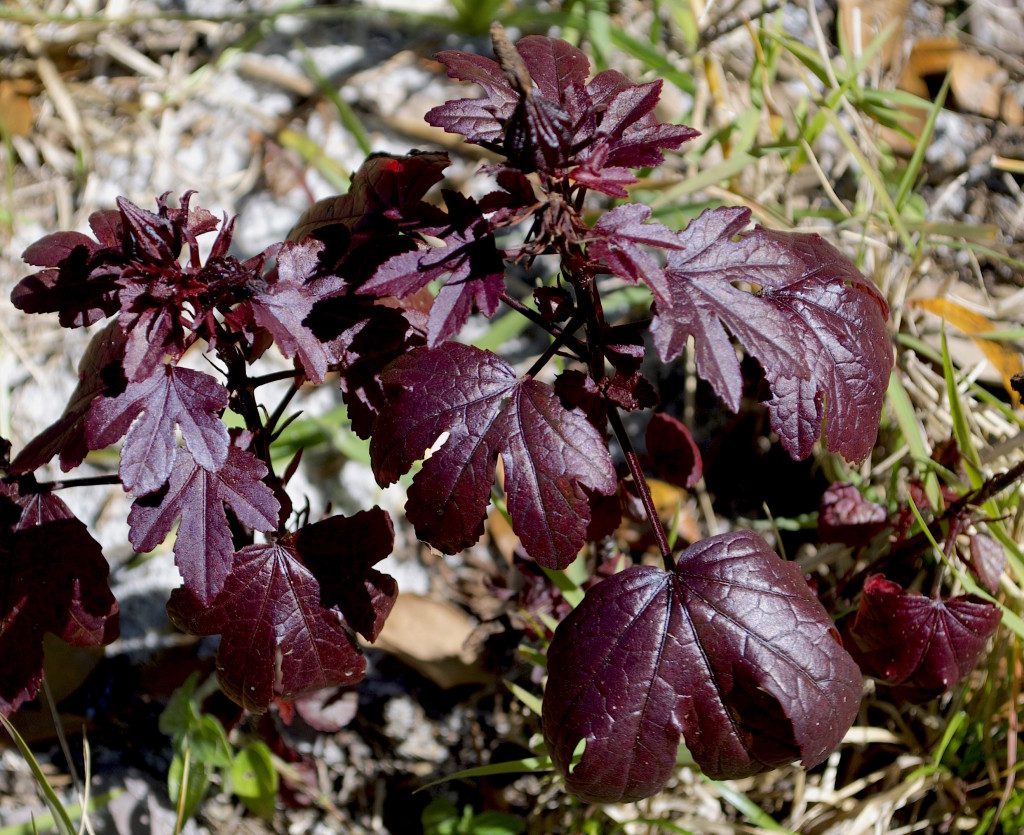
I can’t do a stir-fry without visiting a tree. Actually, the False Roselle is a shrub not a tree but the point is made. Its leaves have just the right color, taste and texture for stir-fries and salads.

P1030926

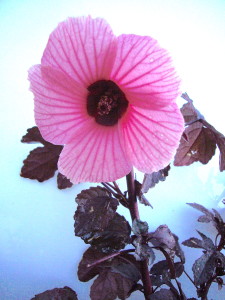
Hibiscus acetosella blossom. Photo by Green Deane

There’s hardly a hibiscus that’s isn’t edible in some way. Several are better than others. The False Roselle, or Hibiscus acetosella (hye-BISS-kus uh-set-o-SEL-luh) is one of the best. Its dark red leaves are tart, sorrelesque. They harvest easily, chop up easily, don’t loose bulk, color or flavor when cooking.

The first thought most plant people have when they see a False Roselle is that it looks like a red maple. On closer inspection the leaves are a different shape, and the False Roselle is a darker red, but the resemblance is there, at least to northerners. Its pink flowers are edible as well, but they are more eye candy than a palate pleaser, being nearly tasteless. The flowers usually go in salads.

The True Roselle

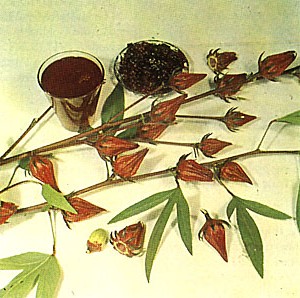
One cannot mention the False Roselle without introducing the real Roselle, left.  Hibiscus sabdariffa (hye-BISS-kus sab-duh-RIF-fuh) is  also known as the “Florida Cranberry” the “Cranberry Hibiscus” and the Jamaican Sorrel.  A tart juice can be made from its fat calyxes and it’s something of a tradition in the West Indies. Many posters on the Internet get these two hibiscus mixed up, but there is no need for it. The False Roselle ( H. acetosella) has maple-esque red leaves — older with an undertone of green — whereas the Cranberry Hibiscus (H. sabdariffa) has lance-shaped, green leaves. They look quite different.

The shrubs can take a light freeze and will come back from roots in the spring. In cold climates they will have to be a potted plant. In my yard they tend to died after five or six years but are always reseeding and sprouting so it’s not much of an issue. Hibiscus means hibiscus or slimy or sticky, and acetosella means “a little sour.” Sabdariffa is a variation of the West Indian name.

Green Deane’s “Itemized” Plant Profile: False Roselle

IDENTIFICATION: Upright and shrubby,  leaves ovate to lobed, red to deep burgundy, to dark reddish green.  Flowers funnel shaped, usually pink but can be yellow or red. Some cultivars don’t flower. Mature plants can split and fall over.

TIME OF YEAR: Year round in warm climates

ENVIROMENT: Plenty of sun, water, good soil and heat. They don’t like it dry or wet.

METHOD OF PREPARATION: Leaves raw or cooked, blossom raw or cooked though they tend to disappear when cooked.

{ 26 comments }

People have written about edible flowers ever since the Romans

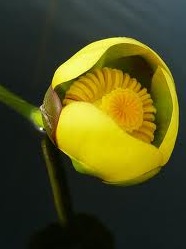
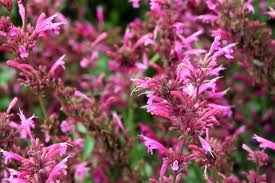
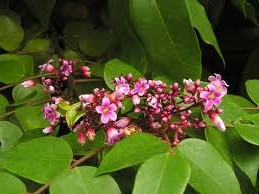
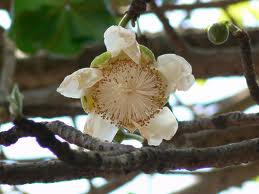
Black Salsify, Coltsfoot, Yellow Pond Lily, Mexican Hyssop, Carambola, Baobob, Kapok, Durian, Italian Bugloss, Blueweed

Black Salsify

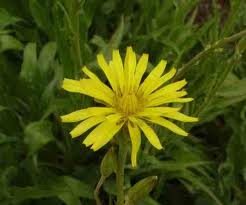
Edible plants collect a lot of names.  This one has been dubbed black salsify, Spanish salsify, black oyster plant, serpent root, viper’s herb, viper’s grass, and simply Scorzonera which is also its botanical name, Scorzonera hispanica. A native of the Mediterranean areas it’s cultivated around the world and happens to be naturalized in California. It was cultivated in Europe by the 1600s and is a significant crop there still. The root contains protein, potassium, calcium, phosphorus, iron as well as vitamins A, B1, E and C. It also has inulin which is suitable for diabetics. The long black roots are boiled, steamed, baked, batter-fried, put into soups and stews or roasted as a coffee substitute. Shoots are added to tossed salads. Flower buds raw or cooked are eaten on salads. Blossom petals are also sprinkled on salads or used in omelets.

Coltsfoot

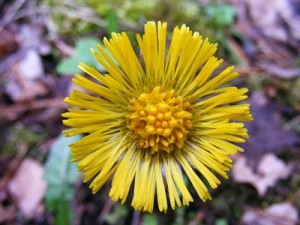
Coltsfoot has become controversial. Young leaves, flower buds, and young flowers can be use in soups or as potherbs. Fresh or dried flowers are used to make an aromatic tea. A delicious wine is made from the blossoms and ashes from the plant are a salt substitute. Used for centuries it has come under scrutiny for chemical that might cause liver damage, at least in infants. There is one documented case of coltsfoot tea causing severe liver problems in one infant. In another case, an infant developed liver disease and died because the mother drank tea containing coltsfoot during her pregnancy. The plant has also been used for centuries to make a cough suppressant. Indeed, its botanical name Tussilago farfara means “cough suppressing activity.” A European native it is naturalized in the northeast quadrant of North America as well as Washington State and British Columbia.

Yellow Pond Lily

The Yellow Pond Lily has been on the botanical move. It’s been Nuphar Luteum, Nuphar lutea, Nuphar lutea var. advena and Nuphar advena. The latter will probably stick for a while. Genetically it never was Nuphar luteum/lutea. Indeed, the Yellow Pond Lilies in North America might go from one wrong species to eight new right ones, once the botanists have argued it all out. One hint that the yellow pond lilies in North America were different than the yellow pond lilies of Europe was the total lack of their use in Europe and their common use “across the pond.”  While the local root is too bitter to eat it’s seeds are only mildly bitter and can be retted to get rid of that quality.  See my article on the Yellow Pond Lily. The large-petaled yellow blossom of the Nuphar advena can be used to make a tea.

Mexican Hyssop

The Agastache genus provides a lot of flowers and leaves for salads and teas. At least nine if not ten species have consumer friendly parts. Despite that one of my readers, a teacher, took some blossoms in for a tasting in her mostly Hispanic class and ran brick wall into the administration who viewed anything not from the grocery store as toxic. So much for ethnobotany. Pictured here is Agastache mexicana, Mexican Hyssop, which is in the greater mint family. It’s highly aromatic leaves and flowers are used in salads, for flavoring and tea. Other useable Agastache include: Agastache cana, Agastache foeniculum, Agastache neomexicana, Agastache rugusa, Agastache urticifolia, and Agastache anethiodora.

Carambola

I happen to have the next tree growing in my back yard, which is about 50 miles north of where the tree would choose to grow. It flowers twice a year but the second setting is minor. Called Carambola or Star Fruit, its botanical name is Averrhoa carambola.  The edible fruit go from small, green and tart to large, golden yellow and very sweet. But, it also has edible flowers and leaves that are used like sorrel. The acid flowers are used in salads or used to make conserves. The fruit is eaten fresh, dried, sliced into fruits and salads, or used in sherbets, ices, creams mousses and other desserts. When the tart the fruit is cooked with fish and fowl or made into a relish. Another member of the genus, Averrhoa bilimbi is the cucumber tree. It’s fruit and flowers have various edible uses as well.

Baobob Blossom

With so many readers around the world I have to include an exotic or two though this next flower does grow in Florida and other warm areas. The Baobob Tree, Adansonia digitata, is extremely odd looking and versatile. Like the Kapok Tree it is pollinated by bats. The fruit is eaten, the leaves boiled as a potherb or dried and ground and used like file, to flavor and thicken sauces, stews and soups. The seeds are used as a coffee substitute or as a baking powder substitute. Germinating shoots and tender shoots are eaten. And the flowers are edible raw.

Kapok Blossom

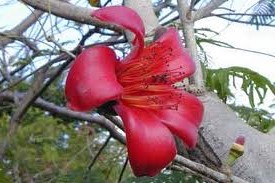
When one studies edible plants you quickly learn that one group can consider a plant only edible, another will think of the same plant as only medicinal, a third will view it as famine food only and a fourth don’t consider it good for anything. The Kapok Tree, Ceiba pentandra, falls into medicine and food, depending upon the eyes of the beholder. Like the Baobob Tree it is pollinated by bats. Tender leaves, buds and fruit are eaten like okra. Seeds are roasted and ground, eaten in soups, used as flavoring, or employed to make the fermented drink kantong. They can be used to make tempeh or squeezed for cooking oil. Wood ashes are a salt substitute. Flowers are blanched and often eaten with chili sauce, the dried stamens are added to curries and soups for coloring. A nice specimen of the tree can be seen in Dreher Park just north of the entrance to the zoo in West Palm Beach.

Durian Blossoms

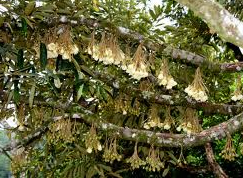
This next tree is infamous for its fruit. You either wildly love its aroma or passionately hate it. Carrying it on trains in Thailand is illegal. It is banned from commercial flights. At least one jet passenger was stopped and a man reeking of it kicked off. Last year a tycoon sent a private jet to pick up 88 fruit when it came into season. He wanted 100 but they weren’t available then. It is the infamous Durian, a spine-covered fruit that smells like a sewer and tastes like microwaved socks, and some people love it. Their passion is not shared. The flower petals are edible.  Did I mention the huge fruit falling from the tree has hit people on the head, killing them. As with coconut, in some areas where there are Durian trees and hotels the fruit is intentionally removed to decrease the likelihood of someone being beaned.

Italian Bugloss

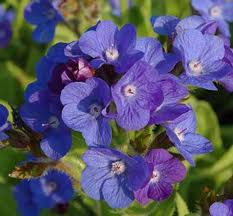
One cannot make up a name like Italian Bugloss. Also known as Wild Bugloss, Alkanet and Anchusa, botanically it’s Anchusa azurea a member of the Forget-Me-Not family. Originally from Europe it’s cultivated around the world, is intensely blue, and is used among other things as a dye. Italian Bugloss has become naturalized without logic in a number of places in North America including New Hampshire, Massachusetts, Connecticut, New York, Pennsylvania, Maryland, Ohio. Michigan, Iowa, Texas, Colorado, Utah, California, Wyoming, Idaho, Oregon, Washington, and British Columbia The bright blue blossoms  are an excellent salad addition and are quite attractive when mixed with rose petals. On Crete it’s called αγόγλωσσος, ang-GO-gloss-ose. Locals eat the tender stems boiled. Also eaten are the bosoms of Anchusa capensis and Anchusa officinalis. “Bugloss” means ox tongue because of the roughness of the leaves. αγόγλωσσος can mean literally “impiety tongue” read rough tongue.

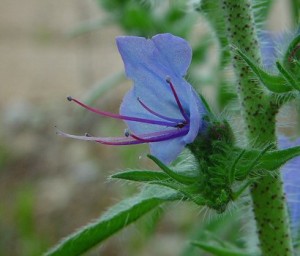
Blueweed blossoms start pink then turn blue.

Closely related to borage and Italian Bugloss, Blueweed, Echium vulgare, is naturalized throughout most of North America, missing only from Florida, Mississippi, Alabama, North Dakota, Arizona, Nevada, California, Canada’s Northwest Territory and the Yukon.  A native of Europe, it’s an invasive species in Washington state. What is slightly odd about Blueweed is that the blossoms start out pink and turn blue. However, the stamens remain red making the blossom striking. Echium is grown as an oilseed crop and contains significant amounts of gamma linolenic acid (GLA) and the rarer stearidonic acid. Leaves are cooked and used like spinach. The flowers are candied and added to salads. The plant is covered with spines, so pick carefully.

See Edible Flowers: Part Eighteen

{ 0 comments }

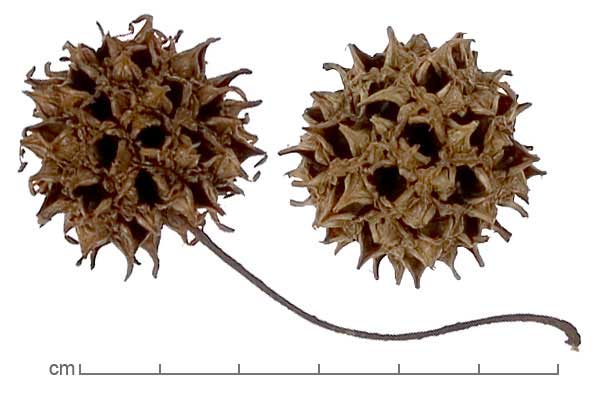
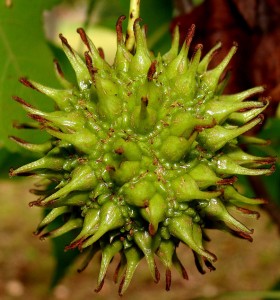
Dried Sweet Gum Fruit

The Sweet Gum tree is the sand spur of the forest. You painfully find them with your feet. The vicious seed pods have impaled many a forager and has done much to ruin the Sweet Gum’s reputation.  Perhaps it is time for some rehabilitation.

The only edible part of the tree is the dried sap which makes a fragrant, bitter chewing gum. Despite its name the gum is not sweet. It’s called Sweet Gum to separate it from a different species altogether, the Black Gum,  Nyssa sylvatica, which is extremely sour and bitter. In comparison the mildly bitter Sweet Gum is definitely sweeter. Dr. Francois Couplan in his book The Encyclopedia of Edible Plants of North America states on page 60 the gum “it has antiseptic qualities.”

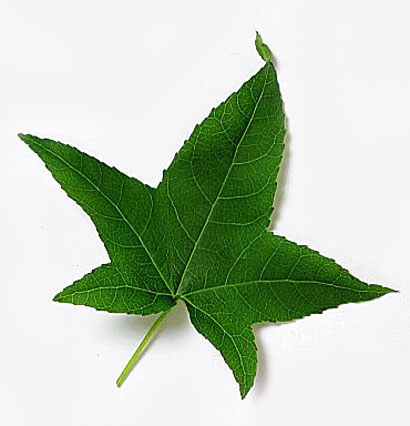
Sweet Gum Leaf

That would be the extent of our interest in the Sweet Gum if it were not for influenza. Viruses are little packets of chemicals that can’t reproduce on their own. They have RNA not DNA. So they need something live to reproduce in. Birds, pigs and humans are the preferred hosts. You might be surprised to learn that most strains of the flu start out in birds. It usually jumps from bird to pig and from pigs to people. It can also be found in whales and seals. Sometimes the flu jumps directly from bird to man, resulting in a very strong and often deadly flu. That led to finding special treatments. Among them is Tamiflu.

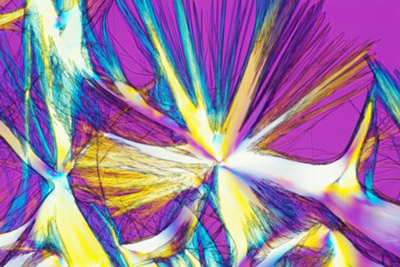
Crystalization of oseltamivir phosphate, the active ingredient in Tamiflu

Tamiflu, or chemically said, oseltamivir phosphate, is made from the star anise tree, Illicium verum, a native of China. Specifically it is made from the seed pods. The prime ingredient is shikimic acid. (she-KEE-mick or SHE-kah-mick.) A shortage led folks to look elsewhere for shikimic acid, and they found it: In pine needles, and infertile Sweet Gum seeds. Sweet Gum bark and  leaves have some but the highest concentration is in the infertile seeds. The star anise pod is about 7% shikimic acid, the pine needles 3% and the Sweet Gum 1.7% to 3%.  Interestingly, Sweet Gum tea was an herbal treatment for the flu and the Cherokee made a tea out of the bark. Shikimic acid is not Tamiflu any more than steel is a car. That said it is an ingredient, a base material, and whether it is efficacious on its own is a different inquiry.

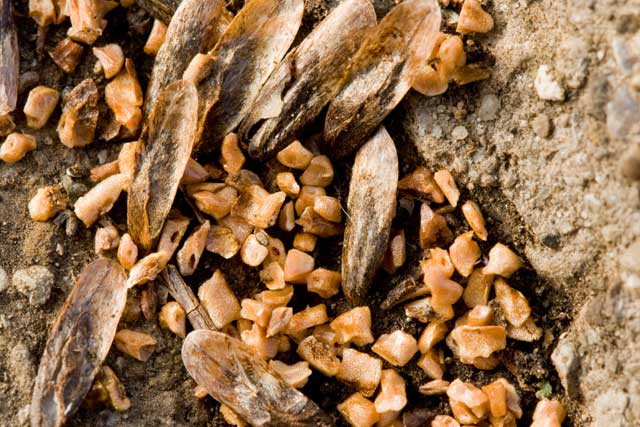
Sweet Gum Seeds

First, how do you tell infertile sweet gum seeds? Fertile seeds are black with wings on either side, infertile seeds are yellow and wingless. Now, how does shikimic acid work? To reproduce the virus needs to break out of the cells it is in.  A protein makes that possible. It is believed Shikimic acid can inhibit the protein. The flu doesn’t reproduce which shortening the duration of the infection and thus shortening or lessening the symptoms, which in some cases of the flu is what is deadly. In some flu infections it is your body’s response to the flu that kills you rather than the flu directly. This is why some flus kill the young. They have very strong and immediate immune systems that overwhelm the body while fighting the disease. Whereas some of us older folks have slower immune responses and may have partial immunity from previous infections. As for the preparation, dosage, and consult a doctor or herbalist. As I say that is all outside my pay grade.  It usually involves soaking crushed green Sweet Gum fruits in alcohol to make a red tincture.

Unripe Sweet Gum Fruit

Botanically the Sweet Gum is Liquidambar styraciflua. (lick-wid-AM-bar  sty-rass-ih-FLOO-uh.) Liquidus is Dead Latin for liquid. Ambar is Arabic for amber (the color of the dried sap.) Styrax is Dead Latin for gum, fluxus for flowing. Liquidambar styraciflua: Liquid Amber Gum Flowing. Two more tidbits: The sap is still used to add flavor to smoking tobacco and is also available at the pharmacy as an ingredient in the “compound tincture of benzoin.”

To read a scientific study on the medicinal side of the species go here. 

Green Deane’s Itemized Plant Profile: Sweet Gum

IDENTIFICATION: Liquidambar styraciflua: A medium-sized to large tree, growing to 65-155 feet (20–35 m) with a trunk up to 6 feet (2 M) in diameter, can live to 400 years.  Leaves alternating, usually have five (but sometimes three or seven) sharply pointed palmate lobes. dark green, glossy turning brilliant orange, red, and purple the autumn. Leaves have substantial amounts of tannin. Fruit, compound, round, 40 to 60 capsules, each with one or two seeds.

TIME OF YEAR: Flowers later spring, fruits in summer, persists in winter.

ENVIRONMENT: Prefers deep, moist bottomland and full sun. Found from southern New England to Florida west to mid-nation.

METHOD OF PREPARATION: Slashed to the cambium, sap will leak out and harden. The resulting gum can be chewed. Unripe fruit can be crushed and soaked in alcohol to make a medicinal tincture. The bark can be used to make a medicinal tea.

{ 164 comments }

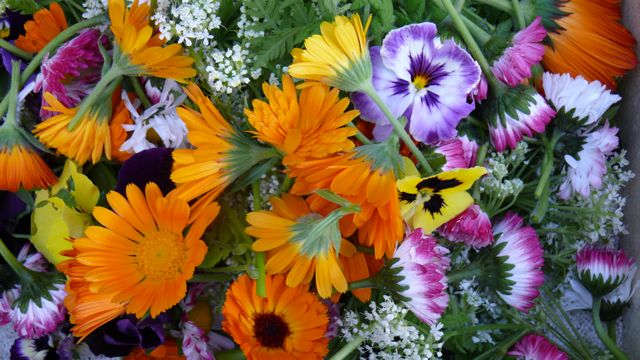
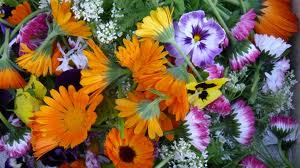
There are hundreds of edible flowers

Oregon Holly Grape, Snapdragon, Caesar’s Weed, Golden Alexanders, Loroco, Safflower, White Sagebrush, Puget Balsam Root, Yellow Commelina, Bitter Gourd

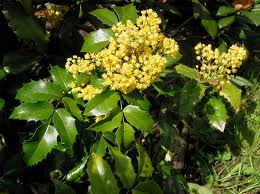
Oregon Hollygrape, Mahonia aquifolium

Oregon Holly Grape is neither a grape or a holly. So much for common names being helpful. It’s the North American equivalent to the Barberry. Beyond cultivation its distribution is a bit strange. One the west coast it runs form California to British Columbia including Idaho, Wyoming, and Alberta. On the east side of the continent it goes from Kentucky due north including Canada but not the east coast. Then for some reason it is also in Georgia and New Jersey. The leaves do look like a holly and its name, for a change, suggests that, Mahonia aquifolium. It usually has clusters of yellow flowers around April, depending exactly where you are in North America. The acidic berries are  used to make pies, jam, jelly, confections and beverages including wine. The flowers are eaten as is or used to make a lemonade-like drink.  Four relatives are used in similar ways but none of the others have flowers that are reported as edible. One however, the Mahonia nervosa, has young leaves that can be simmered in water then eaten.

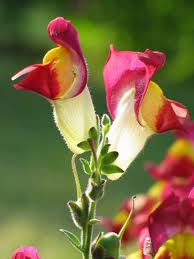
Snapdragons

While most articles on edible flowers include Snapdragons I considered leaving them out. Let me put it this way: If the flavor of the Snapdragons existed in some other plant it would not be eaten. They are edible, they won’t kill you, but when it comes to flavor they are on the poor to bad side. Their taste can run from bland to bitter, depending upon the soil and how they were raised. They get included on edible flower lists — particularly the commercial edible flower list — because they are pretty, a lot of folks recognize or grow them, and few people eat garnishes anyway. If you ever draft a list of edible flowers and you aren’t alphabetizing, put Snapdragons last, better still, as a Post Script, a little asterisk at the bottom. The genus they are in is called Antirrhinum.  It’s Greek and means “opposite the  nose” or “unlike the nose.”  I don’t know why that family is called that but I am sure it is not a compliment. They are called “snapdragons” because of the blosom’s resemblance to a fictional face of a dragon that opens and closes when squeezed.

Caesar weed

There are many invasive species plants locally, some of them intentionally introduced by the United States Department of Agriculture.  One of them is Caesar’s Weed, aka Caesarweed and Caesar Weed, botanically Urena lobata. It was brought to the state as an industry to make fiber and indeed in Africa they still make burlap out of Caesarweed. They ret it like flax, which is to soak it in (preferably) running water which causes the fibers to separate. Young leaves are edible cooked but they are a famine food as they never loose their sandpaper texture. There is a separate article about them here. Caesarweed is in the mallow family and produces a small, pink mallow blossom which can be eaten raw. Toss it into salads.

Golden Alexanders

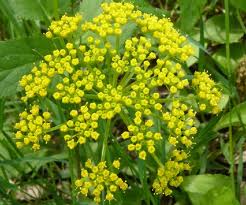
While the name is pretty and flower is as well most folks don’t know about Golden Alexanders, or Zizia aurea. In the carrot family it is a prime edible found in the eastern two thirds of North America plus one county in southeastern Wyoming. It’s native and prefers moist woodlands but is also well-known for surviving droughts. Golden Alexanders blooms from May to June, which varies a bit from Florida to Canada. The yellow flowers are bunched at the top of the plant. Each flower is tiny, some three millimeters long with five sepals, five petals, and five stamens. In the fall the leaves turn purple. The flower clusters with the main stem removed are added to salads, or they make a delicious cooked vegetable reminiscent of broccoli. In Eurasia a related species, Smyrnium olusatrum, Black Lovage, were cultivated as a vegetable, gradually replaced by celery.

Loroco

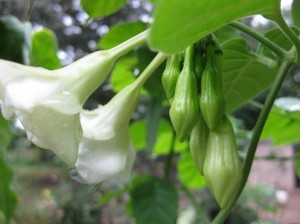
If you like Latin American cuisine one of the well-known edible flowers, buds and blossoms, is the Fernaldia pandurata, or Loroco.  It is part of the traditional dish pupusas. It grows wild in northern Central America and southern Mexico but is also under cultivation and will grow in south Florida. The buds and unopened flowers are cooked with cheese, eggs, rice or chicken. They are also used in crepes, tortillas and tamales. The flowers and buds can also be cooked as greens or folded into egg batter. Originally called Quilite, which means “edible herb” the pungent flowers similar to artichokes in flavor are high in calcium, niacin and fiber, but low in calories. Oddly this vine is closely related to toxic members of the dogbane family but tests on the flowers for cardiac glycosides have been negative. The root, however, is used as a poison.

Safflower

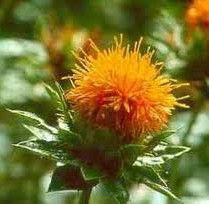
Because saffron is so expensive, $100 to $150 an ounce, several flowers have been used as substitutes and adulterants, among them Safflower. But, safflower has uses in its own right. Botanically Carthamus tinctorius, safflower blossoms are the source of a yellow or red dye used in butter, confections and liqueurs… and you thought that Sambuca was naturally colored… The seeds are fried and eaten in chutney. The oil is used in salads and cooking. Young leaves can be eaten as a potherb or seasoned in soy sauce. The flower’s petals are edible, slightly bitter, often cooked with rice.

White Sagebrush

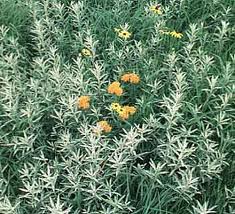
The White Sagebrush is found throughout most of North America except Florida, Georgia, West Virgina, Alaska, the Yukon Territory, and extreme eastern Canada. Called Artemisia ludoviciana, it has also become a favored garden plant though most people have no idea of its uses. Thirteen species in the Artemisia genus were used by the Native American groups for a variety of medicinal, veterinary, and ceremonial purposes. The Apache, Chirichua and Mescalero used the plant to flavor meat. The Blackfoot chewed the leaves like candy. The flowerheads can be used as seasoning or to make a tea. It has many cultivars.

Puget Balsam Root

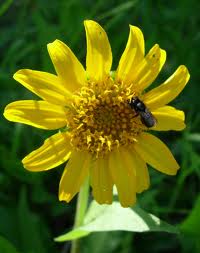
The Puget Balsam Root aka Deltoid Balsam Root is strictly a west coast of North America plant. In the sunflower family Balsamorhiza deltoidea was a food and medicinal plant for Native Americans. Young tender roots are eaten cooked, like carrots, or candied. The natives also roasted and ground the root using it like coffee. The young leaves were boiled as a potherb and the plant’s oily seeds eaten like sunflower seeds. The flower stalk can be cooked and eaten like a vegetable.

Yellow Commelina

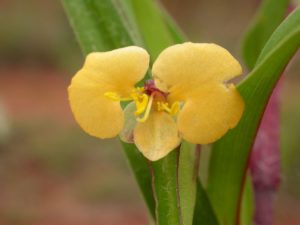
I know I mentioned Dayflowers earlier but I thought a recent discovery deserved its own entry, the Yellow Commelina, or Commelina africana. I was teaching a class in tamp when a student said “what is this?” A low-growing salmon to yellow blossom was looking up at me. I recognized what I thought to be the genus immediately, Commelina but I have never seen or heard of a yellow one. A bit of research identified it. The question is how did it get to Florida? It is listed as one of Africa’s resources and edible cooked including the root.  Can be confused with Aneilema aequinoctinale.

Bitter Gourd Blossom

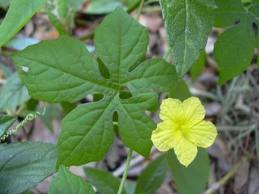
The Bitter Gourd, Momordica charantia, will never win a popularity contest with most people. Though it is a plant that serves us well with many parts edible and medicinal uses it also is bitter and smells like an old, wet, rubber gym shoe. Not exactly a match made in botanical heaven. The leaves can be cooked as a green, and the water used as a tea that controls blood glucose. The bitter fruit is edible cooked and red arils around the seed –the arils not the seed — are edible and nearly all lycopene. And the fragrant blossoms can be used for flavoring. You can read about the bitter gourd here.

See Edible Flowers: Part Seventeen


{ 2 comments }