Cultivate Akebi, photo by Kyoto Foodie

Cultivated Akebi, photo by Kyoto Foodie

Any plant with “chocolate” in the name is sure to get attention. And when it’s also called an invasive species then even more so.
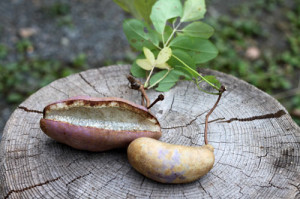
wild Chocolate Vine Fruit, photo by Tsure Zure Gusa

Wild Chocolate Vine Fruit, photo by Tsure Zure Gusa

Oddly the Chocolate Vine reminds me of the Camphor Tree. They are not even remotely related but when  you read about the Camphor Tree it seems to have arrived everywhere from China in 1875, not 1874, not 1880, not 1896. Always 1875.  Whether New York, San Francisco or Tampa, they all got a Camphor Tree in 1875. With the Chocolate Vine it’s 1845… everywhere…. London to New York… 1845… only in Asia in 1844 and everywhere else in 1845.  While not impossible perhaps not probable. What we do know for certain is that it arrived in Britain from China in 1845. We know that because the Chocolate Vine was brought out of China by the most famous plant smuggler and secret agent of his day, a Scotsman called Robert Fortune.

Plant Smuggler Robert Fortune

Plant Smuggler Robert Fortune

Once Fortune got the Chocolate Vine to England it came to the United States, if not in 1845 then soon thereafter. Call that a training theft before the big heist because he then went back for all the tea in China, literally. It was Fortune who three years later single-handily smuggle tea plants and industry knowledge out of China — where the British had little influence — to India where they did. He did so by disguising himself as a Chinese peasant though he did not speak Chinese and knew nothing of botany. He also broke an agreement not to travel for more than a day’s journey from port cities. For the next 150 years India led the world in tea production. Only recently has China become the main producer of tea again. Fortune is why the British drink tea.
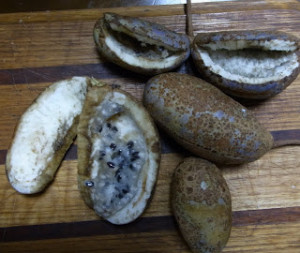
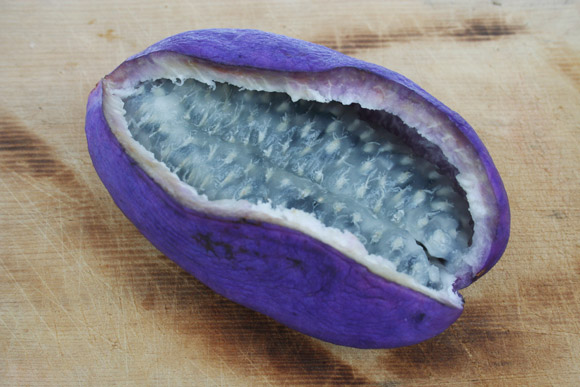
Wild "Akebi"ready for cooking, or eating raw. Photo by Ponkanchan

Wild “Akebi”ready for cooking, or eating raw. Photo by Ponkanchan

Most references are quick to say the Chocolate Vine produces an edible fruit but it doesn’t fruit often and isn’t interesting, as if to discredit any possible benefit this “invasive” might have. However, there is more to it. The mild, viscous pulp of the soft fruit is eaten raw with lemons juice or pureed and made into a cream or a drink. It has a slight coconut milk flavor. Young shoots are used in salads or for salt pickling. The bitter skin of the fruit is fried and eaten and the leaves used as a tea substitute. The empty pod is stuffed and deep fried. The fruit is also used to make wine. The seed oil is was used to make soap and as a vegetable oil. In fact the seeds are about 33% oil but on the bitter side. Most folks spit them out particularly the Japanese who view seeds in any food unappealing. The seeds, however, are edible. A relative, Akebia trifoliata, Mitsuba Akebi, is used in a similar way. Both are high in protein. A 70-gram serving of the fruit has 57 calories and 46mg of vitamin C. Akebi is also now cultivated as a crop in Japan providing a steady seasonal market.
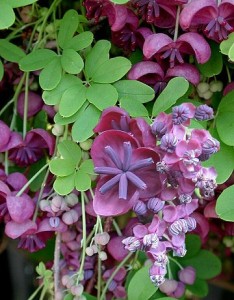
Chocolate Vine in Blossom, photo by valentine.gr

Chocolate Vine in Blossom, photo by valentine.gr

Botanically the Chocolate Vine is Akebia quinata (a-KEE-bee-uh  kwi-NAY-tuh.) Akebia is the Dead Latin version of the native Japanese name, Akebi (AH-ke-bee.) Quinata means having five parts, in reference to the five-leaflet palmate leaves. It is in the quixotic Lardizabalaceae family, name for Miguel de Lardizabel y Uribem, a Spanish naturalist in the 1700s. The vine was scientifically classified by Brussels-born botanist Joseph Decaisne in the 1800s who used the Japanese name. Decaisne had gained some reputation in France for studying new plants from China. He was the natural choice to classify it. Fortune had called the species Rajania. Naive to Japan, Central China, and Korea it is found in Connecticut, District of Columbia, Georgia, Illinois, Indiana, Kentucky, Louisiana, Maryland, Massachusetts, Michigan, Missouri, North Carolina, New Jersey, New York, Ohio, Oregon, Pennsylvania, Rhode Island, South Carolina, Texas, Virginia, Washington state near Seattle. It is also invasive in New Zealand, southwest England,  and threatening to become invasive in other parts of Europe.

Sometimes in Japan the purple-ripe version is called Murasaki Akebi, whereas a brown version is “Ishi Akebi” (stone akebi.) In Japanese the fruit is  通草, or 木通, though in native Hiragana it is あけび… (I lived in Japan a few years and would like to thank Avi Landau’s Tsukublog and Japan Homesteading.) 

The Akebi is closely related to the Mube, or Stauntonia (Stauntonia hexaphylla) which also has an edible fruit except it does not split open when ripe. It is sometimes planted as an ornamental.

Green Deane’s Itemized Plant Profile: The Chocolate Vine
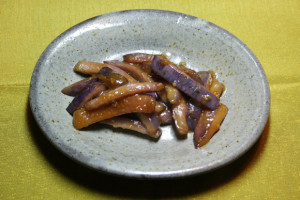
Akebi Pod Miso Itame, see recipe below

Akebi Pod Miso Itame, see recipe below

IDENTIFICATION: Akebia quinata , a twining vine green when young, turning brown with age, lenticels noticeable. Leaves palmately compound with up to five 1.5 to 3 inch long, oval leaflets, is deciduous to semi-evergreen to evergreen depending on the climate it is growing in. Flowers are fragrant and monoecious with both male ( 1/4 inch) and female blossoms (1 inch) on the same raceme, the aroma ranges from lightly chocolate to lilac to vanilla to allspice. Noses can’t agree. The dangling flowers produce fruit that resemble little egg plants. Seed pods purplish with white pulp, black seeds. Vine can grow to 40 feet long. There are five cultivated varieties. Alba: Vigorous with white flowers, Leucantha: White flowers, similar to Alba, Purple Bouquet: Most common in trade, desirable for its compact size, growing about half the height of other varieties, Rosea: Flowers are more pale than the unnamed species, helping them to stand out against the dark foliage, and Variegata: Showy splashes of white on foliage make an attractive backdrop for pink blossoms. Besides having a chocolate aroma (to some) the blossoms sometimes are also dusky in color hence a second reason for calling it the Chocolate Vine.

TIME OF YEAR: Flowers in mid-spring. Fruits September to October. Like apples in the northern United States ripening Akebi tell the Japanese fall has arrived.
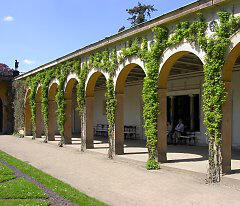
Akebi is often used for its vigorous growth, as here in Potsdam / Brandenburg, Castle Park Sanssouci, photo by Fassaden Grun

Akebi is often used for its vigorous growth, as here in Potsdam / Brandenburg, Castle Park Sanssouci, photo by Fassaden Grun

ENVIRONMENT: Grows easily in most soils, does best in well-drained sandy loam with regular moisture and full sun.  Can form dense mats as an understory species.  It can also climb and kill small trees and shrubs. In its native range it is found along forest edges, streams banks and mountain slopes. For best fruit production there should be more than one vine for good cross-pollination. Hand pollinating increases fruit production. They do not self-pollinate. Propagate by using tip layering or softwood stem cutting. From seed the plant takes five years to mature.

Joseph Decaisne who botanically named the Akebi

Joseph Decaisne who botanically named the Akebi

METHOD OF PREPARATION: When ripe the wild pods will look like purplish-blueish little mango-shaped eggplants that have been slit open. Pulp of the fruit eaten raw or made into a drink or wine, young shoots in salads or pickled with salt, bitter skin fried (often with miso) or cooked with sugar, leaves used as a tea substitute. The fruit dehydrates well whole. Pulp-less pods can be stuffed and deep fried. You can eat the seeds or spit them out. Better, plant them for edible shoots. Seeds of A. quinata usually germinate in one to three months at 59°F or 15°C. Medicinally sliced inner vine is used to make a diuretic. Young vines are used to make baskets.

Akebi Pod Miso Itame あけび みそ炒め by Kyoto Foodie

Ingredients

  • 1 akebi pod (inner fruit removed)
  • 2 tablespoons oil (sesame oil is nice)
  • 1-2 teaspoon miso paste (same as for miso soup)
  • 1 teaspoon sugar
  • 1 teaspoon shoyu (Japanese soy sauce)
  • 2 tablespoons of ryorishu (cooking sake or sake)
  • shiso leaf (fresh green shiso leaf) optional

Use at least two teaspoons of Kansai-style sweet miso paste which is light in color. Tohoku style miso is red and saltier and you might want to go easy on the amount if you are using that style of miso. Adjust amount based on the kind of miso you are using and of course your taste.

Preparation
If you would like to remove some of the bitterness you can soak the pod halves or slices in warm water for 30 to 60 minutes. Pat dry before sauteing.

Mix all the liquid ingredients together in a bowl, dissolving the miso paste and sugar.

Heat a fry pan and add several tablespoons of oil. Once hot, add sliced akebi pod and saute covered until akebi softens, this should take about 2 minutes.

Pour in liquid ingredients, reduce heat and simmer down until little liquid remains. This should take 1 to 2 minutes. Due to the high sugar content, the mixture will quickly burn – don’t allow that to happen. Once the liquid has been reduced, serve on a plate and garnish with chopped shiso leaf.
{ 45 comments }
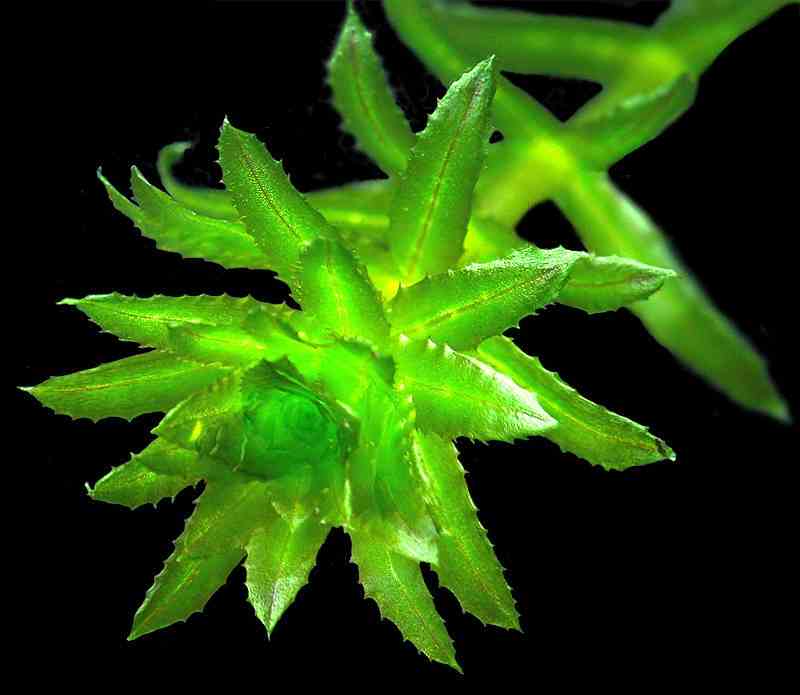
Hydrilla verticillata, photo by Plant

Hydrilla verticillata, photo by Indoaquascape

I am often asked can we eat Hydrilla? The answer is no, and yes.

There is only one species of Hydrilla, verticillata. The Hydrilla you buy in the health food store is the same that clogs lakes around the world. Can you take it out of a lake, cook it up, and chomp it down? No… Well, I don’t know of anyone doing that. But you can buy it as a dried powder to add to soups and stews and smoothies. So what’s the difference?

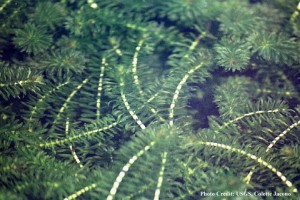
Hydrilla floating on the surface, photo by dsfadflkjhlas

Hydrilla floating on the surface, photo by Colette Jacono

Hydrilla is an Eurasian weed that entered the western hemisphere via Florida sometime in the 1950’s probably through one  aquarium dealer who imported live Hydrilla from Sri Lanka.  It was subsequently found in a Miami canal, and from there it spread.  In fact, for more than a decade no one knew it was Hydrilla. It was mistakenly called Elodea canadensis. However, within 10 years of its discovery Hydrilla became the most troublesome aquatic weed in the state.  (It can expand 1,000 percent a year grow an inch a day.) Florida currently spends about $30 million annually trying to control it.  The strain that was found in Florida was female. Twenty years later male Hydrilla was first reported in Delaware in 1976.

Hydrillas roots, photo by Alison Fox

Hydrillas roots, photo by Alison Fox

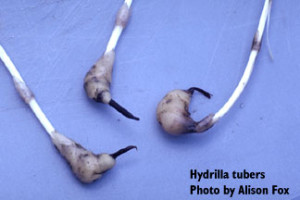
Since that introduction some 60 years ago Hydrilla is now found in 19 states and Washington DC, from the endotrophic waters of Maine, west to wet Washington state. Called the perfect aquatic plant it adapts to a wide variety of climates and water conditions.  Hydrilla can also reproduce four ways: rhizomes, tubers, turions (buds) and fragmentation. It, and Water Hyacinths, are the two most expensive weeds in the world. Because of the economic impact of the species there is a huge amount of information written about Hydrilla as a problem. Historical use of Hydrilla prior to it becoming a “noxious” weed is scant limited to a few references to how it was named and its use in making white sugar (more on that in a moment.)

A search of Chinese literature, for example, shows Hydrilla being cultivated for crab farming, and certain fish farming as well. They eat it. Duck like it, too, and snails. These are all foods the Chinese eat but no mentioning of eating Hydrilla directly. In the Philippines much is made of its nutritional qualities, but again no references found about eating it directly.

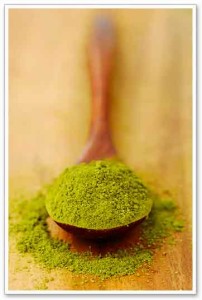
Hydrilla powder, photo by The Healers Store

Hydrilla powder, photo by The Healers Store

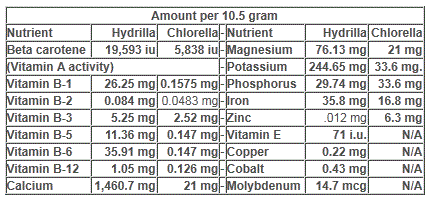
As for powdered hydrilla… in north Florida they raise Hydrilla in an isolated lake, sterilize it with pure water and ozone treatment, low-temperature dry it, powder it and sell it to you. The mild earthy-flavored powder is 13% calcium which some writers call the richest plant source of calcium on the planet. It’s also high in B-12 and iron. Further, Hydrilla has been investigated as possible animal fodder.  It has 16 percent more available dry matter for fodder than cattails and no bad chemicals were found in it during the examination for cattle food. In fact in one study when fed Hydrilla cows gave 20% more milk and chickens 14% more eggs, probably related to the calcium content. But what about Hydrilla as food for people?

Hydrilla Nutrition, courtesy of Nawebstore

Hydrilla Nutrition, courtesy of Nawebstore

As you know I developed and use the I.T.E.M approach to wild foods. Identification, Time of Year, Environment. M is for Method of Preparation. Here’s where the Hydrilla information trail breaks down. I’ve never found any reference in English about consumption of Hydrilla prior to the powdered form.  In theory there should be no problem with eating Hydrilla (beyond the possible problems associated with any aquatic plant such as environmental pollution and some algae.) No special processing is done to make it an edible powder. The entire plant is dried and only water removed. So why isn’t Hydrilla used as human food like a cooked green? Well… edible does not mean palatable. As Dick Deuerling used to say about wild food:  “I only eat the good stuff.”

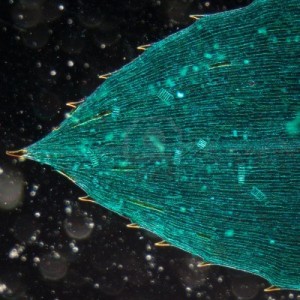
Hydrilla leaf, photo by 123rf

Hydrilla leaf, photo by 123rf

Here’s one possible reason: The plant is tough and prickly, not as bad as many land plants but noticeably so. In fact one quick and easy way to separate it from two similar looking plants (Elodea and Egeria) is to pull Hydrilla through your hand. Edodea and Egeria will feel smooth. Hydrilla will feel harsh and scratchy. It may simply be that texture kept the plant off the dinner table, that and the fact it can grow with just 1% of sunlight. That allows Hydrilla to inhabit cold dark deep areas of lakes one might not want to bother with if there are other edible plants around.

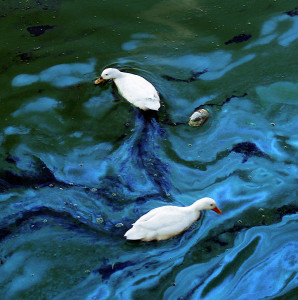
Ducks swimming in cyanobacteria.

Ducks swimming in cyanobacteria.

One tentative down side is when water condition are just right (or wrong depending on perspective) there can be a blue-green algae bloom which can grow on the top leaves of Hydrilla. That cyanobacteria can produce toxic chemicals. And while that is a warning about Hydrilla is should be looked out for on every aquatic plant that one might eat (and that includes seaweed as well.) Always avoid blue-green algae.

In English most pre-1960 references to Hydrilla refer to making sugar or naming it. In sugar making a mat of Hydrilla was placed over crystallized brown sugar. Over the next few days moisture from the Hydrilla would percolate through the sugar lightening its color towards white from brown.  The whitened sugar would be scraped off and a new layer of Hydrilla added.  As for naming the plant…

French botanist and illustrator Louis Claude Marie Richard

French botanist and illustrator Louis Claude Marie Richard

Hydrilla is fairly easy. It’s from the Greek ύδωρ (EE-dor) or “hydro” in English meaning water thus referring to its water habitat. Verticillata means whorls, as in the leaves. Linnaeus himself named it Serpicula verticillata. Over the centuries it has had many different names. Hottonia serrata, Hydrilla angustifolia, Hydrilla dentata, Hydrilla ovalifolia, Hydrilla wightii, Leptanthes verticillatus, Vallisneria verticillata, and Udora verticillata. One Claude Richard (probably Louis claude Marie Richard, 1754 – 1821) came up with the genus name Hydrilla. As it was a monotypic genus — only one species in it — Linnaeus’ species name verticillata stayed. Thus in time Hydrilla verticillata was dubbed. And while in English we say high-DRILL-ah its botanical pronunciation is: HID-ril-lah ver-ti-ki-LAH-tah.

No, I have not personally tried some. When I find some clean water I will. And special thanks to “Josey” for providing some historical data. To seen an older but good video by the state of Florida on Hydrilla click here.

Green Deane’s Itemized Plant Profile: Hydrilla

IDENTIFICATION: Hydrilla is a submersed plant that can form dense mats. Its stems stems are slender, branched and up to 25 feet long. The small leaves are strap-like and pointed. They grow in whorls of four to eight around the stem. The leaf margins are distinctly saw-toothed. Hydrilla often has one or more sharp teeth along the length of the leaf mid-rib. The midribs of the leaves are reddish in color. Hydrilla produces tiny white flowers on long stalks. It also produces 1/4 inch turions at the leaf axils and tubers attached to the roots in the mud. Tubers are yellowish, potato-like, 1/2 in. long, 1/2 inch broad. They can remain viable for four years. One tuber can produce more than 6,000 new tubers. There are two kinds of Hydrilla in North America, plants with just female blossom and those with male and female blossoms. The easiest way to tell them apart is female flowers consist of three whitish sepals and three translucent petals. Male flowers have three whitish to red petals and three red or brown sepals.

TIME OF YEAR: In North America southern populations overwinter as perennials; northern populations overwinter and regrow from tubers.

ENVIROMENT: Hydrilla can grow in almost any freshwater: springs, lakes, marshes, ditches, rivers, tidal zones with 7% salinity or less. It can grow in a few inches of water, or in water more than 20 feet deep. Hydrilla can grow in low nutrient to high nutrient conditions. It is somewhat winter-hardy though its optimum growth temperature is above 68 F. As mentioned it can grow in only 1% of full sunlight.

METHOD OF PREPARATION: Dried and powdered.  Edibility of the tubers, if any, is totally unknown to me.

{ 21 comments }
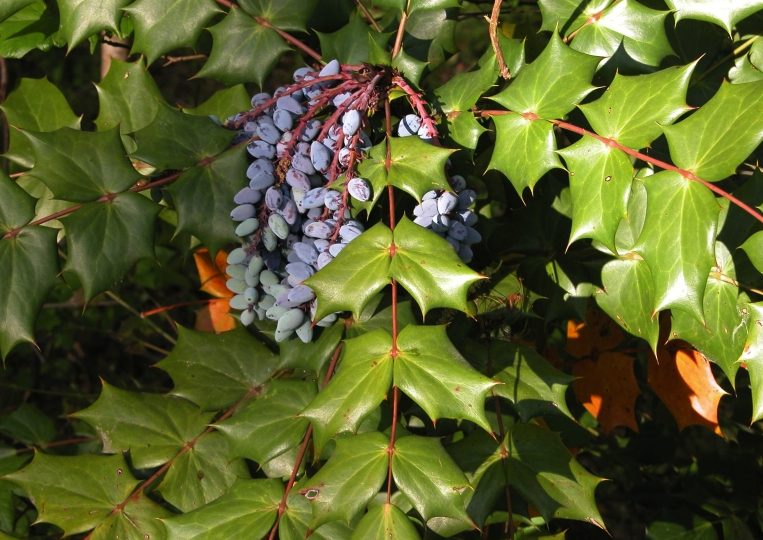
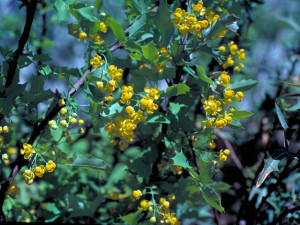
Leatherleaf Mahonia, photo by Invasive.org

Leatherleaf Mahonia, photo by Invasive.org

When I first heard of the Mahonias it was a bit irritating. They’re widespread shrubs in the western United States and here I was in Florida. But as time revealed, we have a Mahonia here, just not a native.

The berries of several Mahonias are edible in various ways including Mahonia aquifolium, Mahonia haematocarpa, Mahonea nervosa, Mahonia repens, Mahonia swaseyi, Mahonia trifoliolata and our local non-native Mahonia bealei, aka the Leatherleaf Mahonia. Their uses vary:

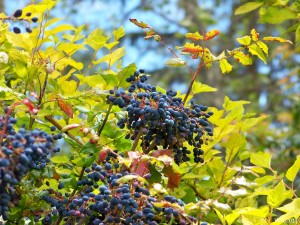
Oregon Hollygrape, photo by NameThatPlant.

Oregon Hollygrape, photo by NameThatPlant.

Mahonia aquifolium, the Oregon Hollygrape or Holly Barberry, has berries that are used in pies, jellies, jams, beverages and confections. Fermented they make a good wine. The yellow flowers are eaten or used to make a lemon-ade like drink. Mahonia haematocarpa, the Red Hollygrape, or Mexican Barberry, has blood red berries that are used to make jelly. Mahonea nervosa, is known as the Oregon Grape. It’s ripe fruit are too acidic to eat raw but are stewed with sugar or other fruits and or made into jelly or pies. They are used to help the flavor of milder fruits or to make a lemon-ade like drink. Young leaves are simmered in water and eaten as a snack.

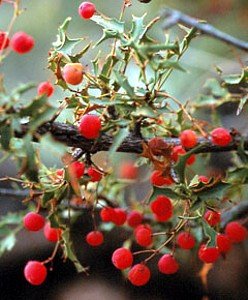
Red Hollygrape, photo by Hirt garden

Red Hollygrape, photo by Hirts Garden

Mahonia repens, the Creeping Barberry or Creeping Oregon Grape, has fruit that are eaten raw, roasted or pickled or made into jam, jelly, wine and or lemon-ade. A jelly made with half Mohonia juice and apple juice is common. Mahonia swaseyi, the Texas Mahonia, Agrito, Wild Currant and Chaparral Berry, has acidic yellow berries. They are used in juices, syrup, tarts, pies, wine, relish, candy and dried like raisins. Roasted seeds are a coffee substitute. Mahonia trifoliolata, Agrito, Laredo Mahonia and Mexican Barberry, has a subtle tart red berry eaten raw or used in jellies, preserves, sauces, drinks, cakes and tarts. Mahonia bealei, the Leatherleaf Mahonia and Beal’s Barberry, has berries edible raw or made into various thinks like pies, jelly and wine.

Texas Mahonia, photo by the Univ. of Texas

Texas Mahonia, photo by the Univ. of Texas

While most Mahonia are western natives the Leatherleaf Mahonia, from China, is a common and escaped ornamental in the South. It is shade tolerant and produces dense clusters of fragrant golden flowers in late winter or early spring. It’s a spiny gangly shrub usually planted on the north side of buildings where only it can tolerate the shade. Birds like the bluish-black berries so you have to be eagle-eyed to harvest them as they ripen. The berries also have a grayish-bloom. It arrived in Europe from China around 1800 and then to the United States. It is prohibited in Alabama, Georgia, Michigan, South Carolina and Tennessee. It is found from Florida to Maryland in coastal states asl well as Arkansas, Alabama, and Tennessee.

That said Mahonia of varying species can be found naturalized or native in most states and providences except states along the western bank of the Mississippi (excluding Arkansas). The USDA says Mahonias are also not found in Nebraska, Oklahoma, Mississippi, Tennessee, West Virginia, Hawaii, New England, Alaska, Yukon, Northwest Territories, Saskatchewan, Manitoba, Newfoundland, New Brunswick and Nova Scotia.

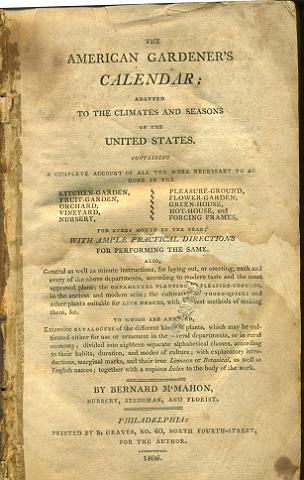
American Gardeners Calender, 1806

McMahon’s American Gardeners Calender, 1806

There are about 70 species in the genus Mahonia (ma-HOE-nee-ah) which is named for the 19th century American horticulturist Bernard McMahon… makes one wonder why they left the Mc off… McMahonia… That can’t be any more un-Dead Latin than Shuttleworthii…Anyway… McMahon (1775-1816) was known as Thomas Jefferson’s “garden mentor” though there was quite a difference in their ages. Jefferson was 32 when McMahon was born and out-lived McMahon by 10 years.  McMahon was born in Ireland but moved to Philadelphia in 1796 and opened a business in 1802, during Jefferson’s first term as president. He must of made himself known quickly. In fact it is said the Lewis and Clark Expedition of 1804-06 — authorized by Jefferson — was planned in McMahon’s home. And McMahon became one of the curator of the plants collected by the expedition when Lewis died in 1809. In 1806, three years before Jefferson left office and the year the expedition finished, McMahon published “The American Gardener’s Calendar” based heavily on previous English editions. But it recognized the harsher North American weather and advocated using natives for food and ornamental use. Jefferson was known to follow the directions in the calendar particularly regarding the planting of tulips and sea kale. McMahon died at 41 in 1816 seven years after Jefferson left office. In 1818 Thomas Nuttall bestowed the genus name of Mahonia on the west-coast evergreen shrubs that are still popular in planned gardens. The species name Bealei (BEEL-lee-eye) honors William James Beal (1833-1924) an American botanist who taught at the Michigan Agricultural College from 1870 to 1910… Or… it honors Thomas Chay Beale, consul from Portugal to Shanghai before 1860…. he grew plants collected by the great botanical spy Robert Fortune, responsible for smuggling tea seeds/plants out of China… Botanists also can’t agree on history.

A letter from Jefferson to McMahon about gardening still exists:

Monticello Jan. 13. 10.

Thomas Jefferson, president, gardener

Thomas Jefferson, president, gardener

Sir: Your favor of Dec. 24. did not get to hand till the 3d inst. and I return you my thanks for the garden seeds which came safely. I am curious to select only one or two of the best species or variety of every garden vegetable, and to reject all others from the garden to avoid the dangers of mixture & degeneracy. Some plants of your gooseberry, of the Hudson & Chili strawberries, & some bulbs of Crown imperials, if they can be put into such moderate packages as may be put into the mail, would be very acceptable. the Cedar of Lebanon & Cork oak are two trees I have long wished to possess. but, even if you have them, they could only come by water, & in charge of a careful individual, of which opportunities rarely occur.

Before you receive this, you will probably have seen Gen. Clarke the companion of Governor Lewis in his journey, & now the executor of his will. The papers relating to the expedition had safely arrived at Washington, had been delivered to Gen. Clarke, & were to be carried on by him to Philadelphia, and measures to be taken for immediate publication. The prospect of this being now more at hand, I think it justice due to the merits of Gov. Lewis to keep up the publication of his plants till his work is out, that he may reap the well deserved fame of their first discovery. with respect to mr Pursh I have no doubt Gen. Clarke will do by him whatever is honorable, & whatever may be useful to the work. Accept the assurances of my esteem & respect.

Th: Jefferson

{ 13 comments }
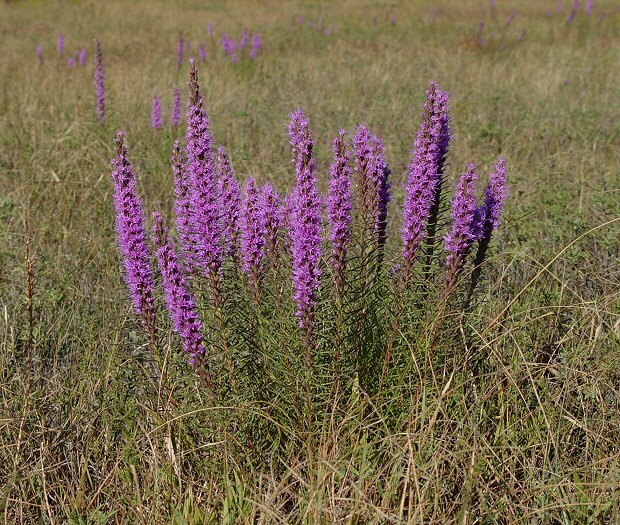
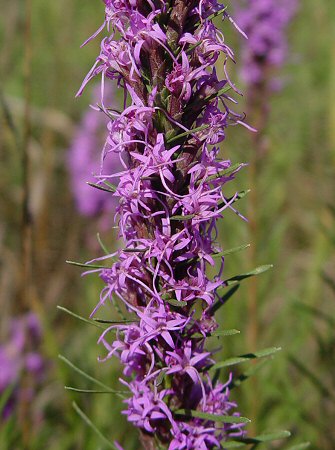
Liatris punctata, Dotted Blazing Star, photo by Missouri Plants.

Liatris punctata, Dotted Blazing Star, photo by Missouri Plants.

If you study ethnobotany one thing you will learn is that natives often used several species in a genus without making any distinction between them. This was quite true of several “ground cherries” found in Florida. They used them interchangeably.  This may also be true with some Liatris of which there are 43 species, all native to North America.

Liatris’ purple spike of flowers doesn’t suggest any edibility. Indeed, until a few years ago I knew it as sporadic wildflower that would lie dormant for perhaps a century before blooming (after being coaxed out of slumber by a forest fire. ) But a few Liatris, perhaps more, put on an edible tuber. Just make sure you are not cooking up a rare one for dinner.

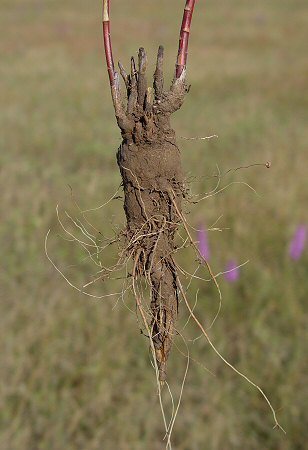
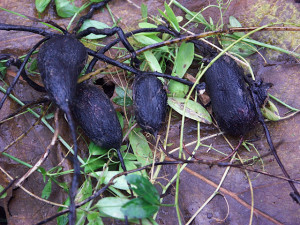
Liatris punctata root, photo by Missouri Plants

Liatris punctata root, photo by Missouri Plants

Charles M. Allen in his book “Edible Plants of the Gulf South” makes no distinction between the 43 species of Liatris. He says the root is edible. Couplan in his “Encyclopedia of Edible Plants of North America” is more specific. He writes L. punctata have edible “corms.” Couplan adds that L. scariosa, L. spictata, and L. squarrosa were used as a diuretic and that L. ohlingera is endangered. Moerman in “Native American Food Plants” says the roots of L. punctata and L. punctata var. punctata were baked and eaten by various tribes.  There is little doubt the L. punctata was eaten. But there are also suggestions L. spicata — found locally — was eaten as well. Complicating this is the fact L. punctata (the Dotted Blazing Star) is rare in some places and prolific in others. Know what kind of area you are in.

Liatris punctata flower spike, photo by Missouri Plants.

Liatris punctata flower spike, photo by Missouri Plants.

L. punctata is found in 19 states: Arkansas, Colorado, Iowa, Illinois, Kansas, Louisiana, Michigan, Minnesota, Missouri, Montana, North Dakota, Nebraska, New Mexico, Ohio, Oklahoma, South Dakota, Texas, Wisconsin, and Wyoming but endangered in Michigan and Wisconsin. We have at least seven different Liatris species in Florida including L. spicata, or Dense Blazing Star. The others are L. chapmanii, L. elegans, L. gracilis, L. ohlingerae, L. pauciflora, and L. tennuifolia. L. spicata is found east of Mississippi, eastern Canada, and states along the western shore of the Mississippi.

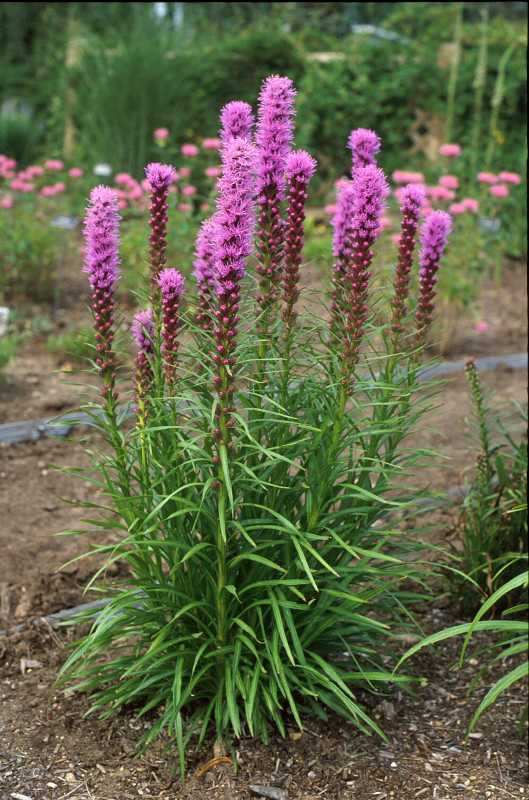
Liatris spicata, photo by Missouri Botanical gardens

Liatris spicata, the Dense Blazing Star, photo by Missouri Botanical Garden

The carrot-flavored roots have inulin, a polysaccharide also found in Jerusalem artichoke roots. It doesn’t spike blood glucose levels when consumed thus is a starch edible by diabetics. While some stems were used as a famine food other parts of the plant were used medicinally often to treat heart ailments which makes sense as the species contains some coumarin. Plains tribes used the Dotted Blazing Star to make a tea that was used for kidney, bladder, and menstrual problems, water retention, gonorrhea, colic, sore throat and laryngitis. Mashed roots were applied to snake bites. Dry roots were burned like incense to relieve headaches, nosebleeds, and tonsillitis. L. chapmanii and L. gracilis might be active against various human cancers.

Domestic livestock like the Dotted Blazing Star particularly sheep. Rocky Mountain Elk also eat it and White-Tail Deer. A variety of small rodents like it — especially the roots — and it is the only source of food for some butterflies. The species apparently also has toxic pyrrolizidine but in very low levels.

As for the botanical name no one knows for sure why the genus is called Liatris (Lee-AT-tris or lye-AT-tris.) Punctata (punct-TAH-ta) means with dots and spicata (spih-KAY-tah) is flowering with a spike. The genus was created by J.C.D. vom Schreber 1739-1810. He might have used the Gaelic word liatrus, spoon-shaped, as a reference to the sometimes bulbous root.

Green Deane’s Itemized Plant Profile: Liatris

IDENTIFICATION: Liatris punctata: Warm-season perennial, several hairless stems, four to 32 inches high, leaves alternate, numerous, dotted with tiny pits, hairless except of coarse hairs on the edges. Lower leaves usually smaller than those above and soon dropped; flower is a dense spike up to a foot long of pink flowers that turn to dandelion-like pappus. Rhizomatous taproot is short, thick, four to 16 feet deep, with lateral roots at various levels. Roots are grayish-black in cross section. Note the L. spicata has a rounder top than the L. puncatata.

TIME OF YEAR: Anytime however only new root growth is edible.

ENVIRONMENT: Dry, open places, sandy soil

METHOD OF PREPARATION: New portion of roots roasted. (The plant keeps adding to the root.)  Sometimes the root was consumed raw.

{ 7 comments }
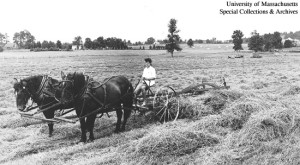
Old Fashion Hay Mower

How I mowed hay in my youth. Photo Powerhouse Museum

Anyone who has mowed fields for hay hates vetch… wild pea.  It binds up the machinery and a lot of livestock won’t eat it. That’s a lose lose all around unless the vetch is Lathyrus tuberosus.

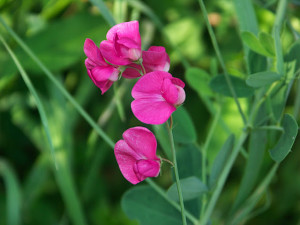
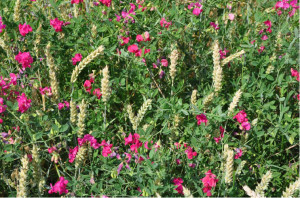
Tubular Sweetpea has typical wings and keel blossom

Tuberous Sweetpea has typical wings and keel blossom

A decade of my life was spent haying with just such a mower above. I know every part of it intimately, personally, mechanically, greasily, irritatingly… Whether pulled by horses or a tractor the larger wheels turned a lateral shaft which changed the circular motion via a wooden “pitman” to a horizontal movement, a six-foot blade of piranha teeth swishing back and fourth through the sicklebar. Whenever you hit a patch of vetch the resistance of the stems was more than the mechanical power to cut through them. That’s when one of two things would happen. The ash pitman (the stick in the lower middle, above and right of the small wheel) would splinter, or if the pitman was made of sterner stuff,  the small wheel would trigger a spring release and the entire left side of the mower in front of the big back wheel would break free and swing back like a broken arm. This required stopping, cleaning the vetch from the sicklebar bar, then backing the entire contraption until the sicklebar bar snapped back into place. If the pitman broke it was the end of haying for that day, the evening spent in repairs. The bane of mowing hay was either vetch, or, ground hornets who were not happy when you cut off the top of their home.

Roots are best roasted or boiled

Roots are best roasted or boiled

Vetch…. legumes — peas and beans if you will permit the common grouping — land all over the foraging spectrum from edible to toxic to this part edible and that part not. Thus it is with the Lathyrus tuberosus (LAY-thigh-russ  two-burr-OH-sus.) The seeds are toxic in quantity, the crisp cooked roots are delicious on par with sweet chestnuts. Raw they have more of a pea flavor. It makes one wonder how a plant once esteemed for its tasty tuber is now a noxious weed in many places… maybe haying had something to do with it. Another issue with this “invasive” is what do we call it? Tuber Vetchling, Earthnut Pea, Aardaker, Tuberous Sweetpea, Tanotte, Gland-de-terre, Gesse tubéreuse, châtaigne de terre, Fyfield Pea, Pebble Pea, Heath Pea, Pea Earth Nut, Earth Chestnuts, Dutch Mice, Earth Mouse. I like Dutch Mice and there are several Earthnuts/Chestnuts out there but let’s go with Tuberous Sweetpea. That is reasonably descriptive and accurate.

adsfdsafdsf in Wheat

Lathyrus tuberosus in Wheat

The Tuberous Sweetpea is native to Eurasia but is also found across much of northern North America. Cultivated since the 1600’s many consider it an “antique vegetable” once popular but now passe. That’s not really accurate. In taste tests the Tuberous Sweetpea always rates high and numerous plans have been made to make it a commercial crop. The problem is the plant does not agree to be domesticated. A consistent crop is difficult to maintain so it has not become a commercial staple. That’s doesn’t mean me and thee can’t harvest a lot of it and enjoy it, or even raise it. The roots can be boiled or roasted. Some also eat the root raw though it might be mildly toxic that way. There is also “lathyrism” to consider.

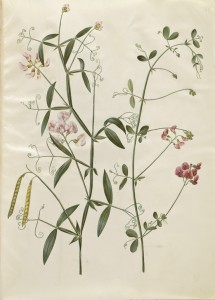
Tuberous Sweetpea

Tuberous Sweetpea

Some members of this large genus — Lathyrus sativus for example — have a toxic amino acid in the seeds that can cause a nerve disease if eaten in large amounts. While some caution is advised that “large amount” is when the seeds are 30 to 50 percent of ones diet. Not exactly a problem for most in the modern era. Also edible are the seeds and young pods of the Lathyrus japonicus ssp. matitimus, with the same caution. However note only the root of the Lathyrus tuberosus is eaten, preferably cooked. It’s also used to favor some scotch whiskey. The root of the Lathyrus linifolius, “knappers” are also eaten. I have not been able to substantiate that the roots of the Lathyrus amphicarpus are edible.

Haying the hard way.

Haying the hard way.

To reiterate the seeds of Lathyrus species — there are 187 of them — are toxic particularly when consumed often and in large quantities. The tubers of the Lathyrus tuberosus were a common food in Europe often sold in produce markets particularly in France under the name “macusson.”  Botanically Lathyrus is from the Greek Lathyros which is an old name for pea. Tuberosus is Dead Latin meaning tuberous, referring to the thickened roots.

If I may add a personal opinion here. After decades of foraging and teaching I have come to view the pea family as one of the most dangerous group, for two reasons. Many of them are indeed toxic, and most people are familiar with peas which gets them to let their guard down. Indeed, just a few years ago an experienced forager in South Carolina ate three wild pea pods from a toxic species and died three days later. All one can say is be careful. There are some good edible members of the family, just make sure you are right.

Green Deane’s Itemized” Plant Profile: Tuberous Sweetpea

INDENTIFICATION: Lathyrus tuberosus: Perennial herb with nut-sized tubers, 12 to 32 inches high, stem limp, sometimes climbing, bristly, wingless, hairless. Flower irregular, rose red if not crimson, five petals standard pea blossom, lateral two petals the ‘wings’, the lower two petals united to form the ‘keel’, overall shape of corolla being butterfly-like. Stamens 10, strong fragrance. Leaves alternate, stalked, elliptic–lanceolate, blunt, no teeth, bluish green. Fruit long, flat, brown pod with three to six seeds. Tubers can be up to 16 inches deep. Oh, by the way you will read that the plant’s stipules (dwarfed petals) are semisagittate. Who on earth thought that term up? It means half an arrow tip…

TIME OF YEAR: Flowering June to September, depending on climate, seeds in the fall. Left on it own the plant develops root rather deep. To avoid that problem under cultivation it is best to plant them in containers. Harvest in late fall or early spring.

ENVIRONMENT: Likes limestone rich soil, forests, hedgerow, roadsides, railway yards, wasteland, parks, sometimes ornamental. Nitrogen fixer. Easily trellised.

METHOD OF PREPARATION: Roots boiled or roasted. Roots boiled for about 10 minutes. Some people like to steam the flowers and eat them. You are on your own with that. To cultivate the Tuberous Sweet Pea either plants the roots or used the seeds. Soak the seeds overnight then plant in spring, preferably in a container. The Providence of Ontario classifies it as a noxious weed.

To read about the amino acids in the genus go here.


{ 10 comments }