Bull Thistle in Blossom. Photo by Green Deane

Thistle: Touch me not, but add butter

Thistles, you’re either going to love ’em or hate em. Of course, I think eating them is the sensible compromise.

Thistles, in this case Cirsium horridulum (SIR-see-um hor-id-YOO-lum) are among the hardest to gather of wild foods, Black Walnuts probably being the worst. But, the reward is edible stalks, edible leaves —trimmed of spines — roots and unopened flower bud bottoms. Like many tasty wild plants, the thistle did not make its way into main stream food channel because of the spines and its two-year growth habit.  The first year the plant is just a root and a rosette, the second year it sends up a stem and blossoms.

Note the basal rosette, photo by Green Deane

The first-year root and leaves are edible, but there isn’t much of a root for a while. The leaves are edible but don’t even bother trying to cut off the spines. That’s too labor intense. Just strip the green off the leaf leaving the very edible midrib.  Rub the “wool” off and enjoy, raw or cooked.  All thistles in the genus Cirsium, and the genus Carduus,  are edible. 

In the second year of growth the inner core of thistle flower stalks is quite tasty and not that much work. The leaves are still edible if you strip them of spines as are the bottom of the flower buds, though the bud bottoms aren’t much more than a nibble.  All can be eaten raw, steamed or boiled.  (Or roast whole by a fire and squeeze the cooked core out.)

Of course, one should wear heavy gloves when working with thistles, and some people have contact dermatitis with thistles, so make sure first. Personally, I prefer the stalks of second year plants in spring, when they are a foot or so high. I just use a long-handled shovel to cut them at the base above the rosette. With heavy gloves and a trimmer I hold the plant upside down and cut off the leaves and sundry spines. Carefully peel the stalk of the fibrous coat, which is most of the green you’ll see. Then you can eat it raw or cooked, I prefer cooked. I think the stalk boiled a few minutes and then served with butter, salt and pepper is absolutely delicious, for a green.

Thisles also grow fibrous as they age — why we don’t eat older stalks — and can be used for cordage. Soaking the plant several days in water makes the threads available. Also, the seed fluff when dry is great tinder. And should you be in the wilderness with little but a thistle for protection, know the Seminole Indians made blowgun darts from the plant. That might require a remaking of the common phrase: I’ve got a thistle stuck in the thick of my tongue. The down was used as guide feathers for arrows.

Incidentally, it’s shaving brush-shaped flowers can be purple or yellow. Personally, I have never seen a yellow one. If by some outside chance you have misidentified the prickly Mexican poppy (Argemone mexicana) for the thistle, the poppy has yellowish sap and flowers, white or yellow, with petals. The thistle’s flower is like a shaving brush when in bloom that then turns into a cottony ball of fluff.

Unopened Thistle Bud, photo by Green Deane

The thistle, which is in the sunflower family, is often called an invasive weed even where it is native. What is native? It can be found around the world and throughout North American and Canada, even in the arctic circle and Greenland, just like the mustard plant, chickweed and blackberries. Thistles can be found from valley bottoms to mountain tops. All you need to be is observant, and hungry. The thistle shown here, C. horridulum, grows from from Maine south along the seacoast to Florida, west from South Carolina to Texas.  When I was a boy growing up in southern Maine this thistle grew every year across the road from our house. Now, it so happens that I went to school eight years in one-room school houses. An annual project, as directed by Mrs. Arlene Tryon, was to bring unopened thistle blossoms to school, hang them up, and watch them turn into cotton-like puffs. The thistle, by the way, is also food for the larva of the  American Painted Lady butterfly, Black Swallowtail, Delaware skipper, Palamedes Swallowtail, Palmetto Skipper), Three-Spotted Skipper, Twin-Spot skipper (What? No One-spotted skipper?) and other butterflies. Goldfinches like the seeds, too.

A tea can also be made from the leaves and the plant was used in ancient times to treat varicose veins, which in Greek is kirsos. After being bastardized by Latin, Kirsos becomes Cirsium. Horridulum means a little spiny, clearly a joke by Andre Michaeux the botanist who named it. (Also, on something almost completely unrelated, it’s a cute linguistic and conceptual hop from kirsos, varicose veins, to kissos, which means ivy.)

There is one poisonous thistle, and that is Atractylis gummifera, found around the mediterranean area and Asia Minor. Its root is quite toxic and a common source of poisoning of children in Northern Africa.The toxicity of is atractyloside and carboxyatractyloside, two diterpenoid glucosides capable of inhibiting mitochondrial oxidative phosphorylation. Both interact with a mitochondrial protein, the adenine nucleotide translocator. Poisoned patients experience nausea, vomiting, epigastric and abdominal pain, diarrhoea, anxiety, headache and convulsions, often followed by coma. No specific pharmacological treatment for Atractylis gummifera intoxication is available and all therapeutic approaches are only symptomatic. 

Green Deane’s “Itemized” Plant Profile

IDENTIFICATION: Biennial or perennial herb, two to five feet high, basal and stem leaves lobed, lower stems leaves can be four to nine inches long, can be woolly in parts, second year stems stopped with shaving-brush flowers, purple or yellow. In some species the branching can be throughout the stalk, in the bull thistle branching occurs only on top. Very spiny, one tough plant. If by chance you have misidentified it with a spiny poppy the poppy has flowers with large petals. If you are in Florida and on the west coast you might see Cirsium nuttallii, which is tall and skinny with many branches.

TIME OF YEAR: Best in spring, first or second year, starting in February in Florida, later in northern climes. In Florida the seasons can be mixed with the plant not taking a break between first and second year growth.

ENVIRONMENT: Sandy open areas, moist or dry, old fields, roadsides, often the only plant still untouched in closely cropped pastures. Some reports say they like wet areas but that certainly is not the case here in Florida.

METHOD OF PREPARATION: Raw, boil or steamed hollow inner stalks peeled of green outer fiber; core of unopened flower buds, when cooked squeezed out like artichoke leaves;  stripped midribs raw or cooked. First year roots once large enough to harvest,  The seeds are edible, 12 pounds will produce 3 pounds of edible oil. Suitable for cooking or lamp use. Thistle root gives some folks gas. Thought you’d like to know ahead of time.

HERB BLURB

 American natives used thistle for neuralgia, over eating, an herbal steam for rheumatism and to shrink hemorrhoids (presumably without the thistles!)


{ 64 comments }
Second year plants have terminal clusters of flowers. Photo by APhotFlora

Second year plants have terminal clusters of flowers. Photo by APhotoFlora

Gather Garlic Mustard now for pesto or it may disappear presto… well… maybe not immediately but if one university succeeds Garlic Mustard will become hard to find or extinct in North America.

First-year plants are short with kideny-shaped leaves in a rosette. Photo by Field Botany

First-year plants are short with kidney-shaped leaves in a rosette. Photo by Field Botany

It all started on this continent sometime around 1868 when Garlic Mustard, a native of Europe, was found on Long Island, no doubt brought over before then for food and medicine. It’s leaves are rich in vitamin C and A and medicinally was used for treating gangrene and ulcers. Garlic Mustard spread slowly across the country reaching Oregon by 1959. It wasn’t a severe problem until about 40 years ago. Then it began to proliferate alarmingly. It went from taking over an estimated 366 square kilometers a year to 6,400. In the last four decades it’s become a significant pest, a dreaded “invasive.” Why? My guess is deer. The deer population has also dramatically increased in numbers during the same for decades. They prefer to eat native plants rather than Garlic Mustard. However, if you have more deer eating the native plants to the ground it gives prolific Garlic Mustard chance and space to get going. Once it does it drives out other plants including trees.

Second-year plants grow rapidly tall and flower. Photo by Gary Fewless.

Second-year plants grow rapidly tall and flower. Photo by Gary Fewless.

Garlic Mustard can produce up to 8,000 seeds per plant. That can translate into 100,000 seeds per square meter which are easily spread around. Germination rate is close to 100% and up to 24,000 seedlings per square meter have been counted. The seeds can remain viable for up to 10 years. Most of the seeds don’t survive but it’s a numbers game and Garlic Mustard is simply out-breeding its competitors. Shade tolerant, the species is found in southern Canada and 34 US states where it’s officially invasive in six. In western Europe is ranges from Italy to Sweden, England to Russia and parts of Asia. Garlic Mustard basically skips the southern United States among other reasons because the seeds need long exposure to cold to reproduce, sometimes as much as one or two winters. However, seeds can germinate right at 32 F giving it a jump over other spring-time plants. Second year plants bolt very quickly.

The larva of this weevile may eventually reduce the Garlic Mustard population.

The larva of this weevile may eventually reduce the Garlic Mustard population.

Regardless of why Garlic Mustard is proliferating it is considered a serious invasive species in North America. But have little fear, the University of Minnesota is coming to the rescue. Starting in the 90s experts began looking for a biological control. Several insect candidates were considered. The university has decided thus far the leading contender is Ceutorhynchus scrobicollis, a weevil of a beetle from Europe. If approved the insect will be released between now and 2016. The goal? Wipe out this foreign invader that also has cyanide in it’s leaves. What? Cyanide? Yep, and those who demonize this wild edible are quick to point that out. So what about the cyanide?

Like many members of the Mustard family the species has long, skinny seed pods. Photo by K. Chayka

Like many members of the Mustard family the species has long, skinny seed pods. Photo by K. Chayka

It’s not that uncommon in the Brassicaceaes. The cyanide is usually minimal and below that to impact animals or people. However it is enough to be toxic to some fungi, pathogens and insects. It can be a killer if you have six legs. That also might be how it keeps other plants from growing where it grows by killing off necessary soil bacteria and the like. The level of cyanide is not a threat to people. Garlic Mustard did not earn a mention in Poisonous Plants of the United States and Canada by Kingbury, for many decades if not still the “bible” on poisonous plants. (See the Herb Blurb below the recipe.)

Like all mustards the flower has six stamens, four long and two shot best seen in the top flower. Photo by Les Mehrhoff

Like all mustards the flower has six stamens, four long and two shot best seen in the top flower. Photo by Les Mehrhoff

A two-year plant, Garlic Mustard grows rapidly in the spring producing a basal rosette. During its second year it can reach one or two yards high. It is usually the tallest bloom plant in the forest around May. Also called Jack-By-The-Hedge and “Sauce Alone” the leaves taste like garlic and mustard with a slightly bitter aftertaste. The leaves smell of mustard when crushed and stems are often purplish. The first-year rosette has kidney-shaped toothy leaves. They can remain green through the winter. Second-year toothy leaves are more triangle shaped along a tall flowering stem. Seed pods are shiny black when mature. Plants that grow near Garlic Mustard and might be confused for it are Toothworts (Dentaria) Sweet Cicely (Osmorhize claytonii) and early saxifrage (Saxifraga virginica.)

Small brown-black seeds aline in the "silique." Photo by Steve Baskauf

Small brown-black seeds aline in the “silique.” Photo by Steve Baskauf

Botanically the species is Alliaria petiolata. Alliariea is a variation of Allium, the genus for garlic and onions. It is from the Greek word αλέω which means “to avoid” presumably because of the garlic/onion aroma. Petiolata is from Dead Latin: petiolatus “petiolate”, referring to leaf attachment. “Jack” by the way when referring to plants usually means the Devil.

If you do go through a patch of Garlic Mustard clean your shoes and any pants’s cuffs to keep you from taking home this species that can easily take over your yard. Of course, eating the invasive is your civic duty and tasty, too.

Green Deane’s Itemimized Plant Profile: Garlic Mustard

IDENTIFICATION: Alliaria petiolata: Biennial herb with a weak single stems 12 – 36″ high its second year. Leaves: Round, scallop-edged, dark green; first year, rosettes of three or four leaves; second year plants have alternate stem leaves. Leaves and stems smell like onion or garlic when crushed. Flowers: White, small, numerous, four separate petals. One or two flowering stems on second year plants. Seeds: Slender capsules to six inches long with a single row of oblong black seeds, 12 to 19 seeds per pod. White, slender taproot, S-shaped at the top. The root smells like horseradish.

TIME OF YEAR: Growing by March or April. Two-year cycle, low rosette the first year, tall and flowering the second. Grows very rapidly in spring.

ENVIRONMENT: Moist, shaded soil; river floodplains, forests, roadsides, edges of woods, trails edges, forest openings, disturbed areas. Does not tolerate highly-acidic soil and prefers to not grow under conifers. Often found in association with hardwoods.

METHOD OF PREPARATION: Garlic Mustard is usually used raw. Second-year shoots before blossoming are choice. British naturalist Richard Mabey says the best use is as a sauce for lamb. Merritt Fernald, the grand botanist of Harvard a century ago, reported it was used like a lettuce leaf but for flavoring in sandwiches, mixed in salads, eaten with salted fish and used as a stuffing in pork. Cornucopia II says the leaves can be finely chopped and added to tossed salads, cooked as a pot herb, or eaten with bread and butter. It is also mixed with mint leaves and made into a sauce for salt-fish, mutton, and as mentioned before, lamb. Ray Mears reports the leaves are good added to nettle soup and the seeds make a very fiery mustard. Pick the leaves just before you want to use them. They wilt quickly.

The following recipe was created by  Paul Wedgwood of Wedgwood the Restaurant, one of Edinburgh’s finest and originally reported by Robin Harford on a British website with a name very close to this one, www.EatWeeds.com.Uk.

Garlic Mustard Vichysoisse


Garlic Mustard Vichysoisse

Garlic Mustard Vichysoisse

Ingredients
•    75g butter
•    1 onion, chopped
•    75g three cornered garlic stems
•    800 ml water
•    1 large potato, peeled, diced and rinsed
•    Salt and freshly ground black pepper
•    75g Jack by the hedge/garlic mustard
•    75g goat’s cheese
•    75ml milk for foam
•    Pinch cumin
•    Pinch white pepper
Suggested Instructions
1.    In a heavy bottomed pan add water and potatoes and a good pinch of salt and boil until potatoes are soft. Remove from the heat and set aside.
2.    Melt the butter in a medium saucepan. Add the onion and cook until softened. Pour over the boiled potatoes and water.
3.    Blitz in food processor until smooth. Add water if required to the correct consistency. Pass through a sieve.
4.    Chill in the fridge. Check seasoning.
5.    Blanch jack by the hedge for 10 seconds in salted boiling water and refresh in ice water.
6.    Add jack by the hedge and blitz again until smooth.
7.    Then add the three cornered garlic blitz until smooth, check for seasoning again.
8.    Serve with some crumbled goats cheese, frothed milk, a pinch of cumin, some crispy fried nettle dusted with white pepper and a three corned garlic flower
Prep time: 30 mins.
Cooking time: 10 mins.
Serves: 4

Herb Blurb


J Chem Ecol. 2007 Jan;33(1):85-94.
Cyanide in the chemical arsenal of garlic mustard, Alliaria petiolata.
Cipollini D, Gruner B. Source: Department of Biological Sciences, Wright State University, 3640 Colonel Glenn Highway, Dayton, Ohio 45435, USA. don.cipollini@wright.edu

Abstract

Cyanide production has been reported from over 2500 plant species, including some members of the Brassicaceae. We report that the important invasive plant, Alliaria petiolata, produces levels of cyanide in its tissues that can reach 100 ppm fresh weight (FW), a level considered toxic to many vertebrates. In a comparative study, levels of cyanide in leaves of young first-year plants were 25 times higher than in leaves of young Arabidopsis thaliana plants and over 150 times higher than in leaves of young Brassica kaber, B. rapa, and B. napus. In first-year plants, cyanide levels were highest in young leaves of seedlings and declined with leaf age on individual plants. Leaves of young plants infested with green peach aphids (Myzus persicae) produced just over half as much cyanide as leaves of healthy plants, suggesting that aphid feeding led to loss of cyanide from intact tissues before analysis, or that aphid feeding inhibited cyanide precursor production. In a developmental study, levels of cyanide in the youngest and oldest leaf of young garlic mustard plants were four times lower than in the youngest and oldest leaf of young Sorghum sudanense (cv. Cadan 97) plants, but cyanide levels did not decline in these leaves with plant age as in S. sudanense. Different populations of garlic mustard varied moderately in the constitutive and inducible expression of cyanide in leaves, but no populations studied were acyanogenic. Although cyanide production could result from breakdown products of glucosinolates, no cyanide was detected in vitro from decomposition of sinigrin, the major glucosinolate of garlic mustard. These studies indicate that cyanide produced from an as yet unidentified cyanogenic compound is a part of the battery of chemical defenses expressed by garlic mustard.
PMID:
17146719
[PubMed – indexed for MEDLINE]

{ 26 comments }
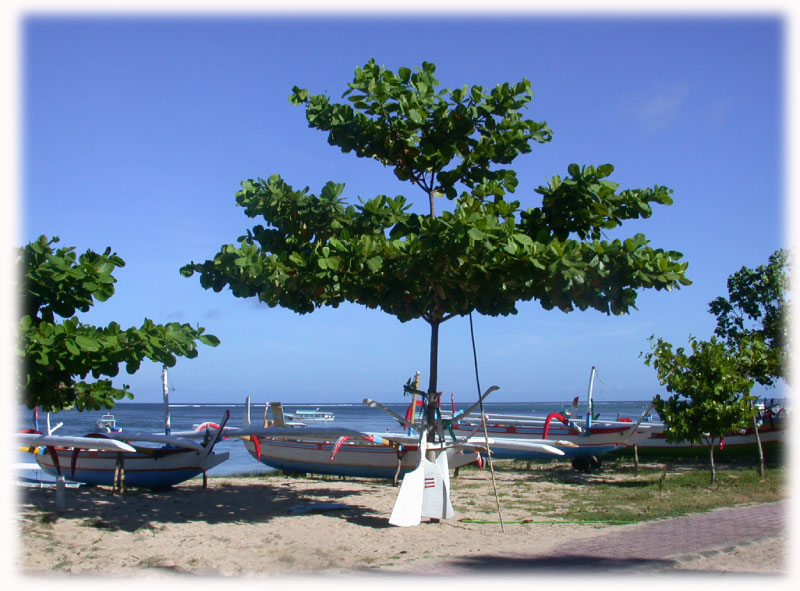
A typical Tropical Almond in a typical setting. Photo by Tropical Plant Book

A typical Tropical Almond in a typical setting. Photo by Tropical Plant Book

I went to Ft. Myers one Friday to look at plants on an 11-acre monastery. On the property there was a large tree they didn’t know nor did I. The following Sunday while teaching a class across the state in West Palm Beach two students knew a tree there that I didn’t know. It was the same tree at the Monastery. Small botanical world. The tree was a Tropical Almond.
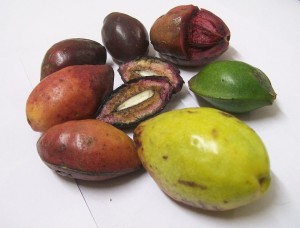
Tropica Almonds at various stages of ripening. Photo by Staticd.

Tropical Almonds at various stages of ripening. Photo by Staticd.

You would not know the Tropical Almond is not native to the American tropics if you judged it by popularity there. Starting in mid-Florida along the coast then south it becomes more common if not excessive by Central America. Not bad for a tree that is native to East Indies and related warm areas from Australia to Africa. It’s usually found in coastal locations because it likes low-elevation (under 1300 feet) and is salt, drought and wind tolerant. Add a lot of rain and no freezes and the tree is happy. It’s often used in landscaping because when a leaf dies it turns red making the tree colorful most of the time. The journey west to east probably started in Hawaii. We know it was there before 1800.  It was definitely introduced to Jamaica by 1790.  The tree is naturalized in southern Florida, the Florida Keys, Virgin Island and Hawaii as well as the West Indies and from Mexico to Peru and Brazil. It is also grown in warm areas of Texas and California
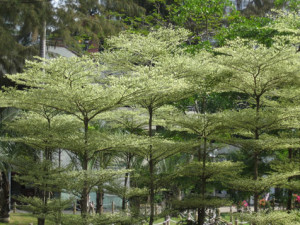
Pagoda-like Terminalia mantaly "Tricolor" in Hong Kong. Photo by Green State

Pagoda-like Terminalia mantaly “Tricolor” in Hong Kong. Photo by Green State

Botanically Terminalia catappa (ter-mih-NAIL-ee-uh kuh-TAP-uh) it is not related to the edible almond. No doubt the tree gets it common name from the seed pods which look like large unshelled three-inch almonds and from the seed/kernel which resembles almonds. Unlike true almonds though the outside of the fruit is also edible. Both the seeds and the fruit of this particular species are edible raw. When the fruit dries it is very light thus buoyant and uses water (ocean currents) to get spread around. They are a common “sea bean” found along Florida beaches. For such light fibrous things they are surprisingly tough to open (especially if you have only two chunks of small concrete as we did that day… the surface of Florida does not have rocks.)  Julia Morton, who was a long-term botany professor at the University of Miami, reported in 1985 that “defleshed, thoroughly sun-dried fruits may be readily cracked by a sharp blow on the keel.” If well-dried they will also open if hit on the end point with a hammer.
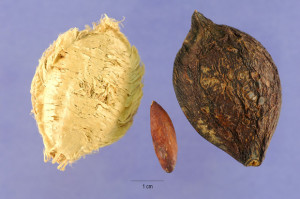
Inside the Almond-like husk is a tasty kernel. Photo by N.I.T. Gallery

Inside the Almond-like husk is a tasty kernel. Photo by N.I.T. Gallery

Propagated by seed the fast-growing Tropical Almond reaches 30 to 55-feet talls on average but can grow to 80 feet. Deciduous, it forms a symmetrical, upright tree with horizontal branches that reach 35 feet in width. The branches are arranged in tiers giving the tree a pagoda-like look. The tree’s large leaves are distinctive, 12-inches long and six-inches-wide, glossy green, leathery with a heart-shaped base. They are also woolly underneath and grow in a rosette at the end of branches. Leaf stems have two glands at the upper end. Before dropping from age, or winter or drought they change through shades of red, yellow, and purple. Spring time blossoms are inconspicuous, green and white, arranged in fives with 10 to 12 stamens each all on six-inch-long terminal clusters.  They produce the edible fruit that changes through the colors already mentioned for the leaves: green to yellow then red or dark purple. The husk is corky, thin with green flesh inside. The fruit is high in tannic acid which can stain cars, pavement and sidewalks. But the tannic acid is also good for tanning hides. Interestingly the tree does not attract much wildlife. Some tropical ants like it and fruit bats eat the husk. Bees are attracted to the blossom but apparently have a difficult time making honey from them. Humans can barely detect an odor from the flowers. A tree can produce (when shelled) about 11 pounds of kernels per season.
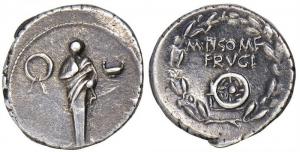
On the let is the Roman God Terminus on a coin from 58 BC.

Above left is the Roman God Terminus on a coin from 58 BC.

There are some 250 species in the Terminalia genus. Terminalia is a variation of the Dead Latin word Terminus, a Roman God who presided over boundaries and frontiers. He liked fences and was never inside a buiding. In English we get termination, terminal and terminus from it. Here Terminalia refers to the rosette of leaves at the end of branches. While I would like to say Catappa is from the Greek word Kata (which means “below, all along” ) it is not. Catappa is variation of the Malaysian name for the tree which is ketapang.
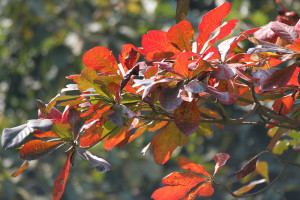
Whether by age or conditions Tropical Almond leaves turn red making attractive foliage. Photo by J.M. Garg.

Whether by age or conditions Tropical Almond leaves turn red making attractive foliage. Photo by J.M. Garg.

For flavonoids the tree has quercertin and kamferol; pigments include violaxanthin, lutein and zeaxanthin; tannins are  punicalin, punicalagin and tercatein. The leaves and bark are astringent. Medicinally the tree has had a myriad of uses in folk medicine including treatment for cancer, sickle cell disorders,  dysentery, cough, leprosy, nausea, diarrhea, intestinal parasites, eye problems, rheumatism, colic, liver disease, scabies, upset stomach, thrush and as an antibacterial agent and contraceptive. There is some modern research that suggests it might be useful in treating high blood pressure. Leaf extracts have shown to have some anti-diabetic and antioxidant activities. The leaves and bark are put in fish tanks to increase water acidity and reduce bacterial infections amongst the tank’s inhabitants.
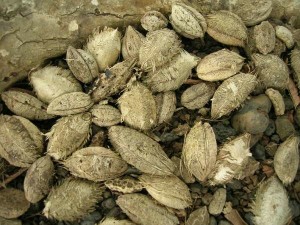
Dried fruit floats and is carried thousands of miles by ocean currents. Photo by N.I.T. Gallery

Dried fruit floats and is carried thousands of miles by ocean currents. Photo by N.I.T. Gallery

The wood is moderately dense but had not been used for timber like other Terminalia species. It’s hard, strong, and has an attractive heartwood. Boxes, crates, buildings, bridges, boats, floors, planks, wheelbarrows, carts, barrels and water troughs are made from the wood. It does not do well in soil such as when used as fence posts but does well in water such as for building boats. In Fiji and Samoa it is the favorite wood for native drums.
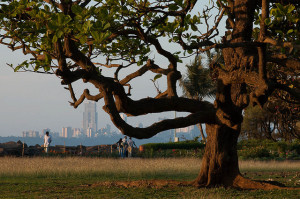
A Tropica Almond Tree in India. Photo by

A Tropical Almond Tree in India. Note the shallow roots, one reason why it grows well in south Florida which in many places only has a few feet of soil on limestone. Photo by Barbara E.

Related species that have edible kernels after washing and cooking are T. glabrata, T. litoralis, T. mauritiana, T. pamela, and T. kaernbachii, the latter of which has seeds that are 12.5 protein and 70% fat.  Morton reported T. cattapa kernels are 52% fat, 25.5% protein and 6% sugar. The oil is mostly palmitic acid, 55.5% and oleic acid, 23%. Per 100 grams the outer flesh is 74% moisture, 5% protein and has 84 mg of calcium, 24mg of phosphorus, 7 mg iron, 21 mg of ascorbic acid. The T. cattapa is the only one in the genus to produce a kernel that can be eaten raw and does not need washing or cooking. A few species produce lesser quality fruit whose fleshy husks (but not seeds) are eaten: T. edulis, T. oblongata, T. platyphylla, T. sericocarpa, and T. solomonensis. The seeds of those species are often not eaten because of a high tannic acid content sometimes as high as 53%. Whether they can be leached like acorns I do not know. I suspect if they could it would have been discovered by now.
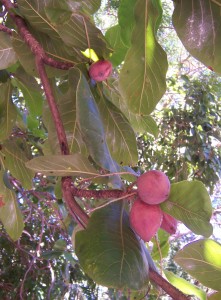
Tropical Almond fruit ripening. Photo by B. Bavez

Tropical Almond fruit ripening. Photo by B. Navez

Other names for the species include: Barbados almond, bastard almond, Bengal almond, country almond, Demarara almond, false kamani, Fijian almond, Malabar almond, Malay almond, sea almond, Singapore almond, story tree, tavola nut, West Indian almond, alconorque, almendrillo, almendro, almendro de la India, almendron, almendro del pais, amandelboom, amandier de Cayenne, amandier des indies, amandier des tropiques, amendoeira, badam, badamier, castafia, castafiola, chapeu de sol, guarda-sol, kalumpit, kamani-haole, ketapang, kotamba, parasol, saori, talie, talisai, tavola, tipapop, tipop, tivi, white bombway, wilde amandel, zanmande, and many more dialect names.

The leaves are also fed to silkworms and animals.

Green Deane’s “Itemized” Plant Profile: Tropical Almond
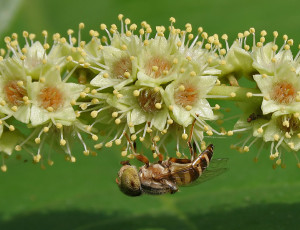
Flowers of the Tropical Almond.

Flowers of the Tropical Almond. Photo by J.M. Garg

IDENTIFICATION: Terminalia catappa:  Usually a single trunk tree that can reach 80 feet high, 18 inches through at the base. It has whorls of nearly horizontal, slightly ascending, branches like pine trees eventually taking on a pagoda-like appearance. Branches droop at the tips. Leaves are short stemmed, spirally clustered at the branch tips, obovate, up to 11 inches long, six inches wide, dark-green above, paler beneath, leathery and glossy turning bright-scarlet, dark-red, dark purplish-red, or yellow in midwinter often right at Christmas time in Florida. In Hawaii the tree is evergreen. Foetid flowers are greenish-white, very small, no petals but 10-12 conspicuous stamens, in slender spikes in the leaf axils. Most flowers are male, a few hermaphrodite, some female. The fruit is two inches or more long, one inch or more wide. Most that I’ve seen are about three inches long and half as wide, ellipsoid more pointed at the end than at the base, slightly flattened, with a prominent keel around both sides and the tip. Skin is smooth, waxy, and thin. Pulp layer is juicy, whitish to pink or reddish, slightly sweet or acidic. The seed in the husk is spindle-shaped with a thin brown covering.  The “kernel” is actually the tightly coiled seed leaves of the embryo, more tender than an almond with a hazel nut like flavor.

TIME OF YEAR: Varies on location, summer, winter or nearly all year.  Here in Florida they bear in November. In southern Indian they have two crops per year. In the Caribbean they fruit continuously.
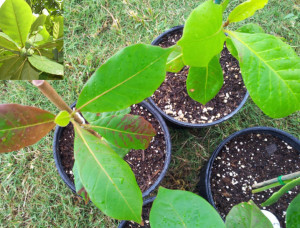
Young Tropical Almonds in pots. Photo by Tropicals USA

Young Tropical Almonds in pots. Photo by Tropicals USA

ENVIRONMENT: Full sun to medium shade on well-drained soil, tolerant of wind, salt, and drought, likes being mulched and regularly fertilized. Will not tolerate freezes. The germination rate for whole fruit is 25%. Seedlings are transplanted into pots and raised in shade slowly acclimatizing them to full sun. Field planting is done when they are seasonally leafless.

METHOD OF PREPARATION: The fruit has a pleasant aroma but is not too tasty. The ripe husks of the fruit can be eat raw but are best when young and sweet.  The seeds have an almond or hazel-nut flavor. In India they are often served sitting in water on a small plate. The oil can also be used for cooking or to make soap. Leaves can be used as plates or to wrap small amounts of food. Among the fruit there can be a lot of variation as to when they are edible and palatable, sometimes when younger other times when older.
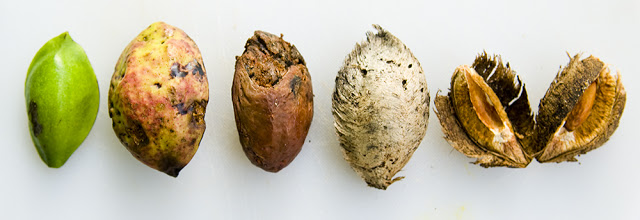
Tropical Almond Fruit. Photo by Barbera E.

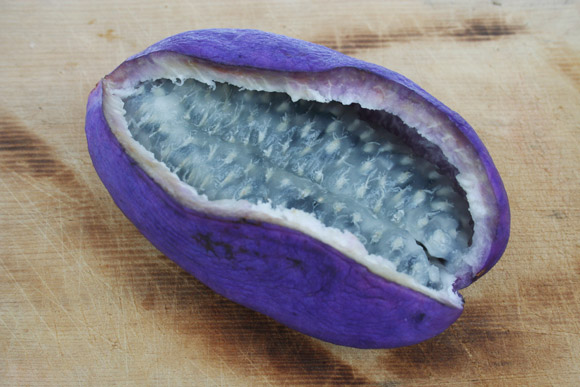
Tropical Almond Fruit. Photo by The Three Foragers
 

{ 77 comments }
asdkl;fdslfj;alsfj

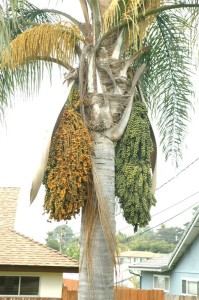
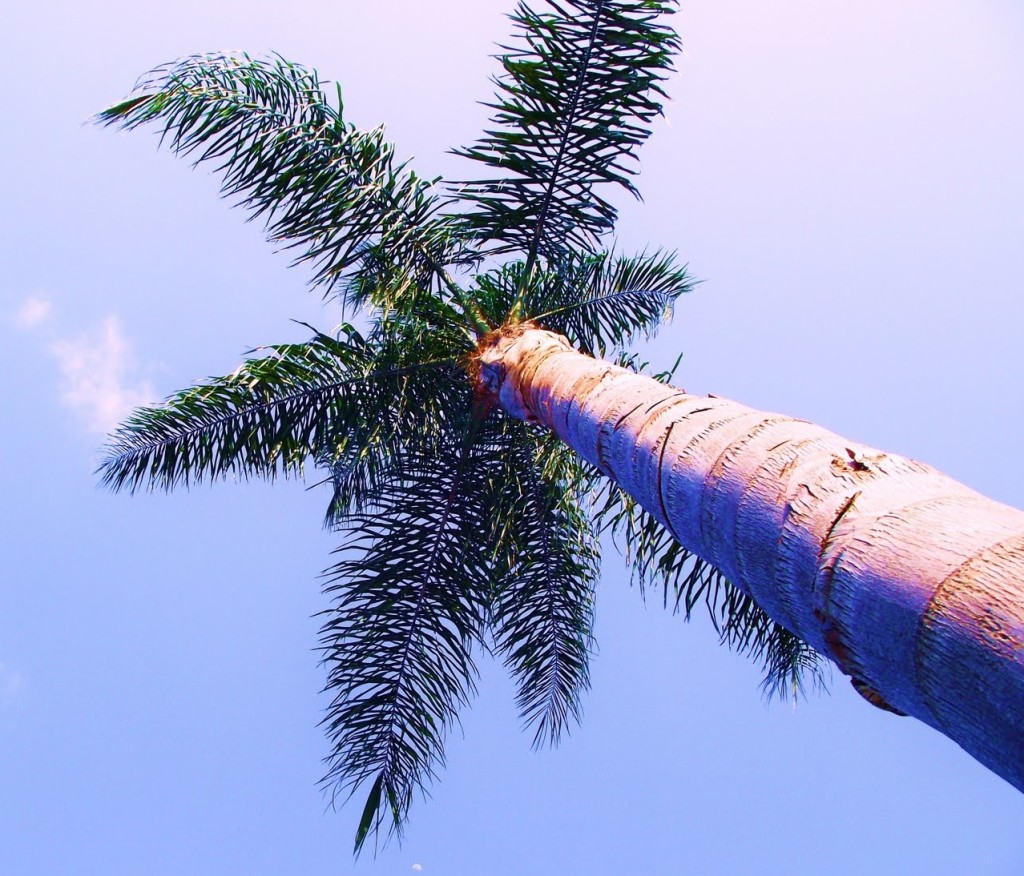
A forager’s typical view of a Queen Palm, photo by a White Washed Cottage

The Queen Palm and I got off on the wrong frond. Before I met one I had read it was toxic. There are a few toxic palms but the Queen Palm is not one of them.

photo by Hawaiin Dermatology

Fruit branches can be up to six feet long, photo by Hawaiian Dermatology

A rain forest native of Brazil, Paraguay and northern Argentina, Queen Palms, Syagrus Romanzoffiana, are more a landscaper’s delight than a forager’s. The palm is tall, stately, single-trunked with a crown of glossy, bright green, soft feather-like fonds. It forms a graceful, drooping 20-foot crown with bright orange fruit (dates) that favor ripening in the winter months but can be found at other times as well. They are popular adornments along streets or walkways usually planted every 15 feet. Their gray trunks are attractively ringed with dropped leaf scars. From Florida to California it is the most commonly planted palm. It’s also common in northern Australia and they’re easy to grow in pots indoors if you live in cooler areas.

dasdsaf dsfasfsf asdfdsf adsf sa

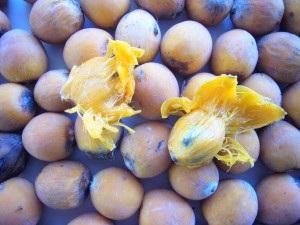
Queen Palms have a lot of fiber and a large seed, photo by Green Deane

The elements that make it a choice palm for landscaping makes it a headache for foragers. Unlike the much shorter and also edible Pindo Palm, the Queen Palm is usually too tall to harvest the dates easily. One is left to picking them up off the ground where they can develop a white mold. Aromatic and sweet the dates are sticky and fibrous with a very large seed. Usually you don’t eat the date meat but you can. One just chews on the pulpy coating getting the sugar out of it then spit out the fiber out. However, some people like to eat the fiber as well but it can cause a tummy ache in some people. Besides being loaded with simple carbohydrates the date has antioxidant qualities almost on par with vitamin C, according to a 2012 study.

From a landscaping point of view the palm while desirable is also a lot of work. They are not “self-cleaning” so the older fronds have to be removed (at just the right time or the palm suffers.)  Also for many gardeners who turn a plot of land into a living painting a messy pile of orange dates is a visual blight on a highly coiffured landscape. Thus the striking seed spikes are often cut off before the fruit gets a chance to ripen and drop.

The Queen Palm’s scientific name is a bit of a hodge-podge. When I first moved to Florida the palm was Cocos plumosa. Then it became a mouthful:  Arecastrum romanzoffianum. Now it is the tongue twisting Syagrus Romanzoffiana (sigh-AY-gruss roe-man-zoff-ee-AY-nuh or see-A-grus ro-man-zof-fee-A-na)  Though those and at least a half-a-dozen other names most people just called it the Queen Palm (or occasionally the Giriba palm.)

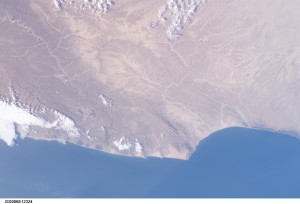
Center, theCape of Fartak, or in the ancient world Cape Syagrus. Photo by NASA.

Center, the Cape of Fartak, or in the ancient world Cape Syagrus. Photo by NASA.

Syagrus (SEE-ah-grus) was a Greek poet who commented about Troy before Homer. Copycat references say the genus was named after the poet. That is Internet nonsense. On the Arabian seacoast there is a point called the Cape of Fartak, now in eastern Yeman, which is in the part of the world where dates were first cultivated and still grown. The ancient Greeks called it Cape Syagrus named after the σύαγρος (SEE-ah-gros) date. Greeks often named an area after what grew there. We also know the Roman author Pliny the Elder also referenced a Syagrus date. The genus is clearly named for the date not the poet.

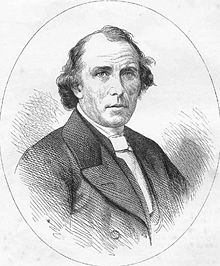
Count Nikolai Petrovich Rumyantsev

Count Nikolai Petrovich Rumyantsev

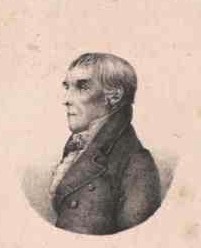
Romanzoffiana is more obtuse. It honors Count Nikolai Petrovich Rumyantsev (1754-1826) which after going through the Dead Latin filter becomes Romanzoffiana. Who was he? Apparently a count you could not count on. Rumyantsev was a foreign minister to Alexander I of Russia.  He sought closer ties between Russia and France in the early 1800s. Rumyantsev also, understandably, suffered a stroke when he heard that Napoleon had invaded Russia. Oopse, slight miscalculation there. As a result of the stroke Rumyantsev lost his hearing and by then his career was in ruins.  So why is a palm named after him? In private life Rumyantsev was a bit of a historian, collector of odds and ends, and patron of exploration voyages including the first Russian navigation around the globe. In short, he bought the honor. Nearly 200 years after his death all that remains of him is a painting and a palm.

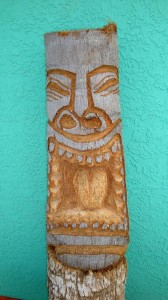
A Tiki made from a Queen Palm trunk. Photo by Tiki Room.

A Tiki made from a Queen Palm trunk. Photo by Tiki Room.

Curiously the University of Florida refers to the Queen Palm date as “ornamental” and classifies the palm as a category II invasive species. In Australia the palm is a threat to a bat called the Flying Fox. They eat the green dates and get sick. Also the large seed lodges behind their back teeth preventing them from eating thus starving. And the bats themselves get stuck in the fronds, which apparently throws off their radar. Despite that they do spread the seeds around causing it to be invasive there.  In South America the seeds are spread by the tapir. In fact, in one study, which I would not have wanted to conduct, 98% of the tapir dung piles had Queen Palm seeds in them (averaging 200 seeds each.) That must be  difficult to put on your resume: Tapir Dung Expert… Anyway, Queen Palms can hybridize with Pindo Palms producing some hard to identify palms and fruit. The hybrid species is called X Butiarecastrum. Why cross them? To get the grace of the Queen but the cold hardiness of the Pindo.

The translucent seed inside the fruit is also edible. It tastes like cocoanut, but is difficult to extract (unlike the pindo palm that gives up the seed easily. The seed is also used to make cooking oil.

 Green Deane’s “Itemized” Plant Profile.

IDENTIFICATION: An upright palm to 50 feet, pinnate compound leaves to three feet. Flowers white to cream, fruit green turning light orange then bright orange.  Often you will see a palm with a bulge in the middle with a skinny trunk on bottom and top. That means it was neglected, then fed and watered well, then neglected again.

TIME OF YEAR: Fruits in late fall or the winter months

ENVIRONMENT: Acidic, well-drained sandy soil in full sun. Likes ample moisture and is slightly salt tolerant. Cold hardy to 20 F.

METHOD OF PREPARATION: The sticky, sweet pulp can be eaten off the seed, or made into wine or jelly. The seed oil is used for cooking. The palm’s inner pith dried might be a flour substitute.

{ 57 comments }
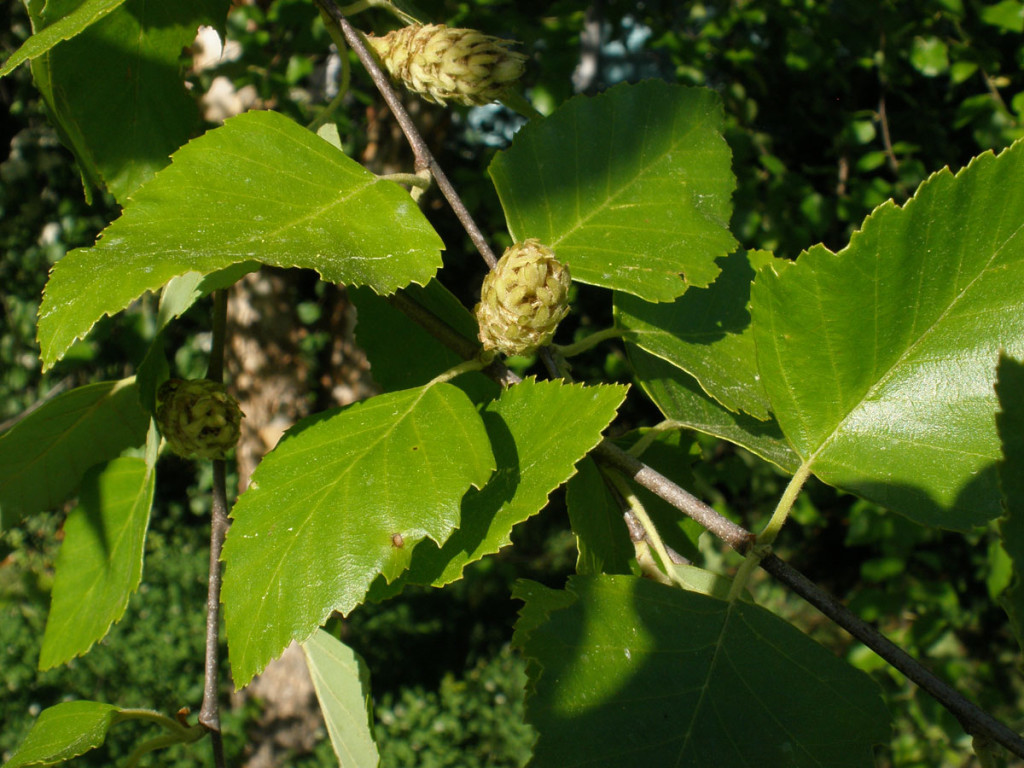
Betula nigra, photo by SIU.EDU

Betula nigra, the Black Birch or River Birch, photo by SIU.EDU

One could easily write a book about Birches because they are so valuable to foragers. While I grew up with white birches in Maine Birches don’t grow locally though if you plant one about 100 miles north of here as an ornamental it will survive. The Black Birch, Betula nigra, however is a native and can be found in northwestern Florida.

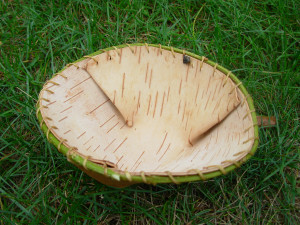
Birch Bark Cup, photo by Etsy

Birch Bark Cup, photo by Etsy

Let’s talk first about the well-know facts about Birches: Yes you can drink the sap and make syrup, beer, wine or vinegar out of it, or sugar. You can make a tea from the root bark, leaves or branch tips or eat the tips. Very young leaves can be eaten or used for flavoring. And you can make cups to baskets to canoes out of the bark. Birch sawdust can be added to flour to extend it. The inner bark, the cambium, is edible and can be used as a flour-like substitute (that won’t rise.) The wood, solid or rotten, can make a smokey burn to cure fish and meat, or the wood can also be used for a fawn-colored dye.  (The wood of Birches catches fire even if wet, another good wet wood is ash, it will burn right off the stump.) Birches’ “wintergreen” aroma is methyl salicylate which is closely related to aspirin and has medicinal applications. If you are allergic to aspirin you might be allergic to methyl salicylate. The Creeks used the Black Birch to treat tuberculosis of the lungs, the Catawbas boiled buds and added sulfur to make a salve to treat ringworm and sores. The Alabama boiled the bark to treat sore horse hooves, and the Cherokee chewed the leaves or made a tea to treat colds, dysentery and urinary issues. The species’ oil was also used to treat dandruff and as a perfume.

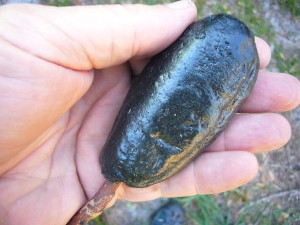
Birch tar cooled to a hard resin, photo by Green Deane

Birch tar cooled to a hard resin, photo by Green Deane

What you may not know is that Birch resin, or tar, was the first super glue. I even have my own chunk of it, left (thank’s Bill!) Archaeological research shows it has been used for at least 80,000 years: A spear point is extant with a Neanderthal thumb print in the tar. There also exists 11,000 year old bits of Birch tar with human teeth marks… crude chewing gum. Ancient Greeks used the tar to mend broken pottery. Birch tar is solid at 65°F, moldable at 85°F, a stiff putty at 105°F, a soft sticky putty at 135°F and boils at 352°F. Birch tar is not made from the sap but rather the bark itself, heated in an oven with little air (similar to making charcoal.) The bark expresses an oil that runs out a small hole in the bottom of the oven. When it cools it’s waterproof and not brittle. Among the tar’s many uses was to glue arrowheads to shafts.

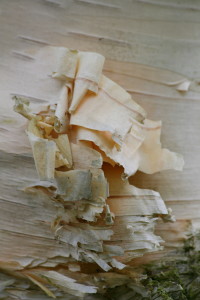
Peeling Birch Bark also makes excellent tinder.

Peeling Birch Bark also makes excellent tinder.

Betula is Dead Latin for the tree and genus (BEH-too-lah and beh-TOO-lah.) “Birch” is from Old English berc or beorc which again is from Betula. Another view is that “birch” is from the Germanic word Birka. In Gaelic it is beith, which is also the first letter of the old Gaelic alphabet. Native Americans had many names for Birch including: mianoo’s (Potawatomi) onaguchscha (Onondaga) wigwass (Ojibwa) winachk (Delaware) and wuskwiy (Plains Cree.) The Black Birch. or River Birch found north and west of the Suwannee River, was called the akcelelas’kv by the Muskogee, lokapi by the Choctaw, onaget by the Onondaga, and yap koko’ha by the Catawba which means “tree breaks, brittle.

The White Birches of New England

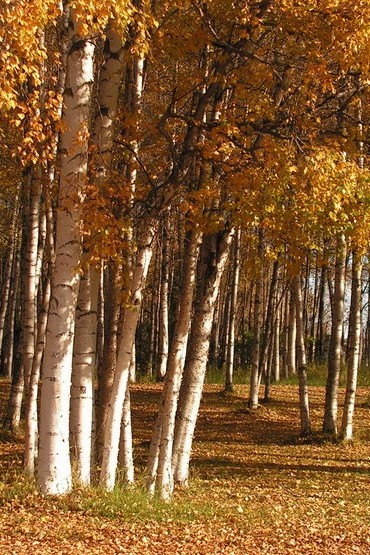
The White Birches of New England in fall color.

Depending upon which authority you consult there are 30 to 150 species of birches in the temperate world (don’t forget cooler South America!) There’s 13 to 15 species in North America, four or so in the Old South.  Found in North America are the Yellow or Gray Birch (Betula alleghaniensis) Sweet Birch (Betula lenta) Black Birch or River Birch (Betula nigra) Water Birch (Betula occidentalis) Paper Birch (Betula papyrifera) European Birch (Betula pendula) Gray Birch (Betula populifolia) and the Virginia Roundleaf Birch (Betula uber) which is endangered. The South has Betula lenta, Betula nigra, Betula alleghaniensis and Betula papyrifera var. cordifolia. There also might be in North America — again depending upon whom you ask — Betula cordifolia, Betula glandulosa, Betula kenaica, Betula michauxii, Betula minor, Betula nana, Betula neoalaskana, and Betula pumila, most of which are dwarf species and just might be smaller versions of the aforementioned species. Record birches tend to be about 60 feet tall and can live to around 140 years.

Birch Polypores only grow on Birches

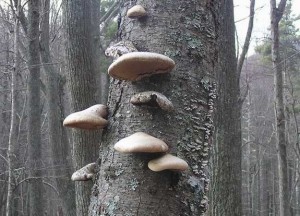
Birch Polypores only grow on Birches, photo by Hitch Hiker’s Notebook

A hardwood the specific gravity of North American birches ranges from  0.55 to 0.65 and has been used for furniture. Where ever they grow Birches are… appealing. An adult birch tree can produce a million seeds a year which is food for birds including the American goldfinch, pine siskin, northern junco, blue jay, chickadees and sparrows. Birches can also be important nesting sites for red-tailed hawks and vireos as well as cavity nesting sites for chickadees and woodpeckers. Strips of birch bark are the main building materials used by vireos for their hanging nests while other birds and squirrels use the bark to make nests and line dens. The Yellow-bellied sapsucker drills into birches to make the sap weep to attract ants which the bird then eats. The Birch Polypore, Piptoporus betulinus, used for sharpening knives, also only grows on birches.

Birch Tree Train Depot, 1955.

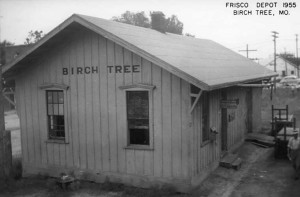
Birch Tree Train Depot, 1955.

By the way, the town of Birch Tree is in Missouri, elevation 991 feet, population 541. Nestled in the Ozark mountains it was named for the tree growing near the post office. Don’t laugh, Viburnum, Missouri, got it’s name in a similar way. Between the 2000 and the 2010 census Birch Tree’s population increased by 45 people, by 2020 it had dropped to the 541. Small as it may be the governor of Missouri from 2001 to 2005,  Bob Holden, was born in Birch Tree. And the governor directly before Holden, Mel Carnahan, was also from Birch Tree. While governor in 2000 Carnahan ran for the U.S. senate and was elected posthumously, the only time that has ever happened. He died in a plane crash three weeks before the election. As Carnahan’s name could not be removed from the ballot his wife Jean stepped in and won the election by a 2% margin. She was then appointed senator by the lieutenant governor, Roger B. Wilson.

Green Deane’s “Itemized” Plant Profile: Black Birch, River Birch

IDENTIFICATION: Betula nigra: Medium size deciduous tree to 35 feet, reddish to yellowish brown, scaly flaking bark. Leaves alternate, simple, almost triangular in shape, doubly serrated. Male flowers pendulous catkins, female flowers short, erect catkins,

TIME OF YEAR: Different parts different times of the year.

ENVIRONMENT: Floodplains and wooded stream banks. It is the only Birch found a low altitudes in the southeastern United States.

METHOD OF PREPARATION: Like all the other birches.

A couple of related issues: People who have an allergy to bananas often have an allergy to Birches. Grace Morley, 18, of England, suffers from one of the world’s oddest allergies. She goes into toxic shock if she eats an apple near a birch tree. Morley has no reaction to either the fruit or tree pollen on their own.

Birches

By Robert Frost, 1915

Robert Frost

Robert Frost, in his mid-30s

When I see birches bend to left and right
Across the lines of straighter darker trees,
I like to think some boy’s been swinging them.
But swinging doesn’t bend them down to stay
As ice-storms do. Often you must have seen them
Loaded with ice a sunny winter morning
After a rain. They click upon themselves
As the breeze rises, and turn many-colored
As the stir cracks and crazes their enamel.
Soon the sun’s warmth makes them shed crystal shells
Shattering and avalanching on the snow-crust—
Such heaps of broken glass to sweep away
You’d think the inner dome of heaven had fallen.
They are dragged to the withered bracken by the load,
And they seem not to break; though once they are bowed
So low for long, they never right themselves:
You may see their trunks arching in the woods
Years afterwards, trailing their leaves on the ground
Like girls on hands and knees that throw their hair
Before them over their heads to dry in the sun.
But I was going to say when Truth broke in
With all her matter-of-fact about the ice-storm
I should prefer to have some boy bend them
As he went out and in to fetch the cows—
Some boy too far from town to learn baseball,
Whose only play was what he found himself,
Summer or winter, and could play alone.
One by one he subdued his father’s trees
By riding them down over and over again
Until he took the stiffness out of them,
And not one but hung limp, not one was left
For him to conquer. He learned all there was
To learn about not launching out too soon
And so not carrying the tree away
Clear to the ground. He always kept his poise
To the top branches, climbing carefully
With the same pains you use to fill a cup
Up to the brim, and even above the brim.
Then he flung outward, feet first, with a swish,
Kicking his way down through the air to the ground.
So was I once myself a swinger of birches.
And so I dream of going back to be.
It’s when I’m weary of considerations,
And life is too much like a pathless wood
Where your face burns and tickles with the cobwebs
Broken across it, and one eye is weeping
From a twig’s having lashed across it open.
I’d like to get away from earth awhile
And then come back to it and begin over.
May no fate willfully misunderstand me
And half grant what I wish and snatch me away
Not to return. Earth’s the right place for love:
I don’t know where it’s likely to go better.
I’d like to go by climbing a birch tree,
And climb black branches up a snow-white trunk
Toward heaven, till the tree could bear no more,
But dipped its top and set me down again.
That would be good both going and coming back.
One could do worse than be a swinger of birches.

{ 28 comments }