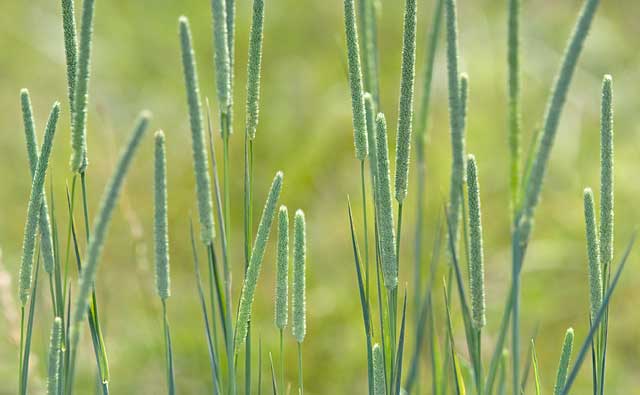
Timothy Grass, a good chew for horses and man.

Timothy Grass, a good food for horses and a sweet nibble for man.

That simple question has a complex answer: Yes, no, and maybe.  It’s a topic I explored in a recent Green Deane Newsletter and the basis for this article.

Strictly speaking we eat a lot of grass, but in the form of grain: Wheat, rice, rye, barley, millet, sprouts et cetera. What most folks want to know is can you eat the culms and blades (stems and leaves.) What you just read — culms and blades — is one of the impediments to learning about grasses; it has an argot all its own, a specific vocabulary worse than mushrooms. More so, often with grass key identifying characteristics can only be seen with a microscope. In fact I attended a grass seminar a few months ago in which the lecturing professor said if you want guaranteed employment become a grass taxonomist. He said they are very rare and very well paid.
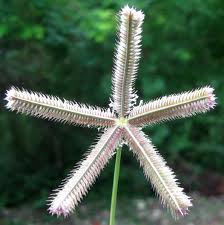
Crowfoot Grass

Crowfoot Grass

As for humans eating grass, we are not multi-gastric (or in theory large-gutted). We aren’t designed to break down the cellulose in grass to get out the nutriments. Cows have a four-chambered stomach for that purpose, horses have a huge large intestine, even the gorilla has a gut that can accommodate large amounts of vegetation. Humans don’t. However, what we can do is dry the grass, grind it into a powder and use it as a bulking agent in food, such as breads, soups and stews. We don’t get much nutrition from grass prepared that way but it does add to the sensation of satiety and reduces hunger. But there are even issues with that, such as how often. There is also the problem of cyanide.
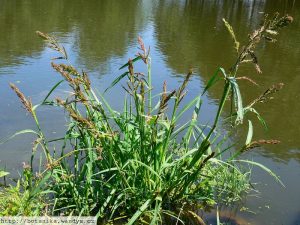
Barnyard Grass seed can be used like wheat.

Barnyard Grass seed can be used like wheat.

I have read and been told by those with Ph.D. after their name that all North American grasses are non-toxic. Many imported grasses, however, do have cyanide in some kind of chemical bond such as with hydrogen or sugar that gets separated on digestion. At the most basic level that means one has to know if the grass is native or not which also requires identification, and I’ve already mentioned grasses are a pain in the .. ah.. grass to identify. And while “natives” might not be toxic there are many grasses that seem to have very little edible value. The Andropogons come to mind which don’t seem to have any use beyond making crude brooms. As for common toxic non-natives Johnson Grass, a sorghum, is a good bad example. The large blades can be full of cyanide, depending upon the weather.  Crowfoot Grass is another. We eat the grain of Crowfoot Grass only after the plant has turned brown and the dry seeds are easily picked. Complicating the issue is that quite a few toxic grasses from Africa and Asia are naturalized in North America. Prime grain ones to look for are Sand Spurs, Barnyard Grass, and Panicums. Clover is not included here in that it is not a grass but in the pea family. Locally there is also sugar cane (non-native and native.) Sugar cane is easy to grow in warm areas but only for sugar which are empty calories but more energy than just the blades. Related native species are very fibrous and very low on sugar. Similar looking to sugar cane is Arundo donax , a controversial and wild-spread invasive in many areas of the United States. I have found only one reference to the plant’s rhizomes as edible (cooked) which makes me suspicious, and it definitely is not native, another reason to be cautious. While Arundo donax leaves and shoots are listed as edible practical experience says they are not.
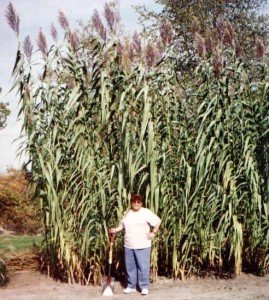
Arundo donax is also called Oboe Grass because it's used to make reeds for woodwinds.

Arundo donax is also called Oboe Grass because it’s used to make reeds for woodwinds.

And now if you will permit, let me reminisce. I recently bought another book for my foraging library, A Guide to Florida Grasses, by Walter Kingsley Taylor, not the first book in my collection from this august author. I will say more about the book in newsletters to come. I spent an afternoon browsing through the guide and noted his entry on Timothy Grass. The picture alone erased more than 50 years and took me back to summers as a boy in Maine. That’s when I was impressed into service to harvest hay for our horses, most of it Timothy, Phleum pratense, a grass originally from Europe. Because of its high protein content and low dust factor it is preferred by horses. It is also good food for small rodents like Guinea Pigs, Chinchillas, as well as rabbits. We “hayed” every summer for some 20 years usually putting ten to 15 tons of loose hay into the barn. There is some irony in that most of the hay we got every year came from the Hayward Farm.

The main machine for cutting this hay was a horse-drawn sickle mower. Instead of two horses the tongue was extended four feet and was pulled by a stripped-down WWII Jeep, which I got to drive. As soon as I was old enough to reach the pedals I drove and dad operated the mower.  By the time I was legally old enough to get a driver license I had already driven thousands of miles in hayfields and across country roads. Most of my annual summer “vacation” was spent haying and driving.
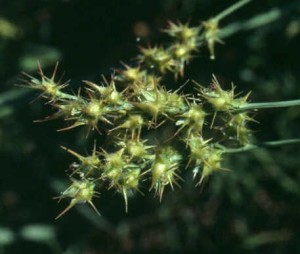
Sand burrs are are food that follow you home.

Sand burrs are are food that follow you home.

The problems of haying became common. The cutter bar would break a tooth, a triangle-shaped replaceable cutting edge held on by rivets, which we replaced red hot from our own forge. At least once a season, more depending upon how thick the grass was, the piston arm would break, as it was intended to do. It was a piece of ash, called a pitman — the tan wood in the picture lower right — that pushed the mower blade back and fourth being moved by gears turned by the wheels of the mower. It translated forward mower movement into horizontal sickle blade movement. When stresses got too much the wooden piston would break saving the rest of the machine from damage. Two other problems were common.

Sicklebar Cutter

Often the cut hay would wrap around each of the Jeep’s drive shafts, build up like a wad of cotton candy, get hot and catch on fire, not far from the gas tank. This required quick stopping, crawling under the hot vehicle, putting out the fire, then removing the tightly wound hay, often, ironically, with a blow torch. The other issue, beside unpredicted rain, was ground hornets. The Jeep, pulling the mower, would run over a ground hornets’ nest — at least one per field. They were never pleased about that. The hornets would instantly swarm under the Jeep, then emerge between the back of the jeep and the mower where they would find both of us and attack. It was an excuse to change gears and drive like hell… It must have been much worse when the mower was pulled by horses.
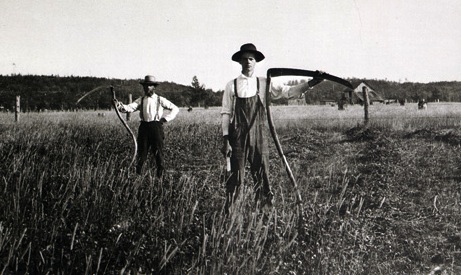
Father and son scything hay

In places where the terrain was too wet or hilly my step-father, who was built like a heavy-weight boxer and did box, would take out a scythe and cut it by hand. He had two grim reaper scythes. One with a long thin blade for hay and one with a short thick blade for brush. Once the hay was cut and sun dried we would winnow it with a Jeep-adapted horse-drawn rake. Then it was loaded loose onto a hay wagon I would drive home. The hay was lifted into the barn by a rope-operated hay fork pulled by the Jeep which my mother drove. My job on those oh-so-hot summer nights was to go up in the high rafters of the barn with 100 pounds of salt for each ton of hay. As each forkful of hay was dumped into the barn I salted it to absorb any moisture thus preventing it from rotting, getting hot and starting a fire. And then throughout the winter I had to shovel and cart the …recycled… hay to the manure pile. No wonder I was a skinny kid.

A modern “Ben Franklin”

And all the time — driving or shoveling — I had a stem of Timothy Grass in my mouth, chewing away enjoying the mild sweetness in the stem. It is a grass I would dry, powder, and use. Being a farm kid and chomping on Timothy was part of the same existence. It’s one grass that I know beyond any doubt. Timothy was unintentionally introduced to North America. In 1711 John Herd found the Eurasian native growing wild along the Piscataqua River near Portsmouth, New Hampshire. He called it “herd grass.” That’s almost clever. He talked it up and it was grown in southern Canada, New England area and New York. In 1720 a Timothy Hanson moved from New England to Baltimore and began to cultivate the seed and sell it.  He was the first person in the new world who grew, bagged and sold hay seed. George Washington and Benjamin Franklin were admirers of the grass and Franklin is credited with calling it “Timothy Seed” in a letter dated 16 July, 1747. The name was shortened to Timothy and it stuck. It is found nearly everywhere in North America and even in Greenland though here in Florida it is naturalized only in the Miami area. I sometimes wonder what my youth would have been like — and adulthood — had Messers Herd, Hanson, Washington and Franklin not known good grass when they saw and tasted it.

the-shape-of-things-to-comeWhile there is no shortage of people on the internet who say grass is edible and nutritious — one native group claims to only eat grass — the Irish Potato Famine of 1845-49 shows otherwise. Folks were reduced to eating grass yet they died, often with grass stains still on their mouth. Another problem with a grass is that it contains a lot of silica, which wears down teeth. Silica is also not good for our digestive track with a history of causing oesophageal cancer. There is some molecular evidence that our very distant ancestors ate grass, or things that ate grass. It’s a debate but those who study the topic say humans did not begin to advance greatly until they had good access to protein, meaning meat. These days grain, the other part of grass, is accused of contributing to bad health and obesity particularly in America. 

All that said grass blades can be dried and turned into powder to add to flour as an extender, or meat oaf or soups as filler that increases satiation. And the green color does provide chlorophyl which is at the center of the magnesium molecule. Magnesium is necessary for good health so even though grass blades and stems might not have a lot of calories they do have at least one chemical we need for good health.

Lastly, in the for-what-it-worth department, in Japan — where I lived for a few years — men who are not the expected Alpha Male type are called soushoku danshiliterally translated “grass-eating boys.” If you sprout wheat grass you might want to be careful just who you tell.

So, are grasses edible? As I said, yes, no, and maybe.
{ 70 comments }
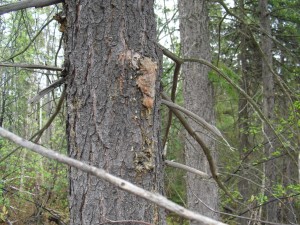
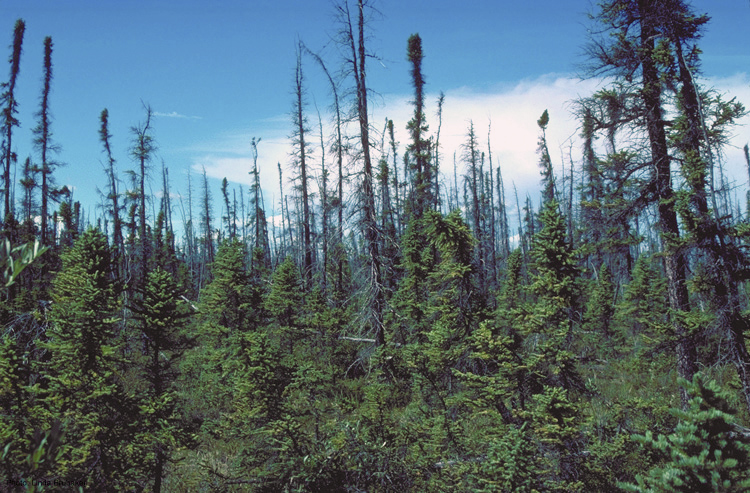
Typical Stand of Spruce Trees

Scruffy northern spruce is typically found in damp spots.

Real spruce gum is not easy to chew. It is not soft or sweet. Hard and crumbly is more accurate along with pieces of bark and bits of insects. But if you have good teeth and patience it will in time become a stiff gum. And if you leave it on your bedpost over night the gum turns hard and crumbly again.

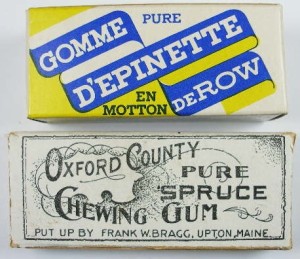
Brands of spruce gum. Photo by Northwoodland.org

Brands of spruce gum. Photo by David Fuller

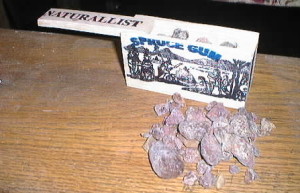
There was a time in America when you could buy spruce gum in almost any store, like other kinds of gum today. In fact it was the first gum sold in America. There were several brand including American Flag, Yankee Spruce, 200 Lump Spruce, and Kennebec. The original commercial version was State of Maine Pure Spruce Gum made by John B. Curtis and his brother in Bradford, Maine, about 30 miles north of Bangor. There was significant demand for debris-less gum and the brothers’ business thrived. Later they added beeswax or paraffin to the gum to soften it and expand their line. They moved their company to Portland around 1850 and had some 200 employees. From the mid-1800s to the early 1900s some dozen and a half companies were producing spruce gum. “Pickers” got paid up to a dollar per pound depending upon the quality. The technique was not unlike collecting pine pitch for making turpentine except the pitch was hard not soft. Some pickers collected thousand of pounds per year. Up until my college years one could still by soft spruce gum from L.L. Bean. (I grew up four miles west of the main store.) L.L.Bean no longer carries the product but the Naturallist does, by the box, as does Damn Yankee Company. Or, you can make your own. First you need the tree.

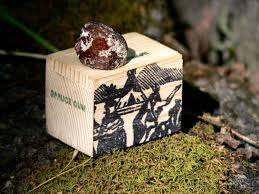
Hard resibn lumbs in a gum book. Photo by Naturallist.

Naturallist sells hard and soft spruce gum.

The Black Spruce, Picea mariana, is found in all of Canada, New England, and the mid-Atlantic States down to Pennsylvania. It is also found in the northern parts of the Great Lakes states excluding Indiana and Ohio. Some report you can find it in the higher, cooler areas of the Appalachians as far south as North Carolina. Red Spruce has also been used to make spruce gum and in fact you can use any spruce as long as it is in the Picea genus. Black Spruce was, however, considered the best source but that is debatable.

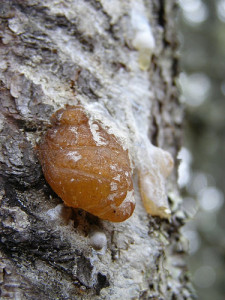
Spruce trees can weep a lot of sap.

Spruce trees can weep a lot of sap.

After finding a spruce you look at the trunk. Where ever there is damage to the bark there should be lumps of spruce sap, id est resin, or pitch. Breaks in the bark are caused by a variety of things from bear clawing to wind damage. The tree tries to repair the damage by covering it with sap. Some of the sap will be soft. We’re not interested in that for gum though it has other uses. It takes two to four years for the sap to harden into lumps, which is what we want. The texture can vary according to how dry it is. The color ranges from cream to yellow, pink to brown. It used to be said that “amber” resin was the best but I think that is folk lore on loan from maple syrup where “amber” is the best. The resin I always collected — by chance not choice — was dark amber which in turn made a light pink gum. Visiting several trees over a couple of hours can get you about a pound of hard resin. You don’t need that much. A small amount will do for experimenting.

Spruce resin can also be used to waterproof boats. Photo by Jamaka

Spruce resin can also be used to waterproof boats. Photo by Jamaka

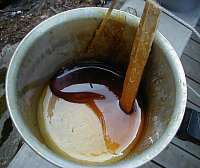
The first step is to reduce the amount of woody pieces in the resin, such as bark and twigs. To do this you put everything in a heavy cloth (a canvas bag works well) and pound it until the resin has the texture of sand. Dry resin crumbles easily leaving the woody bits to be removed by hand. Soft resin only makes a gooey mess. After crushing a small screen works well in cold weather to separate the woody bits if you have good dry resin.  Step two requires some preparation. You will need a shallow metal pan for the hot resin to cool in. This pan needs to be wrapped in cloth which you will pour the hot resin through, further filtering it. You also need, preferably, a tall skinny pot to heat the resin in. It is best to use an old pan for this because you won’t be able to get all the resin out of the pot so the pot can only be used for making spruce gum.  (I learned this short-coming by using one of my mother’s favorite pots the first time.) The small brass pots used to make espresso by hand are good for this. A cast iron pan too pitted for frying works well, too.

Just the right size for a "chaw."

Just the right size for a “chaw” off the tree.

Put your granulated resin in the pot and add enough water to makes a slurry. Then heat slowly over low heat (remember, resin can catch fire easily or burn you badly if it gets on you while hot so be careful. This not a kid’s job.) In time the hot water melts the resin which will float on top. When all the resin has liquified pour it quickly through the cloth into the cooling pan. Some resin will stay in the pot which you can melt next time. It takes about a half hour for all the resin to harden. When it does remove the cloth and pour off the water. A tap on the bottom of the pan should dislodge the resin. Now you can break it up into chewable amounts. Store them in a dry place after sprinkling them with cornstarch to keep the pieces from sticking to each other. Confectionery sugar might be a good choice, too, but I don’t know as I’ve never had a sweet tooth.

sdfasf

Spruce Gum Wrapper, photo by David Fuller

Now comes the hard part. Spruce gum is brittle at first and will shatter into tiny pieces in your mouth. You must keep chewing the little pieces and keep collecting them into one piece. As the gum warms and is ground smaller it will turn into a piece of  gum and stay that way as long as it is warm. A large breath of winter air, however, can harden it, so keep it warm. The taste is… well… sprucy but it does moderate over time, harsh at first, almost sweet after several hours of chewing. And if you swallow it, it should cause no problems.

Damn Yankee Company also sells bite size pieces.

Damn Yankee Company also sells bite size pieces.

With all that said, I am sure the natives did not go to all that bother to melt the resin down and clean it just for gum. It’s a chore with modern equipment and would have been very difficult a thousand years ago when pots were hard to come by. However, the heated sap does make a brittle waterproof glue so maybe when treating their birch bark canoes they chewed some of the  resin. Personally I think they did what I mostly did as a kid: I just took a lump off the tree, crushed it up with my teeth, spit out the woody bits as best I could, and just chewed. Your  teeth will stick together for a while and the pitch flavor is intense but it does turn into gum that way.

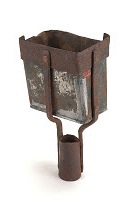
Pickers put spruce scrapers on pole to extend their reach.

Pickers put spruce scrapers on pole to extend their reach. Photo by Adirondack Almanacs.

Not only did the Native Americans show the colonists how to harvest the resin they also used the soft pitch for sore and skin problems. It was also used to make cough syrup which is not that unusual of an idea in that pine pitch can be used the same way, usually mixed with honey. Below are some modern medical references testing the sap. Lastly, spruce gum even found its way into love. Many a picker was also a woodsman of differing trades, such as lumbermen or sawyers. They would often work all winter in the woods away from their sweethearts. Many of them would make gifts of little boxes with sliding tops to store spruce gum in called gum books. And, of course, they were also full of choice spruce gum. However, kissing someone who has been chewing on spruce gum would seem to me to be more along the lines of kissing a Listerine bottle than the sweet lips of poetry and romance.

Medical Studies

Sipponen A, Jokinen JJ, Sipponen P, Papp A, Sarna S, Lohi J. 
Beneficial effect of resin salve in treatment of severe pressure ulcers: a prospective, randomized and controlled multi-center trial. 
British Journal of Dermatology 2008;158:1055-62

Sipponen A, Rautio M, Jokinen JJ, Laakso T, Saranpä P, Lohi J. 
Resin salve from Norway spruce – a potential method to treat infected chronic skin ulcers? 
Drug Metabolism Letters 2007;I:143-5

Rautio M, Sipponen A, Peltola R, Lohi J, Jokinen JJ, Papp A, Carlson P, Siponen P. 
Antibacterial effects of home-made resin salve from Norway spruce (Picea abies). 
APMIS 2007;115:335-40

Sipponen A, Jokinen JJ, Lohi J. 
Resin salve from the Norwegian spruce tree: a “novel” method for the treatment of chronic wounds. 
Journal of Wound Care 2007;16:72-74

{ 11 comments }
A frozen cranberry ready for winter eating.

A frozen cranberry, blueberry’s wet cousin, is still tart and tasty.

The thermometer was near zero one day when I was on ice skates collecting frozen cranberries.

asdfdsf

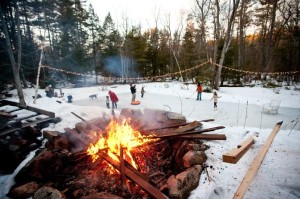
Bonfires and hot beverage make skating fun

The cranberries were conveniently above the ice just waiting to be harvested. I was on the north end of “Gowen’s Pond” in Pownal, Maine. It was at that end where water seeped into the pond to make the couple of acres we skated on every winter. It was also there where I once went skating at 52 below zero… the things you do when you’re a kid and there’s a huge bonfire going. I got chilblained hands and feet that night. More than forty years later air conditioning still makes my hands and feet itch.  (Yes, I now live in Florida and no, I do not have air conditioning.)

The water on that end of the pond wasn’t deep but it was moving so the ice could be shallow. Locals told a story about the farm next door that lost a cow through that ice one winter. I never did ask why the cow was out on the ice to start with. Maybe hungry and looking for cranberries.

sdfasdfasdfdsfs

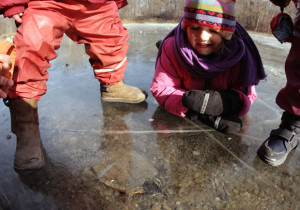
Many turtles stay active under the ice.

The pond had one little island. Very little. One person couldn’t stand on it… more like a stump. But it was always above the ice and had a bush on it. As I skated past it I saw a movement. It was a turtle swimming under the ice eating a little greenery from around the island. ‘Cranberries and turtle,’ I thought. Actually that turtle was spared but it did make me realize early on that one can forage in winter if you know where to look.

Of course, the real issue is what kind of winter? That can range from deep snow and rock-hard frozen ground to only occasional cool days. Finding wild food where there is no snow and little or no freezing is not difficult. It’s finding food in gawd-awful winters that is a challenge.

I am fond of saying food is where the water is. Whether you are referring to your yard, your county, state, region or country, the farther away from water you are the farther away from food you are. While that is true all year perhaps it is most critical in winter. Plants and creatures can be found near water in the winter.

asdfadsfadsf

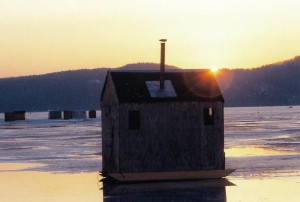
Ice huts are portable man caves.

Everyone is familiar with or knows about ice fishing. In some northern areas it is not only a passion but a rite of passage. It can certainly put food on the table (as can hunting and trapping.)  But not everyone has an ice hut or other equipment to harvest food that can move. In that case look for shallow, open streams or with ice than can be easily broken They have fresh water clams in the shallows. They don’t move too fast. As a young man I fished the Royal River in southern Maine and was always bringing home the clams I found. They are a bit tougher than those from the bay and occasionally one would yield a black pearl. I usually had a well-deserving lass to give it to.

asdfdsfasdf

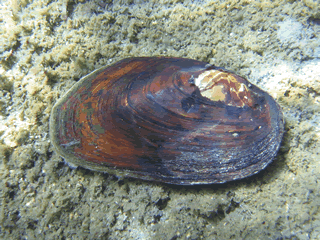
Freshwater clams are tougher than saltwater clams

Freshwater clams have to be handle carefully and cooked thoroughly but they are a good basis for a winter chowder. (The clams pick up parasites from land animal droppings requiring careful handling and cooking. Some clams are also federally protected so I’m sure you’ll check with local laws first.) Depending upon your stream or shallow pond you can also find crayfish and frogs (and turtles.) I should add that one of the advantage of aquatic turtles is that they do not eat toxic mushrooms. There is one instance where a person was sickened from eating a land turtle that had eaten mushrooms not toxic to it but toxic to humans.

asdfsf

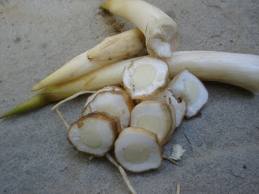
Cattail shoots are edible raw or cooked.

Open streams  or those with little ice can also produce cattail shoots and roots in winter. The shoots look like large dog’s teeth coming off the main root (actually horizontal rhizomes.) You can snap them off  — and the end shoot — eating them raw or toss them into the clam chowder. The roots are also full of starch. Getting it out is labor intensive and I think overrated as a flour. However a more calorie positive way is just toss the roots on a fire. That burns off the covering and the muck they’re usually in. That also cooks the starch in the fibrous middle. Then you open up the root and pull the fibers through your teeth to get the cooked starch off. It tastes like chestnuts, and there are no pots to clean.

ddsfsdfgdgdf

Groundnuts grow in a string in damp areas.

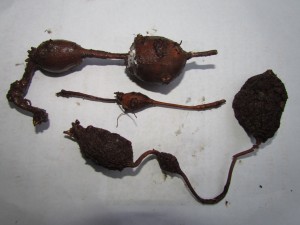
Also available stream side in winter are duck potatoes and groundnuts, the latter a good source of starch and protein. Duck potatoes grow deeper than groundnuts so they probably won’t be in any frozen banks but you do have to fish through cold water. Groundnuts are closer to the surface but still should be below the frost line or protected by water.  That’s a toss up. The good thing about groundnuts is they are unmistakable. Nothing else looks like them. While stream side also look for watercress, a plant that likes cold water. It’s a peppery member of the mustard family. Often found in winter streams, it can be a flavoring and/or a green to put into that clam chowder.

sdfasdfadsfds

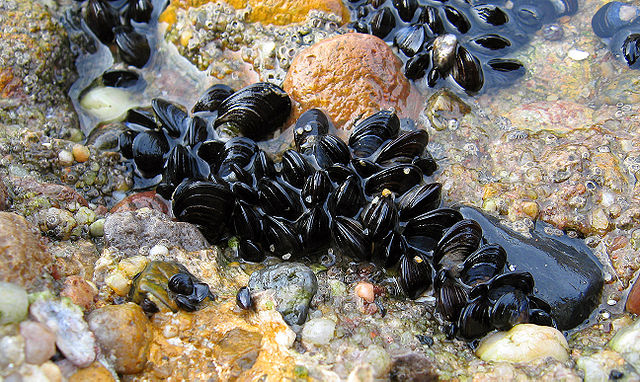
Mussels were prime kid food when foraging 50 years ago.

If you live near the ocean there’s a lot of food available in winter. The natives used to say that when the tide was out dinner was on. Not only are there a wide variety of creatures to be had but sea weed as well. Most seaweed in northern climates is edible except for one variety in the pacific northwest that has sulfuric acid. If you mistakenly bite into Desmarestia ligulata you will know it. The problem with seaweed is most of it is not tasty but semi-drying and frying can help. If the weather is not too cold edibles can also be found hiding in the seaweed or on the rocks, such as crabs. One of the more odd things is that 50 years ago mussel at low tide were ignored except by us hungry latchkey kids. Now they are gourmet fare.

yfgolgyuy

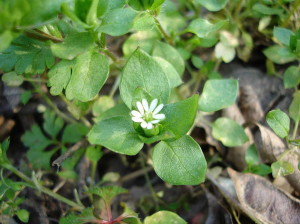
Chickweed thrives in cold weather.

Depending on how cold and how much snow there are quite a few other edibles possible in winter.  Sorrel can often last through a mild winter. Some radishes and wild mustards can take quite a freeze and stay alive and green as can any cabbage left over in your garden. Oyster mushrooms can be found anytime of the year even after warm weather has past. They don’t take freezing, however. Dandelions can survive the winter in snow but they undergo some chemical changes that make them more a famine food than a tasty find. Hardy little chickweed can germinate under snow so when the spring melt comes it is among the first green plants. Wild garlic and garlic mustard can can also be found in winter especially on south facing hills with little or no snow (so can some of the little mustards.)  If there been no snow plantagos (plantains) can also be found in winter along with clover.  But you have to be careful with clover. It can be a blood thinner. In some areas  Stork’s Bill, (Alfilaria) is edible in winter. Just as a matter of routine south facing hills are always worth investigating for edibles particularly in the winter. Don’t forget to (carefully) roll over logs to find wintering lizards and or snakes. Colorful salamanders usually are NOT on the menu.

iilgilg

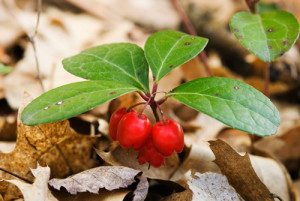
Cheery red and green makes Wintergreen easy to spot.

Just as I collected frozen cranberries don’t forget to look for rose hips, dried grapes and frozen wild apples (which are often better after freezing and cooking.) Hawthorn berries can persist into the winter as can persimmonsmountain ash, wild plums (sloes) various edible Viburnum berries and Rumex seeds still on the stalk.  Partridgeberries are a common winter find as is wintergreen, which has edible berries and leaves for tea.  Where I grew up I always found wintergreen with berries in the spring snow. It was years before I learned the berries over wintered. The little plant is also medicinal. Most persistent grass seeds are also edible. There are no toxic native North American grasses.

pmp[mp[op

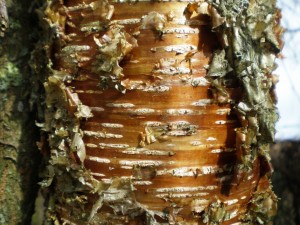
Birches offer several edibles.

You can also eat the inner bark (cambium) of true pines (best fried in oil. Boiling is the least preferred means of preparation.) Pine needles can also be used for tea. Also edible is the cambium of the Sweet Birch (Betula lenta). It can be eaten raw or dried or cooked. It also preserves well. Most lichen — such as Reindeer Moss — is also edible. But it is a survival food that needs to have its acid leached out first and even then it’s a food of desperation. Lichen such as is better used as an antiseptic.

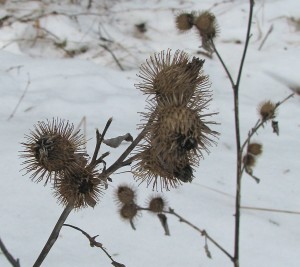
Finding Burdock in Winter is Easy

Finding Burdock in Winter is Easy

There are more winter edibles but much depends upon the conditions. Acorns can be food but if they are covered with snow that doesn’t help much, and they will be frozen, and they need to be shelled, and they need to be leached and… well, you get the idea: Labor intensive in the best of times. The long skinny  Burdock Root is edible but if the ground is frozen it can be a challenge to dig up as are Jerusalem Artichokes. Thistles, the kind that produces a large basal rosette with thorns that prick you like needles, also have an edible root raw or cooked. But the issue is whether the edible is buried in snow, and or is the ground granite hard?

In northern climates juniper berries can be used for flavoring… but not in the clam chowder. Juniper berries are used for bigger, gamey game… Elk and Moose come to mind…

{ 19 comments }

Books could be written about amaranth alone

 Amaranth, the forgotten food

A book could be written about amaranth, and probably has, if not several.

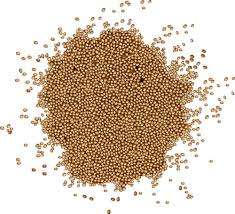
Amaranth is a seed used like a grain.

Amaranth is a seed used like a grain.

A grain, a green, a cultural icon, a religious symbol… amaranth is colorful plant with a colorful history. It’s also nutritious. Amaranth was a staple of pre-Colombian Aztecs, who imbued it with supernatural powers and made it part of their religious ceremonies. They would mix amaranth flour and human blood then shaped the dough into idols that were eaten in their well-known sacrificial ceremonies. Human sacrifices were extremely common among equatorial jungle people around the world. The idea they shared was as decaying plants nourish living plants, decaying flesh, preferably the enemy’s, would nourish the people. Occasionally, however, only a young maiden would assure good crops.  Spanish conquistadors, who saw no religious parallel with their own communion beliefs, thought eliminating amaranth would stop the sacrifices. The blood ceremonies did stop but for more reasons than the outlawing of amaranth. The plant’s use declined and was forgotten except in remote villages where it was still raised for food.

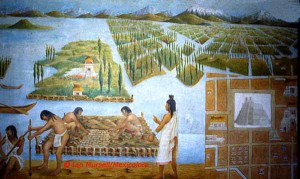
Aztecs farmed with floating matt islands.

Aztecs farmed with floating mat islands.

Amaranth today is enjoyed many ways. In Mexico and India the seeds are popped and mixed with sugar to make a confection. In Mexico they are roasted for the traditional drink “atole.” Peruvians use the grain to make a beer. Elsewhere it’s used to  treat toothache and fevers or to color maize and quinoa. Women performing native dances often wear the red amaranth flower as rouge. In many countries the leaves are used boiled or fried. In Nepal the seeds are made in to a gruel. Although amaranth seed and flour can be found in health food stores, if you want the greens you have to grow it yourself, or forage for it in season, which fortunately is long.

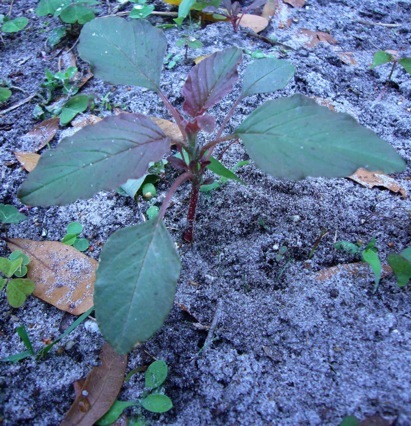
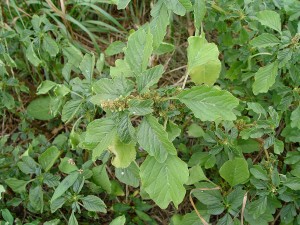
Note notches in the leaves, often present

It’s a bushy plant growing 3 to 10 feet, depending if it’s wild or cultivated, a vegetable variety or a grain variety. Feral versions are green, sometimes with red stems, spindly and usually no more than two feet, rarely three. Cultivated versions can be all red, or all green, showy or dull. Grain varieties can be six or seven feet tall. The lens-shaped seeds are tiny — eye of a needle size — and can be gold to black. Plants produce on average 50,000 seeds each. If you have a calculator, that’s a line of 1/32-of-an-inch seeds 130 feet long. Amaranth will grow under a variety of conditions and climates. I always have some in my garden every year though I have not intentionally planted it for more than seven years. It reseeds itself, and if it sprouts where it’s convenient for me, I let it grow. While the grain is very nutritional and versatile I use amaranth mostly for a summer green because it is among the few plants that can take Florida’s high heat and humidity. It has no significant pests per se. Its leave are nutritionally on par with spinach, which is a relative. Also if you avoid spinach for health reasons you should avoid amaranth.

Amaranth seed is high in protein, some 16%, contains lysine and methionine, two essential amino acids that are not often found in grain,  and is high in fiber, three times that of wheat. It also has calcium, iron, potassium, phosphorus, vitamins A, C and E.

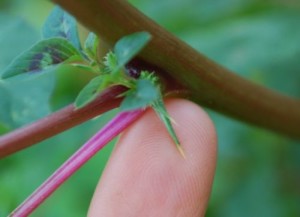
Spiny amaranth has edible leaves and might be a medicine and sex aid.

Spiny amaranth has edible leaves and might be a medicine and sex aid.

There are some 60 amaranth species, maybe 70 (it depends on who’s counting.)  The botanical genus name, Amaranthus, (am-a-RANTH-us) comes from the Greek word “amarandos, (Αμάραντος) which means non-fading, since its flowers last a long time.  Modern Greeks call it Vlita (VLEE-tah.) I see four kinds of amaranth sporadically here in Florida,  one I’m sure is an imported version from up north, probably A. viridis (VEER-ih-diss, green, often with notches at the end of the leaf. ) Another is A. hybridus. (hib-RID-us or HYE-brid0-us, also called Smooth Amaranth, with trowel-shaped leave if not pointed.)  A third is A. spinosus (spin-OH-sus, spiny.) The leaves and seeds of all three are edible. However, with the latter, the Spiny Amaranth, you have to fight the spines for them. But, the Spiny Amaranth has a very positive side. An article published 23 Aug 2007, in the Journal of Natural Medicines, reported an extract of the plant in rats  “exhibited control of blood glucose… showed significant anti-hyperlipidemic … effects….”  and increased sperm count and weight of their sex organs. That should make the spiny amaranth disappear as a road side weed.

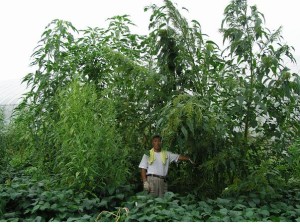
Amaranthus australis (southern amaranth) can easily grow 18 feet or more.

Amaranthus australis (southern amaranth) can easily grow 18 feet or more.

The fourth amaranth was a bit of a mystery for a while.  A new bridge was build over the St. Johns River near Sanford and sod brought in for landscaping. Along with the sod came a big amaranth that I took home and transplanted just to see what it would be. Time revealed it to be Amaranthus australis, also called Hemp Amaranth and Southern Amaranth. Oddly it is the only amaranth I have run into that I can’t find an ethnobotanical reference to. It is native, and huge, 15 feet tall is common. Surely it would have been used if usable. But, search as I may I’ve not come up with much about it. It’s not even mentioned in the 70 year index of the Journal of Economic Botany.  I have read there are no poisonous amaranths but it is curious that such a large and obvious plant has left not usage trail. My friend Andy Firk down in Arcadia, Florida, reports he eats all the time with no problems. It’s absence from ethnobotanical records and foraging books is a mystery to me.

As with most plants used for “greens” young and tender leaves are usually best, take them from the top. Leave the older, larger leaves to collect energy for the plant. If you want to collect the seeds after they form, take a large, non-porous bag, put it over the top of the plant, gently tip the plant to the side, and shake. The seeds will come loose. What bugs you might get is free protein. Then winnow because you’ll get some seed heads and flower debris.

As for cooking the leaves, I use them like mustard greens, boiling them for 10 minutes or so and then season with salt, pepper, and butter, or with some olive oil and vinegar. After boiling, the leaves can be added to various dishes that call for spinach. But do know that if amaranth is fertilized heavily or grows in drought conditions it can hold a lot of nitrates.  If you are going to eat amaranth seeds soak them over night in water to reduce their saponin content.

Here’s an interesting recipe from Salt Spring Seeds.

Tabouli

1 cup pre-soaked amaranth seeds

1 cup parsley, chopped

1/2 cup scallions, chopped

2 tbsp fresh mint

1/2 cup lemon juice

1/4 cup olive oil

2 garlic cloves, pressed

1/4 cup olives, sliced

lettuce leaves, whole

Simmer amaranth in an equal volume of water for 12-15 minutes. Allow to cool. Place all ingredients except lettuce and olives in a mixing bowl and toss together lightly. Chill for an hour or more to allow flavors to blend. Wash and dry lettuce leaves and use them to line a salad bowl.  Put the amaranth “tabouli” on the lettuce and garnish with olives.

Green Deane’s “Itemized” Plant Profile

IDENTIFICATION: Annual growing to three to six feet, is frost tender. Coarse, hairy, stout stems, leaves usually dull green on long stalks, prominent veins, oval to lance shaped, often notched when young; flowers clusters dense, bristly, small and usually green, terminal clusters and out of where leaf meets stem.

TIME OF YEAR: Spring in to summer for the leaves, summer or fall for seeds, depending upon the climate.

ENVIRONMENT: Full sun, rich to poor soil, as long as moisture is available. Found around and in gardens, stops signs, vacant lots, an opportunist. Will not grow in shade. Found throughout most of of the Americas. Has spread around the world. If harvested in fertilized area or in drought the amaranth can be high in nitrogen.

METHOD OF PREPARATION: Tender young leaves raw in salads, or cooked like spinach. Seeds eaten raw or ground into flour. There are no poisonous amaranths.

HERB BLURB

Herbalists say a decoction of Amaranth has been used for inflammation of the gums and as a wash for external wounds. Also internally as a treatment for diarrhea and dysentery

{ 80 comments }
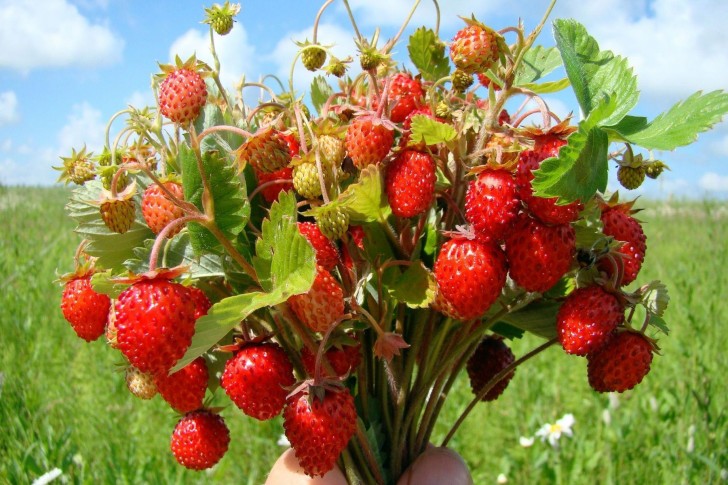
Wild Strawberries can be tart to very sweet.

Wild Strawberries can be tart to very sweet, photo by All Wallpapers

Fragaria virginiana: Be A Strawberry Sleuth

Fragaria do not like Florida. Only one northern county in the state reports having wild strawberries. But that’s all right. I ate more than my fill growing up in Maine.

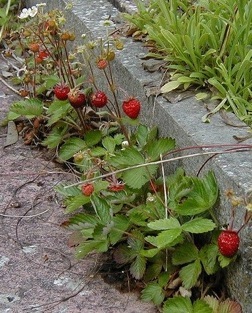
Wild Strawberries eeking out a living

In fact, the best strawberry patch was across the dirt road, in a pasture in Pownal, just beyond a huge and well-armed Hawthorn tree.  The strawberries were typical of the wild version, small… but what flavor! I raided that patch annually for some 15 years.

One of my successful moments as a foraging teacher came years later when a native Floridian friend traveling through New Hampshire found  strawberries and identified them on her own. Not bad coming from a state nearly bereft of wild strawberries. Oddly, however, Florida grows literally tons of strawberries and has an annual Strawberry Festival in Plant City that draws hundreds of thousands and big named entertainment.

While growing up, as kids are wont to do, I found the strawberry patch on my own. I simply presumed they were edible. It’s rather surprising kids don’t make more mistakes than they do. Most plant poisonings involve very young children (and young pets.) Julia Morton, a botany professor at the University of Miami and an expert on toxic plants, said young children and young animals will chew on anything regardless of the flavor. Older kids won’t eat things that taste a bit off to them, as many a parent can confirm. Morton also said women are poisoned more often than men because they are curious about plants and will sampled them. Perhaps that’s an echo of their gathering ancestral history. That said men comprise about 66% of my video viewers. The argument is men do more things that bring them into contact with wild plants, such as fishing, hunting, hiking and the like.

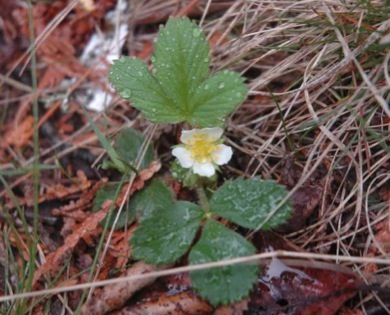
Wild Strawberry blossom, note white not yellow

The botanical name for the common strawberry in eastern North America is Fragaria virginiana, frah-GAY-ree-uh vir-jin-ee-AY-nuh. Fragaria is from the Dead Latin word “fragans” meaning sweet-smelling. Virginiana essentially means of North America. The European strawberry is F. vesca (VES-kuh) meaning thin or small. The Greeks call them fraoules (frah-OU-less) where the Dead Latin “fragans” came from.  Beside the usual delicious uses strawberries can settle an upset stomach, the juice from the plant is good for face sores, red eyes and excessive tears. Root decoctions soothe liver problems, staunches menstrual flow, and firms the gums. Nearly every Indian tribe had a medical use for the entire plant. For some 700 years it has also been used as an  ananaphrodisiac, that is, to dull the libido. (Hmmm, I think I’ll skip the strawberry shortcake, thank you.) And a tea can be made from fresh or dry leaves, but not semi-dried leaves.

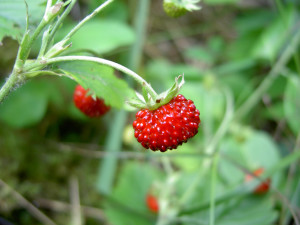
The "wood strawberry" helped sequence the strawberry's genome.

The “wood strawberry” helped sequence the strawberry’s genome.

Strawberries played a significant role in the lives of American Indians, both as medicine and food. Since strawberries have too much moisture to dry easily for winter use they were consumed in season. The Seneca Indians of the Iroquois Confederacy viewed strawberries as proof of their god’s beneficence and had a Strawberry thanksgiving ceremony. The Dakota called June the “red month” because strawberries were ripe then.

There is a second native strawberry in North America, interestingly called F. chiloensis (kye-loh-EN-sis) meaning “of Chile.” The F. Chiloensis  is larger than the F. virginiana and is found in the western United States and up the west coast.  The two natives were hybridized to make the modern garden strawberry.  (See some unusual recipes below.)

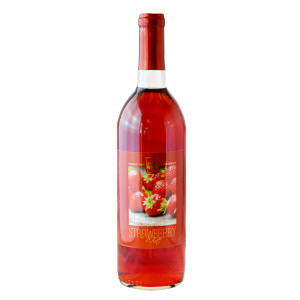
There's even strawberry wine.

There’s even strawberry wine.

The name “strawberry” comes from “strewn berry” meaning the berries were strewn on the plants. That in time was shortened to strawberry. In the rose family strawberries aren’t really berries or fruit. They are enlarged ends of the plants’ stamen, the male part of the flower. The seeds are on the outer skin of the strawberry rather than inside. There are around 200 seeds per berry. If you find a tasteless strawberry in a northern area it is probably the F. vesco, also called a woods strawberry. In Florida that tasteless strawberry is not a true strawberry but the Indian Strawberry, low on taste but good on nutrition.

Heavy Weight World Champion Joseph Fraizer.

Heavy Weight World Champion Joseph Fraizer.

While many states like Florida have a Strawberry Festival  perhaps the most famous strawberry consumption is at Wimbledon, England. There strawberries and cream are eaten between tennis matches. (Your author has been to Wimbledon while an exchange student to the University of London, Whiteland’s College, but preferred Waltney’s Brown Ale to courtside strawberrying.) Lastly, the name of Fraser/Frazier means strawberry… You remember the world heavyweight boxing champ, don’t you? Smoking Joe Strawberry…

Green Deane’s “Itemized” Plant Profile

IDENTIFICATION: Small plant with five-petaled white flowers, leaves of three, toothed (poison ivy usually does not have fine teeth.)  Blossoms to an inch across, on separate stalks; familiar fruit drooping, small. Ten small green sepals at the base of the fruit. Plant spreads by horizontal runners.

TIME OF YEAR: Late spring, early summer

ENVIRONMENT: Full sun in pastures, fields, moist ground, edges of woods, by sidewalks. Throughout North America. There are no similar looking toxic plants.  (See Indian Strawberry.)

METHOD OF PREPARATION: Numerous, only limited by time and imagination. A trail side nibble, pies, jelly, jam, cakes, drinks, deserts, the list is nearly endless. See recipes below. Strawberry leaf tea is laxative. Do not use wilted leaves. Only fresh or totally dry leaves.

Champagne Sorbet with Berry Medley

*   1 (750 milliliter) bottle champagne

* 1/4 cup white sugar

* 1 pint strawberries

* 1 pint blueberries

* 6 fresh mint leaves (optional)

DIRECTIONS

1. Pour champagne into a shallow metal pan or bowl, and stir in the sugar. Cover with plastic wrap, and place in freezer. Freeze for four hours, whisking every 30 minutes. The frozen mixture will be firm and granular.

2. Spoon the sorbet mixture into a blender or food processor, and process until smooth. Return to the metal container, cover, and re-freeze for up to 48 hours.

  1. 3.Combine strawberries and blueberries in a small bowl. Spoon berries into the bottom of champagne flutes or wine glasses, and top with sorbet. Garnish with mint sprig if desired.

 Strawberry Roses

INGREDIENTS

* 2 cups mascarpone cheese

* 1 1/4 cups confectioners’ sugar

* 1 teaspoon vanilla extract

* 1/2 cup whipped cream

* 16 large strawberries, washed and dried well

* 1/4 cup coarse granulated sugar

* 2 teaspoons lemon zest

DIRECTIONS

1. Beat the mascarpone cheese, confectioners sugar, and vanilla in a large bowl until smooth. Fold in the whipped cream. Spoon cheese mixture into a piping bag fitted with a star tip.

2. Leaving the stem end in tact, cut off the tip of each strawberry, and carefully remove the core using a small, thin knife. Stand strawberries upright (stem end down), and slice through the tip toward the stem. Do not cut completely through. Repeat, slicing a total of four times. Each strawberry will have eight sections. Roll the strawberries in the sugar.

3. Gently open each strawberry and fill each with the cheese mixture, using a circular motion. Arrange strawberry roses on a platter, and sprinkle with lemon zest.

The roses are easier to form if strawberries are at cool room temperature when filling.

Strawberry Spinach Salad

INGREDIENTS

* 2 tablespoons sesame seeds

* 1 tablespoon poppy seeds

* 1/2 cup white sugar

* 1/2 cup olive oil

* 1/4 cup distilled white vinegar

* 1/4 teaspoon paprika

* 1/4 teaspoon Worcestershire sauce

* 1 tablespoon minced onion

* 10 ounces fresh spinach – rinsed, dried and torn into bite-size pieces

* 1 quart strawberries – cleaned, hulled and sliced

* 1/4 cup almonds, blanched and slivered

DIRECTIONS

1. In a medium bowl, whisk together the sesame seeds, poppy seeds, sugar, olive oil, vinegar, paprika, Worcestershire sauce and onion. Cover, and chill for one hour.

2. In a large bowl, combine the spinach, strawberries and almonds. Pour dressing over salad, and toss. Refrigerate 10 to 15 minutes before serving.

{ 17 comments }