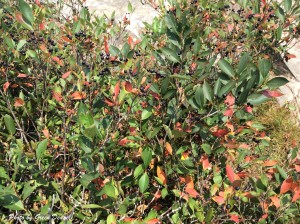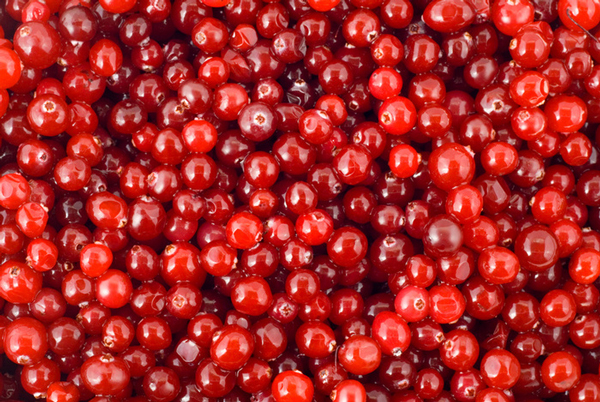
Cranberries are naturally very nutritious and very sour.

Cranberries are naturally very nutritious and very sour.

Get Your Annual Vaccinium Every Year

Frozen cranberries are just as sour as fresh ones.

I know that because when I was a kid skating on frozen ponds in Maine the clinging cranberries above the ice were a nibble of sorts. We never identified them or told anyone, we just kind of assumed they were edible and that was that. Kids are that way, which is a good reason to channel that propensity towards organized foraging.

My next youthful cranberry surprise came when one day I discovered cranberries don’t have to grow in water. I found a patch atop a small hill watered only by rain. They were still sour.
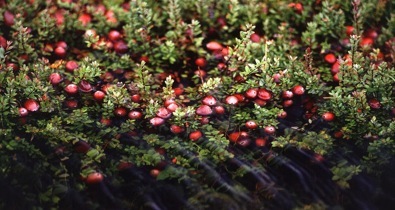
Fresh cranberries

Cranberries are such a common commercial crop that few people ever think of collecting them in the wild. Unfortunately cranberries have also become identified with mostly Thanksgiving leaving the berry to languish the rest of the year, its only saving grace to be made into juice to reduce urinary infections. One of my favorite uses of prepared cranberries is to add them as flavoring to a mix of wild rice and chopped walnuts. The character of the cranberries makes it a delightful dish.

There are three or four species of cranberry, and as usual, botanists don’t all agree with their classifications and distinctions. The most common in the eastern US and northeast is Vaccinium macrocarpon (vak-SIN-ih-um  mak-roe-KAR-pon.)  Others include Vaccinium oxycoccos or Oxycoccos palustris (common in Europe, Asia and northern Canada)  Vaccinium microcarpum or Oxycoccos microcarpus (Small Cranberry) found in northern Europe and northern Asia. There is also Vaccinium erythrocarpum or Oxycoccos erythrocarpus which is found in the upper elevations of the Appalachian Mountains and in eastern Asia.
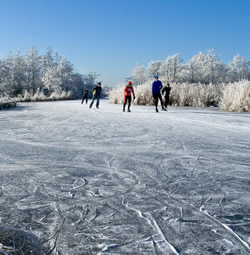
Skating on ponds in the winter.

Skating on ponds in the winter.

Vaccinium macrocarpon means “big cow fruit”  or maybe “Big dark red fruit.”  Vaccinium was the ancient Roman name for the bilberry, also a Vaccinium and vaccinum does mean of or from cows. Why it is associated with cows no one, tellingly, ever said. A different view is that cows have nothing to do with it at all. Vaccinus may be a corruption of the Greek word hyakinthos, which means purple or dark red.  There are similar words in other ancient languages.   “Big dark red fruit” makes more sense than “big cow fruit.” The name “cranberry” came from “crane berry” which early New Englanders called the plant because they thought it resembled a crane.  Canadians called it mossberry. Cranberries were called Fenberry by Old World English, since fen means a marsh.  Some Native Americans called Cranberries Sassamanash or Ibimi. They were used for food, medicine and dye.
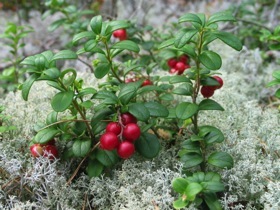
Lingonberries in Lichen

Because of pictures of commercial operations at harvesting time, people think cranberries grow in water. Usually commercial operations are flooded at harvest time or to cover the plants and protect them from cold weather. As I mentioned I found a patch near my home in Maine growing on a low hill. About 95% of commercial cranberries are processed into juice drinks, sauce, and sweetened dried cranberries. The remaining 5% are sold fresh.  Fresh cranberries can be frozen and will keep more than a year (I have several pounds in my freezer.) They can be used directly in recipes without thawing. Cranberries are a significant crop in Maine, Massachusetts, Michigan, Minnesota, New Jersey, Oregon, Washington, Wisconsin, British Columbia, New Brunswick, Ontario, Nova Scotia, Newfoundland, Quebec, southern Chile, the Baltic States, and in Eastern Europe.

Cranberries are cousin to bilberries, blueberries, and huckleberries, which are all Vacciniums. All berries with a crown are non-poisonous, but they are not all palatable. Closely related and worth mentioning is the Lingonberry, Vaccinium vitis-idaea, (VYE-tis eye-DEE-ah.) It is also called the Mountain Cranberry and Low Bush Cranberry. Unlike cranberries Lingonberries are not a commercial crop but are collected in most countries around the top of the world, Canada, Scandinavia, Northern Asia  et cetera. The many recipes below work with either Lingonberries or Cranberries.

What vitis-idaea means is a good guess. The standard interpretation by botanists who only speak English is that it means “Cow Grape from Mt. Ida”  (in Greece.) That really doesn’t make sense to me. Another view is that it means “Dark Red Grape of Mt. Ida” … closer but no cigar in my view.  My guess is that it means “dark red grape above all.”  Ιδία (ee-THEE-ah) in Greek means above all and the Lingonberry, which likes to hug the arctic circle, certainly grows above all.

 Green Deane’s “Itemized” Plant Profile

IDENTIFICATION: Low growing mat, usually less than one foot. Small, glossy, leathery leaves, bronzy in spring and dark-green in summer, white to pink, tube-shaped four-petaled flowers in clusters and followed by a dark red, edible fruit.

TIME OF YEAR: Fruits ripen in September or October.

ENVIRONMENT: Likes sandy soil, will grow in bogs or dry land.

METHOD OF PREPARATION: Many, whole or as a sauce. See some recipes below. They can also be eaten fresh on the trail or picked frozen off the bush, but they are sour.

Cranberry Sauce

4 cups cranberries

2 cups sugar

Wash berries, add sugar, stir thoroughly and cook slowly without additional water (just what is on the berries from washing).

Boil 10 minutes.

Spiced Cranberries

(A good pickle to serve with meat or game)

5 lbs. cranberries

3-1/2 cups white vinegar

2 tablespoons cinnamon or allspice

1 tablespoon cloves

Boil for 2 hours.

Place in hot sterilized jars and seal.

Cranberry Orange Relish

Ingredients

4 cups (1 lb) cranberries

2 oranges, quartered (seeds removed)

2 cups sugar

Instructions

Put berries and oranges (including rind) through food grinder (coarse blade).

Stir in sugar and chill.

Makes 2 pints.

Keeps well for several weeks stored in refrigerator.

Cranberry Pie

Ingredients

1 (9-inch) baked pastry shell

1 cup Cranberry Berry Sauce (see recipe)

1 tablespoon cornstarch

1/2 cup granulated sugar

1/3 cup water

2 egg whites

1/8 teaspoon salt

2 teaspoons lemon juice

1 teaspoon almond extract

1 cup heavy cream

Instructions

Cook berry sauce and cornstarch until thickened. Cool and keep for top.

Cook sugar and 1/3 cup water to soft ball stage (238ºF). Add gelatin softened in 1/4 cup water. Slowly pour this syrup over stiffly beaten egg whites, beating constantly. Add salt, lemon juice and almond extract, continue to beat until cool. Beat cream and combine with egg white mixture. Pour into pie shell. Chill. Spread cranberry Sauce over top and place in the fridge until serving time.

Cranberry Coffee Cake

Instructions

Melt 2 tablespoons butter in an 8-inch square pan.

Spread 1/4 cup of sugar over the melted butter

Combine

1 cup cranberry sauce

1/2 cup pecans, chopped (or walnuts)

1 tablespoon grated orange rind.

Spread this mixture over sugar.

Sift together

1-1/2 cups all-purpose flour

2 teaspoons baking powder

1/2 teaspoon salt

1/4 cup sugar

Cut in 1/3 cup shortening until it resembles corn meal.

Beat 1 egg and add 1/2 cup of milk. Add to dry ingredients, mix only until all the flour is dampened. Turn into pan on top of partridgeberry mixture. Bake in preheated 400º oven for 25 to 30 minutes. Cool on a rack for about 45 minutes, then turn upside down on a serving plate. Serve warm.

Cranberry Bread

Ingredients

2 cups sifted all-purpose flour

1 cup sugar

1-1/2 teaspoons double acting baking powder

1/2 teaspoon baking soda

1 teaspoon salt

Juice and grated rind of 1 orange

2 tablespoons melted shortening

1 egg, well beaten

1/2 cup chopped nuts (pecans or walnuts, other if you desire)

1-1/2 cup partridgeberries

Instructions:-

Sift together flour, sugar, baking powder, soda and salt.

Combine orange juice, grated rind, melted shortening and enough water to make 3/4 of a cup, then stir in beaten egg. Pour this mixture into the dry ingredients, mixing just to dampen.

Spoon a layer of batter into a greased 9″x5″x3″ loaf pan, spreading evenly; sprinkle cranberries over this layer, add more batter, sprinkle with berries, then repeat until all is used up. Bake in a preheated 350ºF oven for 50 to 60 minutes. Remove from pan. Cool. Store over night for easy slicing.

Steamed Cranberry Pudding

Ingredients

4 tablespoons butter, melted.

1 cup sugar

1 egg

2 cups flour (1 pastry flour, 1 bread flour)

(Note:- I use all-purpose flour)

2 teaspoons baking powder

1/2 teaspoon salt

1 cup milk and water

1 cup Cranberry sauce

Instructions

Sift together, sugar, flour, baking powder and salt. Beat egg and water-milk mixture together. Stir into dry ingredients. Lastly, add vanilla and melted butter. Mix well. Pour into a greased mold, cover or tie waxed paper over the top. Place on a rack or trivet in a deep kettle, pour in boiling water to half the depth of the mold and cover kettle. Steam for 2 hours, replenishing water (if necessary) with boiling water to original depth. Served with heated cranberry sauce OR sauce may be put in the mold first and batter added and the whole steamed together.

Cranberry Crumbles

Ingredients

1 cup uncooked rolled oats

1/2 cup flour

1 cup brown sugar

1/2 cup butter

2 cups (1 lb) cranberry sauce

Instructions

Mix oats, flour and brown sugar. Cut in butter until crumbly. Place half this mixture in an 8″x8″ greased baking dish. Cover with cranberry sauce. Top with rest of mixture. Bake in a preheated 350ºF for 45 minutes. Cut into squares, while hot. Serve topped with scoops of vanilla ice cream or with cranberry sherbet. May also be served cold as cookie bars.

Serves 6 to 8.

Cranberry Punch

Ingredients

1 quart berries

6 cups water

2 cups sugar

1 cup orange juice

3 tablespoons lemon juice

1 quart ginger ale.

Cook berries in 4 cups water until soft.

Crush and drain through cheesecloth.

Boil sugar and remaining 2 cups water for 5 minutes, add to berry juice and chill.

Add fruit juices. Just before serving, add ginger ale.

Cranberry Muffins

Ingredients

1 cup whole wheat flour

1 cup rolled oats

1 cup 2% milk, soured

1/4 cup canola oil

1/2 cup brown sugar

1 large egg

11/2 cups cranberries

1 teaspoon baking powder

1/2 teaspoon baking soda

1/2 teaspoon salt

Directions

1. Combine milk and oats.

2. Mix egg, oil, and sugar.

3. Mix dry ingredients.

4. Add berries to dry ingredients till coated.

  1. 5.Mix all ingredients just till blended.
  2. 6.6.Bake at 350 for 18-20 minutes.

Cranberry Salsa

*  12 ounces cranberries, fresh or frozen

* 1 bunch cilantro, chopped

* 1 bunch green onions, cut into 3 inch lengths

* 1 jalapeno pepper, seeded and minced

* 2 limes, juiced

* 3/4 cup white sugar

* 1 pinch salt

DIRECTIONS

Combine cranberries, cilantro, green onions, jalapeno pepper, lime juice, sugar, and salt in the bowl of a food processor fitted with a medium blade. Chop to medium consistency. Refrigerate if not using immediately. Serve at room temperature.   

{ 22 comments }
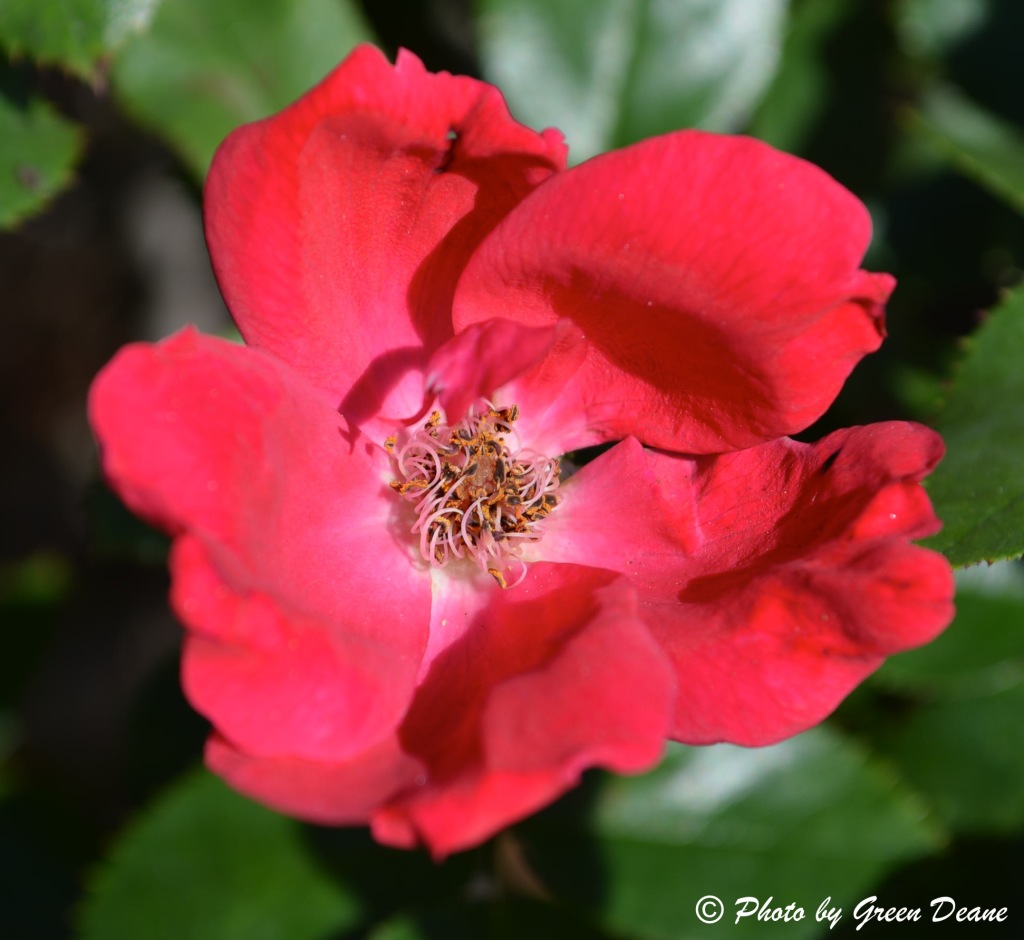
Roses have the classic five petals. Photo by Green Deane

Roses have the classic five petals. Photo by Green Deane

I’m not sure I found wild roses or they found me.

Growing up in Maine the local soil was usually either ground-up glacial sand or clay which is decomposed feldspar, or ledge. Not much of a choice if you’re a plant. We had sand, over ledge with a thin veneer of topsoil. And in that sand grew wild roses, Rosa rugosa. Long and stringy with pink petals and bright yellow centers and thorns, lots of thorns. I do recall, however, having a difficult time as a kid reconciling that the wild roses in the field behind the house were related to the roses in flower shops. They didn’t look like each other that much but the wild roses did have a hint of rose aroma. I grew more interested in roses when I learned the rose seed hairs were the original itching powder.

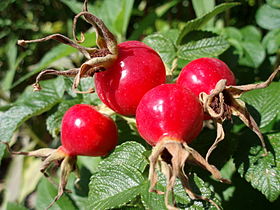
Rosa rugosa hips

If you’ve read my series on Edible Flowers you also know that I once delivered flowers. I had been accepted to law school and needed a job to tie me over until classes started so I delivered flowers. What an eye-opening experience! I went in thinking it had to be a wonderful job because you were delivering joy everywhere… wrong… oh so wrong. It was amazing how many women refused flower deliveries, or took them with a huge air of suspicion. And of course, there were all those deliveries to funeral homes. But most interesting were the roses. They were big and beautiful and absolutely without any aroma. None. They were bred for size and color and in the process the aroma disappeared. We had to spray the roses with artificial rose scent just before delivery, every delivery. AND… you did not spray the roses in the delivery van or get any spray on your or you’d smell intensely like roses for days, literally. Not surprisingly we carried several different spray-on scents so the grand and lovely hybrids of various genera would smell like the original thing. Rose, however, was the most powerful and long-lasting. (By the way, some flower arrangements that were not accepted were kept so they would wilt and die only to be sold for 40th birthday deliveries.)

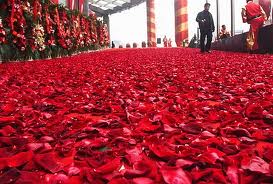
Rose petals for perfume

Let’s start at the top of the rose and work our way down.  Petal flavor depends on the type, color and conditions of raising. They can range from tart to sweet, spicy. Darker ones have stronger flavors. Remove any white portion of a petal. That will be bitter. Petals can be added to salads , desserts, beverages, used to make jelly or jam and be candied. Rose petals are used to flavor tea, wine, honey, liqueurs and vinegar. Rose oil is used in perfume making and requires a ton of petals to get one cup. Rose water is used in cooking and is an eye wash.

Rose Hips are False Fruit

Rose hips are a false fruit. If you have a true rose its hip is edible but they differ greatly in flavor and size. A frost improves flavor. Sap from a fresh hip can be used like sweet syrup. Soft rose hips can be put through a food press to remove seeds and their hairs. If you wet that pressed mass you can run it through the process a second time. Dried hips have to be rehydrated to be pressed. The resulting puree is dark red and tasty. It’s used to make syrup, jam, chutney and various sauces. Dried rose hips are used to make a fruity tea that is high in Vitamin C, some 50 times higher than citrus. They also have vitamins A, E and K.  Seeds, the true fruit of the rose, are diuretic.  You can also grind the totally dry rose hips into a powder to be added to breads, cookies, cakes and desserts. Now, you might be thinking “I’ll just eat the entire rose hip.” Don’t eat unprocessed rose hips. Better is to run the processed hips through a filter to removed the seeds. Remember the itching powder? If you consume unprocessed rose hips you can get what the Aboriginals called “Itchy Bottom Disease” from the hair on the seeds.

In some species the leaves are eaten, mainly in Europe and Asia. Very young shoots are edible cooked. Buds can be pickled. Among the edible species and their cultivars are: Rosa acicularis, Prickly rose, Rosa arkansana, Low Prairie Rose, Rosa blanda, Labrador Rose, Rosa canina, Dog Rose, Rosa carolina, Pasture Rose, Rosa chinensis, China Rose, Rosa cinnamomea, Cinnamon Rose, Rose x demascena, Damask Rose, Rosa fraxinellaefolia, Ash-Leaf Rose, Rosa gallica, French Rose, Rosa gigantea, Manipur Wild Tea-Rose, Rosa laevigata, Cherokee Rose, Rosa macrophylla, Bhaunra Kujoi, Rosa moschata, Musk Rose, Rosa multiflora, Multiflora Rose,  Rosa nutkana, Nutka Rose, Rosa pimpinellifolia, Burnet Rose, Rosa rugosa, Rugose Rose, Rosa villosa, Apple Rose, Rosa virginiana, Virginia Rose, Rosa woodsii, Wood’s Rose, Rosa Blaze, Blaze Rose, Rosa Bucbi, Carefree Beauty Rose, Rosa Rhonda, Rhonda Rose, Rosa Sea Foam, Sea Foam Rose, Rosa The Fairy, The Fairy Rose.

Rosa is Dead Latin for rose. It comes from the Indo-European Sanskrit word “vrod” which means flexible.

Recipes

Rose Petal Drink
Petals from 3 full-bloom roses
5 cups water
1/2 tsp. lemon juice
3 tbsp. sugar
Boil water. Add rose petals and lemon juice to the boiling water, turn off heat and let stand for 6-10 hours. Drain into a pitcher. Discard petals. Add sugar to the rose water and stir. Let cool in the refrigerator or freezer. Serve.
recipe from Maragrita’s International Recipes.

Rose Petal Syrup
4 cups rose petals
2 cups water
2 cups sugar
red food colouring (optional)
Simmer rose petals with water and sugar for one hour. Add drops of red food colouring to get desired colour. Strain through a fine sieve. Bring back to the boil and put in hot sterilised bottles. Recipe from ABC.net.au/Hobart

Rose Petal Tea
1-1/2 cups rose petals
3 cups water
honey to taste
Choose fresh rose petals. Strip the flower gently under running water then place the petals in a saucepan. Cover with the water and boil for 5 minutes, or until the petals become discolored. Strain into teacups and add honey to taste. Serves 4.

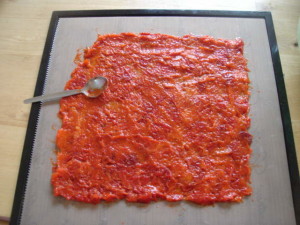
Rose hip leather. Photo by Wild Food Foraging.

Rose hip leather. Photo by Wild Food Foraging.

Rose Hip Leather

Prep Time: 1 hour

Cook Time: 30 minutes

Total Time: 1 hour, 30 minutes

Ingredients:

  • 4 cups (1 Litre) of rose hips

Preparation:

Just after a frost is the best time to gather rose hips. Snap off the tails as you pick,or later when you reach home. Spread the hips out on a clean surface and allow to dry partially. When the skins begin to feel dried and shriveled, split the hips and take out the large seeds — all of them. If you let the hips dry too much, it will be difficult to remove the seeds. If not dry enough, the inside pulp will be sticky and cling to the seeds. After the seeds are removed, allow the hips to dry completely before storing or they will not keep well. Store in small, sealed plastic bags. These will keep indefinitely in the freezer or for several months in the refrigerator. They are packed with vitamin C and are good to munch on anytime you need extra energy…or a moderately sweet nut-like “candy.”

Making Puree:
Use soft ripe rose hips (the riper they are, the sweeter they are). It takes about 4 cups (1 Litre) of rose hips to make 2 cups (480 ml) of puree. Remove stalks and blossom ends. Rinse berries in cold water. Put them into a pan and add enough water to almost cover. Bring to a boil and simmer 10 to 15 minutes. Press through a sieve or strainer. All that does not go through the sieve is placed in the pan again. Add a little water, enough to almost cover, if you want a thicker puree, add slightly less. This time heat but do not boil so vigorously. This will dissolve a little more of the fruit so that it will go through the sieve. Press again and then repeat the process one more time. By now, most of the fruit should have gone through the sieve leaving only seeds and skin to discard.

Drying Puree:
Line a cookie sheet, 12 by 17 inches (30 by 42 cm), with plastic wrap. This size cookie sheet holds approximately 2 cups (480ml) of puree. Spread puree or fruit leather evenly over the plastic but do not push it completely to the sides. Leave a bit of plastic showing for easy removal. Place on a card table or picnic table in the hot sun to dry. If the plastic is bigger than the cookie sheet and extends up the sides, anchor it with clothes pins so it will not flop down and cover the edges of the leather. Puree should dry in the sun six to eight hours.

Recipe Source: Cooking Alaskan By Alaskans (Alaska Northwest Books)

{ 23 comments }

Wild Grapes with perhaps European heritage.

Who ever first wrote the phrase “grapes of wrath” certainly must have been trying to identify a particular grape vine.

Grapes are at the same time easy to identify and maddening to identify. That one has a grape is pretty easy to sort out. Deciding which grape you have can bring on insanity. That problem is compounded in The South because there are native grapes, perhaps escaped hybrid grapes, and a lot of cross breeding by man and Mom Nature…. And the cause of it all is Pierce’s Disease.

Biologist Newton B. Pierce was studying grape disease in California about a century ago. At the time a mysterious disease affecting grapes was called Anaheim Disease. It was later was found to be the same disease causing problems in Florida. The disease was controlled in California but not in The South. While Pierce made great strides with the disease –it was  renamed after him — it was not until 1978 that the insect-carried bacteria involved was finally identified. It was a detective story 400 years in the making.

In the 1500’s, a century before the Pilgrims landed at Plymouth Rock and three hundred years before California became a state, the Spanish in Florida noticed a lot of wild grapes growing. They made wine from the native grapes and planted grapes from back home in Spain. Unfortunately, the European grapes died, and for more than 300 years that was the story of growing non-native grapes in Florida.

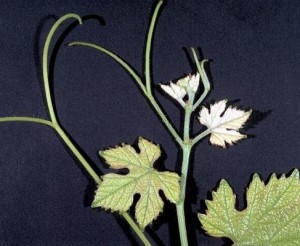
In 1891 some 60 grape varieties were planted mid-state and they, too, died. In 1894 over a thousand acres were planted further north in the state. They perished as well. It looked like the end of growing non-native grapes in Florida. Then the state’s agricultural service got involved and began hybridizing varieties of grapes that could be grown in Florida. They had early successes and over the course of several decades some of those successful hybrids escaped as well. So Florida has five kinds of grapes: Native muscadines, grapes believed descended from muscadines and early plantings of European grapes (let’s call them escaped cultivars) intentional hybrids under cultivation, intentional hybrids that have naturalized (often found unattended near old homesteads) and nearly any combination of the above. Now you know why grapes can be maddening.  (If that is not complicated enough some now think the forked-tendril grapes are not escaped cultivars but native. More DNA testing might sort that out.)

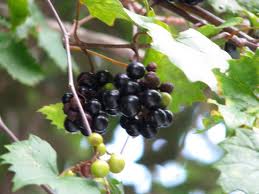
Native muscadine grapes

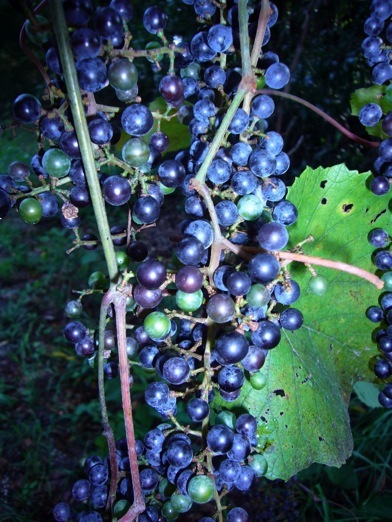
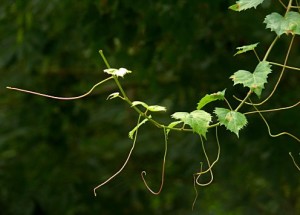
The local muscadines and “escaped cultivars” (if that is what they are)  fall into two groups, which as a forager you will come across from Florida to Texas. First is the pure muscadine native which has a single tendril with six to 30 grapes per cluster, not bunch, see at left. The second is group has split tendrils and bunches of grapes of 30 or more, see photo at top.  Now exactly which grape it is can be confusing. Not counting those specifically under cultivation you can find in the local wild Vitis rotunifolia, Vitis munsoniana, Vitis shuttleworthii, Vitis aestivalis, Vitis cinerea, and Vitis vulpina.  There are also many subspecies as well and over the years local tribes also spread the crossbreeds.

If it has smooth bark, an unforked tendril, smooth, non-hairy leaves and you are north and west of the Suwanee River and the cluster of grapes number six to eight, it is probably V. rotundifolia. If you on the peninsula of Florida and it has smooth bark, non-hairy leaves, the tendril is unforked and the grapes are a cluster of 12 to 30 berries, then it is probably V. munsoniana. though that species might actually be a variety of V. rotundifolia.  If you are in north or west Florida and you think you have V. rotundifolia or V. munsioniana but the bark on mature stems shreds in strips or squares you have V. vulpina.

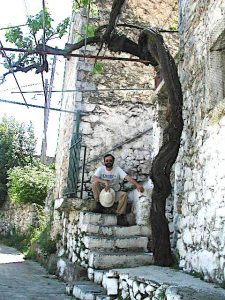
Green Deane with grapevine at his grandfather’s house in Karea, Greece, spring 2000.

Now it gets sticky:  If you have a forked tendril, a thick grape leaf that’s hairy below (whitish short hairs, sometimes light brown, that resemble felt) wrinkled on top (think quilted mattress) a downward curve from the mid-rib and a large semi-sweet fruit, you are in the lower two-thirds of the state and your feet could be wet, you could have V. shuttleworthii, which perhaps a variation of V. aestavalis. If you live in Texas and think you have a V. shutteworthii but the grape tastes fiery pungent, you have V. candicans. Incidentally, V. shutteworthii is the direct ancestor of the cultivated “Stover” grape.

If you have a forked tendril, a thin flat leaf, smooth on top, but hairy below (rust-colored hairs that are NOT felt-like) and you are in New Jersey or below, you probably have V. aestivalis, which has at least four subspecies, V. sola, V. simpsonii, V. smallinana, and V. divegent. The V. aestivalis and V. simpsonii was used in the creation of the Lake Emerald and Norris varieties. The V. aestivalis is also in the ancestry of V. bourquiniana varieties of Herbemont and Lenoir.

If you have a forked tendril, the leaf is wrinkled dull green on top, white hairy below, branchlets look white or gray and the leaf base is deeply indented, and you are in the northwest portion of the state it could be V. cinerea. That is the most common grape in southeastern North America, excluding Florida.

To recap, if possible: If it is a grape with smooth bark, a round leaf, and probably toothy, with a single tendril, it is a muscadine, V. rotundiafolia to the north and west of the state, V. munsoniana to the middle and south. If you have all that and the mature bark is in strips or squares, it is V. vulpina.

Grape with forked tendril

Grape with forked tendrils

If it has a forked tendril, the leaf is wrinkled on top and hairy underneath, and you are in the lower two thirds of the state and your feet are wet, it is probably V. shuttleworthii. If the leaf is smooth on top, hairy below, and has a forked tendril, and your feet are dry it is probably V. aestivalis. If it is wrinkled on top, hairy below, has a gray cast and you live in the western part of the state and north, it is V. cinerea. Whew!

If that is not confusing enough some argue the muscadines should not be in the Vitis genus at all and are rightfully the subgenus of Muscadinia because they have two less genes than other Vitis members.  They would also make at least two more species in the subgenus. I should also mention that bringing into The South grape roots or plants from elsewhere will probably end in death. Pierce’s Disease is known to kill off at least 300 different species of grape.

Grape with single tendrils

Grape with single tendrils

One question I hear often is why aren’t the native grapes producing? They always seem not to have grapes. There are two answers: One is 90% of the vines have male flowers and all they do is basically lie around drinking sun all the time and belching oygen. And the gals? They fruit sporadically. However, the so-called non-native escaped cultivars produce almost every year.

As for pronunciation they are VEE-tiss (grape)  row-tun-dee-FOH-lee-ah (roundleaf) es-tuh-VAL-uhs (of the field) sin-EER-ee-uh (the color of cinders, ashes) KAND-ik-anz, kan-DEEK-anz  (white or wooly) vul-PEE-nah (fox) munso-nee-ANN-ah, simp-SON-ee-eye, bore-quin-nee-ANN-ah, ShuttleWORTH-ee-eye

Three tidbits:

  1. If you make grape jelly from muscadines don’t crush them bare handed or bare footed. The high acid content can lightly burn your hands or feet. Also, grape sap is drinkable.
  2. The grape vine, however, has a peculiar vascular arrangement. If you cut the vine it will not leak water unless you invert it. You can get a quart or more from a one-foot piece.
  3. In all English dialects except American English “vine” means the grape vine. In American English “vine” can mean many plants, not just the grape vine.

 Green Deane’s “Itemized” Plant Profile

IDENTIFICATION: Grapes are woody vines with tendrils. Vines without tendrils that look like grapes are not grapes. The leaves vary greatly  in shape from serrated and round to heart-shaped and smooth to lobed and hairy.  The seeds of the grape are always tear-drop shaped. A grape-look alike is the moonseed which has seeds that are shaped like a crescent moon. Grapes in Florida tend to grow in clusters of two to 10, or bunches of 20 to 30  or more (not counting loss of numbers to birds and foraging humans.)  Fruits are blue to black. There are hybrids under cultivation — some 300 different ones — that can be green, red, blue or black and are often very large.

TIME OF YEAR: Mid-summer to late fall in Florida, more towards fall as one goes farther north. Locally September first is a good date to aim for.

ENVIRONMENT: Grapes like full sun, good drainage and a healthy amount of water. But, they will survive in dry areas, putting on small fruit. They can even be found growing in Florida swamps, so they are very adaptable.

METHOD OF PREPARATION: Out of hand as they come off the vine. They can be made into jelly, jam, wine, raisins, fruit leather; the seeds can be pressed for oil and the young leaves boiled and eaten. The leaves of the hybrids are preferred to the muscadines. Muscadines can be high in acid so when crushing to make jelly don’t use your hand. Oh, and the seeds can be used to make grappa.


{ 38 comments }
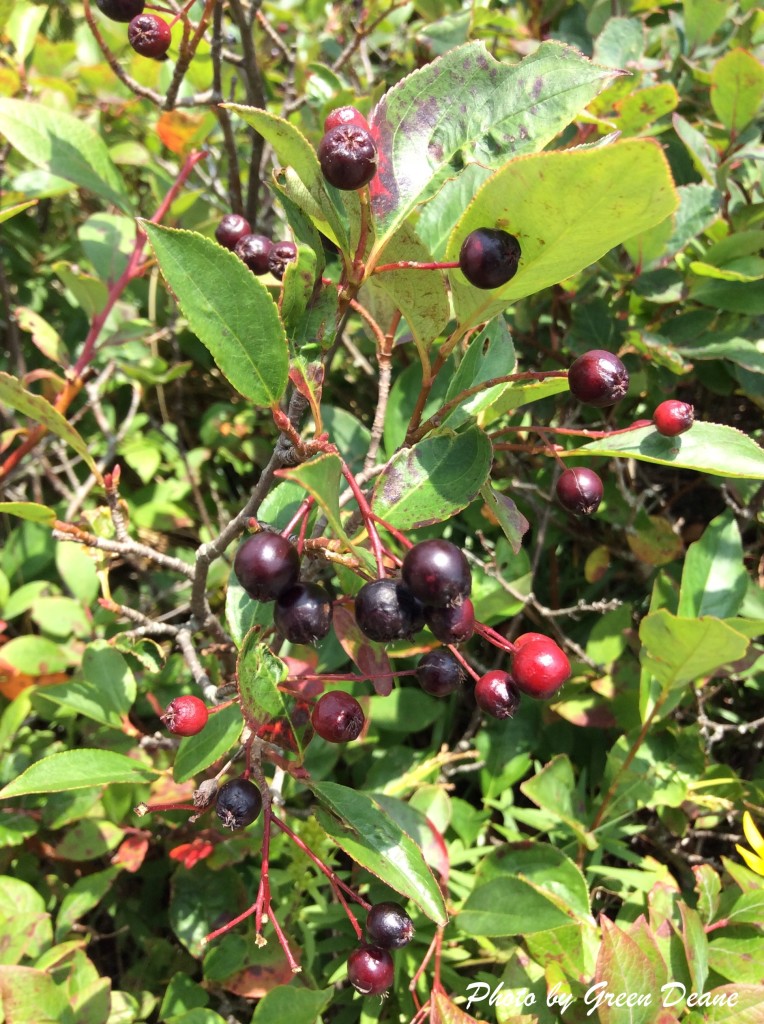
The bitter but edible berries of the Aronia Melanocarpa. Photo by Green Deane

The bitter but edible berries of the Aronia Melanocarpa. Photo by Green Deane

It’s a long ways from the mountains of Maine down the Appalachian Trail to the mountains of western North Carolina. It is also a long ways from ones 20’s to ones 60’s. These distances revealed themselves recently when I notice a plant while hiking in the Smokies.

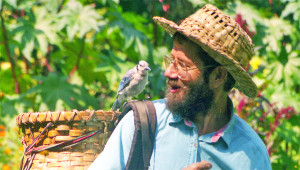
Doug Elliott in his yard with a Blue Jay Friend.

Doug Elliott with a Blue Jay Friend.

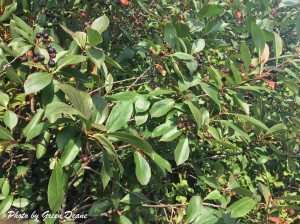
It was familiar but not familiar, a wrong plant in the wrong place I thought. But it was the right plant in the right place, kind of. The problem was I had 40 years of fog in my memory. Helping me sort out the mystery was Doug Elliott, edible plant expert, story-teller and long-time resident of North Carolina. He and his wife Yanna were kind enough to have me and my friend Kelly over to their place in a “holler.” Besides a close up view of their homestead and a taste of sumptuous food I got to ask Doug about my mountain-top mystery. ‘Sounds like an Aronia,’ he said, ‘with the unfortunate name of chokeberry.’ He got it right. The fog began to clear.

In high dry places the Aronia is usually the Black Chokeberry. Photo by Green Deane

In high dry places the Aronia is usually the Black Chokeberry. Photo by Green Deane

What confounded me is that the Aronia is generally thought of as a northern plant and quite common in my native state of Maine. And while North Carolina is not balmy in the winter it’s not the deep freeze New England can be… unless one goes up. Going up 1,000 feet takes you north about 700 miles in climate and season which effects the flora and fauna. Thus the Aronia is a northern genus but it creeps down the spine of the Appalachian Mountains, thriving in the cooler higher altitudes. It was until recently a much over-looked species. In fact, if a big pharmaceutical company could invent a plant it would be the Aronia.

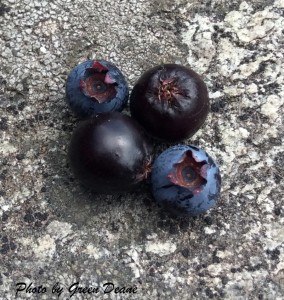
Two chokeberries compared to two blueberries (with crowns.) Photo by Green Deane

Two chokeberries compared to two blueberries (with crowns.) Photo by Green Deane

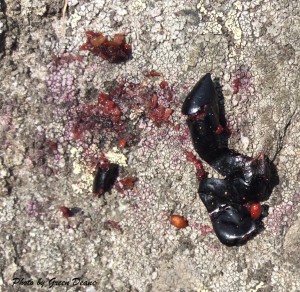
Much like Hawthorns botanists can’t agree on just how many Aronia there are though their numbers are dramatically far less than Hawthorns. There is a red variety, a purple variety, and a black one… maybe… and lot of commercial cultivars and a few natural hybrids and regional genetic differences. But the main point is their edible bitter berries are one of the richest sources of the stuff we — at the moment — think are good for us: Anthocyanins. They are water-soluble pigments that protect our cells from free radicals. Anthocyanins are the main reason, for example, why blueberries are blue and why they are good for us. In fact, Aronia berries have greater antioxidant activity than blueberries and cranberries (five times higher than each) and higher antioxidant activity than pomegranates, strawberries, cherries, even the vaunted goji berry. No fruit grown in a temperate climate has more antioxidants and flavonoids. Though bitter the berries can range from 12 to 20 percent sugar and per 100 fresh grams have 560 to 1059 mg of anthocyanins. It’s no wonder they are being cultivated in many states.

Aronia berries have one to five seeds. Photo by Green Deane

Aronia berries have one to five seeds. Photo by Green Deane

One species of Aronia, A. melanocarpa, has been well-investigated. It not only has anthocyanins but a host of potential positive chemicals including blue Malvidin, Caffeic Acid (an anti-oxidant also found in wine) blue Delphinidin, dark red-purple Cyanidin-3-Galactoside, and Epicatechin, an anti-oxidant found in chocolate. We may not be able to pronounce them but they are anti-… anti-bacterial, anti-viral, anti-arterial plaque, anti-cholesterol, anti-cancer, anti-flu, anti-E coli, anti-high blood sugar, anti-herpes, anti-HIV, anti-Crohn’s Disease as well as improving insulin production while protecting the liver and the stomach. No toxic effects are reported and the genus is naturally pest resistant. That’s quite a lot for a nondescript plant I saw on a mountain top.

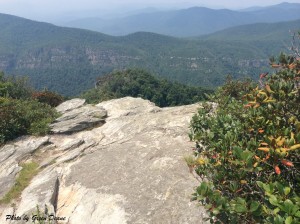
Typical environment for the Black Chokeberry in its southern range. The chokeberry is on the right. Photo by Green Deane

Typical environment for the Black Chokeberry in its southern range. The chokeberry is on the right. Photo by Green Deane

The common name chokeberry is self-evident. The berries are tart and bitter and it’s difficult to choke them down. But they can be made into jams, jellies, juice (by itself or blended) pies and other baked goods. They are also made into wine, stronger alcoholic beverages, pickles, flavoring for ice cream and yogurt and used as a natural food coloring. Among native Americans the Abnaki and Potawatomi ate them for food. Wildlife that live in them or eat the leaves or berries include the white-tailed deer, rabbits, ruffed grouse, sharp-tailed grouse and prairie chickens. The genus name comes from “aria” which is the Greek name for the mountain ash (Sorbus aria.) The red variety of the Aronia has red fruit similar to the red fruit of the Mountain Ash thus the base word was borrowed. Melanocarpa is also Greek meaning black fruit… So Aronia melanocarpa means by intent Red Fruit Black Fruit which is somewhat descriptive but not too inventive. Mountain Ash Black Fruit is just confusing. To get away from the name chokeberry, which people confuse with chokecherry, some have taken to calling it “Aroniaberry” but it hasn’t caught on. Some botanists also put them in the genus Photinia and that is by no means settled. Other botanical names for the Chokeberry have been Aronia arbutifolia (the red one) Aronia nigra, Photinia melanocarpa, Pyrus arbutifolia (red) Pyrus melanocarpa, and Sorbus melanocarpa. A. prunifolia and A. floribunda might be hybrids.

The Aronia can have attractive fall colors. Photo by Green Deane

The Aronia can have attractive fall colors enhancing their ornamental use. Photo by Green Deane

Here are some key identification differences between the Black Chokeberry and the Red Chokeberry:

The Black Chokeberry produces larger fruits that mature to purplish-black, while red chokeberry produces smaller fruits that mature to red;

Black Chokeberry’s fruits mature in late summer and then shrivel and drop, while red chokeberry’s fruits mature in fall and persist into winter;

Black Chokeberry is glabrous (not hairy) while red chokeberry is pubescent (hairy;)

Black Chokeberry plants tend to have a more rounded shape and remain more fully leaved to the base, while the red chokeberry is more upright and tends to be bare at the base;

The Black Chokeberry is naturally found in both wet and dry soils, while Red Chokeberry is found mostly in wet soils. On the mountain tops of North Carolina I saw only Black Chokeberries. Still confused? Know the black and red forms can hybridized. Several cultivars are also available. To be clear, while the research has been on the darker berries the red and the darker-colored berries are edible.

Green Deane’s Itemized Plant Profile

IDENTIFICATION:

Black Chokeberry: a multi-stemmed shrub, deciduous, eastern North American. Four to eight feet, can form dense colonies. Leaves alternate, 1–3 inches in length, 3/4–2 inches in width, oval but narrower at the base than near the tip, fine, regular teeth, top surface dark green, shiny with dark glands on the upper surface of the midrib. Lower surface lighter green, both sides non-hairy. Flowers have five white petals, many pink stamens. Berries 1/3 – 1/2 inch diameter, glossy and black when ripe, hang down in clusters from red pedicels, 30 or so fruits per cluster, one to five seeds each.

TIME OF YEAR:

Flowers open mid-May, fruits usually mature by August

ENVIRONMENT:

Hardy to USDA zone 3 which is to  -40 degrees F. Moderately tolerant of shade, prefers moist acid soils from low wet areas to dry sandy slopes meaning bogs, swamps, low wooded areas and clearings as well as dry rocky slopes, bluffs and cliffs. Also found beside roads and power line rights of way. Tolerant of salt spray, drought and soil compaction. While the Black Chokeberry can be found in wet and dry conditions the Red Chokeberry is usually found in wet conditions and rarely in dry areas. The red variety is more tolerant of heat. The genus is found in the eastern half of the United States, New England south and west to Texas, down the Appalachian Mountains to Georgia and reportedly into north Florida. Aronias can be used in landscaping and some have brilliant fall foliage.

METHOD OF PREPARATION

Can be eaten raw but bitter. Better made into jams and jellies, juice, wine and used in baked goods.

{ 25 comments }
The center core remains when blackberries are picked making them slightly bitter. Photo by Green Deane

The center core remains when blackberries are picked making them slightly bitter. Photo by Green Deane

Blackberries: Robust Rubus, Food & Weed

Anyone who forages will eventually collect blackberries and blackberry scratches. These aggregate fruit are among the best-known berries in North American, if not the world.

As a kid I can remember collecting wild raspberries long before wild blackberries, though I don’t know why. Blackberries are standard foraging fair (see my article about Dewberries.)  What most people don’t know is that blackberries are a two-year plant, some say three years. The first year it sends up a tall cane, replete with thorns. The next year it flowers and has blackberries then dies. Some would add that the cane stays on another year and with its thorns to protect the patch. (I should add though that there are some naturally thornless blackberries.)

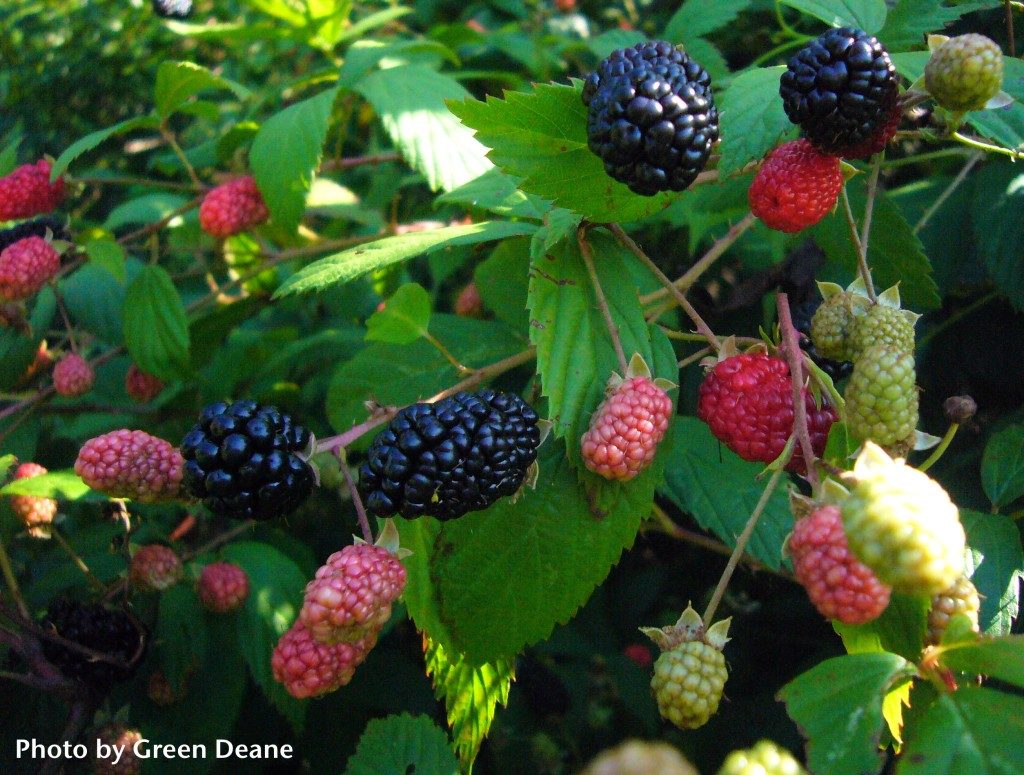
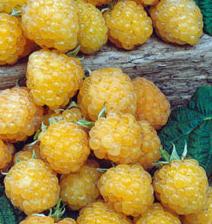
Ripe blackberries can be yellow or red but usually they are black.

Ripe blackberries can be yellow or red but usually they are black.

Blackberry leaves were in the official U.S. pharmacopoeia for a long time treating digestive problems, particularly diarrhea. Their dried leaves make an excellent tea even when you’re healthy. We presume blackberries have been eaten for thousands of years by native American tribes and used medicinally. The ancient Greeks considered the species good for ailments of the mouth and throat and for treating gout. Interestingly blackberries were found in the stomach content the Haraldskaer Woman, an iron age bog body found in Denmark in 1835 but killed around 500 BC. Her last meal was millet and blackberries. Scholars think her death was probably a religious ritual. The millet would have been standard Iron Age fare. Maybe the blackberries were a special treat. Those blackberries would have also put her execution in early summer, perhaps to ensure a good fall harvest by appeasing an agricultural god.

For all their antioxidants and vitamins blackberries will mold within a couple of days of picking if not refrigerated. Do not wash until time of use because that, too, promotes mold. They ripen around June in the south, July in the north, give or take a few weeks. Locally they can be ripe by early May or totally past season by the Fourth of July. Picked unripe berries will not ripen. Black berries are also a good source of potassium, phosphorus, iron, and calcium. The seeds have Omega 3 and 6 fatty acids. Blackberry buds can be used as a flavoring like capers.

Insects and wildlife like the blackberry as well. This includes honeybees, bumblebees, Little Carpenter bees, Nomadine Cuckoo bees, Mason bees, Green Metallic bees (my favorite) flies, wasps, small to medium-sized butterflies, skippers, hairstreaks, and several species of moths. Fowl like the berries such as the Greater Prairie Chicken, Wild Turkey, Bobwhite, Ring-Necked Pheasant, and various mammals from the bear to rabbit. In fact I recently saw a rabbit nibble on blackberry along a local bike trail.

In the rose family, just how many species of blackberries there are is anyone’s educated or non-educated guess. Some argue a few species with a lot of varieties and others argue for 250 or so species. Generally, ones that crawl are in one group and those that form canes are in another group. Then there are numerous unintentional and intentional hybrids, such as the Loganberry, Youngberry and the Boysenberry. Even the raspberry is a Rubus. The name, Rubus (ROU-bus) is the Dead Latin name for the blackberry and it means red hair.  There are several native local species. R. argutus, R. cuneifolius, R. flagellaris and R. trivialis (see the above Dewberry entry.) The ones I harvest annually I think are escaped cultivars in that they produce large, sweet berries consistently year to year.

Russia grows most of the world’s commercial blackberries, some 24 percent. Next is Serbia and Montegegro at 23%, the United States with 13%, Poland 11% and Germany 7 percent. Blackberries are native to every continent except Australia and Antarctica. However, in Tasmania and Australia the species are officially noxious weeds. Think about that: And edible plant on the noxious list. Must not be too hungry in those countries. In 2003 the Blackberry, Rubus occidentalis, became the official fruit of Alabama.

Lastly there is one interesting note about aggregate fruit. At least one expert says 99.99 percent of aggregate fruit are edible (such as blackberries, mulberries, logan berries et cetera.) Personally I would have liked to have seen listed the non-edible .01 percent.

Green Deane’s “Itemized” Plant Profile

IDENTIFICATION:

A woody shrub with canes that grow up but often bend over sometimes re-rooting. The canes grow the first year and fruits during the second year, then they die. Canes are 3-6′ tall/long; green at the growing tip, elsewhere brown or reddish brown with stiff prickles, straight or slightly curved. Can be an inch through at the base. Leaves alternate, usually trifoliate or palmately compound; long petioles. Leaflets up to 4″ long and 3″ across; can be twice as long as wide. Leaflet is usually oval with coarse, doubly serrate edges; may have scattered white hairs on the upper surface, lower surface light green and hairy.  Flowers, to an inch across, have 5 white petals and 5 green sepals with pointed tips; Petals longer than sepals, rather rounded, often wrinkly. Numerous stamens with yellow anthers. Blooms late spring to early summer for a month; little or no fragrance. Drupes, actually aggregate fruit, develop later in the summer;  ¾” long and 1/3″ across,size varies with moisture levels. Berries at first white or green eventually turn red then black. Seedy, sweet.

TIME OF YEAR:

Depending on climate, spring to late summer

ENVIRONMENT:

Full sun, neither too wet or too dry, mesic conditions

METHOD OF PREPARATION:

Numerous:; Fresh, frozen, canned, used for wine, making ice cream, juice, pies, jelly, jam, and best of all when eaten fresh on the trail.  Dry leaves can be used for tea. Leaves can be dried as is or fermented which improves the flavor significantly. Fermented or not they should be dried. Young shoots can be peeled and boiled in one or more changes of water. Running the fresh leaves through the rollers of a pasta machine is a good way to crush them for fermentation. Buds used like capers.

{ 65 comments }