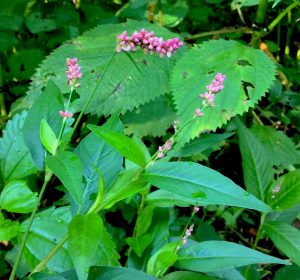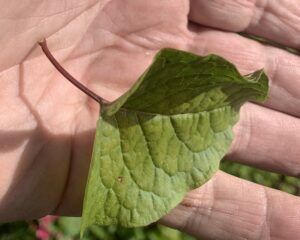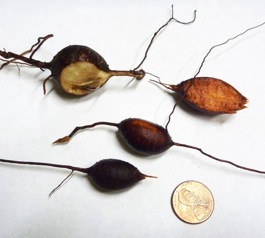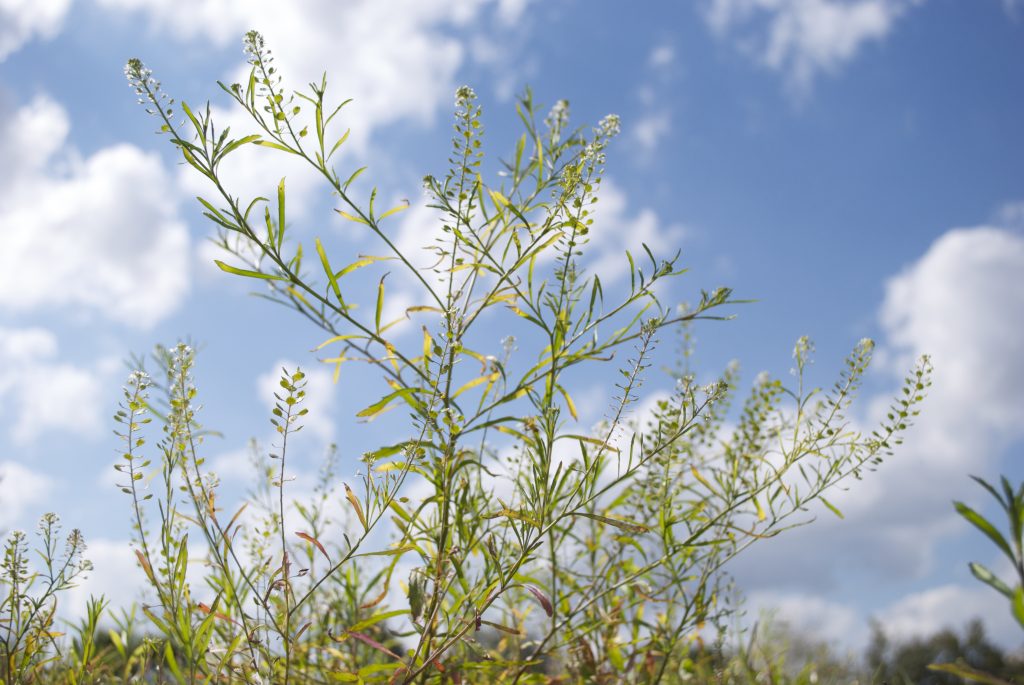
Peppergrass starts as a basal rosette then sends up a flower spike. Photo by Green Deane

Lepidium Virginicum: Bottlebrush Peppergrass

There are two ways of thinking about peppergrass, either as a real neat wild treat, or an obnoxious weed. Regardless of your world view — or weed view — peppergrass is a survivor and part of man’s diet for many thousands of years. As far back as 300 BC Pliny was writing about the Lepidium, and more than a thousand years before that the Incas were cultivating it.
Used in the kitchen and flower arranging

There are about 175 different Lepidiums, no doubt some native to your area and some imported. Growers dislike them because raw they can flavor milk and are herbicide resistant. (Fermented peppergrass, however, is an excellent silage feed for cattle. ) Pictured is “Poor-Man’s-Pepper” Lepidium virginicum (leh-PID-ee-um vir-GIN-i-kum). Virginicum means “North American” and Lepidium is dead Latin’s bastardization of Greek for little fish scale, Lepidion. And indeed, with a little imagination the notched seed pods of the Lepidium can look like little fish scales, some say little purses, I think flat, tiny lentils. Modern Greeks call this (and the related Shepherd’s Purse) kardamo which means cress.
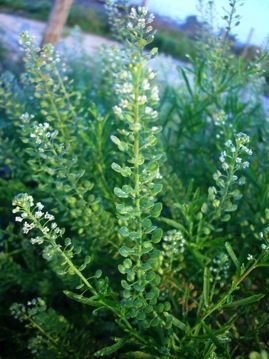
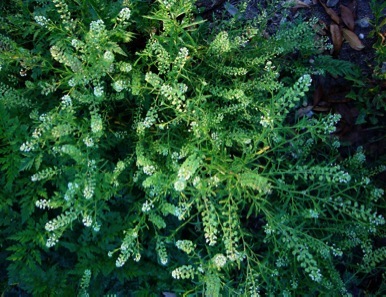
A bottle brush of seeds helps identify it

While in many places Lepidium is a winter and spring visitor, it is a year round plant here in Florida though it is most noticeable and happiest in winter here. The young leaves can be added to salads or soups — they are peppery. The seed pods can be used like pepper. The root, ground and mixed with vinegar is a good substitute for horseradish.  I like them as a trail side nibble. The leaves contain protein, vitamin A and are rich in Vitamin C. There are no poisonous look-alikes. If you have a Peppergrass with really large seeds it might be Thlaspi arvense, an edible relative. 

As with all mustards, it has a tiny four-petal flower, whitish-yellow with two stamen. Bees like them. The flowers are on elongated racemes, which lends them to the classic description of looking like a small bottle brush. The leaves are deeply toothed. First the plant produces a low rosette of deeply cut basal leaves, then vertical growth and seeding. Some species in some places are biennial, rosetting one year, growing up and seeding the next.There are actually four very common Lepidiums and variations in all of North America. The leaves and seeds tell them apart but their use is the same. The shape of the seeds spell T.H.O.R. and that is how I remember them.
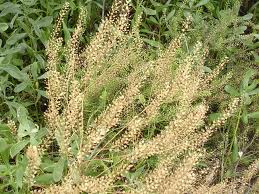
Peppergrass in the fall

The Cow-cress, Lepidium campesire, has basal leaves that embrace the stem — making them rise up — and a seed pod shaped like a front Tooth, with a tiny nick at the end. A close relative, the Shepherd’s Purse, Capsella bursa-pastoris, below, resembles “Poor Mans” but its seed pods are Heart-shaped. “Poor-Man’s Pepper” has deeply toothed leaves and an Ovalish seed pod with a small notch at the end. Pennycress resembles “Poor Man’s” as well, but the seed pods are Round and deeply notched. The common horseradish, that the sauce of the same name is made from, is a relative though it is much larger and has tiny egg-shaped seed pods. That the family is nutritious is just the beginning of the story. There are medical uses, some proven. The L. virginicum is antiamoebic, for example.
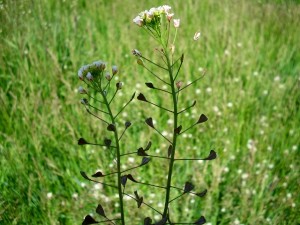
Shepherd’s Purse is a Winter Annual

In a 2003 study looking for antiprotozoal agents from plants researchers found  “a crude extract from the roots of Lepidium virginicum exhibited antiprotozoal activity against Entamoeba histolytica trophozoites,” one nasty bug. “The results support the anecdotal reports for the traditional use of L. virginicum roots in the control of diarrhea and dysentery in the highlands of Chiapas, Mexico.”

Perhaps the most famous Lepidium, however,  is Lepidium peruvianum, also know as Maca. It grows a tuber that has been used to “enhance” fertility in man and beast. Research shows it also relieves stress.
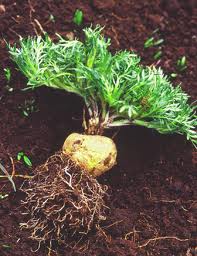
Maca, the most famous Lepidium

Maca is hardy, being cultivated high in the Andes at altitudes from 8,000 to 14,500 feet. It has the highest frost tolerances of all plants and takes seven to nine months to produce a root, which can be eaten fresh or dried. They can be stored dry for as long as seven years. L. peruvianum roots have a tangy, sweet taste similar to butterscotch. In Peru they are eaten as is or made into jam, pudding, porridge, soda even a fermented drink called Maca Chicha.

There is a debate whether the Maca sold today is L. peruvianum or Lepidium meyenii, with the latest opinion favoring peruvianum.  Called the “natural viagra” Maca has caught the attention of the non-Peruvian world: In 1994 less than 50 hectares were used in the commercial cultivation of maca; by 1999 over 1200 hectares were under production. It now exceeds 2000 hectares.

Those 2000 hectacres are found high in the Andes, an inhospitable place of intense sunlight, violent winds, and below-freezing weather. With such extreme condition and poor, rocky soil, the area is among the world’s worst farmland. However, Maca evolved to live under those conditions as have most mustards. They can be found growing in Greenland and the Arctic circle. The Incas domesticated Maca about 2,000 years ago, and primitive versions of Maca — early cultivars — have been found in archaeological sites dating back nearly 4,000 years.

If you’re not inclined to eat the peppergrass, then there is another use: the dried seed stems make a great addition to dried arrangements and wreaths. They are showy, sturdy, and last for a long time.

Sometimes you have to approach an edible plant’s nutrition obliquely. Peppergrass is a good example. There’s been research on the plant for inhibiting pathogens but not much on nutrition. However a 1944 study involving silage (cattle food) gives us some insights. (Journal of Dairy Science, Vol 27, Issue 5, pp 365-367.) 

There was a heavy stand of Peppergrass (Lepidium virginicum) at the Virginia Agricultural Experiment Station at Blacksburg Virginia. There was too much to let it all go to seed but if they left it it would smother out the alfalfa they were growing. Mowing, racking and hauling it away was costly if no use was found for. So they decided to use it for silage. It was a bold idea because plants in the greater mustard family can taint the flavor of milk. 

The ten acres yielded approximately 28 tons of Peppergrass. They mixed it with 50 pounds of molasses per ton as a preservative then let it ferment. At the end of fermentation there was no odor or flavor of peppergrass. They also tested the nutriments of the peppergrass before and after ensilaging. By weight the Peppergrass was 3% potassium, 1.34% calcium, 0.40% magnesium and 0.23% phosphorus. After fermenting the amounts were slightly less. Alfalfa was in the finished silage but the study did not make clear if it was also analyzed with the peppergrass.  

As for other nutriments we have to rely on an unpublished report. A newspaper article in June 1990 said a sample of Peppergrass had been sent sent to the University of Florida Herbarium for analysis. The analysis reportedly said Peppergrass was high in vitamin C (as ascorbic acid) a good source of vitamin A (beta carotene) and iron. It was also a good source of protein. This would be in keeping with it as a member of the greater mustard family. There is also a 1951 University of Florida report on B vitamins in common produce and some wild plants. They included Peppergrass. Per 100 gram serving it has 0.045 mg of B1 (thiamin) 0.623 of B2 (riboflavin) and 2.54 mg of B3 (niacin.) 

Another thing we can do is look at Peppergrass’ relatives. We have reports on two: Lepidium sativum (Garden Cress)  and Capsella bursa-pastoris.  Garden Cress per 100 grams of fresh leaves has: 32 calories, 2.6 grams of protein, 0.7 grams of fat, 5.5 grams of carbohydrates, 69 mg of vitamin C (meeting your daily need) and 930 RE of vitamin A. The minerals are 606 mg potassium, 81 mg calcium, 76 mg phosphorus, 14 mg sodium, and 1.3 mg iron.

Here’s a recipe from Leda Meredith who  forages in New York City .

Peppergrass Chermoula
Chermoula is a North African marinade that is usually used with seafood. It is also wonderful on steamed vegetables and mixed into whole grain salads.

1 large clove garlic, peeled OR several underground field garlic bulbs
1 tablespoon fresh green peppergrass seedpod discs
1 small hot pepper
1/2 cup fresh cilantro (coriander) leaves
1/4 – 1/2 cup extra-virgin olive oil
1/2 teaspoon salt

1. Place the garlic, peppergrass, chile pepper, and cilantro in a food processor and pulse to finely chop. Scrape down the sides of the food processor bowl with a spatula and pulse again (repeat a few times to end up with a more or less evenly minced mixture).

Alternatively, finely chop the garlic, chile and cilantro. Pound them together with the peppergrass with a mortar and pestle.

2. Add the salt and 1/4 cup of the olive oil and blend. You want to have a slightly liquid paste. Add more olive oil if needed.

Chermoula will keep in the refrigerator for up to 2 months.

Green Deane’s “Itemized” Plant Profile

IDENTIFICATION: Flower: Four petals, two stamen. Fruit: See seed. Leaves: Lobbed, toothed, varies, long to lance shape. Stem: Erect. Seed: Seed pods vary in shape round the stem. Root: Tap root vertical

TIME OF YEAR:  Springtime into summer

ENVIRONMENT: Well-drained soil, sandy to rich, old pastures, gardens, lawns, roadside, nearly any sunny spot

METHOD OR PREPARATION: Leaves as potherb, seeds for spice or pepper flavoring, can use flowers to flavor vinegar. Some young leaves can be used raw in salads. Try a little first. Can blanch leaves then saute.
{ 29 comments }


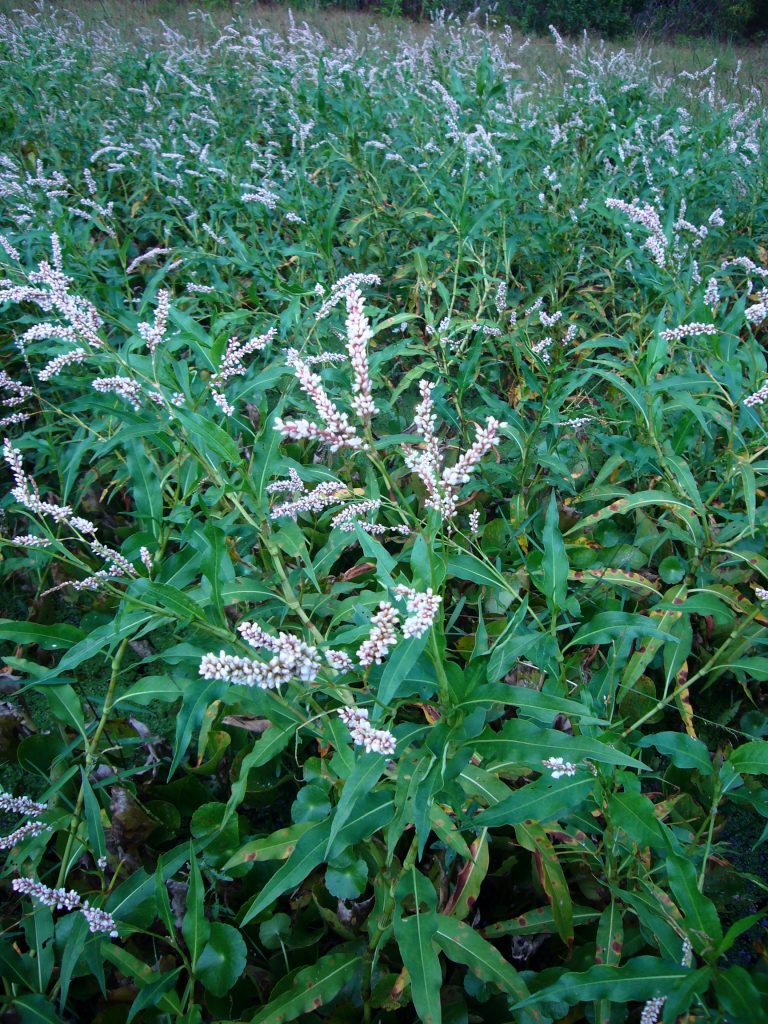
Look for Smartweed in low, damp areas such as clean ditches. Photo by Green Deane

Polygonum punctatum: Smartweed

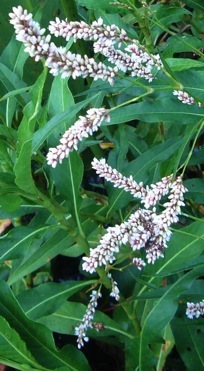
The blossoms are hot and bitter. Photo by Green Deane

I can remember my first taste of a smartweed leaf… kind of like trying a piece of burning paper. Indeed, a lot of plants resemble smartweed but one quick taste and you’ll know if you’ve got the right plant: If it isn’t very peppery, you picked wrong. Actually, the burn is not immediate. It takes a few seconds to kick in and then it intensifies. And about the time you wish it would stop intensifying it’s just getting started. Word to the wise, use sparingly and try only a very small piece to start with chewing between teeth and tongue.

It’s a little hard to stuff inside the head, but the smartweed, Polygonum punctatum, (pol-IG-on-um punk-TAY-tum) is in the the buckwheat family, but you would never use it on morning pancakes.  It’s for seasoning, soups, and perhaps salads. Not only is it burning hot but some varieties, especially P.  hydropiperoides, (hye-dro-pie-per-OY-dees) are also vasoconstrictors. So if you have high blood pressure, go easy on those species. It’s all right as a spice, a bit much as a pot herb.

The Smartweed is common throughout North American and nearly year round in the southern range. Actually it is easy to identify even when brown dead and is still peppery. It has freely branching stems and a lot of joints which gives the plant its name. Polygonum is Greek for many knees. Punctatum means dotted, referring to dots on the tepals, and indeed it is also called Dotted Smartweed. It’s a fine plant for seasoning while camp cooking, but can overwhelm like cayenne pepper. Also be careful because some people can develop dermatitis from it.

Blossoms can be be pink or white depending on the species. Photo by Green Deane

There are three species locally, all useable: The P. punctatum as well as P. densifolrum (compactly flowered) and the aforementioned P. hydropiperoides (water pepper.) P. hydropiperoides has tannins, rutin (3% in leaves) quercitin, kaempferol and some protein. It is considered a diuretic and has been used to stop intestinal and uterine bleeding, hasten menstruation and to treat hemorrhoids. It has many more applications as well. The Natives also cooked the leaves of the trio and ate of them sparingly. It’s also a common waterfowl food. If you crush a bunch and put it in a small body of water it will force the fish to float to the top by interrupting with their oxygen uptake (as does American Beautyberry leaves.)

I saw some P. hydropiperoides in Mead Gardens, Winter Park, Fla., the day I originally wrote this article. It was flowering and taking on a bit of fall red. It had been a while since I had seen the P. hydropiperoides, the P. punctatum being the one my path crosses most often. Soooo, I tried a good part of a leaf…. the hole in my tongue should heal in a few days. The blossoms are hot as well but are also bitter.

Some Polygonums have edible roots, perhaps the best know is P. bistorta, a Eurasian import. The roots are first soaked in water then cooked in embers. Or it can be chopped up, soaked in many changes of water, then passed through a mill to make a puree. The bulbs of the P. viviparum have been eaten raw but they are better roasted. The roots of the Polygonum multiflorum are also edible raw or cooked as are the roots of the Polygonum bistortoides  The seeds of the Polygonum douglassii, Polygonum aviculare and the European Polygonum convolvulus have been eaten since mesolithic times.

And while the Smartweed is called “many knees” at one time its name was arsesmart. I have never found any reference to what chemical(s) make the species peppery. Lastly, I have a video on the Smartweed on You Tube… made it in the rain… dedicated I am…

Green Deane’s “Itemized” Plant Profile

IDENTIFICATION: P. punctatum: Alternate leaves are smooth-edged, lance shaped, willow-like, one to six inches long, leaf base forms sheath around stem. Young leaves flat, older leave  can be wavy,  The stems are often reddish, flowers are small, pink or  white in dense clusters from the leaf joints or stem apices. It can grow to four feet or more but is usually smaller.

TIME OF YEAR: Year round in Florida, seasonal elsewhere, blooms July to first frost.

ENVIRONMENT:  It likes moist areas.  I often find it in the center part of old woods roads where they dip down and collect water or stay moist.

METHOD OF PREPARATION: In Asia the seedlings (sprouts) are collected and used like spicy radish sprouts for a hot flavor. Mature leaves and stems chopped up and used sparingly as pepper, leaves and stems boils in soups, again sparingly.  Numerous herbal applications.  The roots of some species are edible cooked, some require a little cooking, others require much cooking. The seeds of some are also edible. Check with a local expert about your local Polygonum.

HERB BLURB

A Mem-Inst-Oswaldo-Cruz. 2001 Aug; 96(6): 831-3. Abstract:Polygonum punctatum (Polygonaceae) is an herb known in some regions of Brazil as “erva-de-bicho” and is used to treat intestinal disorders. The dichloromethane extract of the aerial parts of this plant showed strong activity in a bioautographic assay with the fungus Cladosporium sphaerospermum. The bioassay-guided chemical fractionation of this extract afforded the sesquiterpene dialdehyde polygodial as the active constituent. The presence of this compound with antibiotic, anti-inflammatory and anti-hyperalgesic properties in “erva-de-bicho” may account for the effects attributed by folk medicine to this plant species.

{ 32 comments }

Kangaroo meat is nutritious but Australians don’t like it because it’s their national animal.

Kangaroo meat is so good it makes one wonder why the Aussies ever imported beef.

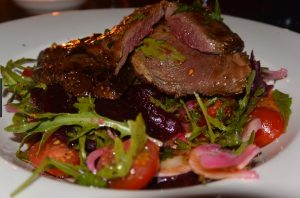
Kangaroo meat likes slow cooking and added fat

If you follow the Paleo lifestyle, as this writer has for some 12 years, Kangaroo meat is just about perfect:  High quality protein, 2% fat, the best known animal source of Conjugated Linoleic Acid (helps you take off body fat) as well as high in iron and zinc. It does us modern cavemen proud. Kangaroos used for food are free-ranging and don’t contribute to greenhouse gasses. Even some vegetarians are eating kangaroo meat under an ethical view called Kangatarianism. I just call it tasty. How do you get it? You can order Kangaroo from several companies that will ship it to you packed in dry ice. Or, in larger cities you can find it in local markets and restaurants. Like other meats you can get various cuts and forms, medalions to ground. As a lean meat it does not over cook well and benefits from added fat in various dishes (as does horse meat.)

This account is from a 1948 expedition to Arnhem Land, a remote part of the northern Australia the size of Ireland set aside for Aboriginals who want to pursue the hunter/gatherer lifestyle. It’s how to cook and eat a wallaby indigenous style.

“A large fire was made in a depression in the sand, and stones and shells were heated.  Small green branches were placed on top of the stones and the wallaby was flung on these.  After 5-10 minutes it was taken off the fire, placed on a layer of green leaves, and the singed fur was removed with a tomahawk. [Just the fur, not the skin.] Although the women sometimes did this preliminary treatment, a man always did the subsequent cutting up, which was done with a metal spear blade.

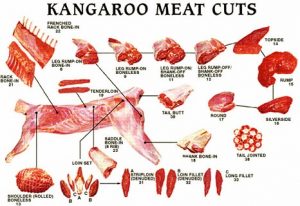
Kangaroo provides a variety of cuts for cooking.

The first cut was made horizontally on the ventral [belly] surface at the level of the anus, and next on the dorsal [back] surface along both sides to sever the leg muscles.  Another cut was then made from the anus to the neck.  The viscera were pulled out; and the kidneys, liver, heart and lungs, and the omental and mesenteric fat [the fat surrounding the intestines] were separated from the rest, and cooked on the hot stones and coals for 5 minutes.  The cooked lungs were used to soak up the blood inside the carcass and then eaten.  The offal was regarded as a delicacy by everybody and a certain amount of squabbling always followed its distribution.

The tail was cut off, and during the cooking was put on or alongside the body.  The carcass was laid flat, dorsal side downwards, on the hot stones and ashes and the body cavity was filled with hot stones. Sheets of paperbark formed a cover over the animal, and sand was scooped out to make an oven.  Wallabies weighing 15-20 pounds were cooked for 25-35 minutes.  Everything edible was eaten except the stomach and intestines.  The skull was cracked open to get the brain, and the bones were broken to extract the marrow.”

Wallabies are edible, too.

Kangaroos themselves are something of a problem in Australia. There were 27 million in 2010. By 2016 that number was 45 million. Blame rainy conditions that produce a lot of kangaroo food thus a lot of kangaroo babies. It seems to be a case of either humans start eating them or the kangaroos are going to starve to death by the millions. It’s a hard  choice for many Aussies who think of  “Skippy The Kangaroo” as many Americans think of “Bambi” a non-edible edible. By the way, as a meat animal kangaroos are very environmentally friendly… unless you have a few million carcasses lying around…

{ 2 comments }

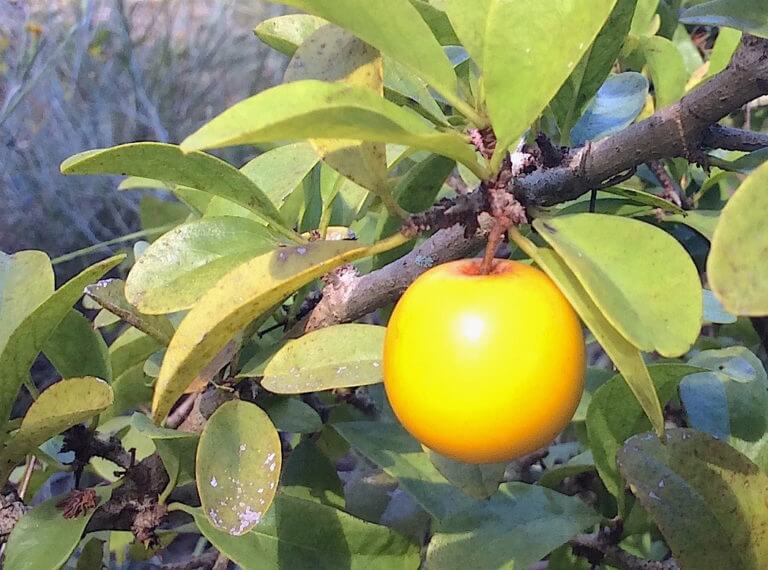
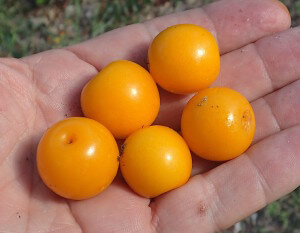
Ripe Tallow Plums are tangy and a delightful trailside nibble. Photo by Green Deane

Ximenia americana: Known by Many Names

If I listed this edible under its botanical name few would find it. On the other hand it has some three dozen commons names in several languages. So which one does one choose? In English, Tallow Plum is the most accurate.

Tart Tallow Plums, Photo by Green Deane

It has also been called the American plum, blue sour plum, monkey plum, mountain plum, seaside plum, Spanish plum, wild plum, hog plum, and yellow plum though it is not a plum but its leaves can be bluish. Other names include pepenance, coastal prune, spiny prune, Brazilian apricot, spiny apricot, wild apricot, little apricot and little wild apricot though it is not a prune nor an apricot.  Then there is ocean cherry, wild cherry and cherry — no, it is not a cherry either; sea lemon, seaside lemon, wild orange, and wild lime…and no it is not a citrus. Others prefer devil’s apple, fiddle apple, little apple and wild quince. Yes, you guessed it again: It is not an apple or any apple relative. Some even call it the Wild Olive. No, it is not related to the olive but it is in the Olax family. Olive/olax… tenuous at best. There is also a darker side with names like purge-nut, cagalera (diarrhea) and fransman moppe (Frenchman’s complaint) a reference to what too many of the seeds can do.

It got the name Tallow Plum because of the waxy texture of the fruit. Botanically it is Ximenia americana (that’s hem-MAY-nee-uh a-mer-ih-KAY-na.) It was named for the Spanish monk Francisco Ximenez, a native of Luna in the Kingdom of Aragon. Americana means of the Americas. It is an important food source in Ethiopia and Brazil. 

Green they were used to numb gums.

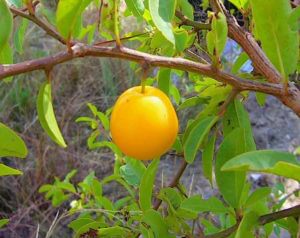
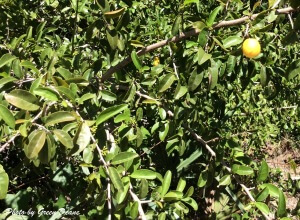
Found in Florida and south, locally it likes dry scrub areas. The picture above came from the southwest side of the entrance road to Haulover Canal parking lot on the north end of Kennedy Space Center. Tallow Plums here in Florida range from a few feet tall to sprawling shrubs five or six feet tall.  In southern hammocks, however, which are islands of hardwoods in wet areas, it can grow to 35 feet. 

Tallow Plum is gangly and has small thorns.

The yellow fruit, sometimes orange/red particularly when dropped off the tree, is edible raw or cooked. It can range from a bitter-almond in flavor to sweet. The flesh is somewhat astringent and sticky. There is no particular aroma of the fruit but the flowers have an intense lilac aroma. Young leaves, which have a strong aroma of almonds, can also be well-boiled then eaten in small amounts. Think famine food.  Do not eat them raw. They contain hydrocyanide.

The oil of the seed is also edible and used for cooking. It has 10 fatty acids, seven unsaturated yielding a total unsaturation of 92.42%. The oil contained essential fatty acids of Linoleic (1.34%), Linolenic (10.31%), Arachidonic (0.60%) and varying levels of unsaturated higher fatty acids, specifically Eicosatrienoic (3.39%), Erucic (3.46%) and Nervonic (1.23%) acids. The level of Oleic acid  is 72.09%. the fruit has chigh levels of vitamin C (160,26 mg per100 g), yellow flavonoids (43,12 mg per100 g), total extractable polyphenols (3066,48 mg per 100 g) and antioxidant activity (365,55 g fruit/g DPPH e 251,70 μmol Trolox/g.

The pulp of the seed itself is purgative raw, and is used as a seasoning. A few can be eaten after cooking but if too many cooked ones are consumed, like the raw ones, they becomes a most efficient laxative. The fruit is known to quench thirst, is used as a drink and in making jams and jellies. In Tanzania the Sandawe (Bushmen) rely on the fruit as a staple. The seed oil is use for skin moisturizing and as of this writing is commercially available costing $5 an ounce, not counting shipping. 

Addendum March 2018: A strapping, young, adult male reported to me that he ate about 20 Gopher Apples and 10 Tallow Plums at one sitting. He then had temporary premature ventricular contractions which he verified by a heart monitor. And they went away in a short while. Thus we don’t know which fruit might have caused said, or if it was a combination of them, the amount, or if it was a personal sensitivity or something else entirely. 

Green Deane’s “Itemized” Plant Profile

IDENTIFICATION: A shrub to a small tree, branches long, zig-zaggy, vine-like, semi-climbing, thorny; leaves alternate, yellowish-green in the scrub, darker green in hammocks, oblong or elliptic, rounded or notched at the apex, or spine tipped, one to three inches long, some times in clusters of three.  Flowers yellowish, four petals, 3/8 inch wide, hairy within, very fragrant, similar to lilac, in small clusters. Fruit a broad oval or nearly round, to 1.5 inches long, skin smooth, bright yellow to orange red, flesh yellow, bitter almond to sweet flavor, sub acid to acid. Seed large, oval, buff-colored with white nut like kernel.  The wood is very dense and the plant can be parasitic.

TIME OF YEAR: Spring and fall

ENVIRONMENT: Dry scrub lands to hardwood hammocks. For several decades I only found them in coastal areas. But this past year I found one under a pine west of Orlando, mid-state.

METHOD OF PREPARATION: Fruit edible raw or cooked, used for juice, jelly, jam and wine. Kernel roasted but in limited quantities, seed oil is edible and can also be used in making soap, lubrication and a vegetable butter. Young leaves can be boiled and eaten sparingly.  Raw fruit picked when unripe.  The fruit is high in Vitamin C and oil that has been used externally on hair and as a skin softener.

HERB BLURB

The bark, fruit, and leaves have several medicinal uses. Leaves and twigs are used to treat fever, colds, as a laxative and an eye lotion. Leaves are used for headaches, angina, and a poison antidote. Roots are used for skin problems, headaches, venereal disease, sleeping sickness, and water retention. The fruit has been used for constipation. The bark has been used for febrile headaches, bath water for sick children, for kidney and heart complaints, and applied to skin ulcers. Stem bark methanolic and water extracts of showed a spectrum of activity against E coli, P. vulgaris, S. aureus, P. aeruginosa and B. subtilis.

{ 27 comments }

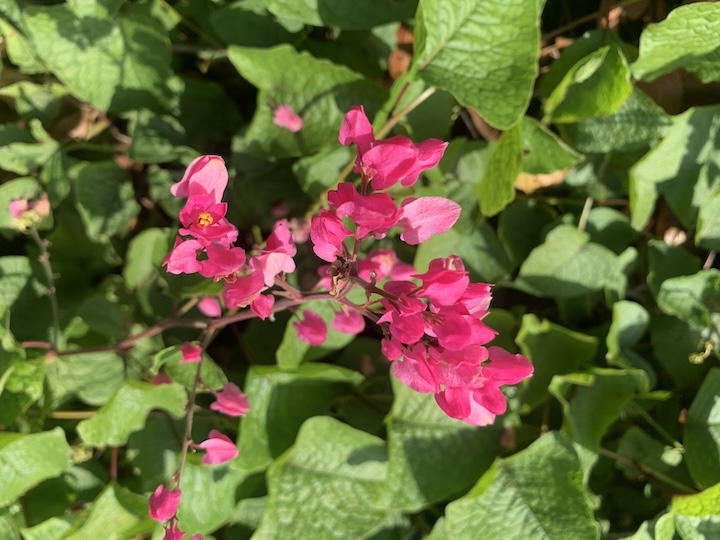
Coral Vine is not a slow creeper. Photo by Green Deane.

Antigonon leptopus: Creeping Cuisine

The Antigonon leptopus ( an-TIG-oh-non LEP-toh-puss) inspires local names everywhere it grows: Tallahassee Vine, Honolulu Creeper, the Christmas Island Crawler, as well as Confederate Vine, Mexican Coral Vine, Mexican Creeper, Chinese Love Vine, Chain of Love, Queen’s Jewels, Desert Bleeding Heart, and Queen’s Wreath.  Other names include: Kadena de Amor, Flor de San Diego, Rosa de Mayo, Corona de Reina, Hierba de Santa Rosa, San Miguelito, and Fulmina. Natives called it Coamecate, Coamecatl, Chak lol makal, Cuamécatl, Gui-bakushu, Mamasa-sai and Tunuc. It’s also called the Rose of Montana, but does not grow there.  In most countries where bellies are full, it’s called an invasive weed.

Antigonon leptopus has a long stem. Photo by Green Deane

Related to the seagrape and in the buckwheat family, the Coral Vine is a native of Mexico and is widely cultivated in South America. In other pan tropical places it is an escaped ornamental. It tolerates poor soil and a variety of light conditions. While the hungry  view it as a reliable food source, most first-world governments think of it as difficult to eradicate. In Florida, where it is naturalized, it is considered a Category II invasive exotic (I have often wondered why they don’t think the same way about non-native citrus.)

A fast-growing climber, the Coral Vine grabs via tendrils and can reach 40 feet in length in old age. Its leaves are heart shaped, sometimes triangular, crinkly edged, with reticulated veins (looks wrinkled.) They are officially around one three inches long though I think they grow larger. The flowers are arranged in panicles, pink to white, blooming from spring to fall, many times year around. It is an evergreen in some climates or looses its leaves for a little while in other areas.

Coral Vine Roots: Photo by Marabou Thomas

The Coral Vine is well-equipped to proliferate itself. It produces a huge amount of seeds, which also float. The edible seeds, and or other parts of the vine, are favored by birds, raccoon, deer, pigs and sheep. Bees and butterflies like it because least least 41.6% of its flowers are open at a given time. The plant can also reproduce via its edible tuber which grows larger with age.  It likes pinewoods, fence rows, yards, railroad tracks, disturbed ground even marshy areas. Climbing by tendrils, it tends to smother what it ascends.

Least you think the Coral Vine is just another pretty invader it’s medicinal as well. An extract of its leaves and flowers inhibit lipid peroxidation. It’s an antioxidant, anti-inflammatory and analgesic. A hot tea made from the aerial parts is used to relieve symptoms of the cold and flu. A leaf tea is also made to treat diabetes and high blood pressure. In the kitchen the cooked roots are nutty, and the leaves and flowers are dipped in flour, fried and served with pasta. The flowers are also mixed into omelet. The seeds can be roasted, winnowed, then ground and used like flour.

Antigonon is from the Greek and means opposite angle, think elbow, a reference to the blossom arrangement. Leptopus is a Greek/Latin mess that comes from the Greek word Leptos meaning thin or delicate. Lepta is pocket change and lepto is a moment.  If you prefer the Greek the pronunciation would be LEP-toh-puss (as in cat.) The Latin would favor lep-TOE-puss. There are four to eight species of Antigonon — depending on who is counting. A second one grows in south Florida,  A. guatemalense.  It has larger leaves and hairy stems. Its edibility is unknown to me.

The vine is found throughout the southern United States, Central America and South America.  It is also found on Africa — it got to Egypt by 1805 — and 98% of the Pacific Islands including American Samoa, the  Commonwealth of the Northern Mariana Islands, Cook Islands, Federated States of Micronesia, Fiji, French Polynesia, Galapagos Islands, Guam, Hawai‘i, Kiribati, Marshall Islands, Midway Island, Nauru, Niue, Palau, Papua New Guinea, Pitcairn Island, Samoa, Tonga, the Philippines. It is also found on most islands in the Caribbean. It can be grown as an annual or a container plant at least as far north as St. Louis. It is also found in India, Australia, and England, and is known to grow in southern California but not blossom there (perhaps it needs more humidity than southern California has.)

 Green Deane’s “Itemized” Plant Profile

IDENTIFICATION: A twining vine, clings and climbs with curled tendrils to 40 feet. Leaves: ovate, heart-shaped, soft, pronounced veins on underside, reticulated on top. Flowers: on branch terminals, reddish or light pink, or white.  Petioles 2cm or longer, whereas on the A. guatemalense they are 1 cm or shorter.

TIME OF YEAR: Roots anytime they are large enough to harvest, often deep. Blossom when in season, in warm areas nearly year round, in cooler areas until frost.

ENVIRONMENT: Nearly any environment will do. Flourishes with good water and plenty of sun

METHOD OF PREPARATION: Roots cooked — some say raw, I do not personally know that — seeds roasted and winnowed. Flowers and leaves cooked.

 HERB BLURB

Tea prepared from the aerial parts of Antigonon leptopus is used as a remedy for cold and pain relief in many countries. In this study, A. leptopus tea, prepared from the dried aerial parts, was evaluated for lipid peroxidation (LPO) and cyclooxygenase (COX-1 and COX-2) enzyme inhibitory activities. The tea as a dried extract inhibited LPO, COX-1 and COX-2 enzymes by 78%, 38% and 89%, respectively, at 100 microg/ml. Bioassay-guided fractionation of the extract yielded a selective COX-2 enzyme inhibitory phenolic aldehyde, 2,3,4-trihydroxy benzaldehyde. Also, it showed LPO inhibitory activity by 68.3% at 6.25 microg/ml. Therefore, we have studied other hydroxy benzaldehydes and their methoxy analogs for LPO, COX-1 and COX-2 enzymes inhibitory activities and found that compound 1 gave the highest COX-2 enzyme inhibitory activity as indicated by a 50% inhibitory concentration (IC(50)) at 9.7 microg/ml. The analogs showed only marginal LPO activity at 6.25 microg/ml. The hydroxy analogs 6, 7 and 9 showed 55%, 61% and 43% of COX-2 inhibition at 100 microg/ml. However, hydroxy benzaldehydes 3 and 12 showed selective COX-1 inhibition while compounds 4 and 10 gave little or no COX-2 enzyme inhibition at 100 microg/ml. At the same concentration, compounds 14, 21 and 22 inhibited COX-1 by 83, 85 and 70%, respectively. Similarly, compounds 18, 19 and 23 inhibited COX-2 by 68%, 72% and 70%, at 100 microg/ml. This is the first report on the isolation of compound 1 from A. leptopus tea with selective COX-2 enzyme and LPO inhibitory activities.

Bioactive Natural Products and Phytoceuticals, 173 National Food Safety and Toxicology Center, Michigan State University, East Lansing, MI, USA. nairm@msu.edu.


{ 23 comments }